A Beggar Interrupted My Church Wedding With a Note, Ordering Me to Open My Phone’s Favorites
Chapter 1: The Steps of Saint Jude
“Ma’am, step back, please—this is a private family service,” Julian said sharply, raising a gloved palm to halt the worn figure climbing the sunlit limestone stairs of Saint Jude’s Chapel.
Bells tumbled through the warm June noon. Beside him, Clara gathered her ivory lace train against the stone balustrade, her bouquet of blush peonies trembling slightly. Behind them, sixty guests in pastel silks and trim summer suits spilled beneath the church’s carved sandstone arches, laughter freezing into sudden silence.
The woman did not retreat. Her brown poplin coat was frayed at the cuffs, dust clinging to her scuffed walking shoes, but her gray-blue eyes remained level and clear. She did not beg. Instead, her weathered fingers pressed a tightly creased rectangle of heavy paper into Julian’s stiffened palm.
“I know whose wedding this is, Julian,” she said, her voice dry as dried grass yet steady. “Look at it. Just one thing, then call whoever you like.”
“Julian, who is she?” Clara whispered, touching his dark sleeve.
“I don’t know her,” Julian muttered, embarrassed heat prickling his collar. He wanted to shield Clara, protect the immaculate afternoon his uncle Arthur had bankrolled down to the string quartet. He moved to drop the paper, but his own name was written on the fold in faded blue fountain-pen ink.
He unfolded it. Inside, six handwritten words read:
*Open the photo hidden in your Favorites.*
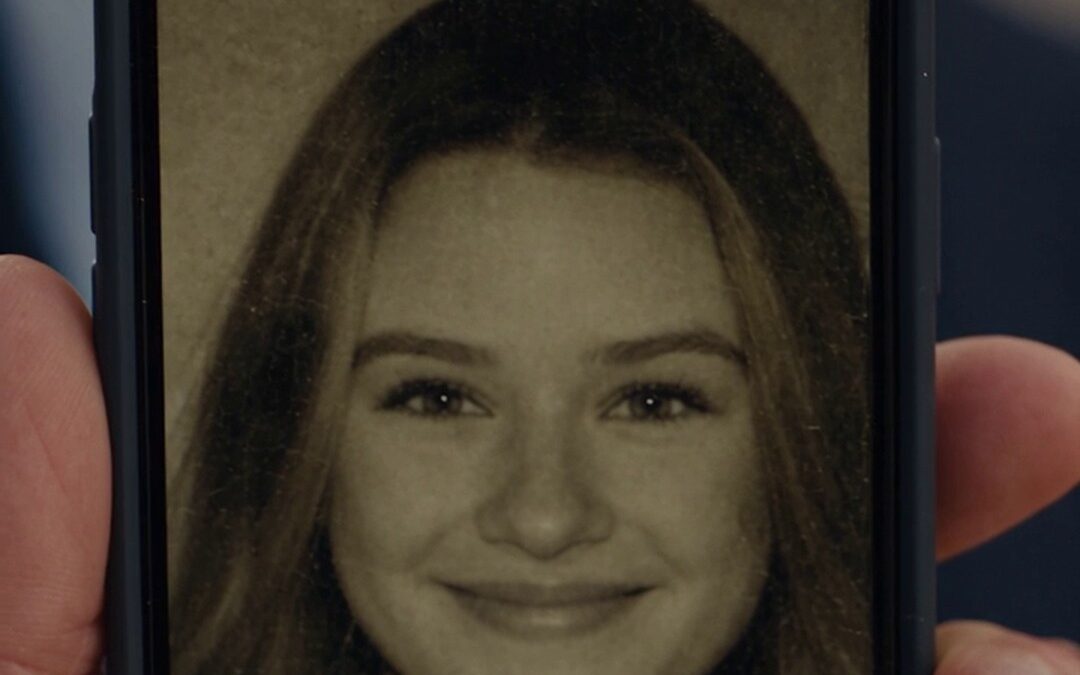
Julian’s breath hitched. Only two people had ever known about the scans stored on his phone: himself and his uncle Arthur, who had given him the family archive flash drive eight years ago after graduation. Julian had kept exactly one monochrome image favorited—an unlabeled heirloom snapshot from 1998, tucked into his cloud library, depicting a four-year-old boy in a wool sailor sweater sitting beside a young woman on a porch swing.
“Julian?” Clara asked, leaning closer as he slid his smartphone from his suit pocket.
With numb thumbs, he unlocked the screen and tapped the heart album. The monochrome square filled the bright glass. The young woman in the photograph wore a plain silver band on her middle finger and bore a distinct crescent-shaped birthmark right at the hollow of her collarbone.
Julian looked up from the glass screen to the weathered throat above the frayed coat.
Right beneath the worn collar, centered at the hollow of her throat, lay the identical pale crescent.
His pulse went dead. “My mother died in a clinic fire in Oregon when I was five. Uncle Arthur brought home her ashes.”
The woman looked directly into his eyes, her weathered chin lifting. “Arthur lied to you, Julian. I’m Maggie. I never died, and I never stopped looking for my son.”
Chapter 2: The Shadow on the Limestone
The bells of Saint Jude swung in heavy, golden rhythm above the square, but the sound seemed to reach Julian through feet of water.
Guests were descending the higher landing now, ribbons of laughter cut short by the frozen tableau. His uncle Arthur Vance, impeccably tailored in light gray linen with a blush pocket square matching the bridal flowers, was already three steps down, smiling for the photographer’s long lens. Arthur’s wife, Evelyn, paused beside him, her diamond earrings catching the bright midday sun.
“Julian?” Clara’s hand tightened over his wrist. Her voice had dropped its wedding-day brightness, turning taut, alert. “Julian, look at me. What is she saying?”
Julian couldn’t pull his eyes away from the woman’s collarbone. The scar—no, not a scar, an irregular pale birthmark shaped like an arching sickle moon—sat precisely where it had rested on the faded monochrome screen. He had zoomed in on that mark during long, lonely nights in his college dormitory, wondering what kind of woman possessed skin so pale and a smile so hesitant before vanishing forever into the smoke of an Oregon convalescent ward.
“This is impossible,” Julian managed, his throat dry. “My mother died twenty-six years ago. We have the memorial plaque in Medford. I have the death certificate in my safe at home.”
“You have a certificate signed by Arthur’s personal attorney,” Maggie said quietly. She did not raise her voice; she did not gesture wildly to stir up the watching crowd. Her hands stayed folded over the waist of her worn coat. “Look at my knuckles, Julian. Look at the ring finger on my right hand.”
Julian stared down. The joint of her right ring finger was slightly enlarged, crooked from an old fracture.
*“She broke it catching the screen door when you were three,”* a sudden, terrifyingly clear phrase echoed in his mind—not Arthur’s voice, but an older memory, buried so deep he hadn’t known it was there.
“Julian, darling!” Arthur’s resonant baritone boomed across the limestone landing. The older man glided down the steps with practiced ease, his silver hair gleaming, an arm outstretched as if to shepherd wayward children back into line. “David needs the two of you by the rose garden for the bridal party portraits before the light shifts. What’s the delay?”
Then Arthur’s gaze landed on Maggie.
The smile did not slide off Arthur Vance’s face; it petrified. For an instantaneous fraction of a second, the older man’s color drained, leaving his tanned, patrician skin the shade of wet sand. His hand, reaching out to pat Julian’s shoulder, stopped mid-air and clenched into a rigid fist.
“Arthur,” Maggie said simply.
Arthur recovered with astonishing speed, stepping directly between Maggie and Clara, his posture expanding to fill the stone terrace. “Good heavens. Officer! Could we get someone from the gate, please? Ma’am, whatever assistance you need, the parish office is around the corner on Fourth Street. This is an inappropriate place for solicitation.”
“Uncle Arthur, wait,” Julian said. His voice was louder than he intended, cutting through the murmurs of approaching cousins and college friends. “Look at her.”
“I see an unfortunate woman trying to disrupt your wedding, Julian,” Arthur said smoothly, his tone dripping with protective authority. He turned to Clara with an apologetic half-bow. “Clara, sweetheart, take Julian inside the vestibule. The heat is getting to everyone. I’ll handle this with a discreet donation.”
“Don’t give me your money, Arthur,” Maggie said. Her gray-blue eyes never left Arthur’s face. “You gave me enough of that thirty years ago when you threatened to have my parental custody terminated for neglect while I was in the county infirmary with double pneumonia. You told me Julian had been placed in private foster care across state lines and that the records were sealed under court order.”
The terrace went dead quiet. Even the string quartet, just beginning a lively Vivaldi allegro near the courtyard fountain, sputtered to an awkward halt as the first violinist caught the atmosphere.
Clara stepped forward, ignoring Arthur’s attempt to guide her aside. Her gown whispered against the stone. She looked Arthur squarely in the face, then turned to Maggie. “You said you’re Maggie. Maggie Vance?”
“Margaret Cole,” Maggie corrected gently. “I never took the Vance name. I was married to his brother, Thomas, for six years until the mill accident took him. Arthur hated that Thomas left me the timber acreage in Coos County.”
Julian felt the ground tilting. “My father died of a heart attack in Portland. You told me—” He turned to Arthur. “You told me Dad died in a hospital room in Portland when I was two.”
“Julian, this is absurd,” Arthur said, though a bead of sweat now traced his silver sideburn. “Thomas was my brother. Do you think I don’t know how my own brother died? This woman is an opportunist who must have read the wedding announcement in the *Oregonian* last Sunday. It listed your parentage and our family background. People prey on weddings, Julian. They look for sentimental openings.”
“Did the announcement mention the photograph?” Julian challenged, holding up his phone. The screen was still glowing under the high sun. “Did the paper mention the scan I made from the shoebox in your attic eight years ago? The one with the sickle birthmark on her neck?”
Arthur didn’t look at the screen. “You are embarrassing Clara. You are embarrassing her parents. Look at Judge Miller over there!”
Clara’s father, retired Judge Robert Miller, was standing ten feet back, his brow furrowed, observing Arthur with the narrowed, calculating eyes of a man who had spent forty years evaluating witness credibility from a bench.
“My father can wait ten minutes, Arthur,” Clara said, her voice ringing clear across the terrace. “Julian, we are not going to the rose garden. Not yet.”
“Clara, please,” Evelyn Vance interjected, stepping up beside her husband. Her smile was tight, her fingers nervously twisting a rope of pearls. “The caterers have the champagne poured at the country club. We have three hundred guests arriving in forty-five minutes. This is completely out of order.”
“Then let’s take it out of the sun,” Clara replied without hesitation. She turned toward the open oak doors of Saint Jude’s side vestry. “Father Thomas is still inside signing the registry. There’s a conference room behind the chancel. We’re going in there.”
“I forbid this,” Arthur said, his voice dropping into the cold, authoritative register he had used whenever teenage Julian had questioned his trust fund distributions or his choice of prep schools. “Julian, you are a grown man with a company to run and a family reputation to uphold. You do not let a stranger off the street humiliate your bride on her wedding day.”
Julian looked at his uncle. For twenty-two years, Arthur had been his sun and his compass. Arthur had paid his tuition at Stanford; Arthur had handed him the vice-presidency of Vance Logistics; Arthur had stood by his hospital bed when he broke his collarbone at seventeen, telling him, *“It’s just you and me, son. We’re all that’s left of Thomas’s blood.”*
Julian had worshipped that loyalty. He had spent his entire twenties trying to repay an unpayable debt of gratitude to the man who had supposedly rescued an orphaned boy from a tragic, burned-out past.
“If she’s lying, Uncle Arthur,” Julian said slowly, “it will take five minutes in the vestry to prove it. If she’s not, you and I have things to settle that three hundred guests and a champagne toast can’t cover.”
Maggie offered no triumphal look. She simply drew her worn coat closer against a sudden breeze that ruffled the church banners and walked steadily toward the side entrance.
***
The vestry was cool and high-ceilinged, smelling of polished beeswax, old vellum, and cold stone. Sunlight fell through tall stained-glass lancets, throwing pools of amber and rose across a long mahogany table where parish records were signed.
Father Thomas, a gentle man in his sixties with white hair, looked up from his ledger in mild surprise as the wedding party filed in.
“Julian? Clara? Is there an issue with the certificate?”
“Father,” Clara said politely, “we need this room for fifteen minutes. Please.”
The priest looked from Clara’s set jaw to Arthur’s crimson flush, then to Maggie’s dusty shoes. He nodded gravely, gathered his brass reading glasses and leather folio, and closed the heavy oak door behind him with a soft latch click.
Julian pulled out one of the high-backed chairs. “Sit down, please.”
Maggie did not sit immediately. She walked to the lancet window, looking out over the manicured lawn where guests were beginning to mill about in confused clusters. “You have your father’s shoulders, Julian. He used to stand just like that when he was trying not to lose his temper. Left foot turned out, shoulders square.”
Julian swallowed hard. The silence in the stone room felt heavy, vibrating with the muffled hum of conversation outside. “How did you find me? Even if… even if what you’re saying is true, how did you know I was here today?”
“A boy named Marcus Green,” Maggie said, turning back into the room. Her hands clasped each other at her waist, steady despite the tension. “He works in Arthur’s shipping yard in Tacoma. He’s my sister’s grandson.”
Arthur scoffed from the doorway, his arms crossed over his linen vest. “Marcus Green was fired three weeks ago for inventory discrepancies. A disgruntled warehouse clerk.”
“Marcus was fired because you caught him looking at old payroll ledgers from 1999,” Maggie said evenly. “He called me two weeks ago. He told me, *‘Aunt Maggie, Julian isn’t dead. He’s thirty years old, he lives in Seattle, and he’s marrying Clara Miller at Saint Jude’s on the twenty-second.’* Up until that call, Arthur, I believed what your lawyer told me in Spokane twelve years ago—that Julian had died in a car wreck in California when he was eighteen.”
Julian felt the room lose all its air. He grabbed the edge of the mahogany table, knuckles whitening against the dark wood. “What did you say?”
“She’s weaving a fantasy out of whole cloth!” Arthur snapped, stepping into the center of the room. “Julian, look at her! She’s destitute. She’s probably found a disaffected employee, bought some tidbits of family trivia, and cooked up an extortion scheme. Do you have any idea how many grifters target estates of our size?”
“I don’t want an estate,” Maggie said. She reached into the pocket of her frayed coat and pulled out an old, creased leather coin purse. From it, she withdrew three items: a folded yellowed paper, a tarnished brass key on a string, and a small, round tin of peppermint pastilles.
She set the paper on the table and pushed it toward Julian.
Julian looked down. It was a certified birth registration from Douglas County, Oregon, dated October 14, 1994. The infant’s name was Julian Thomas Vance. The father was Thomas Edward Vance, mill superintendent. The mother was Margaret Ann Cole, age twenty-eight.
“Anyone can order a replacement birth certificate from public records if they know the county,” Arthur said coldly. “That proves nothing except that Thomas had a wife named Margaret who abandoned him before he died.”
“Thomas didn’t die of a heart attack, Arthur,” Maggie said. Her voice tightened for the first time, a flare of flint beneath the dry gravel. “A hemlock log slipped off the skidder at the Roseburg landing on October 3, 1998. It crushed his chest. He lived for six hours at Sacred Heart Hospital. You were there, Arthur. You held the deed to the timber parcel while Thomas was still on morphine, and you told him you’d take care of me and the boy if he signed the power of attorney over to Vance Holdings.”
“That’s slander,” Arthur hissed. “Thomas signed that agreement months before to settle his debts!”
“What debts?” Julian interrupted, his voice rising, harsh and trembling. “Uncle Arthur, you told me my father never had a dime. You told me he was a drifter who left us in debt, and that you bought out our family name out of charity!”
Arthur’s jaw worked. “Julian, you were four years old! You had no comprehension of business! The timber company was failing. I restructured it, took on the liabilities, and gave you an education that made you who you are today! Look at your life! Look at your suits, your home in Broadmoor, your partnership in the firm! Would you have had that in a two-room rental in Coos Bay with a mother who couldn’t keep a job at the dry cleaners?”
The confession slipped out so naturally, so wrapped in Arthur’s habitual arrogance, that the entire room seemed to freeze.
Clara let out a short, sharp breath. “So she *is* his mother.”
Arthur realized his mistake instantly. His eyes darted to Clara, then back to Julian. “I didn’t mean—”
“You just said it,” Julian whispered. The blood roared in his ears like surf against rocks. “You just admitted she was in Coos Bay. You admitted you knew she worked at a dry cleaners. When I asked you about her when I was twelve, you told me she died in an Oregon hospital fire before I could form memories. You gave me a brass urn, Arthur! Whose ashes are in the columbarium in Medford?”
Arthur did not answer. He pressed his lips together, his chest heaving beneath his linen jacket.
“Whose ashes did I leave flowers for every Memorial Day for twenty years?” Julian demanded, taking a violent step toward his uncle.
Clara caught Julian’s arm, her grip grounding him. “Julian. Stop. Don’t touch him.”
Maggie stepped between them, her weathered hand resting gently on the polished wood. “There were no ashes, Julian. When your father died, I had pneumonia. Arthur brought two social workers to my hospital room. He had a temporary guardianship order signed by a circuit judge who belonged to his hunting club in Eugene. They took you from the day nursery while I was on oxygen. When I got out, the house was locked, your clothes were gone, and Arthur’s lawyers served me with an injunction barring me from approaching within five hundred feet of your school.”
She looked at Arthur, her voice completely devoid of hatred—only an immense, weary sorrow. “I fought you for three years in district court, Arthur. Until my money ran out. Until my lawyer told me that Arthur Vance had filed four separate affidavits claiming I was an unfit vagrant, and that the judge had granted permanent custody with full discretion over Julian’s residence.”
“You were unstable, Margaret!” Arthur snarled, his patrician facade finally crumbling into ugly, defensive fury. “You were living in an unheated trailer! You had no income! Julian was a Vance. He deserved a legacy, not a hand-to-mouth existence in the woods! I gave him everything Thomas couldn’t provide!”
“You didn’t give him his mother,” Clara said. Her voice was ice. She turned to Julian, her eyes shining with fierce conviction. “Julian, look at what she brought.”
Julian looked down at the table. Beside the birth certificate lay the small tarnished brass key.
“What is this?” Julian asked, his voice shaking.
“It’s the key to the toolbox in your father’s workshop,” Maggie said softly. “The old cedar chest Thomas built out behind the porch swing. He carved your initials on the inside lid: *J.T.V.* with a wood-burning iron. You used to hide your plastic toy trucks in it. You cried for two days when you lost the key down the well grate, so Thomas made a duplicate and gave it to me.”
Julian closed his eyes.
A memory, sharp and blinding as glass, slammed into his mind: the smell of fresh cedar shavings, a gray cat sleeping on a warm windowsill, and a woman’s hand—not rough then, but soft and flour-dusted—tucking a brass key into a pocket while he laughed on a wooden swing.
He opened his eyes. The woman standing before him was worn by thirty years of labor, her hair streaked with iron-gray, her coat cheap and dusty. But the eyes—clear, steady, gray-blue—were the eyes from the swing.
“You didn’t abandon me,” Julian said, the words catching in his throat like broken stone.
“I went to your elementary school in Portland in 2002,” Maggie whispered, tears finally pooling in her lower lids. “I stood across the street behind the cedar hedge just to see you get on the yellow bus. Arthur had a private security guard step in front of me and hand me a notice. He told me if I ever came near the curb again, he’d have me jailed for harassment, and that he’d tell you your mother was a criminal who wanted to ruin your life. I didn’t want you to grow up ashamed, Julian. I thought… God forgive me, I thought if Arthur was giving you a good life, a safe life, maybe staying away was the only gift I had left.”
“And the car accident?” Julian asked. “Why did you stop looking twelve years ago?”
“Arthur’s lawyer, Miller & Vance Associates, sent a formal letter to my post office box in Spokane in 2012,” Maggie said. “It had a clipping from an obscure California county paper. A crash on Highway 101. It said Julian T. Vance, eighteen, had been killed in a rollover. There was a signed condolence note from Arthur, offering to pay for a memorial plaque if I waived all future inquiries into the estate.”
Julian turned on Arthur. “You told her I was dead?”
Arthur took a step back toward the door. His face was gray. “You were starting at Stanford! You were finally established, Julian! You had put your childhood behind you! If she had shown up then, with her stories and her demands, it would have ruined everything! The Vance name meant something in this state! I built that logistics firm from twelve trucks to three hundred! Do you think the board would have tolerated an inheritance scandal involving timber fraud and forged custody orders?”
“So it was the timber land,” Clara said, her eyes flashing. “The parcel in Coos County.”
“It’s an industrial terminal now,” Maggie said quietly. “Vance Logistics Port Facility Four. Thomas owned the deep-water frontage. Arthur couldn’t build the dock without Thomas’s title. And Thomas left everything to Julian, with me as trustee.”
The final piece fell into place with the sickening thud of a guillotine.
It was never about providing Julian with a polished life. It was about title. It was about deep-water frontage on the Oregon coast that Arthur Vance could only control if the legitimate heir was under his sole legal guardianship, completely ignorant of his father’s true estate, while the surviving trustee was driven into poverty and silence.
Julian felt a dizzying wave of nausea wash over him. For fifteen years, he had sat across polished oak conference tables from Arthur, studying shipping manifests, signing corporate authorizations, listening to his uncle praise his head for figures. *“You’re my boy, Julian. Thomas would be proud of what we built.”* Every milestone—graduating top of his class, closing the terminal lease in Longview, taking the title of Executive Vice President—had felt like another brick in an altar of filial gratitude. He had spent his twenties believing he owed his very breath to Arthur’s benevolence.
“You had me sign the corporate restructuring papers two years ago,” Julian said, his words dropping like lead weights onto the table. “You brought the documents to my apartment on Thanksgiving morning. You told me it was routine succession planning. You said you were cleaning up old regional land titles so Vance Logistics could secure the bond for the deep-water dredging.”
Arthur’s mouth parted, but no sound came out.
“The title wasn’t clean, was it?” Clara stepped closer, her lace train catching on the leg of a carved chair. Her eyes were sharp, calculating. “That’s why you pushed so hard for Julian to marry into my family, Arthur. My father presided over the appellate bench that handled maritime title disputes in King and Pierce counties. You assumed having Judge Miller as Julian’s father-in-law would create a wall of respectability so thick no state auditor would dare pull the original probate filings from 1998.”
“Clara, keep your voice down,” Arthur pleaded, casting a terrified glance toward the closed vestry door. “You don’t understand the corporate reality. That terminal employs four hundred people. If the underlying title was clouded by an unresolved probate dispute, the bank would call the thirty-million-dollar development loan within forty-eight hours! We would be ruined—all of us! Julian, your entire future is tied to that balance sheet!”
“My future was built on my father’s grave and my mother’s exile,” Julian whispered. He reached out with trembling fingers and touched the tarnished brass key on the table. “You didn’t save me, Arthur. You kidnapped me with paperwork.”
Maggie watched him, her weathered face lined with an ache so profound it silenced the room. “Julian,” she said softly, “I don’t care about the timber land. I don’t care about the shipping docks or the money. When Marcus showed me the newspaper clipping, all I saw was your eyes. You have the same line between your brows when you’re hurt that Thomas had. I just needed to look at you once. To know that you were breathing. That the letter they sent me in Spokane was a lie.”
“How did you get here from Spokane?” Clara asked gently.
“I took the bus to the King Street station,” Maggie replied, touching the collar of her frayed coat. “I stayed two nights at the shelter on Third Avenue. Marcus gave me fifty dollars for food, but I couldn’t eat. I walked up the hill this morning before the bells started. I sat on the bus bench across from the chapel lawn and watched the limousines arrive. I saw you walk in, Julian. You were wearing that dark suit, and you were laughing with your friends. You looked so whole. I almost turned around and walked back down to the depot. I thought, *What right do I have to bring thirty years of grief into his sunshine?*”
“Why didn’t you?” Julian asked, his voice catching.
“Because I saw Arthur get out of the car,” Maggie said, her voice dropping into a quiet, unwavering resolve. “I saw him adjust your lapel on the steps. I saw him smile that same cold, triumphant smile he gave me across the hospital bed in Roseburg when they rolled you away in the social worker’s car. And I knew that as long as you believed his lies, you weren’t truly safe. Even if you hated me, even if you had the police drag me down the limestone steps, you deserved to know who you were.”
Arthur let out a harsh, ragged breath. He lunged toward Julian, catching him by the arm with desperate strength. “Julian, think! If you air this out, the press will tear us apart! The Miller family name, our contracts with the Port of Seattle—everything will collapse! We can handle this privately. I will set up a trust for her. A million dollars. Five million! She can have a house anywhere on the coast! Just don’t destroy what we’ve built on the very day of your wedding!”
“Let go of him, Arthur.”
The voice came from the doorway.
The heavy oak door had swung inward without a sound. Standing on the threshold, framed by the bright sunlight of the courtyard corridor, was Clara’s father, Judge Robert Miller. He had taken off his jacket, his cuffs rolled up, his silver hair catching the amber glow of the stained glass. Behind him, Father Thomas stood with his arms folded within the wide sleeves of his cassock, his face sorrowful and severe.
“Robert,” Arthur gasped, his hand falling from Julian’s sleeve as if burned. “Robert, thank God. Julian has lost his senses. We have a family matter here that—”
“I heard you, Arthur,” Judge Miller said quietly. “The transom window above the hall was open. Half the vestibule heard you.”
Arthur stopped dead.
“Robert, you know me,” Arthur pleaded, the veneer entirely gone now, his hands shaking at his sides. “We’ve served on the hospital foundation board together for twenty years! This is a private family disagreement over old estate settlements!”
“Forging an affidavit of abandonment to obtain custody of a minor is a felony, Arthur,” Judge Miller said, his voice flat and devastatingly measured. “Using interstate mail to deliver a fraudulent notice of death to prevent a beneficiary from claiming real property is mail fraud and grand larceny. If half of what this woman has in that purse is corroborated by county filings in Coos and Douglas counties, you aren’t looking at a family disagreement. You are looking at a federal indictment.”
“You wouldn’t,” Arthur breathed, backing away toward the altar rail. “Clara is marrying my nephew! Our families—”
“My daughter,” Judge Miller said, stepping into the room and placing a large, protective hand on Clara’s shoulder, “is marrying an honest young man who has been lied to his entire life. What happens to your firm and your freedom is entirely your own making.”
Arthur looked at Julian, his eyes wild with terror. “Julian… please. Talk to me. Don’t throw thirty years of family away on the church steps.”
Julian walked over to the mahogany table. He picked up the certified birth certificate, the brass key, and the small note that had started it all. He folded them carefully and placed them into his inside breast pocket, right next to his heart.
Then he turned to Arthur.
“Leave,” Julian said.
“Julian—”
“Get in your car and leave this church,” Julian repeated, his voice dropping into absolute certainty. “If you are at the reception, I will have the county sheriffs remove you. If you ever speak to me again, it will be through Clara’s father’s colleagues. Get out.”
Arthur Vance stood frozen for five long seconds. He looked around the room—at his daughter-in-law-to-be who looked at him with open contempt, at an old colleague who looked through him as if he were glass, and finally at Maggie, who did not look at him at all.
Without another word, Arthur turned and walked out the door, his footsteps echoing down the stone corridor until the heavy outer oak doors slammed shut.
***
Silence settled over the vestry, broken only by the distant murmur of the courtyard and the soft hum of the afternoon wind against the stained glass.
Julian stood by the table, his breath coming in uneven, ragged gasps. The shock that had sustained him through the confrontation was beginning to crack, leaving behind an immense, hollow ache that made his knees feel weak. He rested his palms on the cool mahogany, staring down at the grain of the wood, fighting the sudden urge to double over.
Clara moved to his side, sliding her arm around his waist, resting her forehead against his shoulder. “I’m right here,” she whispered. “I’m not going anywhere.”
Julian nodded blindly, burying his face in her hair for a second before turning to Maggie.
Maggie had not moved from the window. She looked smaller now that Arthur was gone, the adrenaline that had carried her up the church steps fading, revealing the deep, accumulated fatigue of decades. Her knuckles were red from the cold air, her poplin coat threadbare at the hem. She held the small tin of peppermint pastilles against her chest like an amulet.
“You don’t have to figure anything out today, Julian,” Maggie said softly, her hands clasping her purse. “I didn’t come to ruin your wedding. I swear to God I didn’t. I just… Marcus told me you were marrying a good girl, and that you were happy. But he said Arthur was standing as your best man. And I couldn’t bear the thought of him standing behind you at an altar, pretending he made you, while your father’s memory was buried under a pile of lies.”
She reached out, her fingers hovering an inch from his lapel, hesitant, afraid to presume. “I’ll go now. You have your guests. You have Clara.”
“No,” Julian said.
He reached out and caught her hand.
Her skin was rough, calloused from years of cleaning motels, washing laundry, and doing whatever work a woman alone could find. But as his fingers closed around hers, a sudden, piercing warmth rushed through him—the same warmth he had searched for in empty houses and polished boardrooms, the warmth he had assumed died in Oregon when he was four years old.
“You’re not going anywhere,” Julian said, his voice cracking. “Clara, what do we have out there?”
Clara lifted her head, a brilliant, determined light in her eyes. “We have three hundred people who came to celebrate our marriage. We have an empty seat in the front row where Arthur was supposed to sit. And we have a car waiting to take the bridal party to the reception.”
She walked over to Maggie, her white lace train sweeping the stone floor, and took Maggie’s other hand in hers.
“Mrs. Cole,” Clara said gently, “Julian’s mother sits in the front row.”
Maggie looked down at her dusty shoes, her frayed brown coat, her chapped knuckles. “Child, look at me. I’m not dressed for a wedding like this. People will stare.”
“Let them stare,” Clara replied with a fierce, quiet pride. “Let them see what real family looks like.”
Clara turned to her father, who was still standing by the door, watching them with a calm, resolute warmth. “Dad, where is my overnight bag in the limousine?”
“In the trunk, sweetheart,” Judge Miller said, nodding with immediate understanding. “The cream silk shawl and your change of shoes are right on top.”
“Father Thomas,” Clara said, turning to the priest, “do we have five minutes in your study for Mrs. Cole to wash the road dust off?”
“Of course, my dear,” Father Thomas said gently, gesturing toward the inner office. “There is fresh water, clean linen, and warm tea.”
Maggie looked between them, her eyes wide, tears finally spilling freely over her weathered cheeks. She did not protest again. She allowed Clara to guide her through the carved doorway, their hands joined across silk and wool, youth and age, thirty years of separation bridged in a single, sacred step.
Julian remained by the lancet window for a moment, looking out at the sunlit lawn. The string quartet had started again, their music drifting across the green turf like sweet smoke. The world had not ended; it had simply broken open, clearing away thirty years of gilded deceit to make room for the light.
He reached into his breast pocket and felt the corner of the brass key pressing against his ribs.
***
Ten minutes later, the heavy oak doors of Saint Jude’s Chapel swung open once more.
The afternoon sun blazed over the limestone terrace, turning the pale stone to gold and setting the white ribbons on the balustrades fluttering in the warm summer breeze. The guests, who had gathered in nervous, whispering knots on the lawn below, fell completely silent as the bridal party reemerged.
Julian walked out first. His dark suit was straight, his pale tie centered, his shoulders squared just as his father’s had been thirty years before.
On his left arm was Clara, her veil drifting behind her, her bouquet of blush peonies held high, her smile radiant and unbroken.
And on his right arm, her chin lifted against the bright Oregon light, the cream silk shawl draped over her weathered shoulders, her hand resting securely within the crook of her son’s elbow, walked Margaret Cole.
As they descended the stone steps together, the bells of Saint Jude began to ring again—not for an empire of stolen timber and polished lies, but for a son who had finally, truly come home.