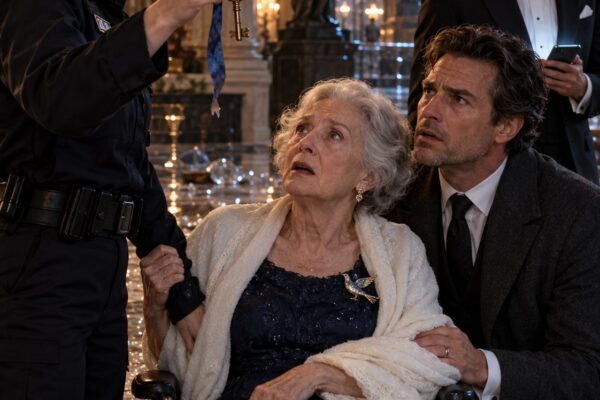
A Feared Crime Boss Watched His Mother’s Maid in Secret—Until Her Kindness Forced Him to Face What He’d Become

Chapter 1: The Fourth Screen
At 1:38 in the morning, Damian Costa sat beneath his cliffside estate before sixteen security monitors, replaying the breakfast disturbance on monitor four.
In Room 104, his seventy-two-year-old mother had thrown a tray at a door, and two trained caregivers had stepped outside.
Alzheimer’s had taken dates, rooms, and sometimes Damian’s name, leaving Beatrice frightened of the man she mistook for a stranger or his father.
Watching hurt less than being asked to leave.
On the recording, Tessa Miller entered with a bucket, stopped before the scattered oatmeal, and approached where Beatrice could see her.
The twenty-six-year-old housekeeper had worked there eleven weeks, long enough to know that employees lowered their voices around the Costa family.
She sat beyond Beatrice’s reach.
“I can clean first, or we can discuss what they’ve done to breakfast,” Tessa said.
“Terrible,” Beatrice said.
“The oatmeal or the service?” Tessa asked.
Beatrice gave one startled laugh.
Tessa offered the untouched bowl on the side table, waited through a long silence, and let Beatrice take the spoon herself.
Over the following days, Damian watched Tessa return with clean towels, a mended cardigan, and time nobody had assigned her.
Some caregivers began timing breaks around those visits.
Paul Ferrell’s report arrived on day four: six months as a home-care aide, two evictions, collection accounts, and loans for treatments insurance hadn’t covered.
Tessa’s younger sister had died of leukemia at twenty-two, three years earlier.
There was no theft or criminal record.
Damian noticed that desperation had walked past silver and diamonds without taking anything, then kept reading instead of questioning why he needed proof.
That rainy evening, he watched Tessa leave for the bus in a thin jacket.
On day five, an east-wing alert sent Beatrice shaking beneath her quilt.
Tessa approached slowly.
“That noise startled you,” she said.
“My boy Damian can’t find me,” Beatrice cried.
“He hates me.”
Tessa pointed toward the white roses.
“Someone keeps bringing fresh ones,” she said.
Beatrice eventually slept against her shoulder.
The next afternoon, Damian left the bunker and stood outside Room 104.
Inside, Beatrice studied Tessa’s wrist.
“Your sister had cancer,” she said.
Tessa went still.
“How did you know that?” she asked.
“He knows too,” Beatrice said.
She raised one finger toward the dark ornament above the bookcase, where the concealed camera watched them.
“Damian.”
Chapter 2: A Chair Within Reach
Tessa looked at the ornament before she looked at the doorway, and the small black center that had always seemed like part of its carved wooden flower became a lens.
Beatrice’s finger trembled in the air until Tessa helped her lower it to the blanket, asking first and touching only after the older woman opened her hand.
A floorboard sounded behind them.
Damian stood at the threshold in the charcoal sweater Tessa had seen passing distant windows, his expression stripped of the composure that usually made other people hurry.
“Is that a camera?” Tessa asked.
“Yes,” he said.
Beatrice turned toward his voice and pulled the blanket higher, and Tessa watched Damian notice the movement as if it had struck him.
“Who’s that?” Beatrice whispered.
“Someone at the door,” Tessa said.
She would not make Beatrice solve his identity to earn a quiet afternoon.
Mara Ellis, the registered nurse covering the afternoon shift, appeared behind him with the water Beatrice had requested a few minutes earlier.
Tessa told Beatrice that Mara would stay while she stepped into the hall, and Beatrice immediately caught the cuff of her sleeve.
“You didn’t lose the little blue one?” Beatrice asked.
Tessa followed her gaze to the bracelet beneath her watch, a faded blue cord threaded through a silver washer.
For a moment, something ordinary broke through her alarm.
On the third day, Beatrice had asked about that bracelet while they sat on the sheltered terrace during a scheduled housekeeping visit, with Mara close enough to hear.
Tessa had shown her a photograph on her phone and said that her sister, Lucy, had made the bracelet during cancer treatment.
She had said leukemia once, quietly, after Beatrice asked whether Lucy still made things.
Until this moment, she had believed Beatrice had forgotten the conversation almost as soon as they came inside.
“You asked me about Lucy on the terrace,” Tessa said.
“Pretty hands,” Beatrice murmured.
The photograph had shown Lucy painting her nails blue in a hospital chair.
Tessa had no way to know whether Beatrice remembered the picture, the bracelet, or only the feeling of a conversation about someone loved.
“You can keep wearing it,” Beatrice said.
“I will,” Tessa answered.
She waited until Beatrice released her sleeve before leaving.
In the hallway, Damian started with the word safety.
Tessa lifted her hand.
“Before you tell me why, tell me what it records.”
He glanced toward Mara, who was moving Beatrice’s water glass within reach, then closed the door most of the way.
“Picture and sound,” he said.
Tessa could still feel Beatrice’s weight against her from the night before, the awkward tenderness of supporting someone who had cried herself exhausted.
She had adjusted a damp nightgown under a blanket while waiting for the nurse, believing the room contained only the people she could see.
“Who watches?”
“Paul and I have access.”
“Live only?”
“No.”
The hallway seemed to narrow around the brass number on the door.
Tessa asked him to get Paul, the monitoring policy, and whoever could answer questions without guessing.
Then she asked Mara, within Damian’s hearing, to document that Tessa was returning to her housekeeping assignment and was not available as break coverage.
Mara’s face tightened, but she nodded.
“That should already have been clear,” the nurse said.
Damian offered his office, and Tessa chose the small staff meeting room instead, where the door had a glass panel and nobody had to sit below his desk.
Paul arrived carrying a thin equipment folder, and his careful manner told her that he understood why she had selected the room.
The camera saw the bed, armchair, bookcase, and interior doorway, but not the bathroom, terrace, or shallow alcove where Beatrice’s wardrobe stood.
Its microphone picked up ordinary conversation inside the bedroom, though running water and the air conditioner sometimes blurred words.
Only Damian’s account and Paul’s maintenance account could open the feed or stored recordings, and the system normally overwrote files after fourteen days.
Paul had reviewed the breakfast disturbance and the east-wing alert after Damian asked him to, but he had not watched every visit.
There were no cameras on the private terrace.
That explained what Damian had missed, but it did nothing to excuse what he had taken.
“The screen in the room is supposed to cover the lens during personal care,” Paul said.
“What turns off the microphone?” Tessa asked.
Paul looked at the equipment folder before answering.
“Nothing on that screen.”
Tessa pressed her palms against her knees beneath the table.
She remembered the paper she had signed when she started work, one paragraph about security systems on estate grounds and in designated work areas.
Nobody had named a bedroom, audio recording, or an employer listening to conversations beside a sick woman’s bed.
Mara, joining them after another licensed nurse relieved her, brought the care agency’s orientation sheet.
It warned of cameras in shared estate areas and instructed staff to preserve privacy during personal care, without identifying the device in Room 104.
Damian said he had thought the agencies disclosed everything.
“You employed me directly,” Tessa said.
He stopped looking at Mara’s sheet.
Two years earlier, after a fall during a temporary period of unsteadiness, Beatrice had agreed to a visible, silent camera near the sitting area for a six-week trial.
Paul found the signed form, with its end date and a note that Beatrice wanted it removed when the trial finished.
Eight months ago, Damian had ordered a smaller replacement after the old casing broke, and a contractor had fitted the concealed model with audio enabled.
Paul had accepted the equipment as installed, and Damian had allowed the recording to continue without arranging a fresh privacy or capacity review.
“I thought taking the visible box away would upset her less,” Damian said.
“You took away her chance to object to the box,” Tessa answered.
He looked toward the hallway as though the room itself might provide an argument.
“She was falling.”
“That explains why you needed a care assessment.”
For the first time since she had entered the estate eleven weeks earlier, Tessa watched Damian Costa have nothing ready to say.
Paul closed the folder.
“I should have checked the replacement against the authorization,” he said.
Damian told him to disconnect the bedroom system, then looked at Tessa before adding that no new device would replace it while they reviewed the arrangement.
Tessa asked that the existing files be restricted rather than casually erased, because employees needed a way to learn what had happened and raise concerns.
Paul wrote that down.
There would be no viewing for curiosity, discipline, or Damian’s reassurance, and an independent reviewer would decide what needed lawful preservation before anything was deleted.
Tessa wanted the confirmation in writing.
Damian agreed without asking her to trust him first.
***
Before the afternoon ended, Mara brought an older care note to the meeting room, where Tessa was waiting for a copy of the temporary arrangements.
Five months earlier, Beatrice had pointed at the wooden ornament and asked whether “the little window” still went to the downstairs room.
A nurse had recorded that she appeared to recognize the monitoring equipment, and the note had traveled into the chart without changing anything.
Paul remembered another incident from the replacement installation, when Beatrice had watched him test the picture on a handheld screen.
She had called it Damian’s television.
“She’s known where it is for months,” Tessa said.
“She has known sometimes,” Mara corrected gently.
The distinction mattered enough that Tessa repeated it to herself.
Beatrice might remember a lens while forgetting lunch, or connect Damian with watching without understanding the recording, the microphone, or the passing of days.
When Mara later asked whether the ornament bothered her, Beatrice said that a bird had lived there, then asked for her green cardigan.
Nobody pressed her for a statement she could not reliably give.
Tessa could imagine Beatrice believing Damian had heard the terrace conversation because he seemed to hear so much, or because the distinction between terrace and bedroom had slipped away.
“He knows too” had not been proof of secret knowledge.
It had been a frightened woman’s imperfect understanding of a real intrusion.
In the bedroom that evening, with the camera disconnected and its little status light dead, Beatrice asked Mara to turn the carved flower toward the wall.
Mara did.
That request went into the care notes as carefully as a medication entry.
***
Dr. Elaine Cho came the next morning, day seven, after reviewing the recent nursing notes and speaking with Beatrice’s regular practice.
Tessa had been invited to contribute observations during paid work time, with the household manager covering the rooms she would otherwise clean.
She sat beside Mara at the small table outside the east wing while Damian remained standing until Dr. Cho asked him to take a chair.
The physician began by asking what Beatrice’s mornings had been like before this week.
Mara described a woman who could usually walk short distances with her walker and someone nearby, choose between two outfits, feed herself once the meal was set up, and enjoy familiar songs.
She needed help with bathing, dressing, medicines, and recognizing hazards, and she could no longer reliably organize a day or summon assistance when distressed.
Her abilities varied with fatigue and surroundings, but recent changes still needed attention rather than automatic attribution to Alzheimer’s.
Tessa described the breakfast room as she had found it on the first day: television loud, sunlight across the plate, oatmeal thickening beside an unfamiliar caregiver.
Beatrice had been gripping the edge of her chair before she threw the tray.
Damian said the nurse had walked away.
Mara turned a page in the staffing record.
“I moved outside the doorway after she threw hot tea toward my face, and I called the second nurse.”
Tessa remembered seeing Mara in the hall that morning, one wrist reddened, though she had not understood why.
The camera angle had hidden the doorway recess where Mara stood within hearing.
The second caregiver had gone for clean clothing and a burn dressing, and neither had documented a handoff to Tessa because neither should have treated her arrival as one.
Dr. Cho separated those facts without softening them.
Stepping back from an escalating encounter could be appropriate, while failing to return promptly or establish clear coverage required correction.
“The recording let me decide what you meant without asking what happened,” Damian told Mara.
Mara lowered her eyes to the page.
“I was also finishing my fourteenth hour because relief hadn’t arrived.”
That fact did not make the handoff adequate, but it changed the story Damian had built beneath the house.
The physician asked about sleep, bowel movements, fluid intake, medication changes, and signs of pain.
There had been no new medication, and the licensed staff handled scheduled medicines and any prescribed pain relief according to the existing orders.
The notes showed several poor nights and repeated rubbing of Beatrice’s right knee before breakfast.
Tessa had thought that rubbing meant impatience.
Mara had documented known arthritis, but the information had not traveled consistently to temporary caregivers.
Dr. Cho examined Beatrice with permission sought at each step, stopping when she pulled away and returning later to what could safely wait.
She found no reason from that morning’s assessment to order an emergency transfer, but she wanted clearer pain observations, regular fluids offered without pressure, and follow-up if function or behavior changed.
The care plan would include a quieter breakfast, fewer unfamiliar faces, glasses cleaned and offered, and a check that Beatrice could hear the person speaking.
Any medication adjustment belonged with the prescribing clinician and nurses.
Tessa’s chair and pauses had helped, but so had the television being off, the glare shifting, and Mara returning with prescribed pain relief before the later part of breakfast.
“She didn’t eat because I discovered a special way into her,” Tessa said.
“She may have eaten because several things finally became tolerable,” Dr. Cho replied.
Damian wrote that sentence on the margin of his copy.
***
The staffing review took longer than the medical visit because nobody could agree at first on what counted as Tessa’s work.
The household manager had logged her east-wing visits as cleaning, while two care workers had listed her in informal notes as “company with Mrs. Costa.”
Neither description accounted for twenty-five minutes of reassurance during an alert or an hour spent waiting beside a frightened woman.
Tessa put her housekeeping schedule on the table.
On day one she had entered to clean the spill, on day two Mara had asked whether she could bring the mended cardigan, and on day three Beatrice had requested her while she was changing towels.
The terrace conversation had followed that visit, with Mara present and Tessa’s supervisor allowing the delayed housekeeping work without recording why.
On day four she had returned at Beatrice’s request after lunch, and two caregivers had staggered breaks based on the assumption that she would stay.
Day five’s alert had brought her from the linen closet.
Day six she had been delivering fresh towels when Beatrice asked her to sit.
There had been no agreed assignment, no defined relief, and no clear person responsible for telling her she could leave.
“I kept thinking another ten minutes would be harmless,” Tessa said.
The household manager admitted that the unfinished cleaning had been added to Tessa’s later rounds.
Mara said the care agency’s relief arrangement had been failing for weeks, with a nurse expected to cover tasks that required a second trained person.
Damian asked why nobody had brought it to him.
Paul, sitting nearest the door, answered before anyone else had to.
“They brought it to people who were afraid to bring you a problem without a solution.”
Tessa watched Damian’s pen become still.
There was no useful reply he could make that would undo the silence his reputation had purchased.
Dr. Cho recommended an independent geriatric care coordinator to review staffing and oversee the transition, and Damian approved the expense.
Mara would remain clinical lead for the immediate plan, with named licensed coverage and trained care assistants assigned around actual needs.
A housekeeper’s presence would never appear on the coverage grid.
When Tessa asked what happened if the second worker called out, Mara wrote down the backup number and the person responsible for using it.
The next line said breaks could not begin until relief had arrived and accepted the handoff.
Tessa asked that staff be allowed to report a gap directly without first finding someone willing to work unpaid.
That became a separate line.
Only then did she sign that her observations had been recorded accurately.
***
She found Damian beside the staff room later that morning, holding a folder she recognized from the meeting table.
Paul stood a few paces away, and his expression made her stop before Damian spoke.
“There’s something else you should know,” Damian said.
He explained that he had ordered a background review beyond the checks made when she was hired.
Tessa heard the words medical debt and addresses, and for a few seconds she saw the hallway outside the apartment she and Lucy had lost during treatment.
She had carried a box of mugs down those stairs because Lucy could not manage both the stairs and the weight.
“Did you look for her hospital records?” Tessa asked.
Paul said no, then explained the sources he had used: employment verification, public filings, a commercial financial search, and an obituary.
The loan information showed the borrowing, while an old fundraising page described treatments insurance had refused to cover.
The report had gathered scattered pieces of her life into something an employer could read without ever meeting the person who had survived them.
Tessa asked to see it.
Damian handed it over immediately.
She read enough to find Lucy’s age, twenty-two, and the word deceased arranged beneath a heading about family circumstances.
“You put her in a risk assessment.”
“I wanted to know why you kept coming back,” Damian said.
“You could have asked whether I wanted to sit down.”
He looked at the folder in her hands.
“Yes.”
Tessa told him that she wanted a complete copy, the vendor’s name, the purpose recorded for the search, and a written account of everyone who had received it.
She wanted no further investigation, no contact with her creditors, and no calls to people from her past.
Paul agreed to supply the access record and stop any continuing alerts from the service.
Damian said he would cover the harm.
Tessa heard the shape of a solution coming before he finished.
“If you mean buying the debt, no.”
“I meant—”
“You don’t know what I want yet.”
He closed his mouth.
She kept the folder because leaving it with him felt too much like leaving Lucy behind.
***
At lunch, Tessa took her sandwich to the covered service steps, where she could see the bus stop beyond the estate’s lower gate.
She called the worker advice number printed on a community center card she had kept in her wallet.
The adviser could not settle every question in one call, but she helped Tessa list what to request and suggested a local appointment if the written response proved inadequate.
Tessa did not need to decide whether to stay employed before receiving the information.
She could keep records, decline a new role, and ask for time to review anything offered.
The plainness of those possibilities steadied her more than Damian’s apology had.
When he came to the doorway, she told him she had twelve minutes left of lunch.
“I can come back,” he said.
She let him stand beneath the awning but did not invite him onto the step beside her.
He said that he had watched her walk through the rain on the fourth evening.
Tessa thought of the camera at the gate and the water that had worked down inside her collar.
“Then you saw the late bus.”
“I did.”
“There are five of us who sometimes miss the earlier one.”
Damian looked toward the bend in the road.
She told him that a driver offered only to her would become another reason people believed she had a private arrangement with him.
A dependable transport policy available to every eligible late worker would solve an actual workplace problem.
He asked whether she wanted him to arrange something that evening.
“Ask the staff what route and times they need, and let people decline.”
He nodded, and she could see the effort it cost him to leave a useful idea unfinished long enough for other people to shape it.
Before he went, he asked what she had learned during her six months as an aide.
Tessa looked down at the blue cord on her wrist.
“How long a minute feels when someone is waiting for you to stop being inconvenient.”
She had learned to explain before touching, leave room for refusal, and notice whether a person needed a bathroom rather than another argument.
She had also learned how little those habits told her about medication, a sudden change in alertness, or whether a person could swallow safely.
“When Lucy was sick, I loved her enough to think I should know what to do,” Tessa said.
She folded the sandwich wrapper carefully.
“Loving her didn’t make that true.”
Damian remained at the doorway until she said her break was over.
***
The first difficult test of the new plan arrived that afternoon, while its pages were still clipped to a temporary board.
Beatrice refused her usual armchair and accused Mara of moving the windows.
Tessa was cleaning the opposite room when Mara asked whether she would join them briefly as a familiar presence, with the clear assurance that she could decline.
This time the request had a beginning, a purpose, and an end.
Tessa washed her hands, entered from the front, and asked whether Beatrice wanted the green cardigan or the cream one.
Beatrice struck both choices away.
“Don’t dress me for the funeral,” she said.
Tessa put the cardigans down.
There was no funeral, but correcting that would not tell her what Beatrice feared.
“You don’t want those clothes,” Tessa said.
“Get out of my house.”
The words landed harder than Tessa expected.
She had known intellectually that yesterday’s comfort promised nothing about today, but part of her had still entered expecting the sound of her voice to help.
Mara nodded toward the doorway, giving her permission to retreat without making it a defeat.
As Tessa stepped back, Beatrice tried to rise, stopped halfway, and made a low sound unlike the sharp anger of the previous minute.
Her hand pressed beneath the edge of her cardigan.
Tessa did not try another joke.
“She made that sound when she stood,” she told Mara.
The nurse approached slowly, checked what Beatrice would allow, and asked for the second caregiver.
The notes showed little fluid since breakfast, a much smaller lunch than usual, and no bowel movement for several days despite an expected routine.
There were enough changes to call Dr. Cho for a same-day reassessment.
Nobody declared a cause from the doorway.
While Mara spoke with the physician, Beatrice became more frightened, pulling at the chair arms and insisting that someone had locked the train station.
Tessa offered the familiar song they had hummed on the terrace.
“Stop it,” Beatrice cried.
Tessa stopped.
The quiet that followed felt painfully empty, but filling it would have served her own need to succeed.
Damian appeared in the hall, drawn by voices, and looked first toward the corner where the camera ornament had been turned around.
There was no picture waiting for him downstairs.
Mara met him at the door.
“She may not know you, and she may ask you to leave,” she said.
“What can I do?”
“Come where she can see you, sit down, and let us handle the assessment.”
He looked at Tessa as if expecting her to go first.
She moved aside.
***
From the chair near the window, Damian could see the pale marks his mother’s fingers left on the upholstery.
He remembered those hands fastening his school collar with an impatience that had never frightened him, because he had once understood that her briskness contained affection.
Now his own face frightened her.
“Enzo,” Beatrice said.
His father’s name made him stop halfway to the chair.
“You always come when there’s trouble.”
He wanted to say that he was not that man, that he had spent years making certain nobody could confuse them, that she had known the difference once.
Mara touched the back of the empty chair rather than touching him.
Damian sat.
“You’re having a hard afternoon,” he said.
Beatrice watched him with open suspicion.
Tessa stood near the doorway, far enough away that Beatrice was not surrounded, and Damian understood that she could not lend him the relationship she had built.
He would have to sit inside his own.
Dr. Cho arrived while the second caregiver helped Mara preserve Beatrice’s privacy for the examination.
Damian waited outside without looking for another means of seeing in.
The physician found abdominal discomfort consistent with constipation and signs that poor intake might be contributing, while continuing to watch for other causes of the abrupt distress.
She prescribed a treatment plan for the licensed staff to carry out and gave clear instructions about changes that would require urgent help.
No one promised that resolving discomfort would remove the confusion.
Tessa listened only to the parts relevant to her participation, then returned to her assigned work while the clinical team continued.
When Damian went back inside, Beatrice was still upset but no longer trying to stand every few seconds.
Mara offered a small drink in the cup Beatrice preferred.
Beatrice turned her face away.
Damian reached toward the cup, then stopped and asked whether he could hold it where she could see it.
Mara nodded.
He held it without moving it toward his mother’s mouth.
After a while, Beatrice took it herself.
“You’ll spill that on the carpet,” she told him.
“I’ll get a cloth if I do.”
She drank two mouthfuls and gave the cup back.
It was the first useful thing he had done in her room that day, and it gave him no proof that she knew who he was.
***
Tessa saw him again at the end of her shift, sitting outside Room 104 with the cup on the table beside him.
He stood when she approached, and she almost told him not to, because the courtesy felt unfamiliar enough to become another demand on her attention.
Instead she asked how Beatrice was doing.
“Resting with Mara there.”
He told her that the physician had stayed long enough to make a plan and would check in again, without reciting details Tessa did not need.
“Did I make it worse?” he asked.
Tessa considered the question before answering.
“She was upset before you came.”
“That isn’t what I asked.”
“It’s the part I know.”
He looked at the closed door.
For months, he said, he had scheduled visits for moments when someone assured him his mother was in a good mood.
If she failed to recognize him, he questioned her gently at first, then with a desperation that made the questions feel like demands.
Once she had wept because she could not produce the name he wanted.
After that, he had watched more and visited less, telling himself that his absence protected her.
“The screen never asked anything of me,” he said.
Tessa thought of the room below them, where sixteen different views could create the illusion that nothing escaped a person.
“It asked you to keep watching.”
He turned toward her.
She told him that Beatrice had asked about Lucy without once requiring Tessa to describe the last night in the hospital.
That was why she had answered the earlier questions about the bracelet.
She had been allowed to share one piece and keep the rest.
“I don’t want my grief made into an explanation for why I’m useful here,” she said.
Damian’s expression changed.
“I did that.”
“Yes.”
He apologized for the investigation, naming the debt search and the use of Lucy’s death rather than sheltering behind the word concern.
Tessa accepted that he had said it, which was different from deciding the matter was finished.
Then she told him she was leaving for the bus.
He did not offer to keep her there until Beatrice woke.
***
On day eight, Tessa found a written invitation to review possible job arrangements, along with the promise that her existing housekeeping position remained available at the same pay and hours.
She took the pages to the staff room instead of signing them.
The first draft called the proposed position “personal companion to Mrs. Costa” and included a phrase about reasonable availability according to family needs.
Tessa drew a line beneath that phrase.
At the morning meeting, she slid it back across the table.
“That can mean every hour if someone is frightened enough.”
The independent care coordinator, who had begun her review remotely while arranging an on-site visit, agreed through the speakerphone.
A defined companion role could support activities, conversation, and familiar routines, but it could not absorb absent nurses, personal care beyond training, or unscheduled night duty.
Tessa wanted a fixed daytime schedule, paid orientation, supervision by the care lead, and written limits that applied even when Damian himself asked for help.
She wanted protected breaks and the right to end a visit if Beatrice asked her to leave.
She also wanted to continue the community college course she had postponed twice, with no expectation that the estate would become her entire future.
Damian asked which course.
“Bookkeeping.”
His surprise was small but visible.
Tessa had expected it.
Being able to comfort someone did not obligate her to build a life from comforting people.
She proposed a four-week paid trial of three companion shifts and two housekeeping shifts each week, with the duties separated and the cleaning load reduced accordingly.
After the trial, she could return entirely to housekeeping without a penalty.
The coordinator asked whether Tessa wanted an outside person to review the agreement.
“I already have someone to ask,” Tessa said.
Damian did not ask for that person’s name.
***
Beatrice’s morning on day eight was quieter, though she remembered neither the examination nor Damian holding the cup.
The prescribed treatment and nursing care had eased her discomfort, and she ate part of a soft breakfast before losing interest.
That improvement went into the notes alongside the continued confusion, without anyone calling it a return to normal.
Tessa came with Mara’s agreement for a short, paid observation visit while the new role was still under discussion.
Beatrice studied her bracelet and said it was ugly.
“My sister had questionable taste,” Tessa answered.
Beatrice looked offended on behalf of the absent sister.
“Then don’t tell people.”
Tessa smiled, but she did not use the opening to test whether Beatrice remembered Lucy.
They sorted a small basket of clean napkins until Beatrice pushed it away.
Two minutes later she asked why there was nothing to do.
Mara offered a familiar magazine, and Tessa watched the older woman settle over a photograph of a kitchen she believed belonged to her aunt.
The same patient approach from a nurse worked as well as it had from a housekeeper, and the ordinariness of that success relieved Tessa.
Near noon, Damian arrived at the agreed visiting time.
He paused where Beatrice could see him and asked whether he might sit beside the window.
“No,” she said.
He had one hand on the chair.
Tessa saw the old impulse in the way his shoulders hardened, the instinct to negotiate until the answer changed.
Instead he let go.
“I’ll come back another time.”
In the hallway, Mara told him that honoring the refusal was part of visiting well.
He asked whether he should remain close in case she changed her mind.
“You can go eat lunch,” the nurse said.
Tessa saw how difficult he found being given an ordinary limit that no amount of influence could improve.
He returned late that afternoon, after Mara checked whether Beatrice wanted company.
This time she asked him to move a vase because the roses were blocking the ocean.
He moved it to the sideboard and stayed for nine minutes.
***
The white roses had come from a standing order Damian placed years before his mother became ill.
She had once kept them near the entrance for guests, preferring their faint scent to flowers that “announced themselves like perfume salesmen.”
As her world narrowed toward the east wing, the arrangement had moved with her.
Tessa learned this from Mara while they updated the preference sheet, not from a revelation delivered at exactly the right emotional moment.
On alert night she had known only that somebody regularly replaced the wilting flowers.
Her reassurance had been an inference, and now she told Damian so.
“I didn’t know they were yours.”
“I assumed you did.”
“You’ve been assuming people know a lot.”
He accepted that without answering.
The preference sheet remained short enough for a relief worker to read before entering: Beatrice, never Bea; approach from the front; explain before touch; offer one choice at a time when she seemed tired.
She disliked oatmeal once it grew cold, loved warm toast with a little jam, and sometimes welcomed music she rejected the next day.
The green cardigan was familiar, but it was not a treatment.
Tessa asked that the last point stay in the notes because people had begun carrying the sweater toward Beatrice as though it could settle any fear.
Mara added it in plain language.
Below the preferences went observations that required clinical attention, including changes in pain behavior, intake, mobility, and alertness.
The sheet did not replace the care record or let an unlicensed employee decide what those changes meant.
It helped the next person notice sooner.
Late that afternoon, Paul delivered the promised monitoring and background-search information to Tessa in a sealed envelope.
He included a separate correction to the personnel record stating that her debt history had no bearing on her performance or trustworthiness.
“I should have challenged the request before I carried it out,” he said.
Tessa accepted the envelope.
He did not ask whether she forgave him.
***
The household review found less villainy than Damian had imagined and more avoidable disorder than he wanted to own.
Agency invoices showed that two-person coverage had been requested repeatedly, while estate scheduling emails treated the requests as temporary extras awaiting approval.
An experienced care assistant had begun arranging breaks around Tessa’s arrivals because the replacement worker rarely appeared on time.
She acknowledged that she had never confirmed Tessa’s willingness or training and had once described her presence as coverage in a handoff note.
Another worker had objected in writing.
The review included that objection rather than letting silence turn everyone into an accomplice.
The care assistant was removed from independent handoff responsibility while her employer completed its process, then assigned retraining and supervised duties under a written warning.
The agency was required to correct the false coverage entry and demonstrate reliable relief staffing before receiving further assignments.
Nobody played a bedroom recording at the meeting.
Mara’s extended shifts were documented, and Damian learned that her requests for relief had reached the household manager and stopped there.
The manager accepted responsibility for letting the gaps persist and for shifting Tessa’s unfinished cleaning into the evening.
Her authority over clinical staffing was removed, with future requests going directly to the care coordinator under an approved budget.
Damian signed that change before the ninth-day meeting.
It meant he could not quietly recreate the old bottleneck by deciding which requests reached him.
Tessa read the summary that concerned her own duties and hours.
She was given no unnecessary medical details about Beatrice and no private personnel information beyond what explained the correction.
The investigation did not need to make the household an audience to everyone’s worst day.
That night, her shift ended on time for the first time since the tray incident.
At the gate, three other workers stood beneath the shelter, comparing proposed transport times on a clipboard.
Tessa added the bus connection she needed and left her name off the optional home-drop list.
The choice stayed hers.
***
On the ninth morning, the meeting took place in the staff dining room after confirmed relief arrived for everyone assigned to Beatrice.
The invitation went only to the household and care staff affected by the changes, with agency representatives and the coordinator attending by video.
There were no visitors, no photographer, and no mention of an employee who had saved the family.
Tessa sat near the door with the unsigned job agreement in her bag.
Damian entered carrying a folder and the small carved ornament from Room 104.
For a second the object tightened every muscle between her shoulders.
He set it on the table with the lens removed, then pushed it aside rather than using it as a prop.
“I authorized bedroom recording without adequate permission or disclosure,” he said.
He named audio, the expired trial agreement, and the concealment of the replacement camera.
He said employees would receive individual notices explaining the system’s scope and a confidential route to raise concerns outside his chain of command.
The reviewer would decide the handling of retained material, with access restricted and every necessary access logged.
No employee would be asked to waive a complaint as a condition of continued work, corrected pay, or a new position.
Tessa watched the household manager’s face as he said that.
The old estate had treated agreement as something a powerful man could obtain by waiting.
Damian placed a signed authorization on the table.
The care coordinator now controlled the approved staffing budget within the plan, and she could arrange replacement coverage or pause unsafe routines without seeking his personal permission.
Clinical decisions remained with licensed professionals.
An external advocate would help represent Beatrice’s preferences and review decisions that affected her privacy, alongside the appropriate medical and legal advice about her decision-making abilities and Damian’s responsibilities.
His status as her son did not make every wish of his a care instruction.
For several seconds, nobody moved.
Tessa had seen rooms go silent because Damian entered them, but this silence came after he gave something away.
Paul looked down at the authorization, then back at him.
“The direct room-access accounts are closed,” Paul said.
Damian handed him the physical access token he had used for the bunker system’s private feeds.
The ordinary perimeter security system would continue under a separate policy, with clear disclosures and no bedroom audio or video.
If future circumstances raised a new safety concern, the answer would require a fresh assessment and a least-intrusive plan, not the automatic return of the lens.
“I won’t have a private exception,” Damian said.
Tessa believed that sentence only because the person who could enforce it was sitting at the table.
***
The costs appeared on the next pages in forms less dramatic than a removed camera.
There would be reliable overnight coverage, an additional trained assistant during the parts of the day when Beatrice regularly needed two people, and a funded backup arrangement for absences.
Training would happen on paid time, with relief workers scheduled so that learning did not simply create another gap.
Breaks required an actual handoff.
Mandatory overtime would no longer be the household’s first answer to a missed shift, and workers could report fatigue that made an assignment unsafe.
The agency representative asked whether all the coverage had to begin immediately.
“The gaps do,” the coordinator answered.
Damian nodded.
The household manager asked which discretionary spending should be postponed to fund the increase.
“The west terrace renovation,” Damian said.
Tessa knew the project because she had spent three mornings dusting stone samples nobody had chosen.
The answer made the budget feel less like generosity and more like a decision about what the household valued.
Payroll would reconstruct Tessa’s unassigned care time with her input and review similar unpaid work for everyone, using schedules, messages, and employee accounts rather than demanding evidence no one had been told to keep.
Any amounts legally due would be paid without conditions.
A separate independent process would consider documented harm from the monitoring and background investigation, with no promise that an apology settled those questions.
The late-shift transport policy would offer scheduled service to the transit hub and optional approved drop-offs, including for agency workers whose shifts matched the route.
Nobody would have to accept a ride or explain why they preferred another arrangement.
Tessa saw two kitchen workers exchange a look at that detail.
Damian then asked whether anyone saw a problem the written plan had missed.
Nobody spoke at first.
He waited long enough that the silence stopped resembling a ceremonial opportunity.
A care assistant raised her hand and said the proposed training session ended after her childcare pickup.
The coordinator moved the session rather than asking her to improvise.
The kitchen supervisor pointed out that warmed breakfast choices required advance notice because the main kitchen was serving three different staff shifts.
Mara proposed a simple east-wing breakfast list and a safe preparation arrangement approved by the relevant staff.
Tessa listened as the promises acquired schedules, responsible names, and small inconveniences.
That was when they began to seem possible.
***
When Damian reached the employment section, he looked toward Tessa rather than reading a new title aloud.
“Have you decided what you want to consider?” he asked.
She took the revised agreement from her bag.
The phrase about family needs was gone.
Her proposed schedule, separate duties, paid training, supervision, and four-week trial were all there, along with a route back to housekeeping.
The hourly rate reflected the companion duties instead of calling access to the family a reward.
There was no debt payment, housing condition, or requirement to be reachable outside scheduled hours.
“I’ll accept the trial after my adviser finishes reviewing this version,” she said.
She wanted the final answer recorded that way, and the coordinator wrote it down.
Damian asked whether there were other changes.
Tessa said that Beatrice’s agreement mattered too, even when it took the form of asking her to leave.
The plan already recognized assent and refusal, but she wanted that protection explicitly linked to companion visits.
Mara added that refusal did not erase necessary care, while the team would use the least distressing approach and assess what was urgent instead of treating every preference as disobedience.
Tessa nodded.
She had not asked to make care optional.
She had asked not to become the person who stayed because an employer valued her presence more than Beatrice wanted it.
Before the meeting ended, Damian corrected the account he had given some senior staff of the breakfast incident.
He said Mara had sought support after a hot drink was thrown and that the camera had not shown where she stood.
He acknowledged the documented handoff failures without using them to preserve his original accusation.
Mara’s jaw tightened, and she looked at him for a long moment.
“Thank you for correcting it where you said it,” she replied.
There was no applause.
Workers gathered their papers and checked the revised shifts, while the relief team remained with Beatrice until each returning caregiver received a proper handoff.
Tessa stayed long enough to see the coordinator assign a date for reviewing whether the changes actually worked.
Then she went upstairs to finish the housekeeping work that was still hers.
***
Beatrice had no interest in the ninth-day meeting.
When Tessa entered with clean pillowcases, she was trying to remove a loose thread from the edge of her cardigan and accusing the furniture of having been rearranged.
Only the vase had moved.
Tessa asked whether she could sit for a minute while Mara prepared the room for the next part of the morning.
“You’re always sitting,” Beatrice said.
“I’m willing to be criticized for it.”
Beatrice considered that and held out the cardigan.
Tessa showed Mara the loose thread before doing anything with it, then folded the garment so it would not catch on Beatrice’s fingers.
Damian arrived at the agreed time carrying a small basket of unmatched socks from his mother’s own drawer.
Mara had suggested an ordinary activity, and he had asked the household staff what his mother once liked doing rather than inventing a therapeutic performance.
Beatrice had folded laundry at a kitchen table even when she could easily have paid someone else.
She said it helped her think.
Now she looked at the basket as though it contained an insult.
“You brought your washing?”
Damian glanced at the socks.
“I brought something we could sort.”
“You can sort it.”
He sat down and began matching gray with gray.
Tessa watched him resist explaining that the socks belonged to Beatrice, because ownership would add nothing useful to the moment.
After several minutes, Beatrice pointed at a navy sock in his hand.
“That one’s black.”
He looked toward the daylight and set it beside another dark sock.
“Here?”
She nodded with the authority of someone accustomed to being obeyed.
Tessa left when her assigned time ended, while Mara remained nearby and Damian continued sorting.
At the doorway, she heard Beatrice tell him he was slow.
“I have time,” he said.
***
The changes did not become a new household merely because Damian signed them.
During the first week, a replacement care worker arrived without the preference sheet, and Mara delayed the handoff long enough to orient her.
A transport pickup ran twenty minutes late, leaving two kitchen workers in the rain until the driver’s route was corrected.
Payroll initially counted Tessa’s extra visits but missed the cleaning she had performed after her shift to catch up.
She returned the calculation with the missing hours marked.
The corrected payment came without a meeting with Damian.
That mattered more than the number on the deposit notice.
Her adviser reviewed the companion agreement, asked for a clearer end date on the trial, and confirmed that the return to housekeeping should require no fresh approval.
Tessa signed after those revisions.
Her training included recognizing changes to report, safe boundaries around mobility assistance, emergency procedures, and ways to support someone without arguing them into agreement.
She practiced with the team before doing anything new with Beatrice.
She never handled medication.
When Beatrice coughed repeatedly over a drink one afternoon, Tessa stopped the activity and called Mara rather than deciding that a different cup would solve it.
The nurse assessed the situation and arranged the appropriate follow-up, and Tessa recorded only what she had observed.
On another day, Beatrice told Tessa that Lucy would be late for supper.
Tessa felt the old grief rise so suddenly that she had to look at the window.
“She’s someone I miss,” she said.
Beatrice patted the chair arm, apparently satisfied, then asked for Mara.
Tessa fetched her.
She was learning that boundaries protected her grief as well as her employment.
Being compassionate did not require offering the most painful part of herself whenever confusion reached for it.
***
Three weeks after the ninth-day meeting, the independent reviewer delivered separate findings to the people entitled to receive them.
Tessa’s copy confirmed the dates and scope of recording, the authorized accounts, and the absence of any identified export of footage from the bedroom system.
It also stated the limits of what the technical audit could establish, rather than promising knowledge the logs did not contain.
Relevant material remained secured only as long as required for the review and any properly raised concerns, while routine retained footage was deleted under the approved process.
Employees received confirmation when that process ended, and the background vendor’s continuing search function was canceled.
Tessa’s financial information was removed from ordinary personnel access, with only the restricted record needed to document and address the investigation retained.
Her request for advice and review had not disappeared into a private apology.
The outside complaints route remained available after the immediate matter closed.
Paul showed her the new security map when she asked.
Room 104 was an empty rectangle.
The corridor camera stopped short of the bedroom interior, and the diagram identified what it could see and the separate rules governing its use.
There was no microphone.
In Beatrice’s room, the carved ornament had been replaced by a small ceramic bowl she had chosen from two familiar objects.
Sometimes she asked what had happened to the bird.
Mara would tell her that the wooden flower was gone and ask whether she wanted the bowl moved.
Nobody used the question as evidence that she regretted the camera.
Damian had stopped visiting the bunker after difficult encounters with his mother.
When he needed information, he asked the care lead for a relevant update.
When he needed reassurance that he was still her son, he had begun recognizing that no nurse could prescribe it.
Tessa saw him wait outside the room one evening until Beatrice finished a bath, holding a folded newspaper he had brought because she liked complaining about the headlines.
He did not knock twice.
***
At the end of her four-week trial, Tessa accepted the mixed schedule for another three months while keeping her college plans.
She preferred three companion shifts to five, partly because she liked the clean completion of a housekeeping task and partly because loving a difficult job did not make it inexhaustible.
The coordinator checked that the arrangement served the staffing plan rather than making Tessa a favored exception.
Other workers received the same access to relevant paid training and clear job boundaries.
Tessa’s college course would be funded from her own wages and ordinary aid, with her schedule agreed in advance.
The estate paid for training required by the job.
Damian did not offer to purchase a different future for her.
He asked once whether the schedule was working, accepted her answer, and took a request about Tuesday hours to the coordinator instead of issuing a personal promise.
His apology had become less audible and more useful.
Beatrice continued to have difficult days.
She sometimes refused Tessa, sometimes preferred Mara, and sometimes wanted everybody out while remaining unsafe alone.
The team learned to provide nearby support without filling her room with people.
She lost the thread of familiar songs and once forgot how to begin brushing her teeth, needing a gentle demonstration from the caregiver beside her.
Dr. Cho continued reviewing changes, and nobody treated the improved household as evidence that the illness had stopped.
There were better breakfasts, fewer hurried handoffs, and earlier attention to discomfort.
There were also afternoons when every sensible effort ended with a tired woman crying for a house that no longer existed.
Damian learned to hear about those afternoons without demanding the name of the person who had failed.
Sometimes he could help.
Sometimes his face added to her fear, and he left with a promise to return later that he kept without requiring her to remember it.
***
Six weeks after the ninth-day meeting, the ocean beyond Room 104 looked nearly white beneath a low morning sky.
Tessa was halfway through her scheduled companion shift when Beatrice decided the room smelled too strongly of flowers.
The roses were fresh, but a preference did not have to remain permanent to deserve attention.
Tessa asked whether Beatrice wanted them farther away or outside.
“Outside, where flowers live,” Beatrice said.
Mara took the vase to the terrace, leaving the door closed against the cool air.
Beatrice watched the empty place on the sideboard and seemed satisfied until she asked who had stolen her flowers.
Tessa told her they were on the terrace and offered to show her later.
The answer was enough for that minute.
Damian arrived with the morning paper folded under one arm and paused at the doorway.
“May I come in?”
Beatrice looked him over.
“Are you selling something?”
“Just bringing the newspaper.”
She considered the offer, then pointed toward the chair beside the bed.
Tessa moved a basket of napkins from it and told Beatrice that she was going to her break while Mara remained nearby.
Beatrice caught her sleeve, then let go before Tessa had to ask.
“You’ll miss your train,” she said.
“I have time to get where I’m going.”
The words were true in more ways than Beatrice could know.
From the doorway, Tessa saw Damian open the paper to a photograph of a badly designed public fountain, the sort of thing his mother had once regarded as a personal offense.
Beatrice leaned toward it.
“Who paid for that?”
“I don’t know.”
“Somebody should ask.”
He smiled without asking whether she remembered the trip when she had said the same thing about another fountain.
Tessa left them with the picture.
A few minutes later, Beatrice grew restless and pushed the newspaper away, and Damian set it down instead of trying to recover the pleasant moment.
She rubbed the edge of her sleeve between finger and thumb.
“Does my boy know I’m here?”
The question still hurt, but he no longer needed her to repair the hurt before he could answer.
“He knows where you are.”
“Will he come?”
“He’s spending some time with you today.”
She studied his face without finding the name he had once begged her to say.
Then she looked toward the small plate Mara had placed within reach.
The toast had been cut into manageable pieces, and beside it sat the little covered dish of strawberry jam she had chosen that morning.
Beatrice tried the lid, lost interest when it resisted, and pushed the dish toward him.
“Make yourself useful,” she said.
Damian loosened the lid, asked whether she wanted a little jam or a lot, and waited while his mother decided.