A Grieving Maid Calmed His Baby in Seconds—Then She Spotted Something His Guards Had Missed in the Nursery Video
Chapter 1: A Familiar Measure
Nico’s cry caught Liana Graves halfway up the service stairs, with folded linens against the red collar of her new uniform and the sudden, useless certainty that the baby calling for her was Ellis.
She stopped until the feeling passed enough for her to remember that she had buried her son twenty-two days ago and still had a job to finish.
At the nursery door, Matteo Varric stood beside a guard with his nine-month-old son squirming against his shoulder.
Matteo’s wife had died seven months earlier, and Liana knew from the agency’s warnings that his money and reputation kept guards at every entrance, though neither appeared to have helped him sleep.
“May I hold him?” she asked.
“You started this morning,” Matteo said, shifting Nico higher as the baby cried again.
“I know, and I’m assigned to the rooms downstairs.”
Nico turned at her voice, went still for a moment, and reached across the space between them.
Matteo watched that small hand with an expression Liana could not read.
“Please,” she said, setting the linens on a chair.
“All right,” Matteo said, and only then did he pass Nico to her.
She held him upright and rubbed a slow measure between his shoulders, the rhythm she had used when Ellis could bear no song.
Nico gave a shuddering breath, pressed his cheek against her collar, and quieted.
Matteo looked from the baby to her face.
“What did you do?”
“Held him,” Liana said.
In the quieter nursery, Matteo told her Nico had grown harder to settle about three weeks earlier, despite visits with his pediatrician and patient work from the people who cared for him.
“A woman got in here using a false staff credential,” he said, opening a recording on the wall screen. “I thought she came for him.”
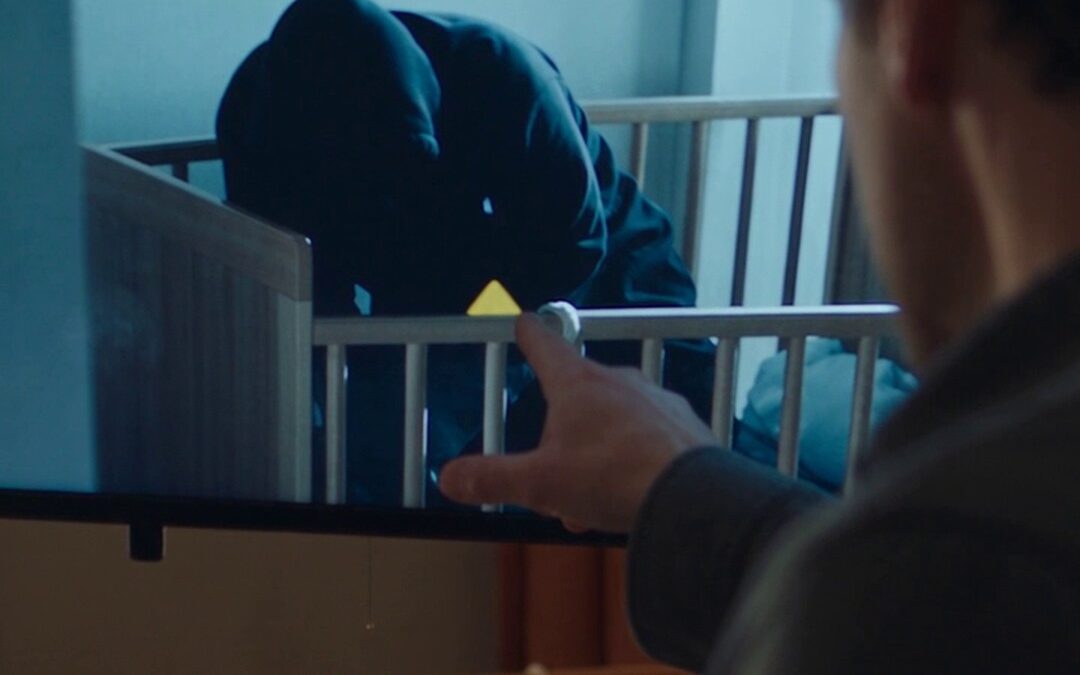
From a high corner, the silent footage showed a hooded woman approach the crib, touch Nico’s forehead, and bend beside the mattress as an amber security light appeared at the doorway.
She left empty-handed before a guard entered the frame.
“She put something there,” Matteo said. “We searched the crib and the room that night.”
“Found nothing?”
“Nothing.”
Liana asked him to pause before the woman bent, then squinted at a pale yellow corner beside the crib’s outer rail.
She had spent months repairing Ellis’s yellow blanket, and she knew what a loose stitched corner looked like even when a camera reduced it to a few bright squares.
“Play it through once more,” she said. “I want to see whether that corner is still there when she leaves.”
Chapter 2: What the Search Missed
Matteo’s thumb remained on the screen, but he did not press play.
“You think my people missed a blanket?”
“I think the yellow bit changes,” Liana said, conscious of Nico’s warm weight against her chest. “I might be wrong.”
“The crib was searched.”
“Then another look should be quick.”
Nico stirred as Matteo lowered his hand, and Liana shifted her palm to support his back without starting the rhythm again.
Matteo glanced at the chair where she had left the linens, as though the red uniform offered a simpler account of who was allowed to speak in this room.
“You don’t know what happened that night,” he said.
“No,” Liana said. “That’s why I’m asking to look.”
He studied her for another moment, then called the nursery nurse on the house phone and asked her to come upstairs.
When the nurse arrived, Matteo told her they needed to inspect the empty crib and asked whether Nico was due for his bottle.
“In twenty minutes,” she said. “I can take him to the sitting room.”
Liana waited for Matteo to nod before handing Nico over, and the baby protested the transfer in the ordinary, indignant way of a child whose comfortable position had been disturbed.
“He may want the chair by the window,” Liana told the nurse, then stopped herself. “Sorry, you know him.”
“I do,” the nurse said kindly. “He likes a change of view.”
As the door closed behind them, Nico’s cry faded toward the next room, where someone who knew his schedule could attend to it.
Matteo turned back to the screen.
The nursery had three cameras, he explained, but the corner camera offered the clearest view of the crib that night; it recorded without sound, and the clock in the image was matched to the security system each morning.
The other two views showed the doorway and the changing table, leaving the outside face of the crib rail partly hidden.
He played the retained clip at its normal speed first.
The woman approached, paused with one hand above Nico, touched his forehead, bent, and hurried away as the amber light came on.
Matteo stopped the recording.
“Now?” he asked.
“Back a little, please.”
Liana stepped closer without touching the screen and pointed to a triangle of yellow near the far end of the outer rail.
It was visible before the woman entered and disappeared behind her sleeve as she bent.
On the next clear frame, after the woman straightened, the triangle was gone.
Matteo replayed those seconds twice.
“That might be shadow,” he said.
“It might,” Liana answered. “Can we see what’s on that side of the crib?”
He summoned the head of household security, a compact woman named Dana Pike, and asked her to bring the original search report rather than describe it from memory.
While they waited, Liana stood at the crib and found that a narrow linen sleeve was tied to the outside rail near the head, well beyond Nico’s reach.
A nurse could use it to hold a spare burp cloth while sitting beside the crib, though the sleeve was empty now and had been washed since the intrusion.
Liana did not put her fingers inside.
“I can see why someone leaning here would look as though she’d reached under the mattress,” she said.
Matteo came around the crib and looked from her position toward the camera.
The mattress edge hid the opening of the sleeve, and the rail hid a hand withdrawing from it.
Dana arrived with a tablet and a hard copy of the report.
She read the list aloud at Matteo’s request: mattress lifted, support checked, sheets removed, under-crib floor inspected, drawers opened, waste collected, and nursery textiles sent through the laundry room.
“Did you examine this sleeve before it went to laundry?” Matteo asked.
Dana looked at it, then at the report.
“It isn’t itemized,” she said. “The guard who searched the crib was looking for what the footage suggested had been put beneath it.”
“Who wrote the report?”
“I did, from the two officers’ checklists and my own sweep of the room.”
Her voice held no evasion, only the discomfort of seeing the gap plainly.
“Then the report doesn’t say whether she took something,” Liana said.
“No,” Dana answered. “It says we found nothing left behind.”
Matteo closed his eyes briefly.
Dana asked permission to review the doorway camera and the search footage she had retained with the incident file.
On that view, the woman crossed the threshold with her near hand empty and left with the same hand folded into her coat pocket, but the low light and the angle could not establish what she carried.
The search footage showed a guard lifting the mattress while the linen sleeve still hung outside the rail.
It did not show him opening the sleeve before another employee removed it with the bedding.
“That was my instruction,” Dana said. “I said to clear the crib textiles after the sweep.”
Matteo looked at her, then away.
“You followed the search I ordered,” he said. “I told you to find what she’d hidden.”
Dana nodded once.
Liana felt a sudden urge to pull the sleeve free and examine every seam, though it had spent three weeks in a house laundry cycle and could tell her little now.
“Could you find out where it came from?” she asked.
“The supply inventory will give us a date,” Dana said. “I’ll check without disturbing anything else.”
Matteo dismissed the screen to its dark idle display.
“The woman still reached my son,” he said.
“Yes,” Liana said. “Whatever she wanted, she crossed a line to get there.”
He looked surprised that she had said it.
Nico’s distant cry rose once, then softened as the nurse spoke to him through the door.
“What made you notice the corner?” Matteo asked.
“Ellis had a blanket with yellow stitching,” Liana said. “One corner kept coming loose.”
She had not meant to say her son’s name here.
Matteo’s face changed, but she raised a hand before he could offer sympathy that would make her either grateful or angry.
“I need to finish the rooms I was assigned,” she said.
“You can take the day.”
“I need the pay.”
“Your pay won’t change.”
“That isn’t the only reason to have work.”
She took the linens from the chair and left him with the dark screen.
By noon, Liana had made two guest beds, sorted towels by size, and discovered that the west corridor could be reached without passing the nursery.
She chose that route twice.
On her third trip downstairs, she found Matteo waiting at the foot of the service stairs, with enough distance between them that she could keep walking if she wanted.
“Dana found the inventory record,” he said.
Liana settled the empty basket against her hip.
“The sleeve?”
“It was added six weeks ago at the request of Nico’s former night caregiver.”
“Who was that?”
“Naomi Bell.”
The name struck a place in Liana’s memory so abruptly that the basket slipped against her wrist.
At the children’s outpatient center, Naomi had worn plain sweaters and called the baby she cared for Nicky.
Liana pictured a woman pouring water into a paper cup while Ellis slept in his stroller, then dismissed the image because she had met dozens of people in that waiting room.
“Do you have a photograph?” she asked.
“An employment file photo.”
“Would she be willing to talk?”
“I don’t know,” Matteo said. “She left three weeks ago.”
“Before the woman entered?”
“Two days before.”
He showed Liana the photograph on his phone only after she asked again.
Naomi Bell looked older without the knitted blue cap Liana remembered, but the lines at the corners of her eyes and the small scar at her chin were unmistakable.
“I know her,” Liana said.
Matteo’s hand tightened around the phone.
“From where?”
“A children’s outpatient center.”
“Nico has appointments there.”
“Yes,” Liana said. “So did Ellis.”
Matteo glanced toward the hall behind her, where staff passed between the kitchen and laundry room.
“Could we talk somewhere private?”
Liana considered the basket in her arms, the hours she still owed, and the way he had accepted her answer that morning when she left the nursery.
“For ten minutes,” she said.
He led her to a small study near the service rooms and left the door open until she chose a chair.
Liana had expected him to demand a list of everything she knew, but he waited while she set the basket on the floor.
“Ellis had a heart condition,” she said. “The center saw him for feeding and movement, and the hospital was close enough for appointments when he needed them.”
Matteo listened.
“He died twenty-four days ago,” she continued. “I buried him two days later.”
“I’m sorry.”
“I know you are.”
She looked down at her hands, where a thin yellow thread had caught beside a fingernail.
“I started going there when Ellis was four months old, and Naomi sometimes came with a baby she called Nicky.”
“Nico,” Matteo said quietly.
“I never asked his surname.”
“Why would you?”
Liana had to swallow before she could answer.
“Parents in those rooms learn what a person offers, and they leave the rest alone unless it’s offered too.”
She remembered Naomi once offering to carry Ellis’s bag while Liana settled him, and she remembered holding a rattle where both boys could see it as they waited beside each other.
Nothing about those ordinary afternoons had looked like the beginning of an inquiry.
“Did you hold my son?” Matteo asked.
“A few times, with Naomi right there.”
“How many?”
“I don’t know.”
His expression closed, and she recognized the impulse to measure everything so that no uncertainty remained.
“I can tell you what I do remember,” she said. “He liked the crinkle of Ellis’s blanket, and Naomi would keep it out of his mouth.”
Matteo’s eyes moved to her hand.
“Yellow?”
“White cotton, yellow stitching.”
She pulled the thread free and laid it on the study desk.
“When Ellis was awake and well enough, they sat near each other in the waiting room,” she said. “Sometimes I talked to both of them.”
Matteo looked toward the open door.
“Naomi never told me that.”
“I don’t know why she would have.”
“Because I asked for details about where he spent his days.”
Liana could hear how angry he was trying not to sound.
“Then you should ask her.”
Matteo reached for his phone.
“Not with me in the room,” Liana said.
He stopped.
“I’ll ask Dana to contact her,” he said.
“Tell her you have questions, not that you’ve found a culprit.”
“I can do that.”
Liana rose, took her basket, and went back to the laundry room with ten minutes having become nearly half an hour.
That afternoon, the house kept its routines around her: a delivery was signed for, the cook planned dinner, and Nico’s nurse wrote down how much of his bottle he took.
Liana was glad to hear those details through the kitchen doorway.
They made the baby someone with an ordinary day instead of the single quiet moment he had given her.
At four, the agency coordinator called her.
“Mr. Varric’s household asked me to confirm your references,” the woman said. “I wanted you to know.”
“They checked them before I started.”
“This was a separate question about who referred you.”
Liana stepped into the empty pantry.
“Who did?”
“There wasn’t a referral on your application,” the coordinator said. “You answered the posting, interviewed on Tuesday, and passed the routine screening.”
Liana leaned against the shelves.
“Did someone ask you to call me?”
“A former household employee said you might be looking for work, but we already had your application.”
“Naomi Bell?”
The coordinator paused.
“Yes.”
Liana closed her eyes.
Naomi had known about Ellis’s burial, yet had sent Liana toward a house whose baby she might have known, without saying so.
“Did she tell you why?” Liana asked.
“She said you were careful and needed a stable position.”
Both things were true, which made the concealment harder to sort.
“Thank you,” Liana said, and ended the call before the coordinator could ask anything else.
She returned to the laundry room, folded three towels, unfolded one because it was crooked, and finally sat on the low stool beside the machines.
Ellis’s blanket had not been placed in his grave.
It was at home in a drawer because she had been unable to choose between keeping something that still smelled faintly of him and washing it before the smell changed.
She had washed the rest of his clothes on the morning of the funeral while her sister stood beside her saying she could stop whenever she wanted.
Now she wondered whether the pale corner in Matteo’s recording had been a strip of that blanket, a similar piece of cloth, or nothing she had ever touched.
The uncertainty did not bring Ellis closer.
It made her angry that a stranger’s choice had carried his things into this house without asking her.
When her shift ended, Liana changed out of the red uniform and found Matteo near the side entrance.
“Naomi agreed to speak tomorrow,” he said. “Dana gave her the choice of a call or a meeting off the property.”
“She chose?”
“A meeting at the library café.”
Liana held the strap of her bag.
“Before that happens, I need to tell you something.”
He waited.
“The agency says Naomi mentioned my name after I had already applied.”
“Did she tell you about this job?”
“No.”
“Did she know you had?”
“I don’t know.”
Matteo rubbed a hand over his face.
“I thought I had found someone who came here independently.”
“You did,” Liana said. “I answered the posting because I needed wages.”
“That may be true even if she hoped you would answer it.”
Liana looked through the glass door at the evening guard checking a delivery truck.
“I don’t want my job turned into an experiment with Nico.”
“It won’t be.”
“You asked me here to clean rooms.”
“I did.”
“Then let me decide whether I have anything more to offer.”
Matteo nodded.
She believed he meant it in that moment, which was more than she had expected that morning, but she still went home.
Her apartment was quiet except for the refrigerator and a bus braking outside.
She took Ellis’s blanket from the drawer and spread it over the kitchen table, where the white cotton looked smaller than she remembered.
One corner bore a line of crooked yellow stitches she had made after his fingers pulled the original seam loose.
The other three corners were neat.
In the recording, the visible piece had looked like the crooked corner, but the image had been no bigger than her thumbnail.
Liana photographed the blanket on the table, then put the phone face down.
She was not ready to send Matteo a picture of something she had sewn beside Ellis’s hospital bed.
She called her sister instead and said, “I need you to tell me what you remember about the day I left the center for the last time.”
Her sister did not ask why.
“You checked out at the front desk,” she said. “I brought the car around, and you had the blanket over Ellis’s stroller.”
“That was four days before he died.”
“Yes.”
“And after that?”
“You took it to the hospital with him.”
Liana touched the crooked corner.
“I brought it home afterward?”
“You did,” her sister said. “I saw you put it in the drawer.”
The blanket on the table confirmed that much, but a single thread could have come loose at any time.
“Why are you asking?”
“Someone may have had a piece of it.”
Her sister went quiet.
“Liana, do you want me to come over?”
“Tomorrow,” Liana said. “Tonight I want to know what I’ve got before anyone tells me what it means.”
After the call, she opened the appointment calendar on her phone.
There were eleven Tuesdays marked for Ellis at the outpatient center, beginning five months earlier and ending just before his final admission.
She found photographs from three of those days.
Most showed Ellis asleep or reaching toward his own shoe, but one from seven weeks earlier had caught a second stroller at the edge of the frame.
A blue knitted cap hung over its handle.
Liana enlarged the picture until the child’s face blurred and the shape of the cap became unmistakable.
She had taken the photograph to remember Ellis grinning at a paper pinwheel she had bought for fifty cents.
She had kept it for him.
At the library café the next morning, Matteo sat across from Liana with a plain paper folder closed beside his cup.
Dana occupied a table far enough away to leave the conversation private, while Nico stayed at home with his regular nurse.
Liana had asked for that arrangement.
She did not want the baby brought in front of Naomi to prompt a reaction, and Matteo had agreed without argument.
Naomi arrived on time in a raincoat and the same blue knitted cap from Liana’s memory.
She stopped when she saw Liana.
“I should have called you,” Naomi said.
“You should have,” Liana answered.
Naomi sat only after Matteo indicated the empty chair.
For a moment nobody opened the folder.
Matteo spoke first.
“Did you enter my son’s nursery twenty-one days ago?”
“Yes.”
“Using a staff credential that wasn’t yours?”
“Yes.”
“Why?”
Naomi looked at Liana, then forced herself to face Matteo.
“I wanted something I’d left there.”
“What?”
“A cloth tab from Ellis’s blanket.”
Liana’s hands closed around her warm cup.
“Why did you have it?”
“Ellis pulled the corner seam open one afternoon,” Naomi said. “You were talking to the receptionist, and the loose strip came away in my hand when I moved it clear of Nico’s fingers.”
“I would have sewn it back.”
“You did sew the corner back,” Naomi said. “I told you I’d put the little strip in the rubbish.”
“You kept it?”
Naomi nodded.
“I shouldn’t have.”
Matteo leaned forward.
“Why bring it into Nico’s room?”
“After Ellis died, I found it in the pocket of my bag,” Naomi said. “I took it out at work because I meant to give it to Liana if I saw her, and I slipped it into the linen sleeve when I was called away.”
“When was that?”
“The day before you ended my shifts.”
Naomi’s eyes flickered toward him.
“I asked the front desk to return it after I left, but they said personal items in the nursery would have to be checked by security, and I was afraid they’d throw it away before anyone knew what it was.”
“You could have told us what it was,” Matteo said.
“I could have.”
“So you came into a guarded house under another person’s credential.”
“I did.”
Matteo’s anger was plain, but he held it inside the question he asked next.
“Did you come to take Nico?”
“No.”
“What was your plan when you reached the crib?”
“To take the strip from the sleeve and leave,” Naomi said. “I touched his forehead because he was awake and I knew him, which was another thing I had no right to do.”
“You left when the alarm light came on.”
“I knew someone would arrive.”
Dana had told them that the borrowed credential had been flagged at an interior reader after the woman entered the nursery corridor.
Naomi said she had crossed the service hall toward the outside door as guards moved in from the front stairs, and an exit camera showed a hooded figure leaving that way.
Her account fit the movements on the recordings, though Liana knew that fitting a recording did not make the rest true.
“Where is the strip now?” she asked.
Naomi opened her handbag, took out a small envelope, and laid it on the table without pushing it toward anyone.
“I brought it.”
Liana did not touch it.
“You’ve had three weeks to say all of this.”
“I know.”
“Why did you tell the agency I would be good at this job?”
Naomi swallowed.
“Because I knew you needed one.”
“That isn’t what I asked.”
“I saw the listing,” Naomi said. “I knew Nico had been unsettled since I left, and I remembered how he calmed when you talked to Ellis.”
Matteo’s face hardened.
“You arranged for her to be here?”
“No,” Naomi said. “She had already applied when I called the coordinator.”
“But you thought it might help Nico.”
“Yes.”
“And you didn’t think Liana should know she was walking into a house where you had entered his nursery?”
Naomi looked at Liana again.
“I was afraid she would stay away.”
“That was mine to choose,” Liana said.
“I know that now.”
“You knew it then.”
Naomi let the correction stand.
A server came to refill water, and all three waited until she left.
Matteo opened his folder to a copy of the signed end-of-employment notice.
“You told household staffing you needed to leave for family reasons,” he said.
“I did need to,” Naomi said. “My father’s care changed.”
“You told me that Nico’s appointments were handled and that he had no close contact there beyond the clinic staff.”
“I told you he had no unapproved care,” Naomi answered. “I believed sitting in a public waiting room with another family was different.”
“You knew I was asking because I wanted to understand his day.”
“You usually asked while going out the door.”
Matteo looked up sharply.
“That doesn’t make your answer complete.”
“No,” Naomi said. “It doesn’t.”
Liana watched him absorb the answer he had invited.
He had left much of Nico’s daily world to Naomi and the nurses after his wife’s death, and a person could have done that from exhaustion without ceasing to be responsible for what she had asked.
Naomi turned to Liana.
“There were afternoons when Ellis slept and you spoke to Nico,” she said. “You made a tapping sound on the stroller handle, three quick taps and a rest.”
“That was for Ellis.”
“I know.”
Liana remembered tapping the handle while waiting for a nurse to call her son’s name.
She had done it when his breathing was even, when she could bear to hope an appointment would end with nothing new to fear.
“Nico heard it too,” Naomi said.
“Maybe,” Liana answered. “He was a baby.”
“He reached toward you sometimes.”
“Babies reach toward people.”
Naomi accepted that as well.
For a few minutes her explanation seemed almost complete.
The two boys had occupied the same waiting room, the yellow strip had been removed, and Nico might have been comforted by a voice or rhythm he had heard before.
Then Matteo asked why the security light had come on.
Naomi said the credential had passed the first checkpoint because the desk expected a substitute employee from an agency, but an interior authorization check found that the person wearing it was not on the house roster.
Dana had already confirmed that staffing confusion had occurred on a day with two scheduled agency replacements.
The false credential explained entry and alarm at a broad level; it did not excuse either.
“I didn’t alter a real employee’s record,” Naomi said. “I used a name I knew the desk was expecting.”
“That person was delayed and never came,” Matteo said. “For twenty minutes, we couldn’t tell who was in the nursery.”
“I’m sorry.”
“You need to speak to the people investigating the breach,” he said.
“I will.”
Liana looked at the envelope.
“If that is Ellis’s thread, I want to decide what happens to it after it’s checked,” she said.
“You can have it,” Naomi replied.
“I’m not taking your word for what’s in it.”
Naomi’s eyes filled, but Liana did not soften the sentence.
At the end of the meeting, Dana took the sealed envelope with Naomi’s written permission, photographed its condition, and logged it with the incident materials.
Liana gave permission for comparison with her blanket only after Dana explained how the examination would work: a textile conservator could compare the torn end, stitch pattern, and fibers without removing more than a loose strand.
She could withdraw that permission before the work began.
Matteo offered to pay her for the time she had missed at the house.
“I didn’t come here on a cleaning shift,” Liana said.
“You still lost wages.”
“I used a day off I’d planned to save.”
“Then I’d like to cover it.”
“That sounds like a debt you want settled.”
“It isn’t.”
“Good,” Liana said. “I’ll let you know what I decide.”
Outside the café, Naomi caught up with her under the awning but kept several feet between them.
“Ellis liked the red pinwheel,” she said.
“He liked anything that moved when the vents came on.”
“I thought you should know I remember him.”
Liana turned toward the wet street.
“You could have remembered him without bringing me into this by surprise.”
“I could have.”
“Why did you keep the strip in the first place?”
Naomi’s answer came slowly.
“His appointment was the last time Nico laughed that week, and I wanted to remember that room before I heard he’d died.”
Liana could see that Naomi believed it.
It did not tell her whether Naomi had kept the thread out of tenderness, guilt, or a desire to carry some part of one child into another child’s nursery.
“Tell the truth when Dana asks you,” Liana said. “That will matter more than explaining how you felt.”
She went home before her sister arrived and put the blanket back in its drawer.
At the house, Matteo spent the morning with Nico’s nurse reviewing care notes from the weeks before and after Naomi left.
He asked for the pediatrician’s records through the office that already treated Nico, using his authority as the boy’s father, and made clear that he wanted dates and care recommendations rather than a diagnosis drawn from the nursery incident.
The notes showed a nine-month-old who had been growing, eating, and sleeping in uneven stretches common enough to discuss with a doctor.
They also showed that after Naomi’s departure, Nico had had several harder evenings and two visits for persistent crying.
His pediatrician had checked him, advised them what symptoms to watch for, and asked the household to keep a steadier bedtime routine.
There was no entry that turned a quiet spell in Liana’s arms into a medical finding.
Matteo called Liana that evening only after texting to ask whether she would take a call.
“He cried with me after his bath,” he said when she answered.
“Did he eat?”
“Yes, and now he’s asleep.”
“Then you got him through it.”
“I thought I’d done something wrong because he stopped for you yesterday.”
Liana sat on her sofa with her shoes still on.
“I can’t tell you why he stopped.”
“I know.”
“He might remember a sound from that waiting room, or he might have been ready to settle when I held him.”
“I know that too.”
She heard Nico’s nurse in the background reminding someone to lower the hall lights.
Matteo moved farther from the sound.
“Naomi said she met Ellis,” he said. “I should have asked you whether you wanted me to hear about him at all.”
“I told you about him.”
“That doesn’t give everyone else permission.”
“No,” Liana said. “It doesn’t.”
A pause opened between them.
“May I ask one thing?” Matteo said.
“You can ask.”
“Was the tapping on the stroller a song?”
“It was a rhythm my father used when I was little,” she said. “I never knew if Ellis noticed it.”
“Would you mind if I tried it with Nico?”
Liana looked toward the drawer.
“I mind if people say it belongs to him now.”
“Then I won’t say that.”
“You may try it.”
The next morning, Liana returned to work because her rent was due in eleven days and because she had promised herself she would decide about the job on facts rather than the shock of the first morning.
She cleaned the guest rooms while Dana checked the former nursery sleeve’s inventory trail and the staffing roster.
Dana found the purchase request with Naomi’s signature and a note from the nursery nurse: spare cloths could be kept outside the crib, away from Nico’s sleep space.
The nurse remembered Naomi using the sleeve during bedtime but had not known about Ellis’s strip.
The laundry log showed that the sleeve removed during the search went through a normal wash cycle; there had been no hidden object in it by then, which matched the recording’s changed yellow corner and Naomi’s account of taking the strip away.
The report’s claim that nothing had been found remained true as written, but Matteo asked Dana to amend the incident summary so that its limits were explicit.
He signed the amendment himself.
At lunch, Liana met him in the kitchen while she filled her water bottle.
“I saw the revised summary,” she said.
“I should have asked what the footage showed before deciding what it meant.”
“You had a woman in Nico’s room.”
“I did.”
“You were allowed to be frightened.”
“That doesn’t make every conclusion accurate.”
Liana capped the bottle.
“Naomi still entered under someone else’s name.”
“Yes.”
“Please don’t let the correction turn into an excuse for her.”
“I won’t.”
Matteo lowered his voice as a cook passed behind them.
“I’ve also asked the agency to keep your employment file separate from the incident review, except for what you choose to provide.”
“That should have happened already.”
“It should.”
She took a drink of water.
“The agency coordinator says Naomi only called after I applied.”
“She sent Dana the call record,” Matteo said. “Dana confirmed the timestamps with the agency.”
Liana had wanted to know whether her application had been steered from the start.
Now she knew it had been her own decision to look for work and Naomi’s decision, afterward, to let her arrive without warning.
The distinction mattered, though it did not make the surprise harmless.
That afternoon, Liana’s sister came to the house by invitation and met her at the side entrance with the folded blanket inside a cloth bag.
Liana had decided that the comparison was worth making, but she wanted someone who had known Ellis outside the waiting room to accompany her.
Dana led them to an unused office, where a local textile conservator examined the blanket and the envelope’s contents under bright light.
The strip was yellow cotton thread and a narrow piece of edging.
Its frayed end matched a gap beneath Liana’s repair, and the old stitch holes aligned with holes in the blanket.
The conservator said the physical match was strong, though she could not say who had removed it or when.
Liana thanked her and asked Dana to keep the strip with the incident materials until the written report was finished.
Her sister waited until they were alone in the corridor.
“Do you want the blanket back in the bag?”
“Yes.”
“Do you want to leave?”
Liana looked down the corridor toward the stairs.
“Not yet.”
In the office again, Dana showed them a printout of two still frames from the recording.
The pale corner was present before Naomi bent and absent when she stood.
The conservator’s finding made it more likely that the object was the strip Naomi had brought, but the recording could not show the material clearly enough to identify it on its own.
Liana preferred the careful wording.
She had spent too much time hearing people turn an uncertain improvement in Ellis’s condition into a promise.
“What does this establish about the night?” her sister asked.
“That Naomi took a small item from the sleeve,” Dana said. “Her account of the item is supported by the match, and the footage supports removal rather than placement.”
“And the part about Nico knowing Liana?” her sister asked.
“We’re still checking the dates,” Matteo said from the doorway.
He had waited outside while the blanket was examined.
Liana saw him glance at her sister before entering.
“I have Nico’s appointment dates,” he said. “I can share those.”
“I have Ellis’s,” Liana answered. “I can share mine.”
They laid two calendars on the desk.
Nico’s feeding appointments had begun four months earlier, when he was five months old.
Ellis’s therapy appointments had begun before that and continued through the month before his death.
The schedules overlapped on six Tuesdays and one Thursday.
A calendar could place both children in the same building but not beside each other, and Liana said so before Matteo could ask.
“I have a photograph from one Tuesday,” she said. “Naomi’s cap is in it.”
“May I see it?”
She showed him the image of Ellis and the paper pinwheel, with the blue cap hanging on the second stroller’s handle.
Matteo looked at Ellis first.
“He has your eyes,” he said.
“He had my father’s,” Liana answered.
Matteo gave the phone back without enlarging it.
“The appointment record puts Nico there that day,” he said. “The photograph puts that stroller near Ellis, if it’s Naomi’s.”
“My sister saw her there once,” Liana said, turning to her.
“I remember a woman with a blue cap and a baby who reached for the pinwheel,” her sister replied. “I can’t swear which Tuesday.”
Dana suggested they ask the center whether its retained waiting-area sign-in log could confirm the caregivers’ names on those dates.
Liana had access to Ellis’s records as his parent, and Matteo had access to Nico’s; the center could answer each of them about their own child without sharing another family’s information.
With both adults’ consent, the center could also confirm a shared attendance window if it still kept that log.
Matteo asked whether Liana wanted to make the request.
“After work,” she said. “I don’t want to spend a cleaning shift calling a place where Ellis used to wait.”
He nodded.
Her sister squeezed her shoulder once and took the blanket home.
The center called back the following afternoon.
Its administrator had checked the appointment system and a reception log kept for families who used the shared waiting room during a renovation.
On four of the overlapping dates, Naomi had signed in with Nico as his caregiver and Liana had signed in with Ellis within minutes of each other.
The administrator could not prove what either child noticed during those visits.
She could confirm that the two families had occupied the same small room for parts of those afternoons, and she sent each parent a copy of the entries concerning their own child, along with a joint confirmation they had both requested.
Liana listened to the call in an empty break room while Matteo stood by the window.
When it ended, he said, “That answers when he could have heard you.”
“It answers where we were,” she said. “What he remembers is his.”
Matteo accepted the correction.
Then he frowned at the fourth date.
“This is nine days before Ellis died.”
“Yes.”
“Naomi said she found the strip in her bag after his death, but she asked for the sleeve six weeks ago.”
Liana looked at the copy of the nursery inventory request.
The sleeve had been installed six weeks earlier.
Naomi had said she put the strip there only after Ellis died, four days before the nursery intrusion.
There was no contradiction in that sequence, yet Matteo kept looking at the request.
“What is it?” Liana asked.
“She told me she had no reason to bring anything personal into the nursery,” he said. “When I asked about the sleeve, she said it was for burp cloths.”
“It was.”
“Yes, but I need to know why she kept a piece of Ellis’s blanket for weeks before his death.”
Liana understood the question he was trying to ask.
It was possible Naomi had attached more meaning to the boys’ meetings than either parent had known.
It was possible, too, that she had simply tucked a bit of cloth into a bag and forgotten it until a death made forgetting impossible.
“We can ask her,” Liana said. “We don’t have to decide it for her.”
Naomi agreed to a second meeting by phone, with Dana present and the questions sent in advance.
This time Liana chose the small conference room at the agency office, a place where neither Matteo nor Naomi had authority over the door.
She wanted Naomi’s account before deciding whether to file a complaint about the undisclosed referral.
Naomi arrived carrying her own calendar, worn at the edges.
“I kept notes for Nico’s appointments,” she said. “You can compare them with his records.”
Matteo took the calendar only after she handed it to him.
The entries listed feedings, naps, and the center’s instructions in cramped handwriting.
On four Tuesdays, Naomi had written E and a small yellow mark in the margin.
Liana stared at the letter.
“Ellis?” she asked.
“Yes.”
“Why a mark?”
“Because Nico reached for the edge of his blanket every time he saw it.”
“You could have written that in the care notes at home,” Matteo said.
“I should have.”
Naomi folded her hands.
“I thought I was keeping a harmless detail for myself.”
Matteo turned a page.
On the last overlapping Tuesday, the note read, E laughed at pinwheel; N laughed after.
Liana remembered that laugh.
Ellis had been tired and had given her one short, startled sound when the paper blades spun in the air from the vent.
She had taken the photograph because he so rarely laughed at an appointment.
“You wrote it down,” she said.
“I was afraid I would forget,” Naomi answered.
Liana looked at the yellow marks again.
They had been made before Ellis died, and Naomi had never known how little of his laughter Liana could bear to lose.
“What happened to the strip?” Liana asked.
Naomi did not reach for an easy answer.
“I took it home in my bag after it came off the blanket,” she said. “I meant to give it back the next week, but Ellis wasn’t at the center, and then Nico missed an appointment.”
“Ellis was admitted,” Liana said.
“I heard later.”
“And you carried the strip back and forth?”
“It stayed in the pocket of the bag I used for Nico’s things.”
“Until the day after the funeral?”
“Yes.”
“Why did you take it out?”
“I saw a message from the center about a condolence card for your family,” Naomi said. “I found the strip while looking for a pen, and I thought I could ask the receptionist to send it with the card.”
“You didn’t.”
“I was at work and put it in the sleeve when the nurse called me to help with Nico’s bath.”
Matteo turned to a fresh sheet of paper.
“The next day you gave notice.”
“My father had fallen,” Naomi said. “I needed to be with him for at least a month.”
The agency had verified that her request to leave was genuine, though its details were Naomi’s private matter.
Matteo did not ask for more.
“Why not tell me about the strip when you called the front desk?” he said.
“I told them it was personal and small,” Naomi said. “They said nothing would be removed from the nursery without a check, and I panicked at the thought of explaining who Ellis was.”
“Why?”
“Because you had asked about Nico’s contacts at the center, and I had answered in a way that kept Liana out of the story.”
Matteo laid down his pen.
“Why did you keep her out?”
“I thought you would stop taking him if you knew he’d become attached to a family there.”
“You thought you could decide that for me.”
“I thought his appointments helped him, and the waiting room helped too.”
“He could have kept going to his appointments.”
“I know that now.”
Liana heard the phrase a second time.
“Did you ever tell anyone at the center that I was helping care for Nico?” she asked.
“No.”
“Did you leave him alone with me?”
“No.”
Liana remembered Naomi staying within a few steps whenever she held the baby.
That was one piece she could check against her own experience.
“Then why did he become hard to settle around the time you left?” Matteo asked.
Naomi looked down at her calendar.
“He had the same nurse most days, but I was there at night, and I’d been there for months.”
“That’s an answer about your leaving.”
“It may be the answer,” Naomi said. “His doctor has better grounds than I do to discuss the crying.”
Matteo’s jaw worked once.
Liana had expected Naomi to use Nico’s distress as proof that she should be forgiven, and she felt some of her anger shift when Naomi did not.
“Did you know he would settle with me?” she asked.
“No,” Naomi said. “I thought your voice might be familiar, but I couldn’t know what would happen on a particular day.”
“Then why tell the agency I was right for the house?”
“You needed work, and they needed someone,” Naomi said. “I told myself those reasons were enough.”
“They weren’t the only reasons.”
“No.”
“I want you to say the rest.”
Naomi faced her.
“I hoped you might help Nico feel safe,” she said. “I let that hope matter more than whether you wanted to see a baby you had known while grieving your own.”
The room was still for several seconds.
Liana could not forgive the decision simply because Naomi had finally named it.
Matteo closed the calendar.
“There’s another account we need to consider,” he said. “You could have seen the agency listing after you planned to enter the house, and you could have shaped this story around Liana once you learned she was hired.”
Naomi nodded.
“Yes.”
“The strip and the notes support pieces of your account, but neither proves what you intended at the nursery.”
“No.”
“You could also have gone in to see Nico, then taken the strip because it was there.”
“Yes,” Naomi said. “I had missed him.”
Liana looked at her.
“That matters.”
“It does.”
Naomi pressed her thumb against the calendar’s frayed cover.
“I went for the strip,” she said. “I also knew I might see him if he was awake, and I let myself want that.”
“You touched his forehead,” Matteo said.
“I did.”
“You could have frightened him.”
“I could have.”
The recording showed Nico stirring but did not show a sustained reaction before the light came on.
None of them tried to use his later crying to assign intent to Naomi’s hand.
Matteo asked Dana to describe what could be checked independently.
Dana had already confirmed the staffing mix-up, the path Naomi had taken through the service hall, and the roster flag that triggered the light.
The textile comparison supported Naomi’s account of the strip.
The center’s log and the two parents’ records supported the waiting-room meetings.
Naomi’s calendar contained notes written at the time, but it was her own account and could not stand alone as proof.
No camera showed what Naomi had thought when she entered, and no witness could.
“We can establish the conduct and its effects without pretending to read her mind,” Dana said.
Matteo looked at Liana.
“Is that enough for you?”
“To know what happened with the strip, yes,” Liana said. “To decide what I want from Naomi, I need time.”
Naomi began to speak, then stopped.
Liana appreciated the stop more than another apology.
After the meeting, Matteo asked whether Liana wanted a ride home.
“My sister’s coming,” she said.
“All right.”
He stood with his coat over one arm, looking less like the man who had blocked the nursery door and more like a father who had learned how much of his child’s day other people had held for him.
“I told Dana to send the case materials to the local investigator,” he said. “The credential and the entry are for them to address.”
“Even though she told us why?”
“Yes.”
“Don’t ask them to make it worse because you’re angry.”
“I won’t.”
“Don’t ask them to make it disappear because Nico knew her.”
“I won’t do that either.”
He waited until her sister’s car pulled into the lot before leaving.
Over the next week, the house grew quieter without becoming suddenly easy.
Nico had mornings when he played on the rug with a wooden ring and evenings when the nurse and Matteo took turns walking him past the same two windows.
Liana kept her cleaning assignment.
She saw Nico when her work took her through shared rooms and sometimes greeted him, but nobody called her upstairs because he cried.
On Thursday, Matteo asked whether she would like a separate paid shift once a week helping prepare the nursery linens and sitting with Nico while his nurse took a break.
He made the offer in writing, with hours, pay, duties, and the assurance that refusing it would not affect her cleaning job.
Liana took the paper home.
Her sister read it at the kitchen table while Ellis’s blanket lay folded beside the fruit bowl.
“You could say yes for the money,” her sister said.
“I could.”
“You could say no because it hurts.”
“I could.”
“What do you want?”
Liana looked at the schedule.
“I want him cared for by people who know him,” she said. “I like him, but I don’t want to become the thing everyone reaches for when they’re tired.”
“Then tell Matteo that.”
The next morning, she did.
“I can take one shift,” Liana said. “The nurse stays responsible for his care, and I can stop after a month if it’s too much.”
Matteo read the paper with the changes she had written in the margin.
“Yes.”
“I may need a day off near Ellis’s birthday.”
“You can take it.”
“I’m telling you now because I don’t want to explain myself that morning.”
“You won’t have to.”
She handed him the page.
“And I want the regular cleaning job available if I stop the nursery shift.”
“It is.”
Matteo signed beside the revised terms and gave her a copy.
Liana knew a signed page could not remove every awkwardness in a house where one person owned the walls and the other cleaned them, but it gave her words to point to if anyone forgot what she had agreed to.
The investigator took statements from Naomi, Dana, Matteo, and the agency employee whose name had been used at the desk.
The household provided the retained recordings and the amended search report.
Weeks later, the investigator told Matteo that the entry and false identification had been documented, and that any formal outcome would follow the ordinary process rather than the household’s preference.
Matteo passed that information to Liana without predicting a charge or promising punishment.
Naomi sent Liana one letter through the agency.
It contained no request to see Nico and no defense of the nursery entry.
She wrote down the four waiting-room dates she remembered, admitted that she had made decisions for two families without their consent, and offered to answer further questions if Liana wanted to ask them.
Liana put the letter in a drawer.
She did not answer it that week.
She spent the following Sunday at the cemetery with her sister, replacing a wind-torn paper pinwheel beside Ellis’s stone.
When she came back to work on Monday, Nico was in the sitting room with Matteo, making a determined attempt to pull a cloth book out of his father’s hand.
Matteo let him have it.
“He has an opinion about who holds the pages,” Matteo said.
“He does,” Liana answered.
Nico looked up at her voice and smiled, then frowned as the book slipped from his grip.
Matteo picked it up and gave it back.
“He cried after breakfast,” he said. “I checked what he needed, and then we sat here until he was ready to play.”
Liana sat on the edge of the rug for a few minutes.
She did not know whether Nico recognized her from the outpatient center, whether her voice reminded him of Naomi’s evenings, or whether their first quiet moment had simply arrived when he was ready for a different pair of arms.
She knew he had spent real afternoons near Ellis, and that knowledge was enough without asking Nico to prove more.
Matteo tapped the rug three times with his fingertips and left a space.
Nico slapped the book against the floor in an uneven answer.
“May I tell him about the pinwheel?” Liana asked.
Matteo looked at her.
“Of course.”
She turned the cloth page slowly so Nico could follow it.
“Ellis laughed when a red paper pinwheel spun above our heads,” she told him, while Matteo kept one hand open beside his son in case the book fell again.








