A Harbor Clerk Recognizes a Stranger’s Boot Knot Moments Before the Boy Leaves for Alaska Forever
Chapter 1: The Midnight Ledger
The young man at the counter pulled his boot lace tight with an extra loop behind the eyelet, cinching the raw hide into a doubled fisherman’s hitch.
Arthur Vance stopped counting register tape, his pencil hovering an inch above the ledger line.
He had not seen that knot tied on a work boot in twenty-two years, not since the timber dock fire in Astoria took his younger brother and scattered the state foster files into sealed county archives.
The boy was barely twenty, his canvas jacket stiff with salt spray from the morning tide on Willapa Bay.
“Three gallons of kerosene, please,” the boy said, laying two crumpled dollar bills flat on the glass case.
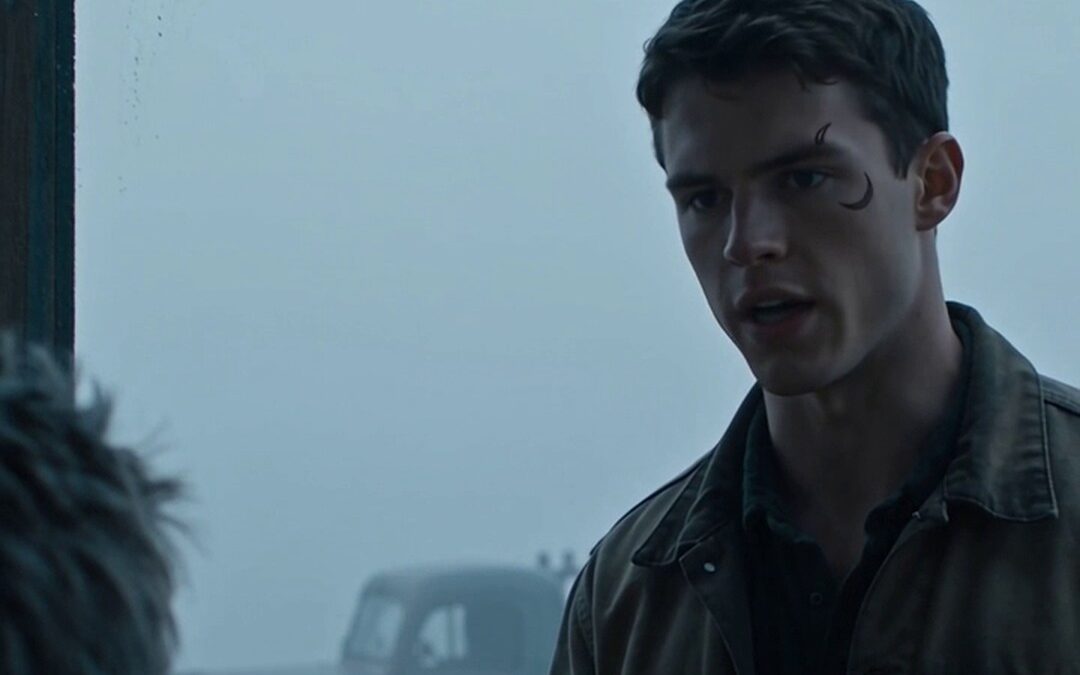
Arthur looked up at the boy’s temple, where a small crescent scar notched into the left hairline, pale against windburned skin.
Every November third, Arthur walked the perimeter of the cannery spit at sunrise, leaving a carved cedar float on the high-water drift for the infant nephew he had been barred from claiming after the funeral.
The boy dug into his canvas pocket for pocket change and pulled out a tarnished brass cotter pin bent into an oval charm, attached to his key ring by faded green parachute cord.
Arthur’s breath caught against his ribs as he stared at the little piece of hardware.
It was identical to the cotter pins Arthur used to file down smooth to make teething rings on the old troller boats.
“You from around the bay?” Arthur asked, his voice rough from forty years of harbor wind.
“No, sir,” the boy replied, looking toward the gravel apron outside where a rusty flatbed truck sat idling.
“Just finishing out the late oyster run for Miller’s crew,” the boy added, pocketing his keys.
“Truck leaves for Alaska out of Seattle at dawn.”
Arthur hesitated, terrified of being the old fool who saw ghosts in every deckhand who passed through Ilwaco.
“That pin on your keys,” Arthur began, pointing a scarred finger toward the counter.
The boy looked down, suddenly defensive, his shoulder dipping inward the way boys do when their pride expects pity.
“It belonged to someone else,” the boy murmured, pulling his hand away from the counter.
The horn on the idling flatbed gave two sharp, impatient blasts into the salt mist.
“Hey, Jesse, move it!” a voice shouted through the diesel exhaust outside.
Jesse grabbed the kerosene can by the bail wire, turned toward the glass door, and paused with his hand on the brass latch.
“Where did you get that scar?” Arthur whispered, the words escaping him before he could stop them, but the boy had already stepped into the fog.
Chapter 2: The Ghost Tide
The door latch clicked shut, leaving a tiny smear of diesel grease on the frosted glass.
Arthur stood behind the wooden counter while the bell above the lintel gave its dying chime.
Outside, the dual exhaust of Miller’s flatbed barked once, threw gravel against the clapboards, and faded north toward the coastal highway.
Arthur did not run after it.
A man did not spend four decades on the Columbia River bar without learning that sudden movement on wet planking usually ended in deep water.
He reached down and touched the open ledger page where the pencil lead had snapped against the line.
His hands shook, not with age, but with the sudden, cold violence of an old wound reopening.
Twenty-two years ago, the county courthouse in South Bend had informed him that kinship rights required a marriage license and an owned residence.
At twenty-four, Arthur had possessed neither, only a berth on an open-deck gillnetter and five hundred dollars in an oilskin pouch.
The state caseworker, a woman named Hattie Crane whose handwriting resembled barbed wire, had sealed the file under the revised juvenile code of 2002.
She had told him the baby would go to an adoptive family in the Yakima orchards, far from the rot of the docks.
Arthur had kept the child’s brass cotter pin on a shelf above his bunk until the night the bunkhouse burned in 2008.
He had believed the physical world had erased the boy entirely.
Now, a boy named Jesse was riding north toward the Seattle container docks with that same brass cotter pin rattling against a truck ignition.
Arthur turned off the overhead fluorescent tubes, locked the heavy deadbolt, and took his battered ledger down to the back office.
The room smelled of neat’s-foot oil, drying rain gear, and thirty years of receipts.
He picked up the rotary desk phone, dialed the non-emergency line for the Pacific County Sheriff, and waited through four hollow rings.
“Sheriff’s office, Deputy Miller,” a voice answered.
“Wayne, it’s Arthur Vance down at the cannery store.”
“Arthur? You’re open late. What’s going on?”
“You still got your cousin working dispatch out of the state patrol barracks in Chehalis?”
There was a pause on the wire, the kind of hesitation that meant an officer was shifting his weight in a swivel chair.
“Depends on what you’re looking for, Art.”
“Miller’s oyster flatbed,” Arthur said, keeping his breathing level.
“Two-tone Ford, green and primer gray.”
“He’s got a crew hand named Jesse heading to Seattle for the Alaska ferry.”
“Did something go missing from the store?” Wayne asked, his tone hardening slightly.
“No,” Arthur said.
“Nothing went missing.”
“Then I can’t put out a stop on a commercial vehicle on a county road, Art.”
“You know how the state troopers are about freight paperwork.”
“I don’t want him stopped,” Arthur said.
“I just need to know if Miller’s staging at the Fishermen’s Terminal in Ballard or going straight to Pier 91.”
“Why don’t you just call Miller’s mobile?”
“Because Miller thinks I’m an old crank who complained about his drainage ditch last August,” Arthur said.
“If I call him, he won’t answer.”
Wayne sighed, the sound crackling through the old copper wires.
“Give me twenty minutes,” the deputy muttered.
“Don’t go doing anything foolish on Highway 101 in that old Plymouth.”
Arthur hung up the receiver and sat in the dark of his office.
On the wall hung a black-and-white photograph from 1999: his brother Julian standing on the deck of the *Sea Wolf*, holding a six-month-old infant in an oversized fleece bunting.
Julian’s work boots in the picture were tied with that same awkward, doubled fisherman’s hitch.
Julian had learned it from their grandfather, a Norwegian rigger who claimed standard bowlines were for men who liked losing their gear in the surf.
Twenty minutes stretched into forty.
The wind off the mouth of the river began to rattle the corrugated roof panels.
The telephone rang once, shrill and sudden.
Arthur lifted it instantly.
“Arthur?”
“I’m here, Wayne.”
“Miller’s truck blew an alternator belt outside Aberdeen,” Wayne said.
“They’re limping into the twenty-four-hour commercial bay at Grays Harbor Tire.”
“The mechanic says he won’t have the part until seven in the morning.”
“You’ve got about five hours before they roll north again.”
“Thank you, Wayne,” Arthur said.
“Art, wait,” Wayne said.
“Who is that kid to you?”
“I don’t know yet,” Arthur whispered, and set the phone into its cradle.
He took his heavy wool mackinaw off the hook, grabbed his cash box, and walked out into the rain.
The drive north from Ilwaco to Aberdeen along Highway 101 at night was a corridor of wet hemlock and black asphalt.
The wipers on Arthur’s 1997 sedan slapped against the glass with a monotonous, rhythmic thud.
Every turn reminded him of the search he had abandoned fifteen years ago.
In 2009, he had hired a private locator out of Olympia, paying fifteen hundred dollars he had saved from three straight seasons of crab fishing.
The locator had produced three amended birth certificates from Pierce County, all bearing the name Jesse Vance.
Every single one had led to a different dead end: one had died of childhood leukemia in Spokane, one was serving a navy hitch in San Diego, and the third had an adoptive father who threatened to shoot Arthur if he ever set foot on their gravel driveway again.
The locator had taken the last five hundred dollars, shrugged, and said, “The state sealed those records under Chapter 26, Mr. Vance. Unless the kid files an inquiry with the Department of Health himself, you’re just chasing shadows.”
Arthur had stopped looking after that.
He had convinced himself that Julian’s boy was safe somewhere with horses, orchards, and clean clothes, far away from salt water.
He had built a quiet life of inventory, tide tables, and winter repairs.
Now, his headlights caught the green overhead sign for Aberdeen: *The Gateway to the Olympic Peninsula.*
It was three in the morning when he pulled into the gravel lot of the commercial repair shop on the edge of the Chehalis River.
The bay doors were shut against the storm, but warm yellow light spilled through the frosted windows.
Miller’s flatbed sat parked near the dumpster, its bed loaded with plastic oyster totes smelling faintly of brine and mud.
Arthur killed his engine and stepped out into the damp chill.
The repair shop office had a vending machine humming in the corner and a low formica counter covered in greasy invoices.
Sitting on a vinyl bench near the radiator was Jesse, his canvas jacket zipped to the chin, a half-empty paper cup of black coffee between his work boots.
The boy’s head was tilted against the wood-paneled wall, his eyes closed.
Arthur stood in the doorway, his boots dripping onto the rubber mat.
The sound of his entry made the boy stir.
Jesse’s eyes opened, wary and sharp, the instinct of someone who had slept in bunkhouses and bus stations where nobody left their pack unattended.
He saw Arthur and frowned, sitting up straighter.
“You’re the storekeeper from Ilwaco,” Jesse said, his voice flat.
“The one who sells the kerosene.”
“Yes,” Arthur said, taking off his wet wool cap.
“I’m Arthur.”
Jesse looked past him toward the dark parking lot, then back at Arthur’s wet coat.
“Did my bill bounce?” Jesse asked, reaching toward his back pocket.
“I gave you two cash dollars. The kerosene was a dollar eighty.”
“Your bill was fine,” Arthur said.
“Then why did you drive ninety miles in a downpour to find a truck crew?”
Arthur took a step closer, keeping his hands visible at his sides.
“I wanted to ask you about the cotter pin,” Arthur said gently.
Jesse let out a dry, tired breath that was almost a laugh.
“Look, mister, if you think I stole it from your shed, you can have it.”
“It’s not worth five cents.”
The boy unclipped the ring from his belt loop, worked the bent brass pin free from the cord, and set it on the formica counter with a sharp *clink*.
“There,” Jesse said.
“Keep it. Don’t call the boss.”
“I need this run to Seward. The boat leaves Friday.”
Arthur did not pick up the pin.
He looked at the small metal loop, worn paper-thin on one side from decades of rubbing against keys.
“I don’t think you stole it,” Arthur said.
“I made it.”
Jesse went very still on the vinyl bench.
“You made it?”
“In July of 2001,” Arthur said, his voice steady despite the hammer in his chest.
“My brother Julian had a six-month-old boy who was cutting his first molars while we were running drift nets out of Chinook.”
“The baby cried for three nights straight.”
“I took a brass pin out of the spare rudder assembly, ground the burrs off with emery cloth, and bent the shank into an oval so he wouldn’t choke on it.”
Jesse stared at the pin on the counter, his jaw tightening until the muscle bulged.
“Lots of people bend wire,” Jesse said quietly.
“Lots of old fishermen have the same junk.”
“Who gave it to you, Jesse?”
Jesse stood up, picking up his empty coffee cup and tossing it into the wire basket by the door.
“A woman named Martha Geller,” Jesse said, staring directly into Arthur’s eyes.
“She was my foster guardian in Raymond until I was sixteen.”
“She said it was in the envelope with my social security card when the state took me out of the hospital in Astoria.”
“She kept it in a mason jar with her buttons until I got my driver’s license.”
Arthur felt the room tilt slightly.
“Astoria?”
“That’s what the intake paper said,” Jesse said.
“She gave me the paper when I aged out.”
“It didn’t say who my people were. Just said *infant male, parental rights terminated by abandonment.*”
The word *abandonment* hit Arthur like a wet timber across the collarbone.
“That’s a lie,” Arthur whispered.
“That is a state lie.”
Jesse crossed his arms, leaning back against the wall, his guard fully raised now.
“That’s what the paper says, mister.”
“I don’t know who you are, and I don’t know why you’re telling me stories about drift nets.”
“Every two years, somebody in one of these harbor towns thinks they know my family because I’ve got red knuckles and a bad haircut.”
“Last winter, a guy in Port Angeles told me I was his cousin until he asked me for twenty bucks for gas.”
“I don’t have any family, and I don’t have any money to give you.”
Arthur pulled his old wallet from his mackinaw, unfolded it, and laid the 1999 photograph on the counter beside the brass pin.
Jesse did not move for several seconds.
Then, slowly, against his own caution, his eyes flicked down to the glossy surface.
In the picture, Julian Vance was laughing into the spray, his dark hair plastered to his forehead, his left temple marked with a distinct, crescent-shaped white scar where a gaff hook had caught him as a teenager.
Jesse’s left hand unconsciously drifted to his own temple, touching the notch in his hairline.
“That’s Julian,” Arthur said.
“He died in the cold storage fire in November of 2002.”
“You were eighteen months old.”
“I was twenty-four.”
“I fought the court for ten months to get custody, but they said my income wasn’t stable and my boat didn’t qualify as a permanent home.”
“They put you in a shelter in Longview.”
“By the time I got a full-time contract at the packing plant, the case was marked closed and sealed.”
Jesse swallowed, his throat moving hard.
“Why didn’t you come to Raymond?” Jesse asked, his voice shaking with sudden anger.
“Raymond is thirty miles from Ilwaco.”
“Thirty damn miles, mister!”
“I spent four years washing dishes at the Raymond Elks Club.”
“You could have driven there on a lunch break!”
“I didn’t know you were in Raymond!” Arthur shouted back, the grief of twenty years bursting through his reserve.
“They told me Yakima!”
“The caseworker told me under oath you were placed with a fruit-growing family in Yakima County!”
“I went to Yakima twice every summer for five years, looking at kids in every baseball diamond from Selah to Union Gap!”
The repair bay door rattled as the night mechanic pushed it open, carrying a greasy wrench.
“Hey, keep it down out here,” the mechanic grunted.
“The boss is sleeping in the back apartment.”
Both men fell silent.
Jesse looked away, staring out through the rain-streaked window at the dark outline of the flatbed.
“It doesn’t prove anything,” Jesse said, though his voice had lost its edge, reduced to a dry whisper.
“Scars happen.”
“People look alike on the coast.”
“We’re all mixed up with the same three or four families from the old logging outfits.”
“What about the knot?” Arthur asked.
Jesse looked down at his boots.
“The hitch on your boots,” Arthur continued.
“Who taught you to tie your boots like that?”
Jesse hesitated, his shoulders dropping slightly.
“Nobody,” the boy said.
“I just do it.”
“Why?”
“Because when I was little, the tongue on my left boot always slipped sideways and rubbed my ankle raw,” Jesse muttered.
“I figured out that if I looped the lace back behind the eyelet, it stayed center.”
“Julian did the exact same thing,” Arthur said softly.
“He broke his left ankle when he was fourteen jumping from the dock to the tender.”
“The bone healed thick, and his boots always rubbed him.”
“He taught me the hitch so I could tie his laces while his cast was on.”
Jesse reached out and picked up the photograph.
His fingers were rough, calloused from shucking knives and nylon line.
He studied Julian’s face, looking at the slope of the nose, the line of the chin, the wide spacing of the eyes.
“He’s dead?” Jesse asked.
“Twenty-two years,” Arthur said.
“Buried in the municipal plot in Chinook.”
“Next to our mother.”
Jesse handed the picture back, his expression closing down again like an iron hatch.
“Then it doesn’t change anything, does it?”
“Jesse—”
“I’ve got a bunk waiting on a forty-eight-foot seiner in Petersburg,” Jesse said, his voice tightening with a fierce, protective urgency.
“The skipper took a two-hundred-dollar advance out of my first share to pay for my ferry ticket.”
“If I’m not at Pier 91 by noon tomorrow, he gives the berth to another kid, and I’m stuck on the beach in Seattle with twenty dollars and no gear.”
“You don’t have to go to Alaska,” Arthur said.
“I have a house in Ilwaco.”
“It’s Julian’s house.”
“I kept it in his name until the probate court forced the transfer in 2015.”
“Your room is still the attic bedroom overlooking the boat basin.”
Jesse shook his head, backing away from the counter toward the door.
“I don’t know you,” Jesse said, the fear finally showing through his anger.
“You’re an old man who showed up in the middle of the night with a picture and a story.”
“I’ve lived my whole life without an attic bedroom.”
“I don’t even know what I’d do in an attic bedroom.”
“You could stay,” Arthur pleaded, stepping toward him.
“We could go to the courthouse in South Bend on Monday.”
“We could pull the archive request under the new open-adoption statutes.”
“It takes six weeks, but we can do it legally.”
“We can get the DNA swab at the clinic in Long Beach.”
“And what if it says you’re wrong?” Jesse asked, stopping with his hand on the outside doorknob.
“What if we spend six weeks sitting in your house, staring at each other across the kitchen table, and the paper comes back saying I’m just some kid from a runaway mother in Spokane who got dumped in a river town?”
“Then I’m twenty-two with no job, no boat, and no crew.”
“And you’re an old man who lost his nephew twice.”
The cold logic of the boy’s words hung in the warm, oily air of the waiting room.
Arthur had no answer for that.
He had spent twenty years imagining the moment of finding Julian’s boy, picturing tears, an embrace, an instant restoration of the family that had been ripped apart by fire and court orders.
He had never imagined the boy would be a grown man with his own fears, his own debts, and his own brutal survival arithmetic.
“Jesse,” Arthur said, his voice cracking.
“Just give me until daylight.”
“Let me buy you breakfast at the diner across the bridge.”
The flatbed’s horn sounded outside.
The shop mechanic emerged from the bay, wiping his arms with a rag.
“Belt’s on, kid,” the mechanic said.
“Miller wants to roll while the highway’s clear.”
“He says get your duffel or find your own way to Seattle.”
Jesse stood frozen between the two doors.
His eyes darted from the brass pin still lying on the counter to Arthur’s weathered face, then out into the wet dark where Miller’s headlights cut through the drizzle.
“Keep the pin,” Jesse whispered.
“It belongs to the baby in the picture.”
“You are the baby in the picture,” Arthur said, reaching out to grasp the boy’s sleeve.
Jesse pulled his arm back, not violently, but with the instinctive recoil of a stray dog that had been cornered too many times.
“Don’t,” Jesse said.
“Please don’t.”
The boy turned, pushed the heavy door open, and ran across the gravel toward the rumbling flatbed.
Arthur followed him to the threshold, the cold rain immediately soaking his gray hair.
“Jesse!” Arthur shouted over the diesel roar.
“The house is on Baker Bay Road!”
“The porch light is always green!”
Jesse threw his duffel into the open bed of the truck, climbed into the passenger side, and pulled the steel door shut.
The flatbed lurched forward, tires spinning briefly in the wet rock before finding the asphalt, and turned north toward Highway 101.
Arthur stood on the gravel apron until the red taillights vanished over the rise of the Chehalis River bridge.
The wind whipped the hem of his mackinaw against his thighs.
He walked back inside the warm waiting room, picked up the brass cotter pin from the counter, and closed his fist around it.
The metal was still warm from the counter’s radiator.
He drove south in silence, the storm breaking into a gray, featureless dawn by the time he reached the mouth of the Columbia.
The cannery store was dark when he arrived.
He did not unlock the front doors.
Instead, he walked around to the gravel driveway of the small cedar-shake house behind the store, climbed the back steps, and unlocked the kitchen.
On the table sat the wooden box where he kept his tax papers, his commercial fishing licenses, and the original deed to Julian’s parcel.
Beside the box was an envelope postmarked November 2003, from the Department of Social and Health Services in Olympia, stamped in red ink: *PETITION FOR RECONSIDERATION DENIED — LACK OF STANDING.*
Arthur sat in the kitchen chair, the morning light gray on the linoleum.
He had failed Julian in 2002 because he had lacked the money to hire a lawyer to appeal the foster placement.
He had failed Jesse in 2009 because he had trusted a cheap investigator who stopped searching when the records turned difficult.
And he had failed him two hours ago in Aberdeen because he had offered him memories instead of security.
Arthur opened the telephone book, found the listing for the Columbia River Legal Services clinic in Longview, and dialed the number.
The answering machine picked up: the office would not open until eight-thirty on Monday morning.
He left a message.
“My name is Arthur Vance,” he said, speaking slowly into the machine.
“I am the biological paternal uncle of an infant placed in the Pacific County foster system in November 2002 under the temporary identifier Child-02-B.”
“I have located the child.”
“I need an emergency petition to unseal the original adoption registry and request a court-ordered genetic comparison.”
“I have money to pay the retainer.”
He hung up, walked to the porch, and took the yellow bulb out of the exterior socket.
From the utility shelf in the pantry, he retrieved an old marine running light with a thick green glass lens, screwed it into the fixture, and flipped the switch inside the door.
A pale, emerald beacon cast its glow across the wet gravel and down toward the tide line.
Then he waited.
Monday morning came with a fierce gale out of the southwest that stripped the last yellow leaves from the alder trees along the bay.
Arthur sat in the small consultation room at the legal clinic in Longview, ninety miles inland.
Across the desk sat Claire Ramos, an attorney with tired eyes and a stack of manila folders that reached her shoulder.
She had Julian’s 2002 death certificate, the fire marshal’s report from the Astoria dock blaze, and Arthur’s commercial license.
“Mr. Vance,” she said, leaning her chin on her hands.
“Washington passed the open-records amendment in 2014, allowing adult adoptees to request their original birth certificates.”
“The keyword there is *adoptees*.”
“The right belongs entirely to the child.”
“A biological relative—even a sibling or an uncle—has no statutory standing to compel the disclosure of a sealed adoption file.”
“He doesn’t know how to ask for it,” Arthur said, his hands flat on the desk.
“He thinks he was abandoned.”
“He has a piece of paper from a foster home that says his parents gave him up.”
Claire tapped her pen against the corner of the fire report.
“If the mother was deceased and the father died in the fire, the state would have initiated an emergency dependency proceeding,” she explained.
“If no legal guardian was established within ninety days, the state would categorize the placement as an administrative abandonment to expedite foster placement.”
“It’s bureaucratic shorthand, Mr. Vance.”
“It doesn’t mean his parents walked away from him.”
“It means the state wanted to clear the case before the fiscal year ended.”
Arthur closed his eyes for a second, the bitter taste of salt and ash rising in his throat.
“Can you file an affidavit?” Arthur asked.
“An affidavit of kinship interest?”
“I can file an inquiry with the state confidential intermediary program,” Claire said.
“If both parties register, the state assigns a certified investigator to review the sealed record and make contact.”
“How long does that take?”
“Six to nine months,” she said.
“Assuming Jesse registers his name in the state system.”
“He won’t register,” Arthur said, shaking his head.
“He’s on an oyster tender heading for Seward.”
“He spends six months on the water, three months in a bunkhouse in Dutch Harbor, and the rest working odd jobs down the coast.”
“He doesn’t look at state registries.”
Claire looked at the photograph of Julian on the dock, then at Arthur’s face.
“Then you have to find where he lives when he’s on land,” she said softly.
“You have to get him to submit a consumer DNA sample, or you have to find the foster parent who took him in.”
“Martha Geller,” Arthur said, remembering the name Jesse had spoken in the repair shop.
“He said her name was Martha Geller in Raymond.”
Claire picked up her phone, clicked her keyboard, and opened the state licensing database for adult family homes and child foster providers.
She typed the name, filtered by Pacific County, and hit enter.
The screen flickered.
“Martha Geller was a licensed foster provider from 1994 until 2012,” Claire said, reading from the screen.
“She surrendered her license when she turned seventy.”
“Her last registered address was on Henkle Street in Raymond.”
Arthur stood up from his chair.
“Thank you, Claire.”
“Mr. Vance,” Claire called after him as he reached the door.
“If you find her, don’t pressure her.”
“Foster records are protected by privacy laws.”
“If she tells you anything, she does it voluntarily.”
“I don’t want to get her in trouble,” Arthur said.
“I just want the truth.”
The drive from Longview back to Raymond took two hours through heavy log-truck traffic on State Route 6.
Henkle Street was a narrow asphalt lane that ran along the mudflats of the Willapa River, lined with single-story houses on cedar pilings to keep them above the winter floods.
Number 412 was a weather-bleached bungalow with a gravel drive and a porch crowded with plastic pots of dead geraniums.
Arthur parked his sedan behind a rusted Buick sedan and walked up the three wooden steps.
He knocked on the screen door.
A small dog barked from somewhere deep inside the hallway, followed by the shuffling sound of slippers on linoleum.
The interior door opened four inches, secured by a brass chain.
A woman with short, curled white hair and wire-rimmed glasses looked out at him through the screen.
“I don’t need any siding,” she said, her voice sharp and dry.
“And I don’t give to the volunteer firemen over the phone.”
“Mrs. Geller?” Arthur asked, taking off his hat.
“I’m Arthur Vance.”
The woman’s expression did not change, but her hand on the door frame tightened.
“I don’t know any Vances.”
“My brother was Julian Vance,” Arthur said.
“He died in the Astoria cold storage fire in 2002.”
The woman looked at him through the wire mesh for a long, silent moment.
The dog stopped barking.
“You’re the uncle,” she said, not as a question, but as a statement of fact.
“The one who lived on the gillnetter.”
Arthur’s heart gave a violent leap against his ribs.
“You knew about me?”
Martha unlatched the chain, pushed the screen door open, and stepped back into the narrow hall.
“Wipe your boots,” she said, turning toward the kitchen.
“The mud in this town ruins the floor.”
The kitchen was warm, smelling of boiled cabbage and old paper.
A wooden drop-leaf table stood against the wall, covered in neat stacks of jigsaw puzzle boxes and recipe cards.
Martha poured two mugs of water from a tea kettle that was already warm on the stove, dropped a tea bag into each, and pointed Arthur toward an oak chair.
“Sit down, Arthur,” she said.
Arthur sat, placing his hands on the worn oilcloth.
“Jesse came into my store three nights ago,” Arthur said.
Martha took a slow sip of her tea, her hands steady despite the blue veins on the backs of her wrists.
“I know,” she said.
“He called me from the ferry dock in Edmonds on Sunday morning.”
Arthur leaned forward.
“He called you?”
“He always calls me when he changes boats,” Martha said, her tone level and matter-of-fact.
“He’s called me every Christmas and every August since he was sixteen.”
“He told me an old man in Aberdeen followed him in the dark and showed him a picture of a dead fisherman.”
“I told him you weren’t just an old man.”
“I told him you were the one who filed three petitions with the county court before they threatened you with contempt.”
Arthur stared at her, stunned.
“You knew about the petitions?”
“Of course I knew,” Martha snapped, setting her mug down with a hard click.
“I was the one the court assigned to evaluate the infant’s transition.”
“Hattie Crane was the caseworker, and she was a lazy woman who wanted every child in an adoptive home with two church-going parents and a suburban lawn.”
“She told the judge you were an itinerant boat hand with no fixed address.”
“She said Julian was drunk the night of the fire.”
“Julian was not drunk!” Arthur roared, rising halfway from his chair.
“The fire started in the ammonia lines on the roof!”
“The fire marshal cleared him completely!”
“Sit down, Arthur,” Martha commanded, her voice cutting through his fury like a blade.
“I know he wasn’t drunk.”
“I read the fire report twenty years ago.”
Arthur sank back into the chair, his hands clenching into fists on the table.
“Then why did you let her seal the file?”
“I didn’t let her do anything!” Martha said, her eyes flashing behind her glasses.
“I was a sixty-year-old widow taking emergency placements for forty dollars a week from the county!”
“The judge didn’t ask my opinion.”
“He signed the permanent custody decree in chambers because the state had an adoptive couple in Yakima with a three-bedroom house and twenty acres of pears.”
Arthur rubbed his forehead, his breath coming in jagged gasps.
“Then why did Jesse grow up with you?” Arthur asked, the contradiction tearing at him.
“Why wasn’t he in Yakima?”
Martha looked away, staring out the window at the gray waters of the Willapa River slipping past the pilings.
“Because the couple in Yakima brought him back after six months,” she said quietly.
The kitchen went dead silent.
“What?” Arthur whispered.
“They brought him back,” Martha repeated, her voice dropping into a low, weary cadence.
“Jesse was two years old.”
“He cried every night.”
“He wouldn’t sleep in a crib; he would only sleep if someone wrapped him in a wool blanket and laid him on the floor near a running motor.”
“He screamed whenever they took him away from water.”
“The adoptive mother had a nervous breakdown, and the father said the child had reactive attachment disorder.”
“They surrendered him back to the state in the summer of 2004.”
Arthur felt a physical pain in his chest, sharp and sickening.
“And nobody told me?”
“Hattie Crane was already gone to the state office in Olympia,” Martha said.
“The Pacific County desk had three hundred cases and two caseworkers.”
“They dumped Jesse back into emergency foster care, and they called me because I had kept him as an infant.”
“I told them I would keep him until they found another placement.”
“Nobody ever came looking for him again.”
“The state just kept sending the monthly stipend, and I kept feeding him.”
“When he was twelve, I tried to petition for legal adoption myself, but my social security wasn’t high enough to qualify under the home-study requirements.”
“So he stayed a state ward until his eighteenth birthday.”
“And the paper?” Arthur asked, his voice shaking.
“The paper he carries that says he was abandoned?”
Martha wiped a drop of water from the oilcloth with her thumb.
“When a child is surrendered by an adoptive family back to the state, the legal term on the intake document is *administrative abandonment by adoptive resource*,” she said.
“Jesse found that document in the kitchen drawer when he was fourteen.”
“He didn’t understand the legal words.”
“He thought it meant his real mother and father threw him in the trash.”
“I tried to tell him, Arthur.”
“I tried to tell him his father died in a fire and his uncle was a good man who had a boat.”
“But when a boy gets that poison in his head at fourteen, he doesn’t believe an old woman.”
“He thinks you’re just trying to make him feel better about being unwanted.”
Arthur buried his face in his hands.
The sheer, monumental weight of the misunderstanding crushed him.
Twenty years of silence, built not out of malice, but out of legal paperwork, lazy administrators, and a fourteen-year-old boy’s broken pride.
“Why didn’t you call me, Martha?” Arthur asked through his fingers.
“You knew my name.”
Martha sighed, a long, rattling breath that showed every one of her eighty years.
“In 2004, Arthur, I walked down to the docks in Ilwaco.”
“I looked for the *Sea Wolf*.”
“The harbor master told me the boat had been sold to a crabber from Eureka, and Arthur Vance was living out of a camper shell in Neah Bay.”
“I didn’t have your number.”
“I was raising three foster children on my own.”
“I did the best I could with what I had.”
Arthur looked up at her.
The anger was gone, replaced by a deep, aching exhaustion that seemed to fill the small kitchen from floor to ceiling.
“Where is he now?” Arthur asked.
“He took the ferry out of Edmonds on Sunday night,” Martha said.
“He was meeting the skipper in Ketchikan on Thursday morning.”
“The boat is called the *Stikine Maiden*.”
“A blue-hull seiner.”
“He said they’re fishing the chum run out of Prince of Wales Island until the end of the month.”
Arthur stood up from the table.
“Can you call him?”
“He doesn’t have a phone on the boat, Arthur,” Martha said.
“You know how it is in the islands.”
“They don’t come into cell range until they offload at the tender in Craig or Petersburg.”
“Then I’m going to Craig,” Arthur said.
“Arthur, listen to me,” Martha said, standing up and grabbing his wrist with surprising strength.
“He’s scared of you.”
“He’s spent eight years convincing himself that he doesn’t need anybody, that he came from nothing, and that nobody owes him anything.”
“If you show up in Alaska waving court papers and trying to buy his love, he’ll jump onto a different boat and you’ll never see him again.”
“He has Julian’s knot,” Arthur said softly.
“He has Julian’s scar.”
“He doesn’t need Julian’s ghost,” Martha said, her eyes watering behind her spectacles.
“He needs to know that somebody kept looking because they loved him, not because they felt guilty about a court hearing in 2002.”
Arthur took the brass cotter pin out of his pocket and laid it on the table between them.
“Keep this, Martha,” he said.
“If he calls you from Craig, tell him the green light is on.”
“Tell him he doesn’t have to come to the house.”
“Just tell him the light is on.”
Martha looked down at the brass pin, her wrinkled fingers closing around it.
“I’ll tell him, Arthur,” she said.
“Now get out of here before the tide comes up over my driveway.”
Arthur drove back to Ilwaco in the twilight.
The wind had died down, leaving the harbor wrapped in a thick, cold fog that smelled of mud and pine needles.
He unlocked the store, turned on the single lamp over the register, and went into the back office.
He took down the old photograph of Julian on the *Sea Wolf*.
He did not look at it with grief this time.
He looked at it with a hard, quiet determination.
He pulled his checkbook from the drawer, calculated his balance from the summer fuel sales, and set aside two thousand dollars for the legal clinic in Longview.
Then he went into the kitchen of the small house behind the store, sat at the table, and wrote a letter.
He did not write about the court or the caseworkers.
He did not write about the fire or the petitions he had lost.
He wrote about the day Julian brought the baby to the dock in a milk crate lined with foam rubber.
He wrote about how the boy had laughed at the sound of the diesel exhaust bubbling through the transom.
He wrote about the exact grade of emery cloth he had used to smooth the brass pin so it wouldn’t cut the baby’s gums.
He folded the letter, put it in an envelope, addressed it to *Jesse Vance, c/o General Delivery, Craig, Alaska*, and walked down to the harbor mailbox to drop it in the slot.
The next three weeks passed with the slow, agonizing crawl of winter on the coast.
November arrived, bringing freezing rain and high tides that washed drift logs over the breakwater.
Every morning at five, Arthur walked the perimeter of the spit.
He did not leave a carved cedar float this year.
He simply stood at the point, watching the gray rollers smash against the jetty, thinking of Julian’s boy somewhere in the freezing chop of Clarence Strait, pulling web over the power block with salt-burned hands.
On the third of November, the anniversary of the fire, the phone in the store rang at mid-day.
Arthur picked it up immediately.
“Vance Marine Supply.”
There was static on the line, the hollow, echoing hiss of a satellite connection from the north.
“Arthur?”
The voice was faint, clipped by radio interference.
“I’m here,” Arthur said, gripping the counter until his knuckles turned white.
“This is Jesse.”
Arthur took a slow, deliberate breath, forcing his voice to remain steady.
“Hello, Jesse.”
A pause stretched over the wire, filled only by the rhythmic hum of an engine in the background.
“I got your letter in Craig,” Jesse said.
“The postmistress held it for two weeks until our tender came in.”
“I’m glad you got it,” Arthur said.
“You wrote that Julian used to sing an old tune to keep me quiet when the swell got bad.”
“He did,” Arthur said.
“It wasn’t a real song. He just made up words about the dogfish and the sandbar so you’d stop crying.”
Another pause.
“What were the words?” Jesse asked, his voice dropping so low Arthur could barely hear it over the satellite crackle.
Arthur felt tears sting his eyes, hot and sudden, but his voice did not break.
He spoke the foolish, simple rhyme his brother had sung twenty-two years ago in the wheelhouse of the gillnetter:
*”Two feet of water on the sand spit bar,*
*The dogfish are swimming where the drift logs are,*
*Sleep, little sailor, with your boots tied tight,*
*The green light will guide you through the harbor tonight.”*
There was silence on the other end of the line.
No engine noise, no static, just the sound of a young man trying not to weep three hundred miles out in the Gulf of Alaska.
“I remembered the words,” Jesse whispered.
“I always thought they were just something I dreamed when I had the flu in Martha’s basement.”
“They weren’t a dream, Jesse,” Arthur said.
“They were Julian.”
The sound of a horn echoed faintly in the background of the call—a boat whistle calling the crew back to the deck.
“The skipper’s calling the set,” Jesse said, his voice tightening.
“We’re offloading our last load in Ketchikan on Saturday.”
“Then what?” Arthur asked.
“Then the season’s done,” Jesse said.
“The crew’s flying south.”
“Will you come to Ilwaco?”
The silence returned, heavy and fragile as thin ice.
“I don’t know, Arthur,” Jesse said honestly.
“I’ve got five months of winter coming, and I don’t know how to be anybody’s family.”
“You don’t have to be anybody’s family,” Arthur said.
“You just have to come home and sleep in a dry bed.”
“The attic window leaks when the wind comes from the south,” Jesse said, a faint, unexpected trace of Julian’s humor in his tone.
“I fixed it last week,” Arthur replied.
“New flashing on the dormer.”
“All right,” Jesse said.
“Saturday night.”
“The ferry gets into Bellingham at six.”
“I’ll catch the bus south.”
The line clicked dead.
Saturday night arrived with a dense, freezing fog that settled over the mouth of the Columbia like a wet wool blanket.
Arthur did not open the store.
He swept the kitchen floor three times.
He bought a fresh loaf of sourdough from the bakery in Long Beach and set two steaks to thaw on the counter.
At six o’clock, he turned on the porch light.
The emerald green beam cut through the white mist, illuminating the gravel driveway and the dark silhouette of the cedar trees along the property line.
Seven o’clock came.
Eight o’clock.
The bus from Seattle to Astoria stopped at the transit shelter in Ilwaco at eight-fifteen.
Arthur stood by the kitchen window, watching the road through the fog.
At eight-thirty, the sound of boots on gravel broke the silence of the night.
Slow, deliberate steps.
Arthur did not rush to the door.
He walked to the entryway, pulled the wooden door open, and looked through the glass storm door.
Standing on the bottom step of the porch, illuminated by the green light, was Jesse.
His canvas jacket was faded, his canvas duffel bag resting on the wet gravel beside his feet.
His face was thinner, weathered by three weeks of freezing rain and salt spray, but his eyes were clear.
Arthur opened the storm door and stepped out onto the porch.
Neither man spoke.
The fog swirled between them, cold and damp, smelling of the river and the sea.
Jesse looked down at his own feet.
His boots were clean, freshly greased with tallow against the winter wet.
The rawhide laces were pulled tight, looped once behind the eyelet, and cinched into a doubled fisherman’s hitch.
Jesse reached into his jacket pocket, pulled out the brass cotter pin, and held it out in the palm of his hand.
Arthur reached out, his scarred, weathered fingers closing over the boy’s cold hand, curling Jesse’s fingers back over the brass.
“Keep it,” Arthur said softly.
“It belongs to the boy on the boat.”
Jesse swallowed hard, his eyes shining in the emerald light.
“I’m home, Uncle Arthur,” the boy whispered.
Arthur stepped down from the porch, wrapped his arms around his brother’s son, and pulled him out of the cold.








