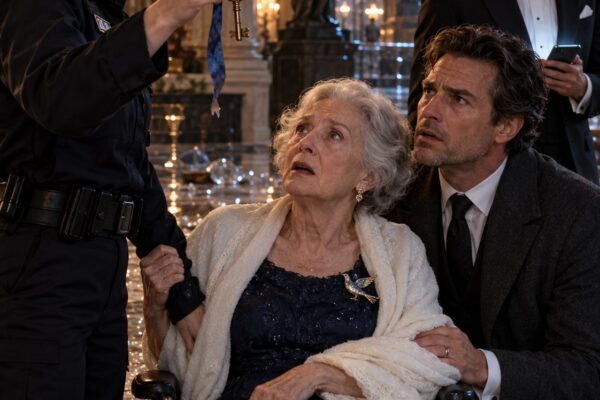
A Street Cleaner Dropped Her Gloves at the Mayor’s Funeral—Then His Son Saw the Name Inside
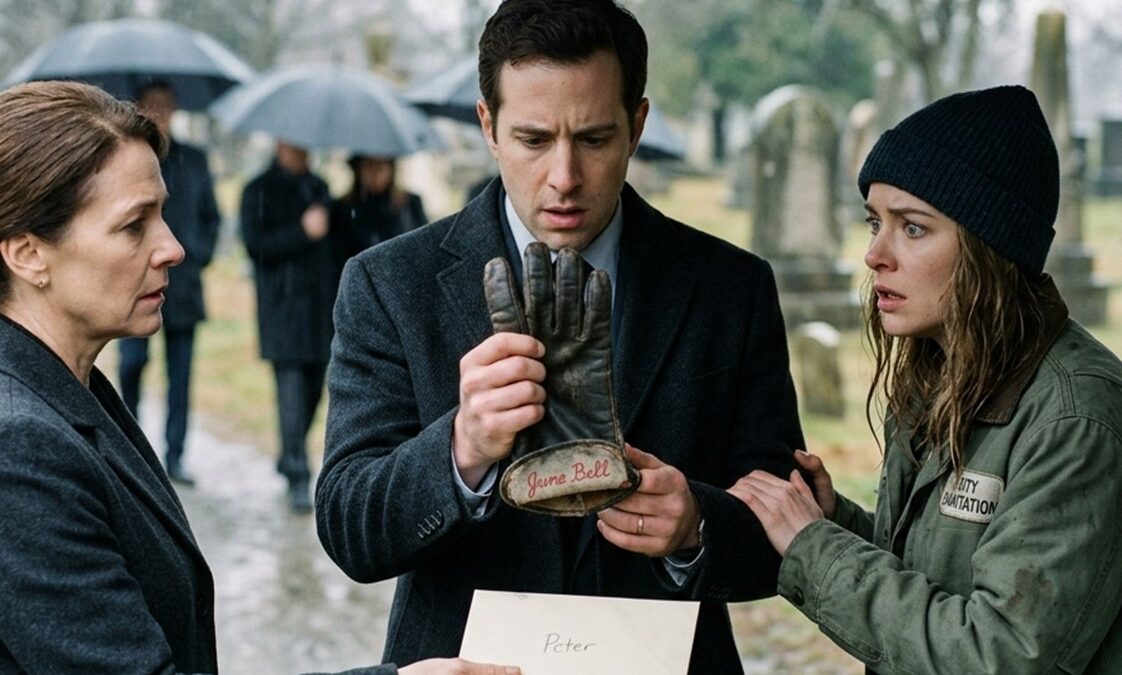
Chapter 2: What the Cuff Kept
The woman moved first.
She took Nora’s wrist, firm enough to stop her.
“Don’t open it here.”
Rain ticked against the umbrellas.
Mayor Halpern’s coffin waited beneath the church awning.
His son, Peter, held one of Nora’s gloves.
The name inside the cuff faced him.
June Bell.
“Who are you?” Nora asked.
“Evelyn Shaw.”
“Why do you have my mother’s letter?”
“I don’t. Your father’s lawyer gave it to me.”
Nora looked down.
Her mother’s handwriting crossed the envelope.
For Peter Halpern.
Deliver only if I cannot.
Peter’s face had gone pale.
“Did my father write that?”
“No,” Evelyn said. “June did.”
“My mother died when I was nineteen.”
“I know.”
“Then why is this arriving now?”
“She asked that it wait until Halpern was dead.”
The church doors opened behind them.
People stepped out, speaking softly.
A photographer lowered his camera.
The mayor’s widow, Marjorie, watched from the top step.
Peter turned to Nora.
“Can we go somewhere private?”
“No.”
“Please.”
“She wanted this delivered.”
“I want to read it.”
“So do I.”
Evelyn looked at the letter.
“Then read it where someone can witness it.”
A city clerk named Tomas stood near the flower stand. Nora knew him from the sanitation depot; he sometimes brought coffee to the overnight crew.
“Will you witness us opening it?” she asked.
Tomas blinked.
“Here?”
“Here.”
Peter nodded toward his phone.
“Record it.”
Marjorie came down the steps.
“Peter, your father’s service is still happening.”
“It’s over.”
“People are waiting.”
“They can wait.”
She looked at the glove.
“What is that?”
“My father’s past.”
Nora opened the envelope.
A folded sheet came out, followed by a brass key stamped 614.
“Peter,” she read, “if you are reading this, I ran out of time.”
She recognized the handwriting from old grocery lists.
“Your father did not fire me for stealing city funds,” she continued. “He fired me because I found the duplicate books.”
“What books?” Peter asked.
“I don’t know.”
“Your mother did,” Evelyn said. “She told me she kept copies.”
“Where?”
Evelyn pointed to the key.
Nora read on.
“Locker 614 at the old municipal annex contains the original ledger and a tape recorded the night I confronted your father.”
“A tape?” Peter said.
“Keep reading.”
The final line stopped Nora.
“If Peter is still the kind of man who asks before he takes, let him come with you.”
Peter held out his hand.
Nora kept the letter.
“I’m coming,” he said.
“You don’t decide that.”
“No.”
“Good.”
“But I’m coming.”
She folded the letter.
“Then you can follow.”
Marjorie stepped between them.
“This is a family matter.”
“It became a city matter when he used city money,” Peter said.
“You don’t even know what she’s talking about.”
“Then we’ll find out.”
“Your father’s reputation—”
“Isn’t the same thing as the truth.”
Nora put the key in her pocket.
Evelyn watched her.
“Do you trust him?”
“No.”
“Good,” Evelyn said. “Neither did your mother.”
They left the church together.
* * *
The municipal annex had been closed for six years.
It stood behind the old courthouse, its service entrance chained shut.
Peter called the records number posted beside it.
“I need to open a city locker,” he said.
“Which department?”
“Public works.”
“Do you have an authorization number?”
“No.”
“Then you need to file a request.”
“We have evidence that may concern Mayor Halpern.”
The supervisor paused.
“That building is closed.”
“It’s still city property.”
“It’s also secured.”
Nora took the phone.
“My name is Nora Bell. The key belonged to my mother, June Bell. She worked in the city accounts office.”
“Can you send a photograph of the key and letter?”
“Not until we know they won’t disappear.”
“You can’t enter without permission.”
“Then meet us there.”
The supervisor sighed.
“I’ll call security.”
“Thank you.”
Nora hung up.
“You sound like your mother,” Peter said.
“You never met her.”
“I heard her once.”
“When?”
“Outside my father’s office. I was sixteen. She was shouting. He told me to go upstairs.”
“And you went?”
“Yes.”
“Why?”
“I was a coward.”
The city guard arrived twenty minutes later.
She checked their IDs and photographed the key. The records department did not answer, so she called the building manager.
He arrived with a ring of keys and a tense expression.
“The annex is scheduled for an asbestos inspection,” he said. “The basement is off limits.”
“The locker is on the old basement map,” Nora said.
He studied the key.
“It’s an old locker key.”
“Will it open 614?”
“I don’t know.”
“Can we find out?”
“Not without written clearance.”
“Then put in the request,” Peter said.
“It can take a week.”
“Send it to me.”
“Your title doesn’t make me faster.”
“Good,” Nora said. “Tell us what the process is.”
They filled out the access form on the hood of the guard’s car.
Nora signed as June’s next of kin.
Peter signed as a witness.
The guard documented the key and letter.
The manager sent the request from his phone.
While they waited beneath a dripping gutter, Peter reached toward the letter.
Nora tucked it away.
“Not yet.”
“I wasn’t taking it.”
“You were reaching for it.”
“I wanted to see the handwriting.”
“You can ask.”
He looked at her.
“May I?”
“Not yet.”
He let his hand fall.
The guard’s phone chimed.
“Your request is approved for supervised access.”
The manager frowned.
“Who approved it?”
“The acting records director.”
“That’s not my supervisor.”
“Apparently they’re covering.”
The guard unlocked the service entrance.
The basement smelled of damp concrete and old paper.
Rows of gray lockers filled the far wall. Their numbers had been painted over, but an old metal tag marked 614.
The key fit.
Peter stood behind Nora.
“Do you want me to turn it?”
“No.”
She turned it.
The lock clicked.
Inside sat a small ledger, a microcassette, and a brown folder.
No dust lay across them.
Nora pulled on gloves and opened the folder.
Payment authorizations listed dates, amounts, and a city contractor: Northline Civic Services.
The company had received millions through a road-repair program.
Several forms carried June’s name.
The initials were wrong.
“Can you tell?” Peter asked.
“I’ve seen her sign her name my whole life.”
“Would that hold up?”
“Not by itself.”
“Then what do we have?”
“The copies. The tape. The ledger.”
The manager leaned toward them.
“Don’t touch anything else.”
Nora put the folder down.
The guard photographed the locker and called the records director. The director instructed her to seal the objects and transfer them to the city inspector general.
Evelyn had arrived while they were downstairs. She waited aboveground with a city lawyer on speakerphone.
The lawyer explained that the inspector general would log each object and issue a receipt. The state auditor could be notified if the documents suggested fraud.
No one promised charges.
No one promised a quick answer.
Nora signed the transfer receipt and watched the folder, ledger, and cassette leave the locker.
* * *
Investigator Leah Ortiz met them at the inspector general’s office.
She asked where each object had been found, who had touched it, and when they had learned it existed.
She asked if anyone had offered them money or threatened them.
“No,” Nora said.
“Has anyone contacted you since the funeral?”
“Not yet.”
Leah scanned the ledger while a technician examined the cassette.
The forms had a faint watermark. Their dates clustered between March and June, fourteen years earlier.
Nora had been seventeen.
Her mother had worked nights at the city office.
“She kept receipts for everything,” Nora said. “She taught me to count change twice.”
“Did she mention Northline?” Leah asked.
“No.”
“City money?”
“She said the city could lose a dollar faster than anyone could find it.”
Leah laid three forms on the table.
“Can you identify her handwriting?”
“Some of it.”
Nora bent close.
The copied signature had the wrong slant. Her mother joined the letters in “Bell” with a small loop. The forms did not.
“She wrote zeros with a slash through them,” Nora said.
The figures on the forms had plain zeros.
“That gives our examiner features to compare,” Leah said.
Nora carried her mother’s old recipe card in her wallet. Leah photographed it as a known writing sample, noting its condition.
“It can help,” she said. “It won’t prove anything by itself.”
The technician came in.
“The cassette is playable, but the tape is brittle. I can make a digital preservation copy without altering the original.”
He placed it in a deck.
A low hiss filled the room.
Nora knew her mother’s voice before the first sentence ended.
“You told me those invoices were real.”
A man answered.
“I told you to stop looking.”
“You signed the release.”
“I signed what the department brought me.”
“You signed the checks.”
“I signed nothing.”
The man was Mayor Halpern.
Peter pressed his fingers to the table.
“You copied my initials,” June said.
“I gave you a job.”
“You gave me a paycheck.”
“I gave you a chance.”
“You gave yourself a cover.”
A chair scraped.
“If you report this, they’ll say you did it,” Halpern said.
“Then I’ll show them the originals.”
“You don’t have originals.”
“I have the ledger.”
The technician paused to check the tape.
Leah asked him to continue at a lower volume.
“Northline did no work on those streets,” June said.
“We had an emergency.”
“You billed repairs twice.”
“The city needed the contract.”
“You sent money to a company your brother owns.”
“That’s not your concern.”
“It is when you forged my name.”
Halpern’s voice sharpened.
“You have no idea how this city works.”
“Then explain it to a grand jury.”
The recording stopped.
No one moved.
Leah marked the time code and directed the technician to preserve the whole tape.
Nora looked at Peter.
“Was Northline your uncle’s company?”
“My father had no brother.”
“Then whose company?”
“I don’t know.”
“Your family knew the contracts.”
“I knew nothing about them.”
“Were you on the city’s youth advisory board?”
“Yes.”
“Did the contract pay for your campaign?”
“I wasn’t running for office.”
“What did it pay for?”
Peter rubbed his thumb against his palm.
“My father’s foundation.”
“Which foundation?” Leah asked.
“Halpern Civic Trust.”
“Did it receive money from Northline?”
“I don’t know.”
“You can find out,” Leah said. “Don’t alter records or access private systems without permission. Give us the public filings and board minutes you have.”
Peter nodded.
Leah asked Nora if June had ever mentioned the tape or why she left.
“She said she’d made a mistake.”
“What mistake?”
“I thought she meant trusting the mayor.”
“Could she have meant something else?”
“Maybe.”
Leah let the question rest.
Two days later, the handwriting examiner reported that the signatures were inconsistent with June’s known writing. The finding was preliminary; a formal comparison would take longer.
The auditor found that the city had paid Northline just under three million dollars across six invoices. Some money had gone to a second company that shared a mailing address with the Halpern Civic Trust.
Peter asked the investigator to suspend the trust’s current scholarships.
“Don’t affect students before we understand the records,” Leah said.
“I don’t want them caught in this.”
“Then ask the board to authorize an independent review.”
“They’ll ask what I know.”
“Tell them the truth.”
Peter gave Leah his tuition records. Two payments from the trust had covered his education. He had assumed the money came from donations.
Nora watched him read the dates.
“You’re saying I benefited.”
“I’m saying the records show you did.”
“I didn’t know.”
“You still got the education.”
He lowered the page.
“I did.”
“Does that change what you owe?”
“No.”
“What do you owe?”
“The students a clear record. The city an honest account. You an apology.”
“I don’t need the last one.”
“You deserve it.”
“Maybe.”
He did not press her.
A week later, Nora went with Leah to the city archive.
The employment file confirmed June had been an accounts clerk. It also contained two conflicting notices: one said she had been fired for theft; another said she had resigned for family reasons.
The dates were three weeks apart.
The signature on the resignation letter looked wrong.
A pressure mark beneath it suggested another page might have been placed over the original, though it could not prove anything.
An unsigned note had been filed with the papers.
“Hold review pending contact with H.”
“Who does H mean?” Nora asked.
“Could be anyone,” Leah said.
The note’s narrow capital H looked like June’s writing, but the sample was too short to identify its author.
It did show someone had intervened in the ordinary review process.
At the end of the week, Evelyn called Nora and asked to meet at a diner near the river.
Nora went alone.
Evelyn had been Halpern’s private secretary for twenty-eight years. She brought a cardboard box of old calendars and appointment slips she had kept for pension records.
One calendar showed Halpern meeting Gordon Saye two days before the first Northline invoice.
“Who was Saye?” Nora asked.
“His campaign treasurer.”
“Was he connected to Northline?”
“I don’t know.”
A second entry showed June had scheduled a meeting with Halpern after work. Beside the canceled appointment, Evelyn had written, “J. says she brought copies.”
“Why keep this?” Nora asked.
“I didn’t know what it meant.”
“You worked for him.”
“I worked for the office.”
“You knew she was fired.”
“Yes.”
“You watched her disappear from the records.”
Evelyn lowered her eyes.
“My husband was ill. I needed the health insurance. I told myself I couldn’t risk my job.”
“So you let my mother carry it alone.”
“Yes.”
“Why help now?”
“Because Halpern is dead.”
“That’s convenient.”
“It’s late.”
“That’s different.”
Evelyn nodded.
“Yes.”
She gave the calendars to Leah and signed a statement about the envelope. Six months before the funeral, Halpern’s lawyer had asked Evelyn to ensure Peter received June’s letter only after the mayor’s death.
“Did you ask why?” Nora said.
“I did.”
“What did he say?”
“He was honoring a promise.”
Evelyn had not known which promise.
Now she did.
Two days later, the state auditor confirmed the city’s payment records had been altered. The ledger showed six payments; the official database listed four. Two invoices had been reclassified as emergency repairs. The change had been approved by the mayor’s office.
The auditor could not yet identify who made it.
June had access to the system.
So did Halpern and his deputy comptroller, Gordon Saye.
Then Leah received an anonymous tip. A maintenance worker claimed to have seen a black sedan outside Nora’s building after midnight, with someone taking pictures of her door.
Nora lived above a laundromat on East Thirty-Ninth. Three tenants shared the front steps. No camera faced the sidewalk.
Leah asked Nora to save any messages and not confront or follow anyone.
“That’s your advice?” Nora asked.
“It is.”
“Someone may be watching me.”
“We don’t know that. We’re documenting it.”
Peter offered to have security watch Nora’s building.
She said no.
“Then let me pay for a camera.”
“No.”
“Why?”
“I don’t want you buying your way into my life.”
“I’m not trying to.”
“That’s what money looks like from your side.”
“I can ask the tenants.”
“Ask the tenants, then.”
He did. The landlord agreed to install a camera as part of the building’s maintenance. Nora told him the angle was poor; Peter arranged for it to be adjusted.
A city investigator later reviewed the footage.
The black sedan belonged to a consulting firm hired by the Halpern Civic Trust. It had parked across the street during a street survey, not outside Nora’s door.
The tip was wrong.
Still, Nora began checking car windows on her walk home.
She hated that.
* * *
Peter’s cousin Colin asked him to meet at the trust’s office.
Peter brought Leah.
Colin had managed the foundation’s accounts for ten years. He wore a blue suit and spoke with the calm of someone used to owning the room.
“Your father’s dead,” Colin said.
“The investigation isn’t.”
“Everyone understands what the documents look like.”
“They show payments to Northline.”
“They show legal payments.”
“Then show the work orders.”
“We’re gathering them.”
“From which records?”
Colin glanced at Leah.
“Are you here in an official capacity?”
“Yes.”
“Then I’ll speak to counsel.”
The trust’s attorney joined by video. Leah asked the board to preserve its records and provide minutes and disbursement records tied to the six invoices. She did not demand access to private accounts.
The lawyer said the board would review the request.
Peter kept his eyes on Colin.
“You knew about the transfers.”
“I knew about grants.”
“Did you know where the money came from?”
“I knew the trust received donations.”
“From Northline?”
“I’d have to check.”
“Check now.”
“Not without counsel.”
The meeting ended without records.
Outside, Peter said, “He’s hiding something.”
“Possibly,” Leah replied.
“Can’t we compel the records?”
“Not yet. We’re preparing the application.”
“That takes time.”
“It does.”
Nora had stayed by the elevator.
“Your father’s money still helped you,” she said.
“Yes.”
“Your cousin may have known.”
“Yes.”
“You want to clear your name.”
“I want the records.”
“Good.”
“What do you want?”
“I want my mother’s name back.”
“Then we’re after the same thing.”
“No. You’re after the version that lets you sleep.”
Peter accepted that.
“You might be right.”
“I usually am.”
“That sounds like June.”
“You didn’t know her.”
“I know one sentence she said.”
“Your father called her a thief.”
“He did.”
“Did you believe him?”
“I was sixteen.”
“That isn’t an answer.”
“I believed whatever let me go upstairs.”
“That’s an answer.”
Three days later, the handwriting examiner’s first report confirmed June had not written the signatures on the invoices. The report could not identify who had copied them, but it ruled out the accusation that she signed the approvals.
The state auditor found another clue in the Northline contract: an addendum listing a delivery address at 28 Bexley Street, demolished twelve years earlier. The mailing address was tied to Clearway Consulting, a dissolved company whose registered agent had been Gordon Saye.
Nora found a pencil note in the ledger beside the address:
“Same gate. Ask Peter.”
Leah showed it to Peter.
“My father took me to a storage building on Bexley Street,” he said. “He said the family foundation kept old files there.”
“Was there a gate?” Nora asked.
“A green steel gate.”
“How long ago?”
“About fifteen years.”
“You were a child?”
“I was twenty.”
“You weren’t a child.”
“I didn’t ask questions.”
“Of course.”
Peter looked at the note.
“Could the records still be there?”
“Maybe,” Leah said. “We can’t go without authority.”
The building belonged to a holding company and was listed for demolition. The owner refused the auditor’s request for access.
The office obtained a preservation order from a judge after showing the site might contain records tied to public money.
Two days later, a court-appointed receiver and a records technician went to the property. Nora waited outside while the team entered through the loose green gate.
The storage room was nearly empty.
A locked filing cabinet stood against one wall.
A locksmith opened it under the receiver’s direction.
Inside were boxes of invoices, a company stamp, and bank statements.
The statements showed Northline transferring money to Clearway, then Clearway sending money to the Halpern Civic Trust. The trust’s books called the transfers “restricted educational gifts.”
The bank records established the route.
The invoice dates matched the city’s payments.
In one box, Nora found a note in the margin.
“J.B. took clean copy.”
“Your mother was here,” Peter said.
“She made copies without the altered figures.”
“Could she have taken them home?”
“She hid the locker key.”
“That doesn’t mean she took anything else.”
One box was labeled “Northline, final.”
Another said “Personal,” but it was empty.
The technician found two partial carbon impressions beneath a divider. They showed a list of payments but no signatures.
Leah photographed the shelves and logged every item.
The property owner cooperated after the order.
No one was arrested.
The auditor sent a referral to the state attorney general. The trust’s board froze new grants pending an independent review. Colin resigned as treasurer.
The next day, he called Nora from an unknown number.
“You’ve done enough,” he said.
“Who is this?”
“You know.”
“No.”
“Colin Saye.”
“Why are you calling me?”
“You’ve made your point.”
“I haven’t made a point.”
“You’ve damaged a good man’s legacy.”
“Your cousin’s legacy?”
“My uncle’s.”
“He’s dead.”
“So are you, if you keep digging.”
Nora’s hand tightened around her phone.
Colin continued.
“People make mistakes when they’re angry.”
“Is that a threat?”
“It’s advice.”
“Give it to someone who asked.”
She ended the call and forwarded the recording to Leah.
Peter wanted to call Colin.
Leah told him not to.
“The threat is vague,” she said. “We document it and review the context.”
“Vague doesn’t mean harmless,” Peter said.
“No. It means we proceed carefully.”
Colin’s lawyer called the next morning and claimed the statement had been a warning about public exposure. Leah asked that all contact stop. The lawyer agreed.
Colin did not call again.
The independent auditor’s report arrived two months later.
Northline and Clearway had moved $1.18 million to the trust. Part of it funded legitimate scholarships. The rest paid consultant fees and undocumented expenses.
The auditor found no evidence Peter directed the transfers. It did confirm he had benefited from tuition paid by the trust.
He had never served on the finance committee.
Colin had.
The state attorney general announced a civil investigation, and the city filed a claim to recover the money.
The city also administratively cleared June’s old criminal charge.
The notice arrived by mail. It said the allegation had been withdrawn for lack of evidence.
It did not say the city was sorry.
Nora held the paper for a long time.
She had expected more.
A voice.
A public correction.
Her mother’s name spoken without hesitation.
The notice gave her a case number and a signature.
Her mother’s record was clean.
That was not the same as justice.
* * *
The public hearing took place in the council chamber.
Residents filled the seats, and reporters stood along the side wall.
The hearing concerned the city records and June’s employment file. The attorney general had not filed charges; the city’s claim against the trust remained open.
Nora sat at the front beside Peter.
Evelyn sat behind them.
The mayor’s widow sat across the aisle.
Colin stood with his lawyer.
The city auditor presented the ledger, payment records, bank statements, handwriting report, trust payments, and missing expense documentation.
He called the transfers unexplained payments.
The word was accurate.
It was frustrating.
Colin spoke next.
“My uncle created programs that helped hundreds of students.”
“That is true,” the auditor said.
“His foundation spent millions in this city.”
“Some expenditures were legitimate.”
“Then why are we here?”
“Because some were not documented.”
“Records can be lost.”
“Yes.”
“People can forget.”
“Yes.”
“An employee can take documents.”
“Yes.”
Colin sounded patient and reasonable. He blamed an old accounting system, noted that emergency classifications had been common, and said a dead man could not answer accusations.
Then he looked at Nora.
“Ms. Bell’s grief is understandable,” he said. “But grief is not proof.”
The room turned toward her.
“The documents show June had access to the records,” he continued.
“They also show her signature was copied,” the auditor said.
“But the examiner couldn’t identify who copied it.”
“That’s correct.”
“So no one knows.”
“We know June did not sign it.”
“We know the examiner can’t say who did.”
“That is also correct.”
Colin turned to the council.
“Then why is my family being accused?”
No one had accused his family.
He had framed the question himself.
The chair invited Nora to speak.
She stood with the notes she had written on the bus.
She did not read them.
“My mother worked nights. She kept every grocery receipt. She marked her zeros with a slash. She knew where every dollar went.”
The room stayed still.
“When the city accused her of stealing, nobody asked her to show her work. Her file was closed. Her job disappeared. The records stayed.”
She faced the council.
“The city has cleared her name. She wasn’t here to hear it.”
Then she looked toward Colin.
“You said grief is not proof. You’re right. I didn’t come here with grief as proof.”
She named the evidence: the ledger, city records, bank statements, examiner’s report, her mother’s handwriting, and the tape where Halpern told June to stop looking.
Nora lifted the old glove, preserved in a clear sleeve. The brass key had been recovered from the evidence bag. The examiner had confirmed it opened locker 614.
She set the glove beside the key.
“When she was fired, my mother gave me these gloves. She said they were good for cold mornings. She never told me why she kept the locker key in the cuff.”
Peter stood.
“I’m Peter Halpern. I received a scholarship from the family trust. I didn’t know the source of the funds. I benefited anyway.”
He faced Nora.
“I’m sorry I didn’t ask.”
Then he turned to the room.
“I’m returning the remaining value of my tuition benefit. I’m not asking that to settle anything. The independent audit found no evidence I knew about the transfers. I’m saying what I know.”
He placed a signed statement on the clerk’s table.
Evelyn rose next, holding the box of calendars.
“I worked in the mayor’s office. I knew June was accused. I knew she had brought records. I kept quiet because I was afraid of losing my job and health insurance.”
She looked at Nora.
“I was wrong. I’m sorry.”
Nora nodded once.
She did not say it was fine.
The auditor introduced the carbon impression from the filing cabinet. The routing code belonged to Gordon Saye, Colin’s father and the trust’s former finance officer.
Gordon lived in another state and had been interviewed by the attorney general, but he had not been charged.
Colin’s lawyer argued that a routing code was not a signature.
The auditor agreed.
“It supports a pattern,” he said. “It does not establish who approved each transfer.”
The city clerk played the preserved tape.
Halpern’s voice filled the chamber.
“You have no idea how this city works.”
June answered:
“Then explain it to a grand jury.”
The tape ended.
The council voted to remove the theft notation from June’s personnel file and ordered the city to publish a correction. It referred the trust’s financial records to the attorney general and state auditor, making no finding about criminal liability.
That decision belonged to the courts.
Colin left before reporters could reach him.
“She would have been nothing without this family,” he said as he walked away.
Nora turned toward him.
“My mother was a person before she met your uncle.”
He kept walking.
Three months later, the attorney general filed a civil case against Colin and the trust’s former finance office. The complaint alleged that they had diverted public money through shell companies; it did not accuse Peter of participating.
Gordon Saye agreed to cooperate. He confirmed he had created Clearway at Halpern’s direction, saying he thought the transfers were campaign expenses.
The bank records showed where the money went.
The case settled before trial.
The trust agreed to repay $1.18 million with interest. Colin paid a separate fine for failing to maintain records. He did not admit criminal intent.
The attorney general did not pursue criminal charges after the available evidence failed to show that Colin personally directed the transfers.
The city reopened its review of June’s firing and issued a formal apology.
It arrived in a gray envelope.
The first paragraph used bureaucratic language.
The last said:
“The city wrongly accused June Bell and failed to correct the record during her lifetime.”
Nora read it twice, then placed it beside the notice clearing her mother’s name.
The papers did not repair the years.
They put the truth in writing.
* * *
Nora returned to work the next morning.
The sanitation truck arrived at 4:20.
Her supervisor handed her the route list.
“Do you want the easier blocks?”
“No.”
“You’ve had a lot going on.”
“I still know how to push a broom.”
He smiled.
“Good. The city forgot how to push a budget.”
She laughed despite herself.
The team cleared leaves from storm drains and swept broken glass from a bus stop. A bakery worker gave them day-old rolls. Nora split one with her partner.
The work felt solid.
She kept the old gloves in her locker and wore new ones.
Two weeks later, Peter visited the department office with a check for the value of his scholarship.
Nora refused to take it.
“Give it to the city fund recovering the money.”
“It’s already there.”
“Then give it to a scholarship outside your family trust.”
“I have.”
“Good.”
“I wanted you to know.”
“I know.”
He left a folder on the table. It held the independent audit, naming every verified payment and listing the expenses that remained undocumented.
Peter had asked the board to publish the full report. They had agreed.
“Do you want a copy?” he asked.
“I’ve read it.”
“Do you want another?”
“No.”
“Okay.”
He did not ask her to forgive him or meet again.
A month later, Nora found him at the public library, reading the city’s revised scholarship rules. An independent committee would now administer the program.
“Checking your homework?” she asked.
“Trying to see how to help without controlling it.”
“That’s a hard trick.”
“I know.”
The librarian brought folders. Peter made room, and Nora stayed.
He gave the committee a written statement about the source of his tuition and agreed it could be included with the public records.
“You don’t have to do this,” she said.
“I know.”
“People will bring it up.”
“They should.”
“Your father’s name will come with it.”
“It already does.”
That was the first answer he gave her that sounded complete.
Nora respected it.
She did not trust him yet.
Trust was not a switch.
It was a route, taken one morning at a time.
The city offered her a position on the records review board. It came with a modest stipend.
She declined.
She needed her work hours and did not want her mother’s story to become a second job.
She agreed to consult on the city’s new records procedure. She asked for a clear chain of custody, a public log when records were corrected, and a written appeal process for employees accused of misconduct.
The board accepted the changes.
Nora kept working the early route.
Evelyn sent a letter admitting what she had done. She said she could not ask for forgiveness, then asked whether Nora would allow her to visit June’s grave.
Nora waited three days before answering.
“You can visit,” she wrote.
“You can’t call me family.”
Evelyn accepted the boundary and visited alone.
At Christmas, she mailed Nora a tin of tea.
Nora drank it.
She did not send a thank-you card.
That was how their relationship began.
Peter sent an email every few months, never with a demand. Sometimes it included a public record; sometimes it was a note about the scholarship program.
Nora replied when there was a reason.
Then she began replying because she wanted to.
One afternoon, Peter asked if she would walk the old memorial route with him.
She agreed.
They met at the church steps where the funeral had ended.
A plaque still honored Mayor Halpern and listed his civic accomplishments. Beside it, the city had added a small statement:
“Public memorials do not replace public records.”
Peter read it.
“Do you think that’s fair?”
“It’s a sentence on a wall.”
“That isn’t what I asked.”
“I think it’s accurate.”
“Would you want it removed?”
“No.”
“Why?”
“People should know what he did.”
“People should know what he did well, too.”
“They can know both.”
They stood beneath the awning.
The rain had stopped.
Peter pointed to the place where the coffin had waited.
“I thought my father was only one thing.”
“He probably thought he was, too.”
“Would you forgive him?”
“He’s dead.”
“That isn’t an answer.”
“It’s the only answer he gets.”
Peter took that in.
Nora let the ordinary pause remain.
* * *
Four years later, the old municipal annex reopened as a public records center.
The basement lockers were gone. Glass cases showed the history of the city departments.
Nora attended because her sanitation team had cleared the block.
She wore her uniform.
Peter arrived with his daughter, Ruth, who was seven and carried a paper pinwheel.
The city clerk invited Nora to speak.
She had prepared nothing.
She spoke about records, dates, and names. She said a correction mattered even when it came late, and people should not have to spend years proving they were wronged.
Then she stepped away from the microphone.
Ruth tugged Peter’s sleeve.
“Is that your friend?”
“She is.”
“Did she know Grandpa?”
“Yes.”
“Was he nice?”
Peter looked at Nora.
“He could be.”
“Was he bad?”
“Sometimes.”
“Can people be both?”
“Yes.”
Ruth turned to Nora.
“Can a glove keep a key?”
“If the cuff is sewn right.”
“I could sew a pocket.”
“You could.”
Ruth’s pinwheel spun in the breeze.
Behind glass, the brass key rested beside a copy of the ledger.
The glove was there too. Nora had donated it after the city published its apology.
The label read:
“Property of June Bell, city accounts clerk. Preserved evidence in a public fraud inquiry.”
It did not mention the mayor.
The records beside it supplied the rest.
Peter read the card.
“You were right about the cuff.”
“My mother knew how to sew.”
“She knew how to keep a record.”
“She did.”
Ruth pressed her face near the glass.
“Why is the glove so small?”
“It belonged to a woman,” Peter said.
“Was she cold?”
“Sometimes.”
“Did she lose it?”
“No. She kept it.”
Ruth smiled.
“Then it’s a lucky glove.”
Nora looked at the stitched cuff.
The key no longer fit any lock.
It had opened a cabinet, a hearing, and a file that should never have been closed.
For years, it had waited in the fold of a glove.
The city had corrected June’s name.
Nora’s work still began before sunrise.
The streets still needed sweeping.
The scholarship fund still gave students a chance.
Peter still brought Ruth to the library.
Evelyn still kept her distance when asked.
The plaque remained.
The corrected record stood beside it.
Ruth spun her pinwheel.
Peter held the door.
Nora walked out beneath the old annex sign.
The wind caught the pinwheel.
It turned bright and fast.
THE END