Framed for Sabotage, a Young Engineer Rides Her Experimental Motorcycle Into a Lake to Save the Evidence That Could Clear Her
Chapter 1: The Shoreline
Mara Ellison looked back at the police lights while accelerating along the road beside Bellwether Lake, and when she faced forward again, another marked cruiser was coming toward her with its lights flashing, slowing across the narrow pavement as the vehicles behind her closed the gap.
Her black leather jacket snapped against the light shirt beneath it, her helmet visor showed a strip of gray water beyond the guardrail, and the motorcycle under her was Morrow, the experimental amphibious prototype whose water controls she had spent three years helping her team make safe.
The approaching cruiser stopped short of the opening to an empty maintenance turnout, leaving Mara enough room to brake if she trusted the arrest waiting behind her, but the warning on Morrow’s display still showed a company command seeking custody of the sealed recorder before any independent examiner could see it.
She eased off the throttle and looked toward the shore, where the grass fell from the pavement to an old test bank the team had used during supervised trials, its familiar slope visible through the morning haze.
A hard bump at the pavement edge jarred her injured shoulder, then Morrow crossed the wet grass with its road tires slipping under her as she held the bike straight and passed the last patch of solid ground.
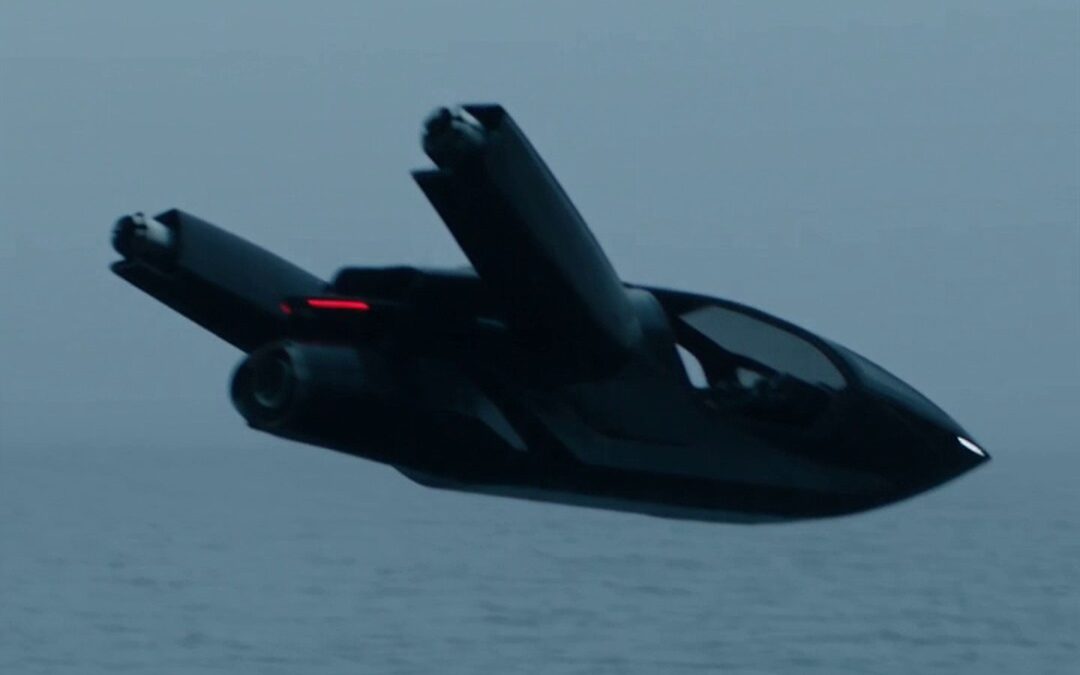
For a moment the black motorcycle hung above open water, its wheels turning uselessly beneath it, and then the road housings drew inward, two sealed side structures swung out around the reinforced center frame, and the narrow body widened as its water controls unfolded beneath Mara’s knees.
The transformation warning turned amber before the hull struck the lake, and the impact drove her chest against the padding, cracked a fairing near the bow, and sent cold spray across her visor as the water drive caught and pulled the damaged craft forward.
Behind her, the cruisers stopped along the shore, their red and blue lights trembling across the wake while Morrow’s display locked out road mode and cut its water range estimate to nine minutes.
Then a second warning replaced the range figure: CAMPUS ARCHIVE PURGE ACTIVE—MORROW LOCAL RECORD NEXT.
Chapter 2: What the Recorder Saw
Mara stared at the purge warning while Morrow skimmed through the water, and the words stayed on the display even after she blinked lake spray from her eyes and pressed the acknowledgment pad with a shaking glove.
The campus archive was a company system, but the local recorder was inside the sealed spine beneath her, and she knew the difference because she had fought to give that recorder its own power reserve and a record of every command sent to the machine.
A command could request custody or deletion, yet the recorder would log the request before carrying out any permitted change, and the request now on her display had come through the service channel reserved for a test supervisor at Breakwater Mobility.
Mara had no reason to believe the next command would obey the limits she had designed, because someone had already made the campus system report that she had sabotaged a trial and injured a technician she had worked beside for years.
The bow dipped as water entered the cracked fairing, and she shifted her weight against a sharp pain in her left shoulder while the craft corrected with a delay that told her one of its water surfaces had taken the landing badly.
The lake was open ahead, but a fishing boat lay off to her right, close enough that its occupants had turned to watch the police lights onshore, and Mara reduced speed until her wake flattened before she crossed well behind it.
The range estimate fell to seven minutes, then steadied when she let the drive cool, and she aimed for the low municipal service pier visible through the mist rather than the farther company test dock.
She knew that pier from flood-response demonstrations with the town of Alder Reach, where the city kept a locked equipment room and a narrow platform for taking water samples, and she knew the approach was clear because the town had marked its shallow intake area with permanent buoys.
Morrow had been built for rescue crews reaching flooded roads, though it had never carried a rescuer or earned approval for public service, and the sight of its damaged bow pushing toward the pier made her think of every person who might someday be asked to trust it.
Her helmet speaker crackled with an incoming company call, and Adrian Kessler’s measured voice said, “Mara, stop the prototype and let the police secure the recorder before you lose more data.”
Kessler was Breakwater’s chief operating officer, the person who had announced each funding round and stood beside Morrow for cameras, and his calm sounded exactly like the voice he used when a test failed in front of investors.
She did not answer, because the line ran through Breakwater’s system and she wanted no fresh company record of where she intended to land.
The display showed one more command request, this one asking Morrow to begin a diagnostic cycle that would write over the oldest temporary entries, and Mara canceled it locally while the system logged her refusal.
She could not tell whether the request was malicious from the wording alone, since a damaged craft genuinely needed diagnostics, but the oldest entries covered the hour before the failed trial and the hour before the police pursuit.
Her phone had a signal inside her jacket, yet photographs of a screen would show only what she claimed the screen had shown, and the signed recorder could be examined only through its sealed port after the machine was powered down under conditions that preserved its key.
She had tried to send a summary before leaving campus, and Breakwater’s network had accepted the upload without producing an outside receipt, leaving her with no proof that anyone beyond the company had received it.
Mara killed the company call, kept the recorder awake, and watched the pier grow larger while the water range estimate shrank again.
Onshore, Officer Lena Ortiz had stopped her cruiser before the grass and stood beside it with her body camera running, watching the black shape move away across Bellwether Lake as two other officers checked the empty road for bystanders.
She had believed the dispatch packet when it described Mara as an armed saboteur fleeing with hazardous company equipment, although she had seen no weapon and the motorcycle had crossed the shore only after another cruiser closed the road ahead.
Ortiz told the officers behind her to hold at the bank and requested the original incident report, because the first packet on her cruiser screen had called the vehicle a stolen road prototype while the update now called it an unstable watercraft carrying evidence of a crime.
The dispatcher read the updated allegations aloud: a test platform had failed at Breakwater’s campus that morning, technician Jo Alvarez had been seriously injured, and company security had identified Mara as the engineer who changed the approved test condition.
Ortiz wrote down the time of the injury as 7:12 a.m., then noticed the earlier packet in her cruiser’s local queue carried a creation time of 7:06.
A prepared warning could precede a crime for innocent reasons, especially if there had been a developing emergency, so she requested the original packet and the name of whoever had supplied it rather than announcing a conclusion over an open channel.
The response came from a supervisor who said Breakwater had reported threatening conduct before the accident and wanted its equipment protected, and Ortiz recorded the explanation while watching a tow truck arrive for the unused turnout ahead.
The driver of that truck had no apparent connection to Breakwater, but its arrival meant more people were being drawn toward a pursuit that had already crossed a public road and a lake, and Ortiz ordered the road kept clear.
Across the water, Mara reached the municipal pier at little more than walking speed, caught a post with her right arm, and nearly fell when her left shoulder refused the weight of the craft.
She tied off the bow with a line kept aboard for test retrieval, switched the water drive to idle, and read the fault list: one flooded fairing pocket, reduced steering authority, a depleted transformation reserve, and road mode locked pending inspection.
The sealed spine still reported intact, though the impact sensor had recorded a force above the limit that allowed another automatic transition, and Mara understood that Morrow would have to leave the pier on a lift or a trailer.
The service room door opened behind her, and Theo Park stepped out in a city rain jacket with a key ring in one hand and disbelief on his face.
Theo had helped write Morrow’s control software and had once called Mara every time a test result looked wrong, even at midnight, but the company had assigned him to the city demonstration that morning and she had sent him one message before the chase.
“You said the recorder mattered more than the bike,” he said, keeping his hands where she could see them.
“It does,” Mara said, “and I need the room’s independent power and a witness before I shut it down.”
Theo looked at the damaged bow, then at the red and blue flashes across the lake, and told her the room’s meter was city property but its bench computer still belonged to Breakwater.
Mara had counted on the room being outside company control, and the disappointment hit harder than the shoulder pain because she had no time to find a second place with shelter and power.
She asked Theo to leave the bench computer off, to keep his phone in sight, and to call the town attorney rather than anyone at Breakwater.
He hesitated long enough for her to see that he had already spoken to somebody, and when she asked whom, he said Kessler had called before dawn to say her access might be suspended during an internal review.
The answer brought back the small humiliations of the past week: a meeting moved without her, a certification draft she could no longer open, and a service appointment that had put Morrow in the vehicle bay during an overnight shift.
Mara had treated each as a sign that Kessler wanted her away from a coming acquisition presentation, a professional fight she thought she could win with test results, and she had failed to document how often Theo had been asked to stand between her and those results.
“Did you turn off the external mirror?” she asked.
Theo lowered the key ring and said, “I approved a temporary isolation because Adrian said the certification lab had found a privacy problem.”
The mirror was the routine route by which Morrow’s signed test summaries reached an independent laboratory after each run, and disabling it meant the local recorder now carried the only complete copy of the last several days.
Theo told her the change request had used Mara’s name as the technical reviewer, because he had assumed she had approved it before Kessler brought it to him.
“I didn’t,” Mara said, and her voice came out flat enough that Theo looked toward the lake instead of answering.
He offered his phone, unlocked, with the request still in his work messages, and Mara photographed the screen with her own phone while he watched.
The message alone could prove only what Theo had received, but its time and sender gave an independent investigator a place to look, and Mara asked him to leave it unedited for the town attorney.
The pier shuddered under Morrow as a small wave struck its flooded fairing, and Mara went back aboard to begin the controlled power-down that would protect the recorder’s remaining reserve.
She stopped when she saw the local event list briefly show her own engineering credential beside a test-condition approval from 6:43 a.m., because she had been at home at that hour and had not approved any trial after the prior evening’s argument with Kessler.
That argument had concerned the company’s plan to demonstrate Morrow’s flood-rescue promise before an insurer and a potential buyer despite an unresolved fault in the campus test platform, and Mara had refused to sign the accelerated condition.
Now the machine’s record said she had signed it anyway.
She looked at Theo, who saw her face change, and told him, “The record points at me.”
Theo asked whether her credential could have been shared through the review system, and Mara told him the system allowed a delegated approval only if the person initiating it was named in the underlying history.
She could not see that history on Morrow’s small display, and trying to retrieve it through the company bench computer would let Breakwater see what she was looking for.
A siren sounded on the far side of the lake, then faded as the vehicle turned toward town, and Theo said the town attorney was out of the office but an assistant had agreed to call back.
Mara sealed the recorder compartment without opening it, switched the drive off, and left the low-power evidence circuit running while Theo wrote the time on a paper tag from the service room.
She knew his tag was no substitute for a trained evidence custodian, but it fixed what they had seen before anyone else touched the craft, and she signed it with her right hand while her left hung stiffly at her side.
At Breakwater’s campus, Jo Alvarez was in surgery for a fractured leg and a lung injury, and Mara learned that through a brief message from Jo’s sister rather than the company announcement that described Jo as stable.
Jo had been at the test platform because Mara had asked her to inspect the persistent fault, and the thought of Jo beneath the collapsed equipment made the accusation feel like a punishment for a decision Mara had actually made.
She sent Jo’s sister one reply saying she was sorry and would preserve what she knew, then put the phone away before she could offer a promise about Jo’s recovery that she had no right to make.
A town utility worker arrived with a maintenance cart, saw the damaged prototype, and asked whether it was safe to leave at the public pier.
Mara told him the high-voltage drive was isolated but that the city should keep people off the platform until qualified inspectors arrived, and she accepted when he closed the gate between the pier and the walking path.
Theo called the town attorney again while Mara sat on the floor of the service room, her helmet beside her and water dripping from the cuff of her leather jacket onto the concrete.
The attorney’s assistant said the office could preserve the city camera recording and the room’s power-meter history, but could not promise Mara shelter from an arrest order.
Mara asked for the camera to be preserved anyway, since it showed her arrival, the state of the damaged craft, Theo’s presence, and the moment the public gate was closed.
The assistant took her name and told her a deputy attorney would call soon, and Mara gave the time on Morrow’s display even though she suspected every clock in the room would soon be compared against it.
Ortiz, still at the lakeshore, received the first complete company statement on her cruiser screen and read Kessler’s account of the morning while another officer photographed the grass torn by Morrow’s tires.
Kessler said Mara had refused a safety review, used her credential to approve a hazardous test condition, fled when Jo was hurt, and stolen a company prototype carrying data she could alter before anyone else examined it.
The statement explained the lake crossing as an intentional escape demonstration, and it pointed to Mara’s knowledge of the test bank as evidence that she had prepared the route.
Ortiz remembered the rider slowing after landing near a fishing boat, a choice that did not erase the danger of the jump but sat awkwardly beside the statement’s claim that Mara was willing to risk anyone nearby.
She asked dispatch for the time Breakwater reported the alleged theft, and the answer came back as 7:19, after the injury and thirteen minutes after the first pursuit packet had been created.
The supervisor said the earlier packet concerned a suspected threat, which might still explain it, but Ortiz requested the original attachment and asked that the local copy in her cruiser be preserved before any routine synchronization replaced it.
She then drove to Breakwater’s campus by an ordinary route, with no lights, because the woman on the lake had nowhere to go by road and the facts at the company were growing more urgent than another pursuit.
Mara finally reached Deputy Town Attorney Celia Wynn by phone, and Wynn said she could send a city employee to witness the craft’s condition but could not take custody of a sealed company recorder without a lawful process.
Wynn also told Mara that officers were looking for her, that an injured person was in surgery, and that any plan for the evidence had to include Mara’s surrender.
“I know,” Mara said, “but if Breakwater gets the recorder first, the approved condition and the command history disappear into an internal review.”
Wynn did not agree that Breakwater would destroy evidence, but she agreed that a disputed company record should be examined independently and offered to contact the state attorney general’s public-integrity office about an emergency preservation order.
Mara asked whether Wynn could also find a lawyer for her personally, and Wynn gave her the number of a criminal defense attorney named Daniel Price, whose office had handled industrial accident investigations.
Price answered on the third ring, listened without interrupting, and told her he would call the prosecutor and appear at any surrender but could make no promise about bail or the traffic offenses visible on the police cameras.
Mara said she was ready to be arrested once the recorder had a neutral custodian and Jo’s treatment records were protected from company editing.
Price asked her to stop speaking about technical conclusions over the phone and to describe only what was physically at the pier, which annoyed her until she heard how easily her own certainty could sound like an attempt to direct an investigation.
She gave him the facts she could verify: Morrow was tied to a city pier, road mode was locked, the recorder seal showed intact, a command to purge the archive had appeared, and Theo had witnessed the display.
Price said he would seek a written agreement for a controlled transfer, with an independent examiner, a court order, and a record of every person who handled the craft.
Theo listened from the doorway and asked whether his name would appear in the agreement.
“It has to,” Mara said, and he nodded as though he had expected the answer.
Ortiz found Breakwater’s vehicle bay quiet except for a security officer and a technician inventorying empty chargers, and the security officer said company security chief June Mercer was at the hospital.
June’s badge appeared in the bay-access list at 6:41, two minutes before the test-condition approval attributed to Mara, and Kessler’s statement identified June as the first person to notice suspicious activity around Morrow.
That placed June near the machine, the alleged approval, and the first accusation, and Ortiz asked to see the original bay recording rather than the still image the security officer offered.
The camera showed June entering with a red equipment case at 6:39, setting it down beside the bay desk, and leaving through a door that led to the medical wing, where Jo and a campus nurse had called for help with an unrelated worker who had fainted.
The recording did not show June returning, yet the badge system showed her credential used again at 6:41 to open the supervisor cabinet inside the bay.
Ortiz marked the discrepancy and asked who could open that cabinet without June’s personal card, but the security officer said the answer was in a separate access system controlled by the operations office.
At the hospital, June told Ortiz she had left her badge on the bay desk when she ran to the medical wing, a mistake she had reported after the accident, and she had not known the cabinet had been opened until Ortiz showed her the log.
June’s account could be self-serving, so Ortiz requested the medical wing’s original camera and the nurse’s intake notes through the hospital’s investigator rather than treating the conversation as proof.
The camera placed June beside the fainted worker throughout the two-minute interval, and the nurse’s note, saved to the hospital system before the platform failed, named June as the person who helped bring him in.
That cleared June of using her badge at 6:41, though it did not yet identify who had picked it up, and Ortiz asked her supervisor to remove June’s name from the informal list of suspects being shared between officers.
Her supervisor was irritated that Ortiz had slowed the search for Mara, but the corrected information mattered to the officers deciding whether to trust a company security account at a pier crowded with evidence.
Mara learned about the badge discrepancy when Price called from his car outside the courthouse, saying a police investigator had asked for a preservation order on Breakwater’s original bay video and access systems.
He could not tell her which officer had asked, and he warned that the request was no guarantee police would accept her account, but its existence meant at least one investigator was treating the company’s records as evidence rather than instructions.
Mara wanted to call Jo’s sister again, then stopped herself because a woman waiting through surgery did not need another message from the person named in the police report.
She used the waiting time to write down her own sequence of events, beginning with the late-night refusal to approve the accelerated test and including the moment she chose the shoreline instead of stopping at the road closure.
Her list included the fishing boat, the damage to Morrow, the grass she had crossed, and the service pier she had occupied without permission, because leaving out those facts would make every other entry easier to challenge.
When Theo read the list, he pointed to the line saying he had disabled the external mirror, and asked her to add that Kessler had given him a written request marked as temporary.
Mara added it, then asked whether Theo had known that the laboratory’s independent copy stopped at the moment he approved the isolation.
“I knew it would pause new summaries,” he said, “and I believed Adrian when he said the lab had asked for it.”
The distinction did not excuse the choice, but it mattered to the sequence, and Mara wrote his exact words rather than reducing them to an accusation.
A public alert appeared on her phone with Kessler speaking outside Breakwater’s campus, standing beneath the company’s blue logo while reporters asked why police cars had stopped at the lake.
He said the company’s priority was Jo Alvarez’s recovery and public safety, then described Morrow as a powerful experimental vehicle taken by an engineer who knew its limits and chose to ignore them.
He held up a printed approval page bearing Mara’s name and said independent investigators would be welcome after police recovered the prototype intact.
The page looked like the one Mara had refused to sign, except that its final line carried an electronic approval beside her credential and a test condition she had said was unacceptable.
Kessler’s claim that she might alter the recorder gained force from a fact she could not deny: she had carried the machine across the lake, handled its controls, and kept police away from it while the company’s chief executive asked for its return.
The town utility worker watched the same clip on his phone, glanced through the service-room window at Morrow, and told Theo his supervisor wanted the craft off city property before evening.
Mara said she would leave when the court directed the transfer, but she heard the strain in the worker’s voice and knew the city had not agreed to host a company dispute beside a public walkway.
Price called ten minutes later to say Kessler had petitioned for immediate return of company property and was claiming the recorder could lose integrity while powered at the pier.
The petition attached a maintenance note written by a Breakwater engineer, warning that the damaged fairing might admit water to the sealed spine if the craft remained afloat.
Mara examined the waterline through the window and saw the fairing pocket had stopped taking water, but she could not prove the note false from a glance, and the worker’s concern was reasonable.
She told Price she would consent to a neutral lift and secure storage away from both Breakwater and her own control, provided the recorder remained sealed and the inspection was recorded.
Price said that choice would likely end any chance of keeping Morrow herself, because Breakwater owned it and the court could later return it, and Mara looked at the machine before she answered.
“I built it to bring people through water safely,” she said, “and it’s sitting damaged at a public pier because I need its memory.”
Price repeated her consent to the state investigator preparing the preservation request.
Theo stepped outside to speak to the utility worker, and Mara saw him point to the gate and explain that a lift crew would come under court direction rather than from Breakwater.
The worker nodded, but the town still closed the path beyond the pier, costing afternoon walkers their access to the shoreline, and Mara added that disruption to her list.
Ortiz reached Breakwater’s records office while the return petition was being filed, and a company lawyer offered a curated export of Mara’s approval history.
Ortiz asked for the system’s original version history and the records of delegated approvals, then waited as the lawyer called Kessler and came back with a claim that releasing those logs would expose confidential design work.
The lawyer’s refusal was lawful until a warrant or order changed it, and Ortiz wrote down the time and wording rather than arguing in the hallway.
She moved next to the state certification laboratory across town, where Morrow’s approved baseline had been deposited three days earlier as part of a preliminary safety review.
A laboratory custodian showed her a signed receipt and a checksum for the baseline package, explaining that the lab held it unchanged but had received no later summary after Breakwater reported a temporary privacy hold.
Ortiz could see that the baseline approved a low-load trial and that the accident had occurred during a higher-stress demonstration, but the lab had not witnessed the change and could not say who authorized it.
The custodian also showed her a message from Breakwater requesting the hold, sent by Theo under a company operations ticket, and Ortiz asked the lab to preserve its own mail server copy before anyone at Breakwater could revise the ticket.
At the pier, Mara received a call from an unknown number that Price told her not to answer, and a voice message from Kessler arrived seconds later.
He said Jo needed the company to remain solvent, that a public accusation could end the buyer’s interest, and that Mara could still return the machine and explain the road flight as a panic response to an accident she had not intended.
The offer was shaped like mercy, but it required her to accept responsibility for an approval she had never given and to put the only complete local record back under Kessler’s control.
Mara saved the message without replying and forwarded a copy to Price, who told her the original on her phone mattered more than the forwarded file.
She placed the phone on the service-room table beside Theo’s, both still powered, and asked the utility worker to note that neither had left the room while they waited.
The worker was uncomfortable becoming a witness, so she thanked him for the time he had already spent and stopped asking him to carry responsibilities that belonged to investigators.
A state investigator named Priya Sen arrived with a court clerk’s temporary preservation order just after noon, followed by a tow crew equipped to lift a damaged test vehicle without opening its sealed compartment.
Sen read the order aloud to Mara and Theo: the craft would be held at a state impound facility, the recorder would be examined by an independent laboratory, and Breakwater and Mara could each send an observer who could watch but not control the extraction.
The order also covered the city camera, the laboratory baseline, and Breakwater’s original access and version histories, though Sen said the company had already objected to the breadth of the request.
Mara asked whether the order protected the old entries from a queued diagnostic, and Sen said the examiner would first record the machine’s current state and then isolate its power under the laboratory’s evidence procedure.
Mara pointed out the warning on the display, named the command she had canceled, and stopped there rather than telling Sen how to operate the system she had designed.
Sen photographed the screen, recorded its clock against a state time source, and asked Mara to move away while the examiners took over.
The request made Mara’s stomach tighten because every habit she had built around Morrow urged her to stay close when something was wrong, but she stepped back and watched the lift straps take the craft’s weight.
As Morrow rose from the water, a stream drained from the cracked bow fairing while the sealed spine stayed dry, and Sen directed a technician to collect the runoff and photograph the damage before the craft went onto the trailer.
Mara saw the faint scrape on the underside where the shore impact had exceeded its tolerance, a mark that would help establish what she had done to it and make the company’s later safety inspection harder.
When the trailer pulled away, she turned to Price, who had arrived with Sen, and told him she was ready to surrender.
Price spoke with Sen and the local prosecutor by phone, arranging for Mara to go to the county courthouse rather than be met by a crowd of officers at the pier, with her counsel present and her injuries assessed first.
No one promised she would avoid a cell, and Sen made clear that the arrangement concerned safe custody and evidence preservation, not immunity.
Mara gave Theo her written sequence only after Price copied it and marked both copies with the time, then walked through the closed public gate with her right hand raised enough for the waiting officer to see it.
The officer searched her, took her wet jacket and helmet as evidence, and placed her in the back of a cruiser while Price followed in his own car.
Mara watched Bellwether Lake recede through the rear window, relieved that Morrow was no longer her responsibility for the afternoon and frightened by how little control she now had over what its record would show.
At the courthouse, a nurse examined her shoulder and sent her for imaging, which found a strain and heavy bruising but no fracture, and Mara returned in a sling to answer the prosecutor’s questions through Price.
She admitted crossing the road closure and leaving officers who were trying to stop her, and she described her belief that the first arrest channel had been fed false information without claiming that any officer at the shore had known it.
The prosecutor said Jo remained hospitalized and that the state would continue to investigate reckless operation, property damage, and failure to obey the police stop even if the sabotage accusation failed.
Mara said she understood, though understanding did not make the sight of her own damp signature on the custody form any easier.
That evening, Sen’s laboratory began its examination with observers for the state, Breakwater, and Mara, while Ortiz sat in a separate room reviewing a copy of the dispatch system’s preserved event log.
The original 7:06 packet had been drafted from a Breakwater operations account and held in a dispatch intake queue until 7:18, when Kessler’s office called to report Mara’s supposed theft.
Its early wording described Mara as likely to flee with Morrow after an imminent test incident, a prediction that could have reflected a known dispute but could not have been based on the injury that happened six minutes later.
A dispatcher had added the injury, the theft, and the armed-risk flag after taking the company call, then passed the combined packet to officers without seeing the earlier draft history.
Ortiz listened to the recorded call and heard Kessler’s chief of staff say a hazardous tool might be aboard Morrow, which dispatch had summarized as an armed risk.
The chief of staff had relied on Kessler’s written note, and the note named a maintenance tool stored in the vehicle bay rather than a weapon carried by Mara.
Ortiz sent the full call and the draft history to Sen, and she asked that the dispatcher’s correction be entered in the police file so the woman who had made the summary would not be blamed for information she had never been given.
The lab examiner reported that Morrow’s signed recorder had survived the lake impact and still contained the full event chain, including the command to purge the archive and the canceled diagnostic.
Its signatures could establish that the recorder had written entries in sequence and that its clock had stayed within the drift measured during prior tests, though they could not by themselves establish which human had used each credential.
The 6:43 approval carried Mara’s engineering identity as Kessler had shown on television, and the first reading of the data made the accusation look stronger.
Mara heard that from Price in a call from the holding room, and for a moment she thought she might have forgotten an approval made during some exhausting late night, even though she knew she had been home at 6:43.
Price told her the version history was still being obtained, and that doubt about a credential was precisely why the state had insisted on records from another system.
The examiner also found a mode-change request sent to Morrow’s service channel during the pursuit, one that would have put the craft into a company recovery state if it had been stationary and connected to an approved service unit.
Mara had seen only a custody warning during the ride, and the fuller record showed the request originated before she reached the lake, while the later purge command had followed her landing.
Neither command had succeeded, but together they explained why Kessler wanted the craft secured quickly and why her continued possession had mattered to the evidence.
The following morning, Breakwater’s access system produced its version history under the preservation order, and Sen’s examiner compared the company export against a backup held by its outside payroll and compliance vendor.
The two histories matched for ordinary design work, but the company export lacked an entry showing that Kessler’s operations role had invoked a delegated approval under Mara’s credential at 6:43.
The vendor’s backup held the entry because its compliance service recorded approvals affecting test-worker assignments, and its receipt had been issued before the platform failed.
The entry did not prove Kessler personally sat at a terminal, but it tied his role to the false approval through a system the company could not silently rewrite after the accident.
Sen asked the vendor to preserve its access logs and then turned to the physical trial records, because a digital approval might still have authorized a legitimate change that failed by accident.
The altered condition had called for a different load profile from the one the outside laboratory had reviewed, and the campus test platform had been fitted with a replacement control module that did not match the certified unit listed in the baseline inventory.
The examiners described the mismatch without attempting a live demonstration, and a manufacturer’s serial record showed the replacement had been delivered to Breakwater’s operations office the previous afternoon.
That record placed the component under Kessler’s budget and staff, but several employees had access to the office, and Sen continued to treat it as a link requiring corroboration.
Jo woke from surgery late that day and told a hospital investigator she had gone to the platform because Mara had asked her to inspect a fault, which confirmed one part of Kessler’s public story.
Jo also said Mara had told her the higher-stress demonstration should wait, and she remembered seeing an operations approval sheet on the platform with a signature line already filled in.
Her memory mattered, yet pain medication and the accident limited what she could identify, so the state recorded her account as a witness statement rather than the sole proof of who approved the trial.
Mara cried when Price told her Jo was awake, then asked whether Jo wanted to hear from her and accepted the answer that Jo did not yet know.
The evidence against Kessler continued to grow without a dramatic admission.
A contract retrieved under subpoena showed Breakwater’s pending sale to a large equipment maker would pay Kessler a retention award if the flood-response prototype passed a staged demonstration before the end of the month.
A separate insurance schedule showed the company faced a steep premium increase if the unresolved platform fault delayed certification, and board messages showed Kessler pushing to classify the fault as a recordkeeping issue instead of a safety problem.
Those documents supplied a motive for an unsafe demonstration, but Ortiz and Sen still needed to explain why Kessler had prepared a police warning against Mara before anyone was hurt.
Theo supplied part of the answer when he gave Sen his original phone and admitted that Kessler had asked him to isolate Morrow’s outside mirror after Mara refused the trial.
He had accepted Kessler’s claim that the laboratory wanted a privacy review, and he had signed the change request without calling the laboratory himself.
The laboratory’s preserved mail showed no such request, while Theo’s message thread showed Kessler saying the pause would last only through the demonstration and that Mara had agreed.
Theo had helped create the gap that made the onboard recorder indispensable, but the messages and his earlier attempts to retrieve Mara’s approval showed he had been misled rather than recruited into the frame-up.
Mara did not forgive him during their first supervised conversation, and she did not accuse him of the sabotage once she saw the original messages.
“You should have called me,” she said through the glass.
“I know,” Theo said, “and I’ll say that under oath.”
Sen’s second link between Kessler and the false police report came from the dispatch call and its attached metadata: Kessler’s office had supplied the 7:06 draft, then added Mara’s alleged theft after the accident using the same document identifier.
His defense was that the early draft anticipated a confrontation because Mara had threatened to take Morrow if the trial went ahead, and he pointed to a message she had sent the prior night saying she would keep the machine out of an unsafe demonstration.
Mara had written those words, and they sounded different on Kessler’s printed page than they had in the thread where she also proposed locking the prototype in the bay until an independent review.
The full thread, held on Theo’s phone and the company mail server, showed her asking for a documented pause, not permission to remove the machine or evade police.
The argument still left a difficult fact: when the accident occurred, Mara had taken Morrow from the bay without company consent and ridden past officers who had lawful reason to investigate an injury.
She told Price she would testify to why she had done it, but she would not ask Jo or the officers to pretend the choice had caused no fear.
A later examination of Morrow’s bay log showed that June’s badge had opened the supervisor cabinet at 6:41, and the original bay video showed Kessler entering the camera’s edge with an assistant while June was still in the medical wing.
The video could not show his hand taking the badge because a vehicle blocked part of the desk, but it showed him leaving with the red equipment case June had set down, and the cabinet access occurred while his group was alone in the bay.
Kessler said an assistant had carried the case for June and that operations staff routinely used a supervisor cabinet during tests.
The explanation was testable, so Sen interviewed the assistant separately and obtained the assistant’s work phone under warrant.
The assistant’s calendar showed a meeting labeled “trial recovery” beginning at 6:35, and a message from Kessler at 6:40 directed the assistant to bring the replacement component to the platform after the cabinet was opened.
The assistant said he had believed the component was approved spare equipment, and the purchase record showed its packaging was labeled for a different trial class.
That did not make him innocent of every careless act, but it placed the decision to use the component with Kessler and gave the investigators an independent account of how it reached the failed test.
Ortiz returned to the lakeshore with a survey team and reviewed her cruiser’s dash camera beside the grass Mara had crossed.
The video confirmed that the oncoming cruiser had stopped short of the turnout and that Mara had room to brake, though the vehicles behind her were close enough to make the scene frightening.
It also showed the fishing boat on the lake before Mara jumped, too distant for a collision at her landing point but close enough that an uncontrolled craft could have reached its wake.
Ortiz included both facts in her report, along with Mara’s later reduction in speed, because neither an exonerating story nor Kessler’s reckless-saboteur story could be supported by cutting the video at the convenient frame.
The oncoming officer, Caleb Dunn, had looked suspicious to Mara because his cruiser closed the last visible road exit, but Ortiz’s review of the preserved command log showed he had been directed to stop ahead and offer a controlled halt based on the combined dispatch packet.
Dunn had not seen the 7:06 draft or the original Breakwater note about the maintenance tool, and his camera showed him stepping away from the cruiser and signaling for Mara to stop rather than trying to force her toward the lake.
Ortiz told Dunn what the record showed, then amended the incident report to make clear that he had acted on falsified source information rather than helping Breakwater trap a witness.
For Mara, the correction mattered when Price read it aloud, because she had spent the first night replaying Dunn’s headlights as though they proved every officer had been part of Kessler’s plan.
The truth was less comforting in one way: Kessler had not needed corrupt police, only a plausible emergency report delivered early enough for ordinary officers to act on it.
The state charged Kessler after the independent laboratory completed its comparison of the sealed recorder, the vendor backup, the certification baseline, and the physical component.
The recorder placed his operations role at the delegated approval, the vendor backup preserved that role after the company export omitted it, the component records tied the substituted unit to his office, and the dispatch history showed his office preparing Mara’s accusation before the injury.
The attempted archive purge was logged under a company operations credential after Mara entered the lake, and an internal message recovered from a retained server backup instructed staff to “clear the temporary trial package before external review.”
Kessler argued that “clear” meant organize, and the state did not ask a jury to read the phrase in isolation; it paired the message with the actual deletion request, the canceled diagnostic, and the records removed from the company export.
He also argued that Mara could have altered Morrow’s local log while she controlled it, but the recorder’s signed sequence matched earlier laboratory receipts for its clock and key, the city camera showed her handling after the landing, and the state’s extraction documented the seal before opening.
No single item carried the case, which made the answer slower than Mara wanted and harder for Kessler to explain away.
A judge released Mara pending trial after Price presented the preservation timeline and she agreed to appear for all proceedings, surrender her access to Breakwater systems, and avoid operating Morrow.
The release order did not decide whether she had committed traffic offenses, and Mara walked out of court past cameras without speaking because Jo’s family would see any answer she gave.
Breakwater placed Kessler on leave and named an interim manager, then tried to continue the sale while claiming that one executive’s conduct did not reflect the company’s engineering culture.
Mara knew many people there had built careful systems, including the recorder that saved her, but she also knew the company had rewarded a demonstration deadline over the concerns those systems raised.
She gave a formal statement to the state transport regulator about the prototype’s intended flood-response use and the design limits revealed by her lake landing, including the damaged steering surface, the short water range, and the locked road mode.
The regulator required Breakwater to halt demonstrations until an outside review addressed the trial failure and the pursuit damage, a decision that threatened the sale but spared another technician from working under the old schedule.
Jo left the hospital on crutches weeks later and met Mara in a quiet room at the investigator’s office, where a support person sat nearby and neither woman was asked to make a statement for the company.
Mara said she was sorry she had asked Jo to inspect the fault that morning.
Jo said the request had been the right way to handle a fault, but Mara’s decision to ride away after the collapse had made it harder for Jo’s family to know whom to trust.
Mara accepted that without explaining the entire chase again, then told Jo the inspection records would remain available to her lawyers regardless of what happened to Mara’s case.
Jo said she wanted the truth to outlast everybody’s excuses, and Mara thought of the recorder still held in a sealed evidence room.
The criminal case against Kessler ended months later with a conviction for falsifying safety records, making a false emergency report, and attempting to destroy evidence, while a separate civil case addressed Jo’s injuries and Breakwater’s responsibility for the failed trial.
The jury did not need Kessler to confess, and he never did; his defense continued to insist that Mara’s flight was the clearest proof she had expected investigators to find something on Morrow.
The same jury heard the dispatch packet’s creation time, the vendor’s approval receipt, Theo’s messages, the laboratory baseline, Jo’s account, the component records, and the recorder’s command history, and it rejected his version of the morning.
Mara’s own case ended separately, after the prosecutor withdrew the sabotage and theft charges and she pleaded responsible to a lesser charge for refusing the police stop and damaging public shoreline property.
The judge ordered restitution for the torn bank and a period without a road-vehicle permit, while noting her efforts to avoid the fishing boat and preserve evidence but refusing to call the lake jump harmless.
Mara paid the restitution from savings she had meant to spend on Morrow’s next development cycle, and she attended the shoreline repair with the town crew even though the order did not require her to be there.
Ortiz testified only to what her records supported, including the room Mara had to stop, the false armed-risk flag, Dunn’s lawful actions, and the time Mara slowed near the boat.
Afterward, Ortiz gave Mara a brief nod in the courthouse hall, the kind exchanged between people who had worked through the same difficult facts from opposite sides.
Theo lost his Breakwater supervisory role for approving the mirror pause without checking the laboratory request, though investigators found no evidence he had known Kessler’s purpose.
He took a job auditing test records for a smaller firm and sent Mara a copy of the procedures he had written for independent confirmation of any future data hold.
Mara read them and answered with two corrections, which was the first work they had done together since the pier.
Breakwater’s board eventually withdrew the sale and agreed, under a regulator-supervised settlement, to place Morrow and its test history in a public-benefit research trust shared with Alder Reach’s flood-response program and an independent laboratory.
The trust owned the prototype, set published conditions for every trial, and gave technicians a direct route to pause work when a result or approval could not be verified.
Mara was offered a paid position helping review the vehicle she had designed, but she accepted only after the agreement stated that her vote would carry no special authority over a safety finding.
By then Morrow had spent nearly a year in inspection and repair, its damaged fairing replaced, its evidence recorder retained intact as an exhibit, and its water systems cleared for one supervised low-speed demonstration.
On the morning of that test, Bellwether Lake was calm enough to hold the reflection of the service pier, and Mara arrived in a light shirt under a new protective jacket with her shoulder strong again.
Jo stood beside the town’s safety officer on the pier, leaning on the rail without crutches, while Theo checked the published test sheet and Ortiz watched from the public path with other residents.
Mara did not ride this time, because the trust had assigned a certified test operator and her role was to sign the observations only after the instruments and people agreed.
The compact black craft rolled down the approved ramp in road mode, paused where the pavement met the lake, and opened its sealed side structures under the eyes of everyone who had come to see whether it could cross safely.
It entered the water without a jump, gathered a modest wake, and carried the operator toward a waiting rescue marker while Mara watched the shoreline stay open behind it.
When the operator returned, she recorded the range, the steering response, and one small fault light that would delay the next trial, then signed her name beneath Jo’s on a report the public could read.
Across the water, the craft settled beside the pier as the wake reached shore and faded against the repaired grass.








