He Came Every Saturday to See His Daughter—So Why Did She Think He Never Showed Up?
Chapter 1: The Other Mitten
Tessa handed Owen the red mitten by its thumb, as if the blue stitches might stain her fingers.
“She doesn’t want it,” she said.
Behind her, the community rink hummed with the scrape of skates and the hollow thud of a puck against the boards.
Owen had repaired the mitten years ago, when June was six and had caught it on a nail at the rink’s skate counter.
He had used blue thread because it was all he had in his truck, and June had made him put seven stitches in the seam, one for every year she said they would be friends.
The mitten had come back in a parcel he had mailed for her thirteenth birthday, still tied to its twin with the ribbon June once used on her skates.
“Did she open the box?” he asked.
Tessa folded the mitten into his hand.
“She stopped waiting for you, Owen.”
He could have argued about the Saturdays at the family contact center, where he had signed in and sat beneath a clock until a staff member told him June would not come.
He had already argued in letters to a court that moved more slowly than a child grew.
Today he had come to the rink’s public skate because June had asked him not to approach her at school, and this was the only place Tessa had agreed they might speak with her present.
Tessa looked toward the ice.
“You can say hello from here.”
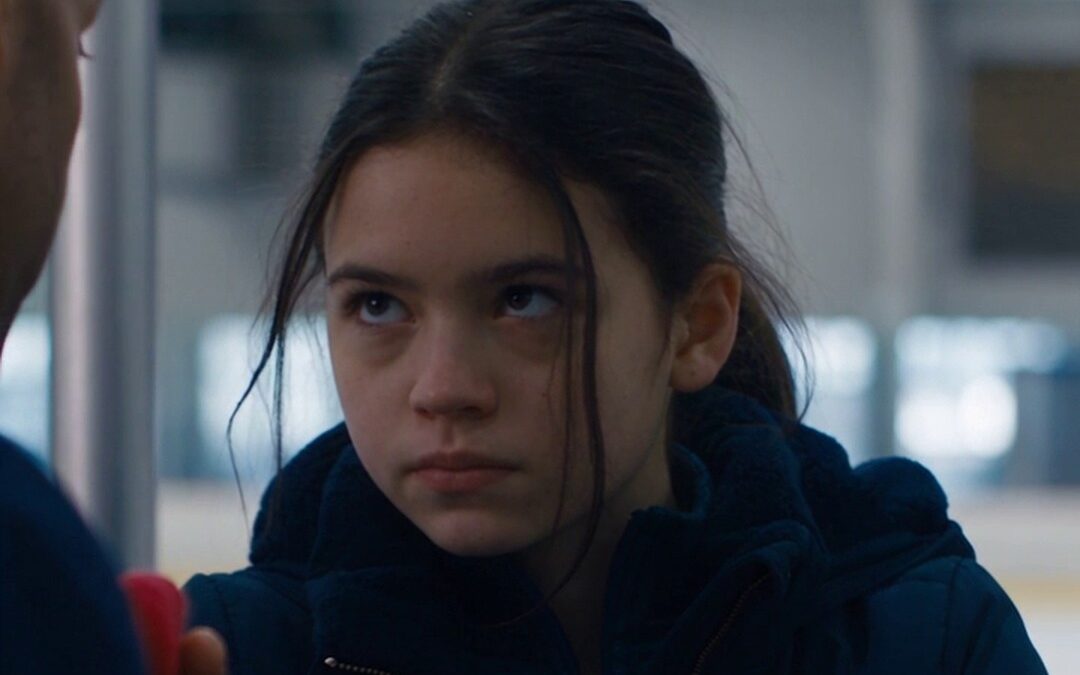
June came off the rink carrying her skates, her cheeks pink from the cold and her dark hair escaping its braid.
She stopped when she saw him.
Owen stayed beside Tessa and kept his hands at his sides.
“Hi, Junebug,” he said.
June’s eyes moved to the mitten in his hand.
“You kept that?”
“I kept your other one, too.”
For a moment she looked like the little girl who used to count his stitches aloud.
Then she glanced at Tessa.
“You didn’t come,” June said.
“I did.”
Tessa’s voice stayed level.
“We aren’t doing this here.”
June turned away, but one red cuff slipped from the pocket of her coat.
Seven uneven blue stitches crossed its seam.
Owen looked at the mitten Tessa had returned, then at the one June had kept.
Tessa had said June wanted neither.
June stopped at the rink door without looking back.
“Then why did I wait alone every Saturday?” she asked.
Chapter 2: The Sign-In Book
“Then why did I wait alone every Saturday?”
The question stayed between them as a skater pushed through the door beside June.
Owen wanted to cross the few yards of rubber flooring and tell her about the chairs at the contact center, the paper cups of water, the staff member who always called him Mr. Mercer.
He wanted to put every Saturday in its proper place before June could disappear into Tessa’s version of them again.
Tessa stepped toward their daughter.
“We agreed to a hello,” she told Owen.
June set her skates down.
“No, Mom.”
Her voice was quiet enough that the families passing behind her kept moving.
“I asked him.”
Owen looked at her face instead of Tessa’s.
“I waited, June.”
Tessa’s hand closed around the strap of June’s skate bag.
“Not here.”
June gave a short, disbelieving laugh.
“You always say that.”
She picked up her skates and went into the corridor that led to the locker rooms.
Tessa followed, leaving Owen by the rink door with the returned mitten in his hand.
He did not follow them.
The last temporary court order said contact outside the family service program had to be agreed upon in advance, and Tessa had agreed to a brief conversation at the rink with her present.
An argument in the corridor would give her a reason to say even that had been a mistake.
Owen sat at a table near the skate counter and turned the mitten over.
The seam was sound, though the red wool around it had worn thin.
He remembered June holding up seven fingers while he pushed the needle through.
Seven years, Daddy.
At thirteen, she had waited for him on Saturdays he had spent waiting for her.
That evening, he drove home along a road bordered by bare fields and low wooded hills in western Pennsylvania.
He put the mitten beside the folder on his kitchen table.
The folder held his copies of the contact center’s appointment notices, his parking receipts, and the statements he had sent to his attorney over three years.
It held almost nothing in June’s own words.
At nine, she had told a counselor she wanted to see him.
At eleven, according to a later report, she had said she did not.
At twelve, she had written that she was tired of waiting.
Owen had read that last sentence until the paper grew soft along its fold.
He called his attorney, Mara Bell, before he could talk himself into waiting for morning.
“She asked me why she waited alone,” he said when Mara answered.
“Did Tessa hear her?”
“Yes.”
“Did you tell June about the center?”
“I said I came.”
Mara let a second pass.
“That’s all?”
“Tessa ended it.”
“That was probably wise.”
Owen looked at the empty chair across his table.
“I’m tired of being wise in rooms she isn’t in.”
“I know,” Mara said.
She had been his attorney only since winter.
The lawyer who had handled the divorce had retired, and by then Owen had spent enough on repeated motions to learn how expensive delay could be.
Mara had taken the case after reading the old center reports.
She had told him the records showed he was present for many appointments, but a court could not repair June’s trust by pointing to a sign-in sheet.
Now June had asked the question herself.
“Request the complete center file,” Mara said.
“I have my attendance sheets.”
“I want the intake notes and cancellation records, including who called and when.”
“Can they still get them?”
“The program says it retains case files for several years.”
Owen rubbed his thumb over the blue stitches.
“What if they’re gone?”
“Then we work with what survives.”
He did not tell her about the second mitten until she asked what else had happened.
When he described June carrying it in her pocket, Mara said, “That matters to June.”
“It felt like it.”
“Leave her room to decide what it means.”
After they hung up, Owen laid both mittens on the table.
He had told himself, when the birthday parcel came back, that June was allowed to reject it.
He had sent it anyway because the wool was hers, and because refusing to send it felt too much like agreeing that the seven stitches no longer counted.
The return label had Tessa’s handwriting.
He had known that before he walked into the rink.
He had not known June still carried the other mitten.
At Tessa’s house, June stood at the washer while her mother measured detergent into the cap.
The house was ten minutes from the rink.
June could still feel the hard edge of her skate blade against her palm, though she had already put the skates away.
“You told me you asked him,” she said.
Tessa poured the detergent.
“I did.”
“You told me he said Saturdays were hard with his work.”
“He did say that once.”
“That’s not what I asked.”
Tessa set the cap on the machine.
“When you were little, he missed a weekend and you sat by the window all afternoon.”
June remembered the window.
She remembered a neighbor’s pickup passing three times, and the way every engine had made her stand up.
Owen had missed that weekend because a bridge crew had been called to repair flood damage two counties away.
He had called her that night and apologized.
June remembered that, too.
“I’m asking about the center,” she said.
“I won’t have you sorting through adult paperwork.”
“You made me go there.”
“I made arrangements so you could see him.”
June pulled the red mitten from her coat pocket.
Its cuff was stretched where she had worn it around the house long after it fit.
“Why did you tell him I didn’t want this?”
Tessa looked at it and then away.
“I said you didn’t want the parcel.”
“You didn’t ask.”
“You haven’t worn those in years.”
June placed the mitten on the washer.
It made no sound.
“I was going to give it back when I saw him.”
Tessa’s expression changed before she caught it.
“June, you don’t have to prove anything to him.”
“I know.”
“Then let this wait until tomorrow.”
June took the mitten upstairs.
She had once liked how sure her mother sounded when other adults made promises.
Tonight the certainty felt like a door closed from the other side.
The next morning, Owen went to the family contact center before his road shift.
The program occupied two rooms in a county services building beside a laundromat.
A receptionist behind a pane of glass recognized him, though the last scheduled visit there had been more than a year earlier.
“I need my complete case records,” he said.
She slid him a request form.
“You can ask for your records.”
“I need the full appointment history.”
“The records manager decides what can be released.”
Owen read the form at a counter worn smooth by other hands.
It asked for dates, case number, identification, and a reason for the request.
He knew the case number without looking it up.
He had written it on enough envelopes.
The receptionist took the form and made a copy of his license.
“It may take a while,” she said.
“How long?”
“I can’t promise.”
He thanked her.
On his way out, he passed the room where he used to wait.
The clock was still above the same row of chairs.
He could remember the first Saturday clearly.
June had been ten.
A court had ordered temporary visits through the center after Tessa said their handovers had become too upsetting for June.
There had been no finding that Owen was dangerous.
The judge had wanted a neutral place while both parents worked with a counselor on a longer plan.
Owen had arrived early with a paperback about tide pools because June was studying them in science.
Twenty minutes after the scheduled start, a staff member told him June would not be coming.
He had asked whether she was ill.
The staff member had said she could share only that the visit was canceled.
On the second Saturday, he brought nothing and waited anyway.
At the rink, June helped stack rental skates after school.
Tessa coordinated volunteers for the youth program, and June had grown up among the counter’s bent wire baskets and the old towel used to dry wet laces.
The work gave her something to do while her mother spoke to the other parents.
It also gave her a place to ask questions without sitting across a table at home.
An older volunteer named Ruth sorted the skates by size.
She had known June since June needed both hands to lift a pair.
“Do you remember when I was little?” June asked.
Ruth gave her a look.
“You’ll have to narrow that down.”
“The family center.”
Ruth set down a skate.
“I remember your mother changing your practice hours around those visits.”
“Did I ever say I didn’t want to go?”
Ruth glanced toward the office where Tessa kept the schedule.
“That’s a question for you, honey.”
“I don’t remember saying it.”
“Then tell someone that.”
June waited.
Ruth picked up the skate again.
“I can remember how you acted here,” she said.
“I can’t tell you what happened at the center.”
June nodded, though she wanted more.
Ruth did not follow when she went to return a basket.
At home that night, June opened the shoebox beneath her bed.
Inside were the mitten and a stack of small spiral notebooks she had used since fourth grade.
The first notebook had cartoon animals on its cover, drawn by June because the plain brown cardboard bored her.
She found a page headed by the month she had turned ten.
The Saturdays had squares around them.
She had drawn a line through the first one after Owen missed the bridge weekend.
The next two had question marks.
After that, the pages changed from hopeful drawings to small marks she could make quickly.
She had wanted to stop counting.
Her mother had said Owen would come when he was ready, and June had decided she would be ready every time.
She closed the notebook when Tessa called her to dinner.
Owen’s records request took nine business days.
During those days, he worked on guardrails, came home with grit inside his cuffs, and resisted the urge to drive past the rink.
Tessa had sent Mara an email saying the conversation there had upset June.
She proposed that any further communication go through the counselor who had seen June the previous year.
Mara sent back an agreement to use a professional, along with a request that June be allowed to choose whether she wanted a meeting.
Tessa did not answer that part.
“She knows June asked me,” Owen said over the phone.
“She does,” Mara replied.
“Couldn’t the judge order one conversation?”
“A judge can set a process.”
“That sounds slower.”
“It is.”
Mara did not soften it.
June was thirteen, and the court would take her wishes seriously.
Her wishes also needed to be heard without either parent speaking for her.
Mara filed for a review of the temporary order and asked the court to appoint someone who could meet June independently.
Owen signed the papers at her office during his lunch break.
On the way out, he noticed a display of old photographs in the county hallway.
One showed the rink decades earlier, before it had a proper roof.
Children stood on rough ice in mismatched coats.
He wondered whether any of their parents had waited years to be believed by them.
The center’s envelope arrived on a Thursday.
Owen opened it at the kitchen table with Mara on speakerphone.
There were twenty-seven pages.
The first was the order that had established the visits.
The next several were attendance sheets with Owen’s signature and the time he had checked in.
He knew those sheets.
Then came cancellation forms.
Most were brief.
One said the receiving parent had reported the child ill.
Another said the child was unwilling to participate.
Several listed a phone call made less than an hour before the scheduled visit.
Owen read the times aloud.
“I was already on the road for three of those.”
“Keep going,” Mara said.
He turned a page.
A staff note from the fourth month recorded that June had arrived with Tessa, sat in the lobby, and left before Owen was told she was there.
Owen stopped reading.
He could hear Mara waiting.
“June came,” he said.
“What date?”
He gave it to her.
“That’s the day they told me she refused.”
“What does the note say exactly?”
Owen read it slowly.
The staff member had asked Tessa whether she wanted help bringing June into the visit room.
Tessa had said June was not ready and asked that the appointment be recorded as declined.
The note did not say what June had said.
Owen found the corresponding page in his old folder.
His attendance sheet showed he checked in nineteen minutes before the appointment and left forty-two minutes after it was scheduled to begin.
He had been in the room across the corridor.
June had been in the lobby.
For years, he had imagined her at home, refusing to get in the car.
He pressed his fingertips against his eyes.
“Owen?”
“I’m here.”
“This note matters,” Mara said.
“It doesn’t tell us what June knew.”
“No.”
He looked again at the blank space where June’s words should have been.
“That’s what I need to find out.”
The records also showed two appointments marked as canceled by Owen.
He had not canceled them.
One had fallen on a day he remembered because his crew had finished early and he had eaten lunch in his parked truck outside the center.
The other was the Saturday after June’s tenth birthday.
He found a fuel receipt from that morning in his folder.
He had kept every receipt when Tessa first said he was not showing up.
Mara asked him to photograph the pages and bring the originals to her office.
“We’ll ask the center for the underlying call records,” she said.
“Do they have them?”
“The file says the calls were logged.”
“Could someone have put my name on a form by mistake?”
“We need to check.”
That answer irritated him because he wanted one that was easier to carry.
Then he remembered the lobby note.
The center had recorded June’s arrival because a staff member had seen her.
Someone had kept that page through an office move, a pandemic closure, and three winters of Owen wondering whether his daughter had ever been near enough to hear his voice.
At school the following week, June met a counselor at Tessa’s request.
The counselor asked whether seeing Owen at the rink had frightened her.
“No,” June said.
“Did it upset you?”
“Yes.”
“In what way?”
“He said he came.”
“Do you believe him?”
“I don’t know.”
The counselor set down her pen.
“You’re allowed to say that.”
June examined the corner of the room where a poster was peeling from the wall.
“My mother says he misses things and then makes them someone else’s fault.”
“Has that happened?”
“He missed one weekend.”
“Do you remember others?”
June rubbed her thumb over a callus from her skate lace.
“I remember going to the center once.”
The counselor waited.
“We sat in the lobby,” June said.
“Mom said he hadn’t signed in yet.”
“Did you see him?”
“No.”
“What happened next?”
“We left.”
The memory came back with the squeak of a shoe on polished flooring and her mother saying they could get cocoa on the way home.
June had asked whether Owen might arrive after they left.
Tessa had said he knew the time.
“Would you like to tell the person appointed by the court what you remember?” the counselor asked.
June looked up.
“Is there a person?”
“There may be soon.”
“I don’t want another adult deciding which of them is telling the truth.”
“You can ask for answers in your own words.”
June thought about the notebook under her bed.
“That part I can do.”
When Owen and Mara met with the center’s records manager, the woman brought a second folder to the conference room.
Her name was Diane, and she had worked there since before June’s first appointment.
She did not remember each family, she said.
She remembered the program’s procedure.
Calls came through the main line during office hours and through an answering service on Saturdays.
Staff wrote a note in the file and changed the appointment status in their system.
The answering service kept call details for a limited period.
“The older audio is gone,” Diane told them.
“The call summaries remain.”
Mara asked to see the summaries.
Diane pointed to the two appointments attributed to Owen.
Both calls came from the same number listed for Tessa in the intake papers.
“That number doesn’t prove who spoke,” Diane said.
“Did staff verify callers?” Mara asked.
“They were supposed to ask for the case number and the child’s birth month.”
Tessa knew both.
Owen knew both.
The summaries showed the caller had said Owen could not attend.
Mara asked whether anyone called Owen to confirm.
Diane checked the file.
“I don’t see a confirmation.”
Owen stared at the number on the page.
He wanted Diane to say a mistake like this could only be deliberate.
Instead, she said the center had changed its procedure two years earlier.
Now it called both parents before recording a cancellation attributed to one of them.
“Why?” Owen asked.
Diane folded her hands.
“Because a canceled visit affects a child.”
She did not claim to know what had happened in his case.
That restraint made him trust the rest of what she said.
Diane could authenticate the attendance sheets, the lobby note, and the call summaries if asked.
She could not say June had been told anything in particular.
Outside the building, Owen sat in Mara’s car while she put the papers in order.
“I keep thinking she was one corridor away,” he said.
Mara did not start the engine.
“Will you tell June?”
“If she’ll let me.”
“Tell her what the records show.”
“I know.”
“She may still remember being left in that lobby.”
Owen looked at the closed doors of the center.
“Then I have to hear that part, too.”
Tessa learned about the records request when Mara sent copies with the motion.
Her lawyer advised her to answer the specific claims and avoid discussing them with June before the court’s appointed professional had met her.
Tessa thanked him and called June into the kitchen that night anyway.
Owen had made progress, and she could feel it in the way June now asked questions before taking off her coat.
Tessa placed a printed page on the table.
It was an old email Owen had sent after the bridge repair weekend.
In it, he had apologized for missing June’s visit and said his work hours were hard to control.
“You should see this,” Tessa said.
June read the few lines.
“I remember that weekend.”
“He did tell me his work came first.”
“He said the crew got called out.”
“He had other choices.”
June looked up.
“Did he?”
Tessa drew out a chair but did not sit.
“He took that job after we separated.”
“He needed a job.”
“He needed one that let him show up.”
June folded the page along its existing crease.
“That was one Saturday.”
“It was the first one you counted.”
“How do you know?”
Tessa’s eyes went to the folded paper.
“You told me.”
June had told her.
She had also told her when she stopped marking the missed days in the notebook because looking at them made her angry.
Tessa had held her then.
June could remember both things at once.
“Did you ever tell the center he canceled when he hadn’t?” she asked.
Tessa went still.
“Where did you hear that?”
“Answer me.”
“There were mornings I called because I knew you couldn’t face another disappointment.”
“That isn’t what I asked.”
Tessa pushed the chair back under the table.
“We’ll talk after you meet the court person.”
“You said adult paperwork didn’t concern me.”
“I said you shouldn’t have to carry it.”
June held out the email.
“You keep handing it to me.”
Tessa took the page.
Her hands were steady.
June had seen her use that steadiness with frightened children at the rink, kneeling beside them to retie a lace before sending them back onto the ice.
It had always felt safe.
Now June went upstairs before her mother could find a calmer answer.
At the next court conference, nobody lost custody.
The judge read the records, heard each lawyer’s position, and said the disputed appointments needed closer review.
Tessa’s lawyer argued that the notes could reflect confusion at a busy service program.
He said Owen’s work schedule had been unpredictable and that June’s resistance was real.
Mara agreed June’s feelings were real.
She asked for someone independent to learn how those feelings had been shaped.
The judge appointed a child’s attorney to meet June and review the relevant documents.
The court also set a later hearing.
Owen left with another date on another piece of paper.
In the hallway, Tessa caught up to him.
“You’re making her feel investigated,” she said.
“I asked for the center’s records.”
“She knows what you’re accusing me of.”
“What did you tell her?”
Tessa glanced toward the stairs, where their lawyers were speaking.
“That you missed things when she needed you.”
“I missed one weekend.”
“You moved away.”
“I moved ninety minutes for work.”
“You could have stayed closer.”
Owen had no answer that would make the distance disappear.
The bridge job had paid enough for him to rent a place with a bedroom for June.
His old position at a local repair shop had ended when the owner closed it.
He had thought the drive was the problem he could solve.
“I should have told her sooner that I was coming back,” he said.
Tessa’s face softened for an instant.
“You always say that after.”
“Maybe I do.”
She seemed surprised he had conceded anything.
Then he said, “I came to the center.”
Tessa looked past him.
“It doesn’t change every time she waited.”
“No,” Owen said.
“That’s why she needs to know where I was.”
The child’s attorney, Elena Price, met June three times.
The first meeting was in Elena’s office with neither parent in the room.
June brought the old notebook in her backpack and did not take it out.
Elena asked about school, friends, skating, and the kind of visits June had liked when she was small.
June described Owen teaching her to tighten the loose wheel on a rolling equipment cart at the rink.
He had held the wrench steady while she turned the bolt.
“Do you want to see him now?” Elena asked.
June looked at the edge of the desk.
“I want to know why he says he came.”
“That’s a fair question.”
“If he has papers, Mom has papers.”
“Yes.”
“How do you decide?”
“I look at where they came from and ask people who were there.”
June opened her backpack.
The notebook’s cardboard cover had softened at the corners.
“I was there,” she said.
Elena let June choose which pages to show her.
Some Saturdays had a small square around the date.
A few had question marks.
On one page, June had written that she saw a man enter the center and wondered whether her father was behind him.
The note was in a child’s uneven handwriting.
June touched that line.
“Mom said he hadn’t arrived yet.”
Elena asked whether June remembered who told her that.
“Mom.”
“Did a staff member say it to you?”
“I don’t remember one.”
June closed the notebook.
“I don’t want you to take this from me.”
“I won’t.”
Elena asked permission to make a note of what June had shown her.
June agreed.
Outside, Tessa waited in her car.
She asked how the meeting had gone.
“Fine,” June said.
“What did you talk about?”
“My skating.”
Tessa heard the boundary in her voice and started the car.
For the first time, June had kept a conversation about Owen from her mother.
She did not feel triumphant.
She felt lonely in a way she had not expected.
Owen spent the next month trying to reconstruct the Saturdays without turning his whole life into a wall of dates.
Mara had the center file.
He found his work schedules from the county maintenance office, which kept electronic time records.
He requested copies through his supervisor and paid a small fee for the older entries.
On most Saturdays he had been off.
For the two appointments marked canceled by him, his shift records showed he had not been called in.
One Saturday had a fuel purchase near the center before the alleged cancellation call.
The other had a diner receipt from after the visit time.
He had eaten alone, then driven home.
Mara said the receipts supported his account but would not, on their own, show what Tessa told June.
Owen knew that.
He also knew June’s notebooks might hold the part he could never document.
He was careful not to ask Elena about them.
Elena represented June, not him.
When a neighbor offered to tell June how often she had seen Owen’s truck on the highway, he thanked her and asked her to speak with Mara if she remembered a specific date.
He did not want June surrounded by adults making claims on her behalf.
One evening he found the photograph of June in the red mittens.
She was six, standing at the rink counter with one hand raised to show the repaired seam.
Tessa had taken the picture.
He placed it back in the folder without sending it to anyone.
June already remembered the mittens.
She had kept one.
At the rink, Ruth noticed June watching the office door.
Tessa was inside with the youth schedule spread across the desk.
“You can put those skates away,” Ruth said.
June stacked the last pair.
“Did Mom seem different when I started going to the center?”
Ruth exhaled.
“She was worried.”
“About him?”
“About you being hurt.”
“Was I?”
“You were waiting for someone you loved.”
June sat on the low bench.
Ruth stayed on the other side of the counter.
“I worked here the day he missed that visit,” she said.
“Mom brought me in afterward.”
“She did.”
“I remember her saying she wouldn’t let it happen again.”
Ruth nodded.
“That sounds like your mother.”
June looked toward the ice.
“And then it happened again.”
“I don’t know what happened at the center.”
“I know.”
Ruth wiped a pair of blades with the old towel.
“She wanted to keep you from hoping too hard.”
The office door opened, and Tessa stepped out with a clipboard.
June stood.
Ruth said nothing more.
That night, June asked her mother why she had kept working the rink’s volunteer schedule when it made her so tired.
“Someone has to make it run,” Tessa said.
“Ruth says you worry about everyone.”
“Ruth worries about everyone, too.”
June leaned against the kitchen counter.
“Did you think seeing Dad would hurt me?”
Tessa stopped rinsing a dish.
“Yes.”
“Because he missed one Saturday?”
“Because I watched you wait through a lot more than one.”
June thought of the lobby.
“Some of those waits were at the center.”
“Yes.”
“Did you tell me when you canceled?”
Tessa set the dish in the rack.
“Sometimes I told you we weren’t going.”
“Did you ever tell me he canceled instead?”
Tessa’s shoulders dropped.
“I was trying to spare you another promise.”
“That sounds like yes.”
“I didn’t always know whether he would come.”
June walked to the stairs.
“You could have found out.”
After June went up, Tessa stayed by the sink until the water ran cold.
She remembered the bridge weekend as more than one missed visit.
Owen had told June he would be there, and June had watched the road until dusk.
Tessa had been the one to feed her, bathe her, and answer her questions.
She had come to believe that every uncertain Saturday demanded the same answer from her.
At first she had called the center on mornings June did not want to get dressed.
Later, she had stopped asking June whether she wanted to go.
It had seemed kinder to end the waiting before it began.
Tessa knew that was the account she would have to give Elena.
She also knew it did not explain why she had told June that Owen had canceled.
Elena interviewed Diane at the contact center and reviewed the original file.
Diane showed her how appointments were entered and how the staff kept the paper notes after changing to a new computer system.
The lobby note was written on the day June came.
The staff member who wrote it still worked for the county.
Elena spoke with her.
She remembered little about the family beyond what she had recorded.
She could say she saw June sitting with Tessa and that Owen was already signed in before they left.
She could not say whether June knew he was there.
Elena thanked her for the limit.
A precise memory was more useful than a generous one.
Elena also met with Tessa.
Tessa admitted making some cancellation calls.
She said June had often been distressed before appointments and that she had believed Owen’s earlier missed visit made the center a place of dread.
Elena asked about the calls logged as Owen’s cancellations.
Tessa looked at the printed summaries.
“I don’t remember saying he called,” she said.
“The calls came from your number.”
“I may have told them he couldn’t make it.”
“How would you have known?”
Tessa folded her hands.
“He’d told me his work changed.”
“On those dates?”
“I can’t remember.”
Elena asked whether she had told June Owen had not arrived on the day they both checked in.
Tessa looked at the lobby note for a long time.
“I thought he was late,” she said.
“He was there nineteen minutes early.”
“I didn’t know that then.”
“Did you ask the staff?”
“I don’t remember.”
Elena did not press for a confession.
She asked Tessa to describe what she had said to June when they left.
Tessa could remember the cocoa, the car, June’s small face turned toward the building.
She said she had told June that Owen knew the time.
“That was true,” Tessa said.
Elena wrote it down.
When Mara received Elena’s preliminary recommendations, Owen read them at his kitchen table.
Elena wanted June to have access to the verified attendance information with a professional present.
She recommended a first meeting only if June chose it after hearing the records explained.
She also recommended a revised parenting plan that would keep both parents from canceling a scheduled contact without direct confirmation through a neutral system.
The court had not yet accepted those recommendations.
Tessa objected to the records meeting.
Her lawyer wrote that reading old center notes to a child would place her in the middle of an adult dispute.
Owen understood the worry better than he wanted to.
June had already been in the middle for years.
He asked Mara whether they could simply send June his attendance pages.
“No,” she said.
“Why not?”
“She needs a chance to ask what the pages mean.”
“I could answer.”
“You could answer your part.”
Owen looked at the red mitten beside his folder.
“I can do that.”
The hearing took place in a plain room at the county courthouse in late spring.
June did not sit through the adults’ testimony.
Elena had told her she could meet the judge privately with Elena present if she wanted, and June had agreed.
Owen testified first.
He described the bridge weekend without blaming anyone else.
He had been called to work, he had failed to give June enough warning, and she had waited.
He said he had apologized then and still regretted it.
Then Mara took him through the center appointments.
He identified his signatures on the attendance sheets.
He explained the receipts and work records.
Tessa’s lawyer asked why he had not sought court enforcement immediately after the first canceled visits.
“I did file after several,” Owen said.
“Not after the first?”
“No.”
“Why?”
“The center kept telling me June didn’t want to come.”
“And you thought forcing her into a room would help?”
“No.”
Owen gripped the edge of the witness chair.
“I wanted the court to find out what was happening before asking her to try again.”
The lawyer asked why he had kept mailing gifts when June had stopped responding.
“Because I was her father.”
“Even when she might not want them?”
“I sent them through her mother.”
He thought of the parcel at the rink.
“I wanted June to be free to refuse them herself.”
Diane testified about the center’s records.
She explained where each page came from, why staff made it, and how it had remained in the archived file.
She identified the staff member’s lobby note and the call summaries.
Tessa’s lawyer asked whether a phone number proved who made a call.
“It does not,” Diane said.
“Could a staff member have misunderstood a caller?”
“Yes.”
“Can you tell this court what June believed?”
“No.”
Elena asked one question.
“Can you tell the court whether Owen signed in before June left that day?”
Diane looked at the records.
“Yes.”
Tessa testified after lunch.
She spoke calmly about the bridge weekend, June’s dread before the visits, and the difficult years of driving back and forth between households.
She said Owen had lived far enough away that every plan required trust in a schedule he did not always control.
“When he missed that Saturday, she blamed herself,” Tessa said.
“I could not watch her do it again.”
Mara asked about the two cancellations logged under Owen’s name.
“I made calls,” Tessa said.
“Did you tell the center Owen would not attend?”
“I may have.”
“Had Owen told you that?”
“His work was uncertain.”
“On those Saturdays?”
“I don’t know.”
Mara held up the lobby note.
“Did you tell June he was there?”
“No.”
“Why?”
“I didn’t know he was.”
“Did you ask?”
Tessa’s mouth tightened.
“I believed the staff would tell me.”
Mara let the answer stand.
Tessa looked at the judge.
“I made choices I thought protected my daughter.”
Owen believed her.
That made the choices harder to forgive.
Before the hearing ended, Elena told the judge what June had authorized her to share.
June remembered waiting in the center lobby and being told Owen had not arrived.
She wanted the verified records explained to her.
She was willing to meet Owen once with Elena and a counselor present, but she wanted to decide afterward whether there would be another meeting.
The judge adopted a temporary process for that meeting.
A later order would address the longer plan.
Outside the courthouse, Owen did not try to speak to Tessa.
He called Mara from his truck even though she was only a few yards away.
“Did June say she’d meet me?”
“She did,” Mara said.
“Once.”
“Once,” Mara repeated.
Owen rested his forehead against the steering wheel.
For years he had asked for a day.
Now that one had a date, he was frightened of how much he might ask it to hold.
The meeting was scheduled for three weeks later in a room at the center that neither Owen nor June had used before.
A counselor would be there with Elena.
Tessa would bring June and wait elsewhere in the building.
The arrangement had taken several calls and a written order.
Owen arrived early out of habit.
He carried no gift.
The red mitten stayed in his truck, tucked inside the glove compartment.
He wanted June to be able to leave the room without having to hand him anything back.
Elena came out first.
“She has seen the records,” she said.
“How was she?”
“She had questions.”
“Did you answer them?”
“The ones the records could answer.”
Owen nodded.
“Be ready for the others.”
June entered beside the counselor.
She wore jeans, an oversized gray sweatshirt, and the wary expression she had worn at the rink.
Owen stood, then sat when she chose a chair across the table.
“Hi,” he said.
“Hi.”
Elena explained that June could stop the meeting whenever she wanted.
June folded her hands.
“I know.”
The counselor asked whether she wanted to begin.
June looked at Owen.
“Were you in the building that day?”
“Yes.”
“Before we left?”
“Yes.”
June looked toward Elena.
Elena nodded once.
“The records support that,” she said.
June turned back.
“Did you know I was there?”
“No.”
“I sat in the lobby for twenty minutes.”
“I know that now.”
“You were across the hall.”
“Yes.”
She looked down at her hands.
“Why didn’t you come out?”
“They told me to wait in the visit room.”
“You could’ve checked.”
“I asked if you were coming.”
“Who did you ask?”
“The staff member who came in.”
June pressed her lips together.
The counselor shifted slightly but did not speak.
Owen wanted to tell June he would have crossed any hallway for her.
That morning, he had stayed where the center told him to stay because the court had ordered them to use the center, and because he thought walking into the lobby uninvited might frighten her.
He said so.
June listened without looking relieved.
“I thought you let me leave,” she said.
“I didn’t know you’d arrived.”
She nodded once, though it was not agreement.
“Mom said you knew the time.”
“I did.”
“That part was true.”
“Yes.”
June’s eyes filled, but she did not wipe them.
“Everything true she said made the rest sound true.”
Owen felt the sentence land.
“I missed the bridge weekend,” he said.
“I know.”
“I should have called before you waited all afternoon.”
“You called that night.”
“It was too late.”
“Yeah.”
He could hear Tessa’s honest case in that single word.
The counselor asked whether June wanted a break.
June shook her head.
“Why didn’t you tell me you’d been at the center?”
“I tried in letters.”
“Mom says you wrote when you felt guilty.”
“I wrote because I missed you.”
June looked toward Elena again.
Elena told her that several letters were in the court file and had been sent to Tessa’s address.
The records did not show whether June had received them.
June turned to Owen.
“I got birthday cards.”
“Did you get my letters after the center visits?”
“I don’t know.”
Owen kept his hands flat on the table.
“I won’t ask you to believe what you haven’t seen.”
June let out a small breath.
“Good.”
They sat in the silence that followed.
Owen had imagined this meeting so many times that every pause felt full of things he had rehearsed.
None of them seemed right for the girl in front of him.
June reached into her sweatshirt pocket.
She laid the red mitten on the table between them.
The seven blue stitches faced up.
“I kept it,” she said.
“I saw.”
“Mom said I didn’t want the parcel.”
“I know.”
“I was mad at you when it came.”
“You were allowed.”
“I still wanted the other mitten.”
Owen looked at her.
“I brought it in my truck.”
June touched the seam of the one she had kept.
“I’m not asking for it today.”
“All right.”
“I don’t know if I want to see you next week.”
“All right.”
Her eyes narrowed.
“Don’t just say that because everyone’s listening.”
“I’m saying it because you get to choose what you can do next.”
June pulled the mitten back toward her.
“I wanted you to tell me you were there.”
“I was there.”
“I also wanted you to know what it felt like to sit outside that room.”
Owen nodded.
“I’m listening.”
She told him about the lobby chair with a split in its vinyl seat.
She told him how she had counted the ceiling lights and watched the door each time footsteps came down the corridor.
She told him she had asked Tessa if he might arrive late, and that they had gone for cocoa instead.
Owen did not correct any part of her memory.
When she finished, he said, “I’m sorry you waited.”
June looked at Elena.
“I want to stop now.”
Owen stood only after she did.
“Thank you for telling me,” he said.
June gave a small nod and left with Elena and the counselor.
The mitten went with her.
Owen stayed in the room until the counselor returned to tell him he could go.
In the parking lot, he took the other mitten from his glove compartment.
It was smaller than he remembered.
He put it back.
June’s meeting with Tessa happened two days later at home.
Elena had offered to be present, but June wanted to speak where she lived.
She asked Tessa to sit at the kitchen table.
That reversal made Tessa nervous.
June put her notebook beside the salt shaker.
“I saw the center records.”
“I know.”
“Dad signed in before we left.”
“Yes.”
“Did you ask anyone if he was there?”
Tessa looked at the notebook.
“I don’t remember asking.”
“You told me he wasn’t.”
“I believed he might not come.”
“You said he hadn’t.”
Tessa rubbed the rim of her water glass.
“I should have checked.”
June waited.
Tessa looked up.
“I should have told you when I canceled visits.”
“Why didn’t you?”
“Because every time I said we were going, you got quiet, and I was afraid I’d watch you wait again.”
“I waited anyway.”
“I know that now.”
“No,” June said.
“I wrote it down.”
She opened the notebook to the page with the lobby visit.
Tessa recognized June’s small handwriting.
She had never asked to see those pages.
For years she had thought June had stopped counting when she stopped asking.
June put a finger on a question mark.
“You thought I was waiting for Dad to decide,” she said.
“I was waiting for you to tell me if he came.”
Tessa looked at the mark until it blurred.
“I was angry with him,” she said.
“For that first day and for moving.”
“I know.”
“I told myself I was keeping you safe from being let down.”
“You made it happen.”
Tessa did not answer quickly.
Then she said, “Yes.”
June closed the notebook.
“Are you sorry because Elena found the records?”
“I’m sorry because I did it.”
“I can’t tell the difference yet.”
Tessa accepted that without asking June to make her feel better.
June took the notebook upstairs.
For the first time since the rink, Tessa let her go without proposing another conversation.
The court issued an order in midsummer after reviewing Elena’s report and the center’s authenticated records.
It found that Tessa had interfered with the temporary contact process and had given June an inaccurate account of at least some appointments.
The order changed how future visits could be canceled, set a gradual schedule guided by June’s counselor, and required both parents to receive the same notices.
It did not order June to feel close to Owen.
Tessa remained June’s primary residential parent.
The judge directed both adults to stop discussing the case as a contest June had to settle.
Tessa’s volunteer role at the rink continued, though she asked Ruth to handle the family skate schedule for a while.
Ruth agreed without making a speech of it.
Owen and June met twice that summer in public places June chose.
At the first meeting they talked about school and the rink, and June left after forty minutes.
At the second, she asked him why he had taken the bridge job so far away.
He told her about the repair shop closing and the apartment he could afford with a bedroom for her.
“I wish you’d told me that then,” she said.
“I thought I had.”
“You told me you found a place with a big window.”
“I did.”
“That wasn’t the part I needed.”
Owen nodded.
He had spent years proving he showed up.
June was teaching him that showing up had included explaining what was changing before she had to guess.
In September, she asked to see the apartment.
Tessa drove her there and stayed in the car at June’s request.
The visit lasted an hour.
June looked at the bedroom that had held a desk and a lamp through years when she had never entered it.
She did not call it hers.
Owen did not ask her to.
When she saw the second red mitten on a shelf, she picked it up.
“I wondered if you’d really kept it.”
“I said I did.”
“You’ve said other things I couldn’t check.”
“That’s fair.”
June held her mitten beside his.
The wool had faded differently.
His was brighter, protected in a drawer for years.
Hers had thinned at the cuff from being carried in a pocket.
She did not put them on.
“Seven stitches,” she said.
“You counted.”
“You made one too long.”
“You told me it didn’t matter.”
“I was six.”
She set the mittens side by side.
“I might want to come back next month.”
“I’d like that.”
“I’ll tell you.”
“I’ll wait to hear from you.”
June considered him.
“You can call on Sunday.”
Owen smiled before he could help it.
“Sunday.”
She moved the mittens so their blue seams touched.
When Tessa came to the door, June picked up the one she had carried for years and slipped it into her coat pocket.
She left the other on the shelf.
Owen watched her go down the hall at her own pace.
On Sunday, he called at the time they had agreed.
June answered.








