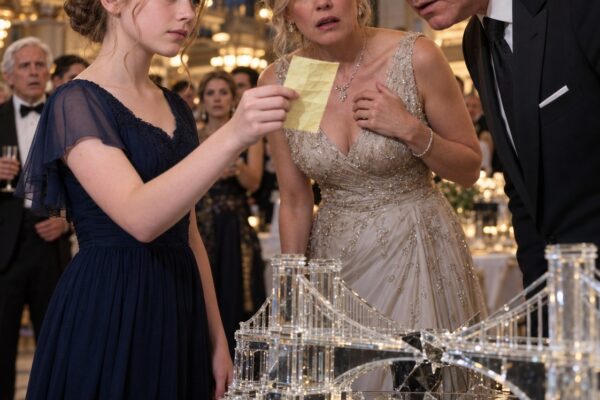
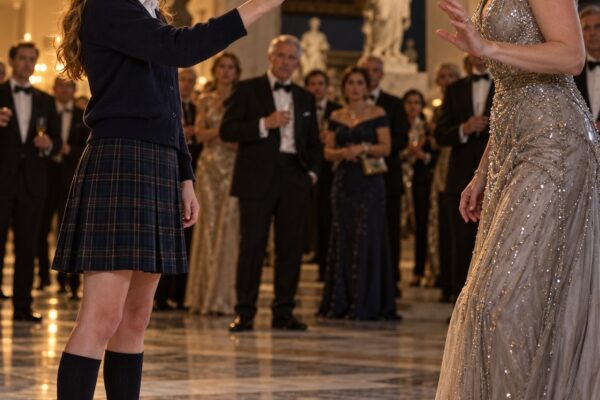
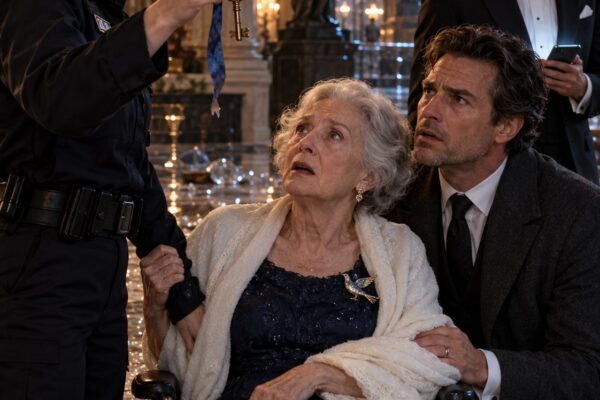
Her Mother Offered Two Daughters to a Billionaire While Making the Third Hold Up the Piano They Pretended to Play
Chapter 2: The Name Underneath
Willa stared at the drawing.
There was her crooked measurement arrow.
Her tiny correction beside the hinge.
Her father’s crescent, sketched in one corner.
Julian kept his hand nearby.
He did not touch her.
“Is this yours?”
“Yes.”
Corinne recovered quickly.
“It was a family project.”
Willa barely heard her.
“Did you answer?”
Julian’s expression changed.
“Three times.”
The room tilted slightly.
Willa steadied herself against the piano.
Three times.
She had checked the mailbox every afternoon until her mother called it pathetic.
Afterward, she had checked at night.
Julian noticed the blood on her palm.
A sharp edge beneath the piano had nicked it.
“Let’s deal with your hand.”
“It’s nothing.”
“It’s still bleeding.”
Corinne stepped toward the hallway.
“I’ll have someone bring a cloth.”
“The clean ones are there,” Willa said.
She pointed toward a cabinet.
She knew every drawer.
Every folded napkin.
Every place where something useful waited.
Julian brought a cloth himself.
He offered it without reaching for her hand.
Willa took it.
The small courtesy hurt unexpectedly.
Her sisters remained by the windows.
Neither had touched the piano.
Neither looked at the drawing.
Julian unfolded another page.
It was a printed email.
Willa’s name appeared beneath a paragraph she had never written.
“She declined,” he said carefully.
Corinne folded her arms.
“She became overwhelmed.”
“I didn’t decline.”
“Willa.”
“I never saw this.”
Julian turned the page toward her.
The message thanked his foundation for its interest.
It explained that Willa preferred privacy.
It authorized all further communication through her mother.
Below that came a proposal.
Blythe and Delphine would demonstrate the family’s adaptive music equipment.
Julian’s foundation might sponsor its development.
Willa read it twice.
Her hand stopped hurting.
Something worse took its place.
“You said nobody wanted it.”
Corinne glanced at their visitor.
“This is hardly the time.”
“You said it was childish.”
“You were becoming obsessive.”
Julian picked up the drawing.
“The prototype solved a specific problem.”
His voice stayed level.
“Our therapists wanted to test it.”
Willa looked at him.
Her father had developed weakness in his left hand during his final illness.
Ordinary piano benches made him twist painfully.
Willa’s design let the seat turn and lock while keeping both feet supported.
He had used her first rough version for eleven days.
Then he had died.
She had built three better versions afterward.
Each one had felt like finishing a conversation.
Julian knew none of that yet.
He only knew the person before him was shaking.
“Who controls that email address?” he asked.
Corinne answered too quickly.
“I manage household correspondence.”
“Mine too,” Willa said.
“You asked me to.”
“I was sixteen.”
“And grieving.”
Blythe finally moved.
“Mother said you didn’t want meetings.”
Willa looked at her sister.
“Did you ask me?”
Blythe’s mouth opened.
Nothing followed.
Outside, the harbor darkened.
The room’s expensive lamps came on automatically.
Willa thought about Friday.
Her course deposit.
Her suitcase with the split zipper.
Everything that required permission here.
Julian put the papers down.
“I came to meet the designer.”
Corinne smiled again.
“Then you’ve met all of us.”
“No,” Willa said.
The word surprised everyone.
Especially her.
“I built it alone.”
Corinne’s expression hardened.
“You live here.”
Willa knew the rest.
You eat here.
You sleep here.
You owe us.
Her mother did not need to say it anymore.
Julian reached for his phone.
“I’d like my foundation counsel to join us tomorrow.”
“This is a private family matter.”
“The proposal requested foundation money.”
That stopped her.
Willa pressed the cloth tighter.
“Could you send your answers somewhere else?”
“Of course.”
“I’ll make a new address.”
Corinne turned toward her.
“You are being extraordinarily ungrateful.”
Willa looked at the wooden wedge.
Her father had taught her to stop when a mechanism resisted.
Find the obstruction.
Never force the piece.
She had spent four years believing she was the obstruction.
Julian opened the folder he had brought.
“There’s another reason for counsel.”
He removed a copy of the proposed agreement.
Corinne reached for it.
He held it back.
His foundation’s routine review had requested proof that the collection could legally be sold.
The papers supplied by Corinne had been incomplete.
An older estate record had raised questions.
Willa saw her father’s name.
Then hers.
Julian spoke softly.
“Your father left you the workshop and its rental income.”
* * *
Willa did not sleep upstairs that night.
She stayed with Ruth Fenwick.
Ruth had repaired instruments alongside Willa’s father for twenty-three years.
She lived above a narrow shop downtown.
Her spare room smelled of cedar.
There were no guest towels.
Only clean ones.
Willa arrived carrying one bag.
Inside were three dresses, her course letter, and her father’s two wooden wedges.
Corinne watched her leave from the staircase.
“If you walk out, don’t expect support.”
Willa had almost apologized.
The habit rose automatically.
Instead, she carried her bag outside.
Ruth opened her door before Willa knocked twice.
Julian had offered a hotel room.
Willa had asked for Ruth.
He had simply said yes.
Now Ruth examined her scraped palm beneath the kitchen light.
“I should have pushed harder.”
Willa sat very still.
“About what?”
“Seeing you.”
Corinne had canceled visits.
Then appointments.
Then a planned apprenticeship.
She had told Ruth that Willa found the shop upsetting.
Later, she said Willa had become unreliable.
Ruth had believed grief could look like withdrawal.
She hated herself for that now.
Willa stared at the tea cooling before her.
“She said you couldn’t afford help.”
“I offered paid work.”
“How much?”
Ruth named the hourly rate.
Willa looked away.
It had been more than enough.
For the course.
For a room.
For a door of her own.
Ruth reached across the table.
She stopped before touching her.
“May I?”
Willa nodded.
The older woman held her uninjured hand.
Neither spoke for a while.
The next morning brought rain.
It also brought Anika Shaw, the foundation’s counsel.
She explained her position immediately.
“I represent the foundation.”
Willa sat straighter.
“That means you need your own lawyer.”
“Can I afford one?”
“We can help you find someone.”
Ruth had already called a local estate attorney.
His name was Peter Ames.
He agreed to review the initial records for a fixed fee Ruth offered to cover.
Willa wrote the amount down.
Ruth noticed.
“We can discuss that later.”
“I need to know.”
“Then we’ll write it properly.”
It was the first promise that morning Willa trusted completely.
They met in Ruth’s workroom.
Julian joined by video.
He was in a plain office.
No harbor.
No chandelier.
Only a half-eaten sandwich beside his keyboard.
Peter had obtained the filed estate documents.
Willa’s father, Edwin Bellamy, had owned a commercial workshop with two rented studios above it.
The building had been his separately.
His will placed it in trust for Willa.
Corinne had been named trustee.
At twenty-one, Willa would receive control.
Until then, the income was supposed to support her education, training, and reasonable needs.
Their twenty-first birthday was five months away.
Willa counted on her fingers.
Then she lowered her hand.
“What about my sisters?”
Peter turned another page.
Edwin had been their stepfather.
Corinne had brought the twins into the marriage when all three girls were six.
He had raised them equally.
He had also left each a substantial cash gift.
Willa remembered the new cars.
The summer abroad.
Her mother had called those scholarships.
“What did I receive?”
“The property interest.”
“And the income?”
“That’s what we need to establish.”
Peter did not promise theft.
He did not promise prison.
He made a list.
Bank statements.
Trust accounts.
Rental agreements.
Distributions.
Willa watched his pen.
Order appeared where shame had been.
Julian’s foundation had found the will because Corinne proposed selling more than the mansion’s piano.
The agreement included instruments stored at Edwin’s old workshop.
His estate inventory showed that several belonged to the trust.
Corinne had submitted a short authorization bearing Willa’s signature.
Willa leaned forward.
“That isn’t how I write my W.”
Peter asked her to say no more about it for the moment.
He wanted clean examples.
Old forms.
School papers.
Something dated.
Willa thought of the course application.
Ruth brought an envelope.
“I kept your apprenticeship request.”
Willa looked up.
“You got one?”
“Four years ago.”
“I wrote another last winter.”
Ruth shook her head.
The earlier letter had been written while Edwin was still alive.
Willa had signed it at his workbench.
Ruth found it in her business records.
Peter photographed it.
Then he asked about the drawing.
Willa took out one wooden wedge.
The crescent caught the light.
“My father marked his tools this way.”
Julian leaned closer to the screen.
“That was in your letter.”
Willa nodded.
She had explained why the bench mattered.
She had enclosed measurements and a picture of the rough prototype.
She had signed the application herself.
The foundation’s archived scan confirmed it.
Later emails changed the story.
They described a joint family invention.
Attached photographs showed her sisters in the workshop.
Willa had taken those photographs.
Her mother said they were for the family album.
Ruth’s jaw tightened.
Peter asked where the prototype was now.
“The carriage house,” Willa said.
“Along with my notebooks.”
He advised her against returning alone.
They arranged a daylight collection.
Corinne’s attorney agreed after Peter made the request in writing.
Julian stayed away.
He did not want his presence to turn the visit into a spectacle.
Ruth accompanied Willa.
Blythe opened the carriage-house door.
Her eyes looked swollen.
“I didn’t understand.”
Willa stepped past her.
The bench waited beneath a sheet.
Her notebooks filled a shallow drawer.
Several pages had been removed.
Willa knew immediately.
The holes remained along the binding.
She had numbered every design.
Ruth photographed the drawer.
Then the notebooks.
Then the bench.
Willa lifted the sheet.
Under the seat, written in pencil, stood a date and three words.
For Dad’s left hand.
Blythe began crying.
Willa could not comfort her yet.
Back at the shop, Peter called.
The first bank records had arrived.
Corinne had transferred trust income into a household account month after month.
Some expenditures might require explanation.
Others were clearer.
A jewelry bill.
A car lease.
A florist.
Willa remembered the flowers surrounding the piano.
White roses.
Nine hundred dollars.
She sat down before Peter finished.
The mansion had not been supporting her.
She had been supporting it.
* * *
Corinne’s first move arrived by email.
The message went to the foundation.
Then to Ruth.
Then to several donors.
She described a vulnerable daughter.
A recent emotional decline.
A wealthy stranger’s troubling influence.
She asked for discretion while the family sought help.
There was no public accusation.
That made it more effective.
People supplied their own.
Julian’s communications director wanted a statement.
He declined to discuss Willa’s private life.
Anika preserved the message.
Peter did the same.
Ruth printed a copy and placed it in a folder.
Then she put the kettle on.
Willa preferred the kettle.
It was doing something useful.
By noon, the course administrator called.
An anonymous message had questioned Willa’s portfolio.
The administrator sounded embarrassed.
They needed to clarify authorship before confirming admission.
Willa thanked her for calling.
Then she went into Ruth’s storage room.
She stayed there eight minutes.
Ruth timed nothing.
She simply waited outside.
When Willa returned, she carried her notebooks.
“We can show them.”
“Yes,” Ruth said.
“All of it.”
They arranged a video demonstration.
Willa explained the bench’s locking mechanism.
She showed the failed early hinge.
The pressure marks.
The reason the footrest needed a wider base.
When someone asked about a measurement missing from the submitted drawing, she answered immediately.
She had changed it after her father’s slipper slipped sideways.
The administrator took notes.
A faculty member asked another question.
Then another.
By the end, Willa had forgotten to be afraid.
They confirmed her place that afternoon.
She still needed the deposit.
Julian offered to pay it.
Willa refused.
His face closed for a second.
Then he understood.
He had offered the easiest thing.
It had not been the right thing.
“What would help?”
“A proper prototype agreement.”
Anika smiled.
That was already possible.
The foundation needed two test benches.
Ruth’s shop could build them.
Willa could be paid for her design work and hours.
Independent staff would approve the fee.
Therapists would evaluate the prototypes.
No promises.
No publicity requirement.
Willa read every page.
Peter reviewed it.
Then she signed her own name.
Her first payment covered the deposit.
She kept the receipt.
That evening, Julian came to Ruth’s shop.
He brought takeout in paper bags.
Ruth made him put on an apron before helping move a dusty upright.
It was striped.
Too short.
Willa looked at him.
Then she laughed.
The sound startled her.
Julian looked delighted.
“I was told dinner required labor.”
“Ruth tells everyone that.”
“Does it work?”
“You’re holding a piano.”
They moved it three feet.
Ruth inspected the position.
Then she announced it had been better before.
Julian looked at Willa.
She laughed again.
For several minutes, nobody mentioned Corinne.
They ate at the workbench.
Julian asked about the first instrument Willa had repaired.
A toy keyboard.
Three missing keys.
She had been eight.
“What happened?”
“My father made me fix all three.”
“Strict.”
“He knew I’d stop after mine worked.”
Julian smiled.
Later, Ruth went downstairs to close the shutters.
Willa folded the paper bags.
“You believed me quickly.”
“I believed you knew the instrument.”
“That isn’t the same.”
“No.”
He rested his hands on the table.
“My first reaction was to solve everything.”
“I noticed.”
“I’m trying to improve.”
She studied him.
Nobody at home ever admitted something so ordinary.
Something unfinished.
“Why music programs?”
“My younger brother spent a long time in rehabilitation.”
Julian’s brother, Owen, had survived a climbing accident at nineteen.
Recovery had been slow.
Music gave him something to pursue besides appointments.
He had complained about inaccessible benches for years.
Julian had funded solutions badly at first.
Expensive equipment.
Impressive photographs.
Too little listening.
Willa’s drawing had been different.
It began with a person.
Not a campaign.
“Is he well?”
“He runs our evaluation meetings.”
“That sounds dangerous.”
“It is.”
Julian showed her a recent message.
Owen had rejected a prototype with five words.
Nobody has knees shaped like that.
Willa smiled into her cup.
Then her phone rang.
Delphine.
Willa almost let it stop.
Instead, she answered.
Her sister spoke quietly.
“Mother says you’re stealing the house.”
“I haven’t asked for the house.”
“She’s putting things into storage.”
“What things?”
“The workshop boxes.”
Willa stood.
Peter had already requested that relevant property and records be preserved.
He contacted Corinne’s attorney immediately.
The next day, the lawyers arranged for disputed business records to be held securely while ownership was reviewed.
Nobody stormed the mansion.
Nobody threatened the movers.
A written agreement stopped the collection.
It was less dramatic than Willa feared.
More effective, too.
Among the boxes was a folder from Edwin’s accountant.
It contained copies of instructions.
Most were routine.
Rent payments.
Repairs.
Insurance.
One concerned an account Corinne had opened shortly after Edwin’s death.
Her brother, Malcolm Voss, had managed the transfers.
Corinne’s lawyer suggested Malcolm might have misunderstood his responsibilities.
Malcolm disagreed.
His own lawyer supplied preserved correspondence.
Willa read it in Peter’s office.
The plan had begun before the first missed course.
Before the unpaid work.
Before her mother called her incapable.
Corinne had known the rental income was hers.
She had also known control ended at twenty-one.
The proposed sale would turn instruments into cash before that birthday.
The foundation money would refill part of the trust.
The rest would pay the mansion’s overdue debts.
The sisters’ supposed brilliance would make the proposal attractive.
A marriage to Julian had been Corinne’s fantasy.
The financial rescue had been her plan.
At the bottom of one email, Malcolm had raised a concern.
Willa might ask for the accounts.
Corinne’s answer was short.
“Keep her dependent until the sale closes.”
* * *
The confrontation took place on a Thursday.
Corinne chose the mansion.
She said a neutral meeting would make the family look divided.
Peter said the address changed nothing.
By then, the proposed foundation purchase had been suspended.
The trust records were under formal review.
Corinne’s lawyer had advised her to stop contacting donors.
She listened to some advice.
She ignored the rest.
She invited the family’s longtime financial adviser.
The estate accountant.
Ruth.
Her daughters.
Julian and Anika attended because the foundation proposal was part of the dispute.
Peter sat beside Willa.
The grand piano stood closed.
Its pedal assembly had been repaired.
Eighty-six dollars.
Willa noticed.
Corinne wore charcoal gray.
There were no flowers.
She began with Edwin.
His illness.
Her fear.
The three girls needing stability.
She described expenses.
School fees.
Food.
The roof.
She had kept everyone together.
Nobody disputed the work that involved.
That made the rest harder.
“I made imperfect decisions.”
Her voice softened beautifully.
“But this was a family.”
Willa looked at the windows.
The same harbor.
A different hour.
Corinne’s attorney presented a preliminary accounting.
Some trust distributions had paid legitimate expenses for Willa.
Peter acknowledged them.
School tuition.
Medical bills.
Necessary clothing.
Then the numbers changed.
Payments continued after graduation.
They grew larger.
The account paid for expenses unrelated to Willa.
Corinne leaned forward.
“The property needed protecting.”
“The trust property?” Peter asked.
“The family’s position.”
He let the distinction remain.
Malcolm was not there.
His records were.
Corinne blamed his poor bookkeeping.
The accountant cleared his throat.
He had warned her about mixing accounts.
Twice in writing.
He had copies.
Corinne looked at him as though he had betrayed a confidence.
He looked down.
Anika addressed the proposal.
The foundation had been told that Blythe and Delphine created the adaptive bench.
It had also received authorization apparently signed by Willa.
Corinne folded her hands.
“Willa always encouraged her sisters.”
Blythe stared at her lap.
Delphine watched the door.
“Families collaborate,” Corinne continued.
“This sudden insistence on individual credit is unfortunate.”
For a moment, the argument worked.
Even Willa felt it.
She remembered Blythe carrying fabric samples.
Delphine fetching a ruler.
Their mother photographing them together.
Had she made it too simple?
Then Peter placed the original application beside the later proposal.
One named Willa.
The other did not.
Anika produced the archived correspondence.
Dates appeared in order.
Interest from the foundation.
Requests for a meeting.
Corinne’s replies from Willa’s account.
Then the transfer of credit.
Corinne’s attorney asked whether Willa could prove she had not authorized those replies.
It was a fair question.
Willa’s stomach tightened.
She had no recording.
No witness inside her bedroom.
Only a life nobody had bothered to watch.
“I can explain the work,” she said.
Corinne smiled sadly.
“No one doubts your practical contribution.”
Willa reached into her bag.
She took out the wooden wedge.
The crescent handle looked small against the polished table.
Her mother’s expression hardened.
“We are discussing money.”
“We’re discussing what I made.”
Willa placed the wedge beside the prototype photographs.
Her first bench had used a crude wooden stop.
She had shaped it with the same taper as her father’s tuning wedges.
Later, she replaced it with a safer metal mechanism.
But the early photographs showed the wedge fitted beneath the seat.
Its crescent handle faced outward.
Corinne gave an impatient sigh.
“A family tool proves nothing.”
“By itself, no,” Peter said.
Willa turned the wedge over.
Tiny pencil marks crossed its underside.
Three measurements.
A date.
Her father had written the first measurement.
She had added the others while adjusting the bench for his weakening leg.
Ruth had found the matching repair log.
Edwin had documented shop work meticulously.
The entry described Willa’s prototype.
It named her.
It recorded Ruth’s visit to test the locking stop.
And it referred to photographs stored with the shop’s old service files.
Ruth supplied those files.
Their dates preceded the family photographs by six months.
In one image, Edwin sat on the unfinished bench.
Willa crouched beside him.
Both were laughing.
Blythe pressed a hand against her mouth.
Delphine turned away.
The wedge did not establish the financial case.
Willa understood that.
Bank records did.
Signatures did.
Written instructions did.
But the little piece of wood destroyed something else.
Her mother’s version of who she was.
Ruth spoke.
“I watched her build it.”
Corinne looked toward her lawyer.
He asked for a short break.
Before he could stand, Blythe lifted her head.
“I knew it was Willa’s.”
Corinne went still.
“Be careful.”
Blythe flinched.
Then she continued.
“Mother said investors wanted a polished presentation.”
She admitted posing for the photographs.
She admitted reading technical descriptions written by Willa.
She had told herself she was only helping sell the idea.
The word only sounded smaller aloud.
Delphine rubbed her bare wrist.
She had removed her bracelets before arriving.
“I signed the description,” she said.
Anika asked which description.
“The one saying we designed it.”
Her voice cracked.
“I knew that wasn’t true.”
Corinne pushed back her chair.
“This is what happens when children are encouraged to resent sacrifice.”
Willa felt the familiar urge.
Stand up.
Fetch water.
Make her mother comfortable.
She stayed seated.
Peter set down the email to Malcolm.
Corinne recognized it immediately.
There was no dramatic denial.
Only a long, furious look.
Her lawyer read the page.
Then he asked everyone to pause.
The discussion ended in separate rooms.
There was no arrest in the music room.
No official appeared at the door on cue.
There were documents to review.
Statements to take.
Accounts to trace.
Willa found that waiting was its own kind of work.
Over the following months, the legal process moved in pieces.
Corinne was replaced as trustee while the accounting dispute proceeded.
An independent professional took over.
The proposed sale collapsed.
The foundation referred the suspected false representations through counsel.
Investigators interviewed the people involved.
Malcolm supplied records and cooperated.
His role did not disappear because he named Corinne.
Neither did the sisters’ false statements.
Willa gave her account more than once.
Each time, she answered what she knew.
She refused to improve the story.
The eventual civil resolution restored the trust’s losses.
Corinne sold the mansion to meet the settlement and her other debts.
Blythe and Delphine returned money traceable to improper distributions.
Malcolm paid his agreed share and lost the family’s business.
The criminal case took longer.
Corinne eventually admitted financial offenses connected with the false documents and diverted funds.
The court imposed restitution, supervision, and community service.
Her attorney emphasized her lack of prior convictions.
Willa did not attend every hearing.
She had classes.
Work.
A life requiring her presence.
After the civil agreement was signed, Corinne approached her outside Peter’s office.
Her face looked older without its careful smile.
“You’ve taken everything your father left us.”
Willa held the wooden wedge inside her coat pocket.
“No.”
Her voice stayed quiet.
“I’ve stopped paying to be unwanted.”
Corinne looked away first.
* * *
The first room Willa rented had terrible curtains.
Orange flowers.
Brown stems.
A border of little yellow birds.
She loved them immediately.
They belonged to the landlady.
They were hideous.
Nobody required gratitude for them.
The room sat above a bakery.
At five each morning, warm bread scented the stairs.
At seven, delivery carts rattled over the pavement.
Willa bought earplugs.
Then she overslept.
Ruth knocked on her door with a croissant and no sympathy.
“Independent living,” she announced.
“Very glamorous.”
Willa ate while finding her shoes.
Her course began that fall.
She traveled twice a week.
The rest of the time, she worked at Ruth’s shop.
She learned things her father had never had time to teach her.
How humidity changed an instrument.
How to quote a job honestly.
How to tell a customer that affection did not make a ruined piano valuable.
That last lesson hurt.
Ruth said it usually did.
The foundation’s bench trials went well.
Not perfectly.
One footrest loosened.
A lock proved awkward for small hands.
Owen Mercer sent comments in red.
Lots of red.
Willa rewrote the design.
He sent fewer comments.
Then one sentence.
I forgot about the bench today.
She framed the email.
Julian saw it during a visit.
“My brother will become unbearable.”
“He already is.”
“That’s reassuring.”
Their friendship grew between ordinary interruptions.
Missed calls.
Late trains.
Workdays that stretched.
He did not appear whenever she struggled.
Sometimes he was in another country.
Sometimes she did not tell him.
At first, she mistook that space for danger.
Then she began to like it.
Nobody was keeping count.
Their first dinner alone was at a small restaurant Ruth recommended.
Julian arrived seven minutes late.
Willa had already ordered.
He apologized.
She believed him.
It felt strangely adult.
He asked about her course.
She asked about a hotel renovation he had described.
Neither mentioned her mother until dessert.
Then Willa did.
“I used to think being chosen fixed everything.”
Julian set down his spoon.
“What do you think now?”
“I think I’d still need curtains.”
He laughed.
She liked that he understood.
Outside, the evening air smelled of rain.
He walked her toward the bakery.
At the corner, he stopped.
“I’d like to kiss you.”
Willa felt her face warm.
“Is that a question?”
“Yes.”
“Yes, then.”
It was a brief kiss.
A little awkward.
She had been expecting fireworks.
Instead, she felt happy on the walk upstairs.
That was better.
At twenty-one, Willa received control of the trust property.
Peter explained the accounts without rushing.
The workshop was valuable.
The rent mattered.
After expenses and restored losses, she had choices her younger self could not have imagined.
Julian offered to introduce potential investors.
Anika explained that the foundation could not simply become her business patron forever.
Willa appreciated both conversations.
She chose a modest path.
The ground-floor workshop would reopen.
One upstairs studio would remain rented.
The other would become a teaching room.
Ruth agreed to move her business there gradually.
They wrote a partnership agreement.
Willa insisted.
Ruth approved.
“Your father hated paperwork.”
“He married Mother.”
Ruth paused.
Then she laughed so hard she removed her glasses.
Willa laughed too.
Afterward, she cried a little.
Ruth let both happen.
They named the teaching program Open Bench.
Students would pay what they could.
A separate fund would cover materials.
Willa put some recovered money into it.
Not all.
Peter made certain she understood that keeping enough for herself was sensible.
She bought a reliable car.
A good mattress.
A winter coat she chose without checking whether her sisters wanted it first.
Julian offered a much larger donation.
She considered it.
Then she asked him to fund a specific number of student places through an ordinary agreement.
No naming rights.
No seat controlling the program.
Annual reports.
Independent review.
He read the proposal twice.
“You negotiate hard.”
“I had expensive training.”
He signed.
Blythe came to the workshop in November.
She wore jeans.
No driver waited outside.
She had found a job at a small event company.
The pay surprised her.
So did the hours.
Willa could not help smiling.
Blythe accepted that.
She carried a folder.
Inside were copies of the corrections she had sent to everyone who received the false portfolio.
She had named Willa as the designer.
She had described her own role accurately.
“I should have said it then.”
“Yes.”
“I liked being the clever one.”
Willa looked at her.
“You were allowed to be clever.”
Blythe began crying.
“I know.”
Willa did not say everything was fine.
It was not.
But she made tea.
They drank it at opposite ends of the workbench.
Before leaving, Blythe asked whether they might have lunch sometime.
“Somewhere else,” Willa said.
“Of course.”
“And not to discuss Mother.”
Blythe nodded.
Their first lunch lasted forty minutes.
Their next lasted an hour.
Delphine took longer.
Her apology arrived in a letter.
No excuses.
No request attached.
She admitted enjoying the difference between their lives.
She had called Willa a helper because it made her own importance feel real.
Willa read the letter three times.
Then she put it away.
Two months later, she answered.
They began slowly.
A birthday message.
A coffee.
A conversation that ended when Delphine defended their mother.
Then another conversation in which she did not.
Corinne requested a meeting after her case concluded.
Willa agreed to a public café.
Ruth waited nearby.
Corinne had moved into a smaller apartment.
She mentioned the stairs first.
Then the neighbors.
Then the loss of the mansion.
Willa listened.
Finally, her mother stopped.
“I was afraid.”
Willa looked at her cup.
“Of being poor?”
“Of becoming nobody.”
The answer was honest.
It was also terrible.
“You made me nobody.”
Corinne’s eyes filled.
“I know.”
For once, she did not add a defense.
Willa let the silence remain.
Then she explained what contact could look like.
An occasional call.
A meal, perhaps.
No access to her accounts.
No arrangements made on her behalf.
No criticism disguised as concern.
Corinne agreed.
Willa did not promise forgiveness on a schedule.
Before they parted, her mother reached toward her hand.
Then stopped.
“May I?”
Willa considered.
“Not today.”
Corinne lowered her hand.
It was the first boundary she kept.
That evening, Julian found Willa in the workshop.
She had finished sanding a student’s first repair.
He waited until she put down the tool.
“How was it?”
“Hard.”
“Do you want company?”
“Yes.”
He sat beside her.
Nothing needed fixing.
She leaned against him anyway.
* * *
Four years after the evening beneath the piano, Willa returned to the music room.
The mansion had changed owners twice.
Its newest owner was a small educational nonprofit.
The ground floor hosted concerts and classes.
The rooms upstairs housed visiting musicians.
The harbor still caught the sunset.
The chandelier still glittered.
But the furniture no longer stood where Corinne had ordered it.
Chairs faced one another.
Children’s drawings hung beside recital notices.
A kettle lived on a side table.
Willa approved of the kettle.
Open Bench had been invited to lead a restoration workshop there.
Six students followed her inside carrying tool cases.
Ruth came last.
She pretended she was only observing.
Nobody believed her.
The old grand piano remained.
The repaired pedal assembly worked beautifully.
Willa crouched to inspect it.
Then she stopped.
The memory arrived physically.
The cramped shoulder.
The screw beneath her knee.
Her mother’s voice saying she was visible.
She stood again.
Julian watched from the doorway.
He did not rush toward her.
He knew the difference now.
She crossed the room herself.
“I’m all right.”
“I know.”
“You looked worried.”
“I can be worried while you’re all right.”
She smiled.
They had married the previous spring.
A small ceremony.
Ruth cried openly.
Owen claimed the music was too sentimental.
Then asked for the playlist.
Blythe arranged the reception under a clear, paid contract.
Delphine took photographs.
She asked before posting any.
Corinne attended as a guest.
She did not choose the dress.
She did not make a speech.
When Willa invited her into one family photograph, she said thank you.
Their relationship remained careful.
There were months when it improved.
There were calls Willa ended early.
Love had not made boundaries unnecessary.
Practice had made them easier.
Now Corinne stood near the music room’s windows.
She had accepted an invitation to the public workshop.
Her coat was simple.
Her expression uncertain.
Willa greeted her.
Then returned to her students.
That mattered more than an embrace.
At the piano, a young apprentice named Tess opened a case.
Inside lay the two wooden wedges.
Willa still used them for appropriate jobs.
The pencil marks had been protected.
The crescent handles had darkened with years of touch.
Tess picked one up carefully.
“This was your father’s?”
“Yes.”
“And then yours?”
“Yes.”
“Shouldn’t it be somewhere safer?”
Willa looked around the room.
At Ruth adjusting a stool.
At Owen testing the newest practice bench.
At Julian helping move chairs without instructions from anyone important.
“It is.”
The students gathered close.
Willa explained the tool’s purpose.
A small piece could hold something steady while the real repair happened.
It was temporary support.
You did not build an entire instrument around forcing it to stay.
Tess tried the wedge.
Too far.
Then not far enough.
Willa let her discover the fit.
Across the room, Blythe arrived carrying sandwiches.
Delphine followed with paper cups.
They had asked what was needed.
Willa had told them.
Such ordinary exchanges.
Such a long road to reach them.
At the break, Corinne approached the piano.
Her fingers hovered above the closed lid.
“I remember this room differently.”
“So do I.”
“I wish I could change that evening.”
Willa watched Tess laughing with Ruth.
“You can change this one.”
Corinne stood quietly.
Then she went to help serve lunch.
Nobody applauded.
Nobody needed to.
Later, Julian found Willa examining the adjustable bench.
Its latest version had been installed in dozens of community programs.
The design still carried her name.
So did the business.
So did the bank account paying her salary.
He touched the back of the seat.
“Can you let go?”
She recognized the words.
The same question.
The same room.
This time, nothing would fall.
Willa removed her hand.
“Yes.”
He offered his.
She took it.
Beyond them, the workshop resumed.
A student asked a question.
Ruth answered with another.
Owen complained about the sandwiches.
Blythe told him to make his own.
Delphine laughed.
Corinne poured the tea.
A father’s tools.
A daughter’s work.
A family learning.
A door left open.
And Willa, standing in the sunset, with both hands free.
THE END