I Caught Their Baby Before He Hit the Marble, Then His Father Accused Me of Causing the Fall
Chapter 1: The Fall
I heard Theo’s blanket slip against the balcony rail before I saw his small body come over it, and I ran across the marble foyer with my arms already reaching up.
My shoes skidded near the foot of the stairs, but I caught him against my chest and turned as we fell, taking the impact on my shoulder and hip while I kept both hands around his nine-month-old body.
For one terrible second he made no sound, then he drew a ragged breath and screamed into my neck.
Richard came through the library door at the scream, saw me on the floor with his son, and shouted, “What did you do?”
“He fell,” I said, trying to sit without shifting Theo’s head, “and I caught him.”
Richard crossed the foyer before I could say another word and struck my left cheek with his open hand.
The blow snapped my face sideways, but I held Theo close, and when Richard reached for him I said, “Call 911 first.”
Above us, the balcony was empty.
Richard stared at the railing, then at me, as if he could make the missing seconds appear by looking hard enough.
“Somebody was up there,” I said.
Theo cried again, weaker this time, and I asked Richard to tell the dispatcher that a baby had fallen from the second floor even though I had caught him.
Sophie ran out of the music room with her hands pressed to her ears, stopped when she saw her brother, and pointed at the security monitor on the foyer console.
“Dad, look there,” she said.
The screen normally showed the front drive beside a wide view from the camera mounted above the stair landing, a camera Richard had installed months earlier so we could see the upper hall and the foyer from the kitchen and his office.
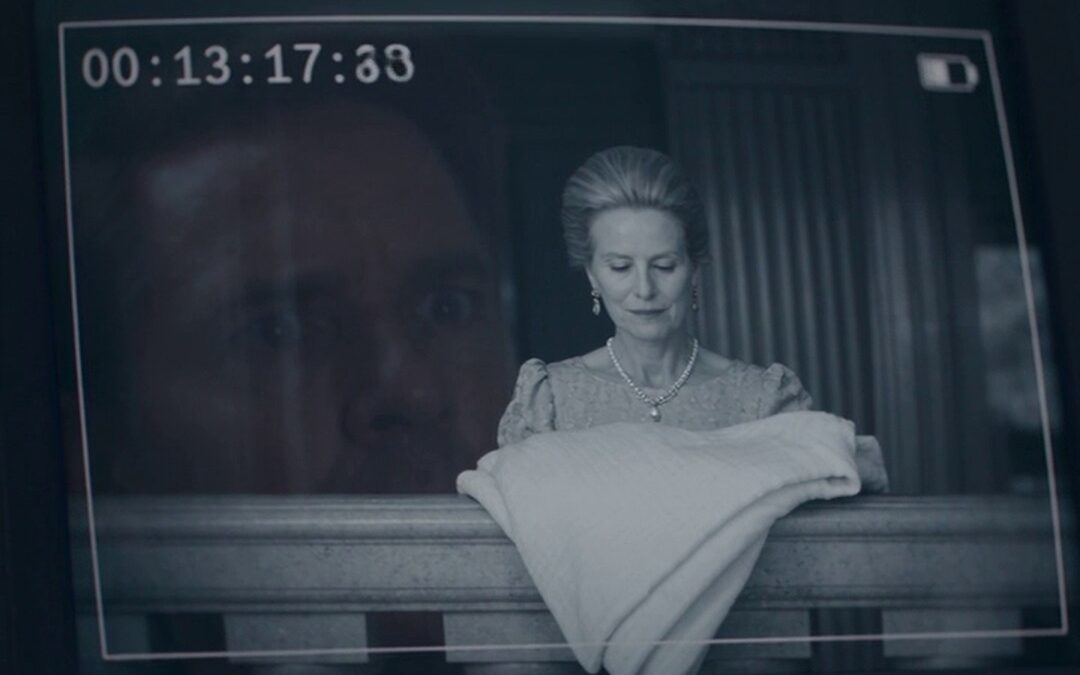
Now the upper view showed Theo’s blue blanket dragging over the balcony rail, with a figure behind it.
Richard bent toward the screen, and his expression changed before he touched the playback control.
The time in the corner read 4:17:22, and the last few seconds showed me crossing the marble only after Theo had begun to fall.
Richard entered the frame seven seconds later.
At the balcony, holding Theo just before the blanket slipped, stood his mother, Celeste.
She stepped back from the rail while I was still running, and in the instant before the live image replaced the recording, I saw her look down at us and then turn away.
Chapter 2: What the Camera Could See
The playback ended with Celeste disappearing into the upper hall, and I told Richard to leave the monitor alone while I gave the dispatcher the address again.
Theo was still crying against my chest, but the pauses between cries frightened me, so I kept one hand beneath his head and told the dispatcher he had fallen from the second-floor balcony and that I had caught him before either of us hit the marble.
She asked whether he was breathing, whether he had vomited, and whether I could see blood, and I answered only what I could tell from the floor: his breathing was fast but regular, he had not vomited, and there was no blood I could see.
His left arm was tucked between us, and when I tried to shift my own weight without moving him, he cried harder.
Richard reached down, and I turned my body around Theo.
“Move back,” I said, and he did.
My right wrist burned, my hip throbbed against the floor, and the left side of my face felt hot where Richard had struck me.
I told the dispatcher about the blow because my head had snapped sideways, and I wanted the paramedics to know why I might be dizzy even though I had not struck my head.
Sophie stood beside the console, staring at the empty balcony on the live feed, so I asked her to bring Theo’s stuffed rabbit from the bench without going upstairs.
She carried it by one ear and stopped several feet away, as if crossing the rest of the foyer might make someone shout again.
“You helped us,” I told her, and she set the rabbit within my reach.
I tucked it near Theo’s leg, clear of his face, and watched his fingers open and close against the blanket.
Richard asked whether he should call Celeste.
“Tell the dispatcher she was on the balcony,” I said, “and let the police speak to her here.”
He repeated it into the phone, then looked toward the stairs when a door clicked shut above us.
For a moment I thought he would go after his wife, but when I told him to stay where the paramedics could find him, he stopped on the first stair and came back down.
The ambulance arrived six minutes after the fall, followed by a patrol car, and the first paramedic through the door asked everyone except me to give him room.
I described the height, the catch, and the way Theo had cried while his partner checked Theo’s breathing, pulse, pupils, and response to touch.
Theo protested sharply when she touched his left shoulder, which hurt to hear and relieved me at the same time because his cries had grown thin.
The paramedics stabilized his neck, lifted him from me together, and secured him for transport while he remained awake and angry.
When my hands were empty, I found I could not straighten the fingers of my right hand without pain.
One paramedic examined my wrist, shoulder, hip, and face, then said I needed an examination too.
I wanted Sophie with us, but I could not promise her a place beside Theo’s stretcher, so I asked Richard to have Mrs. Bell stay with her until the officers knew where Celeste was.
Mrs. Bell appeared from the back hall with flour on her apron and took Sophie’s hand without asking her to explain what she had seen.
One officer stayed by the monitor while the other went upstairs, and I heard Celeste answer him from the nursery before the paramedics carried me out.
She sounded calm enough to say Theo’s name twice, then loud enough to ask why no one had called her sooner.
In the ambulance, Theo’s color stayed good, but he cried whenever the vehicle turned, and I watched the medic check him after each stretch of silence.
She did not tell me he was fine, and I was grateful for her caution even while I wanted certainty more than anything.
At the hospital, a pediatric team examined Theo and ordered imaging because he had fallen from a height, had been caught hard against an adult, and showed tenderness around his left shoulder.
The first examination found no sign of a serious head injury, but the doctor wanted repeated checks overnight because some injuries did not announce themselves at once.
An X-ray showed a small fracture of Theo’s left collarbone, and a nurse arranged his clothes so his arm could rest comfortably while the doctor explained what they would watch.
He drank a measured amount of milk without vomiting, then fell asleep with his uninjured hand curled around the rabbit’s ear.
A physician examined me in another room and found a sprained right wrist, a deep bruise on my hip, and tenderness in my left shoulder without a fracture.
She checked my jaw, hearing, and neck after I told her Richard had struck my left cheek, photographed the swelling with my permission, and wrote down my words.
I asked for copies of the records and a note about work because I knew how quickly an injury could become an argument about whether I had exaggerated it.
By the time I returned to Theo’s room, an officer was waiting to speak with me, and Richard had been asked to remain in the hall.
I told the officer that I had heard the blanket scrape first, looked up, and seen Theo already beyond the rail.
I could describe Celeste on the monitor, but I could not honestly say I had seen her let go, and I asked him to write down that difference.
I also described Richard’s blow, including the fact that I was holding Theo when he hit me.
When the officer asked whether I wanted a separate assault report, I said yes, though my stomach tightened at the thought of losing my job and the room above the garage that came with it.
I had worked for the family for three years, since Sophie was four, and both my health insurance and my rent depended on the salary Richard and Celeste paid me.
Those facts had not changed when he struck me; they had become harder to ignore.
Through the glass beside Theo’s door, I saw Celeste arrive with an officer walking several paces behind her.
She wore the cream sweater she had worn at lunch, and a narrow blue thread hung from one cuff.
I recognized the color of Theo’s blanket before I knew whether the thread meant anything.
Celeste stopped when she saw me, looked toward Theo’s crib, and asked the nurse whether he had suffered brain damage.
Her voice broke on the last word, and for a moment her fear seemed as plain as mine.
Then she looked at my wrapped wrist and said, “Mara, what happened to you?”
“The catch happened,” I said.
The officer asked Celeste to wait in a separate room until he had her statement, and she went with him while Richard took Sophie to a family waiting area.
Sophie looked back once, but Theo was asleep beneath a hospital blanket with a pulse monitor taped to his foot, and I stayed where he could see me if he woke.
Before we left the mansion, Richard had told the officer that he managed the security system, that Celeste also used the family app, and that its recorder stood in a small equipment closet beside his office.
I had stopped him from touching the playback again without knowing whether it was stored or only a few seconds of temporary memory.
An investigator called the hospital to tell me the recorder had kept the full camera feed and that officers had copied the relevant span with Richard’s permission while preserving the original files.
They had photographed the screen, noted the recorder model and its displayed time, and sealed the exported copy.
I asked how she knew the clock was right.
She said the recorder synchronized to the house network, but she was still comparing its time with the dispatch call and other records, so she would call it approximate until those checks were complete.
The camera had been installed the previous winter after Sophie wandered down the upper hall during a power outage, giving Richard a view of the stairs from his office and the kitchen.
Its wide lens looked from above the landing across the balcony and down into the foyer, with a strip of the library doorway at the bottom of the frame.
The foyer console showed that feed beside the front drive so staff could see deliveries, and Sophie sometimes watched herself cross the floor on her way to piano practice.
The camera could not see the balcony floor immediately behind the rail, and it recorded no sound.
It could show where I stood, when Theo came over, when Richard entered, and who held Theo at the railing, but it could not show what Celeste thought or what her fingers did behind the blanket.
I said that to the investigator when she arrived, and she wrote it down without telling me what conclusion she wanted.
She showed me two still images instead of making me watch Theo fall again.
In the first, I waited near the front door while Celeste held Theo above me, and in the second the blue blanket moved over the rail as my head turned upward several yards from the place where I caught him.
Richard appeared at the library door seven seconds after Theo began to fall, exactly as I remembered hearing him shout only after we were on the floor.
Sophie came into view from the music room moments later, where Mrs. Bell said she had been practicing scales.
The investigator pointed to a dark line along the balcony rail and asked whether I recognized it.
It was the bronze cap over the fastening screws, and one corner near the center had lifted enough to catch cloth.
I had told Celeste about it the previous week after Theo’s blanket snagged while I carried him along the upper hall, and I had covered the edge with clear protective tape until Richard’s maintenance contractor could repair it.
The blanket appeared to catch at that point in the still, though the lens could not show whether the tape remained in place.
The investigator asked whether I had touched the rail that afternoon.
I had photographed the loose cap at 3:42 to send to the maintenance contact, but I had not gone upstairs after giving Theo to Celeste at three thirty.
When I found the picture on my phone, it showed the tape peeling at one corner and the blue blanket hanging over the nursery chair behind me.
The image had been made for a repair, yet it placed the blanket in the nursery before Celeste took Theo and showed the rail’s condition before the fall.
I had told Celeste I would replace the tape that evening if no one could fix the cap sooner, and she had said, “Leave it; I’ll keep him away from there.”
At 4:08, she texted me, “Please take the front delivery yourself; I have Theo.”
The grocery order was small, only milk, lemons, and Sophie’s oat crackers, and I had waited in the foyer because Celeste said the driver would arrive around four fifteen.
The text established that she knew where I would be and that she had Theo nine minutes before the fall.
The investigator copied both the message and my photograph with my permission, then let me return to Theo.
His doctor later told Richard and me that Celeste had described Theo twisting suddenly while she tried to free his blanket from the railing.
The doctor offered no judgment about the account; she said the fracture was consistent with the hard catch or landing, the examinations so far showed no earlier injury, and Theo needed observation overnight.
Celeste had a plausible reason to be near the rail because she was his mother and was carrying him, and a loose cap could trap a blanket without anyone intending harm.
Her statement was more detailed than the part I had heard from the foyer.
She said she had carried Theo into the upper hall to calm him because he liked the light, rested the blanket on the rail while adjusting her grip, and lost hold of him when he lunged toward the hanging fabric.
She said she went to the nursery phone afterward to call for help but found the line busy because Richard was already calling emergency services.
Theo did reach for blue things, the cap was loose, and her empty place on the balcony could have meant she ran for the phone.
I still could not understand why she had not shouted down to us.
The investigator asked whether I had heard her call out, and I said no, though I acknowledged that the seconds around the catch were difficult to remember.
There were gaps in my memory, and I refused to fill them for either side.
Richard came to Theo’s doorway carrying a paper bag with my coat and shoes, which Mrs. Bell had gathered from the foyer.
The investigator remained beside me while I took it.
“I was wrong about what I saw,” Richard said.
“Yes,” I answered.
He looked at my left cheek and said, “I hit you while you were holding my son, and I’ve given the officer my statement.”
He said the family attorney had offered to arrange leave and pay my medical bills.
“My care is documented,” I said, “and I’ll decide what to do about the bills after I understand my rights.”
I told him to send any information about Theo’s health to my phone and speak through the investigator about the incident.
Richard said he understood and moved away from the door.
The bag also held the small green comb I used to straighten Sophie’s hair after piano lessons, and I sat with it in my uninjured hand while Theo slept.
At six forty, my phone rang from the mansion’s landline, and I let it go to voicemail.
“Mara,” Celeste said in the message, “I’m sorry this became frightening for everyone, and I hope you’ll let me explain before the police turn an accident into a story they can’t take back.”
She asked me to call her privately.
I saved the message and sent a copy to the investigator.
Celeste had used the word accident before anyone had finished checking her account, and I wondered what she meant by frightening for everyone when Theo was the one with a broken collarbone.
The investigator asked both parents to stop contacting witnesses about the fall and told me the police could arrange a time for me to collect my things once the house had been documented.
She did not presume I would leave the job or return to it.
At seven fifteen, Sophie was allowed a short visit with Theo after washing her hands.
She held the rabbit where he could see it without laying it over him, and he made the offended little sound he made when someone interrupted his nap.
“Is he staying here?” she asked.
“Tonight, so the doctors can keep checking him,” I said.
She looked at the tape around my wrist.
“Are you staying here?”
“I’m being checked too, but I’ll sleep somewhere else.”
She turned the rabbit in her hands and said, “I thought Mom was bringing him down.”
Richard stood at the door while I asked what made her think that.
“She said to put the blue blanket on the rail so he could see it from downstairs,” Sophie said, her face tightening as though remembering had broken a rule.
I did not ask her another question.
“You did the right thing pointing to the monitor,” I told her, “and the adults will handle the rest.”
The investigator had heard Sophie from the doorway, and she asked Richard whether a child interviewer could speak with her later about what she remembered.
Richard told Sophie she could say what she remembered without trying to help either parent.
Mrs. Bell took her to find dinner, and I told the investigator that Theo could not see the balcony rail from his usual stroller height in the foyer.
Sophie might have repeated a phrase without knowing whom her mother meant by it, but she remembered the blanket at the rail before any adult had asked her to explain the video.
I spent the next hour writing down the afternoon while it was still close enough to recall without reading Celeste’s version.
At breakfast, Celeste had made Sophie’s toast herself and listened to her describe paper birds she was making for school.
At noon, Celeste asked whether I could stay late Thursday if Richard needed to work, and I said I could with a day’s notice.
At three thirty, she came for Theo wearing the cream sweater, and at four I heard her speaking in Richard’s office with the door mostly closed.
I caught my name and the words “Thursday’s meeting,” which I took to mean the late shift.
Richard and Celeste had been living in separate wings for weeks, though they still ate dinner with the children, and I knew lawyers were discussing custody because I had signed an acknowledgment that I might be asked for scheduling records.
I had promised only to give accurate information about who cared for Theo and Sophie on any date I was asked about.
Celeste thanked me for being professional when I signed it, then began asking whether I had ever left Theo alone upstairs.
She had asked Sophie, in front of me, whether I let him crawl near the balcony, and Sophie had said I kept the safety gate shut.
The gate stood between the bedrooms and the balcony landing because Theo was crawling quickly, though he could neither open it nor reach the rail on his own.
The stored video showed it closed before and after the fall.
That did not establish Celeste’s intent, but it meant somebody had carried Theo past it.
Mrs. Bell told officers she had seen Celeste take him upstairs at 4:05 while crossing the back hall with a laundry basket.
She had seen neither the balcony nor the fall, and she had assumed Celeste was going to the nursery.
The limited observation placed Celeste upstairs while I was preparing Sophie’s snack downstairs, without asking Mrs. Bell to solve anything she had not witnessed.
At eight, Richard authorized police to examine the security system’s event logs, which recorded changes made through the family app.
The investigator reminded him that helping preserve the recording did not alter the separate report about his blow.
I heard that through Theo’s open door and felt a small, ugly relief that somebody had said it aloud.
Theo woke hungry and managed a few ounces of milk before sleep overtook him again.
I held the bottle with my left hand while a nurse supported his injured side, and when he closed his eyes she eased him onto the mattress without letting his head drop.
The quiet gave me enough room to feel my own fear.
If I had been closer to the stairs, or if my wrist had folded differently, I might have missed him.
At nine ten, the investigator returned with a preliminary reading of the system log.
At 4:12, someone using Celeste’s family account switched off motion notifications for the stair camera.
The change did not stop recording because the camera fed a local recorder that her account could not disable.
If Celeste believed the setting stopped recording, it might explain her confidence, but the change could also fit a mother silencing phone alerts during a baby’s nap.
The same account opened the camera settings again at 4:19, two minutes after the fall, without changing anything.
Celeste said she had been in the nursery then, trying to use the house phone.
The house phone showed no outgoing call between four and five, though the investigator wanted to confirm with the provider whether Celeste’s claim of a busy line was possible.
I remembered hearing a door close upstairs but could not tell whether it was the nursery door or the office door.
The camera’s blind spot included the short passage between them, and the investigator wrote down my uncertainty as carefully as she had written the rest.
At nine thirty, Richard asked to speak with me while the investigator stayed.
Celeste’s lawyer wanted him to issue a statement calling the fall an accident before morning, he said, and I asked whether he planned to sign it.
“No,” he said, “because I don’t know what happened at the rail.”
Seven hours earlier he had been willing to act as though he knew exactly what I had done.
He seemed to understand that I was thinking of it.
“I accused you without seeing the fall,” he said, “and I struck you while you held Theo; I’m sorry, and you owe me no forgiveness or conversation.”
I offered neither.
I asked him to put in writing that no family statement would name or imply me as the cause while the investigation continued, and to preserve every message and employment record concerning my work.
He agreed, and the investigator said preservation was expected regardless of my request.
When he left, I wrote down the time and his words while my left hand could still hold a pen.
Near ten, a child protection worker arrived to assess how Theo and Sophie could be kept safe while the adults’ accounts were examined.
She spoke with the doctors and each parent separately, then asked me about the children’s routines.
I told her Theo usually woke around midnight for a small bottle and settled if someone hummed the song Sophie called the train song.
I told her Sophie hated raised voices and would say she was fine while twisting the hem of her shirt.
Those details did not prove the fall, but they belonged in any plan that claimed to protect the children.
The worker asked whether I could continue caring for them during the inquiry.
“I’m injured, their father struck me, and I’m not deciding my employment beside Theo’s hospital bed,” I said.
She asked whether I had a safe place to sleep, and I texted my friend June, who replied that her door was open.
Celeste objected when the worker asked her to remain apart from the children while a temporary plan was discussed.
I heard her say nobody had accused her of hurting Theo, and the worker answered that conflicting accounts required caution before certainty.
Just before eleven, the investigator asked whether I would look at one still from 4:16.
Celeste stood at the rail with Theo against her left side and the blue blanket across her right forearm, with the safety gate shut behind her.
The frame could not show whether Theo struggled or what she intended to do next.
What caught my eye was the clear tape on the bronze cap: in my afternoon photograph a loose corner pointed toward the stairs, and in the still it appeared to be gone.
Officers had found a narrow strip of tape on the balcony floor near the cap.
It might have torn away when the blanket snagged, or it might have failed on its own, and the investigator would not guess from a photograph.
I asked whether the child interviewer could learn when Sophie heard the words about the blanket without making her watch the fall.
The investigator said that was the plan.
Theo’s midnight check went well: his pupils responded normally, he had not vomited, and the doctor said he could probably go home after a reassuring morning examination.
She showed Richard how to lift him without pulling his left arm and asked him to repeat the movement before letting him settle Theo.
I watched from the doorway because a person could be gentle with his child and still have hit me, and both truths would have to survive the night.
June arrived with a change of clothes and drove me to her apartment after I signed my discharge papers.
She saw the swelling on my cheek and said, “You can sleep first.”
I slept in pieces on her couch, waking whenever my wrist shifted.
At six thirty, a hospital message said Theo had passed his overnight checks, and I cried quietly before June came in from the kitchen.
Theo was safer, but I still did not know why he had been at the rail.
The investigator called at eight to say Celeste had given a fuller statement.
Celeste now said she had been moving Theo away after he pulled the blanket toward the rail, that notifications startled him when her phone sounded, and that she reopened the settings after the fall so emergency responders could see the live feed.
No responder had asked her to change a setting, and the officer who entered the foyer had seen the replay already on the monitor.
Her explanation still contained a possible accident, but its new details answered facts she had learned after her first statement.
I went to the hospital because I wanted to see Theo awake before another interview.
He had a soft sling holding his left sleeve against his body, and he gripped my left thumb when I leaned over his crib.
The doctor gave Richard warning signs to watch for and a follow-up appointment, rather than calling the danger over because Theo had passed the night.
A pediatric social worker asked who would care for him at home while his collarbone healed.
Richard said he would take leave, Mrs. Bell would help with meals, and a pediatric home nurse could teach them the lifting routine if the doctor approved it.
He did not ask me to return.
Sophie was eating dry cereal from a paper cup in the waiting area when I came out.
I sat two chairs away, and she moved over until her shoulder rested against my good arm.
“I told Dad to look,” she said, as if she were confessing something.
“You helped him see where everyone was,” I said, “and the grown-ups are taking care of the rest.”
I did not ask about the blanket because she was due to speak with a child interviewer, and I did not want her to learn a story from my questions.
At the station that afternoon, the investigator showed me a diagram made from measurements of the balcony.
The rail stood a little over twelve feet above the foyer, and the loosened bronze cap projected less than half an inch.
The blue blanket had been collected after paramedics removed it from Theo, and its torn corner matched the cap’s position and shape.
A strip of the clear tape bore blue fibers on its exposed side, while Celeste’s cream cuff carried small traces of adhesive.
Those facts supported contact among the blanket, rail, tape, and sweater, but they could also fit her account of trying to free a snagged blanket.
I said I wanted that recorded, and the investigator told me it already was.
Then she showed me the delivery receipt beside the camera times.
Celeste’s 4:08 text had sent me to the front door, but the driver’s location record showed he remained at the outer gate until 4:23, six minutes after Theo fell.
The grocery company had sent an updated delay notice to Celeste’s phone at 4:11, a minute before her account switched off the stair camera’s alerts.
She might have overlooked the notice, but she had information that could have released me from waiting below the balcony before she took Theo to the rail.
The investigator asked what I knew about Thursday’s meeting.
It was an interview with a custody evaluator, and the notice Richard had supplied listed me among people who might be contacted about the children’s daily care.
Worry about that meeting was understandable, but Celeste had asked whether I left Theo alone, sent me to the foyer, and changed a camera setting before the fall.
I had emailed my scheduling notes to the evaluator’s office that morning after checking them against my calendar.
The notes showed three afternoons when Celeste had been away from the house although she later told Richard she had been home with Theo.
I had not treated the difference as a charge against her; the evaluator asked who had cared for the children, and I answered.
My sent email proved the notes existed before the fall, though it did not prove Celeste knew their contents.
I gave the investigator a copy.
That evening, a woman from Celeste’s law office left a message saying the family hoped to support my recovery and avoid “unnecessary publicity around a tragic household accident.”
She offered to discuss paid leave and asked me to call before speaking further with anyone.
I forwarded the message to the investigator, then called a lawyer whose number the hospital social worker had given me.
My lawyer advised me to keep the message, schedules, pay records, and photographs, and to let her handle any proposed agreement.
I did not feel powerful when I hung up, but I no longer had to answer Celeste’s lawyer alone.
The child interviewer met Sophie the next morning without either parent present.
I was not in the room, and the investigator later shared only the part relevant to the fall.
Sophie remembered Celeste carrying Theo past the music room while she practiced and saying, “Put the blue blanket on the rail so he can see it from downstairs.”
When the interviewer asked whom Celeste had been speaking to, Sophie said, “Maybe herself.”
Sophie had looked up from the piano and seen her mother holding the blanket out over the balcony, then gone back to her scales because Celeste told her to finish.
She had not seen Theo fall.
She heard him scream, ran into the foyer, and pointed to the monitor because the picture showed where her mother had been.
Her memory did not establish intent, but it made Celeste’s claim that Theo had pulled the blanket toward the rail harder to accept.
I wanted Sophie allowed to be seven when the adults finished asking her what she knew.
By Friday, a technician had confirmed that the camera clock matched the dispatch system within two seconds.
The 911 call began at 4:17:39, seventeen seconds after the blanket first moved over the rail and ten seconds after Richard entered the frame.
Celeste’s family account was the only one used to open camera settings that afternoon, and Richard’s app stayed inactive until an officer asked him for access after the ambulance left.
The phone provider found no call from the nursery line and confirmed it was available while Richard called 911 from his cell phone.
Celeste might have lifted the receiver and failed to dial because she panicked, but she could not have heard a busy signal caused by Richard’s call.
The investigator said a mistaken memory and a deliberate lie had to be distinguished through the remaining evidence.
I had begun wanting a verdict with every new fact, and her restraint reminded me that wanting one did not make my guesses certain.
Richard’s attorney provided messages Celeste had sent him during the previous week, and the investigator read me the ones concerning my employment.
In one, Celeste wrote that I was “too close to the children to be objective” and should not shape the evaluator’s view.
In another, sent the day before the fall, she suggested that a lapse in my supervision would show how much Richard had relied on the wrong person.
Richard replied that he trusted my care and would not make the custody process about staff.
The message was not a plan to harm Theo, but it showed Celeste thinking of my supposed negligence as useful.
I remembered her watching me close the balcony gate twice that morning and saying lightly that I was making the upper hall look like a daycare.
She had also packed Sophie’s lunch and kissed Theo’s forehead.
I did not need her to have been cruel every hour to understand that she had put him at a dangerous rail.
Celeste agreed to another interview with her lawyer present.
She maintained the fall was accidental, said the alerts had interrupted Theo’s nap, and explained the nursery phone claim by saying she must have confused its sound with something she heard below.
She said she had not read the grocery delay notice until later and that Sophie misunderstood a sentence about bringing Theo downstairs.
Each answer might have stood alone; together they required the phone line, the delivery notice, Sophie, and the camera settings to be mistaken in ways that all favored her.
Celeste also told investigators I had been “collecting complaints” for the custody evaluator and might exaggerate what I saw on the monitor.
The evaluator’s office had acknowledged receipt of my notes to both parents that morning, which explained how Celeste knew of them during her interview without proving she knew of them before the fall.
I felt the old fear of being believed only after every other account failed.
Then I remembered the still of me waiting by the front door while Theo began to fall above me, and I knew the recording had preserved something my word alone had not been allowed to carry.
On Friday afternoon, the investigator asked me to identify routine objects at the house before officers released the rooms for use.
I went with my lawyer.
The marble had been cleaned, and Mrs. Bell had taped paper over the corner of the foyer monitor where Theo fell because Sophie kept looking there.
The feed still ran beneath it.
Upstairs, an evidence marker stood beside the loosened cap, and I identified Theo’s blue blanket by the initials I had sewn on after it was mixed up with another child’s blanket at playgroup.
Its faded pear-puree stain showed near the torn corner.
I told the investigator I washed it, not that I could interpret its fibers better than anyone else.
Richard’s office closet held the recorder in a ventilated cabinet labeled SECURITY in his handwriting, and a maintenance invoice showed the camera had been serviced three months earlier.
The machine had carried on doing its ordinary work while we acted on what we thought we saw.
My lawyer had received copies of my employment records and a notice that my pay would continue through the end of the month while I decided whether to return.
I told her I did not want taking pay for that period treated as a promise to stay or remain silent, and she said she would put my position in writing.
On the drive back, she reminded me that investigators might never establish every movement behind the rail.
The gap I feared most was intention.
The camera proved Celeste had held Theo there while I was below, but it did not prove whether she meant to release him, expected me to catch him, or lost her grip during a risk she had chosen to create.
When June asked that night what I believed, I said Celeste wanted a story in which I had failed Theo and had put him where that story could begin.
I could not say she wanted him hurt.
I could say she had accepted a risk he was too young to understand or refuse.
On Saturday morning, the investigator called with a message recovered from Celeste’s phone backup and supplied by her attorney after Celeste relied on another part of the exchange.
At 4:06 on the day of the fall, two minutes before Celeste sent me to the front door, she had written, “If Mara is shown to have left him where he could fall, will her notes still matter Thursday?”
Her attorney answered at 4:10 that no hypothetical incident should be created or discussed by text and that any real safety concern required immediate protection of the child.
The investigator said prosecutors and a court would decide what use could be made of the exchange.
I did not need to decide that legal question to understand its timing.
Celeste had asked how an unsafe incident attributed to me might affect my credibility eleven minutes before Theo fell.
At 4:12, her account changed the camera setting; at 4:17, she stood at the rail with Theo and the blanket while I waited below.
The message did not say she planned to drop him, but the accusation she needed had existed before the fall.
I asked why she would keep me in the foyer if she wanted to say I had left him upstairs.
The investigator said Celeste might have expected me to run upstairs afterward, or she might have expected a dispute over where I had been without knowing the recorder still ran.
Both were possibilities, not facts.
I thought of Mrs. Bell in the back hall, Sophie at the piano, Richard behind the library door, and me waiting for a driver who had already been delayed.
Ordinary instructions had put us in separate places, and only the camera had held those places together.
When investigators asked Celeste about the 4:06 message, she said she had worried I might mishandle Theo because the custody process distracted me.
She claimed the fall proved her fear reasonable and said she had been trying to prevent the danger she had described.
She did not explain why she had told me Theo was with her, carried him through a closed safety gate, and placed his blanket over a damaged rail she knew I had reported.
Her lawyer ended the interview without a confession, and I learned its outline afterward from the investigator.
The prosecutor sought a temporary protective order keeping Celeste from unsupervised contact with Theo and Sophie while the child safety inquiry continued.
The order did not decide whether she had intended the fall or settle custody.
Celeste stayed with her sister pending a hearing, and Richard agreed to a separate safety plan for the children at home.
A pediatric nurse visited to teach him and Mrs. Bell how to dress and lift Theo without pulling his injured arm.
Sophie was offered a counselor through her school, where she would not be asked to choose between her parents.
The district attorney would review the records and interviews before deciding what charges the evidence supported.
Richard’s blow remained a separate assault report.
An officer photographed my cheek again when the bruising deepened and told me that report would also go for a charging decision.
Richard did not ask me to withdraw it.
I could not tell whether that was conscience, legal advice, or both, and I did not owe him an interpretation that made him easier to live with.
On Sunday, my lawyer and I sent a letter resigning my position effective immediately.
I wrote that I would answer investigators’ questions and provide the children’s routine notes if requested, but I would not work in the house or accept direct contact from either parent about the incident.
I asked for my final pay, unused leave, and a time to collect my belongings while neither parent was present.
Richard’s attorney confirmed the arrangements without asking for a statement of thanks.
I had loved parts of that work.
Sophie had learned to braid the green yarn for a school project by watching me braid her hair, and Theo quieted when I hummed the train song badly enough to make her laugh.
Leaving them hurt, but returning as their nanny would have made my safety and my testimony depend on the household that had accused and struck me.
I could care about the children without giving their parents that power again.
The next morning, Mrs. Bell let me in through the side door at nine.
The house was full of people moving quietly: a nurse rinsing Theo’s bottles in the kitchen, a maintenance worker waiting outside the upper hall, and a lawyer carrying papers into Richard’s office.
No one said Celeste’s name.
Mrs. Bell called the upper rooms “the rooms” and the cream sweater “the sweater,” though it had already gone into an evidence bag.
Richard had taken Theo and Sophie to Theo’s follow-up appointment, as I had requested, so my lawyer and I went to my room above the garage with a rolling suitcase.
My uniforms took little space.
I packed the drawing Sophie had made months earlier of Theo, herself, and me beneath a blue square she called the sky, because she had given it to me.
When we crossed the foyer on our way out, the monitor showed a worker testing the repaired bronze cap while Mrs. Bell checked the safety gate from the landing.
The paper still covered the corner of the screen Sophie feared, but the live view held both adults in the same ordinary frame.
Mrs. Bell handed me an envelope with my final pay record and said Sophie had asked if she could write to me.
“She can send a letter through my lawyer,” I said, “and I’ll answer without asking her to carry messages for anyone.”
Mrs. Bell nodded and went toward the kitchen when Theo’s bottle timer sounded.
At the front door, I heard the gate click shut above me and watched Mrs. Bell test its latch on the monitor before I stepped outside.