I Caught Their Falling Baby, Then His Father Slapped Me While I Begged Him to Call 911
Chapter 1: The Sound Before the Fall
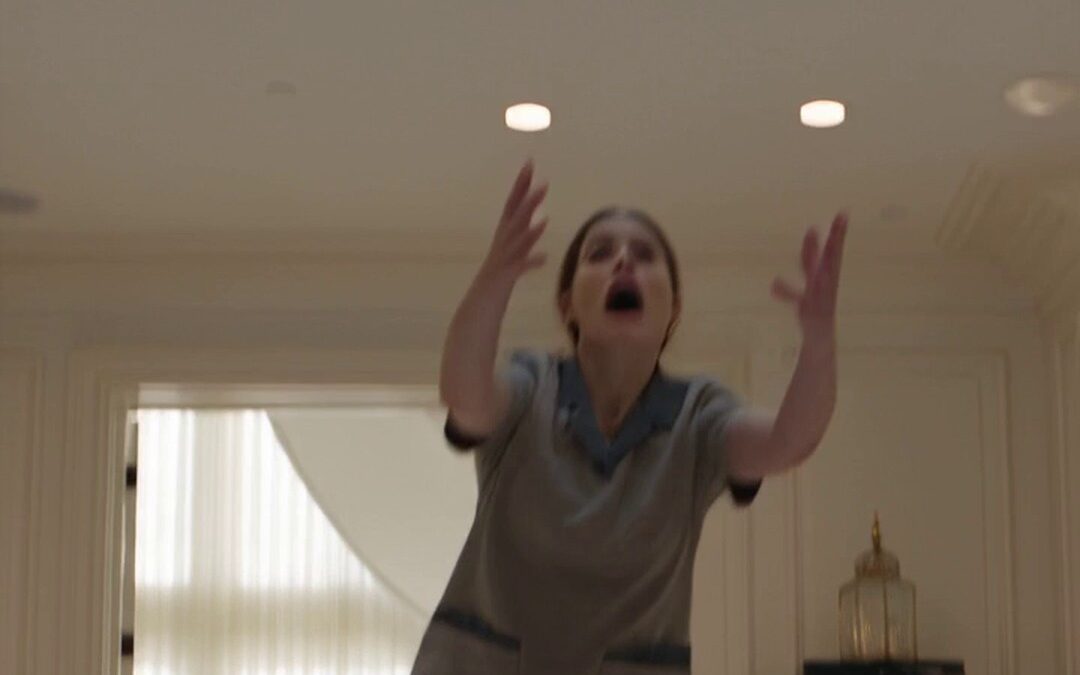
I heard the baby’s blanket slip across the balcony rail before I looked up, a soft dragging sound that sent me running across the marble foyer as the pale blue cloth appeared above me and eleven-month-old Noah tipped into the open air.
I reached him with both arms just as he fell past the chandelier, caught him against my chest, and went down hard on my right shoulder and hip, turning so my body took the marble while I kept his head tucked beneath my chin.
For one second he made no sound, and I pressed two fingers to the back of his neck as I begged him to breathe.
His cry came thin and furious, followed by the front door opening and Richard’s shoes striking the floor behind me.
He had missed the balcony, the fall, and my run, and he saw only his son in my arms and me sprawled beneath the upper landing.
“What did you do to him?” he said, reaching for Noah.
“He fell, and I caught him,” I said, keeping Noah supported as Richard pulled at my elbow.
From above us, Claire called, “I told her not to leave him up here.”
Richard struck my left cheek with his open hand, once, hard enough to turn my face, while I was still holding his son.
I held on to Noah and said, “Call 911 now, and don’t touch me again.”
Noah coughed against my collar, then cried louder, and Richard stepped back with his phone in his hand.
Sophie came from the library hall in her socks, stopped at the sight of her brother, and pointed past her father to the security monitor on the foyer console, where the live view of the upper landing still glowed.
“Daddy, look before it goes away,” she said.
Richard glanced at the screen while he gave the dispatcher our address, and I watched his face change.
The camera covered the balcony and most of the foyer because Claire had wanted to see whether Sophie wandered upstairs after bedtime, and its replay strip showed the seconds we had just lived.
At 4:12, I was visible below, walking toward the console with Noah’s bottle, while Claire stood at the rail with Noah against her shoulder.
The blanket slid, Noah moved beyond her arms, and only then did I run.
Richard lowered the phone far enough to look up at his wife.
On the screen, just before Noah fell, Claire had lifted him onto the broad stone cap of the railing.
Chapter 2: What the Camera Could See
Richard kept looking upward until the dispatcher asked him to repeat whether the baby was breathing, and I answered for him because Noah’s cries had weakened into a frightened, uneven whimper against my neck.
I gave my name, told her Noah was eleven months old and had fallen from the second-floor balcony into my arms, and described the height as roughly fourteen feet because I knew the distance from carrying laundry beneath that rail every day.
She told me to keep him still, support his head, and watch his breathing, so I sat where I had fallen and let the cold marble hold me upright while pain spread from my right shoulder into my neck.
Claire came down the stairs without hurrying, one hand sliding along the banister, and her face tightened when she saw the replay running on the console beside Richard.
“He slipped while I was trying to get him back from the rail,” she said, which was the first account she gave in front of me and the only one I would hear from her for several hours.
I wanted to ask why she had put him there, but Noah had stopped crying long enough to frighten me, and I used my good arm to shift him no more than I had to so I could see his face.
He blinked, drew a breath, and pressed his wet mouth against the shoulder of my blouse, looking for the bottle I had dropped somewhere across the floor.
“The ambulance is coming,” I told him, as I did when I rinsed shampoo from his hair, though this time my voice shook so badly that I barely recognized it.
Richard knelt a few feet away and held out his hands, then stopped when I pulled Noah closer.
“Let them take him when they get here,” I said, and he lowered his hands without arguing.
Sophie was still beside the library doorway, her small fingers hooked through the hem of her sweater, and I asked Richard to have her wait with Mrs. Alvarez in the kitchen.
Mrs. Alvarez had worked as the family’s housekeeper for six years and had been carrying folded towels from the laundry room when she heard the commotion, so she met Sophie in the hall and led her away without asking the child to explain it.
I heard the ambulance siren through the front windows less than eight minutes after the fall, though later, when I looked at the dispatch record, I learned that the minutes had felt much longer than they were.
The paramedics came in with a stretcher, a bag, and the calm urgency of people who could see that a baby might have injuries no one in the foyer could recognize.
I told them exactly how I had caught Noah and where I had landed, and I let the nearer paramedic take him only after she had both hands beneath his head and body.
She checked his airway, breathing, pulse, pupils, and limbs while her partner asked whether he had cried immediately, vomited, lost consciousness, or struck any part of the railing on the way down.
“I don’t know whether his head touched the rail,” I said, because the blanket had blocked my view for part of the fall and guessing would have done him no good.
A faint red mark ran across his upper left arm, and he winced when the paramedic touched it, but he kicked both legs and reached toward the bright patch on her jacket.
They fitted him with a child-sized collar as a precaution, secured him for transport, and told Richard that a hospital would need to assess him for head, neck, and internal injuries.
Richard said he would ride with Noah, then looked at me as if the right to decide who went had suddenly become uncertain.
“He’s your son,” I said, “but I need the hospital to know what happened, and someone needs to stay with Sophie.”
Mrs. Alvarez said she could stay with Sophie until Richard’s sister arrived, and the paramedics agreed that I should be assessed as well because I had taken the impact and had been struck in the face.
When one of them asked whether I felt safe in the house, Richard closed his eyes, and I told her plainly that Richard had hit me while I held Noah.
She repeated my words into her report, asked whether I had been hit anywhere else, and examined my cheek without making me defend why I had mentioned it.
Claire stood beside the staircase with her arms folded, watching the stretcher leave, and said she would follow in her own car because Noah might need clothes.
The paramedic asked her to bring his pediatric records if she had them, but Richard told Claire to remain at the house until someone could speak with her about the balcony.
It was the first useful thing he had said since making the emergency call, and it still left me with the fact that I was going to a hospital because he had struck me after I saved his child.
In the ambulance, Noah cried when the straps tightened and quieted when I hummed the tune I used while changing him, although I sat on the opposite bench and could not touch him.
His eyes followed me, which gave me something ordinary to hold on to while the medic checked his breathing again and asked me the same questions in a different order.
At the emergency department, staff took Noah into a pediatric trauma room and moved me to a curtained bay nearby, where a nurse recorded my shoulder pain, the swelling on my cheek, and the tenderness along my right hip.
A doctor asked about dizziness, nausea, and gaps in my memory, examined my neck and shoulder, and ordered imaging because my arm hurt too much to raise and the fall had driven me into a hard surface.
Richard stayed with Noah until a nurse came to ask who had legal custody and whether there were any restrictions on contact, and I could hear him answer through the curtain in a voice that had lost its certainty.
I had worked for the Vales for twenty-one months, long enough to know which cup Sophie would use when she felt sick and which song settled Noah at three in the morning, but I had no authority to sign his medical consent.
That distinction had rarely mattered during bath time or breakfast, and in the hospital it mattered with every door that closed between us.
The doctor returned to tell me my shoulder was badly bruised but not fractured, my hip had a deep contusion, and my cheek was swollen without a broken bone.
She gave me written instructions to watch for headache, vomiting, confusion, or worsening pain, and she documented Richard’s blow separately from the injuries caused by catching Noah.
I asked her to photograph the cheek while the swelling was visible, then asked for a copy of the record, because the image of Richard’s face changing at the monitor had not erased what he had done before he looked.
A hospital social worker introduced herself and said that, given Noah’s fall and the conflicting accounts of how it happened, the hospital had contacted child protective services and the police.
I said I expected that, then told her I wanted my statement taken apart from Richard and Claire.
She wrote down my request, asked whether I wanted an advocate present, and arranged a quiet room where I could speak without either parent in the doorway.
I had just finished describing the sound of the blanket when a nurse stepped in to say Noah was stable, alert, and being monitored while the doctors decided what imaging he needed.
His first examination showed no obvious head injury or abdominal tenderness, she said, but he had bruising on his arm, and they would keep checking because a normal first examination could not settle a fall like his.
I pressed my palms together until the nurse had gone, then let myself cry for less than a minute because I had been holding fear in my teeth since the marble floor came up to meet us.
The officer who came to take my account was Detective Mara Chen, accompanied by a uniformed officer who stayed outside, and she began by asking me what I had seen rather than what I thought Claire had meant to do.
I told her where I had been walking, where the bottle had landed, how Noah had moved in the air, what Claire had said, and how Richard had struck me.
When I reached the monitor, I stopped myself from saying the recording showed Claire throwing him, because what I had seen was Claire placing him on the rail and Noah falling after her arms moved away.
Chen asked whether I had touched the console after the fall, and I said I had not, though Richard had used the replay strip while still on the phone with the dispatcher.
She wanted the original recording preserved, and I gave her the name of the company that maintained the house cameras because I had been there when its installer replaced the foyer lens in June.
The system had been fitted two years earlier after Sophie began leaving her room at night and nearly fell on the stairs, and Claire had asked for the upper landing and the staircase to be visible from a monitor in the foyer.
A single wide camera mounted above the library door covered the foyer below and the north balcony above it, leaving the upstairs bedrooms out of view and preserving a broad blind corner beyond the balcony’s far end.
The monitor on the console showed that feed live, with a short replay bar, while a recorder in the locked utility cabinet stored the full files on the house network.
I knew those facts because I used the monitor each evening to see whether Sophie had crossed the landing after bedtime, and because Claire had shown me the replay control when Sophie once hid behind the staircase at cleanup time.
Chen asked who could reach the utility cabinet, and I named Richard, Claire, Mrs. Alvarez, and the security company, though the first three of us had no reason to open it during an ordinary day.
I could not say who knew the administrator password, and I told her so.
By the time she left to arrange preservation of the recorder, my shoulder had stiffened enough that lifting a cup with my right hand made me gasp.
A nurse brought me water, and I asked whether anyone had told Sophie that Noah was alive and being cared for, since the last thing she had seen was him strapped to a stretcher.
The social worker had spoken to Mrs. Alvarez, the nurse said, and Richard’s sister Helen was on her way to sit with Sophie at the house.
That gave me enough room to notice that I still had a smear of Noah’s formula on my left sleeve and a tiny blue thread from his blanket caught under one fingernail.
I left the thread where it was until Chen could see it, then let the nurse help me wash my hands.
Later that evening, Richard’s attorney tried to reach the hospital security desk for the camera file, and Chen told him that detectives had already asked the household to stop using the system until a technician could make a documented copy.
The technician did not arrive with a miraculous new angle or a verdict, only with the password information Richard supplied and a way to export the original footage while recording its file details and the recorder’s clock.
When Chen explained the process to me the next day, she was careful to say the export had kept the minutes before and after the fall, not just the few seconds Richard had replayed.
The recorder clock was forty-three seconds ahead of the dispatch system’s official time, a difference the technician measured and noted rather than silently correcting.
That mattered because Claire would later say she had been calling for help before Noah went over the rail, and a difference of less than a minute could make a frightened voice seem to come before or after an action.
The wide image showed me entering the foyer at 4:12:04 on the recorder clock with Noah’s bottle in my right hand, then stopping under the balcony when the blanket began to slide.
It showed Claire on the upper landing with Noah and Sophie entering the library hall several seconds before I ran, so Richard’s later arrival could not be mistaken for a figure on the balcony.
At 4:12:11, Noah moved beyond the railing, and at 4:12:14 I caught him near the foot of the stairs.
Richard came through the front door at 4:12:25, after I had gone down with Noah and after Claire had moved away from the rail.
Those times did not tell Chen why Claire had lifted Noah onto the stone cap, whether her grip had failed, or what she had believed would happen below.
They did show that I had been on the foyer floor with a bottle when the danger began, which made Claire’s claim that I had left Noah upstairs with her a question about my duties rather than an account of who had let him fall.
I thought the distinction would feel like relief, but it mostly made me angry that a screen had been allowed to speak before my own words carried any weight.
The hospital kept Noah overnight for observation after a head scan showed no acute bleeding and the rest of his examinations remained stable, and a pediatric specialist checked the bruising on his arm against the fall described by the adults.
No one called him unharmed, and every time a monitor sounded behind a door I looked up from my chair because a baby can worsen after seeming to settle.
A nurse let me see him briefly with Richard present, and Noah reached for the zipper of my jacket the way he always did when I came in from outside.
I let him hold the little metal tab while I sang half a line of his bedtime song, then handed it back gently when he tried to pull it into his mouth.
Richard stood beside the crib without asking me to forgive him, which I appreciated only in the narrow sense that I could bear the room long enough to look at Noah.
Before I left, he said, “I told the social worker I hit you, and I told her you caught him.”
“You need to tell the police,” I said, and he answered that he already had.
I did not ask whether he had described the force of the blow, because the nurse’s photograph and my cheek would answer that if his words did not.
Claire arrived at the hospital after dark with a neatly packed bag of Noah’s clothes and a written statement she had prepared for the police.
She told staff that she had been trying to lift Noah down from the rail when the blanket tangled around her wrist, that I should have been upstairs supervising him, and that she had screamed for me when she saw him slip.
The nurse did not argue with her in the hallway; she directed Claire to the social worker and kept Noah’s room closed while the adults’ accounts were being sorted out.
I heard Claire’s version from Chen, who asked me whether a blanket had ever caught around Claire’s wrist earlier in the day and whether Noah had been able to climb onto the rail by himself.
“He couldn’t climb there,” I said, “and I didn’t see the blanket on her wrist before he fell.”
The blanket itself belonged to Noah, a cotton knit square with a blue binding that he rubbed between his fingers when he was sleepy, and I had wrapped it around him after his nap at three.
Its binding had frayed near one corner the previous week, and I had meant to mend it when I finished my shift, a small undone task that made my stomach turn when I thought of it caught on the rail.
Chen said officers had photographed the balcony before touching anything, including a loose brass screw at the underside of the stone cap and blue threads hooked around it.
A snag there might explain why the blanket had slipped unevenly and why Claire had lost a secure hold, if she had ever had one.
It might also explain why a person placing Noah on that cap had expected the blanket to stay put and had been wrong, which was an uglier possibility I kept to myself until there was more than an image to support it.
Claire’s counterclaim protected her for a while because it contained part of the visible truth: she had been at the rail, the blanket had caught, and her hands did move toward Noah as he began to leave her reach.
She also knew how to sound like a frightened parent without supplying a motive, and people who had known her for years could picture her making a terrible mistake more readily than making a plan.
Richard’s mother called him twice that night and then called me once, though I let the phone go to voicemail because she had never called me outside a schedule change.
Her message said she hoped I would “avoid making accusations while emotions were high,” and that the family would cover my medical bills whether I remained employed or not.
I saved the message and listened to it again only to be certain that she had not asked how my shoulder felt.
The money mattered because I rented an apartment with my younger sister and could not lose a month’s wages without rearranging both our lives.
That vulnerability had made me careful at work, but it had never made me willing to say a child fell by himself when an adult had placed him in danger.
At nine that evening, Helen called from the house to say Sophie had eaten toast, put on her pajamas, and asked whether Noah would remember falling.
I told Helen a doctor would have to answer questions about his recovery, and I asked her to tell Sophie only that Noah was being cared for and that she had helped the adults look at the right thing.
Helen said Sophie had asked if her mother would be angry that she pointed at the monitor.
I closed my eyes, picturing Sophie’s hand stretched toward the screen while Richard spoke over her, and said that Sophie should hear from an adult she trusted that telling them what she saw had been the right thing to do.
I had known Sophie since she was five, when she sorted her crayons by whether their names sounded like foods, and I had learned that she asked a question twice only when the first answer left something frightening inside it.
No one should have put her in a position where she had to choose between her brother’s safety and her mother’s approval.
The next morning, Chen asked whether I would speak to a child interviewer before Sophie was interviewed, so the interviewer could understand Sophie’s ordinary routines without having an adult feed her an interpretation.
I described the library, the foyer monitor, and the way Sophie used the hall clock’s chime to decide when to wash for dinner.
I also told her that Sophie had passed through the library hall on the camera before the fall and had pointed to the monitor afterward, but I did not tell the interviewer what I hoped Sophie might say.
Sophie later made one useful observation in her own words, as Helen told me after the interview had ended: “Mommy put the little white box in her pocket and said the beep was off.”
The interviewer had asked what Sophie remembered before the noise, and Sophie had described standing by the library shelves while Claire walked past with Noah and a white remote she called the little box.
Sophie did not know what the remote controlled, had not watched anyone press a button, and had waited to speak because Claire had told her to stay in the library until Richard came home.
She had pointed at the monitor because she had seen her mother upstairs on its live picture while the adults in the foyer argued about me.
That was all the child needed to contribute, and Chen did not ask her to prove anything else.
I knew the white box: a palm-sized control for the balcony door alarm, installed after Noah learned to crawl so the door would sound in the kitchen and the foyer if someone opened it.
Claire usually kept it on a hook beside the upstairs linen closet, though I had seen it missing that afternoon when I carried a fresh blanket to Noah’s room.
At the time, the empty hook meant nothing more to me than Claire checking a battery or Mrs. Alvarez using the control while cleaning the balcony doors.
After Sophie spoke, the missing remote began to matter, though its location still did not prove who had turned off the alarm or why.
Chen asked the security company for the alarm history, and its service record showed the balcony door alert had been silenced at 4:03 that afternoon from the upstairs remote, with no new battery fault.
The record did not identify the hand holding it, and the remote had been found in Claire’s coat pocket only after officers asked her where she had put it.
Claire said she silenced the alarm because Noah was asleep and she intended to carry him onto the balcony for air, a reason I could almost hear her giving on any other day.
She had taken him outside to settle him twice that summer, and the alarm’s sharp beep had sometimes made him cry.
It was only when the timestamp was set beside Sophie’s account and the footage that the ordinary act changed shape: Claire had removed the warning shortly before carrying Noah to the rail.
I had spent most of the morning after the fall trying not to replay my own route through the foyer, but a calendar reminder on my phone brought back why I had been walking with Noah’s bottle instead of standing upstairs.
At 3:48, Claire had texted me from the house account, “Leave his bottle on the foyer console before Richard gets home; I’ll bring him down.”
She had never before asked me to leave Noah’s bottle there, because he usually drank it in the kitchen chair where I could see how much he took.
I had read the message as one of her small changes to the afternoon schedule, annoying but harmless, and I had put the bottle in the warmer while I folded Sophie’s school sweater.
I showed Chen the message on my phone with its time and sender visible, then forwarded an exported copy through the evidence portal she gave me.
Claire said she had sent it because she planned to feed Noah downstairs, which was possible, but it also placed me directly beneath the camera’s view at roughly the time she took him to the balcony.
What she had expected me to see or do there remained uncertain, and that uncertainty frightened me more than a neat explanation would have.
The day before, Claire had asked whether I still wrote my daily notes in the green notebook I kept in Noah’s nursery drawer.
I had said yes, because his pediatrician wanted his feeding and sleep patterns tracked after a week of stomach trouble, and because I recorded which adult took him when my shift ended.
Claire had turned a page with her fingertip and stopped at the entry for Wednesday, when she had asked me to leave Noah with Sophie for ten minutes while she took a call outside.
I had refused, stayed with him, and written down the request because it affected his care.
She had told me that written notes could make an ordinary mother sound negligent, and I had answered that I recorded care, not judgments.
Two days later, Richard had asked to see the notebook while he and Claire discussed who would manage the children’s routines if they separated.
I had not known they were planning a separation until that question, and I had told him I would give the notes to both parents if they needed them for Noah’s doctor or a formal arrangement.
I had also said I would answer honestly if anyone asked who had cared for the children on a particular day.
Claire had heard me, standing in the nursery doorway with a clean stack of washcloths, and her expression had been as controlled as it was when a guest arrived early.
That exchange did not prove she later endangered Noah, and I would not let it become proof merely because the balcony footage made me afraid of her.
It did explain why I, rather than another employee, had become inconvenient at the exact moment she was trying to shape a story about the children’s safety.
Richard and Claire had retained separate lawyers the previous week, and a temporary parenting conference was scheduled for Monday, according to the documents Chen later reviewed with permission from the people who held them.
The dispute was narrow but fierce: Claire wanted to take Sophie and Noah to her parents’ home in Connecticut for the school term, while Richard wanted them to remain in their familiar house until the adults agreed on care.
My green notebook mattered because it recorded that Richard, despite his long workdays, had arranged consistent care through me and Mrs. Alvarez, while Claire’s account to her lawyer described me as unreliable and often absent.
I was not a custody judge, and I had no wish to become the hinge of a marriage, but I could see why a record of ordinary mornings had acquired a price.
On Friday, the day before the fall, Claire had asked me to sign a short statement saying I sometimes left Noah alone on the upper landing while I fetched supplies.
I had said I could not sign it because I had never done that, and she had folded the paper into her folder without raising her voice.
When Chen asked for the folder, Claire initially said the page was a private draft for her attorney and had no bearing on the accident.
Her attorney arranged for relevant material to be produced after a warrant and a review of what was privileged, a process that took longer than a dramatic demand in the foyer would have done.
The unsigned statement itself was not a confession, but it showed that Claire had been trying to place a specific version of my conduct on paper before Noah fell.
She had also told Richard that morning I was “getting careless near the stairs,” using a complaint about a bottle I had dropped the week before as evidence.
I had dropped the empty bottle while reaching for Sophie, who had slipped on a wet stair tread, and Mrs. Alvarez had watched me catch Sophie before she fell.
Until the balcony, Richard had not treated the remark as a reason to dismiss me, but it was waiting in his mind when he opened the front door and saw Noah in my arms on the floor.
Knowing that did not make his blow understandable in any forgiving sense; it showed how easily a planted suspicion and his own willingness to use force had worked together.
When Chen interviewed Mrs. Alvarez, she confirmed the earlier stair incident and described hearing the balcony door’s usual beep on other afternoons but hearing none before Noah fell.
She had been in the laundry room with its door closed, so she could not claim the alarm was silent throughout the house, and Chen wrote down that limit with her observation.
Mrs. Alvarez also remembered seeing Claire carry a folded pale blue blanket upstairs at 3:55 while Noah rested against her shoulder.
She had thought Claire was taking him to his room, which was a reasonable thought because the same stairs led to the nursery.
No witness had watched Claire position Noah at the rail before the camera did, and I was grateful for every careful “I don’t know” in the interviews because the case had begun when Richard refused to leave room for one.
The doctors discharged Noah the following afternoon with instructions to watch for unusual sleepiness, vomiting, breathing trouble, feeding changes, or new pain and to follow up with his pediatrician.
His head scan remained clear, his examinations stayed stable, and the bruise on his arm was expected to heal, but the discharge papers treated the height of the fall seriously.
Richard arranged for Helen to take both children to her house under a temporary safety plan approved by the child protection worker, with Claire seeing them only under supervision until the investigation established more.
I heard that from Helen rather than Richard, and I told her which sleep sack fit Noah without pressing against his bruised arm.
She paused before thanking me, as though practical knowledge from the nanny they had nearly blamed had become difficult for the family to accept.
I spent that afternoon at my apartment with ice on my shoulder, trying to button a shirt with one hand while my sister watched me do it badly.
She asked whether I would return to work, and I said I could not decide employment while Noah was still in a hospital crib and the people who paid me controlled the story in the house.
Then I called a lawyer recommended by the hospital advocate, because Richard’s slap, my medical bills, and the possibility of losing my job were separate matters from whether Claire had committed a crime.
The lawyer listened without promising a result and helped me send a written notice that I was taking medical leave, preserving my right to wages owed, and would not enter the Vale house or meet Richard alone.
I signed it with my left hand resting under my sore right wrist, then felt a little of the fear loosen because a boundary had become something more durable than a sentence in a hospital hall.
Richard replied through counsel that he would pay my wages during leave and preserve my position until I decided what to do.
I accepted the wages I had earned and the leave available under my contract, while my lawyer made clear that payment did not settle the assault or buy a change in my account.
No one asked me to negotiate with Claire, and I would not have done it if they had.
On Sunday, Chen asked whether I could identify a small metal shape visible at the far end of the balcony in the minutes before the fall.
The camera’s broad view could show Claire’s figure and Noah against her shoulder, but it could not resolve the shape beneath the rail, and I told Chen I would need to see the physical space.
She arranged for me to walk the foyer after officers had documented it, with my lawyer present and both parents away from the house.
The marble had been cleaned, but I could still point to where the bottle had rolled beneath the console and where I had landed with Noah between my arms.
From below, the broad stone cap looked like a shelf, though the balcony was designed as a barrier and not a place to set a child.
At the far end of the railing, a brass screw held a narrow trim strip in place, and blue fibers remained snagged there inside an evidence marker.
The metal shape in the recording was a small silver rattle Noah liked, visible on the stone cap before Claire arrived at the rail.
I had seen him reach for that rattle from his high chair, and I knew its bright sound could turn his head even when he was sleepy.
Claire had said in her written account that she carried him onto the balcony because fresh air calmed him and that he lunged unexpectedly toward the courtyard.
The rattle’s position suggested another reason for his sudden movement, but it could have been left there earlier, and I said so.
Chen asked when I had last seen it, and I remembered putting it in the basket near Noah’s play mat after lunch, before Claire took him for his nap.
The basket had been in the nursery, not on the balcony, and my memory of putting the rattle there was mine alone until Mrs. Alvarez recalled hearing it when she moved the basket to vacuum at two.
Officers photographed the rattle and checked it for prints, but Chen warned me that prints could show who had handled a baby’s toy without proving when it had been placed on a railing.
The camera later supplied part of the timing: in the wider preserved footage, Claire crossed the upper landing at 4:01 with the rattle in one hand and returned two minutes later without it.
The far corner remained partly hidden, so the recording did not show her set it down, but the object was visible on the cap when she brought Noah to the rail at 4:10.
Those minutes also put the alarm’s silence in sequence: first the rattle went upstairs, then the balcony alert was switched off, then Claire came back with Noah and his blanket.
I stood in the foyer beneath the camera and felt the slow, cold difference between an accident that could happen once and a series of choices made while there was still time to stop.
Chen asked whether I knew any reason Claire would put Noah near the rail even if she intended to pull him back.
I told her I knew what Claire wanted from me before the parenting conference and what she had asked me to sign, but I could not tell Chen which outcome Claire had expected when Noah went over.
That remained the hardest part for the adults to face, because an explanation that made the act seem less terrible had to live beside the fact of a baby falling fourteen feet.
Claire’s lawyer said the sequence was consistent with a mother taking a child onto a balcony for air, silencing a startling alarm, bringing a toy to comfort him, and making an unforgivable mistake when he reached for it.
The account was specific enough to test, and I was relieved the investigators tested it rather than treating the camera as a window into Claire’s mind.
In her first statement, Claire had said she carried Noah out already wrapped in his blanket and that he slipped as she tried to lift him down from the cap.
In her later interview, after learning what the preserved minutes showed, she said she had placed the rattle there to distract him from the alarm and had set him on the stone only for a second while she adjusted the blanket.
Neither account explained why she needed both hands free at the rail, and neither matched the video of her keeping one hand beneath the blanket until she moved it away from his body.
The camera could not show the pressure of her grip, and Chen did not pretend it could.
The blanket offered a smaller, firmer fact: fibers from its worn blue binding were wound around the screw beneath the cap, while the intact part of the blanket lay over the stone above.
An examiner could say the binding had caught as the blanket moved across that edge, but could not say whether Claire noticed the snag or relied on it to hold the blanket.
Claire had called it a tangle around her wrist, yet her sleeve and the blanket showed no corresponding snag where her wrist would have been, and the footage never showed cloth wrapped around her arm.
That inconsistency did not settle intent, but it removed the explanation she had given when Noah was still in the hospital.
At the same time, the medical findings confirmed something vital and limited for me: Noah’s pattern of bruising and his lack of injuries suggesting a separate impact were consistent with a fall into my arms and our shared landing.
The specialist could not identify the person who had placed him on the cap, but she found no support for the claim that I had struck or dropped him before Richard entered.
I had told the truth about what my hands did, and for days I had needed other people to put that simple fact in the right column.
Monday’s parenting conference was postponed because the children’s safety had become an active investigation, and Claire remained away from them under the temporary plan.
Richard’s lawyers asked Chen whether a formal statement from him would help, and Chen said he could provide any truthful information without trying to direct the investigation.
He gave detectives the message Claire had sent him at 4:07 on the day of the fall: “Maya isn’t watching Noah the way she promised, so come home now.”
I had never seen that message, and when Richard showed me a copy through my lawyer, I understood why he had reached the foyer already angry.
Claire had sent it while the footage showed me downstairs with Noah’s bottle and before she carried him to the rail.
She could still argue that she believed I should have been upstairs, but the timing showed she had invited Richard home to witness the scene she expected would follow.
Richard told Chen he had left an office twelve minutes away after receiving the text, entered through the front door without using the garage, and heard Claire yell that I had left Noah upstairs.
The door camera and his phone’s travel record aligned with his arrival on the foyer feed, though those records were not needed to prove he had missed the fall.
They mattered because Claire’s message had set a father in motion toward a planned confrontation, and he had supplied the violence himself when he got there.
My lawyer called to tell me about the text, then asked whether I wanted to amend my statement with anything it stirred.
I remembered Claire asking that morning whether Richard’s car would come in the front drive or the garage, a question I had answered without thought because I knew his usual route.
I told Chen when and where she had asked it, and Mrs. Alvarez later confirmed hearing Claire ask me about the front drive while we cleared breakfast.
The question could have been about a delivery, as Claire said, but when it sat beside the message to Richard it sounded less casual.
I could feel myself wanting every ordinary word Claire had spoken to become evidence, and I had to keep resisting that urge if I wanted anyone to trust the parts I knew for certain.
On Tuesday, Chen obtained another piece of the sequence from the family law materials Claire had not intended to give investigators.
Her attorney had kept a timestamped copy of the unsigned statement Claire offered me on Friday, and the file’s revision history showed Claire had drafted a second version at 3:35 on the afternoon of the fall.
That version claimed I had left Noah “on the upstairs balcony without securing the door alarm,” although the alarm log showed it had been silenced by the upstairs remote after I went downstairs to warm his bottle.
The draft was prepared before any accident occurred, and its wording anticipated precisely the failure Claire later assigned to me.
Claire said she had been documenting an existing concern and had written it while Noah slept, which remained a possible explanation for writing about a door alarm before the fall.
But she had also told Richard that I was neglecting Noah at 4:07, after she herself silenced the alarm, and the camera showed her carrying Noah to the rail minutes later.
Those facts together did more than make her appear careless; they made her story about my carelessness look built in advance.
Chen called me with the news because the allegation named me, though she could not give me the whole document while the investigation continued.
For a moment I thought of my green notebook and all the evenings I had worried that writing down who fed a child might seem petty to the family who paid me.
The notes had become a threat because they stayed the same from day to day, while Claire’s account moved each time another fact became visible.
That evening, Helen invited me to visit Sophie and Noah at her house with the child protection worker’s approval, and I went because I wanted the children to see that I had not disappeared as punishment for Sophie pointing at the monitor.
Noah was sitting in a padded chair with his bruised arm free of pressure, banging a spoon against a tray while Helen watched him eat small pieces of pear.
He looked up when I said his name, grinned, and pushed a wet fist toward me, and I sat close enough to touch his foot without lifting him with my sore shoulder.
Sophie came down the hall carrying a book about bridges and asked whether I could still read the page with the red suspension cables.
I read it slowly, letting her interrupt to correct my pronunciation of a town name, and for a few minutes the adults’ accounts of the balcony stayed outside the room.
When the page ended, she asked, “Is Mommy mad at me?”
“I don’t know how she feels,” I said, “but you didn’t do anything wrong by showing us the screen.”
Sophie studied my cheek, where the swelling had turned yellow at the edge, and asked if her father had done that.
“Yes,” I said, because making her doubt what she had seen would have taught the same lesson Richard had taught himself in the foyer.
Helen was nearby and heard us, and she later told Richard that Sophie needed a truthful, age-appropriate explanation from him without being asked to carry his shame.
I left before dinner, with Noah waving the spoon at me and Sophie returning to her bridge book, and I sat in my car for several minutes before starting it.
The children were safe for the night, but safety now required locks, visiting rules, interviews, and adults who could bear the truth without making Sophie responsible for delivering it.
Richard asked through Helen whether I would meet him at my lawyer’s office to hear what he wanted to say, and I chose a time the following afternoon.
My lawyer stayed in the room, and Richard arrived alone, carrying no flowers, check, or paperwork.
He looked at my cheek, then at the table, and said, “I hit you while you were holding Noah, and I accused you of hurting him after you saved him.”
He said fear did not excuse it, that he had told the police and the child protection worker the same thing, and that I owed him no forgiveness or continued work.
I let him finish before I said that he had made me more afraid to loosen my hold on Noah when a paramedic needed to take him, because for those minutes I could not trust the person who had legal authority over him.
Richard’s hands tightened around each other, but he did not ask me to soften what I had said.
“I want any contact about work to go through my lawyer until I decide whether I return,” I told him, “and you don’t get to make that decision for me by offering money or asking Helen to speak for you.”
He agreed, and I believed he meant to keep that boundary because he had brought neither an offer nor a defense to the meeting.
Belief was not the same as trust, and I left with the bruise still visible and no promise about the future.
The investigation continued while I healed, moving at the pace of records, interviews, and people checking one another’s assumptions.
Claire was interviewed again with counsel present, and she maintained that Noah’s fall had been accidental and that her statements about me had come from concern rather than a plan.
When Chen laid out the alarm history, the rattle, the texts, and the draft statement, Claire stopped describing me as someone who had left Noah on the balcony and said instead that she had meant to confront me about inconsistent supervision.
She acknowledged lifting Noah onto the stone cap, saying she had believed she could hold him there long enough to smooth his blanket and show him the courtyard lights.
She did not acknowledge letting him go deliberately, and Chen later told me that no investigator could force a confession out of a person who chose not to give one.
What the evidence established was narrower and still grave: Claire had positioned a baby on a dangerous rail, disabled the warning, prepared a written allegation against me, summoned Richard with that allegation, and given changing accounts after the fall.
A prosecutor could consider that sequence alongside the risk to Noah without needing a camera to read Claire’s thoughts.
The case did not resolve in a single announcement, and I learned not to measure its seriousness by how quickly someone was taken away.
Claire was charged with child endangerment and with making a false report about my conduct, while the prosecutor continued reviewing whether the evidence supported any greater charge.
The court set conditions that kept her from unsupervised contact with Sophie and Noah while the case proceeded, and the family court maintained a separate temporary plan for the children.
A judge, not Richard or his family, would decide what happened next in those proceedings.
Richard faced his own consequence when I reported his blow and the officer took a separate assault complaint.
He admitted striking me in his statement, and the case was handled apart from Claire’s conduct because what she had done did not erase his choice.
I did not attend the first court dates, though my lawyer kept me informed of the filings that concerned me, and I spent most mornings rebuilding the ordinary reach of my shoulder with exercises from a physical therapist.
Some days my cheek felt normal until I heard a door open behind me, and then my body remembered Richard’s hand before I had time to think.
My sister started leaving the kitchen light on when I came home late, a habit I had once teased her for, and I stopped teasing because it helped me walk into our apartment without bracing.
I told Helen I would finish the month on medical leave, then resign from the Vale household when the leave ended.
I cared for Sophie and Noah, but returning to a house where their father had hit me and their mother had tried to make me answer for a fall she caused would make my job depend on pretending those facts were smaller than they were.
Richard accepted the letter through counsel and arranged payment for the leave, my accrued vacation, and the medical expenses he had agreed to cover without asking me to sign away any claim.
I let my lawyer review every document, because I had learned how much could hide in a sentence written by someone with more money than I had.
Helen asked whether I wanted to keep seeing the children, and I said I would consider visits through her while the temporary safety plan remained in place, if Sophie wanted them and if the adults did not use those visits to gather information.
That was the contact I could offer without letting my affection become another way to pull me back into the household.
On the morning after the charges were filed, I went to the Vale house with my lawyer to collect my green notebook and the few clothes I kept in the staff room.
The house was quiet in a way it had never been when Sophie and Noah were there, with no spoon tapping a high-chair tray and no small footsteps testing the stairs.
Mrs. Alvarez opened the door and said only that my things were ready, avoiding Claire’s name even when she explained why the nursery drawer had been sealed during the investigation.
A gardener crossed the drive outside and looked toward the upstairs balcony, then lowered his eyes when he saw me, and I understood that everyone in the house knew more than they could bear to say aloud.
Richard was in the study with the door shut, and I neither saw him nor asked to.
Mrs. Alvarez handed me the notebook in a clear evidence sleeve, released after its pages had been copied, and I checked that the dates were still in order before placing it in my bag.
On the last page, beneath my notes about Noah’s bottle and Sophie’s school pickup, there was a line in my own handwriting: “Balcony alarm sounded at 2:17 when door opened for cleaning.”
I had written it two days before the fall because Noah startled awake at the beep, and I wanted to remember why his nap had been short.
It was such a small record that I almost laughed, standing there with my shoulder aching and the household too stunned to speak Claire’s name.
Mrs. Alvarez walked me to the front door, where morning light reached across the marble to the place I had fallen, and she asked whether I wanted the pale blue blanket if it was released later.
“Noah should have it if he still wants it,” I said, thinking of the binding between his fingers and knowing it might never look ordinary to the adults again.
Outside, Helen’s car pulled into the drive because she had come to collect the children’s winter coats, and Sophie stepped out beside her holding Noah’s hand while he balanced unsteadily on the pavement.
Helen stayed close as he took three determined steps toward me, and I crouched with my left arm open, waiting until he reached me before I touched him.
Sophie stopped at my side and glanced up at the balcony, then down at the clear stretch of ground between us.
“Can we go the other way?” she asked, pointing toward the garden path with its low gate and level stones.
“Yes,” I said, and Helen opened the gate while I walked beside Noah at his pace, close enough to catch him if he stumbled and far enough to let him choose his next step.








