I Found My Daughter’s Suitcase at My Mother-in-Law’s Family Luncheon—Then I Saw Who Had Signed Her School Form
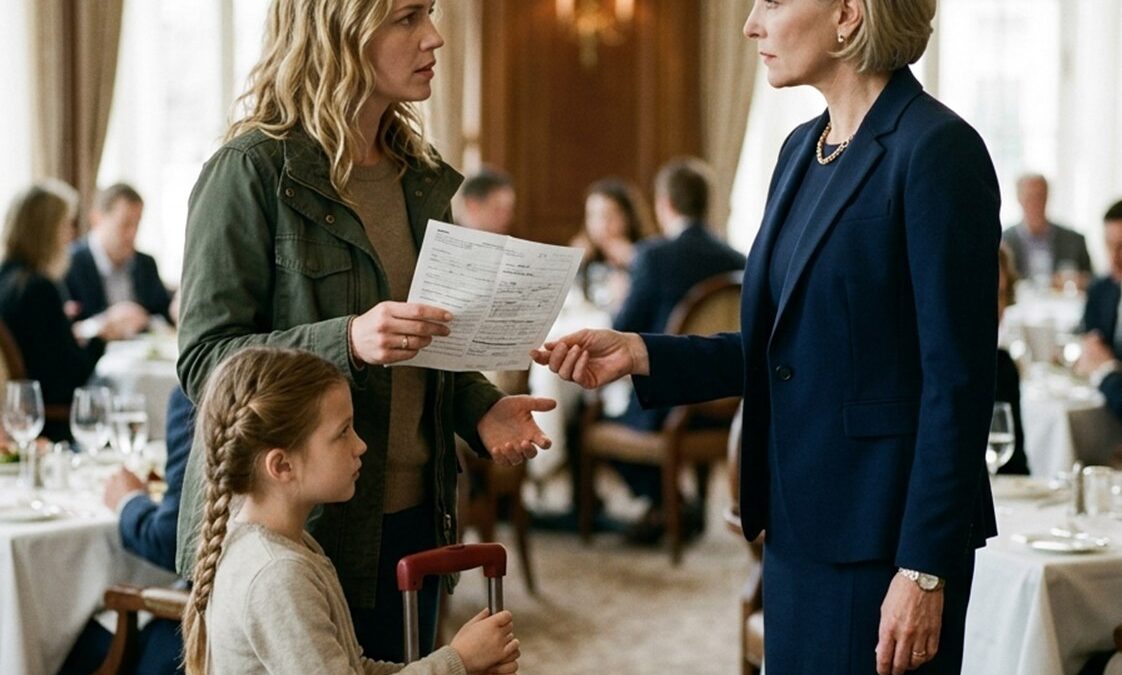
Chapter 2: What the Suitcase Carried
Wren stood behind my leg.
Celia held out her hand.
“Give me the form.”
“No.”
“It belongs to me.”
“It has my daughter’s name.”
A waiter stopped beside the coffee station.
Across the room, Celia’s guests pretended to study their plates.
Wren’s fingers tightened around my sleeve.
“Am I going?” she whispered.
“No.”
I said it before I knew whether anyone would try to stop us.
Celia heard me.
“You are making a scene.”
“You packed her suitcase.”
“She packed it herself.”
Wren shook her head.
“I put my rabbit in.”
That small correction landed harder than an accusation.
Celia had packed the rest.
I turned the form over.
It listed a residential school in western Massachusetts.
The proposed arrival was that afternoon.
There was an address.
There was a phone number.
There were boxes marked for both parents’ consent.
Caleb’s signature sat under the second box.
A signature he could no longer give.
I felt Wren’s forehead against my arm.
She was warm.
Her hands were cold.
“Did anyone hurt you?” I asked.
“No.”
“Did anyone tell you not to call me?”
Wren looked at Celia.
Celia looked at the waiter.
“Children misunderstand adult plans,” she said.
“That wasn’t my question.”
“The school needed preliminary paperwork.”
“Why does it say today?”
“It was a visit.”
“With a suitcase?”
“A sensible precaution.”
I knelt beside Wren.
“You can tell me.”
“She said you had work.”
“I do.”
“She said you wanted me there until Christmas.”
It was September.
I kept my voice level.
“I never said that.”
Wren’s mouth trembled.
“But you signed.”
“I didn’t.”
She searched my face.
I had promised her something after Caleb died.
No matter how bad the news was, I would tell her myself.
I had kept that promise through overdue rent, broken cars, and every question about her father that I could answer.
Now somebody had used my name to break it.
I stood.
“Who gave you this form?”
Celia folded her arms.
“My attorney prepared it.”
“What attorney?”
“You know Mr. Mercer.”
“I know he works for you.”
“He has helped this family for thirty years.”
“Did he sign for a dead man?”
A chair scraped.
Celia’s cheeks colored.
“Caleb signed a parental authorization years ago.”
“For a school that opened last year?”
Her eyes moved to the page.
Only for a second.
Then she smiled again.
“Let us discuss this privately.”
Wren pulled at my sleeve.
“Can we go home?”
“Yes.”
Celia stepped aside.
That surprised me.
She had spent six years telling me that I rushed every decision.
I expected a speech.
I expected her to call someone.
Instead, she watched me take the suitcase handle.
“The car is waiting,” she said.
“Then send it away.”
Wren and I walked through the hotel lobby.
The bellman opened the front door.
Cold air reached us.
Wren stopped on the sidewalk.
“Am I in trouble?”
“No, honey.”
“I told her I didn’t want to go.”
I crouched again.
“You did exactly right.”
“She said it would upset you.”
“It did.”
“I’m sorry.”
“You didn’t do anything wrong.”
I wanted to hold her until her hands warmed.
I also needed to know where the car had been taking her.
I called the number on the form.
An admissions coordinator answered.
I gave my name.
She put me on hold.
The hotel doors opened behind us.
Celia came out without her coat.
For a moment, she looked like Caleb.
The same dark eyes.
The same way of bracing against bad news.
She saw Wren shivering and took off her scarf.
Wren accepted it.
I let her.
Then the coordinator returned.
“Mrs. Vale, we haven’t approved an arrival.”
I looked at the suitcase.
“What have you approved?”
“A visit request.”
“Who made it?”
“I can’t discuss the application over the phone.”
“You can tell me whether my child is expected today.”
“No, ma’am.”
I closed my eyes.
Celia had heard every word.
“There,” she said softly.
“It was a visit.”
“Why tell Wren she was staying?”
Celia’s face changed.
Not much.
Enough.
“Because she would have refused to see it otherwise.”
I stared at her.
“You let her think I sent her away.”
“I thought you would thank me later.”
Wren stepped closer to me.
Celia reached for her scarf, then stopped.
“Caleb wanted her protected,” she said.
“What does Caleb have to do with this?”
Celia looked at the form in my hand.
“He left money for her.”
The traffic moved behind us.
A delivery truck rattled past.
I barely heard it.
“Caleb left debts,” I said.
“That’s what you told me.”
Celia did not correct me.
She didn’t need to.
Caleb had left Wren a trust.
* * *
I drove us home in my old sedan.
Wren fell asleep before we reached the second light.
The red suitcase rode on the back seat beside her.
Every time I checked the mirror, I saw them both.
At home, I made toast.
Wren ate one corner.
Then she asked whether she could leave the suitcase closed.
“Of course.”
“I don’t want to know what she packed.”
“Then we won’t open it yet.”
She carried her rabbit to her room.
I called my supervisor.
I told him I could not cover the evening shift.
He said to call by Friday about the next schedule.
That meant I might lose Saturday.
Saturday paid time and a half.
I wrote the loss on the back of an envelope.
Then I called the school on the form again.
This time I asked for the admissions director.
Her name was Ms. Bell.
I said someone had submitted my daughter’s name without my permission.
She did not rush me.
She confirmed that Celia had requested a visit.
No admission decision existed.
No child was expected to stay.
The school had received scanned consent pages.
Ms. Bell would preserve them while her office reviewed what happened.
“Please don’t send anything to the applicant,” I said.
“I can’t promise how our process works,” she replied.
“But I can note your concern.”
That was more honest than comfort.
I thanked her.
Next, I searched our county’s public probate records.
Caleb’s estate appeared where I remembered it.
So did a separate filing.
It had been made six months before his death.
A trust in Wren’s name.
The index showed Celia as trustee.
I stared at the screen.
When Caleb died, Celia had brought me a folder.
She said his medical bills and business debts had consumed everything.
I had been twenty-eight.
Wren had been three.
I had believed a woman who could pay a lawyer to explain things.
I had signed papers I barely understood.
I called a legal aid office.
The intake worker listened.
Then she gave me the number of a lawyer who handled trust disputes on a sliding scale.
“Take the original form,” she said.
“Keep every message.”
“Should I call the police?”
“If someone tries to take your child, yes.”
“For the signatures, the lawyer can help you report it.”
I wrote it down.
At six, Wren came into the kitchen.
She had slept with her shoes on.
“Grandma texted me.”
I held out my hand.
“May I see?”
Wren passed me her tablet.
Celia had written, I am sorry today frightened you.
Below it came another message.
Your mother and I need time to make a good plan.
Wren watched my face.
“I can answer,” she said.
“You can.”
“Do I have to?”
“No.”
She turned the tablet face down.
“Can we have noodles?”
We made noodles.
I burned the first batch of garlic.
Wren told me so.
That helped.
The next morning, I met attorney Priya Shah in an office above a pharmacy.
Her desk held two neat stacks of files.
She offered Wren colored pencils.
Wren drew at the far end of the room while we spoke.
Priya read the school form.
She looked at both signatures.
Then she looked at the date.
“Your husband died in 2020?”
“Yes.”
“This form names a school established in 2025.”
“Yes.”
She laid it flat.
“Did Celia say what document she believes Caleb signed?”
“She called it a parental authorization.”
“We’ll ask for it.”
Priya explained what the probate index could and could not tell us.
A trust existed.
That did not tell us its current balance.
As Wren’s parent, I could ask for information on her behalf.
Priya would review the trust terms before deciding what to file.
“What if there’s nothing left?” I asked.
“Then we find out where it went.”
I told her about the forty-three dollars.
She said her office could take a small initial payment.
The rest could wait until she had reviewed the documents.
I almost cried.
I didn’t.
Wren was listening.
Priya made copies of the form.
She placed the original in a clear sleeve.
“Where do you work?” she asked.
“At a print shop.”
“Do you see anything unusual?”
I had seen it in the dining room.
I had been too angry to trust myself.
Now I pointed to Caleb’s signature.
“At the end of the C.”
Priya leaned closer.
“There’s a square edge.”
The signature had a faint gray box around it.
A scanned image had been laid over the page.
It vanished under normal light.
Under Priya’s desk lamp, I could see two corners.
“I know that mark,” I said.
“From a document?”
“From the copy I made for Caleb.”
The week before his final hospital stay, Caleb had asked me to print a letter for Celia.
He signed it at our kitchen table.
The pen had leaked.
A blot formed under his C.
I had scanned the letter so he could email it.
He died twelve days later.
I still had the original in a folder at home.
“What was the letter about?” Priya asked.
“He wanted her to stop charging her hotel expenses to a family account.”
Priya held very still.
“Do you remember the words?”
“Some.”
“Find it.”
I found it that night.
The folder was beneath old tax returns.
Caleb’s letter was there.
So was the envelope he had meant to mail.
He never mailed it.
I read it sitting on the floor.
The family account was not named.
The letter asked Celia to meet with him and the trust accountant.
He wrote that charges labeled “guest services” required explanation.
He wrote that Wren’s money could not be used to solve hotel problems.
Under his signature was the ink blot.
The same blot appeared on the school form.
There was more.
On the back of the letter, in Caleb’s handwriting, were three dates.
Beside each date was an amount.
They added to $84,000.
I photographed everything.
Priya asked me to bring the original the next morning.
Before bed, I checked Wren’s tablet again.
Celia had sent nothing else.
I sat beside Wren until she slept.
For six years, I had thought Caleb died believing his mother would look after us.
His last letter said he was trying to stop her.
* * *
Priya sent a formal request to Celia.
She asked for the trust document.
She asked for account statements.
She asked for the source of Caleb’s signature on the school form.
She also asked Celia to contact me only through counsel about school plans.
Celia called anyway.
I let it ring.
She called again.
Then Grant called.
Grant was Caleb’s older brother.
He had managed the hotel since Caleb died.
I answered because Wren was at school.
“Elise,” he said, “Mom says you hired a lawyer.”
“I did.”
“She’s upset.”
“So is Wren.”
“She should have asked you first.”
“She used Caleb’s signature.”
Grant said nothing.
“Did you know about the trust?”
“Yes.”
“Did you know I didn’t?”
“I thought Mom told you.”
“She told me he left debts.”
“That part was true.”
“Was the trust part true?”
“Yes.”
I waited.
Grant breathed into the phone.
He had always sounded tired to me.
Now he sounded afraid.
“I was twenty-six when Caleb died,” he said.
“I signed whatever the lawyers put in front of me.”
“You manage the hotel.”
“I manage rooms and payroll.”
“Do you manage the trust?”
“No.”
“Then tell me who does.”
“Mom.”
He hung up after I said I had to go.
That afternoon, the hotel’s human resources manager called my print shop.
My manager brought me into his office.
He said someone had complained that I had used company equipment to copy private family documents.
I knew what document she meant.
Caleb’s letter.
I had scanned it at home.
My manager listened.
Then he said he would make a note of my answer.
He also said the complaint had come from a hotel that bought thousands of dollars of printing each year.
I understood the rest.
Priya asked me to write down the call.
I did.
The next day, a woman I had never met waited outside Wren’s school.
She did not approach Wren.
She approached me.
“I’m Celia’s driver,” she said.
Her name was Denise.
She had driven Celia for eleven years.
She looked embarrassed to be there.
“I heard about the luncheon.”
I kept my hand on Wren’s shoulder.
“Okay.”
“Mrs. Vale asked me to take Wren to the hotel that morning.”
“Did Wren know where she was going?”
“She thought you’d meet her there.”
Wren pressed against me.
Denise saw it.
“I’m sorry,” she said.
“I should have called you.”
“Why are you telling me now?”
“Because Mrs. Vale asked for my trip sheet.”
“What trip sheet?”
“The one with the school address.”
Denise worked as a contractor.
She kept her own records.
Celia had booked a trip from the hotel to the school.
Then she had asked Denise to change the destination on the invoice to a nearby museum.
“Did you change it?”
“No.”
Denise gave me Priya’s card back.
“I called your lawyer first.”
That mattered.
She had not handed me a secret file.
She had offered to provide her own records to the person helping us.
Priya met with her that evening.
I sat beside Denise while she explained the booking.
It had been placed three weeks before the luncheon.
The requested passengers were Celia and Wren.
One large suitcase had been noted.
The return trip named Celia alone.
Wren heard none of that.
She was at a neighbor’s apartment, eating pizza and watching a baking show.
I wanted to go over there.
Instead, I stayed.
Priya asked Denise if Celia had said why she wanted the destination changed.
“She said the school visit was private.”
“Did she mention Elise?”
“She said Elise had agreed.”
Denise looked at me.
“I believed her.”
“So did Wren,” I said.
Denise’s eyes filled.
She looked away.
Priya did not call it proof of a crime.
She called it a useful record.
It showed the plan existed before Celia asked me.
It also showed why Wren had been frightened.
The next morning, a packet arrived from Celia’s lawyer.
It included the trust agreement.
Caleb had created it using money from an insurance policy and the sale of his share in a small commercial building.
The trust was for Wren.
Celia was trustee.
Grant was named as a successor if Celia could not serve.
It also included a short cover letter.
Celia denied wrongdoing.
She offered to pay for Wren’s school visit.
She requested that I return “all hotel and family documents.”
There were no complete account statements.
Priya wrote back.
That evening, Wren asked whether she could keep going to her regular school.
“Yes.”
“Even if Grandma says it’s bad?”
“Yes.”
“Is Grandma bad?”
I put down the dish towel.
“She made a choice that scared you.”
Wren waited.
“She needs to answer for it.”
“That’s not what I asked.”
“I know.”
I sat beside her.
“I don’t have to decide everything about Grandma tonight.”
Wren nodded.
“Can I decide?”
“What do you want?”
“I don’t want to see her yet.”
“Then you won’t.”
She leaned against me.
We stayed there until the noodles boiled over.
Three days later, my manager cut my Saturday shift.
He said orders were down.
I could not prove otherwise.
I wrote the lost pay on the same envelope.
Priya told me to keep it.
She had filed a petition asking the probate court to order an accounting and, if needed, appoint someone independent to review the trust.
That would take time.
She also sent the suspicious school form and Caleb’s original letter to the county prosecutor’s office.
An investigator called me.
He asked when Caleb died.
He asked who had access to the scanned letter.
I told him Celia had been copied on the email.
The email account still existed.
I found the sent message.
It was dated twelve days before Caleb died.
I forwarded it to Priya.
She forwarded it through the proper channel.
The investigator said he would speak with the school.
He did not promise an arrest.
I was glad he didn’t.
Promises had become cheap around us.
On Friday, Grant came to my apartment.
He stayed outside.
I opened the door with the chain on.
“Mom wants to settle this,” he said.
“What does that mean?”
“She’ll pay your rent for a year.”
“For what?”
“For a written agreement.”
“What agreement?”
“She keeps managing the trust.”
“And Wren?”
“Visits, when Wren’s ready.”
I almost closed the door.
Grant put his palm against the frame.
“Wait.”
He took it away when I looked at it.
“I didn’t bring the offer because I like it.”
“Then why?”
“She told me the hotel could fail.”
“What does that have to do with Wren’s trust?”
He looked down the hallway.
“She said the trust made loans.”
“To whom?”
“I don’t know.”
“Grant.”
“I found invoices.”
He swallowed.
“They were billed to Wren.”
That night, Grant emailed Priya copies of three invoices from the hotel’s accounting system.
They called themselves educational hospitality services.
They charged Wren’s trust for hotel rooms.
No student had stayed in them.
The rooms had housed hotel consultants during a renovation.
Celia’s name approved every invoice.
Priya asked Grant to preserve the system records.
The next day, she sought an emergency order to protect the remaining funds while the accounting proceeded.
The judge did not decide the whole case.
The judge ordered records preserved and blocked new transfers without court approval.
Celia’s attorney objected.
The court set a hearing.
Grant called me afterward.
His voice broke once.
“She told me she was borrowing it.”
“How much?”
“I don’t know.”
“Why didn’t you ask?”
“I was afraid of the answer.”
I thought of Caleb’s letter.
I thought of Wren’s suitcase.
Celia had not sent Wren away for school.
She had tried to take control of the person whose money she was spending.
* * *
The hearing took place five weeks after the luncheon.
Wren spent the day with my neighbor.
She chose that herself.
I wore the navy jacket I used for job interviews.
The sleeve lining had a tear.
Priya had taped the original school form inside a folder.
Caleb’s letter sat beside it.
The courtroom was smaller than I expected.
Celia arrived with two lawyers.
Grant came alone.
Denise sat behind him.
Celia looked at me once.
Then she looked at the judge.
Her attorney spoke first.
He said Celia had supported Wren for years.
That was true.
She had paid for a winter coat once.
She had taken Wren to the aquarium.
She had brought soup when I had the flu.
He said the hotel invoices reflected a long-standing family arrangement.
That might have sounded possible if the amounts were smaller.
He said the school visit had been poorly communicated.
That part was also true.
Celia’s best defense began with things nobody could deny.
I felt the room lean toward her.
Then her attorney said I had “misunderstood” the trust after years of financial strain.
My face grew hot.
Priya touched the edge of my folder.
She did not tell me to calm down.
She stood.
“The parent was never given a copy of the trust,” she said.
“Her daughter was listed for a school visit without her consent.”
“The form bears the signature of a man who had been dead for six years.”
Celia’s lawyer rose.
“We dispute how that signature appeared.”
“Then we welcome an explanation.”
The judge asked Priya to proceed with the records.
The school’s admissions director had supplied a written statement.
The scanned form had arrived from an email account used by Celia’s office.
It had been sent four days before the luncheon.
The school had treated it as a visit inquiry because required enrollment documents were missing.
Nobody at the school had authorized Wren to stay.
Priya showed the court Denise’s booking record.
It had been made three weeks earlier.
Celia’s attorney said a parent might plan a visit early.
That was fair.
He said the driver could have misunderstood the return booking.
That was possible.
Celia took the stand.
She wore a gray suit Caleb had once called her court armor.
She answered carefully.
She said she loved Wren.
She said I worked too many hours.
She said she had feared Wren spent evenings alone.
“She never spent an evening alone,” I said.
The judge looked at me.
Priya touched my arm.
I apologized.
Celia did not look pleased.
That frightened me more than anger would have.
She had practiced this.
She described three missed school pickups.
Two had happened during a bus strike.
My neighbor had collected Wren both times.
The third had been a day I was eleven minutes late.
Celia did not mention those parts.
Priya asked her about the form.
“Did Elise authorize you to sign?”
“No.”
“Did Caleb?”
“Caleb signed a broad authorization while he was alive.”
“For this school?”
“For educational decisions.”
“Where is that authorization?”
“With my former attorney’s files.”
“Have you produced it?”
“We’re looking.”
“Did you place Caleb’s signature on this form?”
Celia paused.
“I asked my assistant to prepare the paperwork.”
“That wasn’t my question.”
“I did not personally alter a signature.”
Her lawyer objected to the wording.
The judge let Priya ask it another way.
“Who directed your assistant to prepare it?”
“I did.”
“Who approved it before it went to the school?”
“I did.”
Priya picked up Caleb’s letter.
It was yellowed along one edge.
The ink blot looked almost black under the courtroom light.
She showed Celia the signature.
“Have you seen this letter?”
“Yes.”
“Did Caleb email you a scan?”
“He may have.”
Priya placed the school form beside it.
The signatures matched.
Not simply the name.
The blot matched.
A tiny gap in the lower stroke matched.
Even the pale rectangular edge matched the scan I had made.
Celia stared at both pages.
I watched her decide what to say.
“I didn’t create that image,” she said.
Priya nodded.
“We can leave that question to the investigators.”
Then she turned to the trust.
A court-appointed accountant had reviewed records produced under the temporary order.
She had traced payments from Wren’s trust to the hotel.
Some were labeled as school planning.
Some were labeled as beneficiary travel.
Others were labeled as education services.
The accountant had requested backup for each payment.
The hotel supplied room lists.
The room lists named consultants, contractors, and one lender’s inspection team.
Not Wren.
The total was $312,400.
The hotel had repaid none of it.
Celia’s attorney stood.
He argued that the charges might still be lawful loans.
He pointed to a clause allowing investments.
He said the hotel had assets.
He said the trust could recover every dollar.
For a moment, I saw how she had done it.
She had taken money from a child while telling herself it would come back.
Each new transfer made the last one harder to confess.
Priya asked the accountant one question.
“Were these recorded as loans in the trust ledger?”
“No.”
“How were they recorded?”
“As expenses for Wren.”
The accountant turned a page.
“There are no signed loan agreements.”
Celia’s attorney asked for more time.
The judge granted time for a final accounting.
He did not need more time to protect the trust.
He suspended Celia as trustee pending the case’s resolution.
He appointed an independent professional to control the accounts.
He ordered Celia and the hotel to preserve their records.
He also said the school form would be referred to the prosecutor’s office with the hearing transcript.
Celia stood as if she meant to argue.
Her attorney put a hand on her folder.
She sat.
Outside the courtroom, she caught up with me.
“You think you’ve won,” she said.
“I think Wren is at school.”
“You’ll spend years proving you can care for her.”
“She already knows.”
Celia’s face tightened.
“Caleb would hate what you’ve done to this family.”
I held her gaze.
“Caleb wrote you a letter.”
Grant stepped between us before either of us said more.
Celia turned away.
The legal work continued.
The independent trustee found another $41,000 in unsupported charges.
The hotel’s insurer and lender became involved.
The hotel sold a small parcel of unused land to repay the trust.
Grant left its management before the sale.
He provided records to the accountant and the prosecutor.
My job was harder for a while.
The hotel canceled its print orders.
My manager gave me the Saturday shift back after another client expanded its account.
Six months after the hearing, Celia entered a plea in the criminal case arising from the forged school form and false trust records.
The court imposed restitution and supervision.
She was barred from serving as Wren’s trustee.
The civil court approved the full repayment schedule and kept an independent trustee in place.
It was slower than I wanted.
It was also written down.
No one could smile it away.
The last time I saw Celia that year, she stood outside the courthouse beside her lawyer.
She asked whether Wren missed her.
“She remembers the aquarium,” I said.
Celia’s eyes filled.
“She remembers the suitcase too.”
I let her sit with both truths.
* * *
Winter came.
Wren lost a front tooth.
She put it under her pillow in a sandwich bag because she said the tooth fairy should not have to search.
I found the bag easily.
I left two dollars.
She asked whether the tooth fairy was affected by inflation.
I told her everyone was.
At school, she joined the art club.
She painted a whale that looked like a blue potato.
We put it on the refrigerator.
The independent trustee sent quarterly statements.
Priya explained the first one.
The numbers still made me uneasy.
They belonged to Wren.
We did not use them to repair my car.
We did not use them to make our apartment look like Celia’s house.
The trustee paid for Wren’s dental work from the trust after discussing it with me.
That felt ordinary.
Ordinary was what I had wanted.
In March, Grant asked to meet.
I chose a diner.
He arrived early.
He looked thinner.
He ordered coffee and did not drink it.
“I owe you an apology,” he said.
“You do.”
“I should have asked about the invoices.”
“Yes.”
“I should have told you about the trust after Caleb died.”
“Why didn’t you?”
“Mom said Caleb wanted her to handle everything.”
“Did you believe her?”
“I wanted to.”
He looked at his cup.
“She had always handled everything.”
I understood the habit.
I did not excuse it.
“Wren isn’t ready to see you,” I said.
“I know.”
“She asked me to tell you that.”
“Okay.”
“When she is ready, she can decide.”
“I’ll wait.”
He pushed an envelope across the table.
It held a check.
The amount would have paid for a better car.
“From me,” he said.
“For the lost work.”
I pushed it back.
“I kept a record.”
“I know.”
“I’ll submit what the court allows.”
“This isn’t from Mom.”
“That doesn’t make it simple.”
He folded the envelope.
“I thought it might help.”
“It might.”
I watched a waitress carry pancakes to the next table.
“Help someone else.”
Grant looked up.
“There’s a fund at Wren’s school,” I said.
“It covers field trips for kids whose parents can’t.”
“You want me to give it there?”
“I want you to decide.”
He did.
The principal sent a note later.
The donation covered the spring trip for eleven children.
Wren went too.
She brought back a plastic fossil that broke in my purse.
I glued it badly.
She said it looked more authentic.
In April, my manager offered me a lead position.
It meant regular hours.
It also meant training new staff.
I accepted.
On my first week, a customer brought in a document with a signature pasted in crookedly.
It was a birthday card design.
I laughed so hard I had to step away from the counter.
Wren asked what was funny.
“Sometimes people are allowed to paste things,” I said.
She asked to see the card.
I showed her.
It had three dogs wearing party hats.
She agreed that it was allowed.
She also began asking questions about Caleb.
Not all at once.
One night, she wanted to know whether he could sing.
“No.”
“Did he?”
“Constantly.”
“Was he brave?”
I thought of his letter.
“I think he was frightened near the end.”
“That’s not what I asked.”
I smiled.
“He did something brave while he was frightened.”
She considered that.
“Could he make noodles?”
“Better than me.”
“That’s easy.”
I put a hand over my heart.
She laughed.
Then she asked to read one of his letters.
I gave her a birthday card.
It was for her third birthday.
He had drawn a terrible horse inside.
His message told her she could ask him for help with anything.
Wren traced his handwriting.
“Did he mean it?”
“Yes.”
“Even if it was hard?”
“Yes.”
She left the card on her bedside table for weeks.
In May, Priya called about Celia.
Celia had written a letter to Wren.
Her lawyer had sent it to Priya rather than to us.
That was the boundary we had asked for.
Priya said I could read it first.
I picked it up from her office.
The letter was one page.
Celia wrote that she had frightened Wren at the hotel.
She wrote that Wren had been right to say no.
She did not explain the missing money.
She did not ask for forgiveness.
She said she would respect whatever contact Wren chose in the future.
I read it twice.
Then I told Wren it existed.
“Do I have to read it?” she asked.
“No.”
“Does it say why she packed my suitcase?”
“It says she was wrong to do it.”
“That’s different.”
“It is.”
Wren asked me to keep the letter.
I put it in a drawer.
We did not talk about Celia for a month.
Then Wren asked whether Grandma still had the scarf.
“You have it.”
“It smells like her house.”
“Do you want it put away?”
“No.”
She wore it on a rainy morning.
She left it in her cubby at school.
I picked it up when we got the usual email about forgotten things.
That night, she said she might want to send Celia a drawing someday.
“Whenever you choose,” I said.
“Would you be mad?”
“No.”
“Would you go with me if I saw her?”
“Yes.”
“Even after what she did?”
“Yes.”
She nodded.
Then she changed the subject to whales.
I followed her there.
By summer, the hotel had a new manager.
Grant worked for a small inn two towns over.
He sent Wren a postcard from its opening weekend.
The front showed a lighthouse.
There was no request to visit.
She pinned it above her desk.
The red suitcase stayed in our hall closet.
For months, I could not touch it.
Wren could not either.
One Saturday, she asked if we could open it.
I said yes.
We set it in the living room.
I unzipped the front pocket.
Inside were two sweaters, a toothbrush, three pairs of socks, and a book Wren had outgrown.
Her rabbit was tucked under everything.
Wren picked him up.
“He hated it in there,” she said.
“I bet.”
In the side pocket, we found a packet of crackers.
They had crumbled into dust.
Wren laughed.
Then she stopped.
“Did Dad sign the paper?”
“No.”
“Grandma used his old signature?”
“Yes.”
“Because he wasn’t here to say no?”
I looked at her.
“Yes.”
She carried the rabbit to the couch.
“Can we use the suitcase for something else?”
“What would you like?”
“A trip.”
I thought she meant an afternoon away.
She meant three days by the coast.
We saved for it.
The trustee offered to cover part of the cost from Wren’s trust.
I declined.
This trip was mine to give her.
We stayed at a motel with a view of a parking lot and a thin strip of ocean beyond it.
Wren liked the vending machine best.
On our second morning, rain kept us inside.
We played cards on the bed.
I lost four times.
She accused me of doing it on purpose.
I told her I had never been that good at cards.
She wanted proof.
We played again.
I lost honestly.
When the rain stopped, we carried the red suitcase back to the car.
It was too big for three days.
Wren said she wanted room for seashells.
There were six.
Five were broken.
She kept every one.
* * *
Four years later, Wren stood beside the red suitcase again.
She was thirteen.
She had packed it herself.
We were in the hotel lobby where Celia had once told us a car was waiting.
This time, we were waiting for Grant.
Wren had decided she wanted to visit the city where Caleb grew up.
Grant had offered to show her the house, the library, and the corner store that sold the candy Caleb loved.
She had asked me to come.
I had said yes.
The hotel belonged to a new company now.
Its lobby smelled of coffee.
Nobody there knew our names.
Wren held a folded form.
It was her school’s permission slip for a history trip the following month.
She had forgotten to give it to me at breakfast.
“Did you sign it?” she asked.
“Not yet.”
“Please do.”
I borrowed a pen from the desk.
My signature looked like mine.
No one else’s appeared beneath it.
Wren checked the date.
“Good,” she said.
Grant came through the revolving door.
He stopped a few feet away.
“Ready?” he asked her.
Wren looked at me first.
I nodded.
She looked back at him.
“Yes.”
Celia was alive.
She lived across town.
Wren had read her letter at twelve.
She had sent a drawing in return.
They had exchanged two more letters.
Wren had chosen not to visit yet.
Celia had kept her word.
She had not asked twice.
The trust was whole.
The debt was repaid.
Caleb’s letter was stored with the court records and a copy at home.
I no longer counted Saturday shifts on an envelope.
Some things had taken years.
Wren lifted the suitcase handle.
The wheels caught briefly on the lobby rug.
Grant reached toward it.
“May I?”
She considered him.
Then she let go.
He tipped the suitcase gently over the edge.
Wren took the handle back.
Outside, the morning was clear.
She walked between us toward the car, carrying everything she had chosen to bring.
THE END








