I Found My Son Wearing a Transport Tag at My Mother-in-Law’s Fundraiser, and She Claimed I Had Signed It
Chapter 2: What the Tag Carried
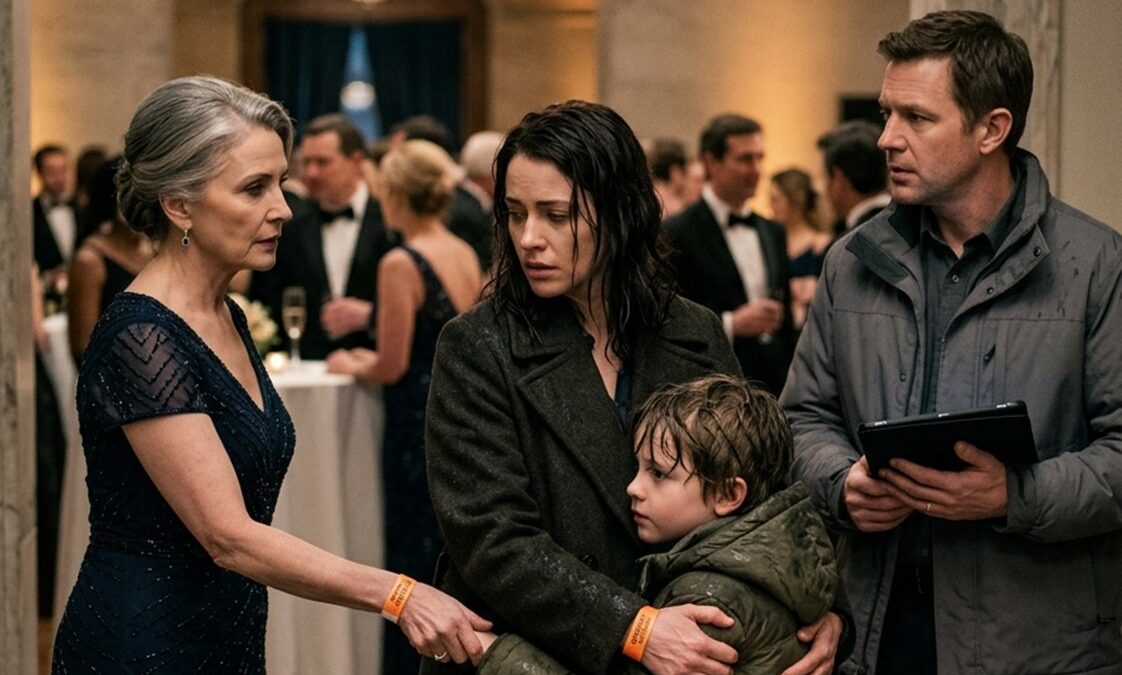
The driver stopped when he saw Theo crying.
He wore a gray jacket and held a tablet.
“Is there a problem?” he asked.
“Yes,” I said.
Celeste answered at the same time.
“No.”
Theo pressed his face against my coat.
The driver looked between us.
“I’m his mother,” I said.
I held up the orange tag.
“I did not authorize this.”
Celeste lowered her voice.
“June is overwhelmed.”
“I’m standing right here.”
“She’s been working nights.”
“Three nights this week.”
“She left him alone.”
Theo lifted his head.
“I was with Mrs. Bell.”
I felt Celeste’s eyes on him.
Mrs. Bell lived downstairs from us.
She watched Theo after school.
She kept a jar of his favorite crackers above her stove.
The driver glanced at his tablet.
“I have a signed pickup form.”
“Show me.”
Celeste held out her hand.
“That’s private.”
“It has my name on it.”
The driver hesitated.
Then he turned the screen toward me.
The form showed my signature again.
Below it sat another name.
Micah Vale.
My husband’s name appeared beside the words SECOND PARENT CONSENT.
The date was yesterday.
For a moment, the ballroom slipped away.
I could hear rain ticking against the tall windows.
I could feel Theo trembling.
I could see Micah’s name.
“Where did you get this?” I asked.
The driver swallowed.
“Our office received it by email.”
“From whom?”
“I’ll have to check.”
Celeste stepped closer.
“The paperwork can wait.”
“No,” I said.
“Think about Theo.”
“I am.”
She looked toward the guests.
Some watched openly.
Others pretended to study the auction tables.
Celeste had taught them that trick.
She could turn anything ugly into a private matter.
A guard stood near the exit.
I raised my hand.
“Could you call the police?”
Celeste’s mouth tightened.
“That would frighten him.”
“He’s already frightened.”
The guard touched his radio.
The driver put the tablet against his chest.
“I didn’t know his father had died.”
I looked at him.
“He died three years ago.”
The driver stared at Celeste.
She offered him a hard, practiced smile.
“An administrative error.”
Theo shook his head.
I crouched in front of him.
His fingers were cold.
“I’m taking you home,” I said.
“Tonight?”
“Tonight.”
He looked past me at Celeste.
“She said you agreed because of the box.”
“What box?”
Celeste moved.
It was only one step.
I felt it like a door slamming.
“Theo’s tired,” she said.
I kept my voice gentle.
“What box, honey?”
“The one Dad hid.”
Celeste’s hand closed around her purse strap.
Micah had hidden something.
And Celeste knew where to look.
* * *
A police officer took our statements in a quiet museum office.
The fundraiser continued without us.
Music returned through the wall.
It sounded thin.
The driver’s name was Owen Pike.
He showed the officer his dispatch record.
His company had been hired that morning.
Northfield was a licensed family respite center two counties away.
Owen thought both parents had consented.
He had been told Theo would meet him at the museum.
No one had told him to wait outside.
Celeste had sent Theo with a volunteer.
The volunteer had mistaken the service entrance for the pickup point.
It was forty-two degrees and raining.
Theo had waited there nine minutes.
That was nine minutes too long.
Owen gave the officer the email address on the order.
It belonged to Celeste’s assistant.
Celeste said her assistant had forwarded documents supplied by me.
I said that was false.
The officer wrote it down.
He did not arrest anyone that night.
He explained what he could establish then.
Theo was with his legal parent.
The pickup would not happen.
The documents needed examination.
He gave me a report number.
He asked for copies of Micah’s death certificate.
I had one at home.
I hated knowing exactly which drawer held it.
While he spoke, Theo sat beneath my arm.
Someone brought him a dry museum sweatshirt.
It had a dinosaur skeleton on the front.
He let me help him into it.
That was the first time he released my coat.
Celeste stood near the door.
“You’ve made a spectacle,” she said.
I looked at Theo.
He was watching the dinosaur ribs.
“He’s going home,” I said.
We left through the front entrance.
Owen followed us outside.
“I’m sorry,” he said.
“You stopped.”
“I should have checked the second signature.”
“Yes.”
He nodded.
Then he held out a small printed receipt.
“It came off the tag printer.”
The receipt listed the booking number.
It also listed the billing account.
VALE COMMUNITY FUND—FAMILY SERVICES.
I knew that account.
I had reconciled it for seven years.
I had also questioned a payment from it shortly before Micah died.
Celeste had told me to let it go.
At home, Mrs. Bell met us at the stairs.
She had Theo’s pajamas in a warm paper bag.
I had asked her to collect them after the officer called.
She took one look at his wet shoes.
“Bath first,” she said.
Theo nodded.
He trusted her voice.
I trusted it too.
After he was asleep, I opened the kitchen drawer.
Micah’s death certificate lay under our marriage license.
Below those papers sat an old photograph.
Micah had taken it in our kitchen.
Theo was four.
His father was showing him how to fold a cardboard box.
I remembered that afternoon.
Micah had brought home a little blue storage box.
He kept receipts in it.
Theo called it Dad’s treasure chest.
After the warehouse accident, I had searched everywhere.
The box was gone.
I studied the photograph again.
Behind Micah stood the open pantry.
On its highest shelf was a row of flour tins.
The blue box was barely visible above them.
We had moved from that apartment six months after he died.
The tins went to Celeste’s house.
She said she wanted something of her son’s.
I had let her take them.
At the time, I could barely get out of bed.
Now I understood why Theo knew about the box.
Micah had shown it to him.
Celeste had taken it.
* * *
The next morning, I called Northfield.
I spoke to its director.
Her name was Dr. Alana Reed.
I gave her the police report number.
Then I asked what they had been told about Theo.
She did not read me his file.
She was careful.
She confirmed that an intake had been scheduled.
She confirmed the center would cancel it.
She said someone had described an urgent family crisis.
I asked if Theo had a diagnosis.
She said she could not discuss information supplied by others.
I told her he did not.
There was a pause.
“I’m glad you called,” she said.
An hour later, a detective called me.
Officer Navarro had referred the forged documents to her.
Detective Imani Price asked me to bring examples of my signature.
She asked for Micah’s death certificate.
She also asked me to preserve the tag.
I put it in a paper envelope.
Theo had drawn a frowning face on the corner.
I left the drawing there.
Price met me at the station.
She had a soft voice and direct eyes.
She did not promise an arrest.
She asked what I knew.
I told her about Celeste.
I told her about the warehouse.
For eleven years, Vale Cold Storage had handled medical shipments.
Micah supervised the night shift.
The company belonged to his family.
Celeste chaired its board.
I managed billing for the family’s charitable fund.
Three months before Micah died, I found a strange transfer.
Forty-eight thousand dollars had left the fund.
The description said FAMILY SERVICES.
The vendor number belonged to the warehouse.
Celeste told me it covered a refrigeration repair for donated medicine.
That could have been legitimate.
The invoice looked wrong.
Its approval line used a code reserved for emergency maintenance.
The work date fell on a Sunday.
The contractor named on it did not appear in our vendor list.
I asked Micah about it.
He told me he would check.
Two weeks later, a refrigeration unit failed.
Micah entered the warehouse to help move stock.
A loading door mechanism jammed.
He suffered a fatal injury.
The state inspector found a maintenance failure.
The company paid a fine.
I buried my husband.
I quit my job.
Celeste told everyone I had left because I could not bear the building.
I had never corrected her.
That was partly true.
Price listened.
“Do you have the invoice?” she asked.
“No.”
“Did your husband?”
“Maybe.”
I showed her the photograph.
“The box may be at Celeste’s house.”
Price studied it.
“A photograph of a box won’t get us a search warrant.”
“I know.”
“Do you have any emails about the payment?”
I shook my head.
“The fund disabled my account.”
She wrote down the dates.
Then she pointed to the transport receipt.
“Why would they use this account now?”
“I don’t know.”
It frightened me that I didn’t.
I had spent years thinking Celeste wanted control of Theo.
Perhaps she wanted more.
Price asked whether there was a custody case.
“There was a petition last year.”
Celeste had claimed I worked too much.
The judge had dismissed it.
Mrs. Bell had testified.
So had Theo’s teacher.
Celeste had smiled through the hearing.
Afterward, she sent Theo a telescope.
He had never used it.
Price asked for the case number.
I gave it to her.
By afternoon, I had hired a lawyer.
Her name was Ruth Calder.
She listened to the same story.
Then she read the transport form.
“The signature is bad,” she said.
“I know.”
“The second parent line matters more.”
“Because Micah is dead.”
“Because someone submitted it as current.”
Ruth explained the immediate steps.
She would notify the court of the attempted pickup.
She would ask that Celeste’s visits pause until the facts were clear.
She would send Northfield a preservation request.
She would ask the museum and transport company to preserve their records.
“Will a judge believe me?” I asked.
Ruth put down her pen.
“You have a police report.”
“I had one last year too.”
“Last year, no one tried to transport him.”
I looked at the orange tag.
Theo’s little frown stared back.
Ruth followed my gaze.
“Do you know why she chose Northfield?”
“No.”
“Think about the wording on the form.”
I read it again.
FAMILY STABILIZATION.
URGENT PARENTAL ABSENCE.
I felt sick.
Celeste had not just arranged a night away.
She had built a record suggesting I could not care for him.
That evening, Mrs. Bell brought dinner.
Theo ate half a grilled cheese sandwich.
Then he asked whether I would be home when he woke.
“Yes.”
“Even if Grandma calls?”
“Yes.”
He considered that.
“Dad said boxes keep things safe.”
“He did.”
“He said paper remembers.”
I froze.
Micah used to say that to me.
He said it when an invoice made no sense.
I called Detective Price.
Theo had remembered a sentence.
I remembered why Micah had said it.
* * *
Celeste called at seven the next morning.
I let it go to voicemail.
“June,” she said, “I hope you’ve slept.”
Her voice was warm.
“I can see Theo this afternoon.”
Then it hardened.
“You know what happens when families make accusations they can’t support.”
I saved the message.
At nine, my old supervisor called.
Doreen had taken my job at the fund.
She sounded nervous.
“Celeste says you took records.”
“I didn’t.”
“She’s asking everyone.”
“Did you tell her that?”
“Yes.”
“Why are you calling?”
Doreen was quiet.
“Because she asked me to delete a vendor file.”
I sat down.
“Which vendor?”
“Family Services.”
I closed my eyes.
“Did you?”
“No.”
Doreen had worked in accounting for thirty years.
She knew what a deletion request meant.
“She said the account was duplicated,” Doreen told me.
“Was it?”
“I checked.”
Doreen had found two payment streams.
One covered legitimate grants.
The other paid a consulting company.
The consulting company belonged to Grant Vale.
Grant was Micah’s older brother.
He had managed the warehouse before its closure.
He had also sat beside Celeste at every fundraiser.
“What did the invoices say?” I asked.
“Outreach.”
“How much?”
Doreen gave me the total.
More than half a million dollars.
My hand tightened around the phone.
“Please tell Price.”
“I already have.”
“Good.”
“June?”
“Yes?”
“Celeste knows someone opened the file.”
I looked toward Theo’s bedroom.
He was building a tower of books.
“I won’t let him out of my sight.”
Ruth called soon after.
She had received a letter from Celeste’s lawyer.
It claimed I was interfering with family contact.
It also claimed Theo’s emotional condition required urgent assessment.
The letter cited an incident at school.
Theo had cried during a fire drill.
His teacher had called me.
He was frightened by alarms.
Micah’s accident had brought sirens to our apartment.
That was the whole incident.
Celeste had turned it into a case.
Ruth sent the teacher a request for her account.
The teacher replied before lunch.
Theo had returned to class within ten minutes.
He had completed the day.
There had been no recommendation for assessment.
Ruth filed it with the court.
I took Theo to the library that afternoon.
Mrs. Bell came with us.
We chose a table near the children’s desk.
Theo read a book about whales.
He kept one hand on my wrist.
I let him.
When he reached the page with a calf beside its mother, he smiled.
“Whales stay together.”
“Most of the time.”
He looked up.
“You’re staying?”
“I’m staying.”
Mrs. Bell pretended to study a cookbook.
Her eyes shone.
Later, Price met us at the library entrance.
She had news.
The transport company had preserved its records.
The booking came from Celeste’s assistant’s account.
The forged form had been uploaded from an office computer.
Price was seeking the original files.
“What about Grant?” I asked.
“We’re looking at the money.”
“Could Celeste have done this alone?”
Price did not answer.
That was answer enough.
On the walk home, a black car slowed beside us.
Grant sat behind the wheel.
He lowered his window.
“Mom wants to talk.”
“Call Ruth.”
“You’re making this worse.”
Theo moved behind me.
I held his hand.
“Drive away, Grant.”
His gaze shifted to Theo.
“We’re family.”
“Then act like it.”
He looked back at me.
For a second, I saw Micah in his face.
Then the car rolled on.
Price took my report.
Grant had not threatened me.
She said I was right to document the encounter.
That night, Ruth told me the court had set a hearing.
Until then, Celeste could contact Theo only through my lawyer.
Theo slept with his bedroom light on.
I slept badly.
At dawn, Price called.
She had spoken to the state inspector who handled Micah’s accident.
He had kept a copy of a maintenance complaint.
Micah had filed it six days before he died.
The complaint named the failed door.
It also named the person who canceled the repair order.
Grant.
* * *
The hearing room was smaller than the ballroom.
That helped.
No chandeliers.
No audience arranged by Celeste.
Just a judge, lawyers, a clerk, and chairs that squeaked.
Theo waited elsewhere with Mrs. Bell.
I had promised he would not have to sit through it.
Celeste arrived with Grant.
She wore navy.
Her lawyer carried two folders.
Ruth carried one.
The judge asked why we were there.
Ruth described the transport attempt.
Celeste’s lawyer called it a misunderstanding.
He said the respite booking had been made out of concern.
He said Theo had become anxious.
He said I worked nights.
Every fact contained a piece of truth.
That was how Celeste built a wall.
I did work nights.
Theo had been anxious.
Families could seek respite.
Then Ruth showed the forged form.
Celeste’s lawyer said an assistant had made an error.
The judge looked at him.
“An assistant signed the mother’s name?”
“We don’t yet know who signed it.”
“Then don’t call it an error.”
Celeste did not look at me.
Ruth showed Micah’s death certificate.
She showed the date on the form.
Celeste’s lawyer shifted course.
He said the center had received an old family template.
He said no one intended to suggest Micah was alive.
Ruth held up the transport receipt.
“Yesterday’s booking used yesterday’s form.”
The judge asked Celeste a question.
“Did you know the child’s father was listed as consenting?”
Celeste looked wounded.
“I lost my son.”
“That was not my question.”
“I did not prepare the paperwork.”
Grant stared at the table.
Ruth called Owen.
He testified by video.
He described the pickup.
He described my objection.
He described Celeste’s first response.
The judge took notes.
Then Celeste’s lawyer presented photographs.
Theo at the fundraiser.
Theo at Celeste’s house last spring.
Theo opening the telescope.
He said the bond mattered.
It did.
Theo had once loved his grandmother.
That hurt more than anything.
Celeste finally spoke.
“I never wanted to take him from June.”
I wanted to stand.
Ruth touched my arm.
“I wanted him to have support,” Celeste said.
“His mother refuses help because it comes from me.”
Her voice shook.
She was good at that.
“She sees a threat in every offer.”
The judge looked toward me.
“What do you say, Ms. Vale?”
I answered slowly.
“Help doesn’t need a forged signature.”
Celeste’s eyes met mine.
“I offered to pay for child care.”
“You offered if I quit my job.”
“I offered him a room.”
“You asked him to call it home.”
“I was trying to keep this family together.”
Micah’s face rose in my mind.
His hands on that blue box.
His voice in our kitchen.
Paper remembers.
I looked at the judge.
“She didn’t ask me to keep him safe.”
“She booked a driver.”
Ruth then introduced the orange tag.
The judge leaned forward.
Ruth pointed to its billing code.
The printed code matched a fund account.
Doreen had supplied the legitimate account records under subpoena.
The fund had paid for the transport.
Celeste’s lawyer objected to any discussion of unrelated finances.
The judge agreed the broader finances belonged elsewhere.
But the payment mattered to this request.
This was no private family favor.
It had been ordered through an organization Celeste controlled.
Then Price’s evidence arrived.
The assistant had agreed to speak.
She had kept a text exchange.
Ruth handed the certified copy to the clerk.
The message was from Celeste.
Use the current form.
Put both parents.
The assistant had replied that Micah was deceased.
Celeste’s response was short.
Leave the second line.
Celeste stared at the table.
The judge read the exchange twice.
Ruth had one more document.
It came from Northfield.
Dr. Reed had reviewed the intake request.
It included a statement that I had abandoned Theo at the museum.
The statement was submitted before the fundraiser began.
I felt the room tilt.
Before I had even arrived, Celeste had written the story she wanted told.
The judge ordered that Celeste have no direct contact with Theo pending review.
He referred the documents to investigators.
He made no finding about the warehouse.
That belonged to another process.
Celeste rose before the clerk finished speaking.
At the door, she leaned toward me.
“Micah would be ashamed of what you’ve done.”
For three years, I had let her speak for him.
I did not move aside.
“Micah filed the repair complaint,” I said.
“He put his name on it.”
Celeste’s face emptied.
Grant grabbed her elbow.
That was how I knew she had never expected me to see it.
The criminal investigation took months.
Price found the original maintenance records.
The warehouse had approved the repair.
Grant canceled it to keep shipments moving.
Celeste saw the cancellation.
She did not restore the order.
After Micah’s death, the family fund paid Grant’s consulting company.
The payments were disguised as outreach.
Some covered his legal costs.
Some covered debts he had hidden from the board.
The attorney general’s office reviewed the fund.
The transport forgery became a separate case.
Celeste’s assistant testified about the instructions she received.
Computer records supported her account.
Grant accepted responsibility for falsifying warehouse records.
Celeste pleaded guilty to charges tied to the false documents and misuse of fund money.
The judge sentenced her under terms Ruth explained to me plainly.
There were penalties.
There was restitution.
There were restrictions on the charity work she had used as a shield.
The civil case about Micah’s death settled later.
No ruling gave him back to us.
I still wanted the facts on paper.
They were there.
* * *
Spring arrived without an announcement.
One morning, Theo asked for cereal.
He did not ask whether I was leaving.
I stood in the kitchen with the box in my hand.
He looked at me.
“What?”
“Nothing.”
“You’re looking weird.”
“I’ve always looked weird.”
“No,” he said.
“You usually look tired.”
I laughed.
It surprised both of us.
I had changed jobs.
A clinic needed a billing manager.
The hours ended at five.
The pay was a little lower.
The settlement covered the difference for a while.
Ruth helped me set most of it aside for Theo.
I used some to pay our debts.
I used some to take a week off.
We went to the coast.
Theo spent twenty minutes watching crabs.
I spent twenty minutes watching him.
Mrs. Bell came for two days.
She complained about the wind.
Then she bought a kite.
At home, Doreen joined the new board overseeing the fund’s remaining grants.
She asked whether I wanted a seat.
I told her I could help review the books.
I did not want my name on a wall.
She understood.
The fund paid back what it owed.
Its new board published clearer accounts.
A warehouse workers’ group received a grant for safety training.
I attended the first session.
I sat near the back.
When someone asked about Micah, I told them what he had filed.
I did not make him a saint.
He was my husband.
He forgot birthdays.
He sang badly.
He once brought home six pounds of oranges because he thought they were on sale.
He had also tried to get a broken door fixed.
Both truths belonged to him.
Grant wrote to me from his lawyer’s office.
The letter contained an apology.
It admitted the repair cancellation.
It said he had been afraid of losing a shipping contract.
It said fear had made him a coward.
I believed that part.
I did not answer.
Theo did not need a relationship with Grant.
I told him that when he was old enough to ask.
For now, he knew only that Uncle Grant had made unsafe choices.
Celeste’s first letter arrived in June.
Ruth read it before I did.
Celeste apologized for the transport.
She said she had thought she could give Theo stability.
She did not mention the forged signature.
She did not mention the rain.
I put it away.
Her second letter came in August.
It was shorter.
“I lied about your parenting,” she wrote.
“I lied because you would not let me decide for him.”
That was closer to the truth.
I wrote back once.
I told her Theo was safe.
I told her he had not asked to see her.
I told her any future contact would depend on him, on time, and on advice from people who knew his needs.
I did not promise forgiveness.
I did not offer a date.
Ruth mailed it.
Later, Theo found the telescope in a closet.
“Can we use it?” he asked.
“Of course.”
“Grandma gave it to me.”
“She did.”
He rubbed dust from the case.
“Am I allowed to like it?”
I sat beside him.
“Yes.”
“Even if I’m mad?”
“Yes.”
He considered that.
“Okay.”
We carried it outside.
The moon looked blurry until he adjusted the lens.
Then he shouted for Mrs. Bell.
She came downstairs in slippers.
Theo let her look first.
I watched him give someone else a turn.
That felt like healing too.
A week later, Price called.
Celeste’s house had been searched months earlier.
The blue box had not been there.
Grant said he had never seen it.
Celeste said Micah had taken it.
Price had no reason to believe either of them.
I had nearly stopped looking.
Then Doreen called.
The old warehouse was being cleared for sale.
A former maintenance clerk had found a sealed carton.
It carried Micah’s name.
Price collected it before I saw it.
Inside was the blue box.
Micah had moved it from the pantry to his office.
The flour tins had been a false trail.
Or perhaps only a shelf in a photograph.
Theo had remembered the box correctly.
I had remembered where it once stood.
The box held copies of repair requests.
It held handwritten dates.
It held the invoice I had questioned.
It also held a note addressed to me.
Price returned it after the evidence was copied.
Micah’s handwriting filled one page.
He had found the payment to Grant.
He had confronted his brother.
He planned to speak to the inspector if the repair was delayed again.
Then the last line made me sit down.
June, if I’m wrong, tell me so.
He had trusted me to check him.
He had not known what would happen six days later.
I cried over that ordinary trust.
When I could speak, I showed Theo the box.
I did not show him the accident records.
I showed him a receipt for oranges.
Six pounds.
He laughed so hard he fell sideways on the couch.
“Dad really bought all these?”
“He thought we needed vitamin C.”
“Did we?”
“We needed a bigger bowl.”
Theo put the receipt back carefully.
“Can I keep this one?”
“Yes.”
He held it against his chest.
Then he asked something harder.
“Did Grandma know Dad was worried?”
“Yes.”
“Did she help him?”
“No.”
He looked down.
I waited.
“Can I still remember when she was nice?”
“Yes.”
His shoulders loosened.
Children could carry more than one truth.
I wished he had not needed to.
He placed the orange receipt in the blue box.
Then he looked at me.
“Can we put my drawings in there too?”
“Only if you want.”
“I want to.”
He brought me a picture of three people under a blue moon.
One had slippers.
That was Mrs. Bell.
One had wild hair.
That was me.
The smallest held a telescope.
That was Theo.
He pointed to a fourth shape near the edge.
It was a crooked box.
“That’s Dad’s,” he said.
I asked before I closed the lid.
“May I keep it safe for you?”
He nodded.
* * *
Five years later, the museum asked Theo to speak.
Its new exhibit showed how public charities worked.
There was a section on records.
Doreen had helped build it.
She wanted a young person to say why documents mattered.
Theo was thirteen.
He had opinions about everything.
I told Doreen she could ask him herself.
She did.
Theo said yes.
We returned to the ballroom on a rainy Thursday.
The coat rack stood in the same corner.
Theo noticed it before I did.
He had grown taller than my shoulder.
He wore a green jacket he had chosen himself.
“Is that where I stood?” he asked.
“Yes.”
He walked over.
For a moment, I saw the wet little boy again.
I saw the orange tag.
I saw Celeste reaching for it.
Theo touched the coat rack.
Then he came back.
“You okay?”
“I am.”
“That took a while.”
“It did.”
He smiled gently.
He had learned that from Micah.
In his pocket sat the orange tag.
I had offered to leave it at home.
Theo wanted to bring it.
Doreen introduced him.
He stood before a room of students and donors.
I stood beside Mrs. Bell near the back.
Theo held up the tag.
“A printed name can be wrong,” he said.
His voice carried.
“A signature can be false.”
He looked at me.
“So you check.”
He told them about the billing number.
He told them a driver had listened when I objected.
He told them a detective had followed records.
He did not tell them more than he wished.
When he finished, the students asked questions.
One wanted to know whether he was afraid of museums.
“No,” Theo said.
“I like dinosaurs.”
The room laughed.
Afterward, Doreen asked whether the tag could become part of the exhibit.
Theo looked at me.
I kept my hands at my sides.
“It’s yours,” I said.
He thought for a moment.
“Could you make a copy?”
“Certainly,” Doreen said.
“I want to keep the real one.”
On the walk out, we passed the coat rack again.
Rain silvered the windows.
Theo stopped beneath them.
“Grandma said Dad wanted me to go,” he said.
I waited.
“I know what he actually wanted.”
“What?”
Theo reached into his pocket.
He held the tag in one hand.
In the other was Micah’s orange receipt.
“He wanted us to check.”
Then he slipped both papers away.
Mrs. Bell called us toward the door.
She had forgotten her umbrella.
Again.
Theo opened his over all three of us.
It was too small.
We stepped into the rain together.
THE END








