I Helped My Roommate Hang a Missing-Person Exhibit—Then She Begged Me to Take Down One Photograph
Chapter 1: The Face on the Wall
The first time I saw my roommate’s old face, I was holding a ladder for her.
Kit had come to the neighborhood center after her shift to help me hang a row of display boards. She was good at the small jobs nobody signed up for: keeping the ladder steady, sorting screws into a paper cup, remembering which volunteers drank decaf. We’d shared a duplex for eight years, and I knew she would stay until the last chair was stacked.
“Left side’s low,” she called.
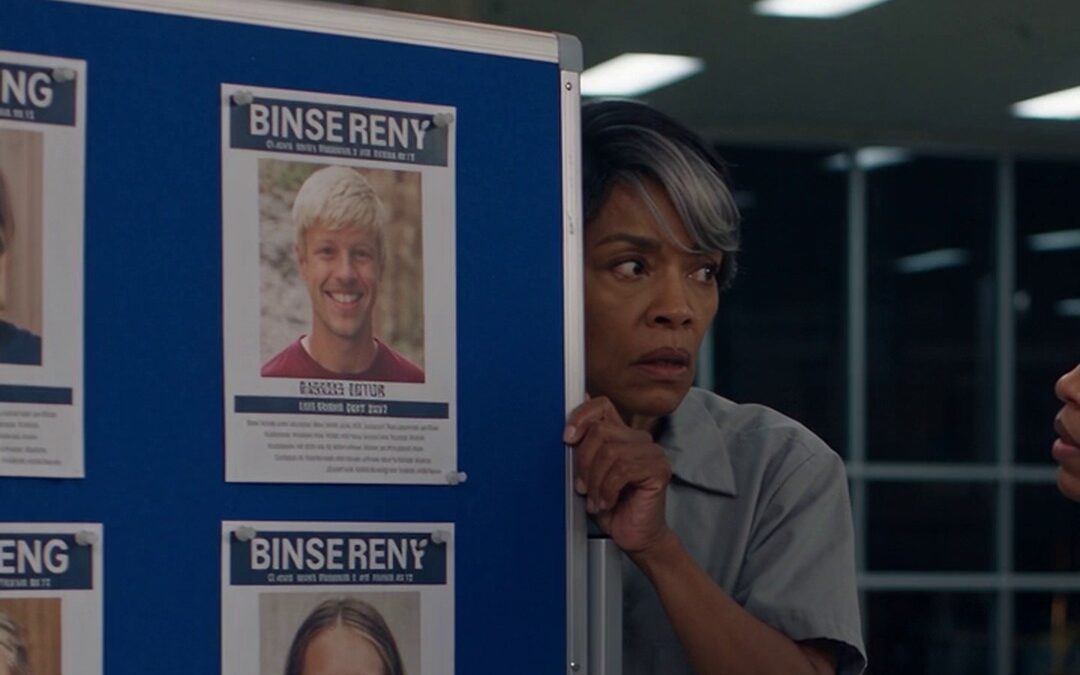
I adjusted the board. It held photographs collected for an exhibit about people who had vanished from the county. Beneath one portrait, a card read **AMELIA VALE, MISSING SINCE OCTOBER 2012**.
The woman in the photograph had long dark hair. Kit wore hers short and threaded with gray. The face was younger and fuller. But the small white mark beside her eyebrow was in the same place, and when I stepped back, I saw the familiar way she held her mouth, as though she was about to disagree politely.
I looked at Kit. She had let go of the ladder.
“Do you know her?”
She stared at the card, not the photograph. “Take that one down.”
I thought she meant the board was crooked. “It’s level.”
“Nora. Please.”
At home, Kit left the porch light on until I came back from late maintenance calls. On Tuesdays she made tomato soup, though she hated tomatoes, because I liked having it after work. Last winter, when my mother spent three weeks in the hospital, Kit paid the gas bill I’d forgotten and told me only after Mom came home.
I took down the portrait.
In our kitchen, she set her keys beside the chipped blue bowl where we kept them. Her hand shook badly enough that they slid onto the floor.
The center had borrowed the display from a group seeking new information about Amelia. A notice on the back said they would photograph the finished exhibit in the morning.
I picked up the keys. “Is Amelia your sister?”
Kit shook her head.
“Then why did you need her picture gone?”
“Because somebody might see it next to mine.”
For a moment, all I could hear was the refrigerator clicking on. Then Kit pulled out a chair but remained standing behind it.
“I was the one who left the car at Mercy Quarry,” she said.
Chapter 2: What We Owe the Living
I knew about the car. Most people in our part of Ohio did, even if they couldn’t have named the woman who owned it.
It had been found with its driver’s door open near the old quarry road. Her purse was on the front seat. A rainstorm had come through overnight, and water had washed tire tracks and footprints into the ditch. Searchers spent days combing the woods and dragging the flooded pit. They found no Amelia Vale.
I had learned those details that afternoon, while helping set up the exhibit. Now the woman who had been missing for fourteen years stood in my kitchen, staring at the keys I’d put back in the blue bowl.
“You’re Amelia,” I said.
“My name is Kit.”
“Was it your name then?”
“No.”
I waited. Kit rubbed her palms on the sides of her jeans. It was what she did before making a difficult phone call or telling me she couldn’t cover a shift at the center. I had always thought the gesture meant she wanted to do the right thing and was nervous about getting it wrong.
“I changed it legally,” she said. “There are papers. I can show you.”
“Why was your car at the quarry?”
She pulled out the chair and sat. “I put it there.”
That much she had already told me. I wanted her to say something that would make the rest of it smaller: a misunderstanding, a confused witness, a photograph that merely looked like her. Instead, she seemed to be deciding how much truth she could bear to give me at once.
“There was a man,” she said. “Graham. We were married. I had tried to leave twice, and both times he found me before I got out of town.”
“Did he hurt you?”
“Yes.”
I sat across from her. Kit had helped me repaint this table the summer after she moved in. There was a rough spot near my elbow where we had missed a drip of varnish.
“I had bus fare and a place to go,” she continued. “I needed him to look somewhere else long enough for the bus to leave. He watched the highway out of town. I thought if he found the car by the quarry, he’d believe I’d gone into the woods.”
“With your purse inside.”
“It was an old purse. I took my ID and the money.”
“People thought you went into the water.”
“I didn’t plan for that.”
“But they did.”
Kit looked down. “Yes.”
The question I wanted to ask next frightened me. A man named Paul Harlan had died during the search. His photograph was on the second board we’d hung that evening: a volunteer in a yellow rain jacket, one arm around his daughter. The card beneath it said his boat had overturned in bad weather on the fourth day.
“Did you know about Paul?” I asked.
“I heard a week later.”
“And you let them keep looking for you?”
“The search had ended by then.”
“That isn’t what I asked.”
“No,” she said. “I didn’t tell anyone I was alive.”
The heater rattled awake in the hall. Kit had fixed its loose cover twice and refused to call it broken. I looked at her hands, at the neat, square nails and the burn on one thumb from the soup pot. They were Kit’s hands. I could not make them belong to the stranger who had left a purse in a car fourteen years ago.
“I need you to leave me alone for a while,” I said.
She nodded and stood. Her bedroom door closed softly.
I stayed at the table until the heater stopped rattling.
The next morning, there was no soup pot on the stove. It was Wednesday, so there wouldn’t have been, but its absence felt like a decision. Kit’s mug sat washed and upside down on the drying rack. She had gone to the bakery before I woke up.
On the refrigerator, under a magnet shaped like a lemon, was a note.
*I took Friday off. I’ll answer whatever you ask when you’re ready.*
She had also written the number for the furnace repair company. It was due for its annual service, and I was the one who always forgot to call. I hated that she remembered it this morning.
At work I replaced a broken lock at a public library, then spent an hour tracing a leak through the ceiling of the children’s room. The work required a ladder, a flashlight, and a bucket. It should have kept my mind busy. Instead I kept seeing the photo of Paul Harlan with his daughter. She had looked about ten.
At lunch I called the center. Del, who ran the exhibits, answered.
“The missing-person boards,” I said. “Are they going up today?”
“Already are. Why?”
“I took down the Amelia Vale portrait last night.”
“I saw. I put it back. Did the clip give you trouble?”
“No.” I pressed my free hand against the wall of the supply closet. “Has anyone photographed it?”
“Probably. We sent the group a picture of the finished wall this morning.”
There was no useful way to take that back. The center had permission to display the exhibit. Amelia’s family had been asking people to look at her face for years.
“Is something wrong?” Del asked.
I thought of Kit beside the ladder, asking me to remove the picture. “I need to talk to someone before I can answer that.”
He accepted it, though reluctantly. Del had known me long enough to hear the strain in my voice.
Kit was waiting at the duplex when I got home. Her bicycle was leaned against the porch rail, the front tire turning slowly in the wind. She was at the kitchen table with a folder closed beneath her hands.
“I’m not going to ask you to keep this for me,” she said before I took off my coat.
“Yesterday you asked me to take down the picture.”
“I did. I’m sorry.”
“What would you have done if I hadn’t recognized you?”
She met my eyes, then looked away. “I would have spent all night hoping nobody else did.”
I hung my coat on its hook. Hers was beside it, a green canvas jacket with a patch I’d sewn over a tear in the pocket. Eight years of our lives hung together on four wooden pegs.
“Show me what’s in the folder,” I said.
There was an old driver’s license, a certified copy of a name-change order, and a more recent license bearing the name Katherine Ellis. Kit laid them out and let me look without guiding me to a conclusion. The older license showed the woman on the exhibit board. It also showed the white mark beside her eyebrow, closer and clearer. The name-change order linked Amelia Vale to Katherine Ellis. I checked the dates twice.
“I don’t need another name,” I said, pushing the papers back. “I need to know who was looking for you.”
“My sister, Lena. My mother was still alive then. And people I worked with.”
“Do they still think you’re dead?”
“Lena does. My mother died three years ago.”
I sat down because my knees had gone weak.
Kit reached for the papers but left her hand on the edge of the folder. “I kept thinking I’d call when I was settled. Then there was the search. After Paul died, I thought I’d wait until I could explain why I’d done it. Every year I had a better reason to be afraid of that conversation and a worse reason to delay it.”
“Your mother died believing you were in the quarry.”
“Yes.”
She didn’t say it quietly to make me feel sorry for her. She said it like a fact she had to carry.
“What happened to Graham?”
“He moved to Indiana. I divorced him by mail. He stopped trying to find me after a few years, as far as I know.”
“Did you report what he did?”
“I tried once. I left the station when they said they’d call him for his side. I know that sounds foolish.”
“It doesn’t.” I had seen people leave the library, the center, and even our porch because an ordinary question asked at the wrong moment felt impossible to answer. “How did you get out?”
“A woman I worked with drove me to the bus station. She didn’t know about the car. I told her Graham had it.”
“So someone knew you were alive.”
“For a few months. She sent mail to me through the place where I stayed. Then I asked her to stop. I was scared Graham would press her.”
There were enough ordinary steps in her story to make it believable. A bus ticket. A job. Papers she could show a landlord. There were also fourteen years in which she could have made one call.
“Why move in with me?” I asked.
“You had a room to rent.”
“That’s all?”
“That was all at first.” Her face tightened. “You showed me where the fuse box was. You told me the upstairs windows stuck in August. You asked if I minded the sound of your mother’s TV when she visited.”
“My mother’s TV is loud.”
“It is.” Kit gave a small, helpless smile. “I thought I’d stay six months. Then we built shelves, and you started leaving the porch light on for me when I closed at the bakery. Eventually I couldn’t imagine going somewhere else.”
“You let me think I knew you.”
“You do know me.”
“I know the person who paid half the rent. I know the person who sat with me at the hospital. I don’t know how those people fit with what you did.”
“I don’t know if I can make them fit for you.”
That answer was more honest than the one I’d feared. It didn’t make me feel better.
When my mother had been in the hospital, Kit brought clean socks and a toothbrush without being asked. She sat with me through the night after Mom’s surgery, reading a library book with one hand and keeping the other free in case I reached for it. Nothing about Amelia Vale erased that. But every time I remembered Kit saying she had no family, I now heard Lena’s name underneath.
“Did you ever go back?” I asked.
“Once a year. I drove past the road to the quarry. I didn’t stop at my old house.”
I remembered those trips. Kit always called them her October days. She took them alone, no matter how often I offered to come along. Once, after my mother’s funeral, she had returned with a packet of coffee beans from a shop two counties away. She said she’d gone for a drive to clear her head.
“You went while my mother was dying,” I said.
“Yes.”
“And you let me worry because you wouldn’t tell me where.”
“I came back that night.”
“That wasn’t the question.”
She looked at the table. I left before she could try to answer.
I drove to my mother’s old apartment, now empty and waiting for me to finish clearing it out. I had the key on the same ring as the duplex key. Inside, the rooms smelled of cardboard and the lavender soap she had kept beside every sink. For months I’d been doing one box at a time, telling Kit that I wanted to take care with things. The truth was I wasn’t ready for the place to look as though Mom had never lived there.
I sat on the floor among her folded kitchen towels. One had cherries embroidered on the corner. She used to say she’d been given it for a wedding present, though the cherries had clearly been stitched years later. When I was twelve, I caught her doing the embroidery herself. She laughed and admitted she liked the towel better with a story attached.
I tried to make a comparison and couldn’t. Mom had made up a harmless beginning for a towel. Kit had let her sister bury her.
Still, I knew something about how a home can become the place where you postpone a hard thing. I had asked Kit to help me move boxes every Saturday for three months and canceled most Fridays. She never pushed. Now I wondered whether she had been generous because she understood avoidance, or because it made her own easier.
My phone rang. It was Kit. I let it go to voicemail.
A minute later, she sent a message: *The exhibit group posted a photo. Lena left a comment. She thinks she saw me standing beside the boards.*
I read it twice. “Standing beside the boards” meant the photograph Del had sent. I hadn’t known Kit was in the frame. I imagined her on the ladder, looking at a picture of the person she had been, unaware someone would capture them both.
I called her.
“What does the comment say?”
“She asked if anyone knows the woman in the green jacket. She hasn’t said my name.”
“You read it yourself?”
“Del called the bakery. He recognized my jacket and thought I should know someone was asking.”
“Have you answered her?”
“No.”
I looked around Mom’s apartment. For all the hours I had spent here, it was still possible to pick up the phone and tell someone where I was. Lena had not had that choice with her sister.
“You need to call her,” I said.
“I know.”
“When?”
Kit took a breath. “Tonight.”
“I’m staying here for a while.”
“All right.”
“And when you call, tell her the truth. Don’t say somebody else put the car there.”
“I won’t.”
I ended the call before I could offer to come home and sit beside her.
That evening, Del texted me a screenshot of Lena’s comment. The photograph showed half the exhibit wall, two volunteers holding a level, and Kit at the far right, steadying the ladder. Her face was turned away. I might not have recognized my own mother from that angle, but Lena had recognized the green jacket? Then I noticed the hand gripping the ladder rail. Kit’s thumb was bent sharply at the top joint, an old injury she said came from shutting it in a car door. There was no way Lena could see it clearly in the photograph.
I enlarged the image. Kit’s profile was blurred, but the white mark near her eyebrow caught the overhead light. Lena had spent fourteen years looking at photographs of her sister. She had been searching in a way I couldn’t measure from one image.
I wanted to ask Kit whether she had planned to tell Lena if the photograph hadn’t gone online. I already knew the answer.
The next afternoon I went to the library where I had fixed the lock. A librarian who knew me helped find the local newspaper archive. I wasn’t hunting for a secret identity now. Kit had shown me the papers. I wanted to know what had happened after she boarded the bus.
The reports were short at first. *Vehicle found at quarry; search underway.* Then longer: more volunteers arriving, rain making the trails hazardous, family asking anyone with information to come forward. Amelia’s sister was quoted on the third day saying Amelia would not leave without telling her.
I read that sentence several times.
Paul Harlan died the next morning when a small search boat overturned. He was forty-one. One of the other volunteers made it to shore. The report said the boat had been working the quarry’s flooded edge because there was still hope Amelia had fallen there.
A week later the search was scaled back. The final article I opened included a photograph of Lena carrying a cardboard box of donated supplies into the volunteer hall. I saw Kit’s eyes in her face.
I printed the articles and took them home. Kit had made pasta. It waited in a covered dish on the stove, not served. She was sitting at the table with her phone face down.
“Did you call?” I asked.
“I left a message with the number on the exhibit group’s page. She called back this morning.”
“What did you say?”
“That it was me. That I was safe. She asked me to say something only I’d know, and I told her where we buried the tin box in our yard.” Kit swallowed. “She remembered.”
I put the papers on the table. “How did she take it?”
“She asked where I’d been while Mom was dying. I told her. Then she said she couldn’t speak to me and hung up.”
Kit touched the corner of one page but didn’t turn it over. “I’m going to call her again. She can decide whether to pick up.”
“Don’t call her again today.”
“I wasn’t going to.”
The folder of old documents sat near the fruit bowl. Kit had left it where I could reach it. I found that I didn’t want to touch it.
“There’s something else,” she said. “A reporter has already seen Lena’s comment. The exhibit group got a message asking if the woman in the picture was Amelia.”
“Did they answer?”
“Del said he wouldn’t give out volunteers’ names.”
“He can’t keep people from recognizing you.”
“I know.”
I moved the covered pasta dish off the warm burner. “What are you going to do?”
“I want to tell Paul Harlan’s family before a reporter does.”
It was the first choice she’d described that had no route back to hiding. I was relieved, then angry that relief had come so easily.
“Do you know where they are?” I asked.
“His daughter, Ruth, still lives in town. She works at the hardware store his family owned. I’ve seen her there.”
“You’ve seen her?”
“On my October drives. I went in once because my wiper blade broke.”
“And she had no idea.”
“No.”
Kit’s face crumpled briefly. She steadied it before she spoke again. “I bought the blade. I didn’t say anything.”
I thought of Ruth ringing up the purchase while Kit stood there holding a piece of her father’s unfinished search in her hands.
“You should write down what you need to tell her,” I said.
“I will.”
“Leave me out of it. I met you years after this happened. I can’t confirm your reasons, and I don’t want you using our friendship to show her you’re a good person.”
Kit closed her eyes. “I wasn’t going to.”
“I need you to hear me say it.”
“I hear you.”
I took a plate of pasta into my room. It had gone cold by the time I ate it.
For two days we moved around each other in the duplex as carefully as people carrying full cups. Kit left for work before breakfast. I stayed late at maintenance calls I could have handed to someone else. At night I heard her walking between the kitchen and her bedroom. I wondered if she was making tea or checking her phone, and I refused to ask.
Then the furnace stopped.
A cold snap had settled over the city. By Thursday morning, the bedrooms were fifty-eight degrees. I had called the repair company after seeing Kit’s note, but the technician wasn’t due until noon. When I came downstairs, Kit had sealed the kitchen window with a towel and set the space heater near the table. She had put two mugs beside it.
“We have an hour before I need to leave,” she said. “Do you want the warm room?”
I did. We sat in coats, holding hot coffee. It was the first time since the exhibit that we had occupied the kitchen without a question waiting between us.
“I told the bakery owner,” Kit said. “Not every detail. I told him my former name might be in the news, and that I’d need Friday off. He asked if I was in trouble. I said I might be.”
“Did you tell him about Paul?”
“Yes.”
“And?”
“He said I should make the calls I have to make. He’ll handle payroll.”
Kit did payroll, supplier invoices, and whatever else broke behind the counter. People counted on her to notice mistakes before they became missed paychecks. I had thought of her work as part of her ordinary life. It still was. Now her employer might have to explain why his bookkeeper had once been the subject of a search that killed a man.
She followed my glance to the stack of bills by the toaster. “Rent’s paid through the month. If you want me to move out, I can find somewhere.”
“I haven’t decided what I want.”
“Okay.”
She didn’t tell me I owed her time. She didn’t promise that leaving would make everything simpler. The space heater clicked off and on between us.
“I’m meeting Ruth tomorrow afternoon,” she said. “Lena gave me her number.”
“Lena called back?”
“For about five minutes. She wanted to know whether I had told Ruth yet. I said I hadn’t. She said Ruth deserved to hear it from me.”
“Is Lena coming?”
“No. She said she can’t sit beside me right now.”
I understood her.
“Ruth agreed to meet?” I asked.
“She said I could come to the hardware store after closing. I offered somewhere private. She chose the store.”
Kit’s thumb moved along the seam of her mug. Bent joint, square nail, familiar hand.
“What will you tell her about the car?”
“What I told you.”
“And the search?”
“That I learned Paul died and stayed silent.”
“Don’t tell her you couldn’t call. You could.”
Kit looked up sharply. Then she nodded. “I could.”
The technician arrived late. The furnace needed a part he didn’t have, so the duplex would be cold another night. I spent the afternoon borrowing another heater from a neighbor and checking the outlets upstairs. Kit came home from the bakery with weather stripping, which she had bought without asking me to reimburse her.
At six, I found her trying to press it along the drafty back door. She had it upside down. Usually I would have teased her and taken over. Instead I showed her how to turn it, then held the door while she did the work herself.
It was a small thing. I could feel how carefully we both treated it.
That night Lena sent Kit a photograph. Kit showed me after asking whether I wanted to see it. Two girls sat at a picnic table, their arms dusty from digging. The taller one was Kit at about fifteen. Lena, younger by three years, held up a round tin cookie box.
“We buried notes in it,” Kit said. “Mostly complaints about each other. The last time we dug it up, she wrote that she was going to be a veterinarian and I wrote that I would own a shop where people could bring broken things.”
“You remember what she wrote?”
“I remember most things about her.”
“Does she know that?”
Kit lowered the phone. “She knows now.”
I went upstairs before I said something cruel. Memory was a poor gift to offer someone you had allowed to grieve you.
On Friday morning, I drove to my mother’s apartment again. The furnace part was due that afternoon, and I could have waited at home. Instead I packed two boxes of dishes and chose which pans to donate. It felt good to finish a task with edges I could see.
Kit had planned to drive alone to meet Ruth. At noon she called. I answered because the display showed her name, not because I was ready.
“My car won’t start,” she said. “I’ve called for a tow. I can rent one, but it may take a while.”
I looked at the boxes in the back seat of my car. Ruth was expecting Kit at four. The drive took a little over an hour.
“I can take you,” I said.
“You don’t have to.”
“I know.”
We drove through neighborhoods we both knew, then past fields turned brown for winter. Kit had a folded page in her lap. I didn’t ask to read it. She didn’t try to rehearse her story with me.
Near Mercy Quarry, the road rose between bare trees. A new fence ran along the shoulder, and signs warned drivers to stay back from the unstable ground. Kit watched the fence pass.
“Did you think about going into the water yourself that night?” I asked.
“No.” She kept looking out the window. “I wanted to live. That was the whole point.”
I had wondered if she would soften the story by saying she had been too desperate to know what she was doing. Her answer left the harm intact and made her reason unmistakable.
“How did you get from the quarry to the bus station?”
“I walked a mile to a church parking lot. My coworker picked me up there. I had a backpack in the bushes behind the sign.”
“Had you chosen the quarry because people might think you drowned?”
She folded the page once, then opened it again. “I chose it because Graham hated the woods and wouldn’t follow me on foot. The water was there. I knew he might think I’d crossed the trail to the other side. I didn’t think through what everyone else would think when they found the car.”
“That sounds like an answer you’ve spent years making precise.”
“I have.”
“Is it true?”
“Yes. It doesn’t make the search anyone else’s fault.”
I pulled into a gas station because my hands had tightened on the wheel. We sat there while a delivery truck unloaded bags of ice into a freezer.
“Ruth may tell you to leave,” I said.
“I know.”
“She may tell everyone where you live.”
“I know.”
“She may not believe any of it.”
Kit held the folded page against her knee. “I still need to tell her.”
I started the car.
The Harlan family hardware store sat on a short main street beside a diner and a closed movie theater. Its windows held rakes, work gloves, and a display of painted wooden birdhouses. A sign on the door said it closed at four. We arrived at three fifty-eight.
“I’ll wait in the car,” I told Kit.
She turned toward me. “Thank you for driving.”
I nodded. Anything warmer would have felt like a promise I wasn’t ready to make.
Kit went inside. I watched Ruth Harlan turn the sign on the door. Ruth was grown now, with her father’s broad shoulders and dark hair tied at her neck. The two of them moved toward the back of the store and disappeared behind a tall shelf.
I had imagined the meeting all morning. In one version Ruth shouted. In another she listened in stony silence. Both let me place Kit somewhere clear afterward, forgiven or condemned. Waiting outside the hardware store, I realized Ruth did not owe either of us a scene that settled anything.
I walked down the street to the diner and ordered coffee. A man at the next table asked the server whether the quarry road was still closed to trucks. She said it had been for years. I stared into my cup. For the people who lived here, Mercy Quarry was a road and a fence and a place where somebody’s father had died. The story I had been reading was only one part of their town.
After forty minutes, Kit came out. Ruth stood just inside the door. They did not shake hands. Kit said something I couldn’t hear; Ruth answered with a single word and closed the door.
Kit got into the car and fastened her seat belt.
“Do you need a minute?” I asked.
“Yes.”
We sat through a change of the traffic light at the corner. Kit pressed her folded page against her leg. It was still folded. She had not needed to read it, or Ruth had not wanted her to.
“She asked whether I watched the search on the news,” Kit said at last. “I told her I did, when I could. She asked if I saw her at the memorial. I said yes.”
I remembered the photograph of Ruth in her father’s yellow rain jacket. It had appeared in a story published after the search.
“Did she ask why you didn’t come forward?”
“Yes. I told her I was afraid Graham would find me and afraid they’d blame me for Paul. She said both could have been true, and I still had a phone.”
Kit turned her face toward the window. I gave her the silence she needed.
“Then she asked whether I expected her to feel sorry for me,” Kit said. “I told her no. She said she was glad I was alive, and she wished she had heard it from me while her mother could hear it too.”
Ruth’s mother had died six years earlier. I had seen that in an article, but Kit had learned it from Ruth.
“Was there anything she wanted?” I asked.
“She wants me to tell the sheriff what happened, so the missing-person file can be closed. She wants Lena to have an answer that doesn’t depend on me asking her to keep a secret. I said I would.”
Kit had a right to be frightened of speaking to authorities after what had happened with Graham. Ruth had a right to ask her to end the search. Kit held both truths without asking me to decide which one mattered more.
We stopped at a motel outside town. I had planned to drive back that evening, but the light was going and neither of us had eaten. I booked two rooms. At the front desk, Kit offered me her card for her room; I gave the clerk mine for mine. It was a tiny division of expenses after eight years of shared grocery receipts, and both of us noticed.
In the motel restaurant, Kit ordered soup and barely touched it. I ate a grilled cheese. Then her phone rang. She looked at the screen.
“Lena,” she said.
I went to my room.
Through the wall I heard no words, only Kit’s voice rising once and then falling. I turned on the TV at a low volume. An old home renovation show featured two people arguing over where to put a stove. I watched them choose a wall, tear it open, and find pipes where their plans said there should be none.
In the morning, Kit knocked on my door at eight.
“Lena wants to meet,” she said. “Today, if I can.”
“You can use the car. I’ll wait here.”
“She asked about you.”
“What did you tell her?”
“That you’re my roommate and my friend. That you found the picture. That you didn’t know.”
I appreciated that she had named what I knew and what I didn’t.
“Where does Lena want to meet?” I asked.
“At our mother’s house. She still lives there.”
Kit’s hands were shaking again. On the first day, I had taken that as proof that the secret was frightening. It was also proof that telling it was frightening. I could believe her fear without making her choices disappear.
“I’ll come with you as far as the house,” I said. “Then I’ll leave you two alone.”
Lena’s house was a small white bungalow with an overgrown lilac hedge. There were fresh flowers in pots by the steps. Kit sat in the car for several minutes, looking at the front door.
“Did you grow up here?” I asked.
“Yes. Lena took it over when Mom couldn’t manage the stairs.” She touched the handle. “I don’t know what’s inside anymore.”
“You’re going to find out.”
Lena opened the door before Kit reached it. She was shorter than the woman in the newspaper photograph and wore work pants with mud on one knee. She looked at Kit’s face, then at mine.
“I’m Nora,” I said. “I drove her. I can come back later.”
“Thank you.” Lena’s voice was flat. She stepped aside for Kit, then remained in the doorway until I got back into the car.
I drove to a park two blocks away. Children were playing on a set of swings despite the cold. A father pushed one child while talking on the phone; the child shouted for him to watch. He put the phone away.
I thought about the woman Kit’s mother had been at the end of her life. I knew only the fact of her death and the lines Lena had spoken in a newspaper years ago. Kit might learn how her mother lived those last years from the sister she had left behind. She might hear things that had nothing to do with her. She deserved to hear them, and Lena deserved to decide whether to tell them.
An hour later Kit called. She asked if I would pick her up. When I reached the bungalow, Lena stood on the porch beside her. They were not touching. Kit carried the tin cookie box from the photograph.
In the car, she held it on her lap. “Lena dug it up after Mom died. She said I can keep it until we see each other again.”
“Did she say when that would be?”
“No.”
Kit traced a dent in the lid. I had heard her describe her childhood many times: a small town, a mother who worked hard, a younger sister she said she had lost touch with. The words had given me a picture. Now I knew which parts she had drawn carefully and which parts she had left blank.
“She told me Mom kept my room for nine years,” Kit said. “Then she needed it for a home aide. Lena helped her pack the things away.”
I glanced at the tin. “What’s in there?”
“Our notes. The ones we buried. Lena said she hasn’t read mine.”
Kit didn’t open it. I didn’t ask her to.
Before we left town, Kit called the sheriff’s office. She gave her former name, her current name, and a number where she could be reached. The person who answered arranged a time for her to come in the following week. She wrote it down on the back of a gas receipt because neither of us had paper handy.
The drive home was slow with traffic. A light snow began just before the county line and melted on the windshield.
“Did Lena ask if you’ll move back?” I said.
“No. She asked where I live. I told her about the duplex.”
“About me?”
“About the porch light.”
I kept my eyes on the road.
“She said you must have worried about me when I went away in October,” Kit added. “I told her I had. She asked why I kept making someone else do that.”
I hadn’t known Lena well enough to be proud of her, but I was grateful she’d asked.
“She’s right,” I said.
“I know.”
The furnace was running when we got home. The technician had repaired it and left the invoice under the door. The duplex felt almost too warm. We carried our bags in, and Kit put her keys in the blue bowl. I put mine beside them.
The next week did not bring a clean ending. A local reporter called the bakery. Kit spoke to him after she had talked to the sheriff and after she had told Lena what she planned to say. She described leaving the car, boarding the bus, and failing to come forward when the search began. She did not give Graham’s current address; she did say that fear of him had shaped her decision. She named Paul Harlan and said his death was part of what she had left his family to carry.
The story appeared online on Thursday. It included her old photograph and a recent one she had agreed to provide. Some people wrote that she had saved herself the only way she could. Others wrote that she should have called. Both kinds of comments landed in our kitchen through our phones, though I tried not to read them.
Ruth gave the reporter a short statement. She said her father had chosen to join the search, that his family had missed him every day since, and that Amelia’s return did not make those years easier to explain. She wanted the file closed and asked people to leave her family alone.
I admired the care in those sentences. They made room for Paul’s choice without taking away Kit’s responsibility.
The bakery kept Kit on. A customer recognized her and asked questions over the counter, and the owner told him to buy his bread or leave. At home, Kit stopped going on her October drives. She did not need to visit a road to confirm she was still alive somewhere else.
I asked her to find another place to live at the end of our lease.
It took me two weeks to say it. In those weeks we paid bills, washed dishes, and carried the trash out on Wednesday nights. We sometimes ate at the same table. Once she asked if I wanted tomato soup, and I told her I couldn’t bear the smell of it yet. She made eggs instead.
When I finally spoke, we were replacing the weather stripping on the back door. The first strip had come loose. Kit pulled it away, and I cleaned the frame.
“I want to keep you in my life,” I said. “I can’t keep sharing a home with you right now.”
Kit pressed the new strip against the door, then let her hands fall. “All right.”
“I don’t know what our friendship looks like after this.”
“Neither do I.”
“You might be angry that I took you to Ruth and Lena and still asked you to go.”
“I’m sad about going.” She looked at the doorway we had been trying to seal. “I’m not angry that you need it.”
I wanted her to argue. I wanted to be certain the choice was mine and that it cost her something. Then I saw her eyes and knew both things were true.
Kit found an apartment three bus stops away, above a laundromat. Lena came to help her move. I met her on the porch when she arrived. She had Kit’s eyes and a voice I recognized from the phone, though we had never spoken.
“Thank you for driving her here,” Lena said.
“She needed to come.”
“Yes,” Lena said. “She did.”
Inside, she and Kit carried boxes from the bedroom. They spoke like sisters who knew where a conversation could hurt and sometimes touched the sore place anyway. I heard Lena ask why Kit had kept three chipped mugs. Kit said one was hers, one was mine, and one was for guests who didn’t mind a chip. Lena told her to wrap them separately.
I gave Kit the green jacket on moving day. The patch on its pocket was coming loose, so I had sewn it down again. She put the jacket on without checking the stitching.
For a month we spoke mostly about practical things: an electric bill that covered both of us, a package delivered to the wrong address, a cookbook Kit had left behind. Then she texted that Lena was visiting and they were going to make dinner together. I wrote back that I hoped it went well. Later she sent a photograph of a scorched pan and two plates of takeout noodles.
In January, my mother’s apartment was finally empty. I carried the last box of towels to the duplex and found the cherry one on top. I put it in the kitchen drawer. Then I called Kit.
“I finished Mom’s place,” I said.
She was quiet for a moment. “That was a lot to carry.”
“It was.”
“Do you want company?”
I looked at the blue bowl by the door. For years, Kit’s keys had been in it whenever she was home. Now it held mine and a spare set for emergencies.
“Come for dinner on Tuesday,” I said.
“Would you like me to bring anything?”
“Bread. I’m making soup.”
When I hung up, I turned on the porch light. It was still afternoon, and I left it on while the sky grew dark.








