“I Know What’s Under the Floor,” the Valet’s Daughter Told the Crime Boss—Then He Dropped the Deed
Chapter 2: The Room Below
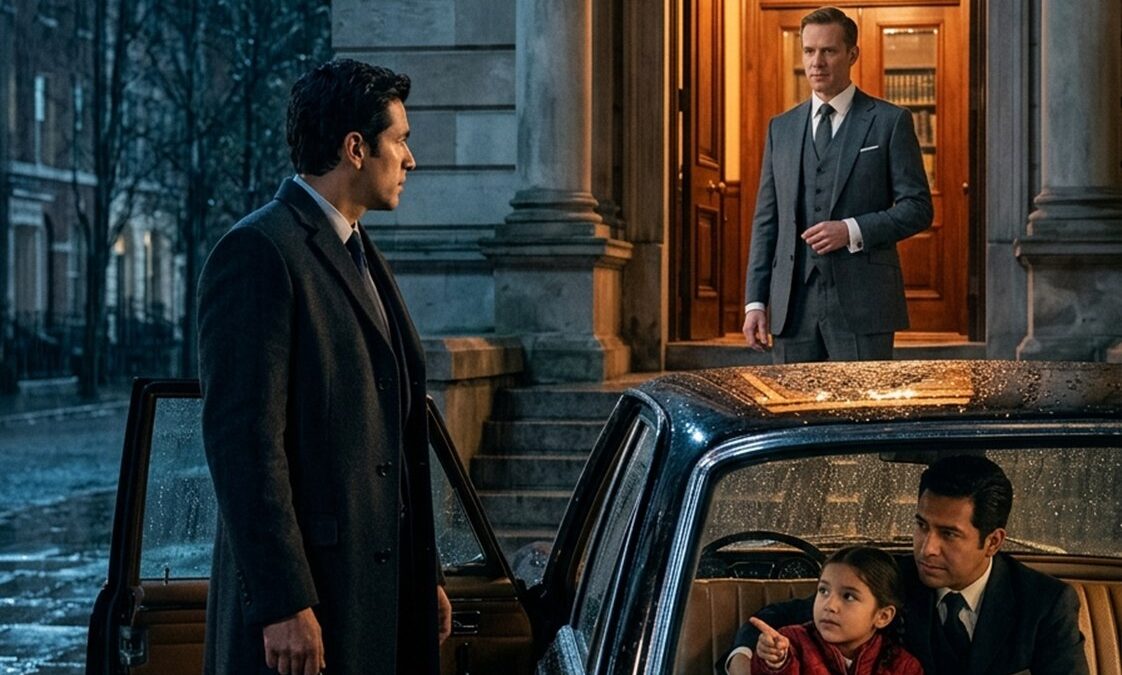
June climbed into the back seat without taking off her red jacket.
Tomas sat beside her. Rafe took the front, keeping the brass key in his palm.
The rain blurred the city.
The Mariner Hotel stood six blocks from the river, trapped between a boarded bakery and a warehouse with broken windows.
Its stone facade had gone black with age.
The painted sign was gone.
Only pale rectangles remained where the letters had been.
Rafe had not visited in seventeen years.
He knew the route without looking at the driver.
He also knew the smell that would meet them.
Wet plaster.
Old smoke.
The memory of his brother’s hand slipping from his.
“Was your mother there the night of the fire?” he asked.
Tomas stared out the window. “She said she arrived after.”
“Did she ever say she saw my brother?”
“No.”
“Did she know him?”
“She worked nights. She knew everybody.”
June leaned forward between the seats. “She said he was kind.”
Rafe looked at the girl in the mirror.
“She said that?”
“She said he carried books for her when her hands hurt.”
The old image surfaced without warning.
A boy with ink-stained fingers. A woman with a limp. A stack of library books carried up the service stairs.
Rafe had forgotten the books.
He had not forgotten the fire.
The driver stopped beside the hotel’s chained entrance.
A security guard came out from the neighboring office. He recognized Rafe and unlocked the gate.
“You want the building opened?” the guard asked.
“Yes.”
“City says no entry without a structural engineer.”
“Then call the engineer.”
“It’s after six.”
“Call him anyway.”
The guard looked at June. “You’re bringing a kid inside?”
“She stays with her father.”
“Mr. Calderon, the floors are—”
“I heard you.”
The guard called his supervisor.
While they waited, Tomas checked June’s zipper. He tugged the fabric closed where rain had seeped inside.
She endured it without complaint.
Rafe watched the gesture.
“You don’t have to prove anything to me,” he said.
“I’m not,” Tomas answered.
“I’m making sure she doesn’t get hurt.”
“That’s what I’m doing.”
A small exchange. No surrender in it.
Rafe respected that.
The engineer arrived twenty minutes later, carrying a hard case and a flashlight. Her name was Lenora Wells, and she had inspected the building for the city two months before.
She checked their identification.
Then she checked the door.
“You’re not walking around in here without me,” she said.
“Agreed,” Rafe replied.
“You’ll need hard hats.”
“Get them.”
She pointed at June. “She waits outside.”
“No,” June said.
Tomas put a hand on her shoulder. “You’re with me.”
“I can wait by the entrance.”
“That’s not what she said.”
June’s eyes filled, but she did not cry.
Rafe recognized the look. Pride first. Fear second.
“You can come as far as the lobby,” he told her. “Then you stay behind the barrier.”
“Can I see the blue door?”
“If it’s safe.”
Lenora sighed. “I set the limits.”
“Then set them.”
She studied him for a long second.
“Fine. Lobby only.”
The front door groaned open.
Dust shifted in the flashlight beams.
The lobby still held its marble counter and a chandelier with half its crystals missing. Water stains spread over the ceiling like dark maps.
The building had been empty for years, but the air felt occupied.
Rafe stepped in last.
June stopped just inside the threshold.
“Mom used to stand there,” she said, pointing at the old desk.
Tomas looked around. “She told you that?”
“She showed me a picture.”
“Where is the picture?”
“At home.”
Rafe turned toward the desk.
A copper plate remained on its front, dulled nearly black. Someone had polished a small strip through the tarnish, leaving the letters C. M. visible.
“Celia Marlow,” Tomas said.
The name had returned.
Rafe moved closer.
Under the plate, the desk had a narrow drawer with a brass lock.
June’s key fit it.
Tomas reached out, then stopped himself.
“Your mother gave you that?”
“After she couldn’t walk anymore.”
June slid the key into the lock.
The mechanism turned.
Inside the drawer lay a folded photograph and a narrow envelope.
Rafe opened the photograph first.
It showed a younger Celia standing beside a boy of about twelve. Behind them, the hotel’s lobby was lit and bright. The boy looked like Rafe’s brother.
His name had been Elias.
Not missing.
Not dead.
Rafe remembered that the family had called him Elias once. Then the newspapers called him Eli. Then his father’s people stopped saying his name altogether.
He turned the photograph over.
Celia had written a date on the back.
February 12, seventeen years earlier.
The fire had occurred two days later.
The envelope carried Rafe’s name.
His hands went still.
“Do you want to read it here?” Tomas asked.
“Yes.”
Inside was a single sheet of paper.
Celia’s handwriting had trembled across it.
Rafe,
If you have come back, then the room is still there.
Your brother did not start the fire.
Your father knew.
Rafe read the lines twice.
The hotel seemed to tilt.
June looked up at him. “My mom said the truth was there.”
“What else did she say?”
“She said you’d be angry.”
“I am.”
“She said you’d want to blame somebody.”
Rafe lowered the letter.
Tomas spoke carefully. “Maybe we should stop here.”
“Why?”
“Because whatever this is, it’s making you look like you might break something.”
Rafe set the letter down.
He had been taught that anger was useful if it stayed controlled. He had also learned that it could make an honest man look guilty.
“You’re right,” he said.
Tomas nodded, surprised by the admission.
Lenora checked the lobby floor with a small sensor.
“Nothing here suggests an immediate collapse,” she said. “The east hall is unsafe. The service stairs are blocked. We can inspect the west side.”
June pointed at the photograph.
“My mom said the blue door was downstairs.”
“Where downstairs?” Rafe asked.
“She said the floor kept what men forget.”
“That’s not a map.”
“She didn’t get to tell me more.”
The last word landed heavier than the rest.
Rafe folded the letter along its crease and returned it to the envelope.
“We find the room,” he said.
Lenora raised a hand. “We assess the structure first. Then we decide.”
“Fine.”
They crossed the lobby to the west hall.
Rafe remembered the hotel in flashes. The carpet had been red. The walls had been cream. There had been a brass directory beside the stairs.
Now a strip of wallpaper hung loose.
A service corridor ended at a collapsed section of ceiling.
Lenora checked the doorway.
“Not through here.”
June peered past her. “The door was under the ballroom.”
“The ballroom is on the second floor,” Rafe said.
“No. Mom said the blue room was under it.”
“Basement?”
“Maybe.”
The hotel’s floor plan had been in the library. Rafe remembered an old freight lift behind the kitchen.
He showed Lenora the route.
She let them proceed one at a time, testing each section before they crossed. Tomas kept June’s hand in his.
At the kitchen, a steel door opened onto a narrow stairwell.
The basement smelled of damp stone.
The engineer checked the steps and gave them permission to descend.
The old boiler sat in darkness. Pipes ran overhead. On the west wall, a row of storage cages had been fitted with newer locks.
Rafe knew the layout.
His father’s office had been upstairs. The family had used the basement for wine and records.
The third cage had been removed.
A clean rectangle remained on the concrete.
“What was here?” he asked.
Lenora swept her light across the floor. “Something heavy.”
June knelt near the empty rectangle. “There.”
A scratch crossed the concrete.
Not a mark from furniture.
An arrow.
It pointed toward the old laundry room.
Rafe followed it with his light.
The laundry room had no door, only a warped frame.
Inside, the tile floor had collapsed near the rear wall. Someone had filled the gap with boards and poured a thin layer of cement over them.
The repair was older than the hotel’s closure.
Lenora crouched. “We don’t go on it.”
“I can inspect the edge,” she added.
The cement had a hairline crack.
Through it, Rafe could see a smear of blue paint.
June’s breath caught.
“That’s it.”
Lenora stood. “We need a structural scan.”
“How long?” Rafe asked.
“Tomorrow, if I can get a crew.”
“Do it.”
“Nothing gets removed before then.”
“Agreed.”
June looked at the blue through the crack.
“Mom said it was bigger than a closet.”
“We’ll find out.”
They returned upstairs.
At the front door, Rafe called Pike.
The attorney answered on the second ring.
“Where are you?” Rafe asked.
“In my office.”
“Did you know Celia Marlow?”
A pause.
“I knew of her.”
“Did you know about the room beneath the laundry floor?”
“I don’t know what you’re talking about.”
“You were in the library when June said it.”
“I heard a child make a claim.”
“Why didn’t it surprise you?”
Pike exhaled slowly. “Because the hotel has been searched.”
“By whom?”
“The city.”
“That’s not what I asked.”
“Rafe, this is a property matter. Don’t turn it into something else.”
“Who ordered the room sealed?”
“I don’t know.”
Rafe ended the call.
Tomas looked at him. “He lied.”
“Maybe.”
“He paused before he answered.”
“That doesn’t prove it.”
Tomas held June’s hand more tightly. “You seem to know that.”
Rafe did.
Proof was different from certainty.
His father had taught him to take certainty as a sign that someone wanted him to stop asking questions.
That night, Rafe assigned two licensed guards to the hotel entrance and gave their names to Lenora. The guards would observe from the public sidewalk.
No one entered without the engineer.
No one touched the floor.
Rafe took June and Tomas to the Calderon family townhouse, where three guest rooms remained empty.
Tomas refused the offer at first.
“Your daughter needs a dry place,” Rafe said.
“She needs her own bed.”
“She can have it tomorrow.”
“Why are you helping?”
“I don’t know yet.”
Tomas held his gaze.
“That’s the first honest thing you’ve said.”
They stayed.
June slept in the guest room with the door open. Tomas sat on the floor outside it until she fell asleep.
Rafe watched from the hallway.
The old man who raised him would have called it weakness.
Rafe called it a father staying where his daughter could find him.
At midnight, a security alert came from the hotel.
A side entrance had been opened.
No one had crossed the lobby.
The guard had seen a van stop outside, then drive away.
Rafe took the alert to the police liaison assigned to the property.
The officer, Maren Price, arrived before dawn with a second unit.
She photographed the door, took the guard’s statement, and asked for the building access logs.
“The city’s contractor used a digital lock,” she said. “We can request the records.”
“Do that,” Rafe said.
“Don’t move anything.”
“I won’t.”
“Don’t call your own people to follow the van.”
“I won’t.”
Price looked at Tomas. “You agree?”
“I do.”
June appeared at the top of the stairs, holding a blanket.
“I want to go back.”
“Not until the engineer says it’s safe,” Tomas told her.
“I can wait outside.”
“Not alone.”
“I won’t be alone.”
Rafe turned to Price. “Can they come with us?”
“If the engineer agrees.”
Lenora came at seven with a ground-penetrating scanner and two technicians.
They mapped the laundry floor from the basement and the ground level.
The readings showed a hollow space beneath the patched cement.
One chamber.
About eight feet long.
A narrow access shaft ran beneath the old linen closet.
Lenora studied the screen. “This was built into the original plan.”
“Why didn’t the plans show it?” Rafe asked.
“Because the section was removed.”
“By whom?”
“I can’t tell from concrete.”
She marked the likely entry point.
The team removed one board at the edge. Then another.
A steel hatch emerged beneath the thin cement.
Its surface was painted blue.
The key did not fit the hatch.
Rafe examined the lock.
There was no external keyhole.
A metal plate sat flush against the frame, held by four screws.
“Could be a pressure latch,” Lenora said. “I’ll need to examine the hinge.”
June stepped close enough to see the paint.
“My mother said the door had no handle.”
Lenora looked at the plate. “She was right.”
The hatch opened after the engineer released a recessed catch.
It resisted at first, then lifted several inches.
A pocket of cold air came up from below.
No one moved.
Lenora shone her light into the opening.
A short ladder led down.
She descended first, secured to a harness, and inspected the room.
“It’s stable,” she called. “Small, but stable.”
Rafe went down next.
The chamber had brick walls and a low ceiling. A worktable stood beneath a bare light fixture.
There were no jewels or cash.
Only paper.
A stack of files.
A small metal box.
A child’s drawing, folded into quarters.
Rafe recognized the handwriting on the first file.
His father’s.
He opened the folder.
A hotel insurance claim. A report about the fire. A list of altered room assignments.
The fire had started in a service stairwell.
The report named a faulty electrical panel.
Someone had written a different note in the margin.
Elias found the west ledger. Get it from him before he talks.
The date was two days before the fire.
Rafe read it again.
His brother had found something.
The metal box contained a reel-to-reel tape and a pocket notebook.
The notebook’s first page bore Elias’s name.
The last entry had been made the night of the fire.
If I don’t get out, Celia knows the room.
Rafe gripped the paper.
The room had been built to hide things from his father.
His brother had not been hiding from the family.
He had been trying to expose it.
Tomas stood at the ladder’s base.
“Was he alive when the fire started?” he asked.
“The note says he planned to leave.”
“That isn’t an answer.”
“No.”
Rafe looked at the archive. “We need to preserve everything.”
Officer Price came down with gloves and evidence bags. She documented the room, photographed the files, and took custody of the tape.
The original documents stayed with her.
Copies went to a forensic accountant and an attorney chosen by the court.
Pike’s name appeared in the insurance file.
He had signed the legal certification.
Rafe stared at the signature.
“What is it?” Tomas asked.
“Pike handled the claim.”
“Could he have changed it?”
“Possibly.”
The records were scanned and compared with public filings.
The fire report had been amended three weeks after the incident.
The amendment removed the missing ledger from the inventory.
It also changed the cause from suspicious to electrical.
The city’s original engineer, a retired man named Vance, was still alive.
He agreed to meet Officer Price and Rafe at his assisted-living center.
Vance remembered the fire.
He remembered a young man in the lobby holding an injured hand.
He remembered the hotel manager telling him a guest had been safely evacuated.
That guest was Elias.
“Did you see him leave?” Price asked.
“No,” Vance said. “I was told he had.”
“Who told you?”
“Your father’s attorney.”
“Pike?”
Vance’s gaze dropped to his hands. “Yes.”
“What happened after that?”
“My report was changed.”
“Did you change it?”
“I signed the revision.”
“Why?”
Vance looked at Rafe. “I had a daughter in college. I was told the family could make the bill disappear.”
Rafe said nothing.
“I should have gone to the police,” Vance continued. “I’m sorry.”
“Were you paid?”
“No. I was threatened with losing my job. Then the family paid my daughter’s tuition.”
“Did you know Elias survived?”
“No.”
“What did you see?”
Vance leaned back.
“I saw him in a service van, wrapped in a blanket. He was conscious. He told the driver to take him north.”
Rafe’s hand closed around the chair arm.
“Who was driving?”
“A woman.”
“Celia?”
“I don’t know. I never saw her face.”
“Why tell the police now?”
“Because I thought the boy was dead,” Vance said. “Then I saw his picture in the paper last year.”
Rafe looked up.
“What paper?”
Vance pointed to a stack on the side table.
A local weekly had run a photograph of a volunteer teacher at a rural shelter. The man in the photo was older, thinner, and had a scar along his jaw.
But the eyes were Elias’s.
Rafe took the paper.
“Where does he work?”
“At a school outside Bellweather,” Vance said. “He uses another name.”
Officer Price wrote it down.
“Has he been contacted?” Rafe asked.
“Not by me.”
Rafe did not call the number.
He wanted to.
He wanted to hear his brother answer.
He also knew that a call from the Calderon name could feel like a threat.
“Price will contact him,” Rafe said.
“I can go myself,” Tomas replied.
“Why?”
“Because if he sees your name, he might hang up.”
Rafe held the paper.
Tomas was right.
They found Elias through the school’s public office line. Officer Price explained who she was and asked whether he would speak to Rafe.
Elias declined.
The refusal arrived through the officer, quiet and clear.
“He says he wants no contact,” Price told Rafe.
“Then we respect it.”
June sat at the table with a bowl of oatmeal.
“He’s your brother,” she said.
“Yes.”
“Maybe he’s scared.”
“He has a right to be.”
“Do you want to see him?”
Rafe did not answer at once.
“Yes.”
“Will you make him?”
“No.”
June nodded as if that settled it.
The evidence continued to grow.
The fire ledger, recovered in the hidden chamber, recorded a large cash transfer from the hotel’s holding company to a shell charity.
The recipient was a group called New Harbor.
It had no public office, no listed board, and no tax filing for the relevant year.
The ledger also showed that several hotel employees had been paid off after the fire.
One name appeared on every payment approval.
Pike.
A former bookkeeper agreed to speak with Price. She confirmed that Pike had handled the false claim and ordered the ledgers destroyed.
She had kept a duplicate on a personal drive.
The drive had been locked in a safe deposit box since the fire.
She brought it to the police.
The drive showed the shell charity had acquired the hotel’s debt at a discount.
Then it had transferred the debt to Calderon Holdings.
Rafe’s father had planned to sell the property to the family company before the fire.
Afterward, the deed vanished from public records.
The hidden room had held the documents needed to prove it.
The building was not simply an abandoned liability.
It had been the center of a long fraud.
Price asked the financial crimes unit to review the filings.
They found transactions routed through a nonprofit controlled by Pike’s brother.
The money had paid for three homes, two boats, and private school tuition.
The pattern led to one conclusion.
Pike had made the hotel’s debt disappear, then prepared to transfer the property again.
He had expected Rafe to sign.
That evening, the side entrance alarm sounded again.
The guards saw a man in a dark coat testing the lock.
He left before police arrived.
On the pavement, Price found a folded note.
It bore no signature.
Stop digging. The hotel has already taken enough from your family.
Tomas read it over her shoulder.
“That’s a threat.”
“It’s an attempt to influence an investigation,” Price said. “We’ll document it.”
Rafe wanted to put every security team he owned on the block.
Price told him to wait for her instructions.
He waited.
The police installed a temporary camera at the entrance and asked the guards to keep a written log.
June’s school schedule was changed. Tomas stayed with her. Rafe arranged for the family driver to pick them up, but Tomas made the driver wait at the curb.
“I don’t want her thinking she’s trapped,” he said.
The next afternoon, a stranger approached June outside the townhouse.
He told her that her father had sent him.
June did not go with him.
She went back inside and told Rafe.
The man left before the police arrived.
The camera caught the plate.
It belonged to a vehicle registered to Pike’s brother.
Price filed for a warrant.
No one was arrested that day.
The legal process moved slower than Rafe’s anger.
It moved anyway.
The school contacted Elias again after Officer Price shared the documented threat.
Elias agreed to speak by video, with a lawyer present.
Rafe sat in a plain conference room with the recovered ledger on the table.
The screen filled with his brother’s face.
Elias looked older than Rafe had imagined.
His hair had gone gray at the temples. The scar on his jaw crossed one cheek.
Neither brother spoke first.
Finally, Elias said, “You look like him.”
“So do you.”
“That’s not a compliment.”
“I know.”
Elias glanced at the ledger.
“Where did you find it?”
“Under the hotel.”
“Celia found the room.”
“She left the key with her daughter.”
“June?”
“Yes.”
“Is she all right?”
“She’s safe.”
Elias looked away.
“You were there that night,” Rafe said.
“I was.”
“Why did you run?”
“Because Father told me to.”
Rafe leaned forward.
“What?”
“He said he was going to make me the reason for the fire.”
“Why?”
“I found the ledger.”
“Why didn’t you come back?”
“Because he had people watching your school, your mother, and anyone who might talk.”
“He’s dead.”
“I know.”
“Pike is alive.”
“I know that, too.”
“You knew?”
“I read the reports. I saw the filings.”
“Why didn’t you come forward?”
“Because the first time I tried, the police brought your father’s lawyer into the room.”
Rafe looked at Price.
She nodded. Vance’s statement matched the old report.
“Did you start the fire?” Rafe asked.
“No.”
“Did you know who did?”
Elias held his gaze.
“Pike arranged it.”
The room went still.
“He ordered the faulty panel?” Rafe asked.
“He hired a contractor to create a small fire and destroy the books. He didn’t expect the flame to catch the curtains.”
“Why were you in the hotel?”
“I had copied the ledger. I came back to get the original.”
“Why did you leave me?”
“I didn’t.”
Rafe’s jaw tightened.
“Someone told me you were gone.”
“I was trying to come back.”
“You could have called.”
“I did.”
“No one told me.”
“I know.”
“Who?”
Elias looked into the camera.
“Your father.”
The revelation made the old memory turn inside out.
Rafe remembered standing on the curb while the hotel burned.
He had asked for Elias.
His father had held his shoulder and said, “He chose this.”
Rafe had believed the sentence for seventeen years.
He had built his life around it.
“My father knew you were alive,” Rafe said.
“He helped me get out.”
“Then why tell me you were dead?”
“Because I had the ledger. He wanted me away from the family while he negotiated with Pike.”
“You could have told me later.”
“Your father was alive.”
“That isn’t an answer.”
“No,” Elias said. “It’s the reason.”
Rafe’s hand flattened on the table.
“You let me hate you.”
“I thought it kept you safe.”
“It made me like him.”
Elias closed his eyes.
“I know.”
The admission did not heal anything.
It made the wound more precise.
They ended the call without a promise to meet.
Price added Elias’s statement to the case file. She made clear that his testimony would need independent support.
The support existed in the ledger, Vance’s account, the duplicate records, and the contractor’s payments.
The contractor had died years earlier.
His invoice remained.
The financial crimes unit traced the payment to a company that Pike’s brother owned.
The case moved toward formal charges.
Then Pike asked for a meeting.
He requested the hotel’s former ballroom, claiming he would provide documents.
Officer Price approved a controlled interview with counsel present. She also invited the city’s property officer, the company’s board chair, and two auditors.
The meeting would be recorded.
Rafe agreed.
Pike arrived in a dark suit, silver cuff links bright against his wrists.
He sat at the long conference table.
The hotel ballroom had been cleared of debris. Temporary lights cast hard shadows over the walls.
Elias did not attend.
Tomas and June came with the property officer’s permission. They sat near the door.
Pike looked at the girl.
“Your mother was a fine employee,” he said.
June stared back. “She said you lied.”
Pike’s face remained calm. “She was grieving.”
“So was I,” Rafe said.
Pike turned to him.
“You signed nothing,” he said. “There was no transfer.”
“I stopped the signing.”
“And now the company owns a condemned property full of old documents.”
“Documents you said did not exist.”
“I had no reason to believe the room was real.”
“You had signed the fire claim.”
“I signed hundreds of reports.”
“You amended that one.”
“The city requested a correction.”
Vance’s statement lay in front of Officer Price.
“The city’s engineer says you brought him the revision,” Price said.
“After seventeen years, his memory is weak.”
“The original report survived,” she replied.
Pike looked at the file.
“Do you have proof I ordered the fire?”
“The contractor’s payment,” Price said. “The duplicate ledger. The insurance claim.”
“The contractor is dead.”
“The payment is not.”
“You can’t prove intent from an invoice.”
“Then let’s discuss the transfers,” said the financial auditor.
Pike looked around the table.
“You’re making a serious mistake.”
“No,” Rafe said. “That’s what the room was for.”
He placed the brass key on the table.
The faded tag faced Pike.
Pike’s eyes flicked toward it.
Only once.
Rafe noticed.
So did Price.
“You’ve seen that key before,” she said.
“I’ve seen many keys.”
“This one belongs to Celia Marlow,” Tomas said.
Pike turned to him. “You’re a valet.”
“I was.”
“You have no understanding of the documents.”
“I understand when someone tries to take my daughter.”
Pike’s smile tightened.
“You’ve made accusations based on a child’s imagination.”
The room grew quiet.
June sat very straight.
Rafe wanted to answer for her.
He did not.
She deserved to speak.
“My mother kept rooms clean,” she said. “She knew what you hid.”
Pike looked at her. “Your mother was ill.”
“My mother was honest.”
“Children don’t understand—”
“Enough,” Price said.
The auditor opened the recovered file. “The ledger’s entries correspond to transactions in the duplicate records.”
Pike looked down at the page.
The transfer approvals carried his signature.
The shell charity’s bank account had moved money to Pike’s brother.
The bank had preserved the records.
The documents were independent.
Price placed another sheet beside them.
“This is the city’s original inspection log.”
Pike’s face changed.
The log showed that no engineer had inspected the hotel’s basement after the fire.
The revised report had claimed one did.
Pike had signed that report.
The key remained between the papers.
“You’ll have to prove I knew about the room,” Pike said.
Rafe pointed at the line in the old ledger.
“Your name is on the payment to seal it.”
“Anyone could have entered that.”
“No.”
Rafe tapped the line again.
“You approved the contractor’s invoice.”
Pike leaned back.
“Your father approved it.”
“Your signature is here.”
“On a copy.”
“The bank verified the original.”
Pike glanced at Officer Price.
“I’m done answering questions.”
Price closed her folder.
“That’s your right.”
Pike stood.
The officers did not grab him.
They asked him to remain.
He refused.
Price explained that the warrant had been issued an hour earlier.
Pike’s counsel asked to see it.
The officer handed it over.
Pike read the page.
His posture barely moved.
“Rafe,” he said, “your father built the family on compromises. You’re going to ruin everything he left you.”
“I’m keeping what he should have protected.”
“Your brother abandoned you.”
Rafe felt the sentence strike.
It did not control him.
“He has a name,” Rafe said. “Use it.”
Pike looked at June.
Then at the key.
“You can’t trust people who spent their lives in your house.”
Tomas stood.
“We spent our lives keeping it standing.”
Pike had no answer.
The officers escorted him outside without force.
His lawyers stayed behind.
The meeting ended.
The case did not.
Three months later, Pike was charged with fraud, evidence tampering, and conspiracy related to the fire.
The charges came after the bank records, the contractor’s invoice, and Vance’s testimony were independently reviewed.
Pike pleaded not guilty.
The court froze the assets connected to the shell charity.
His brother’s company entered bankruptcy.
The city opened a formal investigation into the hotel’s original condemnation.
Rafe did not attend every hearing.
He attended the ones where the old fire was discussed.
Elias gave a recorded statement and later testified under his legal name.
The brothers did not embrace in a courthouse hallway.
They sat across from each other in a small waiting room.
They talked for twenty minutes.
Then Elias left.
That was enough for that day.
The hotel’s ownership transfer was halted.
A judge ordered the property preserved while the case continued.
The company’s board asked Rafe to sell the parcel after the freeze ended.
He refused.
He also refused the board’s offer to pay Tomas for his silence.
Tomas had not asked for payment.
Rafe set up a trust for the hotel’s restoration instead, with an independent administrator and public reports.
Tomas reviewed the documents with a lawyer of his choosing.
“You don’t need to put my name on it,” he said.
“I know.”
“Then why are you?”
“Because your wife found the room.”
“My wife didn’t do it for money.”
“I’m not offering money for what she did.”
“What are you offering?”
“Her name on the restoration.”
Tomas looked at the draft.
“Celia Marlow Reading Room,” he read.
“Yes.”
June sat beside him, coloring on the back of an old city brochure.
“She would like that,” she said.
“What would she want the room used for?” Rafe asked.
“Books,” June answered. “She liked books.”
“Then books.”
Tomas studied Rafe.
“She also liked a place where people could sit without being watched.”
Rafe understood the line.
“Then it won’t be a company office.”
The months moved forward.
Pike’s trial took place the following spring.
The prosecution presented the original ledger, the bank records, the amended report, and Vance’s testimony.
Pike’s defense argued that the fire had been accidental and that the accounts were routine business transfers.
They argued that Celia had been confused.
They argued that Elias had been estranged and unreliable.
The judge allowed the paper trail to speak.
The jury found Pike guilty of fraud and conspiracy.
The court ordered restitution and barred him from managing financial accounts.
The separate fire investigation remained open.
No one could charge the dead contractor.
The record did establish that the fire had been deliberately set.
It also established that Elias had not started it.
Pike’s final statement blamed Rafe’s father.
It named no one else.
Rafe did not defend his father.
He did not denounce him, either.
He told the court what he knew.
His father had hidden the truth.
His father had also helped Elias escape.
Both facts remained true.
Outside the courthouse, Elias waited near a tree.
Rafe approached alone.
“I didn’t know,” he said.
“I know.”
“I should have kept looking.”
“You were twelve.”
“I was old enough to remember.”
Elias folded his arms against the cold.
“I left because I thought you were safer without me.”
“You were wrong.”
“Yes.”
“Why did you keep the clipping?”
“I didn’t.”
“Then why did you know about it?”
“I saw it online.”
Rafe nearly smiled. “That’s not the same.”
“No.”
They stood in the winter air.
“Do you want to come see the hotel?” Rafe asked.
“Not yet.”
“All right.”
“Maybe after the work is done.”
“All right.”
Elias looked toward the courthouse.
“You didn’t use my statement to bury the family.”
“No.”
“Why?”
“Because the truth wasn’t supposed to be useful only when it hurt someone.”
Elias looked at him.
That sounded like their mother.
Neither of them said so.
Six months later, the hotel’s upper floors were declared unsafe for public entry.
The city approved repairs to the lobby, the ballroom, and the former laundry area.
Workers reinforced the beams before opening the hidden chamber again.
The records were archived.
The blue hatch was removed carefully, restored, and placed behind protective glass.
The key stayed in the family trust.
Rafe gave it to June for the ceremony.
She held it with both hands.
Tomas stood beside her in a clean gray suit.
He no longer worked as a valet.
The hotel had hired him to supervise its restoration, with a salary reviewed by an outside board.
He took the job after negotiating the hours himself.
“I want Sundays,” he had said.
“You have them,” Rafe replied.
“I want to leave by six.”
“You can leave at five.”
“Don’t spoil it.”
Rafe had almost smiled.
Almost.
At the opening, June cut the ribbon.
The lobby had been restored with its old marble counter and new lights.
The chandelier was gone.
In its place hung a simple brass fixture made by a local metalworker.
The reading room stood where the laundry entrance had been.
Shelves lined the walls.
A table held books donated by the neighborhood.
A plaque on the door read CELIA MARLOW READING ROOM.
The blue hatch sat beneath it, preserved as part of the wall.
People came in quietly.
Some had worked at the hotel.
Some had lived nearby.
Some had never heard of the Mariner before.
The room filled with the sound of pages turning.
Rafe stood near the doorway.
June walked over with a book against her chest.
“Can I keep the key?”
“For tonight.”
“Why not forever?”
“Because it belongs to the trust.”
“Can I borrow it?”
“You already did.”
She considered that.
Then she placed the key in his hand.
It no longer felt cold.
Tomas joined them.
“Your brother called,” he said.
“When?”
“An hour ago.”
“What did he say?”
“He’s coming next month.”
Rafe looked toward the restored lobby.
“Good.”
“He asked if the room was still there.”
“It is.”
“And the family?”
Rafe watched June choose a seat by the window.
“We’re working on that.”
Tomas nodded.
The answer was enough.
Years later, the Mariner remained open.
The legal case ended with restitution and a public record that cleared Elias.
Pike served his sentence.
The family company dissolved its old shell accounts and submitted to independent oversight.
Rafe sold the waterfront parcel beside the hotel.
The proceeds funded the reading room and a scholarship for hotel workers’ children.
Tomas never let the company name the scholarship after Rafe.
He named it after Celia.
Elias came back.
He and Rafe met at the hotel twice a year, then more often.
The first reunion lasted twenty minutes.
The second lasted an afternoon.
The third included June, who asked Elias why he had changed his name.
He told her the truth.
“I needed a quiet life.”
“Did you get one?”
“I’m trying.”
“That sounds hard.”
“It is.”
She accepted the answer and handed him a book.
The room beneath the floor became a place where students learned to read old records.
The brass key remained in a glass case beside the blue hatch.
It did not open the room anymore.
It opened the story of how the room had been found.
Once, during a school visit, a child asked Rafe why he had dropped the deed.
He looked at the restored floor.
“Because I heard someone I had forgotten.”
June, now grown, stood near the window with a stack of library books.
She glanced over.
“You remember what you said?”
“I remember.”
“Good.”
The rain moved softly against the glass.
No one was waiting to be rescued.
No one was hidden beneath the floor.
The key caught a line of afternoon light, and the room kept nothing from them.
THE END








