I Stopped the Bullying Outside My Daughter’s School, Then a Boy’s Bracelet Brought Back the Secret I’d Buried
Chapter 1: A Name Under Glass
The first french fry hit the boy’s backpack, and the second landed in the gutter beside his shoe as three students in Ashcroft Academy jackets told him he didn’t belong near their school.
One of them tipped a paper cup, and its cold contents splashed across the sidewalk while the boy in the torn gray hoodie kept his head down and gripped the strap of his battered backpack.
“Stop, and go inside with Mr. Price,” I said, stepping between them and the boy as the security officer came through the gate.
Mr. Price took the students’ names, called the front office, and asked the boy if he wanted to come out of the wind, but the boy backed toward the brick wall.
My daughter, Sophie, stood close enough to touch my coat; she was seven, and a moment earlier we had been arguing about whether the clouds looked like whales.
I asked Mr. Price to take her to Ms. Alvarez at the front desk, then knelt several feet from the boy with my hands where he could see them.
“Are you hurt?” I asked.
He shook his head, though his lips looked dry and his face was streaked with dirt.
“I’m used to it,” he said.
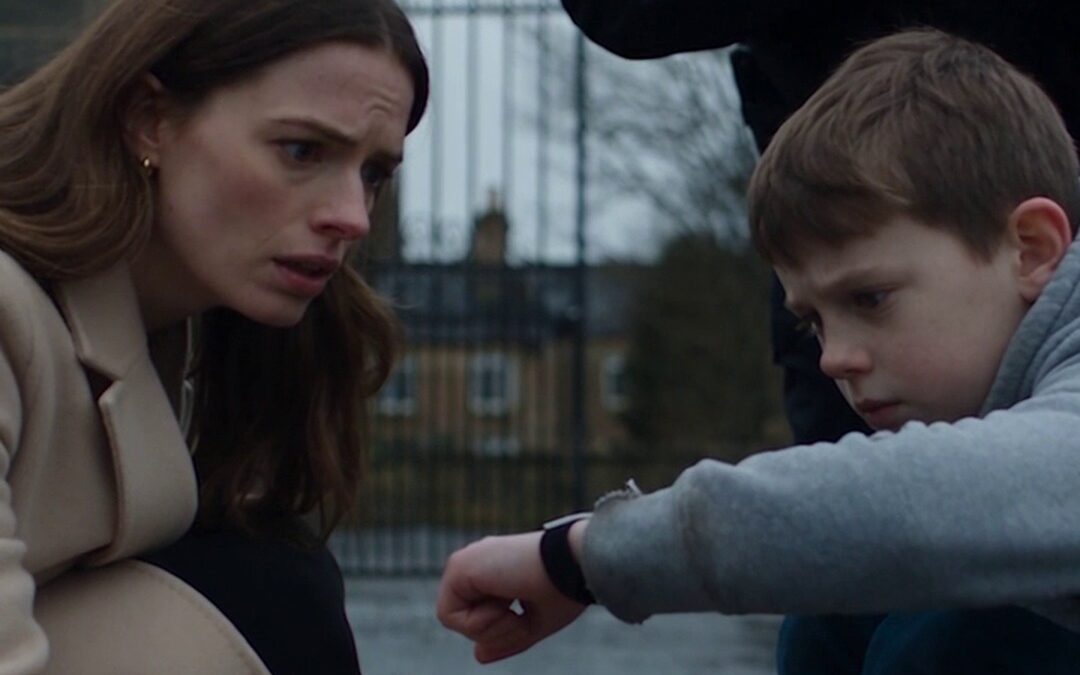
He reached for his backpack, and the cuff of his hoodie slid up to show a broad black fabric band around his wrist with a narrow strip of faded blue plastic stitched beneath a clear window.
An infant’s hospital bracelet could never have fit him now, but I knew the name printed on that strip: North River Mercy Hospital.
I knew the year, 2017, and the small handwritten correction above the last two digits of the infant number, where a nurse had changed a three to an eight after reading the delivery sheet.
Nine years earlier, at eighteen, I had watched her make that correction while a newborn boy slept against my chest.
By the next evening, I had signed papers and left the hospital without him.
The boy looked up, and the shape of his mouth made me think of photographs of myself at his age, which proved nothing at all.
“Why are you looking at me like that?” he asked.
I almost told him what the bracelet had made me hope and fear, but Sophie had returned to the gate beside Ms. Alvarez, and this child deserved more than a stranger’s guess.
Mr. Price came back with his radio pressed against his shoulder and said quietly, “His name is Jonah Bell, and there’s a missing-child report under that name.”
Chapter 2: What the Records Could Hold
Mr. Price kept his voice low enough that Jonah could not hear him, and I kept mine steady long enough to ask whether the school had called the people responsible for a missing child.
He said the front office had called the number on the report and that a police officer and county child-welfare worker were coming, while Ms. Alvarez led Sophie inside with the promise that I would tell her where I was as soon as I knew.
I wanted to follow my daughter and explain my face to her, but Jonah was watching the gate as if every adult who passed through it might take something from him.
“Can we wait somewhere private?” I asked Mr. Price, and he offered the small reception room beside the office without asking Jonah to hand over his backpack.
Jonah considered the open doorway, then asked whether he would be locked in.
“No,” Mr. Price said, showing him the door that opened from the inside, “and I’ll stay right here unless you want space.”
Jonah walked in ahead of us and chose the chair nearest the door, with his backpack upright between his shoes.
Ms. Alvarez brought a dry school sweatshirt and a cup of water, and when Jonah asked about food, she said the nurse could help him choose something that would sit well after a long night.
He accepted the sweatshirt without putting it on, drank half the water, and watched me over the rim of the cup.
I gave him my first name, Lena, because “Mrs. Ward” sounded like another person with authority over him.
“You work here?” he asked.
“No, Sophie goes here,” I said.
He glanced at the closed door and said, “The little kid?”
I nodded, and he said nothing more.
The school nurse, Ms. Chen, came in with a packet of crackers and a banana, asked permission before looking at his scraped palm, and checked whether he felt dizzy, cold, or sick.
Jonah said he was tired and hungry, disliked bananas, and would rather keep the crackers for later.
She put them beside him and told Mr. Price that he needed a medical assessment that day, particularly because nobody yet knew how long he had been without regular food or sleep.
The officer who arrived was a woman named Ruiz, and she checked Jonah’s name and description against the missing report before speaking to him directly.
“You’re not in trouble,” she said, “and I need to make sure the people looking for you know you’re safe.”
Jonah’s fingers tightened around the backpack strap.
“Is June dead?” he asked.
Officer Ruiz did not answer from a report she had not read; she called the hospital listed in the case notes, spoke to someone there, and came back to tell him that June Bell was alive and receiving care.
His shoulders dropped so suddenly that I understood how long he had been holding them up.
He asked to call her, and the officer said the county worker would help arrange that once the hospital confirmed she was able to talk.
I waited until Jonah was occupied with Ms. Chen’s questions before telling Officer Ruiz, away from him, that the blue strip appeared to be from the hospital where I had given birth to a boy in 2017.
I gave her the date, my name at the time, and the detail of the corrected number, then told her that I did not know whether the bracelet belonged to Jonah or how he had obtained it.
She wrote down what I said without looking toward his wrist.
“Please don’t ask him to take it off,” I added.
“That’s his decision unless a safety need changes it,” she said.
The county worker arrived twenty minutes later with a soft-sided medical bag and a plain canvas tote instead of a stack of forms.
Her name was Mara Gaines, and she asked Jonah if he preferred to speak with her alone, with Officer Ruiz nearby, or with someone from the school in the room.
He chose Mr. Price because Mr. Price had stopped the students, and I stepped into the hall before anyone had to ask me.
Through the glass in the office door I could see Sophie sitting beside Ms. Alvarez, working on a spelling sheet with the grave concentration she used when she knew adults were worried.
I called my husband, David, and asked him to come for her at the usual dismissal time unless I called sooner.
He heard something in my voice and asked whether Sophie was safe.
“Yes,” I said, “but I need to tell you about something from before we met, and I’ll do it in person today.”
I had kept that sentence out of our marriage for eight years, and saying it in a school hallway made my mouth feel unfamiliar.
Mara came out after a short conversation and told me Jonah wanted a hospital check, wanted news about June, and did not want anyone looking inside his backpack.
“He also asked whether you can leave,” she said.
I told her I could.
“He didn’t ask you to,” she added, “but I wanted you to know he gets to change his mind.”
I stayed in the office while Mara arranged transport to the children’s emergency department, where a clinician could assess dehydration, exposure, injuries, and his recent eating without asking him to repeat his story to every new person.
Officer Ruiz documented that he had been located and notified the missing-child unit, while Mr. Price preserved the school camera footage and took the three students’ names to the principal.
No one announced why Jonah was there, and the office staff kept other families out of the reception room.
When Jonah came through the hall with Mara, he had put on the sweatshirt and slipped the crackers into his backpack pocket.
He stopped in front of me, not close enough for either of us to touch.
“You cried because of the bracelet,” he said.
“Yes,” I said.
“Is it yours?”
“It reminds me of someone I knew,” I said, “but I don’t know yet what it means.”
He studied me for a moment, then followed Mara out through the side entrance.
I watched their car leave before I went to Sophie, because she deserved my attention without having to compete with a child whose name I had only learned that morning.
“Is that boy going to get help?” she asked as soon as Ms. Alvarez gave us privacy.
“Yes,” I said, “a worker is taking him to a doctor and finding his family.”
“Those kids were mean.”
“They were, and the school is dealing with it.”
She pressed her pencil into the paper until its point broke, and I asked Ms. Alvarez for another one rather than making Sophie tell me what she was feeling in the front office.
At home that afternoon, I sat at the kitchen table with the hospital discharge envelope I had kept beneath old tax records.
The envelope held my own discharge instructions, a copy of the voluntary surrender papers I had signed three days after the birth, and a photograph of my hand beside a swaddled infant whose face was turned away.
I had never taken a picture of his face.
My son had been born on March 18, 2017, at North River Mercy Hospital in Philadelphia, and the nurse who printed the paired identification bands had written a correction on both because she had transposed the last digits of the unit number.
The number on my paper was NR-17-038, not the number Jonah wore.
I held it closer to the window, looked again at the eight with its little dark loop, and remembered that the boy’s faded strip had shown the same correction above the last two digits.
The recognition was real, but memory after nine years was a poor custodian of plastic, ink, and grief.
I called Mara’s office, identified myself, and asked how to put my own records in the hands of the right person without receiving information I was not entitled to have.
She asked me to photograph the outside of the envelope and bring the originals to a meeting the next morning; she would speak with the agency’s legal staff about what could be compared and what a court would have to release.
I also told her that I was available for a lawful DNA test if the investigation reached that point.
“We’ll discuss consent and custody before anyone collects anything,” she said.
When David came home with Sophie, I asked him to sit with me after she had eaten and gone upstairs to draw.
I had imagined this confession many times, usually with a carefully prepared explanation that began with my mother’s pressure or the rent we could not pay.
What I said first was, “When I was eighteen, I gave birth to a boy and signed a voluntary surrender so he could be adopted.”
David set his keys on the table, looked toward the stairs, and asked whether Sophie had heard me.
“No,” I said.
He waited, and I told him the birth date, the hospital, and the fact that I had seen a boy that morning wearing what might be the infant’s hospital band.
I told him I had no proof the child was mine and that a missing-child response was already underway for Jonah Bell.
David asked why I had never told him about the pregnancy, even when we had talked about having Sophie.
“Because I was ashamed of leaving him, and then I was ashamed of having hidden it from you,” I said.
He did not reach for me, and I did not ask him to make the conversation easier.
“What happened to him after you signed?” he asked.
“I was told he went to an adoption agency, but I never asked for the updates they offered,” I said.
David looked at the old envelope between us.
“You could have asked?”
“Yes,” I said.
The answer remained there while Sophie came down to ask where we kept the blue markers, and David found them for her with the same patient voice he used every day.
After she went back upstairs, he asked whether I had been made to sign.
I told him that my mother had wanted the pregnancy hidden, that the baby’s father had stopped answering my calls, and that I had believed adoption would give my son stability I could not provide at eighteen.
A hospital social worker had told me I could take time and speak with a lawyer, but I had refused both because I was terrified that one more hour holding him would make the decision impossible.
My mother had paid my rent that month and made her preference unmistakable; I had signed the papers myself.
“I thought if I did it quickly, he would never know what I had almost done,” I said, “and I was wrong to make his future into something I didn’t have to look at.”
David said he needed time to understand what I had kept from him, and I told him he had it.
Then we spoke about Sophie, who had seen a boy frightened at her school and her mother crying in front of him.
We agreed to tell her enough that she could trust what she had seen, without asking her to carry the history of my pregnancy or guess at a relationship no one had confirmed.
At bedtime I sat beside her and said the boy had a grown-up named June who was ill, that helpers were making sure he had a safe place while June got better, and that I had been upset because something he wore reminded me of a baby I had known long ago.
“Did the baby die?” she asked.
“No,” I said.
“Do you know where he is?”
“I’m trying to learn what happened, and when I know something I can tell you, I will.”
She considered this while arranging three stuffed animals along her pillow.
“I don’t want those boys in my class tomorrow,” she said.
“They aren’t in your class, and Ms. Alvarez knows what happened,” I said.
She made me promise to walk her to the gate in the morning, a request about her own day that I could answer without hesitation.
After she slept, I wrote down every detail I remembered from the birth before anyone showed me another record.
I recorded the nurse’s correction, the date and time of delivery, the social worker’s name, the photograph of my hand, the agency listed on my surrender form, and the fact that I had seen only a glimpse of the strip on Jonah’s wrist.
I added what I did not know: whether it was an original band, whether another infant had the same correction, whether a caregiver had given Jonah someone else’s keepsake, and whether my longing had made a familiar face out of a stranger’s.
By morning Mara had permission to tell me only that Jonah was medically stable, had eaten and slept at the hospital, and was in a temporary placement arranged through the county.
His examination had found fatigue, mild dehydration, and an untreated scrape but no injury that required admission.
June Bell was still in the hospital, and the county was checking both her condition and Jonah’s legal status before deciding where he could stay.
I drove Sophie to school, kept my promise to walk her to the gate, and saw Mr. Price standing where he had stood the day before.
He told me the principal had spoken separately with the students and their parents after reviewing the footage, and that the school was addressing the throwing and the insults under its conduct rules.
He did not tell me the students’ names or make Jonah’s situation into an example for an assembly, which was one decision I was relieved to leave in competent hands.
At the county office, Mara introduced me to an agency records liaison named Elaine Sato and laid my envelope on a clean desk.
Elaine checked my identification, noted each page she received, and copied the hospital number from my discharge sheet without suggesting she could open Jonah’s sealed adoption file for me.
“The hospital can compare records in response to the child-welfare investigation,” she said, “but its staff won’t release another person’s chart to you because you recognize a number.”
I agreed, though every part of me wanted the answer immediately.
Elaine showed me the limited facts already verified from public and current records: Jonah Bell was nine, his legal name had been Jonah Bell since an adoption finalized when he was an infant, and his birth date on the amended certificate was March 18, 2017.
The certificate named his adoptive parents, Nora and Benjamin Bell, and listed Philadelphia as his birthplace without naming the hospital.
“Birth dates can travel with a child through adoption,” Elaine said, “but they aren’t enough to identify the birth parent.”
I asked about the bracelet, and Mara told me Jonah had allowed her to photograph it while he held his own wrist out.
He had declined to remove it, and she had respected that choice.
The photograph showed more than I had seen outside Ashcroft: the blue strip sat under a stitched clear window on a black watchband, and the handwriting above the printed 038 could be read as a corrected eight.
It also showed that the strip had been cut short at both ends, leaving no original clasp and no way to tell from the object alone who had worn it first.
Then Elaine read from the hospital’s preliminary index, which had been produced for the county that morning.
The entry for NR-17-038 said “Baby Mercer, female,” with no correction visible in the digital transcription.
I felt heat rise in my face because the child I had delivered was a boy.
“Could it be another baby’s band?” I asked.
“It could,” Elaine said, “and we need the original paper record to know whether the transcription is wrong or the bracelet points somewhere else.”
Mara added a second possibility: Jonah had lived with other children during an early placement, and a caregiver could have preserved or handed down a strip that did not belong to him.
She was careful with the possibility because Jonah had already said the band mattered to him.
I drove home with my own paper showing “male” in the delivery section and an official hospital index saying “female” under the number I remembered.
On the way I passed North River Mercy, a square brick building I had avoided for nine years despite its place on a road I used often.
Inside my car, I called my mother.
She had not met David until after Sophie was born, and they both believed my college years had been ordinary except for the financial strain I mentioned when the subject came up.
I told her that a child had been found wearing a bracelet from North River Mercy and that the county was checking whether he was the boy I had surrendered.
My mother was quiet long enough that I thought the call had dropped.
“You don’t have to tell them anything you aren’t sure of,” she said.
“I already gave them what I know,” I said.
She began to say that we had done what seemed best, and I stopped her before “we” could smooth over who had held the pen.
“You pressured me, and I chose,” I said, “and neither of us gets to tell him those things cancel each other out.”
She asked whether she could meet him if he was my son.
“That belongs to him and the people caring for him,” I said.
The call ended without an agreement, which was the first honest ending we had given that subject.
Two days passed before the county received the original hospital chart from off-site storage.
During that time, Jonah remained with a licensed emergency foster parent named Mrs. Ellison, June remained in the hospital after a stroke, and Mara arranged one brief phone call between them after June’s doctor said she could manage it.
Mara did not tell me what Jonah said on the call, only that he had chosen to make it and had asked for another.
I spent those days at work as a city library archivist, checking dates and names for other people while resisting the urge to use professional habits to pry into Jonah’s private life.
I could identify how records went astray, but I had no right to make his file my personal research project.
When Mara called me back to her office on Friday, Elaine had a certified copy of the paper nursery log and a short statement from the hospital records custodian.
The original log showed that a nurse had first marked the infant “F” on a handwritten intake line, then crossed it out, initialed the change to “M,” and corrected the final digits of the bracelet number from 033 to 038 after comparing the delivery sheet.
The transcription company had captured the first sex marker and omitted the correction because the line was cramped.
The hospital also had a discharge inventory signed when the agency took custody: one blanket, one paper footprint card, and the infant’s blue identification band placed in a sealed keepsake envelope.
The envelope had left the hospital with the child’s case materials, not with me.
The record answered why an infant strip could have survived the birth, but it still could have passed through many hands afterward.
Elaine had requested the agency’s placement ledger through the appropriate release process, and the first entry introduced another gap.
The infant listed as “Baby Mercer” went from North River Mercy to temporary caregivers named Rosa and Miguel Avila, while the adoption summary available to the county named the Bells as Jonah’s adoptive parents.
I asked if the Avilas had adopted my baby and Jonah had later acquired the bracelet from someone else.
“That is a possible reading of what we have,” Elaine said.
Mara watched me fold my hands around the edge of the chair.
“We’ll follow the transfers,” she said, “and we won’t ask Jonah to settle a records question with his memory of being a baby.”
Jonah’s own memory began later, in the Bell family’s yellow kitchen, where Nora had taught him to make pancakes that looked like uneven planets.
Mara told me only the parts needed to understand his safety and the bracelet, with the agency’s permission and Jonah’s growing consent to share them.
Nora and Benjamin had adopted him at four months old after the Avilas’ temporary placement ended, and Nora had sewn the blue hospital strip into a larger cloth band when Jonah was five because he kept trying to wear the brittle original around his wrist.
She had told him it was from the day he was born, while also telling him plainly that another woman had given birth to him.
After Nora died of cancer, June Bell, Benjamin’s mother, replaced the worn cloth with the black band Jonah wore now.
Jonah liked to show the clear window to friends who asked about it, but he did not like adults using it to start a conversation about his adoption.
I thought of my question at the gate and was grateful he had been allowed to stop it where he did.
Benjamin had struggled after Nora’s death, missed school meetings, and once left Jonah with June for a week without a reliable way to reach him.
The county had opened a case after a school counselor reported the absences, and Benjamin had agreed to June’s guardianship while he received treatment and found steadier housing.
He was not barred from Jonah’s life, but June made the daily decisions and kept his vaccination and school records in the same kitchen drawer as the pancake recipes.
That attachment had survived many more ordinary mornings than the one I had held him at North River Mercy.
I asked whether Benjamin had been contacted when Jonah disappeared.
“He was,” Mara said, “and the police initially considered whether Jonah had gone to him.”
She could not give me his movements, but she said officers were verifying them and would not treat a parent’s history of instability as proof of what happened this week.
On Saturday morning David and I told Sophie more because the uncertainty had entered our home whether we named it or not.
We sat with her at the kitchen table after breakfast, while her cereal bowl was still there and she could leave whenever she wanted.
“When I was younger, before I knew Dad, I gave birth to a baby boy who went to live with another family,” I said, “and the helpers are checking whether the boy at school might be him.”
Sophie looked from me to David.
“Would he be my brother?” she asked.
“He might be related to you,” I said, “but we don’t know yet, and he already has his own family and his own name.”
“Would he sleep in my room?”
“No,” David said, “your room stays yours.”
“Do I have to tell anyone at school?”
“No,” I said, “you can talk to us or Ms. Alvarez if you need to, but this is private information about him and about us.”
She asked whether I had loved the baby, and I answered with the truth I could give her without making her carry its weight.
“I cared about him, and I made a choice I’ve been sad about,” I said.
She asked whether being sad meant I would leave again, and David moved his chair closer while I told her that I was here, that she had two parents caring for her, and that nothing about the investigation changed that.
Later, she asked to go to her friend Iris’s birthday party as planned, and I drove her there with a gift bag on the passenger seat.
The request felt like a reminder that she had a seven-year-old life whose ordinary events still deserved room.
On Monday, Mara asked if I would come to a meeting with a lawyer assigned to represent Jonah’s interests and a genetic counselor from an accredited laboratory.
Jonah’s legal guardian, June, was recovering enough to discuss the case with counsel, and a court had authorized the county to obtain records relevant to his identity and care.
June consented to Jonah’s participation in the test after speaking with his attorney, while Jonah was told in plain language what the cheek swab would and would not answer.
He agreed only after Mara promised that no one would cut his hair, take his bracelet, or make him meet me because of the result.
I signed my own consent in a separate room, showed identification, and watched a technician seal my sample in a labeled kit with its collection time and custody form.
Jonah’s sample was collected that afternoon at Mrs. Ellison’s house by another trained collector, with his attorney present and June consulted by phone.
The laboratory estimated a week for processing and review.
I was offered no photograph of the swab, and I was glad no one had thought such a thing would comfort me.
The waiting week brought the missing-child timeline into focus.
June’s building manager found the apartment door open after Jonah had called emergency services on Monday afternoon because June had fallen and could not speak clearly.
The ambulance crew had taken June to the hospital, and a neighbor who thought she had been asked to watch Jonah arrived too late to find him.
In the confusion, the crew believed the neighbor had him, the neighbor believed he had gone with the ambulance, and the building manager did not know there was no adult with him until evening.
A report under Jonah Bell’s legal name was entered shortly before eight that night.
Police searched near June’s building and notified child welfare, but nobody connected the nine-year-old in a torn hoodie with the affluent school until Mr. Price called the next morning.
Jonah had gone to Ashcroft because June had once worked there as a part-time crossing guard and had told him that, if he was ever lost nearby, Mr. Price at the gate would know how to reach her.
He had reached the correct gate at the wrong moment, before Mr. Price came outside for dismissal preparation.
His explanation made the place feel less like a coincidence without making the cruelty there necessary to our meeting.
The missing report had first listed Benjamin as a possible contact, and I had let that phrase turn him into the villain of a story I barely knew.
Officer Ruiz’s follow-up cleared him: employment records and transit footage placed him across the city throughout the period when Jonah went missing, and his calls to June’s phone after hearing about her stroke showed he had been looking for news, not hiding a child.
When Mara later told Jonah the police had cleared his father, he asked whether Benjamin could call him after school.
The answer depended on June and the placement plan, but the request went into the plan because his wishes belonged there.
The Avila records took longer to arrive than the police timeline.
Rosa Avila, now retired from fostering, located her old placement notebook and gave it to the agency rather than to me.
Her dated entries described the baby placed with her on March 21, 2017, under the code NR-17-038, and the agency’s certified transfer sheet showed the same code moving to Nora and Benjamin Bell on July 12.
Rosa remembered putting the sealed keepsake envelope into a labeled folder and handing it to Nora at the transfer meeting.
She could not remember the infant’s face well enough to identify a nine-year-old, and nobody asked her to pretend otherwise.
The notebook also showed that another infant had lived with the Avilas that spring, a girl from a different hospital whose records had their own number.
That did not make it impossible for an object to be mixed up, but it narrowed the innocent explanation that had frightened me.
Mara had a court-certified copy of the Bell adoption order, which listed Jonah’s preadoption agency code, his March 18 birth date, and the July placement date without disclosing my name on the face of the order.
The sealed original birth record, opened for the authorized identity inquiry, connected “Baby Mercer” and my name to that same agency code.
The amended certificate connected the child adopted under the code to Jonah Bell, and pediatric records showed the code on his first examination with Nora before the adoption was finalized.
A hospital chart, an agency ledger, a court order, and a doctor’s file each came from a different custodian and carried the same child forward.
I copied the dates into the notebook I had started on the first night, then closed it because Jonah’s life was becoming more than a trail I could trace.
On the eighth day after the swabs, Mara called to say the laboratory result had arrived and had been reviewed with Jonah’s attorney and the genetic counselor.
She asked me to come in that afternoon.
David offered to drive, and I accepted because my hands shook when I tried to put the car key into the lock.
The counselor explained the result in a small conference room with the window open a crack.
The tested samples supported a biological mother-child relationship between me and Jonah to a very high degree, and the lab had verified the sample labels, collection records, and chain of custody before issuing its report.
She also said a DNA result established a biological relationship between the tested people; it did not, by itself, tell the story of an adoption or grant anyone a legal role in a child’s life.
Mara placed the documentary timeline beside the report, and for the first time the corrected hospital number, the Avila transfer, the Bell adoption, and Jonah’s medical record formed one line without a missing person between them.
I asked whether Jonah had been told.
“Not yet,” Mara said, “his attorney and June are deciding with him how and when he wants to hear it.”
I looked at the signed report until the words lost their edges.
I had imagined proof as a door opening, but it arrived as a responsibility with another person standing on the far side of it.
“Please tell him I won’t come near his placement unless he asks,” I said.
Mara wrote that down.
When I got home, I told David the result, and he sat with me on the couch while Sophie played in the next room.
He asked whether I wanted to call my mother.
“I will,” I said, “after Jonah has been told, because it’s his news before it’s hers.”
David said he was angry that I had hidden the birth from him, though he also understood why I had been afraid.
I told him I would listen whenever he wanted to talk about it, and that I would find a counselor for myself instead of making him carry every piece of my regret.
He took my hand then, but neither of us treated the gesture as the end of that conversation.
Two days later, Mara invited me to provide a short account for Jonah in writing.
She said he had chosen to hear the test result from June and his attorney, with Mara present, and afterward he had asked whether I had known where he was all these years.
I wrote three versions before I found words that answered his question without asking him to soothe me.
I wrote that I knew I had given birth to him, that I signed papers so he could be adopted, and that I was told he had joined another family.
I wrote that I had been offered a way to request updates but did not use it, and that I had never known his name or where he lived until the day at Ashcroft.
I wrote that being young, frightened, and short of money explained some of my decision, but did not make the years without answers his fault.
I ended by saying he did not have to meet me, write back, forgive me, or call me anything in particular.
Mara read it with his attorney before offering it to him, and they asked me to change one sentence that sounded like a promise I could not make about the future.
I changed it because the first thing I could give Jonah was a truthful page.
He chose to keep the letter in his backpack rather than read it in the meeting room.
For three days I did not know whether he had opened it.
During those days June left the hospital for a rehabilitation center, where she worked on walking safely and managing her medicine.
The county visited her apartment, reviewed how the emergency had unfolded, and spoke with her about who could help if she became ill again.
June had kept Jonah fed, enrolled, vaccinated, and loved; she had also relied too much on an informal understanding with a neighbor who had never agreed to be an emergency caregiver.
She accepted that failure without allowing anyone to reduce her years with him to it.
Benjamin met with the county and June to update his contact schedule, and Jonah’s attorney asked that his calls continue while adults sorted out the rest.
The officer’s investigation found no evidence that June had abandoned Jonah or that Benjamin had taken him, and the missed handoff after the ambulance became a concrete change in the county’s emergency-contact practice for that building’s case.
Jonah remained with Mrs. Ellison while June recovered, and he attended a public school nearer her apartment with transport arranged through the placement.
His teachers were told only what they needed to know about his temporary address and fatigue.
At Ashcroft, the students involved in throwing food and a drink faced school consequences and a supervised repair process that did not require Jonah to meet them.
He declined the school’s offer of an apology meeting, and the principal accepted that answer.
When Mara called again, she said Jonah had read my letter and wanted to ask me one question in person.
The proposed visit would be at the county family center, with his attorney nearby and June able to end the meeting if he wished.
I agreed to the conditions before Mara told me when it would be.
I bought nothing for him, though I stood in a bookstore aisle holding a puzzle I thought a nine-year-old might like.
I put it back because his question mattered more than my idea of what a first meeting should look like.
The family center had chairs too large for children and a table with colored pencils worn down unevenly.
Jonah came in wearing a clean green sweatshirt, the black band still around his wrist, and carrying his backpack by its top handle.
June walked beside him with a cane, slower than he was but unwilling to let anyone else bring him through the door.
I stood until Jonah chose a chair.
“June said you were eighteen,” he said.
“I was.”
“Did somebody make you give me away?”
I looked at June, who gave me no help and no warning.
“My mother pressured me, and I was scared about money and being alone,” I said, “but I signed the papers, and I could have taken more time before I did.”
Jonah drew a crooked line across the paper in front of him.
“Did you know Nora?”
“No,” I said.
He looked at June.
“She would’ve liked Nora,” June told him, then turned to me and added, “Nora would have decided that for herself.”
I nodded because it was fair.
Jonah asked why I had cried at the gate if I did not know he was the baby.
“Because the band looked like one I remembered, and I was afraid of what it might mean,” I said.
“You looked like you knew.”
“I’m sorry I made you feel watched.”
He pressed the pencil so hard its tip snapped, and his attorney reached for the sharpener without interrupting us.
“I don’t want another name,” Jonah said.
“You keep Jonah,” I said.
“I don’t want to live at your house.”
“I understand.”
“I didn’t ask if you understand,” he said.
“You’re right,” I said, “and I won’t ask you to.”
He studied me with an expression that resembled mine in old photographs, though I no longer needed that resemblance to tell me who he was.
“Why didn’t you check on me?”
I had prepared for that question and still needed a moment before answering.
“I was ashamed of what I’d done, and I told myself checking might disturb your life,” I said, “but I was also protecting myself from hearing something painful, and you deserved better than that.”
Jonah stared at the pencil shavings gathering beside the sharpener.
“Nora died,” he said.
“I know June told Mara.”
“She didn’t leave me.”
“No,” I said.
I let the words stand without making my grief equal to his.
After a while Jonah asked June if they could go, and she said yes.
Before they left, he took the page I had written from his backpack and put it on the table.
“I read it,” he said, “but you can have it back.”
I did not touch it until he had gone.
On the back he had written one question in heavy pencil: “What did you call me?”
I gave the paper to Mara, who asked whether I wanted to answer in another letter.
I said yes and wrote that I had called him Eli for the two days I held him, because I liked the sound of it and had no other name to give him.
I told him the hospital used “Baby Mercer” in its chart and that he owed the name Eli nothing.
Jonah kept that second letter, though he did not reply.
The placement review took place four weeks after he was found at Ashcroft.
June had regained enough strength to return home with regular therapy, a written emergency plan, and two neighbors who had explicitly agreed to take calls if she needed help.
The county and Jonah’s attorney recommended that he return to her guardianship with follow-up visits and continued contact with Benjamin under the existing order.
No one proposed moving him to my home merely because a laboratory had confirmed our relationship.
I submitted to a background check and home assessment because Jonah’s attorney said those would be needed if he ever chose contact outside supervised meetings.
The assessor spoke with David and me separately, checked that Sophie had support, and made it clear that a safe house could be available without becoming Jonah’s destination.
David told the assessor the truth about the strain between us and the steps we were taking to address it.
Sophie met with her school counselor twice because she had begun watching the gate for Jonah and asking whether adults could disappear while she was in class.
The counselor helped her make an ordinary plan for whom to ask if she was worried, and David and I kept walking her to school until she said she wanted to walk from the corner again.
I told my mother the test had confirmed the relationship only after Mara said Jonah had heard and June knew.
My mother cried and asked to send a gift.
I told her to write down what she remembered about the pregnancy and her part in my decision, and to send it to me for Jonah’s attorney to hold if he ever wanted it.
She did, including the rent payment, the arguments, and the morning she had driven me to the hospital.
It was an imperfect account from someone who still wanted to sound kinder than she had been, but it preserved dates and actions that might matter more to Jonah later than her apology did.
I added my own account beside it without correcting hers into agreement.
When June read my second letter with Jonah’s permission, she called Mara to say he had asked whether “Eli” was on any official paper.
It was not, except in the note I had written to myself before leaving North River Mercy.
Jonah said that was fine because he was Jonah Bell.
The county closed the missing-child response once his location and care were documented, while the investigation into the ambulance handoff produced a review of the mistaken assumptions that had left him unaccounted for overnight.
June’s guardianship remained in place, and the family court scheduled a later check on her health and support plan.
Benjamin began calling every Sunday and visiting every other week at June’s, with Jonah free to shorten a call when he wanted to go outside.
Those decisions made no dramatic picture, but they gave his days a shape again.
In November, Jonah asked whether I could come to the library near June’s apartment for an hour.
He liked a series of books about machines that turned out to be impossible, and he wanted to know whether my job meant I could find old plans for real bridges.
Mara arranged the first outing with June and Jonah’s attorney, and I arrived early enough to sit where he could find me without feeling I had been waiting at the door.
He brought the black band in his pocket instead of wearing it.
“Nora made the first one,” he said, setting it on the table between two books, “and June fixed it when it got too small.”
“It looks strong,” I said.
“It got wet that day,” he said.
I knew he meant the drink at the gate, but he did not invite me to speak about it.
“June said we can put the blue part in a box at home if I want,” he said.
“Do you want to?”
“I haven’t decided.”
I showed him a book of bridge drawings from the library’s local archive, and he asked why an engineer had crossed out three different supports on the same page.
I explained that the drawings showed what had changed while the bridge was being planned, and he turned the page to see what the engineer had built.
At the end of the hour, June came in from the reading room where she had been working on a crossword.
Jonah put the band back in his pocket and carried the bridge book to the checkout desk himself.
“See you next Saturday, Lena,” he said.
“If you still want to,” I said.
He gave me a look that made June hide a smile.
“I said Saturday,” he told me.
Outside, the library’s iron gate stood open, and I watched him walk through it beside June with the book under his arm and the blue strip safe in his own pocket.








