My Brother Marked Mom’s Orchard for Removal, and Dad Gave Me Until Thursday to Save Her Trees
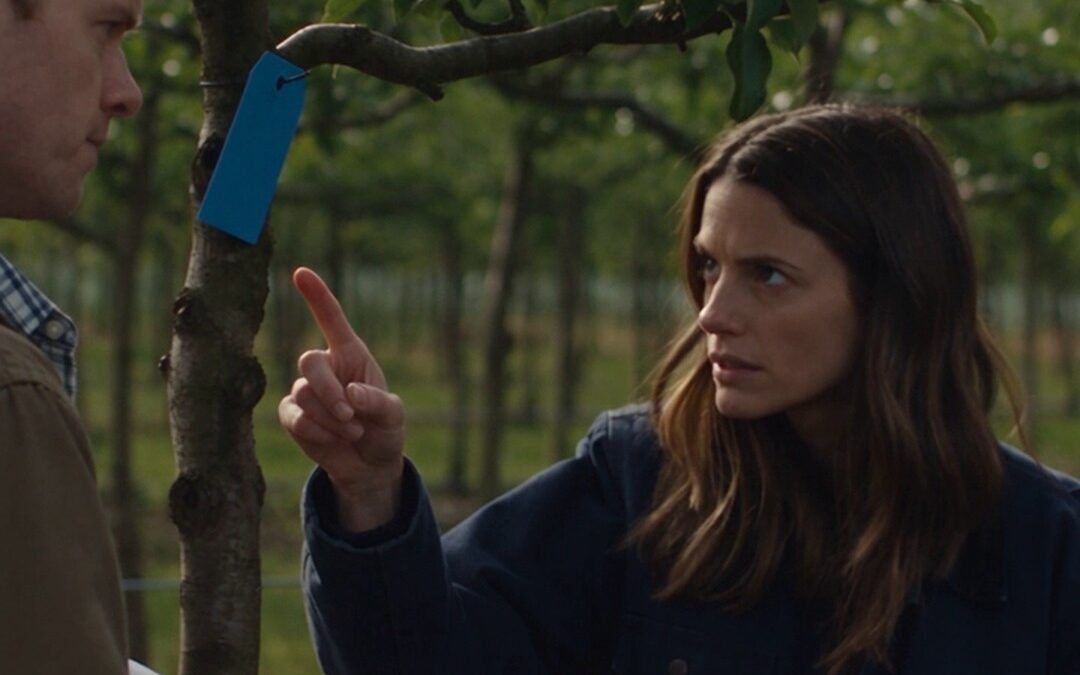
Chapter 1: The Trees Marked for Removal
The first blue tag was tied to the apple tree where my mother had taught me to graft.
There were twenty-three more by the time I reached the end of the row.
My brother Daniel stood beside the county truck with a clipboard under his arm. “Don’t touch them, Mara.”
The blue tags meant removal. At Bell Orchard, we used them when a tree was too diseased to keep. The trees in front of me had green leaves, clean bark, and fruit just beginning to form.
“What did you tell Dad?”
“I showed him the lab report.”
Dad sat in the truck’s passenger seat. Since his stroke, he could walk the rows, but he tired easily. Daniel had taken over the wholesale accounts while I managed the trees. We had argued about money all spring. I hadn’t thought he would use Dad’s trust to settle it.
Dad lowered the window. “The lab found fire blight in those samples. Daniel says the trees have to go before it spreads.”
“Then I want to see where he cut them.”
Daniel handed me a report. The sample numbers matched blue tags on six trees. The report called those samples positive and recommended removal of the affected trees and any visibly infected neighbors. I knew the lab. I knew its work was good.
I also knew the little nick in the bark of Tree 41. I’d left it while repairing a deer guard in March. There was no nick beside its blue tag.
“When were these samples taken?” I asked.
“Tuesday,” Daniel said.
Tuesday morning I had worked this entire row. I remembered because the irrigation line had split, leaving mud on my boots. I had seen no blue tags and no cuts.
Dad watched me over the rim of the window. “You missed the blight last year, Mara.”
He was right. I had waited too long to remove one infected limb, and we lost four trees. Daniel had reminded him often enough.
A crew was booked to pull the marked trees on Friday. Behind them stood the oldest block in the orchard, planted by Mom. She had died before Dad’s stroke, and tending it was the one promise I had managed to keep to both of them.
I held up the report. “Give me until Friday to have the trees checked.”
Dad looked at Daniel. My brother shook his head.
“Thursday at noon,” Dad said. “After that, I sign the removal order.”
As the truck pulled away, I looked again at Tree 41. The missing nick bothered me. Then I noticed the report’s sample location: *northwest block*.
Mom’s trees were in the northeast block.
Chapter 2: What the Labels Could Prove
I called the lab from the packing shed. Its receptionist confirmed that the report was genuine, then told me that questions about where samples had been collected had to go to the person who submitted them.
“Daniel Bell,” she said.
I thanked her and hung up. The distinction mattered, though it gave me less than I wanted. The lab could tell us what was in six bags. It had relied on Daniel to tell it which trees those bags came from.
The packing shed smelled of damp cardboard and the cinnamon soap Dad kept at the wash station. Mom’s block showed through the open doors, twenty-four blue tags moving in a light wind. We had lost trees there before. The block was old, crowded, and dear to us; none of those things made it immune to disease. I took the report back outside and looked for what I had asked Daniel to show me.
Each tagged tree had a square of bark scratched below its tag. It was a sample mark of sorts, visible from the lane. On Tree 41 the scratch was fresh. It sat well above the nick I had made in March. I photographed both, then walked all twenty-four trees. I found no curled black shoots, no sunken cankers, and no other obvious sign of fire blight. A tree can carry infection before it shows much. I knew that. I also knew we did not pull twenty-four bearing trees on the strength of six samples without being certain where the samples came from.
I called the county extension office. A plant specialist could visit Friday morning, the woman at the desk said. That was after Dad’s deadline. She offered to put me on a cancellation list.
By the time I returned to the shed, Daniel had emailed Dad and me a copy of the report and a plan for removal. He had marked a circle around the six sampled trees, then added eighteen neighbors. It was the kind of map a cautious manager might draw if the samples belonged to the block. At the bottom, under *Reason for urgency*, he had written, “Prior delay in removal resulted in avoidable spread.”
He meant my mistake last year. Four trees, one lost harvest, and a winter of Dad looking over my shoulder whenever I carried pruning shears. Daniel had been fair to be angry then. He had helped cut and burn the damaged wood after I admitted I had waited. That history made this map persuasive in a way an invented report alone could not.
I went to his office beside the cold room. He was on the phone with a grower who bought our cider apples. He held up one finger and finished the call without rushing.
“The report says northwest,” I told him.
“The person at the lab used the wrong block name.”
“Which person?”
“I don’t know, Mara. Call them if you need to.”
“I did. They said you filled in the location.”
He leaned back. “Then I wrote northwest by mistake.”
“You wrote the tag numbers right.”
“Yes. I also photographed the bags before I mailed them. I’m not trying to trick you.”
“Show me.”
He turned his monitor toward me. The photo showed six clear sample bags laid across the tailgate of his truck. Each carried a white adhesive label with a tree number. There was a blue tag in the corner of the picture, mostly covered by a bag.
I couldn’t tell where the branches in those bags had grown. Daniel could see that I couldn’t.
“I’m asking for a day,” I said.
“Dad gave you one. If you want to bring in somebody else, bring them.”
“The extension specialist can’t come until Friday.”
“Then find somebody who can.” He swung the monitor back. “If I’d ignored a positive report and you found out, you’d be in here asking how I could gamble with Mom’s block.”
He was right about that too. It was part of what made talking to him so exhausting.
I called three private orchard consultants. One was in Michigan for the week; another did not inspect suspected fire blight in the field; the third, a retired extension specialist named Ruth Calder, could come Thursday afternoon. I booked her anyway. I could ask Dad to extend his deadline if she was already on her way.
Then I called the tree crew. Its owner, Luis Ortega, had worked with us for eleven years. He told me Daniel had booked his excavator for Friday and had asked whether he could also grind the stumps.
“Did he say why?” I asked.
“Because he wanted the ground ready by Monday.”
Ready for what, Luis didn’t know. When I asked him to wait until we had another inspection, he said he would if Dad told him to. The contract was with Bell Orchard, and Dad was still the owner.
I spent the rest of the morning checking our records. The lab invoice showed Daniel had paid for six samples with the orchard card. The shipping receipt showed a package sent Tuesday at 4:18 p.m. None of that located the branches. The blue tags in Mom’s block bore numbers 41 through 64, assigned years ago when we mapped the orchard. On Daniel’s photo, the bag labels read 41, 44, 48, 53, 58, and 63. He had chosen a reasonable spread.
At lunch Dad came into the shed with his cane. His left hand still curled toward his palm when he was tired. He set a paper sack on the table and took out two sandwiches.
“Daniel says you called Luis.”
“I did. I asked him to wait for an inspection.”
Dad unwrapped his sandwich. “The lab did an inspection.”
“The lab tested what arrived. I want somebody to see the trees.”
He studied me. “Did you find something wrong?”
“The location says northwest. The trees are northeast.”
“Daniel said he wrote it wrong.”
“He might have.”
Dad gave a short, weary laugh. “I thought you were going to tell me something I didn’t know.”
I wanted to say that Daniel always made his errors look small and mine look like warnings. Instead, I told Dad about Ruth Calder and Thursday afternoon. He listened, then shook his head.
“If she finds it’s safe to wait, I’ll hear her out. But I need a decision at noon. Luis has other jobs.”
“Then let me give you what I know at noon. You can call Luis afterward.”
Dad looked through the doors at the tagged trees. “Your mother would have hated seeing those ribbons.”
“She would have checked them herself.”
“Yes,” he said. “She would.”
For a moment I thought he might agree. Then he folded his sandwich wrapper. “Thursday at noon.”
After he left, I went to the northwest block.
It was the youngest section of the orchard, planted on a slope beyond the equipment barn. Daniel had wanted to replace it with a new packing building since Dad’s stroke. The trees there grew varieties that ripened unevenly and sold poorly to our wholesale buyers. I had argued that a packing building would cost more than we could carry. Dad had postponed the decision.
At the top of the slope, I found two limbs with the unmistakable black hooked tips of fire blight. The branches were on Tree 7, nowhere near Mom’s block. I cut neither. The diseased wood would be needed for an inspection, and I wanted somebody besides me to see it in place.
There were no blue tags in the northwest block. Along the lane, though, the grass had been flattened where a truck had stopped. I crouched and found a narrow strip of backing paper from an adhesive label. It might have been there for weeks. Daniel had sampled trees somewhere on Tuesday; a scrap of paper was hardly proof of a switch.
I called him from the lane.
“There’s blight on Tree 7,” I said.
“I know. I saw it this morning.”
“Were your samples from up here?”
“No.”
“Then why didn’t you mark Tree 7?”
“Because I’m waiting for you to assess that block. You’re the orchard manager.”
“You’ll have my assessment in an hour.”
“Good.”
He ended the call. I could not tell whether I had surprised him.
By late afternoon I had photographed Tree 7, walked its neighbors, and written a short plan to remove two infected limbs under clean cutting conditions. The disease appeared confined to those limbs. I left the plan on Dad’s desk and copied Daniel. When I passed his office, his door was closed.
That evening our cousin June called. She handled the farm stand three days a week and had seen the tags.
“Daniel told Aunt Bev you refused to remove diseased trees,” she said. “Bev’s already telling people to buy their cider somewhere else.”
“I asked for another inspection.”
“That’s what I told her. She said you asked for time last year too.”
I sat on my porch steps while June talked. Her voice was kind, which somehow made it harder. Last year I had let pride get ahead of judgment. I saw a black shoot in a tree Mom had grafted with me and told myself it was winter damage. The lab result came later, after rain had helped the infection spread. I had apologized to Dad and Daniel, but I had never said out loud that part of my delay came from wanting to spare one of Mom’s trees. I had kept the exact reason to myself because I was ashamed.
“Come see the trees tomorrow,” I told June. “Bring Bev if she’ll come.”
“I’ll come. Bev won’t.”
The next morning I drove to the lab rather than call again. It was forty minutes away, a low brick building attached to a county agricultural center. The woman at the counter would not give me Daniel’s submission form because I was not the customer named on it. When I explained that the bill had gone to Bell Orchard, she checked with her supervisor and returned with a copy I was allowed to review there.
Daniel’s handwriting filled the location box: “NW / old block.”
That was strange in a different way. We called Mom’s trees the old block. On our maps, they were northeast. The northwest block was newer. Daniel had written both descriptions together.
“Do you amend locations when somebody corrects them?” I asked.
The supervisor, a man named Patel, said they could issue a corrected report if the submitter requested it. The original entry would remain in their system. He pointed out that the lab did not verify field locations. They tested plant material for disease.
“Can you tell me whether these samples came from six different trees?” I asked.
“No. The bags were labeled as six different trees. We didn’t observe collection.”
He gave me the best answer he could: the test was valid, its location depended on the labels, and any decision about removal should account for what a field inspection found. He suggested I ask Daniel for the original photos and collection notes. There were no collection notes in the lab file.
At the door I stopped. “If somebody brought you infected branches from Tree 7 and labeled them 41 through 63, would your report look exactly like this?”
Patel met my eyes. “The result would tell you the branches were infected. I couldn’t tell you which tree they came from.”
Outside, I sat in my truck and thought about the words “NW / old block.” Daniel knew the difference between those places. He had helped plant the northwest block. Had he begun to write where he actually stood, then added the description he needed? Or had he used a shorthand that made sense only to him? Suspicion could fit itself around either answer. I needed a fact he could not explain away with a pen stroke.
I went to the farm stand and found June stacking jars of apple butter. She had grown up on our property and still knew every shortcut between the blocks.
“Walk with me,” I said.
She left the stand to an employee, and we crossed Mom’s row together. June examined the tags without touching them. I showed her the scratch on Tree 41 and my old nick below it.
“Daniel made that scratch?” she asked.
“I think so.”
“He could have sampled there Tuesday and scratched it afterward.”
“He could have. But the bark he scratched is clean.”
June looked at the branches above us. “I can’t promise you there’s no disease I can’t see.”
“Neither can I.”
That helped her trust me. She went with me to the northwest block, where I showed her Tree 7. The black tips were obvious once she knew where to look.
“Why aren’t these tagged?” she asked.
“He says he left them for me to assess.”
“Does that make sense?”
“He knew I’d have to find them eventually.” I looked across the slope. “Maybe he wanted me busy up here while the crew took down Mom’s trees.”
June crouched beside a lower branch. “Mara.”
She pointed to a neat cut about an inch long, recent enough that the wood was still pale. There was another cut higher up. Both sat among the infected shoots.
“Sample cuts,” I said.
“You can tell?”
“I can tell branches were taken. I can’t tell who took them.”
June took photographs with her own phone. She had come expecting a family quarrel; now she looked unsettled. “I’ll tell Dad what I saw.”
“Tell him the cuts and the blight. Don’t tell him what you think they mean.”
She gave me a sharp look. “You think I’m like Aunt Bev?”
“I think Daniel will have an answer if we guess.”
He did. When June called Dad from the stand, Dad said Daniel had already mentioned the blight on Tree 7. Daniel said he had cut samples from that tree for a second test, separate from the six bags sent Tuesday. He intended to submit them Thursday. The pale cuts, in his telling, showed that he was watching both blocks.
He had not told me that when I called him from the lane. He had said he was waiting for me to assess it. I repeated his exact words to June. She believed me, but Dad said we had misunderstood each other. Daniel offered to show me the second bags. He placed them on the desk between us that afternoon. They were sealed and labeled for the northwest block. I could see the date written in black marker: Thursday.
“You’ve got your proof I sampled up there,” he said.
“I’m asking where Tuesday’s branches came from.”
“From the old block.”
“Then why did you write northwest?”
“I answered that.”
“Show me the cuts in the old block.”
He walked me to six marked trees. Beneath each tag was the scratched square I had seen the first day. On Tree 41 he pointed to a small cut on a side shoot. Its surface was pale.
I had inspected those trees Tuesday morning, before the package went to the lab. I had not photographed every twig. He could have cut them that afternoon. The existence of a cut proved only that a cut had happened.
“Why twenty-four trees?” I asked. “The report recommends the affected trees and any visibly infected neighbors. I can’t see a single infected neighbor.”
“Because we’re not waiting to see black shoots on Mom’s block.”
“If you want to remove an entire row as a precaution, say that. Don’t make the report say it.”
His face hardened. “You’re right about the wording. I’ll change the plan to call it a precaution.”
That concession startled me. He took the easiest criticism off the table and left me with the one I could not yet prove.
We walked back toward the buildings without speaking. Near the equipment barn, a surveyor’s orange flag stood in the grass. I had noticed it earlier in the week and assumed it marked an irrigation repair.
“What’s that for?” I asked.
“The drainage line.”
“Which drainage line?”
“The one we’ll need after we clear the row.”
I stopped. “You’ve already planned what goes there?”
“We have to plan for the ground after removal.”
“Who is we?”
“Dad and me.”
Dad had mentioned no replacement plan to me, though I managed the orchard. Daniel said it was a business decision and that Dad would tell me when he was ready. He went inside before I could ask more.
In the office, I checked our shared calendar. A meeting marked “land use” was scheduled with a surveyor for Monday. Daniel had entered it two weeks earlier. That was before the samples were mailed, before the lab result, before any blue tag appeared on Mom’s trees.
I printed the calendar entry and took it to Dad.
He read it twice. “Daniel’s been pricing drainage for months.”
“For this row?”
“For several places.”
“He told me the flag is for after we clear it.”
Dad set the paper down. “You think he planned to make trees sick because he wanted drainage?”
“No. I think he planned to clear them.”
“With a real lab report?”
“That’s what I’m trying to work out.”
Dad rubbed the scar along his left wrist, a habit he had kept since the stroke. “I signed off on a survey. We can’t run a farm by waiting until every crisis happens.”
I had no answer to that. Planning was Daniel’s strength. He remembered deadlines, read contracts, and kept our buyers when Dad was in the hospital. I had once been grateful that he could speak calmly to people when I could barely finish a sentence. If he wanted to clear Mom’s block, he would have made a plan.
Dad picked up the calendar page. “Have you walked the northwest block?”
“Yes. Tree 7 has two infected limbs. I wrote you a plan.”
“I saw it.”
“Then you know the disease is there.”
“And the lab says it’s in the old block too.” He lowered his voice. “Mara, I can’t have you taking a second chance with the farm because you couldn’t bear to cut a tree.”
The words landed where Daniel knew they would. I left before I could say something I would have to take back.
That night I spread our orchard maps across my kitchen table. Mom had drawn the first one in pencil on butcher paper. Over the years I had copied it into a binder and added tree numbers, varieties, and notes on every graft. Tree 41 was an Ashmead’s Kernel she had rescued from a neighbor’s neglected yard. Tree 44 carried a graft from a tree her father had planted. Some of the others mattered only because she had tended them for thirty years.
I understood, looking at that map, that I was making a mistake of my own. I had been trying to prove the trees were healthy because I wanted to keep them. The real question was where Tuesday’s infected branches had grown. Even if the old block had disease, Daniel’s plan still required us to know which trees and why. Even if the northwest block supplied the bags, its infection still needed treatment.
I put the old map aside and opened the field notebook I kept in my truck. On Tuesday morning, when I repaired the irrigation line, I had written down the pressure reading and the time I shut off the valve. Beside it I had noted, “blue hose in ditch.” The hose belonged to the spray rig. Daniel had borrowed it the previous afternoon and left it where I needed to work. I remembered stepping around it. The rig was usually kept near the equipment barn, between the two blocks.
That detail gave me a way to check his photograph. His bags lay across the truck tailgate, but at the edge of the image was a coil of blue hose. It could have been anywhere on the farm. I enlarged the photo from the email he had sent Dad. Behind the hose was a short run of white fence and, beyond it, the roof of the barn. The angle looked like the northwest lane.
I drove out before dawn. From the northwest lane, I could frame the barn and fence as they appeared behind the tailgate. From Mom’s block, the barn was hidden by the cold room. The photograph had been taken near the northwest trees.
I took my own pictures from both places. I knew what Daniel would say: he had collected samples in the northeast and taken the bags to his truck near the barn. That was possible. Still, the photo placed him near the diseased Tree 7 before he mailed the bags, and his claim about a separate Thursday sampling sat less easily beside it.
At eight, I asked the packing crew whether anyone had seen Daniel collecting branches Tuesday. The crew chief, Rosa, remembered his truck beside the northwest block at midday. She had been taking an empty bin to the wash station. She did not see what he put in the bags.
“Did he ask you to say you saw me?” she asked.
“No. I’m asking because I need to know.”
Rosa studied me. Her husband had worked for Dad for twenty years; she had known Daniel and me since we were children. “I saw the truck. That’s all I can say.”
“It’s enough. Thank you.”
When Daniel heard I had spoken to the crew, he came to the shed with Dad. He carried a copy of the field notebook page I had left on the office printer the day before.
“Rosa says Mara’s questioning people about me,” he said. “We have to stop doing this in front of employees.”
“I asked where your truck was Tuesday.”
“And now Rosa’s worried about her job.” He turned to Dad. “I’ll take the blame for the bad location on the form. I’ve said that. But she’s turning a disease decision into an accusation of fraud.”
Dad asked me to send the crew back to work and bring future questions to him or Daniel. I said I would. Rosa’s worry was a real consequence of my search, and Daniel had used it well.
Then he went further. He put a document on the table: a proposed amendment to our management agreement. Until the disease question was settled, all decisions about removal and outside inspections would require Dad’s written approval. My role would be limited to daily field work.
“You wrote this last night?” I asked.
“I asked the lawyer for it last month,” Daniel said. “I hoped we wouldn’t need it.”
Dad did not sign it in front of me. He took it home. I knew he might sign after another call from Aunt Bev or another buyer asking whether our trees were diseased. Daniel had shifted the argument. Every hour I spent checking him could now be offered as evidence that I could not do my job.
I called Ruth Calder and told her she might arrive after a removal order was signed. She offered to come an hour earlier than planned, at one. It was still after noon. Then she asked what I had found in the northwest block. I described Tree 7 and the fresh cuts. She said she would need to see both blocks and our records. Her fee covered a written opinion, but she could not force Dad to wait.
I called Luis next. “If Dad signs at noon, when do you start?”
“Seven Friday morning. That’s the booking.”
“Will you ask to see the trees yourself before you pull them?”
“I will. But I’m an equipment guy, Mara. If the owner and a lab report say remove them, I’m not the one to overrule them.”
I did not ask him to. I asked him to call me before he unloaded his excavator. He agreed.
Thursday morning, June arrived with coffee and a folder from the farm stand. She had been thinking about Daniel’s plan.
“He told Bev the old block costs more to harvest than it earns,” she said.
“He’s been saying that for years.”
“Then I looked at last fall’s sales. The stand sold more jars made from those apples than from any other block.”
“That doesn’t account for labor.”
“I know. I’m not pretending it does.” She sat across from me. “Why didn’t he tell you about the land use meeting?”
I showed her the survey flag on the map. The flag stood at the edge of Mom’s block, near the county road. Its position was poor for a drainage line serving only that row. Water ran downhill the other way.
June leaned over the map. “That’s where the old farm entrance used to be.”
“It was closed when they widened the road.”
“Could a new entrance go there?”
I didn’t know. I went to the county website and searched public planning applications under our address. There was a preliminary request for a commercial driveway review, submitted by Bell Orchard on the previous Friday. The attached sketch showed a driveway cutting through the first twelve trees in Mom’s block, then continuing toward the open ground behind it. The application described a “future packing and distribution facility.”
Daniel had applied before the lab result came back.
The proposal was preliminary. A driveway review was not a construction permit. Dad could reasonably ask whether a new packing building would keep the farm alive. What Daniel had concealed was the location, the number of trees it would take, and his willingness to let a disease report make the choice for us.
I printed the application and went to Dad’s house. He was at the kitchen table with the agreement Daniel had brought yesterday. His signature was at the bottom.
“I’ve got something you should see,” I said.
He read the driveway sketch, then looked up. “I know about the building.”
“Did you know the entrance runs through Mom’s block?”
“He showed me a few options.”
“This is the one he filed.”
“It’s an early review.”
“He filed it before the lab report.”
Dad put the paper beside his cane. “He’s said for years that we need better packing space. That doesn’t mean the trees aren’t sick.”
“It means he had another reason to want them out.”
“I’m willing to hear that. I’m not willing to call your brother a liar because you found a planning form.” He tapped the signed agreement. “Any more outside people come through me. Is Ruth Calder coming?”
“Yes. At one.”
“She can come. I’ll be there.”
He was still giving me that much. I left the planning application with him and drove back to the orchard to prepare for Ruth. At eleven, Daniel called to say he had spoken to Luis. The removal order was ready for Dad’s signature at noon. Daniel invited me to the meeting in his office.
June came with me. Dad sat behind Daniel’s desk, the lab report and the amendment in front of him. Daniel had added a revised removal plan. It now said the eighteen neighboring trees would come down “as a precaution,” not because the lab had found disease in them.
I laid out the county sketch and my photographs from both blocks. I did not claim the photos proved where the branches came from. I said the lab’s location was unverified, the old block showed no visible infection, and Ruth would arrive in an hour. I asked Dad to delay the order until she examined the trees.
Daniel let me finish. Then he pointed to the photo of his tailgate.
“Yes, my truck was near the northwest block,” he said. “I park there because I can get to the barn. Those bags came from the old block. The mistake on the form is embarrassing, but it doesn’t make the samples clean.”
“Where are the branches you cut?” I asked.
“At the lab.”
“The branches from Tuesday. Did you keep any offcuts?”
“No. You know we don’t leave diseased wood lying around.”
He turned to Dad. “Ruth may look at the trees and tell us there are no symptoms. If she does, I’ll listen. But the lab already found the bacterium in material labeled from those trees. What can she see this afternoon that cancels that?”
“She can tell us whether your removal plan matches what’s in the field,” I said.
“I changed the plan to separate the positive trees from the precautionary ones. That’s what you asked me to do.”
He had answered each point without answering the one that mattered. Dad held the pen a long time. Then he signed the order.
“Ruth can still come,” he said. “If she finds a reason to stop the crew, we’ll stop them.”
It was a concession with a very short life. Luis would arrive at seven the next morning. Ruth had an afternoon to identify something strong enough to overturn a genuine report.
After the meeting, June took me aside. “I believe you think he switched the samples.”
“You don’t believe he did?”
“I don’t know. I saw the cut on Tree 7. He had an answer for it.” She watched Daniel leave in his truck. “I want you to be right about the trees. I hate what being right would mean.”
So did I. I had grown up following Daniel between the rows. When Mom died, he was the one who drove Dad home from the hospital after the funeral, because I could not stop crying long enough to see the road. He had never been gentle with me about mistakes, but he had always done what the farm required. If he had labeled diseased branches as Mom’s trees to clear a road for his building, I would have to learn how much of that reliability had belonged to him and how much I had supplied in my own memory.
Ruth arrived with a clean pair of boots and asked to see the report before she saw a tree. She read Daniel’s submission location and the revised removal plan. Dad joined us. Daniel came out of the office carrying his photos.
Ruth walked all six sampled trees first. She checked new growth, bark, nearby limbs, and the weather history I had written in my field book. She made no promise that a healthy appearance meant freedom from infection. At Tree 41 she examined the little cut Daniel had shown me. She asked for pruning shears, cut a separate small piece from a different branch, and sealed it in a bag with her own label. She did the same on the other five trees, then sampled several neighbors.
At the northwest block, she found the infected shoots on Tree 7 without my pointing them out. She checked the fresh cuts. Daniel said he had made them Wednesday while preparing the second submission. Ruth asked to see the bags. He brought them from his office, still sealed.
“These can go to the lab with mine,” she said. “But the results won’t be back before tomorrow.”
Dad looked toward the road. “Would you pull the old block in the morning?”
“On the material I can verify from today, no,” Ruth said. “I’d isolate and remove the infected limbs here in the northwest block, using the proper cleanup procedure. I’d hold removal in the old block until its samples are tested or symptoms appear.”
Daniel held up Tuesday’s report. “You can’t verify the material the lab received, but you can’t make it disappear.”
“I’m not making it disappear,” Ruth said. “It’s evidence of infection in six bags. The field origin of those bags is disputed. I can’t settle that with a visual inspection.”
Dad asked her whether a week’s delay could endanger the farm. Ruth gave him a careful answer: risk depended on weather, active infection, and whether the reported samples truly came from the old block. She would not guarantee a week. She would, however, wait for properly documented samples rather than remove twenty-four trees that showed no signs.
It was enough for Dad to call Luis. He postponed the crew until Tuesday. Daniel did not argue in front of Ruth. He thanked her for coming, then went inside.
Ruth stayed to make a sketch of her sampling locations. I watched her label every bag at the tree, with Dad and June standing there. That small, ordinary care made me furious. We could have done it Tuesday. We could have avoided the fear on Dad’s face and the blue tags Mom would have hated.
When Ruth finished, Dad asked me to take her to the shed so she could wash her tools. On the way she said, “You have a question you haven’t asked.”
“How do I prove where his samples came from?”
“You may not be able to. If mine are negative, that tells you about today’s branches. It doesn’t tell you what was in Tuesday’s bags.”
“What would?”
“An independent record of Tuesday’s collection. Or a reason those six branches could not have come from the trees on the labels.”
I thought of Mom’s binder. Every tree had a variety, a graft history, and a description of its growth. Daniel knew the tree numbers, but he had never spent much time with the graft notes. Some apple varieties carried reddish wood; some had distinctive buds. Yet a lab sample of infected tips might not show enough to identify a tree, and I was no expert at distinguishing them by sight.
Then I remembered the adhesive labels in Daniel’s photograph. I had looked at the numbers and the blue hose. I had not looked closely at the branches inside the bags.
I opened the photo on the shed computer. The resolution was better than it had looked on my phone. Bag 41 contained a short branch with narrow leaves and a cluster of tiny fruit. Tree 41’s Ashmead’s Kernel had flowered late. Its fruit was tiny in early June; that matched. Bag 44 held two dark shoots. Nothing useful there. Bag 53, though, contained a branch with a pale plastic strip tied around it.
I enlarged it until the pixels blurred. The strip had writing on it. I could make out a seven.
My hands went cold. Tree 7 in the northwest block had a pale plastic tie on one of its lower limbs. I had tied it there in April after finding a weak union that needed watching. On Tuesday morning, before any bags were mailed, I had written in my field notebook: “7—check tie after rain.”
I ran to the northwest block. The tie was still there, on the main limb, marked with a 7 in my handwriting. That meant the strip in the bag could not be this tie. I searched below the two fresh cuts. One was on a smaller branch that had carried a second tie, made from the same roll, because I had marked both sides of the weak union. I remembered now that the second tie had been missing when I photographed the cuts with June. I had assumed the wind had taken it.
The photo showed a pale strip tied to a branch inside a bag labeled 53. It could have been a different strip from elsewhere on the farm. To be decisive, I needed a close view of the writing.
Daniel had sent Dad the photo by email, reduced for the message. The original might still be on his phone. Asking him would warn him what I had seen. I asked Dad whether Daniel had given him any other pictures. Dad scrolled through their messages and found one sent Tuesday afternoon, before the lab report existed. It was the same tailgate photo, but clear enough that I could read the plastic tie through the bag.
It said “7—WU,” my shorthand for weak union.
Dad stood beside me at the kitchen counter as I showed him. At first he said Daniel might have reused a branch for the photo. Then he heard what that meant: if a branch from Tree 7 was in a bag labeled 53, the picture Daniel had offered as proof of proper labeling proved the opposite.
“Maybe that bag was for the second test,” Dad said.
“The second bags are dated Thursday. He sent you this Tuesday.”
Dad enlarged the image himself. I waited while he read the tie.
“We should ask him,” he said.
“Yes.”
He called Daniel and told him to come to the house. I wanted to rehearse every point, but Dad shook his head. “We’ll ask one thing at a time.”
Daniel arrived forty minutes later. He saw my truck and Ruth’s written opinion on the table. He set his keys beside it.
“Is this about delaying Luis?” he asked. “I already called him.”
Dad showed him the photograph. “Tell me what that tie says.”
Daniel leaned in. For a moment he seemed only puzzled. Then his face closed.
“It’s a marker Mara tied on one of the trees.”
“Which tree?” Dad asked.
“I can’t read it.”
“Try.”
Daniel looked at me, then back at Dad. “It looks like seven.”
“The bag says fifty-three.”
“I might have put a branch from seven beside the bags when I took the picture.”
“It’s inside the bag,” I said. “Look at the fold above it.”
He picked up Dad’s phone and studied the image. “Then I put one branch in the wrong bag.”
Dad sat down. “You told us these were samples from the old block.”
“They were.”
“All six?”
Daniel did not answer immediately. He set the phone on the table. “I collected from both blocks. I was making sure we caught what was moving through the orchard.”
“Why label Seven as Fifty-three?” I asked.
“I told you, I made a mistake.”
“You made it before you sent the samples. Did you correct it?”
“No.”
“Did you tell the lab?”
“No.”
Dad’s right hand tightened around the edge of the table. “Did the other bags come from the old block?”
Daniel looked at the wall behind him. “I don’t know which bag got which branch now.”
“You knew on Tuesday,” Dad said.
The room was quiet long enough for us to hear a truck change gears on the county road. Daniel had defended the report through two days of questions. Now he had to choose between admitting he knew the origins and claiming he had been careless with a disease test that would destroy trees. He chose neither.
“I was trying to get a clear answer,” he said.
“A clear answer to what?” Dad asked.
“To what we have to do with the orchard.” Daniel sat across from him. “We are losing the wholesale buyers who kept this place going. The old block takes twice as long to harvest. We need the new building, and the only affordable entrance goes through those rows. Every time I’ve brought it up, Mara says Mom planted them and the conversation ends.”
“That’s not true,” I said. “I said the building cost too much.”
“Because you counted income from the old block as if it would always be there.”
“We can discuss the numbers.”
“We have discussed them for three years.”
Dad held up his hand. “Did you put diseased wood from the northwest block into bags labeled as the old block?”
Daniel stared at him. “I found disease on the farm. We couldn’t keep pretending the old block was untouchable.”
“That isn’t an answer.”
“It is the answer you’ve both been avoiding. We can’t afford to treat every tree like a memorial.”
Dad’s voice was low. “You knew where those branches came from.”
Daniel looked away. That was the first answer he gave that I believed completely.
I had imagined feeling triumphant when he could no longer deny it. Instead I felt the floor shift under years of smaller memories: Daniel asking me to trust him with contracts, Daniel telling Dad I was too attached to the orchard, Daniel cutting away infected wood beside me last winter. He had built his case from a real need, then put false labels on real disease because he believed he could make us do what he thought was necessary.
“Why didn’t you tell Dad about the driveway?” I asked.
“I did tell him about the building.”
“You filed a route through Mom’s trees before the report came back.”
“Because there are months of reviews. Filing a sketch doesn’t mean we build it.”
“You booked Luis to grind the stumps before you knew the test result.”
“I booked a window with him. He’s busy.”
His answers still had pieces of truth. That was how he had nearly pulled it off.
Dad asked for Daniel’s phone. Daniel refused at first, then said the photograph was already on Dad’s phone and he had nothing else to show. Dad did not press for it. He pointed instead to Ruth’s opinion.
“Tomorrow you’ll call the lab,” he said. “You’ll tell them Tuesday’s locations were wrong and the report cannot be used to identify the old block.”
Daniel opened his mouth.
“You’ll do it with me listening,” Dad said. “Then you’ll call Luis and cancel the removal order, not postpone it.”
Daniel looked at the signed management agreement on the counter. “You can’t run the wholesale side without me.”
“We’ll have to find out what we can do.”
“That building was our chance.”
“Then you should have trusted us enough to make the case for it.”
Dad sounded older than he had that morning. Daniel picked up his keys but did not stand. “I didn’t want to lose the farm.”
“You were ready to let me lose my work and think I’d failed you again,” I said.
He looked at me. “I thought once the trees were gone, you’d see the building had to go there.”
“That’s what you thought I’d forgive.”
He had no answer for that.
The next day he called the lab from Dad’s kitchen, on speaker. Patel explained that the lab could issue an amended report recording the submitter’s correction: the identities of the sampled trees could not be confirmed. The positive finding would remain, because the branches themselves had tested positive. Daniel gave the correction. He did not say he had deliberately mislabeled a bag. Dad did not ask Patel to adjudicate what had happened inside our family. He asked for the amended report and for guidance on testing the northwest block.
Ruth’s samples from Mom’s block came back negative the following week. She warned us that a negative result from those branches was a finding about those branches, not a promise that no tree would ever become sick. We followed her plan: inspect the old block regularly, remove the infected limbs from Tree 7, clean the tools between cuts, and watch the northwest trees closely through the warm, wet weather. It was ordinary orchard work. After the blue tags, ordinary work felt like a privilege.
Dad took down the tags himself. He started at Tree 41. His left hand would not manage the knot, so he held the branch while I untied it. We worked the row without speaking much. When we reached the end, he gathered the tags and put them in a bucket instead of throwing them away.
“I should have waited for Ruth before I signed,” he said.
“I should have told you last year why I delayed on that limb.”
“I knew.”
I looked at him.
“Your mother grafted it,” he said. “I knew you wanted to save it.” He rubbed a tag between his fingers. “I let Daniel turn that into a reason I didn’t have to listen to you.”
He did not ask me to forget what he had signed. I was grateful for that. An apology did not make the two days disappear, or the look he had given me when he thought I was choosing a memory over the farm. But it gave us somewhere honest to begin.
Daniel remained my brother. He also remained the person who had put a false number on a diseased branch and nearly had Mom’s trees pulled. Dad removed him from decisions about orchard health and withdrew the driveway application. Daniel stayed long enough to transfer the wholesale accounts to June and Dad. At the end of the month he took a job managing shipments for a produce warehouse two counties away.
Before he left, he came to the shed while I was sharpening shears. He put Mom’s old field binder on the table. It had been in his office since the stroke.
“I thought you’d want this,” he said.
“I’ve been looking for it.”
“I know.”
He had kept it through every argument about the block. I opened to Tree 41. Mom had drawn the first graft in the margin, a thin pencil line joining two pieces of wood. Daniel waited, perhaps for thanks or a fight. I gave him neither. He went to his truck and drove away.
In August, Dad and I met with an accountant to look again at the building. Daniel had been right that our packing space was costing us work. He had also left out what June’s farm stand earned and what a smaller addition beside the existing cold room might cost. We could not afford either project that year. We could afford to keep measuring, keep saving, and let the numbers decide where a building belonged when we were ready.
One morning after the first cool night, I found Dad in Mom’s block. He stood beside Tree 41 with the binder open against its trunk.
“Your mother wrote that this graft almost failed,” he said.
“It did. She held it with tape for a second year.”
He closed the binder and handed it to me. Small apples hung above us, rough skinned and still green. Dad took one careful step down the row, and I followed with the shears. There was a dead twig to cut from the next tree, no bigger than my thumb. I showed him where I would cut. He nodded and held the branch steady while I did it.