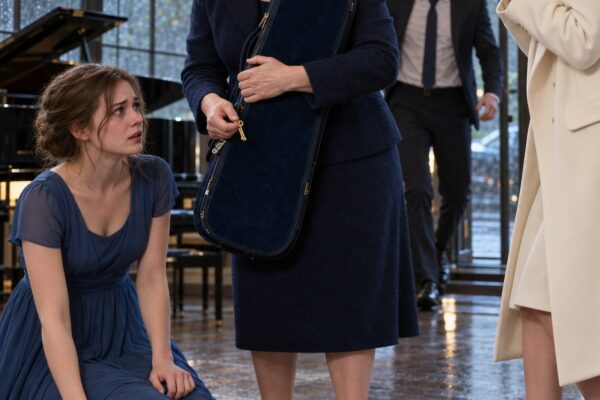
My Daughter-in-Law Cut Up My Husband’s Last Recording for Her Party, So I Ruined Her Camera and Found My Son’s Signature
Chapter 2: What the Tape Remembered
Curtis reached for the agreement.
I pulled it against my chest.
The cut tape hung from Nadine’s hand.
Coffee dripped from her camera.
“Who received the money?” I asked.
Curtis looked at his wife.
That answered one question.
Not the important one.
“Mom, the paper isn’t what it looks like.”
“It looks like my signature.”
“It was a complicated deal.”
“I can read.”
Nadine set down the scissors.
“Then read the date.”
I did.
June fourth.
I had spent that day in a hospital waiting room.
My sister had needed a heart procedure.
Curtis had driven me there.
He knew exactly where I had been.
He also knew I never signed documents in hospital waiting rooms.
I kept a folder for that purpose.
He had laughed about it for years.
“Who received the money?” I asked again.
Nadine crossed her arms.
“First, we discuss my camera.”
I placed the agreement on the piano.
“Send me the repair estimate.”
“It’s destroyed.”
“Then send the estimate anyway.”
“You can’t ruin my property and act righteous.”
She was right about the property.
I had ruined it deliberately.
I would account for that.
I would not let it purchase my silence.
Curtis stood close enough to touch the paper.
He did not try again.
Instead, he took the strip of tape from Nadine.
He folded it into his palm.
“Dad had boxes of these,” he said.
“He had four boxes.”
“You always said they weren’t worth money.”
“I said he didn’t make them for money.”
Nadine gave a short laugh.
“That distinction cost this family plenty.”
I looked at her.
For three years, she had called the little studio a shrine.
She wanted it cleared for a dining room.
I had kept the instruments, the tapes, and one chair.
She had called even that selfish.
Curtis moved toward the piano bench.
“Let me explain privately.”
“We are private.”
“Nadine’s here.”
“She was holding the scissors.”
He shut his eyes.
I heard tires on the street.
The guests would come soon.
Some were his friends.
Some were neighbors who remembered my husband.
I did not want them walking into this room.
I did not want Curtis performing grief for them.
“Call everyone,” I said.
“Cancel the party.”
“Nadine planned for weeks.”
“She can unplan it.”
Nadine picked up her phone.
“You always make him choose.”
“No one made you cut that tape.”
“It can be fixed.”
“Then you knew what it was.”
Her thumb stopped moving.
Curtis held out the strip.
“I’m sorry about this.”
I took it.
The tape was thin.
His father’s handwriting marked the reel box: LAST ROOM, TAKE TWO.
That was the name of the song.
There had never been a take three.
“Where did the money go?” I asked.
Curtis leaned against the piano.
“Into a company account.”
“Whose company?”
Nadine answered first.
“Ours.”
He stared at her.
She stared back.
Something passed between them.
Not agreement.
A warning.
My husband had trusted Curtis with the studio key.
I had trusted him with more.
When his restaurant closed, I let them move into the apartment above my garage.
They had paid rent twice in twenty months.
I knew the amount.
I also knew how much I had spent on heat.
I had made those choices with open eyes.
This agreement was different.
Someone had put my name where it did not belong.
“Did you witness me sign?” I asked.
Curtis rubbed his palm against his jeans.
“No.”
There it was.
One honest word.
Nadine’s phone rang.
She turned away to answer.
Curtis reached for the reel box.
I let him hold it.
His fingers found a cracked corner he had broken at eleven.
His father had patched it with blue tape.
Curtis traced the patch.
“Dad told me to take care of you,” he said.
“He expected you to know what that meant.”
Curtis set the box down.
“Mom, I didn’t know they were selling all of it.”
I watched his hand leave the cardboard.
Not all of it.
He had known they were selling something.
* * *
I photographed every page before Curtis could suggest another explanation.
Then I called the licensing firm.
A woman named Patrice confirmed they had sent the notice.
She would not discuss the deal by phone.
I understood.
I asked her to preserve the file.
She told me to email that request.
I did it while she waited.
Curtis sat on the sofa.
Nadine canceled the party in the kitchen.
I could hear her explaining that I was unwell.
I opened the kitchen door.
“Tell them the party is canceled,” I said.
She ended the call.
“You enjoy embarrassing us.”
“You supplied the reason.”
The first guest arrived before she finished texting.
It was Mr. Bell from next door.
He carried peach preserves.
I thanked him and said we had a family emergency.
He looked past me at Curtis.
Then he left without a question.
That was why I had liked him for nineteen years.
I put the preserves beside the reel.
Nadine watched the jar.
“Now that looks authentic,” she said.
Curtis told her to stop.
She went upstairs.
Their apartment had a separate outside entrance.
The inside stairs were a convenience I had given them.
I closed that door.
I did not lock it.
I called my sister, Bernice.
She had worked forty-one years as a county records clerk.
She knew how to keep paper in order.
“Bring the whole envelope,” she said.
“And eat something.”
Bernice had survived the heart procedure.
Her advice had not changed.
I ate half a sandwich.
Then I placed the letter, agreement, and photographs in my car.
Curtis came to the driveway.
“Let me come.”
“I’m going to Bernice’s.”
“I can explain the company.”
“You had twenty minutes.”
“I need to find the statements.”
“Find them.”
He glanced toward the garage apartment.
“Nadine keeps those.”
His name was on the company.
His wife kept the statements.
I drove away.
Bernice lived twelve minutes from me.
She read the agreement at her kitchen table.
She used a pencil to follow every line.
She did not write on the pages.
The agreement claimed I had transferred every composition my husband owned.
It also transferred his recorded performances.
In return, the buyer would pay $116,000.
My husband had written songs for church choirs, small theaters, and local singers.
Some earned nothing.
A few earned modest checks.
After he died, I registered the estate’s interest properly.
The yearly income averaged $7,400.
I paid taxes on it.
I never called it a fortune.
Bernice tapped one paragraph.
“The buyer had an option,” she said.
“What kind?”
“Exclusive use in advertising.”
I read the paragraph.
It named a national furniture company.
I had seen their commercials.
My husband’s song had not appeared in one.
Not yet.
The agreement gave the buyer the power to license it.
I felt the first shift in the floor beneath me.
We called a lawyer Bernice trusted.
Elena Price handled estates and business disputes.
She had no appointment until morning.
She made one after hearing about the signature.
I sent her copies.
She told me to preserve the originals, avoid arguing about the deal, and notify my bank if anyone else held access.
Curtis did not have access to my checking account.
He had once been authorized to collect royalty mail while I recovered from knee surgery.
That authorization had ended two years earlier.
Elena asked for a copy.
I knew where it was.
I kept my folders.
The next morning, she examined the agreement.
Elena was fifty, careful, and unimpressed by expensive stationery.
She noticed that the witness line lacked an address.
She noticed the date preceded the company’s registration by six days.
That did not prove fraud.
It gave her places to look.
She called the licensing firm with my written permission.
Patrice sent the application packet securely.
The packet contained a scan of my driver’s license.
It was an old scan.
I recognized the blue sweater from a pharmacy visit.
Curtis had helped me upload identification for Medicare paperwork.
The packet also contained an electronic signature certificate.
It listed an internet address.
Elena said the provider could preserve more records.
She sent a formal notice.
Then we called the organization that tracked my husband’s songwriting royalties.
Their staff could confirm recent changes to my account.
No change had been completed.
A request had been submitted.
It named the same buyer.
That stopped a payment scheduled for the following month.
Elena asked them to flag the account.
By afternoon, I had learned that paperwork could move faster than truth.
I also learned it left tracks.
Curtis called six times.
I answered the seventh.
“Do you have the statements?” I asked.
“I have some.”
“Send them to Elena.”
“I wanted to talk first.”
“Send them first.”
“Nadine says you’re getting a lawyer to take our home.”
“It’s my home.”
“The apartment is our home.”
“Then tell your lawyer that.”
He went quiet.
I had never threatened him with an eviction.
I had asked for statements.
Nadine had given him a different question to fear.
Elena obtained the company’s public filing.
Its name was Open Door Audio.
Curtis owned forty percent.
Nadine owned sixty.
That split did not tell me who forged anything.
It told me who expected control.
Bernice found another detail.
The company’s mailing address was my garage apartment.
Nadine had listed my property on a registration I had never seen.
“Can she do that?” I asked.
“She can write it down,” Bernice said.
“What matters is what she claimed.”
Elena checked the application packet.
There was an occupancy statement.
It said Open Door Audio had my permission to operate from my property.
The attached consent carried my signature.
It looked better than the one on the music agreement.
It still was not mine.
I had kept my left hand in a brace that June.
The two signatures had neat, strong loops.
I wrote Elena a note about the brace.
She asked for records.
My doctor’s office supplied the visit summary with my consent.
My hand was not proof by itself.
But it was another fact.
Elena also asked why I knew the tape mattered.
I told her about the reel box.
My husband labeled everything.
He wrote dates, take numbers, and the names of everyone who played.
The box Nadine had cut open held the only full studio recording of Last Room.
A shorter version had been released years earlier.
The full version had a verse no one else knew.
I could recite it.
Curtis could, too.
His father had taught it to him at twelve.
Elena requested the license schedule.
It listed Last Room as the lead song.
A second schedule showed an estimated advertising fee.
Not $116,000.
$620,000 over three years, if the furniture company exercised its option.
Elena put down her pen.
The agreement had transferred a valuable option for a fraction of its potential price.
The buyer stood to make the larger sum.
We asked who owned the buyer.
Patrice sent the corporate name listed in her file.
It was an investment group called Summer Street Media.
Elena searched its public registration.
The manager was a woman named Tessa Ward.
I knew Tessa.
She had been Nadine’s employer.
* * *
Tessa Ward owned a branding agency across town.
She dressed charity events for photographs.
Nadine had worked there before she married Curtis.
Tessa came to our house once, two Christmases ago.
She praised my husband’s studio.
She asked whether his recordings had been digitized.
I told her some had.
She asked who controlled the originals.
I said I did.
I remembered that exchange because she called the tapes “inventory.”
My husband would have disliked her for that word alone.
Elena said knowing Tessa did not establish a scheme.
We needed the records.
We also needed to protect what remained.
I returned home before dark.
Curtis stood in the driveway with two cardboard boxes.
They held my husband’s tapes.
“What are these doing out here?” I asked.
“Nadine thought you’d want them upstairs.”
“She packed them?”
“She said they weren’t safe near the kitchen.”
The kitchen was across the house.
The boxes were damp beneath.
The concrete had held rainwater.
I carried them inside.
Curtis carried the heavier one after I pointed to it.
In the studio, I inspected every reel.
Nadine had cut three short lengths from Last Room.
The rest seemed intact.
Two other boxes had been opened.
I photographed their seals.
Curtis watched.
“She said she only used one.”
“She has used three inches more than she admitted.”
I did not know yet what lay on the other reels.
I knew an open box meant I should check.
Curtis picked up a photograph from the piano.
It showed him at nine, playing a cardboard guitar.
His father stood behind him, laughing.
“He was proud of my restaurant,” Curtis said.
“He came every Friday.”
“Even when I was losing money.”
“He liked the soup.”
Curtis gave me a tired smile.
“The soup wasn’t profitable.”
“I noticed.”
He set the photograph down.
“After the restaurant closed, I owed taxes.”
“I helped you make a payment plan.”
“There were other debts.”
“Why didn’t you tell me?”
“Because you were already helping.”
That sounded almost like shame.
Then he added, “Nadine found a way out.”
“What did she tell you?”
“That Dad’s music could bring in money.”
“It already did.”
“She said a new deal could bring in more.”
“For whom?”
Curtis looked at the floor again.
I had seen that pose at the party.
I had mistaken it for reluctance.
Sometimes it was calculation.
“I signed as a witness,” he said.
“I know.”
“She said you’d agreed.”
“You were with me that day.”
“She said you’d signed earlier.”
“The agreement says you watched me.”
“I didn’t read that line carefully.”
He was forty years old.
His father had been gone for seven.
There was no useful way to call him a child.
I put the photograph facedown.
“That was your choice,” I said.
“I know.”
“Then keep making choices.”
He nodded.
It was a small movement.
I did not reward it.
The next morning, Nadine posted a photograph online.
It showed my living room.
The piano stood behind her.
Her caption announced a coming partnership with Summer Street Media.
She called it a family legacy project.
The photograph was from before the party.
My husband’s reel sat beside her hand.
Elena saved the page.
She told me not to comment.
By noon, the post was gone.
That afternoon, a delivery service brought a packet.
It contained a letter from Tessa’s lawyer.
They said my ownership claim was disputed.
They warned that public allegations could damage a pending campaign.
They offered to discuss a confidential resolution.
Elena read it twice.
“They are asking for silence,” she said.
“Are they allowed?”
“They can ask.”
“Can they use the song?”
“We’ve put them on notice.”
Elena had already contacted the furniture company.
She sent proof that the transfer was contested.
Their legal team paused the campaign pending review.
That cost Summer Street something immediately.
Tessa had reason to move quickly.
Nadine came downstairs that evening.
She carried a printed repair estimate.
The camera required a new body.
The amount was $3,860.
I read it.
“I’ll pay for the damage,” I said.
Curtis, behind her, looked surprised.
Nadine looked disappointed.
She had expected a fight.
“I’m not calling us even,” I added.
“Neither am I.”
She held out a pen.
The estimate had a line marked settlement.
I did not sign it.
“I’ll pay the repair shop directly.”
“It’s my camera.”
“It is.”
“I decide where it gets fixed.”
“You can choose the shop.”
She folded the paper.
“You’ve made this ugly.”
“You cut a recording.”
“I cut blank leader.”
I opened my hand.
The brown tape rested there.
Leader was usually clear.
She looked at it.
For a moment, her expression changed.
Then she recovered.
“You can’t tell what’s on it.”
“I can have it played.”
“Then do that.”
She turned toward the stairs.
Curtis stayed.
I waited until the outside door closed.
“Did you tell her which reel to use?” I asked.
“No.”
“Did Tessa?”
“I don’t know.”
He touched the piano lid.
“She wanted the song before the deal.”
That was new.
“When?”
“Last winter.”
“Why didn’t you tell me?”
“She said you would refuse.”
“She was right.”
Curtis flinched.
I let him.
Later that week, Elena received the signature provider’s records.
The agreement had been signed from a device registered to Open Door Audio.
The device had used our home internet connection.
The consent form carried a different digital certificate.
It had been completed from Tessa’s agency office.
The records did not identify whose fingers touched either screen.
They narrowed the rooms.
Elena also obtained the payment instruction.
Summer Street had sent $116,000 to Open Door Audio.
Within four days, Open Door Audio paid $72,000 to Tessa’s agency for “campaign development.”
Nadine had approved the invoice.
Curtis had approved the transfer.
When Elena showed him, he sat without speaking.
“Why pay Tessa?” I asked.
“She said the campaign needed production.”
“Did you see any production?”
“No.”
“Did you ask?”
“No.”
He had been promised enough money to clear his debts.
He had taken the promise as a substitute for proof.
Elena asked him whether he would give a statement.
He asked for his own lawyer.
That was sensible.
I told him so.
For the first time in days, he looked directly at me.
“I thought you’d be angry.”
“I am.”
He nodded.
That night, I put the boxes on shelves behind a locked studio door.
I slept badly.
At dawn, Bernice came with biscuits.
She found me at the kitchen table.
“You look like your father,” she said.
“When did he ever lose sleep?”
“When he was right about someone.”
We ate in silence.
Then she asked if I had played the cut tape.
I had not.
The reel frightened me in a way the agreement did not.
Paper showed what people had done.
His voice might remind me why I had stayed soft so long.
Bernice put the last biscuit on my plate.
“Call the engineer,” she said.
I knew one.
My husband had worked with Aaron Pike for twenty years.
Aaron arrived with clean gloves and a small player.
He spliced a copy of the damaged section.
He preserved the original pieces in a sleeve.
Then he played the reel.
My husband sang.
The room filled with him.
I gripped the edge of the table.
Behind the music, after the final note, came a conversation.
My husband had left the machine running.
A younger Curtis said he wanted to work with him.
My husband said they could start Saturday.
“I thought he refused,” Curtis whispered.
His father’s voice answered from the speaker.
“Bring your own ideas, son.”
Curtis stared at the player.
For years, he had believed his father thought music was a foolish path for him.
Someone had told him that.
The recording said otherwise.
* * *
Aaron stopped the machine.
Curtis asked him to play the exchange again.
Aaron looked at me.
I nodded.
My husband’s invitation came through the little speaker.
It was plain.
It was generous.
Curtis sat down.
“He never said that to me.”
“He did,” I said.
“He said I should keep the restaurant job.”
“You had already signed the lease.”
“He told me music wouldn’t pay.”
“He told you to keep wages while you learned.”
Curtis rubbed both hands over his face.
“I heard something else.”
“You heard what you feared.”
He shook his head.
“Nadine told me he called the studio his, not ours.”
“When?”
“After the funeral.”
Nadine had barely known my husband.
She had met him twice.
Yet Curtis had accepted her account of a private conversation.
I wanted to ask why.
The answer was in his face.
He had lost his father before he could settle their argument.
Nadine had offered him an ending.
It was false.
It had still relieved him of trying.
Aaron copied the recording onto two drives.
He logged where each came from.
Elena arranged for a specialist to make a verified preservation copy.
That did not turn a song into a legal argument.
It settled a family question.
My husband had invited Curtis in.
Curtis had stayed away.
At Elena’s office, Curtis arrived with his own attorney.
Her name was Priya Shah.
She asked to speak with Elena alone first.
They spent nearly an hour reviewing documents.
Then they invited us in.
Curtis had brought bank records and his messages with Nadine.
He consented to Elena copying them.
Priya warned that doing so did not excuse his signature.
Curtis said he understood.
The messages began eight months earlier.
Nadine had sent him a proposal from Tessa.
It offered to buy one song.
Curtis replied that I would never sell.
Nadine wrote that the right campaign could make his father famous.
Curtis asked what they would tell me.
Her answer appeared on the screen.
After the contract is done, she’ll see the benefit.
I read that sentence twice.
Two months later, the messages changed.
Tessa had asked for more recordings.
Nadine sent photographs of my shelves.
She also sent a picture of my driver’s license.
Curtis said he had not known about that photograph.
Priya told him to stop guessing.
He did.
The next message came from Curtis.
I’ll witness it if Mom signs.
Nadine answered, She will.
On June fourth, Nadine sent him the completed agreement.
He signed the witness line from his phone.
He did not call me.
He did not ask where I was.
He had known I was at the hospital.
Priya placed the phone facedown.
“We’ll give a full account,” she said.
Elena agreed.
They arranged an interview with a financial crimes investigator.
I gave my own statement separately.
I described the studio, the ownership records, the hospital visit, and the signatures.
I provided the original courier envelope.
I provided the reel box and the cut pieces.
I also described what I had done to Nadine’s camera.
The investigator looked up.
“That isn’t part of the transfer.”
“It happened in the same argument.”
He wrote it down.
I had no interest in editing myself into innocence.
The agency’s records supplied another piece.
Tessa had pitched the furniture campaign before Open Door Audio existed.
Her proposal valued the song package much higher than she had paid my family.
She had offered the company a clean license.
The company’s counsel confirmed that they relied on her claim of clear rights.
When they learned of the dispute, they stopped work.
No advertisement had aired.
That mattered.
The song had not left us in public.
The money had.
Summer Street’s $72,000 payment to Tessa had been booked as development.
The agency produced invoices.
Several were for work done before the rights transfer.
A forensic accountant later compared them with the company’s own records.
Tessa had billed Open Door Audio for a campaign she had already charged to another client.
It was an independent problem.
It gave the investigators a reason to examine her books closely.
Nadine still held the remaining $44,000 in Open Door Audio’s account.
She tried to move some of it.
The bank paused the transfer after receiving notice of the dispute.
That was a bank decision, made under its procedures.
It did not give me the money.
It kept the money available while the claims were examined.
At home, Nadine removed her clothes from the garage apartment.
Curtis remained.
I handed him a written notice ending our informal rental arrangement.
Elena had prepared it under local rules.
It gave the required time.
Curtis read the date.
“You’re asking me to leave.”
“Yes.”
“Even if I cooperate?”
“Yes.”
He folded the notice.
“I thought helping would change that.”
“It changes what comes next for you.”
“It doesn’t change where I live.”
“No.”
Nadine came down the outside stairs.
She carried a suitcase and the camera box.
“You got your wish,” she said.
I stepped aside so she could reach her car.
“You can send the final estimate,” I told her.
“I don’t want your check.”
“Then tell the shop.”
She put the suitcase in the trunk.
Curtis watched her drive away.
He did not run after her.
That did not make him brave.
It was simply the first time I had seen him let her leave.
Two weeks later, Tessa requested a meeting.
Her lawyer called it a business resolution.
Elena agreed on conditions.
Everyone’s lawyers would attend.
A representative from the furniture company would listen remotely.
Curtis and Priya would be present.
We met in a conference room with windows facing the courthouse.
Tessa arrived first.
Nadine came beside her.
They had prepared a story.
Tessa began gently.
My husband’s recordings had been neglected, she said.
The campaign could introduce his music to millions.
Open Door Audio was a family company.
I would receive a generous share once the campaign launched.
My signature, she said, might reflect confusion over electronic documents.
I had approved the project in conversation.
I asked when.
She named her Christmas visit.
“You asked whether the tapes were digitized,” I said.
“You seemed excited.”
“I said some were.”
“You said Curtis could handle the business.”
“I said he could carry a box.”
Tessa’s smile held.
She turned to the company’s representative on the screen.
“This is a painful family misunderstanding.”
Nadine added that I had grown protective after my husband died.
She described the camera.
She described my refusal to let them improve the studio.
Each fact had a piece of truth.
Together, they pointed somewhere false.
For several minutes, I understood how she had persuaded Curtis.
She gave everyone a reason to feel reasonable.
She made my ownership sound like a mood.
Tessa offered a new deal.
I could receive the original $116,000.
Curtis could keep his company.
The furniture campaign could proceed.
She would pay my legal fees.
Nadine looked relieved.
The representative on the screen leaned forward.
That offer was close to what her company wanted.
Clear rights.
No delay.
A good song.
Elena asked one question.
“Why did Summer Street buy the catalog through Curtis?”
Tessa said Curtis had presented himself as authorized.
“Did you verify that?”
“We relied on signed documents.”
Elena opened a folder.
The agency’s early pitch deck included a photograph of the reel box.
Its blue tape showed clearly.
The deck was dated February.
Four months before the agreement.
Tessa had used the recording’s image while asking the furniture company to consider the song.
She had also written a note beneath it.
Rights controlled by widow; approach through son.
The representative looked away from the screen.
Tessa reached for water.
Elena let her drink it.
Then she showed the independent confirmation.
The signature provider’s records placed the consent form at Tessa’s office.
Its account was registered to an agency employee.
That employee had given a statement to the investigator.
Tessa had asked her to prepare the form from Nadine’s scan of my identification.
The employee said she refused to submit it without my approval.
Someone else submitted it after she left.
The provider’s timestamp placed the submission on Tessa’s device.
Tessa set down the glass.
Nadine looked at her.
For the first time, they did not appear to be partners.
The meeting ended soon after.
No one confessed at that table.
They did not need to.
The furniture company withdrew its proposed campaign.
Its lawyer confirmed they would not use the song under Summer Street’s claim.
The investigation continued.
Months passed.
A civil court later set aside the transfer agreement.
The judge’s order restored the rights to my husband’s estate.
The payment was treated as part of the dispute, not as a gift to me.
Open Door Audio returned the money still in its account.
Tessa’s agency repaid the disputed development fees through a court approved settlement.
The remaining financial claims took longer.
I did not recover every dollar immediately.
I recovered the rights.
That was the part I could not replace.
Tessa faced charges related to the false documents and invoices.
Nadine faced charges connected to the identification scan and consent form.
They resolved those cases separately, months later, with penalties and restitution orders.
Curtis gave a truthful account of his witness signature.
He accepted a separate legal consequence for it.
None of those outcomes arrived at once.
There were hearings.
There were records.
There were days when nothing happened.
At the last civil hearing I attended, Nadine passed me in the hall.
“You could have made money from this,” she said.
“I may still.”
“You ruined Curtis’s life.”
I looked through the glass at my son.
He stood beside Priya, reading a document before he signed it.
“I didn’t sign for him,” I said.
* * *
Autumn came before Curtis moved out.
He rented a small place near the bus line.
The apartment above my garage felt larger after he left.
It also felt like mine.
I had the inside stair door repaired.
The latch had stuck for years.
I put the studio boxes back on their shelves.
Aaron returned the restored copy of Last Room.
The missing seconds sounded rough.
He told me the original could be preserved safely.
I paid him.
Then I paid the camera shop directly.
Nadine had chosen a reputable repairer.
The damage cost $3,860, as estimated.
Elena sent proof of payment to her lawyer.
That ended the camera dispute.
I kept the receipt.
Bernice said it was the most expensive cup of coffee I had ever made.
“I’ve had worse coffee,” I said.
She made me show her the receipt anyway.
The royalty organization resumed payments to the estate.
It also sent a careful accounting for the months on hold.
Nothing had been diverted there.
I was relieved to confirm it.
I had spent weeks imagining holes in every account I owned.
I checked my bank statements.
I changed my passwords.
I updated the people allowed to speak for me.
Those were ordinary chores with an unpleasant origin.
Once done, they let me sleep.
Curtis visited in November.
He rang the front bell.
I let him in.
He had brought soup in a container with a cracked lid.
It had leaked into the bag.
“Still not profitable,” I said.
He almost laughed.
We ate at the kitchen table.
He worked at a hotel kitchen now.
The hours were long.
The pay was steady.
He had separated from Nadine.
He had not asked me to help with the rent.
I noticed that before he mentioned it.
“I’m sorry,” he said.
I waited.
“I signed the witness line without seeing you sign.”
“Yes.”
“I knew that was wrong.”
“Yes.”
“I wanted the money.”
“Yes.”
He rubbed a stain from the table with his thumb.
“Nadine didn’t make me do it.”
I set down my spoon.
That was the apology I had been waiting for.
Not because it repaired anything.
Because it located the damage.
“I believe you,” I said.
“Can I come by again?”
“You can call first.”
“Can I help with the studio?”
“Not yet.”
He accepted both answers.
After lunch, he washed the bowls.
He did not ask where the tapes were.
He did not ask for a key.
I watched him tie the leaking bag shut before he left.
It was not redemption.
It was a man handling his own mess.
In January, the furniture company contacted Elena again.
They still wanted the song.
This time, they approached the estate directly.
They offered a license for one recording, one campaign, and a fixed term.
They offered more money than I expected.
I read the proposal twice.
My husband had hated furniture commercials.
He had also loved a good paycheck.
I could hear him arguing both sides.
I asked Aaron to listen to the proposed edit.
He said it was respectful.
I asked Bernice.
She said she disliked the furniture but liked the check.
I asked Curtis.
He said the choice was mine.
That mattered more than his answer.
I declined the campaign.
The edit removed the quiet final verse.
It was the verse my husband cared about most.
The company made another offer with the full song.
Their ad would have been too long.
They withdrew politely.
I did not feel triumphant.
I felt clear.
Then a public radio producer wrote.
She wanted to make a program about local musicians who had shaped the city.
She knew my husband’s early work.
She did not know Last Room existed.
We met in the studio.
She asked about the boxes.
I showed her the labels.
She asked permission before touching one.
That small courtesy stayed with me.
The station could not pay much.
It could credit the musicians properly.
It could play the whole song.
I agreed to a limited license after Elena reviewed it.
The broadcast aired in spring.
I listened with Bernice.
Curtis listened from his apartment.
Mr. Bell listened next door.
The host named every player my husband had written on the box.
Then the full recording began.
It was longer than the version people remembered.
My husband’s last verse went out over the city.
When it ended, the host let a few seconds pass.
I appreciated that.
The station received letters.
One came from a woman whose mother had sung in my husband’s choir.
Another came from a former student who remembered carrying cables.
The letters did not make him famous.
They made him present.
I put them in a folder.
Curtis came over one Sunday with a photograph.
It showed him at twelve beside the piano.
His father held up two fingers.
Curtis explained they had been counting the second take.
“I thought we argued that day,” he said.
“You did.”
“What about?”
“You wanted the drums louder.”
“They should have been.”
“Your father agreed by supper.”
Curtis laughed.
Then he asked if I would play the full reel with him.
I considered it.
“Yes,” I said.
We sat in the studio.
He listened to the invitation at the end again.
He did not ask me to tell him what his father meant.
The words were enough.
Afterward, Curtis said he had started writing music.
He did not ask me to hear it.
He told me when he was ready.
That was new.
Summer brought a restitution payment from the settlement.
It covered my legal bills and some losses.
There was enough left to do something useful.
My husband had once taught recording basics at a neighborhood arts center.
Their equipment was older than some of their teachers.
I bought them two reliable recorders and a set of microphones.
I did it in his name.
I did not put my name on a wall.
The director sent a photograph of teenagers learning to set levels.
Curtis noticed it on my refrigerator.
“Dad would’ve complained about those mic stands,” he said.
“He complained about every mic stand.”
“He’d have fixed them.”
“He would.”
Curtis offered to repair a shelf in the studio.
I said he could.
He measured twice.
He cut once.
His father had taught him that, too.
I paid for the wood.
He did the work.
When he finished, he asked whether he could take a photograph.
“Of the shelf?”
“Of the room.”
I looked at the tapes.
“Only for yourself.”
He put his phone away instead.
“Then I’ll remember it.”
In September, he asked if I wanted to hear his song.
I said yes.
He brought a small speaker.
The song was rough.
The drums were too loud.
I told him both things.
He grinned.
For a moment, he looked twelve again.
Then he looked his age.
That was better.
Nadine wrote me one letter.
Her lawyer had no part in it.
She apologized for cutting the tape.
She said she had believed the recording could be copied.
She also said she had wanted the campaign so badly that she had stopped caring what belonged to whom.
I read the letter once.
I filed it with the case papers.
I did not answer.
Her apology was hers to make.
My peace did not require a reply.
A year after the party, Curtis asked if he could bring a friend to hear the radio program.
I said he could bring one friend.
They came on a Saturday afternoon.
The friend was a drummer from his hotel kitchen.
She admired the piano.
She asked before sitting down.
Curtis looked at me.
I nodded.
She played softly.
The room held a sound I had not expected to hear again.
Not my husband’s.
Not his son’s.
Something new.
* * *
Five years later, the living room filled with music again.
The piano had been tuned that morning.
Mr. Bell had died the previous winter.
His daughter brought peach preserves in his place.
Bernice sat by the window and corrected everyone’s memories.
Curtis’s drummer had become his wife.
Their daughter sat between them.
She was old enough to know the piano keys had names.
She was young enough to prefer the black ones.
We gathered for the arts center’s annual recording night.
They had outgrown their first equipment.
The microphones I bought still worked.
Students came to our house to hear how songs had once been made.
I let six in at a time.
The rest waited on the porch with lemonade.
A girl with silver headphones studied the reel box.
Blue tape held its cracked corner.
My husband’s writing crossed the front.
“Can I touch it?” she asked.
I placed it in her hands.
She read the title.
“Last Room,” she said.
“Was it really his last song?”
“Yes.”
“Why keep the damaged tape?”
“Because the damage happened.”
She looked at the neat splice.
“Does it still play?”
“Yes.”
Aaron had taught us how to protect it.
The station kept a verified copy.
The original lived in its box.
I no longer needed to choose between using it and keeping it safe.
Curtis brought in the portable player.
He waited for my nod.
Five years earlier, he might have started without asking.
Now he asked in front of everyone.
I nodded.
The students settled on the rug.
His daughter sat on his knee.
My husband’s voice came through the speakers.
It was warm.
It was a little tired.
It belonged to him.
When the final verse ended, Curtis stopped the player before the private conversation.
That part belonged to us.
His daughter looked up.
“Play it again.”
“We have other songs,” he told her.
“I like that one.”
“So do I.”
The girl with the headphones returned the reel box.
She held it by the edges.
I placed it on the piano.
At the party, I had seen that box in Nadine’s hand.
I had thought the cut tape meant the song was gone.
It had survived.
So had the truth about who wanted it.
Curtis still visited by invitation.
He still had no key.
Some Sundays, he brought soup.
It was finally profitable.
Bernice still made us eat.
The arts center had new students.
My husband’s name was spoken by people who had never met him.
Curtis lifted his daughter off his knee.
She reached for the reel.
He caught her hand gently.
“Ask Grandma,” he said.
She turned to me.
“May I?”
I opened the box.
I showed her where the tape began.
Then I put it away before she could pull.
She frowned.
Curtis laughed.
“She wanted something authentic,” he said.
I looked at the old blue patch.
“Then let her hear the whole song.”
He pressed play.
THE END