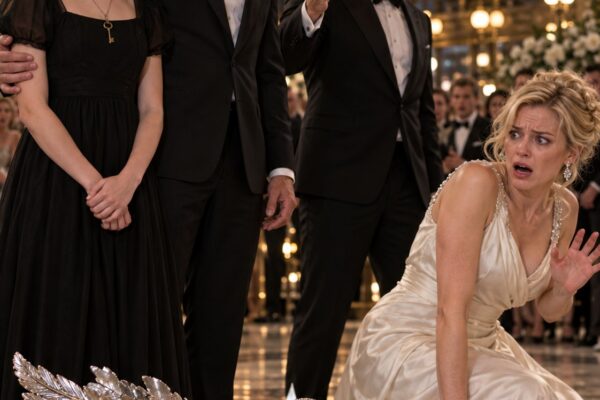
My Son’s Bride Humiliated My Wife at His Vineyard Wedding—Then the Original Deed Appeared in My Hand
Chapter 2: The Ground Beneath Us
Caleb stared at the deed.
June leaned against my shoulder.
The guests stayed where they were.
The band had stopped playing.
Sloane looked from the paper to me.
“What is this supposed to prove?”
“Who owns the land.”
“We know who owns the winery.”
“That isn’t the land.”
Caleb reached for the document.
I folded it before he could touch it.
“Don’t.”
His hand dropped.
June winced.
“Can you move your fingers?”
“Most of them.”
“Let’s get you seated.”
“I can stand.”
I helped her into a chair beside the glasshouse.
A few shards glittered near her shoes.
A server brought a clean napkin.
June pressed it around her wrist.
I looked at Caleb.
“Call the event manager.”
“Dad, there are two hundred people here.”
“Then he’ll find us quickly.”
Sloane folded her arms.
“You can’t cancel a wedding because you’re angry.”
“I haven’t canceled anything.”
“You just made a scene.”
“You shoved my wife.”
“I moved her.”
“She fell.”
“She was in the way.”
Caleb turned toward her.
“Let’s talk inside.”
“You’re the one who laughed.”
“I was trying to keep the evening from becoming a disaster.”
“It already was.”
The words came from June.
She kept her eyes on her hand.
Caleb looked stricken, then glanced at the guests.
“Dad, can we talk privately?”
“We’ve done that for years.”
“What does that mean?”
“It means you knew the land was mine.”
Sloane lifted her chin.
“Caleb told me the winery was his.”
“The winery lease is his.”
“You gave him the vineyard.”
“I gave him the business.”
“And the buildings?” Caleb asked.
“Leased.”
“The event barn?”
“Leased.”
“The tasting room?”
“Leased.”
Sloane stared at him.
“You told me your father signed them over.”
“I said they were part of the business.”
“You said you owned them.”
“I thought I did.”
“You signed the lease.”
Caleb glanced down.
The event manager arrived. I handed him the deed.
“Would you hold this while I speak?”
“Of course.”
Sloane gave a thin laugh.
“So this is a threat.”
“No,” I said. “It’s a record.”
“Then show everyone.”
Our attorney, Maren Pike, stepped out of the crowd.
She had come as a guest.
Now she stood beside the manager.
“The deed is genuine,” she said.
Caleb’s jaw tightened.
“Did you bring it here?”
“I didn’t know your father planned to show it.”
“Then you shouldn’t be speaking.”
“I’m speaking because you asked the room to doubt a recorded document.”
Maren checked the county stamp and recording number.
The deed named me as owner.
Sloane pointed at it.
“You can’t throw us out.”
“I haven’t asked you to leave.”
“This venue is paid for.”
“Tonight’s event is valid,” Maren said. “The winery booked it under its agreement. That agreement doesn’t transfer ownership of the land.”
Sloane turned toward Caleb.
“You told me I was marrying into the vineyard.”
“You were.”
“Not the way you said.”
Caleb looked at me.
“Can we please stop this?”
“I’m trying.”
“You’re humiliating us.”
“June fell into a door.”
“She’s fine.”
June raised her eyes.
“Don’t say that for me.”
Caleb stopped.
“Mom, I’m sorry.”
“Are you sorry you laughed?”
“I didn’t mean it that way.”
“How did you mean it?”
He had no answer.
Sloane stepped closer.
“Your wife came to our wedding to make it about herself.”
“She came to help,” I said.
“She’s always trying to insert herself.”
“She built the garden beside this glasshouse.”
“That doesn’t make it hers.”
“No,” I said. “The deed does.”
Sloane walked toward the barn.
Caleb followed.
The guests waited for someone else to decide what happened next.
I could have ended the reception.
The lease gave me that power.
I did not want to use the land as a weapon.
I wanted June out of the wind.
The answer to why Caleb had chosen this place lay in the folder I carried.
Behind the deed was a copy of the winery lease.
Maren read the page and narrowed her eyes.
“This isn’t the copy we have.”
“I know.”
“Where did you get it?”
“My safe.”
A clause had been added in blue ink.
It promised Caleb the right to buy the land for one dollar after ten years.
My signature appeared beneath it.
It looked like mine.
It was not.
I recognized the slant of the M from a fountain pen I had stopped using in 2021.
The altered copy was dated 2022.
“You knew this existed?” I asked Caleb.
“I’ve never seen that page.”
“Your signature is on it.”
“It’s not mine.”
“Then someone copied it.”
“Probably.”
“Who had access to your records?”
He looked past me.
“Your office.”
“I don’t have staff.”
His mouth opened, then closed.
Maren took the paper.
“We need to preserve this.”
“Is it real?” I asked.
“The added clause isn’t in the recorded lease.”
“Could it still be binding?”
“That depends on the evidence.”
“Did you sign it?” I asked Caleb.
“No.”
“Did you give anyone permission to use your name?”
“No.”
“Did you tell Sloane you owned the land?”
“I thought the option was part of our agreement.”
“That wasn’t my question.”
He rubbed his forehead.
“I told her the land would be ours.”
“Why?”
“Because I believed it.”
“You saw the original lease.”
“I saw a draft.”
Maren held the page beneath the string lights.
“There’s an impression from another page underneath.”
“What does it say?” June asked.
“I can’t read it here.”
Sloane returned to the patio.
“You’re all acting like he forged something.”
“We’re asking how an altered copy was created,” Maren said.
“It came from a file you gave him,” Sloane said.
Caleb stared at her.
“What file?”
“The acquisition packet.”
“I gave him the lease.”
“You gave us the whole packet.”
“I didn’t.”
“Caleb said you did.”
“Caleb says a lot tonight.”
“Where is the copy now?” Maren asked.
“In our house.”
“Which house?”
“Caleb’s place.”
The winery owned the manager’s cottage where he lived.
“Please preserve it,” Maren said.
“You can’t demand that.”
“I’m asking.”
“Send it through lawyers.”
“We will.”
The event manager brought water and a clean towel.
June’s fingers trembled around the glass.
“Do you want the clinic?” I asked.
“Not yet.”
“Your wrist is swelling.”
“I know.”
“Let’s have someone look.”
“I’ll go when the guests are settled.”
“June.”
She met my eyes.
“Don’t make me into another problem you need to solve.”
“I’m not.”
“You’re already holding the deed.”
“I’m holding the paper.”
“You’re holding the room.”
That was true.
People had come to celebrate our son.
Some had been told the vineyard belonged to Caleb.
Everyone had watched June fall.
“Tell me what you want,” I said.
“I want you to stop this from becoming a spectacle.”
“It already is.”
“Then don’t feed it.”
She took a sip of water.
“Please.”
I put the deed away.
“Resume service,” I told the manager.
“Are you certain?”
“Yes. Let the reception continue, if the couple wants it.”
Sloane looked startled.
Caleb looked relieved.
I had done it for June.
The band restarted with a slow song.
The guests returned to their tables.
The wedding went on.
It did not recover.
A nurse examined June and recommended an X-ray.
The scan showed a small fracture near her wrist.
The doctor placed it in a splint.
No surgery was needed.
We went home after midnight.
I put the folder on the kitchen table.
June set her splinted hand beside it.
A photograph of Caleb at twelve sat on the counter, grinning in his baseball uniform.
I turned it face down.
She turned it upright again.
“He was a good boy,” she said.
“He was.”
“Don’t make his worst choice his whole life.”
“I won’t.”
“But don’t pretend it was small.”
“I won’t.”
Maren came the next morning with the recorded lease, old correspondence, and a copy of the altered page.
“Before anyone makes accusations, we establish what was signed and when.”
“Can the county verify the recorded version?”
“Yes.”
“Can the ink be tested?”
“Possibly. We’ll need a document examiner.”
“What else?”
“Access records, email, scans, drafts, and everyone who handled the file.”
“I can help identify our records.”
“Don’t contact anyone yet,” she said. “If someone is involved, we shouldn’t alert them before we know what records exist.”
The official lease gave Caleb the right to buy the winery equipment at a fair valuation after ten years.
It said nothing about the land.
He had asked for that equipment clause when I transferred the business.
I agreed because I wanted him to have a future.
I also told him that family property stayed separate.
He had heard what he wanted.
Or someone had told him what he wanted.
“What would someone gain by adding this?” I asked.
“Property value,” Maren said.
The vineyard and surrounding fields had recently been appraised at just over four million dollars.
Caleb had seen the appraisal.
So had Beatrice Shaw, our bookkeeper.
I fetched it from my study.
Maren copied it, then checked my old ledger.
I had recorded contracts, payments, and meetings there for decades.
The relevant entry read: “Caleb lease renewal. Original signed June 2.”
The altered page was dated June 14.
“What happened that day?” she asked.
“Dinner with a distributor. I was in town.”
“Could you have signed the page?”
“I could have.”
“Would you sign a land option for a dollar without reading it?”
“Not a chance.”
I searched the study until I found the fountain pen I had used before 2021.
Its nib was bent.
The cartridge was empty.
Maren photographed it.
“An examiner might compare the ink,” she said. “The more useful question is who had the pen and document.”
“Beatrice had access to the office. She managed payroll.”
“Could she open the safe?”
“She had the combination years ago.”
“Did you change it?”
“After Caleb moved out.”
“Did you tell him the new one?”
“No.”
Maren arranged to obtain the county file and title history.
She asked me to contact the safe company for its service records.
The document examiner would need the original altered page.
I could tell it was wrong.
I could not yet tell who made it.
June returned from an appointment with her sister.
“What did Maren find?”
“Nothing conclusive.”
“Who had access?”
“Beatrice. Maybe Caleb. Maybe others.”
“Don’t say ‘maybe’ as if it means nothing.”
“It means we need evidence.”
She looked at her splint.
“Caleb knew we owned the land.”
“Yes.”
“Did he know the option wasn’t there?”
“I believe so.”
“Do you want to believe so?”
I sat across from her.
“I’m trying to separate what I know from what I fear.”
“That’s new.”
“It should have been.”
“I don’t want to lose him.”
“Neither do I.”
“Then don’t use the deed to make him crawl.”
“I won’t.”
“Make him tell the truth.”
“That’s what I want.”
“And if he doesn’t?”
“Then I protect what is ours.”
“Were you protecting me at the wedding?”
“Yes.”
“Were you protecting the vineyard?”
“Yes.”
“Were you protecting Caleb from consequences?”
I had no answer ready.
“I was,” I said.
She nodded.
“I’m tired of carrying his excuses.”
“I am too.”
“Then put them down.”
The county clerk confirmed the original lease the next day.
There was no option to buy the land.
The recorded document matched Maren’s copy.
The deed was clean.
The land had never transferred.
Maren filed a notice with the county preserving the property’s status.
She arranged for a document examiner.
Caleb called that night.
“Dad, can we meet?”
“About the paper?”
“About everything.”
“Your mother may join us.”
“Of course.”
“Does Sloane know?”
“She’ll come too.”
“That may not help.”
“I’m not asking you to like her.”
“I didn’t say I did.”
“I want to fix this.”
“What are you offering?”
“I don’t know yet.”
“Then come prepared to listen.”
We met at Maren’s office.
She asked whether we wanted the conversation recorded.
Sloane declined.
Maren turned the recorder off.
Caleb sat across from me.
“Dad, I’m sorry.”
“What for?”
“For the wedding.”
“What part?”
“The way it went.”
“That’s vague.”
“I shouldn’t have laughed.”
“Why did you?”
“I was trying to avoid a fight.”
“By laughing at your mother?”
“I know how it looked.”
“How did it feel to her?”
He turned to June.
“I’m sorry, Mom.”
“Do you understand what you did?”
“I do.”
“Tell me.”
“I laughed when Sloane knocked you down.”
“She shoved me.”
“Then I laughed after she shoved you.”
“Why?”
“I was embarrassed. I wanted everyone to think it was nothing.”
“It wasn’t nothing.”
“I know.”
Sloane leaned forward.
“Can we keep this about the lease?”
June looked at her.
“No.”
Sloane sat back.
Caleb continued.
“I want to make this right.”
“What does that mean?” I asked.
“I’ll apologize publicly.”
“Would you apologize if there were no guests?”
“Yes.”
“Then start with your mother.”
“I did.”
“Start again.”
He faced June.
“I’m sorry I laughed at you. I was ashamed of how Sloane treated you, and I chose to protect my image instead of you.”
“That sounds closer,” she said.
“I was wrong.”
“That doesn’t fix it.”
“I know.”
Maren placed the altered lease on the table.
“We need to discuss this.”
“I didn’t create it,” Caleb said.
“Do you recognize the page?” I asked.
“I saw a copy once.”
“When?”
“Before the wedding.”
“Where?”
“At home.”
“Who gave it to you?”
“Sloane.”
“Where did she get it?”
“I don’t know.”
“Did you tell her the land was yours?”
“I told her it would be ours after the lease term.”
“Did you believe the clause was genuine?”
“I wanted to.”
“That is not the same.”
“I know.”
“Did you tell her you’d verified it?”
“No.”
“Did you tell her it was signed by your father?”
“Yes.”
“Why?”
“I thought it was.”
“You had the signed lease.”
“I had a photocopy.”
“You knew the recorded lease was different.”
“I hadn’t compared them.”
Maren noted his answers.
Sloane turned on him.
“You told me your father gave you the whole packet.”
“I thought he had.”
“You said it was in the acquisition packet.”
“I thought it was.”
“You also told me the loan was preapproved.”
Caleb shifted.
Maren asked about a bank inquiry she had found among the wedding papers.
The form listed the vineyard land as collateral.
“It was a preliminary inquiry,” he said.
“Did you submit it?” Maren asked.
“I didn’t send anything.”
“Why does it have a bank reference number?”
“I was exploring options.”
“With land you didn’t own.”
“I thought we had the option.”
“You had a copy you hadn’t verified.”
“I didn’t submit it.”
The bank’s notation said it had asked for title documents.
Caleb had provided none.
The inquiry was closed as incomplete.
Sloane stared at him.
“You told me the loan was secured by the vineyard.”
“I thought it could be.”
“Did you tell them you owned it?”
“I said the land would eventually be mine.”
Maren set the form aside.
“The bank can confirm the full file.”
“Call them,” Caleb said.
Sloane stood.
“I need air.”
“Stay,” Caleb said.
“I’m not sitting through this.”
She left.
Caleb rubbed his face.
“I’m not the only one who believed it.”
“That doesn’t answer what you did,” I said.
“I know.”
“Did you tell Sloane the land belonged to us?”
“Yes.”
“When?”
“After I saw the copy.”
“Before?”
“I don’t know.”
“You don’t know?”
“I thought it was part of the deal.”
“What deal?”
“The lease. The winery. Your support.”
“My support was not a transfer.”
“I understand that now.”
“You should have understood it then.”
He nodded.
Maren put the bank form in a separate folder.
“This is relevant. We shouldn’t reach conclusions from it.”
“I didn’t submit it,” Caleb repeated.
“The bank can confirm that.”
We left without a resolution.
That evening, June and I sat on the porch.
“Do you think Caleb stole from us?” she asked.
“I don’t know.”
“You think he tried.”
“I think he believed himself.”
“That can be worse.”
“Maybe.”
“I don’t want to lose him.”
“Neither do I.”
“Then don’t use the deed to make him crawl.”
“I won’t.”
“Make him tell the truth.”
“That’s what I want.”
“And if he doesn’t?”
“Then I protect what is ours.”
She touched her splint.
“Were you protecting me at the wedding?”
“Yes.”
“Were you protecting the vineyard?”
“Yes.”
“Were you protecting Caleb from consequences?”
“I was.”
She nodded.
“I’m tired of carrying his excuses.”
“I am too.”
“Then put them down.”
Maren obtained the bank’s complete inquiry file.
Caleb had asked if a loan could be secured by the vineyard.
The banker requested a current deed and title report.
Caleb provided neither.
The inquiry closed as incomplete.
No money was advanced.
The examiner’s findings arrived two weeks after the wedding.
The added clause had been inserted after the page was printed.
Its typeface differed from the lease.
My signature image matched the 2019 equipment loan.
The same faint mark sat beneath the M.
It was a copied signature, not a new one.
Blue ink had been added around the signature line to make the page look signed by hand.
The examiner could not identify who made it.
The real lease had never been amended.
Someone had built a false page from a document already in circulation.
The lie did not lead to a stranger.
It led to people who knew our office.
* * *
Maren reviewed the business access records.
The old server had been replaced, but a migration log remained on a backup drive.
It showed a folder copied from the winery archive to a personal flash drive in 2022.
The account belonged to Beatrice Shaw.
She had worked for us for twenty-seven years and retired in 2023.
The folder contained the equipment loan scan and the real lease.
Beatrice had permission to access the files.
She did not have permission to copy them to personal storage.
We called her through counsel.
Beatrice came carrying a canvas bag.
“I heard about the paper,” she said.
“Who told you?” Maren asked.
“Caleb called me two days after the wedding. He asked if I kept a copy of his lease.”
“Did you?”
“I kept financial records.”
“Did you create this page?”
“No.”
“Did you copy the equipment loan?”
“I handled the paperwork.”
“Did you move the folder to a personal drive?”
She looked down.
“I may have. I was finishing the tax package at home.”
“Do you remember the drive?”
“I used one. I don’t know if I returned it.”
“Could you search your house?”
“I can.”
“Did Caleb ask you about buying the land?”
“He asked what the business would be worth if the property came with it.”
“When?”
“Last year.”
“What did you tell him?”
“That the land wasn’t part of the business. I told him to check with you.”
“Did you believe him when he said you had promised it?”
“No.”
“Did you prepare an option?”
“No.”
Maren showed her the altered page and server log.
Beatrice did not touch the paper.
“I didn’t make that.”
“Did Caleb have access to the archive?” Maren asked.
“Yes. He ran the winery.”
“Could he know where the signature scan was stored?”
“He could.”
Beatrice searched her home but found no flash drive.
Later, she brought in a printed copy of the equipment loan scan among her old tax records.
It showed the same signature image.
That established the source.
It did not establish who had copied it into the false page.
The examiner compared the handwritten markings with samples from Beatrice and me.
The results were inconclusive.
Maren also spoke with Gordon Wells, the former IT contractor.
He had digitized the loan file, but his service logs showed no archive access after his retirement.
Nothing linked him to the false page.
Caleb called after we spoke to Beatrice.
“She had nothing to do with it.”
“You sound certain.”
“She’s been with us forever.”
“So have you.”
“I’m not saying you did it.”
“Good.”
“Are you accusing me?”
“I’m asking what you know.”
“I told you.”
“You saw an altered copy.”
“Yes.”
“Where did you get it?”
“Sloane.”
“Where did she get it?”
“She said it came from an old packet.”
“Which packet?”
“I don’t know.”
“Did you ask?”
“No.”
“Why not?”
“I thought it proved what we had discussed.”
“We never discussed a land transfer.”
“You said the vineyard would be mine someday.”
“I said I hoped you would run the business.”
“You said the family would keep it.”
“That doesn’t mean you own it.”
“I know that now.”
“You knew it then.”
He went quiet.
“Did you submit the altered page to a lender?”
“No.”
“Did you use it to ask for money?”
“I asked about financing.”
“Against land you didn’t own.”
“I thought I had a right to buy it.”
“Did you verify that?”
“No.”
“Did you ask me?”
“No.”
“Why?”
“I thought you would say no.”
“That is not a reason.”
“I know.”
“Who created the page?”
“I don’t know.”
“Did you help?”
“No.”
“I don’t believe you yet.”
“I’m your son.”
“That doesn’t answer me.”
“I know.”
He ended the call.
Maren confirmed that no lender had received the false page.
Caleb had made an incomplete inquiry but provided no title documents.
The loan was never funded.
The lease gave us grounds to protect the land, but Maren advised against using it as punishment.
“Follow the written terms,” she said. “Preserve the records. Don’t sign anything new.”
The next week, Sloane’s lawyer sent a letter claiming Caleb had a beneficial interest in the land based on family assurances and years of reliance.
The letter attached the altered page.
Maren rejected the claim with the recorded deed and lease.
She demanded preservation of all versions, communications, and storage devices.
Sloane’s attorney replied that she had not created the document.
Caleb’s lawyer said the same.
The letter turned the dispute into a legal matter.
Caleb called me.
“You’re making it impossible for us to move forward.”
“You made a claim to land you don’t own.”
“I didn’t file it.”
“Your lawyer did.”
“She wants to protect me.”
“From what?”
“From losing everything.”
“You don’t own everything.”
“I own the business.”
“Under a lease.”
“I built it.”
“You built a successful winery.”
“You gave me the operation.”
“I did.”
“Then why are you acting like I’m a stranger?”
“Because you treated your mother like an obstacle.”
“That has nothing to do with the lease.”
“It has to do with what I trust you with.”
“Dad, please.”
“Tell me the truth about the page.”
“I have.”
“Then show us where it came from.”
“I can’t.”
“Why not?”
“Because I don’t know.”
“Then find out.”
“I’ll try.”
He sounded sincere.
I wanted him to be.
That evening, June was pruning rosemary with her left hand.
I took the clippers from her.
“You should rest it.”
“I am resting it.”
“You’re pruning.”
“Slowly.”
I set the clippers down.
“Do you believe Caleb?” she asked.
“I don’t know.”
“Did he sound afraid?”
“Yes.”
“Of what?”
“Losing the business.”
“Anything else?”
“Losing us.”
She returned to the rosemary.
“Then let him choose what to save.”
“I can’t make him choose.”
“No.”
I held the branch steady while she cut it.
The next issue came from an insurance form.
The winery’s insurer had received an update listing Caleb’s company as owner of the vineyard.
The form bore Caleb’s signature.
He said the broker supplied the wording.
The broker said he used information provided by the applicant.
The insurer flagged the form because county records showed a different owner.
No policy change took effect.
No claim was made.
Maren asked Caleb to correct the statement.
He signed a correction acknowledging that the land belonged to me and the company held a lease.
The insurer accepted it.
There was no proof Caleb intended to obtain money, and no loss had occurred.
We changed the office locks anyway.
That night, someone tried the door after midnight.
The alarm logged the attempt.
The person did not enter.
Nothing was damaged.
The camera showed a hooded figure, but no face.
The sheriff took a report and advised us to keep recording.
We had no suspect.
It might have been a wrong door.
It might have been connected to the paperwork.
We did not know.
Caleb called after hearing about it.
“Did someone break in?”
“No.”
“Was anything stolen?”
“No.”
“Did the sheriff say it was connected to us?”
“No.”
“Do you think I did it?”
“I don’t know.”
“Dad, I didn’t.”
“Then you have nothing to fear from the records.”
“I’m afraid of losing my family.”
“You should be more afraid of losing your honesty.”
“I’m trying.”
“Try where we can see it.”
“How?”
“Tell the truth without waiting for us to discover it.”
He did not answer.
The winery board had scheduled a meeting about an expansion plan for the east field.
Caleb intended to announce a new tasting pavilion.
He had not applied for a permit or asked for my written approval.
The plan relied on the assumption that the land would eventually be his.
The altered page had shaped the couple’s claims at the wedding, a loan inquiry, an insurance form, and a business plan.
Maren advised me to attend and correct the ownership record.
June did not want her fall used as a weapon.
“I won’t mention it,” I told her.
“Tell them about the land.”
“That’s all?”
“That’s all they need to know.”
“Caleb is still your son,” she said.
“I know.”
“Don’t make his worst act larger than it was.”
“I won’t.”
“Make the lie smaller than the truth.”
The board meeting was held in the winery’s tasting room.
Caleb stood beside a screen showing the east field.
“The pavilion would increase our tasting capacity,” he said. “It would create six year-round jobs.”
A board member asked about permits.
“We’re in early discussions.”
“Do you own that parcel?” a lender asked.
Caleb stopped.
“It is part of the family property.”
“That doesn’t answer the ownership question.”
I stood.
“May I clarify?”
The chair invited me to speak.
“The east parcel is mine. The winery holds a lease for its current operations. It does not own the land.”
Caleb lowered the remote.
“That’s not how we understood it.”
“How did you understand it?”
“I believed there was an option.”
Maren placed the county copy of the lease on the table.
“This is the lease on record. It contains no option to buy the land.”
She handed over the altered page.
“A document examiner found an inserted clause and a copied signature.”
“Who created it?” the chair asked.
“We don’t know.”
Caleb spoke quickly.
“I didn’t create it.”
“Did you receive it?” the lender asked.
“Yes.”
“When?”
“Before the wedding.”
“Did you believe it was valid?”
“I thought it reflected what my father promised.”
“Did you verify it?”
“No.”
“Did you tell this board you owned the land?”
“I said the property was part of the family operation.”
The chair asked if the winery had sought financing against the property.
Caleb admitted making a preliminary inquiry.
He confirmed no title documents were submitted and no loan was made.
The lender asked about the insurance form.
Caleb confirmed it had been corrected.
“Has the winery built anything on the east parcel?” the chair asked.
“No.”
“Has a permit been applied for?”
“No.”
“Was the landowner’s approval requested?”
“No.”
“Was it granted?”
“No.”
The chair turned to me.
“What are you asking the board to do?”
“Correct the record.”
“Are you asking us to remove Caleb?”
“No.”
“Are you seeking to terminate the lease?”
“I’m reviewing it with counsel.”
Caleb looked at me.
“You planned this.”
“I brought the recorded documents.”
“You wanted everyone to see me fail.”
“I wanted them to stop relying on a false claim.”
Sloane stood from the second row.
“This is a family disagreement being used to damage a young business.”
“The board was given an expansion plan based on land ownership that doesn’t exist,” Maren said.
“Caleb had reason to believe it did.”
“Then he should have verified the records before seeking financing and expansion support.”
Sloane faced the board.
“He built the winery.”
“He operates it under a lease,” I said.
“You let him believe he owned the ground.”
“I let him believe he had a future here.”
“You know what he meant.”
“I know what I signed.”
The chair raised a hand.
“We need to stay with the records.”
Caleb picked up the altered page.
“This came from my father’s office.”
“No,” I said. “It came from your account.”
“You don’t know that.”
Maren opened the verified email.
“We have a message from your winery account with this page attached.”
The email had been sent to Sloane two days before the wedding.
Its subject was “the land page.”
The message read: “The page is a copy, but it says what Dad promised. Use it for the family dinner. I’ll explain if anyone asks.”
A former events coordinator, Tessa Vann, found the message while correcting a guest list.
She kept a printed copy, thinking it concerned a vendor.
The email service later confirmed the original.
The lender read the message.
Caleb sat down.
“Did you send this?” the chair asked.
“Yes.”
“Did you create the page?”
“No.”
“Did you know it was not the original lease?”
“I knew it was a copy.”
“Did you know it had not been filed?”
“I didn’t know.”
“Did you verify it?”
“No.”
“Did you tell Sloane it was legally valid?”
“I told her it showed what I believed.”
“That isn’t the same,” the chair said.
“I know.”
The email did not prove who made the page.
It did prove Caleb knowingly used a copy he had not verified.
The lender set it down.
“You presented the east parcel as part of the expansion plan. The plan cannot proceed.”
The chair agreed.
The board suspended the proposal, required ownership disclosures in future materials, and scheduled a review before approving new financing.
Caleb remained operating manager under the lease.
No one was arrested or thrown out.
The board took the records and followed its process.
In the hallway, Caleb caught up with me.
“Dad, I can fix this.”
“How?”
“I’ll withdraw the expansion plan.”
“It has been withdrawn.”
“I’ll tell the board I was wrong.”
“You just did.”
“I’ll correct every form.”
“The insurance form is corrected.”
“I’ll repay the business for the wedding costs.”
“Those were authorized expenses.”
“I’ll repay the part that came from the company.”
“Review the accounts with the accountant.”
“I will.”
“Who made the page?”
“I don’t know.”
“Who gave it to you?”
“Sloane.”
“Who gave it to her?”
“She said it came from a packet at the cottage.”
“You had the page before the wedding.”
“I did.”
“You told her to use it.”
“I thought it would settle the matter.”
“What matter?”
“The family’s future.”
“You tried to settle a legal question with a page you knew was only a copy.”
“I thought it was the signed version.”
“Why didn’t you ask me?”
“Because I was afraid you’d say no.”
“And if I had?”
“I would have been angry.”
“That is why you didn’t ask.”
He did not deny it.
The board’s review found no loan against the land and no insurance change.
The false page had not been filed with the county or used to transfer title.
It had been used to persuade family, guests, lenders, and business partners that an option existed.
The record did not identify its creator.
Maren advised us to make no accusation beyond what we could prove.
The lease remained in place for its current term.
I issued formal notice that the east parcel was excluded from any expansion.
I did not evict Caleb or close the winery.
The vendors were paid according to their contracts.
Guests who asked what happened received one answer.
“The deed and lease were reviewed, and the ownership was clarified.”
A week later, Caleb came to the house alone.
He brought a handwritten apology for June.
He sat at the kitchen table and set the page beside his untouched tea.
“I didn’t create the page,” he said.
“That is still true,” I replied.
“I want you to know that.”
“Do you know who did?”
“No.”
“Do you know how it reached Sloane?”
“She says it came from a packet at the cottage.”
“Which packet?”
“She doesn’t know.”
“Do you believe her?”
“I don’t know.”
“That answer is acceptable.”
He looked at June’s wrist.
“I should have stopped Sloane.”
“Yes,” she said.
“I should not have laughed.”
“No.”
“I was trying to look like I had control.”
“You did.”
He lowered his eyes.
“I’m sorry.”
June read his letter.
He named what he had done.
He did not blame Sloane or mention the deed.
When she finished, she folded the page.
“Thank you.”
“Does that mean you forgive me?”
“It means I believe you regret it.”
“That’s not the same.”
“No.”
He nodded.
“I understand.”
“I’m not ready to have you at the house without calling first,” she said.
“I can do that.”
“I’m not ready to let Sloane come here.”
“I understand.”
“I’m not asking you to choose between us.”
“I know.”
“You may need to choose what you stand beside.”
He looked at me.
“I want the family.”
“Then stop asking us to carry a lie for you.”
“I will.”
“Show us.”
He offered to repay the wedding expenses charged to the winery.
I told him to make a plan through the accountant, not pay me personally.
“I won’t turn a legal correction into a private bargain.”
He agreed.
He left without asking us to forgive him on a schedule.
The business survived the season by cutting costs and changing its expansion plans.
It canceled an equipment order, renegotiated with vendors, and sold an underused delivery van.
Caleb reduced staffing and focused on direct sales and small tastings.
The winery stayed solvent.
The wedding bills were paid.
The unauthorized portion charged to the business came to just under twelve thousand dollars.
Caleb arranged an eighteen-month repayment plan through the accountant.
The money went back to the business account, not to us.
The deed remained in the county record.
The altered page stayed in Maren’s file.
The insurance form was corrected.
The loan inquiry was closed.
The east-field expansion was withdrawn.
The person who created the false page remained unidentified.
That question stayed open in the file.
It did not remain open in our lives.
The false clause had no legal effect.
The deed and lease settled ownership.
Caleb had chosen what to do with the page.
That was enough to judge his choices.
June’s wrist healed in six weeks.
She began tending the herbs again.
One morning, I found her carrying rosemary to the kitchen.
“You’re not supposed to lift that much,” I said.
“It’s a basket.”
“It looks heavy.”
“It has herbs.”
She set it on the counter.
“Then you can help me tie them.”
I brought the twine.
The smell filled the kitchen.
Neither of us mentioned the wedding.
Caleb began calling before visits.
He brought paperwork, asked about June’s hand, and accepted when she said she was not ready to see Sloane.
He asked again in spring whether she would visit the winery.
She said yes.
The tasting room smelled of oak and citrus cleaner.
Caleb had taken down the photograph of me handing him the keys.
In its place he framed the first winery ledger, with a note beneath it:
“Operating under the Mercer family lease.”
June read it.
“You didn’t have to put that up.”
“I wanted it clear.”
“Why?”
“Because people should know what this place is.”
She nodded.
He offered us a tasting flight.
June chose the dry white.
She liked it.
“That’s better than last year,” she said.
“I changed the blend.”
“Good.”
A month later, the accountant approved Caleb’s repayment plan.
He paid on schedule.
When he made the final payment, he sent the receipt to the accountant.
He did not send it to us.
That was right.
Money did not settle the injury.
It showed that he understood a responsibility.
Sloane asked through counsel whether she could attend a family dinner.
June declined.
She was not ready.
The answer was accepted.
Caleb and Sloane remained married.
We did not pretend to know what happened between them.
Caleb never told us whether she had created the page.
Sloane never admitted to making it.
The evidence did not prove either claim.
The business moved forward under the lease.
It paid down its debt and secured a small equipment loan without using our land as collateral.
Caleb signed a personal guarantee.
He did not ask me to sign one.
The business was his work.
It was not his land.
In early summer, a young couple asked to hold a ceremony near the greenhouse.
June considered the request.
“Will the glasshouse be closed?” she asked.
“Yes,” I said. “We can reserve the path and keep the door clear.”
“Will the guests be told who owns it?”
“The contract will state the landowner and the winery’s role.”
“Good.”
She agreed.
The ceremony was small.
Thirty people sat beneath the vines.
A server dropped a tray of glasses near the entrance.
The guests startled.
The server apologized.
June stood.
Caleb reached her first.
“Let me get it.”
“I can help.”
“I know.”
He set a hand between her and the glass.
Not to block her.
To protect her from the shards.
He called the manager.
The two of them gathered the broken pieces.
The ceremony continued.
June sat down again.
Caleb stayed beside her.
“Are you all right?”
“Yes.”
“I’m glad.”
She looked at him.
“Thank you for asking.”
He nodded.
That was all.
The vineyard survived the lie.
The winery survived losing its imagined future.
Our family did not return to what it was.
We learned to live in what remained.
* * *
Two years after the wedding, June and I returned to the glasshouse for a family dinner.
The estate had been repaired.
The old door had a stronger frame.
The stone path had been reset.
The glass no longer carried any mark of that night.
The deed was kept in the county file and Maren’s office.
The altered page remained sealed with the legal records.
It had become evidence of a lie without becoming the owner of our story.
Caleb arrived early with bread from the bakery.
June opened the door.
“You’re early.”
“I had time.”
“Then help me set the table.”
He carried plates inside.
He did not enter the greenhouse until June invited him.
That mattered.
We ate together.
Caleb told us about the winery’s harvest schedule.
June told him the rosemary had survived winter.
He answered questions about the business with numbers, not promises.
The yearly family dinner became a tradition.
Caleb asked before visits.
He told the truth about money.
He asked before making plans on our property.
He apologized to June without asking her to forgive him on a schedule.
She accepted his apology over time.
She did not erase what had happened.
The land stayed mine.
The business stayed Caleb’s to operate under its lease.
The deed stayed what it had always been: a record of ownership, not a measure of love.
One evening, years later, June and I stood beside the glasshouse.
Warm air carried the scent of basil and wet soil.
Caleb was inside, helping his six-year-old daughter plant rosemary.
“Where does this go?” she asked.
“Where you have room,” June said.
The girl pressed the seedling into the earth.
Caleb steadied the pot.
He did not rush her.
He did not take the work from her hands.
I watched June smile.
The ground held the small plant.
The glasshouse held the warmth.
The old door stood open between us.
No one was being pushed through it.
THE END