Part 1: Why Did the Port Boss Halt the Waterfront Cargo Auction Over an Old Leather Ledger?
Chapter 2: The Blood on the Channel
The iron gate swung open with a screech.
Cold harbor mist rolled past the bent hinges.
Julian Vance stepped onto the pier.
He wore an Italian cashmere overcoat.
His leather shoes never touched dock mud.
Two private security guards walked behind him.
Their hands remained buried inside dark overcoats.
Julian stopped five paces away.
He looked at Maya.
Then he looked at the ledger.
“You shut down the auction, Silas,” Julian said.
“Step back,” Silas answered.
“The buyers are freezing out there,” Julian said.
“They can wait,” Silas said.
Julian glanced at the perimeter fence.
Forty bidders pressed against the chain links.
None dared make a sound.
“What is that rubbish?” Julian asked.
“Salvage,” Silas said.
“Salvage belongs to the maritime trust,” Julian said.
“Not this,” Silas replied.
Maya stood beside the crane cable.
Her canvas jacket was soaked through.
Cold salt spray dripped from her dark hair.
She watched Julian’s hands.
His right hand stayed inside his pocket.
It never shifted position.
“You’re making a scene, brother,” Julian said.
“You should be at the terminal.”
“My business is here,” Silas said.
“Who is the girl?” Julian asked.
“Her name is Maya,” Silas said.
Julian smiled without warmth.
His teeth were straight and pale against the grey fog.
“She looks like pier trash.”
Silas moved one step forward.
The wet timber groaned under his boot.
Julian’s guards tensed instantly.
Their shoulders dipped toward their left lapels.
“Speak carefully,” Silas said.
“Or what?” Julian countered.
“The board meets at noon, Silas.”
“I know the schedule,” Silas said.
“Then clear this junk off the dock.”
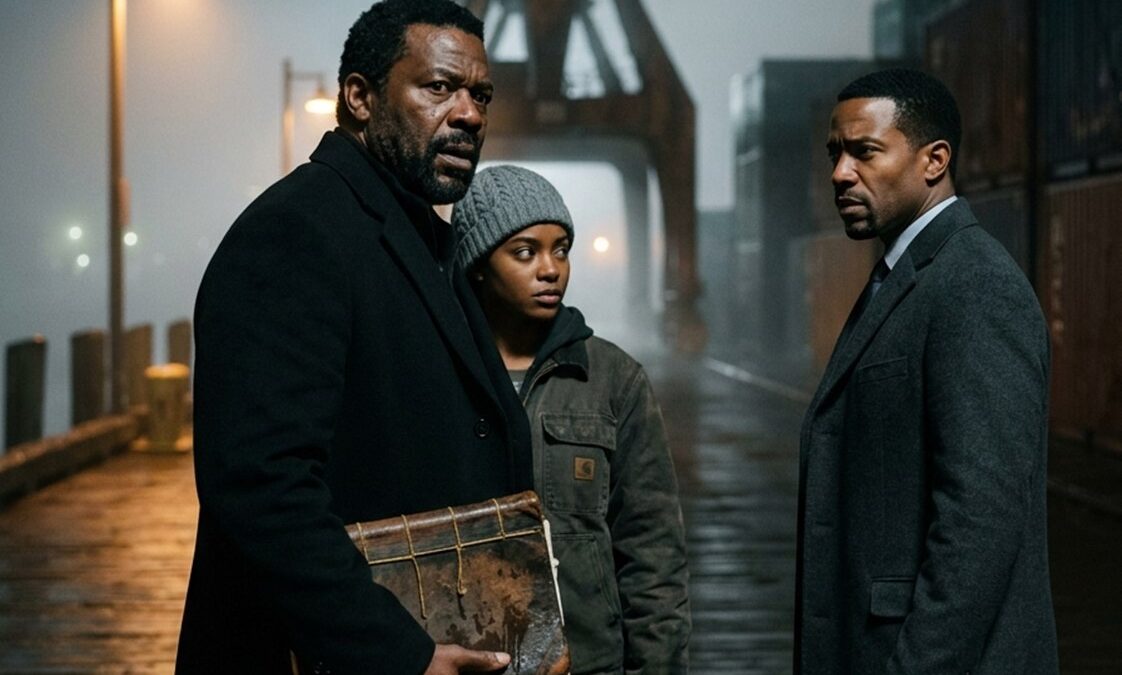
Silas held up the leather ledger.
The brass binding caught the grey light.
Torn threads dangled from the waterlogged spine.
Julian’s smile vanished.
His eyes narrowed to thin slits.
His right hand twitched inside his cashmere pocket.
“Where did that come from?” Julian asked.
“Box forty-two,” Silas said.
“From the channel bottom.”
“That crate was supposed to be scrapped,” Julian snapped.
“You knew it was there?” Silas asked.
Julian caught himself quickly.
A muscle jumped along his jawline.
“I know the manifests,” Julian said.
“Every manifest crosses my desk.”
“Not this one,” Silas said.
“Arthur logged it three hours ago.”
“Arthur is dead,” Silas said.
Julian did not blink.
His expression remained smooth as polished marble.
“An industrial accident, no doubt,” Julian murmured.
“A poisoned needle,” Silas said.
“Fired from Pier Nine.”
Julian tilted his head slightly.
“Dock work is dangerous business.”
“You would know,” Silas said.
Julian’s eyes flicked to the perimeter fence.
“The board wants results, Silas.”
“They don’t want old dock gossip.”
“This is not gossip,” Silas said.
“It is an accounting.”
Julian took a slow half-step to the right.
His guard moved with him in lockstep.
“You are getting sentimental in your old age.”
“And you are getting careless,” Silas said.
Maya shifted her weight against the crane base.
Her work boots scraped on the wet wood.
Julian looked down at her feet.
“Get her off this pier,” Julian ordered his guards.
Neither guard moved.
They saw Silas’s six men closing the gap.
“Touch her and you stay in the basin,” Silas said.
Julian sneered, tucking his chin into his scarf.
“You think she matters?”
“She matters to me,” Silas said.
“She is an interloper,” Julian said.
“She is Nora’s daughter,” Silas replied.
The color dropped from Julian’s jaw again.
A gust of wind caught his coat flap.
“Nora Lin died penniless in a tenement,” Julian said.
“How do you know where she died?” Silas asked.
Julian tightened his lips.
“People talk in South Boston.”
“Nobody talked about Nora,” Silas said.
“Not for twenty years.”
Silas looked down at Maya.
Her hands were still shaking from the cold.
Her lips had a faint blue tint.
He took off his heavy wool coat.
He placed it over her shoulders.
It smelled of cedar and salt air.
It hung down past her knees.
“Come with me,” Silas told her.
“Where?” Maya asked.
“Inside,” Silas said.
Julian stepped forward to block the walkway.
“She has no clearance,” Julian protested.
“She has mine,” Silas said.
Julian did not yield the planks.
“You can’t protect everyone, Silas.”
“I didn’t protect Nora,” Silas said.
Julian went rigid.
The wind tore at his tailored collar.
“Nora chose to disappear,” Julian said.
“No,” Silas whispered.
“She was hunted.”
“By whom?” Julian asked.
“We will find out,” Silas said.
“Step aside, Julian.”
Julian looked at Silas’s guards.
Six weapons remained outlined beneath wool coats.
Julian stepped back toward the iron gate.
“The board convenes at twelve,” Julian said.
“Be there, Silas.”
“I will,” Silas said.
“Bring the girl if you like,” Julian added.
“It will make the vote simpler.”
Julian turned on his heel.
His guards followed him through the bent iron gates.
The black town car waited on the cobblestones.
Its brake lights flared red in the fog.
Silas watched the car turn toward Atlantic Avenue.
“He’s afraid,” Maya said softly.
“He is dangerous,” Silas answered.
“There is a difference.”
He gripped her shoulder gently through the heavy wool.
“Let’s get out of the wind.”
* * *
The harbor office smelled of floor wax and old paper.
A coal stove burned red in the corner.
Rain lashed against the tall, arched windows.
Silas laid the leather book on his mahogany desk.
Water pooled on the polished grain.
Maya sat in a leather armchair.
She wrapped the heavy wool coat around her ribs.
Her boots left small pools of muddy water on the rug.
Her teeth clicked together once.
“Drink this,” Silas said.
He handed her a porcelain mug of black tea.
Steam rose into the drafty room.
Maya took the cup with both hands.
Her fingers were still red and stiff.
“Thank you,” she said.
She took a slow sip.
The warmth reached her throat.
“Did my mother ever sit here?” Maya asked.
Silas looked at the high bookshelf behind his chair.
“She sat in that chair every Friday,” he said.
“She checked the fuel requisitions.”
“She brought pastries from the bakery on Hanover Street.”
“She never ate them herself,” Maya murmured.
“She said sweets made a clerk slow.”
Silas gave a dry, soft laugh.
“She said the exact same thing to me.”
A tall woman with silver hair entered the room.
She carried a medical kit and a clean white towel.
“This is Dr. Helen Cole,” Silas said.
“She runs the maritime clinic.”
“Roll up your sleeve, please,” Helen said gently.
Maya looked at Silas.
She set the mug on the edge of the desk.
“Why?” Maya asked.
“Because facts do not lie,” Silas said.
“People lie every day on these docks.”
“Paper can be altered,” Silas added.
“Blood cannot.”
Maya unbuttoned the cuff of her flannel work shirt.
She rolled the sleeve past her elbow.
Her skin was pale beneath dock dust.
Helen opened a leather case of sterile instruments.
She swabbed Maya’s arm with cold alcohol.
“Just a pinch,” Helen said.
Helen drew three drops of blood onto a glass slide.
She took a cotton swab from Maya’s cheek.
She sealed the swab in a sterile glass tube.
Then she turned to Silas.
Silas offered his right hand without hesitation.
Helen pierced his thumb with a disposable lancet.
She pressed three dark red drops onto a matching slide.
“I need two hours with the centrifuge,” Helen said.
“Take one,” Silas told her.
“The board convenes in two.”
“I will use the rapid chemical assay,” Helen said.
“It matches direct paternal alleles.”
“Do it now,” Silas said.
Helen packed her case and walked to the door.
She paused and looked at Maya.
“You have your mother’s cheekbones,” Helen said quietly.
“Did you know her?” Maya asked.
“I delivered you,” Helen said.
“In a basement room on B Street.”
“It was snowing so hard the ambulances couldn’t run.”
Maya leaned forward in the leather chair.
“She told me I was born in a hospital.”
“She told you what she needed to tell you,” Helen said.
“She was terrified every single hour.”
“Of Julian?” Maya asked.
Helen looked at Silas before she answered.
“Of what Julian was capable of doing to keep the piers.”
Helen stepped into the corridor.
The door clicked shut behind the doctor.
The coal stove hissed as a pocket of sap burned.
Silas sat behind his desk.
He pulled open the heavy center drawer.
He lifted out an old iron key.
The metal was pitted with grey oxidation.
“Your mother worked for the port authority,” Silas said.
“She kept the maintenance logs.”
“She told me she was a schoolteacher,” Maya said.
“She taught night classes at the mission.”
“She lied to keep you alive,” Silas said.
“Why would anyone care about a clerk?” Maya asked.
“She wasn’t just a clerk,” Silas said.
“She audited the deep-channel manifests.”
“She saw what came off the international freighters.”
“She saw what never reached customs.”
Maya touched the silver anchor at her neck.
“She gave me this before she died.”
“She wore it on a ribbon,” Silas murmured.
“Every day she worked Pier Four.”
“Do you know what number forty-two means?” Silas asked.
“It was her locker number,” Maya said.
“She kept her winter boots in forty-two.”
“No,” Silas said.
“It was the channel buoy where my first cargo boat sank.”
Maya pulled the pendant away from her collar.
The number was stamped deep into the silver flukes.
“The Osprey?” she asked.
“Yes,” Silas said.
“How did it sink?” Maya asked.
“They said the hull plates cracked,” Silas said.
“They blamed poor steel from the shipyard.”
“And you believed them?”
“I was twenty-six,” Silas said.
“Julian handled the insurance claim.”
“He handled the federal hearing.”
“I was out at sea searching for bodies.”
“Did you find them?” Maya asked.
“None of them,” Silas whispered.
“The current takes everything out past Boston Light.”
Maya looked down at the leather ledger.
“The pages are water-damaged,” she said.
“Some of them,” Silas agreed.
“The ink has run together like black oil.”
“My mother taught me how to read water-damaged ink,” Maya said.
Silas paused.
His hand stopped on the iron key.
“How?”
“Lemon oil and a heat lamp,” Maya said.
“She used it on old ship logs at home.”
“She said salt water locks the pigment beneath crystalline crusts.”
“Oil lifts the salt without softening the carbon.”
Silas stood up and opened the oak cabinet by the window.
Row upon row of nautical manuals filled the shelves.
On the bottom shelf sat emergency repair supplies.
He found a bottle of mineral oil and a high-intensity inspection lamp.
He set them beside the soggy book.
“Show me,” Silas said.
Maya stood up and walked to the desk.
Her boots squelched slightly against the wood floor.
Her hands were steady now.
She uncapped the amber bottle.
She dipped her fingertip into the oil.
She smoothed it across the brittle twelfth page.
The dark stains receded under the amber sheen.
The crust of dried brine grew translucent.
Maya switched on the high-intensity lamp.
A sharp white beam pierced the paper fiber.
Faint blue pencil lines appeared beneath the salt crust.
Maya read the entries aloud.
“Tugboat Osprey. November twelve, twenty-four years ago.”
“Departure dock: Pier Nine.”
“Destination: Portland harbor.”
“Cargo declared: Machine parts.”
“Cargo actual: Industrial bonds.”
Silas leaned closer to the lamp.
The heat of the bulb warmed his face.
“That was the shipment that made Julian rich,” Silas said.
“He said the bonds went down with the ship.”
“He collected eighty million from Lloyd’s of London.”
“Look at the signature at the bottom,” Maya said.
Silas adjusted the brass lamp shade.
The signature was written in clean, slanted script.
It was not Nora Lin’s name.
It was Julian Vance’s personal clerk.
“Gideon Ross,” Silas read.
“Julian’s shadow for thirty years.”
Beneath the signature was an order number.
“Order forty-two,” Maya read.
“Scuttle vessel at channel markers. Report total hull loss.”
“Ensure zero salvage retrieval.”
Silas did not blink.
His reflection in the lamp reflector looked carved from stone.
“My first vessel,” Silas whispered.
“He didn’t just steal the bonds.”
“He sank it with three crewmen inside,” Maya said.
“One of them was my grandfather,” Silas said.
“Nora’s father was the captain,” Maya said softly.
“He went down with the wheelhouse.”
Silas closed his eyes.
“She knew,” he whispered.
“She found this ledger that night.”
“And Julian found out she had it,” Maya said.
“She took the ledger and ran.”
“She didn’t run from me,” Silas realized.
“She ran from him.”
“To protect you?” Maya asked.
“To protect both of us,” Silas said.
“Julian had the board.”
“He had the police commissioners.”
“If she had spoken to me, Julian would have sunk my boat too.”
Silas turned the page with trembling care.
Page thirteen was covered in handwritten notes in Nora’s hand.
Names of harbor pilots.
Bribe payments to customs inspectors.
And bank account numbers in Bermuda.
“This is the whole machine,” Silas said.
“Julian didn’t build a shipping line.”
“He built a smuggling syndicate behind my back.”
Maya traced her finger along the edge of the paper.
“She carried this for twenty-four years.”
“She kept it in a cedar chest under her bed.”
“Why throw it in the harbor?” Silas asked.
“She didn’t throw it,” Maya said.
“The night she died, two men broke into our flat.”
“I was at the pharmacy getting her medicine.”
“When I came back, the mattress was slashed.”
“The floorboards were torn up.”
“She had already slipped the ledger into the salvage intake bin at Pier Four.”
“She knew the dredging scows would pick it up eventually.”
“She trusted the mud more than the city,” Silas said.
“She trusted you to find it,” Maya said.
“She knew you inspected every salvage cage from the channel.”
“She bet her life on that habit,” Silas murmured.
* * *
The rain turned to sleet against the windowpanes.
Small grains of ice tapped like fingernails on the glass.
A dark sedan idled across the street from the pier gate.
Its exhaust plumed white in the freezing air.
Two men in grey work jackets stood beneath the awning of the bait shop.
They never looked at the water.
They never looked at the trawlers pulling into the basin.
They only looked at Silas’s office window.
Silas stood by the curtain with his hands behind his back.
“They won’t come through the front door,” Silas said.
“Who are they?” Maya asked.
“Julian’s enforcement squad,” Silas said.
“They operate off the railroad docks.”
“Men who don’t exist on port payrolls.”
“Are they going to kill us?” Maya asked.
Her voice had no tremor, only cold curiosity.
“They are waiting for orders,” Silas said.
“Julian still thinks the ledger can be bought or burned.”
A tap sounded on the side door.
Three short raps, followed by two long ones.
Silas nodded toward the door.
Detective Marcus Vance walked in.
He was Silas’s nephew, forty years old, with an unbuttoned trench coat.
His hair was wet with sleet.
He carried a thick manila folder under his arm.
“You called the precinct, uncle,” Marcus said.
“I called you,” Silas corrected.
“There is a difference.”
Marcus looked at Maya.
He took off his dripping hat.
“Is this her?”
“Yes,” Silas said.
“Her name is Maya.”
Marcus opened the manila folder on the desk.
He pushed the lamp aside to clear space.
“Arthur’s autopsy just cleared the medical examiner.”
“Cyanide?” Silas asked.
“A compressed-air dart,” Marcus said.
“Fired from sixty yards.”
“Through the open window of his cab.”
“Professional,” Silas noted.
“Too professional for a dock dispute,” Marcus said.
“The weapon was specialized military surplus.”
“The kind Julian’s private security imports for terminal patrols.”
Marcus pulled out three black-and-white photographs.
They showed an old warehouse on Wharf Seven.
Blackened beams hung like ribs above standing water.
“Julian bought this property last month under a shell company,” Marcus said.
“Called North Atlantic Holding.”
“What was stored there?” Silas asked.
“Nora Lin’s original employment files,” Marcus answered.
“Every logbook from the nineteen-nineties.”
“They burned it down two nights ago.”
“Arson squad found kerosene traces in four corners.”
Maya looked at the burnt timbers in the photograph.
Her eyes hardened.
“My mother kept duplicates,” Maya said.
Marcus looked at her with skepticism.
He leaned against the edge of the mahogany desk.
“Where, young lady?”
“Inside my locker at the salvage yard,” Maya said.
“Locker one-hundred-fourteen.”
Silas turned from the window.
“Why your locker?”
“She told me never to trust the house,” Maya said.
“She said houses burn easily.”
“She said a waterfront locker is steel, bolted into sea concrete.”
“She was right,” Silas murmured.
“She knew Julian’s methods.”
Marcus checked his service pistol beneath his coat.
The steel slide clicked softly as he inspected the chamber.
“If Julian finds out those duplicates exist, he’ll level that yard.”
“He already sent his men there,” Silas said.
“How do you know?” Marcus asked.
Silas pointed toward the street.
The dark sedan had just pulled away from the curb.
Its brake lights flared red against the slush.
It was heading south toward the industrial yard.
“They know she works the scrap line,” Silas said.
“They’re going to search her locker.”
“Take the back launch,” Silas told Marcus.
“Cut them off at the canal bridge.”
“Secure the steel locker before they reach the gate.”
“What about you?” Marcus asked.
“I have the ledger,” Silas said.
“Julian wants the ledger.”
“He thinks it is the only copy in existence.”
Marcus zipped his coat.
“Don’t go into that boardroom alone, Silas.”
“I won’t be alone,” Silas said.
He looked at Maya.
“Maya is coming with me.”
“It’s suicide,” Marcus warned.
“The board belongs to Julian.”
“Eight of those directors took his kickbacks on the channel lease.”
“Then they will fall with him,” Silas said.
“Do you have the warrant?” Silas asked.
Marcus tapped the folder.
“Signed by Judge Albright twenty minutes ago.”
“Conditioned on the forensic match.”
“Helen will deliver the match,” Silas said.
“Go to the canal bridge, Marcus.”
“Don’t let them burn that locker.”
Marcus nodded grimly.
He turned his collar up and slipped out into the freezing sleet.
Silas picked up the ledger from the desk.
He slipped it into a clean canvas document bag.
“Are you ready?” Silas asked Maya.
“I’ve worked three winters on these docks,” Maya said.
“I’m not afraid of men in suits.”
Silas looked at her proud jaw.
“You have your mother’s backbone,” he said.
“She needed it,” Maya replied.
“So do you.”
* * *
The boardroom on the tenth floor of the Port Exchange was paneled in dark walnut.
A massive crystal chandelier rattled faintly in the winter wind outside.
Twelve directors sat around an oval table made of ship timber.
They wore tailored wool suits and gold watch chains.
Julian Vance sat at the head of the table.
He had a silver water pitcher on his right.
He held a fountain pen in his left hand.
The directors spoke in low, murmuring voices.
Julian tapped his pen against the blotter.
“The motion is to revoke Silas’s administrative authority over the north piers,” Julian announced.
Several directors nodded.
“He has become erratic,” Julian said.
“He stopped commercial traffic this morning.”
“He caused fifty thousand dollars in delayed freight.”
“The container ships are backed up to Boston Light.”
“He claims an old trunk contained confidential records.”
Julian smiled thinly around the room.
“Our brother has spent thirty years chasing ghosts.”
“The company cannot afford his sentimental grief.”
“He is bad for business.”
“He is bad for the share price.”
Director Harrison, an older man with silver sideburns, cleared his throat.
“Silas has voting control over the northern berths,” Harrison noted.
“Under Article Nine, we can suspend voting rights during a breach of fiduciary trust,” Julian replied smoothly.
“Shutting down a licensed auction constitutes gross negligence.”
“I have the proxy votes ready.”
“We can conclude this before lunch.”
The door at the back of the room opened.
The heavy brass latch hit the doorstop with a loud crack.
Silas walked in.
Maya walked beside him.
She still wore her canvas trousers and heavy work boots.
She held a rusted steel lockbox under her arm.
Salt water dripped from the corner of the metal case onto the deep-pile carpet.
Julian stopped talking.
His pen hovered over the resolution document.
“You don’t belong in this room,” Julian said, standing up.
“I built this room,” Silas answered.
His voice carried across the high ceiling.
The directors looked down the table in silence.
None of them moved to greet Julian’s command.
Silas set the canvas bag on the table.
He unzipped the canvas and withdrew the leather ledger.
He laid it in the center of the polished wood.
“This is the salvage manifest from the Osprey,” Silas said.
Julian sneered, spreading his hands wide.
“That ship sank twenty-four years ago,” Julian said.
“The case was closed by federal maritime investigators.”
“A tragic loss at sea due to hull failure.”
“The investigators never saw the real logbook,” Silas said.
Julian laughed quietly.
The sound was sharp and brittle.
“You bring a dock worker and a waterlogged book to challenge the board?”
“She is not just a dock worker,” Silas said.
The rear doors parted once more.
Helen Cole entered through the rear door.
She carried an embossed envelope from the city forensic laboratory.
She did not look at Julian.
She walked straight to the board chairman, an elderly man named Arthur Vance Sr.
She handed the paper directly to the board chairman.
The chairman put on his reading glasses.
His hand shook slightly as he unfolded the seal.
He read the first paragraph.
He read the secondary test results.
His face lost all color.
“What is that?” Julian demanded.
“What nonsense have you fabricated, Silas?”
“A certified DNA match,” the chairman said.
His voice cracked slightly.
“Between Silas Vance and Maya Lin.”
“A ninety-nine point nine percent match.”
The room remained utterly silent.
Outside, a foghorn sounded from the harbor entrance.
Julian’s hand tightened around his silver pen.
The metal bent slightly under his white knuckles.
“That proves nothing about the shipping lines,” Julian said.
“Silas had a bastard with a pier girl.”
“That is personal scandal, not corporate malfeasance.”
“It proves motive,” Silas said.
“Nora Lin was pregnant when the Osprey sank.”
“She was going to tell me that Julian ordered the scuttle.”
“She discovered the bond theft that morning.”
Maya stepped forward.
She set the steel lockbox on the table.
She opened the brass clasp with her mother’s anchor key.
The iron lid creaked open.
Inside lay three bundles of official port receipts from twenty-four years ago.
Each receipt was dry, crisp, and sealed in archival plastic.
Each receipt bore Julian’s personal seal.
They documented the removal of twenty crates of treasury bonds from the Osprey two hours before it sank.
“You forged those,” Julian whispered.
“The ink was tested twenty minutes ago,” Marcus Vance announced from the doorway.
Two uniformed police captains stood behind Marcus.
Their leather holsters were unclasped.
“The ink contains copper traces used only by the state treasury in nineteen-ninety-nine,” Marcus said.
“And there is more, Julian.”
Marcus held up a digital recorder.
“Your two men at the scrap yard talked.”
“They had your signed authorization to execute Maya Lin.”
“And Arthur’s murder weapon was in your trunk.”
Julian looked around the table.
His gaze swept from face to face.
Not one director met his eyes.
Harrison looked away.
The other directors stared at the blotter.
Arthur Vance Sr. pushed his chair back from the table.
“You are stripped of all voting shares, Julian,” the chairman said.
“You are removed from the board effective immediately.”
“We will cooperate fully with the District Attorney.”
Julian stood frozen against his leather chair.
He straightened his cashmere coat with trembling hands.
He looked at Maya.
“Your mother was a fool,” Julian hissed.
“She died in a basement flat with nothing.”
Maya looked straight into his eyes.
“She was smart enough to survive you,” Maya said.
“And she left the truth in my hands.”
“You have nothing,” Julian said.
“I have her name,” Maya said.
“And I have my father.”
Marcus stepped forward with a pair of steel handcuffs.
“Hands behind your back, Mr. Vance.”
Julian did not resist.
The steel bracelets clicked around his wrists.
He walked past his brother without saying another word.
His polished shoes made no sound on the carpet as the officers led him away.
Silas stood at the head of the table.
He looked at the directors.
“The meeting is adjourned,” Silas said.
* * *
Three months passed.
Spring came to Boston Harbor.
The grey salt mist gave way to clear blue skies over the water.
Gulls wheeled above the green surface of the channel.
Silas Vance stood on the balcony of his harbor office.
The north piers were open and busy with merchant vessels.
Cranes swung cargo containers with steady, rhythmic thuds.
The salt wind was mild, carrying the scent of thawing earth from the south shore.
Maya walked through the door carrying an architect’s portfolio.
She wore a clean wool sweater and simple dark trousers.
Her boots were new, but they were still sturdy leather dock boots.
“The plans for the new clinic are ready,” Maya said.
She spread the blueprints across the mahogany desk.
They showed a wide brick pavilion with sunlit examination rooms.
“You don’t want an office in the corporate tower?” Silas asked.
“Ten floors above the water?” Maya asked with a faint smile.
“I like the smell of the docks,” Maya answered.
“I like being where the shifts change.”
Silas smiled faintly.
His eyes looked less weary than they had all winter.
“Your mother said the exact same thing.”
“She said the tower was full of men who forgot where their bread was baked.”
“She loved the morning tides,” Maya said.
“She always took me to the seawall when the tide turned.”
“Julian’s trial starts next month,” Silas said quietly.
“He won’t take a plea.”
“He still thinks he can buy a judge.”
“Marcus says the federal prosecutors have eighty counts of wire fraud,” Maya said.
“And Arthur’s murder charge,” Silas added.
“He will never see these docks again.”
Silas reached into his desk drawer.
He placed a legal document on top of the blueprints.
It was a transfer of ownership for Pier Forty-Two.
“This is yours,” Silas said.
Maya looked at the paper.
The embossed corporate seal gleamed gold in the sunlight.
She did not touch it.
“I don’t need a pier,” she said.
“I make my living.”
“It is not a gift,” Silas said.
“It is restitution.”
“I don’t want restitution from you,” Maya said softly.
“You didn’t sink the boat.”
“You didn’t send men with poisoned needles.”
“I failed to look for her,” Silas said.
“When she disappeared from the docks, I should have torn this city apart.”
“Why didn’t you?” Maya asked.
“Julian showed me a letter,” Silas said.
“Written in her hand.”
“He told me she left the city with another man.”
“And you believed him?” Maya asked.
“I was young and arrogant,” Silas admitted.
“I thought she left because I spent every night at the shipyards.”
“That was my failure.”
“A failure of pride.”
Maya looked out the window at the harbor.
A tugboat moved steadily across the green channel.
Its engine thrummed against the morning calm.
“She forgave you,” Maya said.
Silas turned his head sharply.
“Did she tell you that?”
“She told me on the night she died,” Maya said.
“She said you were stubborn as an iron anchor.”
“She said your pride was your cage.”
“She told me if I ever found you, I should give you the book.”
“Not to punish you.”
“To set you free from Julian.”
Silas closed his eyes against the sunlight.
A tear ran down the deep line of his weathered cheek.
“We cannot fix twenty-four years,” Maya said gently.
“No,” Silas agreed.
“We cannot give Nora back her life.”
“We can only build the clinic,” Maya said.
“And train the young apprentices so they aren’t cheated on the manifests.”
Silas nodded slowly.
“Then we build the clinic.”
He signed the deed and pushed it into her hands.
“Take it, Maya.”
“For Nora.”
Maya took the deed.
She folded it neatly and placed it inside the blueprint folder.
“For Nora,” she said.
* * *
Five years later.
The morning sun reflected bright gold off the calm waters of Pier Forty-Two.
The old wooden wharf was gone.
In its place stood a two-story brick maritime training school and free medical center.
The brass plaque near the front entrance read: NORA LIN HARBOR FOUNDATION.
Dozens of young dock apprentices stood near the entrance, holding new equipment.
They wore clean canvas jackets and safety helmets.
Maya Vance-Lin walked down the timber gangway.
She held the hand of her four-year-old daughter.
The little girl wore bright yellow boots.
She carried a small wooden toy boat carved from pine.
Silas stood by the harbor railing.
His hair was entirely white now, but his wool coat remained pressed and clean.
He held a cup of coffee in one hand.
He looked down at the child with soft eyes.
“Is the engine ready for the water, Nora?” Silas asked.
“She built the rudder herself,” Maya said.
“She tested it in the basin sink this morning.”
Silas crouched down on one knee, just as he had five years earlier on the splintered pier.
He inspected the carved wooden toy.
He turned the tiny brass screw on the propeller shaft.
“Good balance,” Silas said.
“A stout keel.”
“Just like the Osprey should have had.”
Little Nora laughed, pointing at a passing tugboat.
“Look, Grandpa! Big boat!”
Silas smiled, his hand steady on the child’s shoulder.
“That’s our boat, Nora.”
“She keeps the channel clear.”
Maya touched the leather ledger resting in a glass display case inside the school’s lobby.
The brass binding was polished clean.
The ink was preserved behind UV glass.
The pages showed the true names of the lost crewmen.
The salt was gone.
The fear was gone.
The old channel markers flashed green across the harbor mouth.
The ships sailed out toward the open sea.
THE END








