She Had Three Hours to Save the Pear Shipment, and the Only Woman Who Could Approve It Was the One She’d Accused
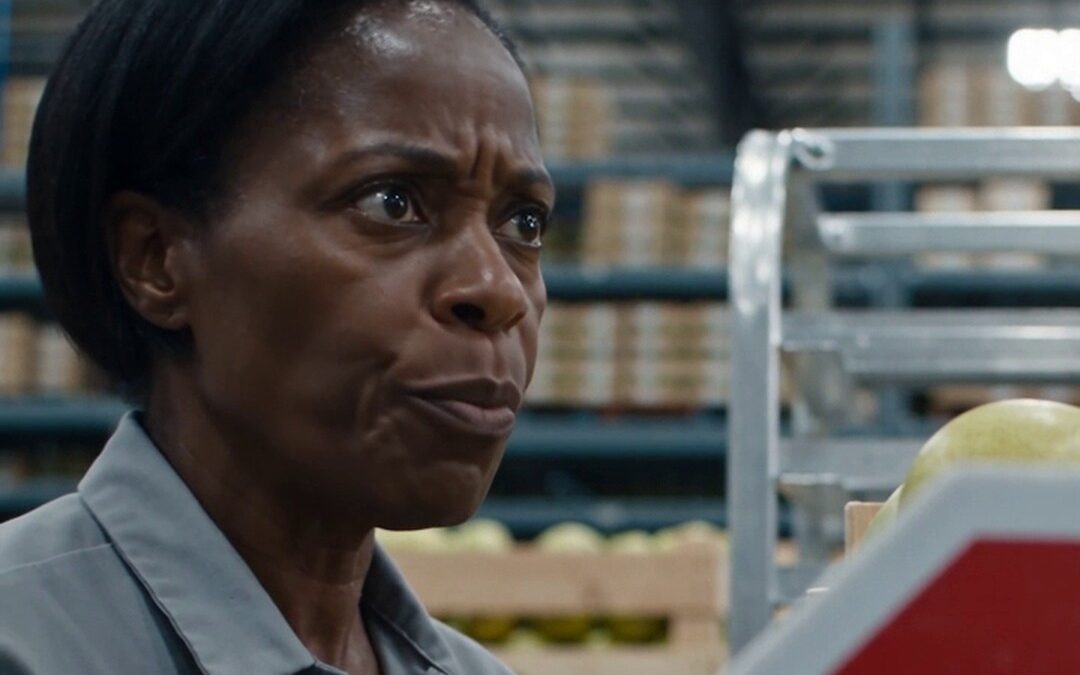
Chapter 1: The Hold Paddle
Celia cut blue twine from a pear bin that had no reason to be tied, and the loop fell around her boots.
At the farm co-op packing shed, blue meant a bin stayed off the line until someone could explain what was inside it.
Celia had tied that loop herself before dawn, but the knot facing her was Inez Vale’s.
“You moved it,” Celia said.
Inez set her red hold paddle against the bin without letting go.
“Then tell me why you tied it.”
They had not spoken alone since Inez rejected Celia’s entire harvest two years earlier.
At the next co-op meeting, Celia had accused Inez of protecting a relative’s fruit at her expense, and she had never taken the accusation back.
Now eighteen growers needed their pears on one refrigerated truck by four, and Celia’s orchard supplied the last six hundred boxes needed to fill the order.
The buyer required graded fruit from identified blocks, with a sample taken from each bin before packing.
Celia knew which bins had come from the ridge, where the pears were firm enough to travel.
Inez was the co-op’s designated quality lead, and the buyer would accept a load only after she signed its release sheet.
The other trained lead was away until Monday; the truck had a scheduled collection at the next warehouse and would leave without Celia’s fruit.
They tried one bin while the packing line waited.
Celia opened the one she said came from the ridge.
Inez cut three pears, pressed their flesh with her thumb, and found one that yielded too easily.
“That doesn’t belong here,” Celia said.
“It came from your bin.”
Inez lowered the paddle, and the rollers stopped with a wooden knock that made every packer look up.
On the bin’s side, beneath fresh chalk, a strip of old blue paint showed through.
Celia had painted that strip two years ago, when the rejected harvest went to the juice plant.
She had not brought any of those bins back to the orchard.
Across the shed, co-op manager Ellis Boone watched a driver close the truck’s rear doors against the warm loading bay.
“Three hours,” he said.
Celia looked from the old paint to the knot in Inez’s hand.
Someone had put an old bin into today’s harvest, and neither woman could tell whose pears it held.
Inez laid the red paddle across the bin’s open rim.
“Before one more box goes on that truck,” she said, “we open every blue-marked bin.”
Chapter 2: The Release Sheet
“Every one?” Celia asked.
“Every one.”
Celia counted the visible blue marks down the first row and stopped at seven.
Behind those bins were two more rows, each crowded close enough that the painted sides faced inward.
Ellis came over with the slow walk he used when he expected to disappoint somebody.
“The driver can give us until four,” he said.
“He said three hours,” Celia replied.
“It’s one now.”
Inez kept the paddle on the rim.
“I can release identified fruit,” she said.
“I can’t release fruit because we need it.”
Celia wanted to tell her what a full rejection had cost the last time, but every person in the shed knew.
She picked up the cut twine instead.
“This was mine when I left the orchard,” she said.
“I retied it here.”
“Why?”
“To hold a bin with mixed pick dates.”
Ellis glanced toward the idle line.
“Mixed by whose count?”
“Mine,” Celia said.
The admission came out louder than she meant it to.
She had caught two bins beside the loading ramp at dawn with yesterday’s tags tucked under their top slats.
Her pickers had been finishing the ridge while the sun was still low, and she had no time to open every bin before loading.
She tied blue twine on the doubtful pair, told the driver those bins were on hold, and marked their positions on her block map.
At the co-op, the pair had become seven.
“I wasn’t concealing them,” she told Inez.
“I know what blue means.”
“Then you know why I moved the tie to the front.”
Inez showed her the cut ends of the knot.
“The first loop had been pulled under a slat,” she said.
“I wanted it visible from the line.”
Celia recognized her own knot beneath Inez’s, tight and low where a fork tine could have caught it.
For a moment, the small correction annoyed her more than the seven bins.
Ellis called to the packing crew to take their paid break early.
Nobody objected, although several watched Celia with the direct interest of people whose afternoon wages depended on what she said next.
Ruth, who kept the carton rack stocked, left one flat box resting against her hip.
“We’re coming back to a line?” she asked Ellis.
“That’s the plan,” Ellis said.
Ruth looked at the paddle and then at Celia.
Celia could have promised her one, but the bin between them was already proof that promises would not move fruit.
“We’ll have something for you to pack,” Celia said.
Ruth set the box down without folding it.
“Terms,” Inez said.
Celia folded her arms.
“We have terms now?”
“We sort by block and pick date.”
“We already did.”
“We check that the bins still match your map.”
Celia held out the folded map from her back pocket.
Inez did not take it.
“You call each block,” she said.
“I sample each bin.”
“If a bin fails?”
“It goes aside while we check the rest.”
“No sweeping the whole lot because one pear goes soft?”
Inez met her eyes.
“No sweeping the whole lot.”
Celia looked at Ellis.
“And the crew?”
“They’re on the clock while we work,” he said.
“If the buyer takes fewer boxes, I’ll offer the spare hours cleaning the cooler and sorting tomorrow’s local order.”
It was a useful answer, though it did not make the lost sale smaller.
Ellis moved two empty pallets to the hold side, leaving a clear lane between them and the rollers.
He asked Ruth to send anyone returning from break to the packing table, where approved fruit could move without crossing the bins still under review.
Inez waited until he finished before lifting the paddle from the rim.
“Nothing crosses that lane without my release,” she said.
Celia disliked hearing a boundary stated over her fruit.
She disliked even more that the crew needed to know where it was.
Celia placed the map on an empty pallet, weighted its corners with four pears, and pointed to the first row.
“Ridge, morning,” she said.
Inez lifted the first pear from the bin.
The line’s wooden knock sounded again when Ellis restarted the empty rollers for the crew to clear yesterday’s waxed cardboard from beneath them.
Celia felt the sound in her jaw.
Two years ago, that knock had been followed by Inez raising the same red paddle.
Celia had delivered forty-eight bins of pears on a Thursday morning, certain they would make the fresh-fruit grade.
Inez had stopped the entire lot before the first box was packed.
By afternoon, word had reached every orchard in the co-op.
The following month, Celia had stood in a meeting room and said Inez rejected her fruit to make space for her nephew’s.
Inez’s nephew grew apples in another county, a detail Celia learned the next day.
She had let the accusation stand.
Now Inez cut a pear, examined the seed cavity, and set the halves flesh-side up.
“Good,” she said.
Celia wrote a short stroke beside the bin on her map.
The second pear passed, then the third.
Ellis rolled the approved bin toward the line.
When its bottom runners reached the transfer table, the old strip of blue paint appeared along the lowest board.
Inez put up one hand.
“Stop.”
Celia groaned.
“You’ve sampled it.”
“That paint is from the old lot.”
“Wood gets reused.”
“These bins were supposed to be at the juice plant.”
Ellis bent to look.
“Some came back to the pool after washing,” he said.
“Who checked them in?” Inez asked.
“I can check the tally.”
The tally cards were kept on hooks inside the co-op office.
Ellis left for them while Inez turned the bin sideways to see the paint beneath the runner.
Celia read the worn wood as she would a familiar ladder.
The blue strip had been brushed hastily, leaving a thick drop below the corner brace.
She remembered painting it.
She had stood at her own loading ramp after Inez rejected the lot, too angry to let anybody else touch the brush.
On each bin, she had painted a short line to help the juice plant count what it received.
The fresh paint had stained her thumb for a week.
“This one came back,” she said.
“Why does that matter to today’s pears?”
“It matters to identification.”
“Then identify it.”
Inez tapped the loose board at the top.
“No permanent number.”
“The block tag was on the twine.”
“Which somebody moved.”
“You moved it.”
“After it was pulled under.”
Their voices carried farther than either seemed to intend.
A packer named Ruth, standing by the empty carton rack, turned her head toward them.
Celia lowered hers first.
“Set it aside,” she said.
Inez slid the bin onto the hold side of the floor.
The first passed bin now sat next to the doubtful ones.
They moved to the next.
Celia called the slope of the ground, the row where the fruit had been picked, and the hour her driver had loaded it.
Inez checked the visible fruit, took samples from deeper down, and placed the cut halves in shallow trays.
The routine slowed Celia enough to notice the bins as objects again rather than a single threatened sale.
Three bore new slats and dry red dirt from her upper track.
One had a cracked runner she had meant to repair in spring.
Two held pears with slightly longer stems, the work of Mateo’s crew, who used clippers more carefully than anyone else on her payroll.
When she said so, Inez marked those two for another sample.
“His picking is good,” she said.
“That isn’t why.”
“You know his stems?”
“I’ve graded his fruit for six seasons.”
Celia almost smiled.
Inez had once been welcome at her orchard kitchen table.
She knew which pickers took lunch early, which rows ripened last, and why Celia kept a spare pair of clippers on the hood of the field cart.
That history made the distance between them more deliberate.
At the fourth bin, Inez found another soft pear.
Celia checked the top layer and found three firm ones.
“Could be a bruise from loading,” she said.
“Could be.”
Inez cut a pear from halfway down.
Its flesh yielded near the core.
She laid it beside the first.
Celia rubbed the back of her neck.
“Those are yesterday’s,” she said.
“You tied two bins.”
“This is a third.”
“We need to know where it entered your count.”
Celia took the map by one corner and walked its drawn route with her finger.
At the orchard, she had watched twenty filled bins leave on the trailer.
She could picture the held pair near the gate, but she could not picture every bin beside them once the driver began moving the stack.
“That one was in the middle when we picked,” she said.
“Was it in the middle when you loaded?”
“I don’t know.”
Inez turned the cut halves so Ellis could see the soft centers when he returned.
Celia understood the gesture as a record made in plain sight.
She still wished Inez had asked before displaying her fruit.
Ellis returned with the cards, a set of narrow pieces of stiff board on a metal ring.
He carried them face toward himself, reading as he walked.
“Sixteen pool bins went out to Celia yesterday,” he said.
“Four more this morning.”
“I loaded twenty,” Celia said.
“Then twenty came back.”
“Eighteen were logged at intake.”
Celia looked up from her map.
“Where are the other two?”
“Could be on the ramp.”
“Could be in the orchard,” Inez said.
Ellis turned the cards over.
“There’s an intake correction.”
“What kind?” Celia asked.
“Two bins came in without a yard count, so Jo added them when they crossed the scale.”
Jo was the forklift operator on the morning shift.
She had gone home at noon to take her father to a dental appointment, an ordinary absence that suddenly filled the shed.
Ellis rubbed the card between his fingers.
“She’ll be back tomorrow.”
“We don’t need Jo to find twenty bins,” Celia said.
“We need to stop pretending the count proves which twenty.”
Inez gave a brief nod.
That irritated Celia too.
She wanted a fight she could win quickly.
Instead, she had a row of fruit that could be sold only after both of them had done the slow work.
They opened the next bin.
The pears near the top were firm.
Halfway down, Inez found a sheet of dry brown orchard grass tucked against a sideboard.
“This grew by the lower ditch,” Celia said.
“Yesterday’s crew ate there.”
“Your ridge crew never passes it?”
“They use the upper track.”
Inez set the grass on the rim.
“Useful.”
Celia reached for it, then stopped.
“What?”
“I said useful.”
“It sounded like a trap.”
“I can’t fix how it sounded.”
“You’ve had practice making things sound one way.”
Inez put down her knife.
“You want to finish today?”
Celia glanced at the crew returning from break.
“Yes.”
“Then give me the map for ten minutes.”
“You said I’d call the blocks.”
“I need to compare your route with the bins.”
Celia held the map against the pallet.
It was pencil on paper, creased where she had folded it into quarters.
Her father had taught her to draw the rows like that: not as perfect rectangles but as the orchard actually grew around a low mound and a drainage swale.
Inez knew the marks well enough to read them.
Celia released the map.
Inez did not thank her.
She followed the pencil lines with one finger, then looked toward the loading doors.
“You took the upper track this morning.”
“Yes.”
“You brought yesterday’s two bins from the lower ramp with the first trailer.”
“I told you.”
“And the driver unloaded everything in one pass?”
“He was supposed to.”
Inez turned the map sideways.
“Supposed to?”
Celia thought of the driver reversing twice because the first stack was too tight against the trailer gate.
She had helped guide him from the ground.
The two held bins had been nearest the door then.
“He had to shift the back stack,” she said.
“Where?”
“On the co-op ramp.”
Ellis looked toward the doors.
“That’s where the pool bins wait for washing.”
The three of them went to the ramp.
Eight empty wooden bins sat against the wall, their open mouths facing the shed.
One had a fresh smudge of blue paint near its runner.
Another carried the faint outline of a loop where twine had rubbed clean wood.
Celia stared at the spaces between them.
“This is where the first loop went under,” she said.
Inez examined a slat.
“Maybe.”
“If my held bins were shifted next to these, your count could still be twenty.”
“And some of today’s fruit could be in old wood,” Inez said.
Ellis looked from one woman to the other.
“Can we get a new set of bins?”
“We could,” Celia said.
“Then we’d spend an hour moving fruit without knowing which fruit it is.”
Inez set the red paddle flat across the empty bin.
For the first time since she raised it, Celia saw the work the paddle demanded.
A hold meant finding the boundary of uncertainty.
Inez could not draw that boundary alone.
They returned to the fruit.
Celia called Mateo’s crew from the stems, then identified a patch of orchard grass that grew only beside the lower ditch.
Inez checked firmness, skin damage, and the pattern of pressure marks along each pear’s shoulder.
She used a pocket penetrometer on samples from suspect bins, pressing its round tip into peeled flesh and reading the dial close to her chest.
She did not turn the instrument into a verdict.
A sample could tell them the firmness of the pears she chose; it could not tell them what every hidden layer held.
At one bin, Celia selected a pear from the top and passed it over.
Inez reached farther down for another.
“You think I picked the best one,” Celia said.
“I think the top gets handled first.”
Inez pressed both samples and showed Celia the dial after each reading.
The numbers were close, but the lower pear yielded sooner under Celia’s thumb.
She returned to the bin and drew out a third pear without choosing for its color.
“Test this one,” she said.
It held firm.
They marked the bin for a deeper check and moved on while Ellis kept the first approved fruit going toward the cartons.
By two, they had approved eight bins, held five, and left seven awaiting deeper checks.
The crew resumed packing approved fruit in the background.
Their motions returned to the room: flat cartons opened, cardboard corners folded, pears settled into molded trays.
The order had been built around six hundred boxes.
Eight bins would not get them halfway there.
Ellis brought cold water and set three paper cups on the pallet beside the map.
“The buyer might take a short load,” he said.
“Ask,” Celia replied.
“They’ve told us before they prefer full trucks.”
“Ask what they’ll take today.”
Ellis went to call from the office.
Inez drank half her water.
Celia said, “He can call another orchard.”
“There isn’t graded fruit waiting.”
“He can call another co-op.”
“This buyer arranged one pickup.”
“I know.”
Celia looked at the map she had allowed Inez to keep.
At the edge, beside the lower rows, she had drawn a square around two bins and written a small question mark.
Inez touched the square.
“You knew there might be more than two,” she said.
“I knew my count was off.”
“By how much?”
“One trailer space.”
“That’s four bins.”
“I tied what I could identify.”
“And sent the rest.”
“I sent them here to be checked.”
“You sent them with your block tags.”
Celia took a breath.
“That was wrong.”
Inez waited.
“It was wrong,” Celia repeated.
“The picker’s tags stayed on the bins after the shuffle, but I should have stopped the trailer until I found the missing ones.”
“Why didn’t you?”
“Because the truck wasn’t going to wait for my yard to get tidy.”
Inez rolled her cup between both hands.
“Now your hurry is in my sampling.”
Celia wanted to answer with the loss from two years ago.
She let the thought pass because this morning’s error was hers.
“Yes,” she said.
A pear dropped softly into a packing tray across the room.
Inez moved the map back toward Celia.
“Show me the trailer space.”
Celia drew a short line with the pencil from her pocket.
The trailer had carried four bins across and five deep.
The blue-tied pair sat at the back until the driver shifted them on the ramp.
If the driver had set down a group of four, the two beside them would have looked like ordinary ridge bins from one side.
The old wood could have belonged to any of the four.
“We isolate this row,” Inez said.
“Which row?”
“The four he moved.”
“We don’t know which four those are.”
“We can work backward from the runners and the dirt.”
Celia surveyed the seven remaining bins.
It would take most of the afternoon.
She picked up the red paddle and placed it against the first doubtful bin.
Inez looked at her hand.
“I know how to use it,” Celia said.
“Then start with the one on the end.”
They found red dirt trapped beneath two runners, gray dust beneath another, and a small curl of dried leaf in a fourth.
Celia could name the soils but not prove the fruit had stayed with its bin.
Inez could judge each sample but could not turn a stem into a block tag.
Their separate certainties got smaller as they worked.
Celia asked Ellis to bring the farm trailer beside the ramp.
He parked it where the crew had room to keep carrying approved bins to the line.
Celia climbed onto the empty bed and crouched over the scuffed boards.
Red dirt lay in the grooves toward the front, where the ridge bins had spent the trip.
Near the gate, pale gray dust had been ground into a broad patch by bins set down and lifted again.
Inez stood beside the trailer and looked up at Celia rather than at the map.
“Can you tell which runners made those marks?”
“Only that somebody moved the back four,” Celia said.
She ran a finger along a short scrape in the wood.
“I wish I’d made him stop right then.”
Inez glanced at the shed, where Ruth was folding cartons.
“We can stop this part,” she said.
At two-thirty, Ellis came back from the office.
“The buyer will take a short load if it’s at least four hundred boxes,” he said.
“Below that, they can’t justify the pickup.”
“How many now?” Celia asked.
“Two hundred forty packed, roughly.”
“We need one hundred sixty more.”
“By four,” Inez said.
Ellis nodded.
“The driver will back in at three forty.”
Celia calculated how many bins of solid ridge fruit remained, then how long the line needed to pack them.
They could make the minimum if every unresolved bin passed.
Inez would not release every unresolved bin.
Celia would not ask her to.
Across the shed, the packers heard the number and worked a little faster.
Ruth flattened a carton that had opened crooked, remade its corners, and sent it down the table without a word.
Celia had worked beside those people since she was twenty-three.
She had defended their pay at meetings and occasionally spoken for them when they had asked her to listen instead.
The memory stung enough to keep her voice level.
“What’s your lowest clean count?” she asked Inez.
“Three more bins if the samples hold.”
“Then we’re close.”
“Close is honest.”
“Close doesn’t fill a truck.”
“No.”
Inez turned toward the next bin.
Celia reached past her for a pear, choosing one from a deeper pocket beneath the top layer.
She handed it over stem first.
Inez examined it and set it aside to cut.
They worked through two bins with only the sounds of the knife against the board and the packing line behind them.
One passed.
The other produced a soft patch near the core that Inez could feel before the cut pear showed it.
Celia identified the fruit by its skin: a lower-block pear, paler on the shaded side.
She pointed to the old blue paint on the bin.
“That’s one of the shifted four.”
“Likely.”
“Hold it.”
Inez raised the paddle.
Celia took it from her and set it where the line crew could see.
No one cheered a correct rejection.
The packers simply kept working with the approved fruit.
They were now one bin further from four hundred boxes.
At the end of the row, Inez found a pear with a shallow crescent nick beside its stem.
She stopped.
Celia knew the mark.
Two years ago, a loose wire on the orchard sorting table had nicked fruit as it passed.
She had replaced the wire after the rejected harvest.
“This shouldn’t be here,” she said.
Inez turned the pear in her hand.
“Is it old fruit?”
“No.”
Pears from two years ago would have been long gone.
Celia took another from the same bin.
It had the same crescent, faint but fresh.
“My sorter,” she said.
“You fixed it.”
“I thought I did.”
The wire guide had been repaired, but a worn edge beneath it could still catch a stem when the table ran too full.
This morning they had hurried the ridge fruit through the sorter.
The mark was small enough to miss at a glance.
Inez cut the pear.
The flesh was firm.
She cut another, also firm.
“The nick doesn’t make it soft,” she said.
“It makes it identifiable.”
Celia felt the old meeting room return, with its folding chairs and her own raised voice.
The day before the rejected harvest, she had found the nick on several pears.
She had told her crew it was cosmetic, and for many pears it was.
But Inez’s hold had come after a different problem appeared in the samples.
Celia had spent two years keeping the two facts joined in her mind because it made the loss easier to explain.
Inez set the nicked pears beside the sound samples rather than with the soft ones.
Celia watched her make the distinction.
The old accusation had depended on Celia refusing to make one like it: the sorter had damaged some fruit, and the bins had also held pears from two blocks.
She had spoken about the visible marks at the meeting because everyone could see them.
The mixed fruit had stayed beneath the top layer, where she had put it.
“What did you find back then?” she asked.
“I wrote it on the rejection sheet.”
“I saw the sheet.”
“You argued with it.”
“I argued with the whole-lot hold.”
Inez laid the second cut pear beside the first.
“You brought mixed firmness in bins marked as one pick.”
Celia’s face heated.
“I knew the lower block was ready before the ridge.”
“You packed both as ridge.”
“I combined the tail ends of two crews so I could fill the trailer.”
“You didn’t tell me.”
“You held all forty-eight bins.”
“I couldn’t tell which had the lower fruit.”
“You could have sampled every one.”
“There were forty-eight, the buyer’s truck was loading, and the fruit already failed in three scattered bins.”
Celia remembered the scattered bins.
She had said Inez must have chosen bad fruit on purpose.
She had said it again at the meeting.
“You could have told the board about the mixed pick,” Celia said.
“I did.”
“Not until after the meeting.”
Inez looked toward Ruth, who was checking carton corners at the far table.
“No,” she said.
“Why?”
“I wanted you to correct the accusation yourself.”
“That was a poor bet.”
“Yes.”
Ellis appeared beside them.
“The driver’s here early.”
Celia glanced at the wall clock.
It was just after three.
“He can wait until three forty,” Ellis said.
“He’s taking a break before the next collection.”
The pressure did not ease.
The packing line had two hundred eighty boxes.
They needed one hundred twenty more and a little more than half an hour of loading time.
Inez marked the newly found bin as likely ridge fruit, then stepped aside.
“I need five minutes,” she said.
Celia followed her to the open side door, where sunlight fell across a stack of washed trays.
They remained several feet apart.
Outside, the truck driver sat on a low wall eating from a paper bag.
Inside, the line kept its steady cardboard rustle.
“I don’t need another account of the meeting,” Celia said.
“I wasn’t going to give one.”
“Then what?”
Inez folded the red paddle under her arm.
“My mother was in the back of that room.”
Celia remembered Mrs. Vale, who had volunteered at the co-op office after retiring from the library.
She had come because growers’ meetings were usually dull enough to entertain her.
“She heard me,” Celia said.
“She did.”
“I was wrong about your nephew.”
“You were.”
“I learned that the next day.”
“I waited for the next meeting.”
Celia watched the driver fold his empty bag.
“I didn’t correct it.”
“No.”
The simple agreement left nothing for Celia to push against.
“My fruit was mixed,” she said.
“Inez, I knew that much.”
“You knew when you accused me?”
“I knew I’d filled the trailer from two blocks.”
“You said I was punishing you for complaining about my grading.”
“I believed you were.”
“Because I held the whole lot?”
“Because you barely looked at me.”
Inez’s mouth tightened.
“I was trying to keep the crew moving.”
“You looked at me like I’d tried to cheat you.”
“You hadn’t told me about the mixed pick.”
Celia accepted the correction.
She had believed she was combining sound fruit; she had also wanted the buyer’s premium for the whole load.
Both things had fit in the same act.
“I was protecting my sale,” she said.
“And I let everybody think you were protecting someone else’s.”
Inez shifted the paddle to her other arm.
“The juice plant paid enough to cover some picking wages.”
“I remember.”
“Ellis asked whether I’d help arrange the haul.”
“You did?”
“He asked because he knew I could call them.”
Celia had spent two years thinking Inez had watched the bins leave and washed her hands of them.
The blue paint on the old wood had become proof, in Celia’s mind, of what she had lost.
Now that same paint sat on a bin Inez had helped send somewhere useful.
“You arranged the juice pickup,” Celia said.
“I made a call.”
“You didn’t tell me.”
“You weren’t speaking to me by then.”
“I was speaking plenty.”
“To the whole co-op.”
Inez’s answer was dry enough that Celia almost laughed.
She did not deserve the ease of it yet.
“The call doesn’t erase the hold,” Celia said.
“It shouldn’t.”
“And my accusation doesn’t turn that day into your fault.”
“No.”
Inez looked back toward the line.
“Today’s fruit has to stand on today’s samples.”
Celia nodded.
“And my count has to stand on what I can prove.”
The truck driver brushed crumbs from his hands and glanced at his watch.
For a second Celia wanted to stay at the door and work out how much of the past could be repaired by telling Inez she was sorry.
The rollers knocked inside the shed, and Ruth called for another approved bin.
Inez moved first.
Celia went with her, leaving the apology where it was until she could give it without asking anything in return.
The driver rose from the wall.
Ellis called from inside that the next bin was ready.
They went back to work.
Celia took the position by the bins, not beside Inez.
She dug through the loose soil caught under the runners, comparing it with what still clung to the farm trailer’s floor.
Inez sampled the fruit and kept the cut halves arranged by bin so the crew could see why a hold or release was made.
Ellis counted completed boxes every ten minutes.
At three-twenty, they had three hundred forty.
One approved bin was waiting to be packed, and two remained uncertain.
The easy answer was to put both through.
Celia could see it in the way Ellis watched the clock, then the fruit, then the clock again.
He did not ask.
He had spent too many years managing the co-op to mistake a full truck for a good one.
Celia found a narrow brown leaf caught between a runner and a brace on the first uncertain bin.
Lower-ditch grass had been broad and dry.
This leaf came from the ridge hedgerow, where the windbreak shed narrow leaves onto the upper track.
She showed Inez.
“Ridge,” she said.
“Likely ridge.”
“Can you sample it?”
“I can.”
Inez pulled pears from three depths.
The first two were firm.
The third had a pressure mark under its skin, no wider than Celia’s thumb.
Inez cut through the mark.
The flesh beneath was sound.
She sampled two more.
Both passed.
“Release,” she said.
Ellis waved the bin to the line.
Celia let herself count the boxes it might make, then stopped.
There was one bin left.
It sat at the end of the row with no twine and no leaf beneath its runner.
The top pears looked like ridge fruit.
The board along one side held the old strip of blue paint.
Inez set her hand on the rim.
“We need to open it down to the bottom.”
“That takes twenty minutes.”
“We have twenty.”
“The line needs it sooner.”
“Then they’ll pack the released one while we check.”
Celia looked at Ellis.
“How many boxes can you make from the bin on the line?”
“About forty-five.”
That would put them near three hundred eighty-five.
The buyer had said at least four hundred.
Inez heard the arithmetic too.
“Finish this bin,” she said.
They moved fruit by hand into shallow trays.
The top layer was sound.
Beneath it lay pears with the careful clipped stems of Mateo’s crew.
Celia felt a little relief.
Mateo had worked the ridge.
Then she found a pear with a stem pulled loose.
His crew’s careful clipping did not prove anything about the whole bin.
She kept moving fruit.
Inez took a sample from the middle and another from the bottom.
Both passed.
The third pear she cut showed a brown, watery patch by the core.
Celia set down the pear in her hand.
“One,” she said.
“We need to see how many.”
They sampled the bottom layer.
Another pear was soft inside, though its skin looked clean.
Celia recognized the pale shade of lower-block fruit.
“It’s mixed,” she said.
Inez did not lift the paddle yet.
“How many lower pears?”
“Enough that I can’t separate them by eye.”
“Then I can’t release it fresh.”
Ellis stood at the end of the table with a carton in his hands.
“We’re at three hundred eighty-three,” he said.
No one moved.
The buyer’s threshold was seventeen boxes away.
The held bin would make enough, if Inez released it.
The truck driver appeared at the loading door and leaned against the jamb.
“I can give you ten more minutes,” he said.
Ellis thanked him.
Celia stared at the cut pear.
The lower-block fruit had been good when picked yesterday, but it was not firm enough for this buyer’s journey.
The last two years had taught her how easily a person could tell herself a different story with a pen in her hand.
“Can we sort seventeen boxes from the top?” she asked.
Inez looked at the loose pears.
“We’ve lost the block identity inside this bin.”
“Can you test each box?”
“Not before the truck leaves.”
Celia knew that answer before she asked.
From the line came the quick thump of another carton closing.
Ruth carried it to the stack and counted the rows with one finger.
Seventeen boxes looked small beside the load they had planned; Celia could imagine them on a single pallet with space left around the edges.
She looked down through the opened bin.
A clipped stem lay against a pulled one, and the two pears beside them were nearly the same color.
She picked up neither.
“We can’t call the top a separate block,” she said.
Inez waited.
Celia reached for the red paddle and placed it across the bin.
“Hold it.”
The driver looked at Ellis.
Ellis looked at the count.
Inez looked at Celia, then bent and checked the last cut pear once more.
“Hold,” she agreed.
The line packed the remaining approved fruit.
It reached three hundred ninety-six boxes.
Four short.
Ellis called the buyer from the office while the crew closed the cartons already filled.
He returned with his shoulders a little lower.
“They won’t take it,” he said.
The driver stayed by the door.
He had another collection to make and no reason to solve their arithmetic.
Celia thought of asking him to carry the boxes anyway.
That would only place the decision at the far warehouse, where the buyer could reject a short load after everybody had paid to move it.
“Local orders?” she asked Ellis.
“Tomorrow’s stores can take some.”
“The rest?”
“We have cooler space through the weekend.”
“Juice plant?”
“They can quote us Monday.”
Celia nodded.
The fruit would bring less than the truck order, but it would not vanish.
She turned to the packing crew.
“We’ll finish the local cartons today,” she said.
“I’ll stay and help sort the held fruit for processing.”
Ruth put down a folded box.
“We’ve got two hours left on the shift.”
“Ellis said he has cooler work too.”
“We heard.”
Ruth gave Celia a look that was neither forgiveness nor blame.
“What do you want us on first?”
Celia pointed to the approved boxes.
“Cool those.”
The crew rolled the cartons away.
The driver pulled the empty truck door down, latched it, and left at four with nothing from their shed.
Its departure made less noise than the line stopping had.
Ellis counted the cartons once more and wrote the number on a sheet.
Celia watched him write without asking him to change it.
Inez washed the sampling knife, dried it, and hung the red paddle on its hook.
There was still fruit to handle, but the decision that had held them together all afternoon was made.
Celia took her block map from the pallet.
At the bottom, in the margin, she wrote four short marks for the four boxes they had lacked.
Inez saw them.
“That won’t improve tomorrow’s count,” she said.
“No.”
“Why write it?”
“So I remember where I tried to borrow certainty.”
Inez considered that.
Then she picked up a tray of pears and carried it to the sorting table.
Celia brought another.
They worked beside Ruth until the held fruit was separated for processing and the approved cartons were in the cooler.
Ruth set two shallow trays side by side so they could keep the soft fruit apart from pears bruised only on the skin.
Celia took the first tray and showed her which lower-block pears would keep poorly even if their surfaces looked clean.
Inez cut samples when Celia could not tell by feel.
They found fruit worth cooling for local sale and fruit that would go to processing, though none of it could restore the missed truck.
When Ruth went to collect more trays, Celia spoke across the sorting table.
“I owe you a correction at the next meeting.”
Inez placed a cut pear in the processing tray.
“Yes,” she said.
“I know an apology goes with it.”
“Yes.”
Inez slid the tray toward Celia so she could see the next layer.
For the rest of the shift, neither tried to make the promise do the work of carrying it out.
No one asked the two women to settle the past before they could finish the shift.
Three weeks later, Celia came to the co-op meeting with a corrected account of the old rejection.
She said she had mixed two pick dates and accused Inez of favoring a relative without evidence.
She said Inez had arranged a buyer for the rejected fruit.
There were questions about that day’s records and about the missed truck this year.
Celia answered what she knew.
Inez answered what she knew.
Ellis brought the tally cards and described how the old pool bins had reentered circulation without clear identification.
The board changed the pool-bin routine: returned bins would be checked at the ramp, and temporary tags would stay attached until fruit entered the grading line.
It was a small procedure, plain enough to be followed.
The co-op lost the truck premium that week.
Local stores bought much of the approved fruit; the juice plant bought the held fruit for less.
Celia paid her crew for the hours they had worked and cut back her own draw for the month.
Inez’s mother heard about the correction from two different growers before Inez called her.
She asked whether Celia had been clear.
Inez said she had.
That was all either of them could offer the woman for what she had heard two years before.
The next harvest brought new bins to Celia’s loading ramp, each checked before it left the co-op yard.
She still marked doubtful fruit with blue twine.
One morning, Inez arrived to sample an early load and found a loop lying on the boards beside a bin.
Celia lifted it before either of them could step over it.
“This one’s mine,” she said.
Inez held out her hand for the other end.








