She Planned Her Mother’s Retirement Party Perfectly—Then Asked Her to Cover One More Shift
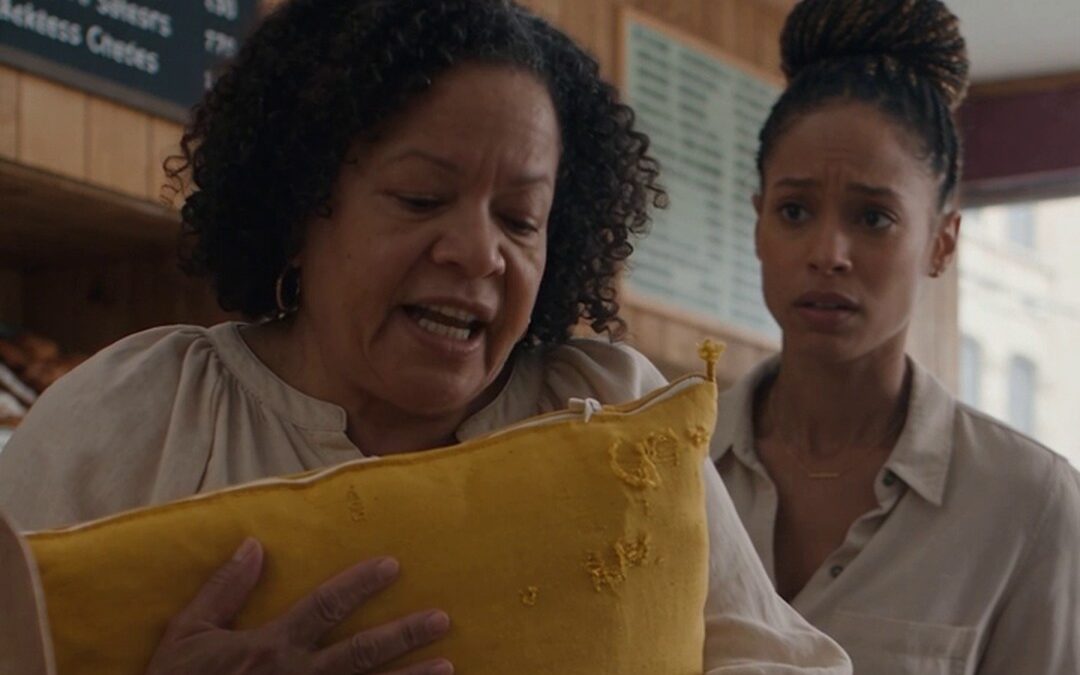
Chapter 1: The Yellow Cushion
Celia lowered the retirement cake onto the yellow cushion her mother had brought to sit on.
“Where should I put this?” she asked.
Bea had one hand on the chair back.
Three hours earlier, that chair had stood beside the cooling racks, where it had stood for nineteen years.
The cushion was faded along its front edge, with two crooked ties Bea had sewn from an old curtain.
Every afternoon, she brushed flour off it and turned the chair toward the little table beneath the bakery’s high window.
Every afternoon, something landed there first.
That Friday, in a western Pennsylvania town smelling of September leaves and fresh pavement, it was a carton of cake boxes.
“Keep that one out,” Bea said.
“I’m only putting these here a second.”
Celia was forty, with a pencil trapped in her dark bun and an overdue invoice tucked beneath the register.
Her mother was sixty-three, broad through the shoulders, with copper-colored hair she cut herself and a habit of correcting people’s folding.
“You’ll split the corners that way,” Bea said.
“They’re boxes, Mom.”
Behind them, Willa pressed the folded corners into place without comment.
At nineteen, Celia’s daughter had learned that helping at the bakery sometimes meant pretending not to hear.
Bea lifted the carton away.
At the little table, she set down two green saucers.
“You have ten minutes?” she asked Celia.
“After I get this order out.”
Bea returned one saucer to the shelf.
Willa watched her thumb rest inside the remaining one.
For six weeks, Bea had reminded them that Friday was her last shift.
Celia had ordered flowers, invited twelve people, and purchased a cake from another bakery because her mother had specifically requested not to make her own.
She had also asked whether Bea could cover the following Tuesday.
“Only until we find somebody.”
“You’ve had six weeks.”
“I’ve been trying.”
Bea untied the cushion.
When Willa reached for the chair, her grandmother shook her head.
“I can carry my own place.”
At supper, in the bakery’s cleared front room, the flowers occupied one table and folded pastry cartons occupied another.
People moved chairs to make room for arriving guests.
Celia came through carrying the cake.
The chair with the yellow cushion stood nearest her elbow.
She lowered the cake onto it.
“Where should I put this?” she asked.
Bea had one hand on the chair back.
Chapter 2: Ten Minutes
“On a table,” Bea said.
Celia glanced toward the flowers.
“There isn’t any room.”
“Then move something.”
Her mother said it quietly enough that the guests nearest the windows continued discussing a road closure.
Celia shifted the cake against her palms.
It was heavier than she had expected, a square cake with thick white icing and little piped peaches because Bea disliked roses made of sugar.
“I just need to set it down.”
“I know.”
Bea kept her hand on the chair.
For one strange second, Celia felt they were negotiating something much larger than furniture, and she resented having to do it while holding a cake she had driven forty minutes to collect.
Willa crossed behind her and lifted the vase of flowers off the nearest table.
“Here.”
Celia put the cake down.
Nobody clapped or fell silent or understood that anything had happened.
A cousin asked where the plates were.
Celia pointed toward the counter, then reached automatically for the yellow cushion.
Bea’s hand covered it first.
“I’m sitting here.”
“Of course you are.”
Celia heard the sharpness in her own voice and lowered it.
“That’s why we brought the chair.”
“No,” Bea said.
“That’s why I brought it.”
Willa pulled another chair alongside, leaving a space between them.
Celia almost sat there.
Then someone needed a fork, and the coffee had finished, and she remembered the little speech she had written on the back of an envelope.
When she finally stood beside the cake, her mother was eating a peach slice from a paper plate.
Celia thanked her for twenty-eight years of early mornings, steady hands, impossible Christmas orders, and knowing where everything was.
People laughed at the last part.
“Honestly, I don’t know how we’ll manage without her.”
Bea looked down at the cushion beneath her.
Celia raised her cup.
“To Mom.”
“To Bea,” Willa said.
The correction was mild, but Celia felt it.
Later, while folding a table, she found herself speaking too brightly.
“So Tuesday really is impossible?”
Bea slipped the cushion under her arm.
“Yes.”
“Even a couple of hours?”
“Yes.”
Her mother kissed her cheek, thanked her for the cake, and left with half a slice wrapped in a napkin.
Celia watched through the open doorway until Bea turned the corner toward the municipal parking lot.
Then she picked up the empty vase.
“Well,” she said to Willa.
“She certainly made that clear.”
Willa carried the chair back toward the kitchen.
“Where do you want this?”
Celia almost said anywhere.
***
On Tuesday, Celia discovered that finding somebody and knowing what to ask somebody to do were different problems.
She had hired a morning assistant for twenty-four hours a week, a capable woman who had worked a supermarket bakery counter and arrived with sensible shoes and a notebook.
By nine, the assistant had filled the display, boxed six orders, and washed a sinkful of utensils.
She had also asked Celia eleven reasonable questions.
Which cream-filled pastries stayed in the refrigerated case?
Were the plain rolls sold individually after noon?
Where did customers collect prepaid cakes?
Who recorded an order that came in by telephone?
Bea had answered those questions so often that Celia no longer heard them as work.
She heard them now while weighing dough.
“Put the cake orders on the clipboard.”
“Which clipboard?”
“The one by the—”
There were three.
At ten-thirty, a regular customer arrived for two dozen dinner rolls that Celia could not find on any of them.
Her mother would have remembered the customer’s church supper.
Her mother would also have complained that people thought a conversation beside the bread rack counted as ordering.
Celia felt an ugly little satisfaction at remembering the complaint.
Some of this was Bea’s fault.
Too much had lived in her head.
Then she found the order in the bakery’s shared email, printed it, and made herself stop constructing a defense against an accusation nobody had made.
“We can have them at two,” she told the customer.
“I asked for noon.”
“I know.”
He accepted a refund for the rush charge and said he would buy bread elsewhere that day.
The business did not collapse.
The ovens worked, customers came, and the assistant learned where the correct clipboard belonged.
At one-fifteen, Celia took a photograph of a misshapen braided loaf and opened her mother’s messages.
She typed, Your replacement.
She erased it before sending.
Then she typed, Hope you’re enjoying freedom.
That sounded worse.
Her phone rang while she was still holding it.
Bea’s name appeared.
Relief came so quickly that Celia answered with irritation.
“I was just going to call you.”
“Can you bring my blue casserole dish on Sunday?”
Celia looked toward the sink.
“Are you coming here?”
“No, I’m having lunch at my apartment.”
“Oh.”
“You have the dish.”
“Yes, I know which dish.”
“All right.”
There was a pause in which Celia could have asked how her mother’s morning had gone.
Instead, she said, “What did you used to do about telephone orders?”
Bea exhaled.
“Write them down, sweetheart.”
***
By Thursday, the assistant had created a single order sheet with spaces for pickup time, payment, and a contact number.
Celia felt embarrassed that this improvement had taken forty-eight hours.
She also felt protective of her mother.
“Her system worked.”
“For her,” the assistant said pleasantly.
Celia could not dispute that.
They moved the packaging station so cake boxes no longer crossed the path between the ovens and the racks.
They wrote a closing checklist.
They discovered that the back door’s latch needed a firmer pull than anybody expected.
Practical things improved.
Other things stayed awkward.
An older customer lingered beside the register after buying half a loaf.
Celia asked whether he needed anything else.
“No, that’s all.”
He remained there.
She checked the clock above his shoulder.
After he left, the assistant said, “Was he waiting for somebody?”
“My mother usually asks about his sister.”
“Is she ill?”
“She moved.”
Celia knew nothing else.
At noon, Willa arrived between community-college classes and picked up the sandwich Celia had left for her.
“Did Grandma call?”
“About a casserole dish.”
“She started her printing class.”
Celia straightened.
“What printing class?”
“The one at the arts center.”
“She didn’t tell me she’d actually signed up.”
Willa’s expression changed by a fraction.
“She told us at dinner in August.”
“She mentioned it.”
“She showed us the apron she bought.”
Celia remembered a gray apron spread over Bea’s knees while she was answering a supplier’s message.
She had thought it was for the bakery.
“What does she print?”
“Pictures, Mom.”
“I understand the general principle.”
Willa wrapped the sandwich again.
Celia wanted to ask another question, but embarrassment turned it into the wrong one.
“Does she have to be there all Tuesday morning?”
Willa looked toward the little table.
The chair stood beneath it without its cushion, the bare wooden seat showing a pale square where the fabric had protected it.
“I think she gets to be.”
Celia turned back to her work.
At closing time, she found two green saucers on the drying rack.
The assistant had used them beneath tasting samples.
They were perfectly suited to that purpose.
Celia put them on the shelf, then took them down again, unable to explain to herself what she was saving them for.
***
Sunday lunch had originally been Celia’s idea.
After she took over the bakery, she had promised Bea that they would still have family time, not just working time.
For a while, they ate at one another’s homes.
Then Sunday became the best day to prepare fillings, review the following week’s orders, and get ahead of Monday.
Lunch moved to the bakery’s little table.
Bea brought food because she was already coming.
Celia brought invoices because she was already there.
Now, carrying the blue casserole dish toward her mother’s apartment, Celia realized she had put three purchase receipts inside it.
She took them out on the landing and stuffed them in her purse.
Bea opened the door wearing soft green trousers and a shirt Celia had never seen.
There was ink beside one thumbnail.
“You’re early.”
“By four minutes.”
“I know.”
Her mother sounded pleased.
For a moment, that hurt more than a complaint would have.
Willa was setting three places at the kitchen table.
The yellow cushion was tied to a chair near the window.
Celia put down the casserole dish and lifted its lid.
“You washed it,” Bea said.
“Was I supposed to bring it dirty?”
“No.”
Something careful entered the room.
Lunch was roast chicken from the grocery store, bread from a different bakery, and a bowl of cucumbers cut thicker than Bea ordinarily allowed.
Celia noticed the bread before she noticed anything else.
“You could’ve asked.”
“I was at the store.”
“I would’ve brought some.”
“I know.”
Willa asked about the printing class.
Bea described rolling ink too heavily and turning a picture of a pear into something resembling a potato.
Celia laughed.
Her mother’s face opened.
Then Celia said, “You always did press too hard.”
Bea’s face closed again.
“I meant with the order stamp,” Celia added.
“Yes.”
Willa asked whether she could see the pear.
Bea fetched a sheet from the sideboard.
It was clumsy, uneven, and oddly cheerful.
Celia examined it, searching for something truthful and kind.
Before she found the words, her phone vibrated.
An employee needed to know whether tomorrow’s pickup could move to an earlier time.
Celia glanced down.
When she looked up, Bea had taken the print away.
“The chicken’s getting cold,” her mother said.
Celia turned her phone over.
But the moment when she might have asked to keep the pear was already gone.
***
The following week, Celia hired Sunday help.
She called it the obvious solution, with an emphasis that made Willa stop drying a tray.
The new worker would prepare fillings and clean while Celia dealt with paperwork.
Bea would no longer have to work, and family lunch could return to normal.
When Celia described the arrangement over the telephone, her mother waited until she finished.
“Where would we have lunch?”
“At the bakery.”
“No, thank you.”
“Mom, somebody else will be doing everything.”
“You’ll still be there to work.”
“For part of the time.”
“That’s the part that keeps growing.”
Celia leaned against the office door.
“I’m trying to make this easier.”
“I believe you.”
“Then meet me halfway.”
There was a small noise on the line, perhaps a cup touching a counter.
“I stopped halfway for years.”
Celia closed her eyes.
She could picture the yellow chair, the cooling racks, her mother waiting while she finished something.
But in that picture, Bea was always comfortable.
Bea had tea.
Bea liked the bakery.
Bea had helped choose the paint.
“I thought you liked being here.”
“I did.”
“You never acted as though it was some terrible burden.”
“It wasn’t always.”
The qualification made Celia angrier than a direct accusation would have.
She had paid her mother the agreed hourly wage.
When the bakery had a good year, she gave her a bonus.
She had arranged the retirement party carefully, even remembering the peaches.
“I can’t fix something you don’t tell me.”
“I asked you to eat with me.”
“And we ate together all the time.”
“No,” Bea said.
“We ate in the same building.”
Celia stared at the freezer’s temperature log without seeing it.
From the kitchen came the sound of her assistant laughing at something Willa had said.
For a second, she wanted her mother to hear that laughter.
She wanted proof that the bakery was not a place where everybody suffered around her.
Instead, she said, “I have to go.”
“All right.”
Her mother did not sound surprised.
After the call, Celia walked to the little table.
A bag of sugar stood on the bare chair.
She moved it to the shelf with such unnecessary force that white dust settled over her sleeve.
***
On Saturday evening, Celia tried eating alone at the little table.
She had told herself she needed a proper break.
The bakery was closed, the display emptied, and the cleaning finished.
Without customers or machinery running, the building made small unfamiliar sounds.
The refrigerator clicked.
A pipe settled.
Someone rolled a trash bin through the alley.
Celia put a bowl of soup on one of the green saucers, then exchanged it for a plate because the arrangement looked ridiculous.
Her mother would have said so.
Her mother would also have asked whether she had eaten anything green.
Celia used to find this irritating because she was forty years old and bought vegetables without supervision.
Now she found herself looking at the soup’s carrots as though preparing an answer.
She called Bea.
The call went to voicemail.
Celia did not leave a message.
Ten minutes later, a photograph arrived.
Bea stood beside a long table covered in paper, holding up her dark, lopsided pear.
Three other adults crowded into the picture.
Her message said, At class exhibition practice.
Celia enlarged the photograph.
Her mother looked neither transformed nor especially young.
She looked like Bea, except that she was leaning toward someone Celia did not know.
Celia typed, Looks fun.
Then she typed, Call when you can.
Then she deleted the second sentence.
Willa arrived to collect a forgotten charger and found her staring at the photograph.
“She sent me that too.”
“I’m glad.”
Willa sat across from her.
Celia turned the phone facedown.
“Do you think I was awful to her?”
“I think you keep asking questions with only two answers.”
“What does that mean?”
“Either you were awful or everything was fine.”
Celia pushed the soup away.
“I don’t need a philosophy lecture.”
“I’m taking accounting.”
Despite herself, Celia laughed.
Willa did too, then reached for the bowl.
“Are you done?”
“I suppose.”
As Willa carried it to the sink, Celia looked at the empty place across from her.
She could manage a bakery without her mother.
She was beginning to understand that this had never been the question.
***
The old daily planners were in a carton beneath the office desk.
Celia went looking for them because the assistant needed previous holiday sales numbers, and the register reports alone did not show which orders had required extra labor.
Bea had kept those details.
She recorded weather only when it affected business, shortages only when they changed an order, and customer requests in a cramped, impatient hand.
On the first page Celia opened, she found a complaint about a late flour delivery.
Underneath it was a smaller note.
Lunch with C, 1:30.
A line crossed through the time.
Below that, 2:15 had also been crossed out.
Celia turned a page.
The next week contained the same appointment.
Not every day.
Tuesdays and Thursdays, usually.
The bakery closed earlier on those afternoons.
Celia pulled out another planner.
She remembered those lunches as something that happened when they both had time.
Her mother had been making appointments for them.
Willa came into the office carrying a stack of flattened cartons.
“Where do these go?”
Celia showed her the page.
“Did you know she wrote this down?”
“She wrote everything down.”
“Not like this.”
Willa set the cartons against the wall.
On another page, Celia found a note to make potato salad because Celia had mentioned wanting it.
On another, Bea had written that she needed to leave by two for an open studio session.
That note was crossed out too.
Celia searched her old messages by the date.
She had asked her mother to stay because an order had grown.
Bea had answered, This is the class afternoon.
Celia’s reply was still there.
I know, just this once.
Two weeks later, almost the same exchange appeared.
Not secret sacrifice.
Not a discovery her mother had concealed.
Evidence of things Celia had known long enough to dismiss.
She turned another page and saw the words ten minutes, underlined once.
Willa bent to pick up the cartons.
“Grandma didn’t save that chair because it was comfortable.”
Celia looked up.
“She saved it because you might sit down.”
Willa left the office before Celia could ask her to make that easier to hear.
***
Celia brought the oldest planner home.
She did not read all of it.
After a while, reading began to feel like collecting enough evidence to stage a satisfying apology.
She had done that before with other problems.
Find the error, identify the cause, produce the correction.
Her mother was not an incorrect total.
Still, one page held her.
Nineteen years earlier, when Willa was an infant, Bea had drawn a small square beside a shopping list and written foam.
Celia remembered the cushion then.
She had returned to work earlier than she wanted because the bakery belonged to both women at the time, and a temporary replacement had left.
The wooden chair hurt after an hour.
Bea had made the cushion from an old kitchen curtain, using a sewing machine that jammed whenever she hurried.
Celia remembered snapping that yellow would show every stain.
Bea had snapped back that she could stand up, then.
They had laughed ten minutes later.
That part mattered too.
They had not spent nineteen years miserable.
There had been singing over mixers, arguments about salt, shared gossip, and mornings when Celia genuinely looked forward to seeing her mother.
But somewhere along the way, Celia had stopped treating those moments as something either of them had to choose.
She telephoned Bea the next morning.
“I found the note about making the cushion.”
“Oh, that horrible machine.”
“You broke two needles.”
“Three.”
“I thought you kept the chair there for your breaks.”
“I used it sometimes.”
“You turned it toward me.”
Bea did not answer immediately.
Celia sat on the edge of her bed.
“I kept thinking we spent all day together.”
“We did spend all day together.”
“But I was always asking you for something.”
“Not always.”
Her mother was not going to make the case simpler than it was.
Celia pressed her palm against the planner.
“Can I come over?”
“Not tonight.”
The refusal landed hard, even now.
“All right.”
“Thursday, if you like.”
“I can bring dinner.”
“I have food.”
Celia heard herself preparing a list of useful offerings.
She stopped.
“What time?”
“Six.”
“I’ll be there at six.”
After they hung up, she entered the appointment in her calendar without adding a second task beside it.
***
At five-forty on Thursday, a customer arrived for a cake scheduled for Friday.
The order sheet showed Friday.
The confirmation showed Friday.
The customer had driven from another town and was close to tears.
Celia could have finished the cake in an hour if she stayed.
She could also feel, with unpleasant clarity, how easily this would become another story in which she had no choice.
The assistant examined the order.
“We can box the undecorated cake.”
“That won’t work,” the customer said.
Celia explained what they could complete immediately and what would require the following morning.
The customer chose the simpler finish and remained unhappy.
Celia helped for fifteen minutes.
Then she washed her hands.
“You’re leaving?” the assistant asked.
“I have dinner with my mother.”
The assistant looked surprised, then nodded.
“Go.”
In the parking lot, Celia almost called Bea to describe the sacrifice.
She put the phone away.
At six, Bea opened her apartment door.
There were two plates on the table.
No flowers.
No audience.
Celia had brought nothing but a bag containing the old planner.
She left it beside the door.
Over dinner, Bea talked about a woman in her class who made prints of grocery carts.
Celia asked why grocery carts.
“I asked that too,” Bea said.
“She said she likes the way they look.”
“That’s allowed?”
“Apparently.”
They both smiled.
Only after the plates were cleared did Celia say what she had come to say.
“I kept treating your plans as the flexible ones.”
Bea folded her napkin.
“Yes.”
“I knew about the class.”
“Yes.”
“I knew you wanted lunch.”
Her mother looked toward the window.
“I don’t want you to read a few crossed-out appointments and decide I never enjoyed my life.”
“I don’t think that.”
“I stayed because I liked the work, and I liked being needed.”
Celia nodded.
“I also stayed because when I asked for something else, you acted as though I was changing the agreement.”
Celia opened her mouth.
Bea waited.
There were explanations available.
Payroll.
Rent.
A child.
Years when every broken piece of equipment meant a week of worry.
All of them were true.
None of them answered her mother.
“I was changing it too,” Celia said.
“I just kept calling my changes emergencies.”
Bea smoothed the napkin flat.
“And they became my schedule.”
***
Celia had expected admitting fault to release something.
Instead, it left them sitting in the difficult part without cover.
“I want us to have Sundays again,” she said.
Bea shook her head.
“Not every Sunday.”
“I didn’t mean at the bakery.”
“I know what you meant.”
Celia stared at the table.
Her mother poured them more water, an ordinary act that made Celia want to cry.
She resisted the urge to turn the conversation toward her own distress.
“What do you want?”
“I want to find out.”
“Find out what?”
“What I do when nobody assumes they have the first claim.”
Celia leaned back.
“That sounds like you don’t want to see us.”
“It sounds like I want to choose when I see you.”
The distinction was reasonable.
It still hurt.
Bea rubbed a thumb over the rim of her glass.
“When your daughter calls, I don’t want my first thought to be whether she needs a shift covered.”
“She loves you.”
“I know she does.”
“She isn’t doing what I did.”
“Sometimes she is.”
Celia looked up sharply.
“And sometimes I offer before either of you asks,” Bea continued.
“I’m very good at making myself necessary and then being angry about it.”
This was so recognizably her mother that Celia almost smiled.
Bea saw it.
“Don’t look relieved.”
“I’m not.”
“You are a little.”
“A little.”
Her mother let that pass.
“I should have stopped earlier.”
“I should have listened earlier.”
“Yes.”
The word stayed between them.
Celia wanted to ask whether Bea forgave her.
Instead, she asked about the exhibition.
“Can I come?”
“It’s an open house.”
“That isn’t what I asked.”
Bea looked at her for a long moment.
“Yes.”
“What time?”
“Saturday after next, three until five.”
The bakery closed at four on Saturdays.
Celia knew Bea knew that.
“I’ll come at three.”
“Don’t promise because we’re sitting here.”
Celia took out her phone, opened her calendar, and showed nothing to her mother.
She merely entered the time.
On the way home, she realized she had not once mentioned the Tuesday staffing gap.
She had wanted to.
That was the part she would have to keep doing something about.
***
The exhibition date fell on a Saturday with two large cake pickups and a wholesale order for a café.
Celia considered asking whether the exhibition ran until six.
Then she looked at what she had written.
Three until five.
She examined the bakery’s numbers instead.
For years, Bea had absorbed short gaps between paid shifts, stayed to finish conversations, and turned family meals into preparation time.
Not all of it had been unpaid.
Much of it had been paid badly in a different sense: it had cost her mother plans that Celia never entered on a balance sheet.
Celia could afford a trained shift lead for a limited number of hours.
She could not afford one while maintaining every low-margin order and every opening hour.
The café order was dependable revenue.
It also required Saturday labor that barely paid for itself at the old price.
Celia telephoned the owner with a revised quote.
He said he would find another supplier.
She wanted him to argue.
Instead, he thanked her for letting him know.
Afterward, she sat with the calculator until its display went dark.
The assistant agreed to additional responsibility with additional pay.
They practiced closing together.
Celia explained the alarm twice.
“You can write it down,” the assistant said.
“I have.”
“Then let me do it.”
Celia moved her hand away from the keypad.
At home, Willa found her reviewing the new schedule.
“Are we in trouble?”
“No.”
“You look like we’re in trouble.”
“We’re making less money on paper.”
“And in real life?”
Celia thought about that.
“In real life, we were using time we hadn’t properly counted.”
Willa pulled out a chair.
“Do you need me Saturday?”
The answer rose automatically.
Then Celia looked at her daughter’s backpack and the lab manual sticking out of it.
“What were you planning?”
“Studying with two people from class.”
“Then do that.”
“I can change it.”
“I know.”
Celia turned the schedule around.
“I’m hiring for the hours we need.”
Willa studied her.
“Grandma would tell you the café was underpaying.”
“She did.”
“How many times?”
Celia closed the calculator.
“Enough.”
***
The night before the exhibition, Bea called.
Celia was sealing an order box and answered with the phone balanced on a shelf.
“I’m still coming,” she said.
“I didn’t ask.”
“Sorry.”
“I was calling about the shirt you borrowed.”
Celia looked down.
She was wearing it beneath her apron.
“It’s here.”
“Keep it until next week.”
There was something careful in Bea’s voice.
Celia stopped folding the box.
“What?”
“One of the prints didn’t dry properly.”
“Can you make another?”
“Not for tomorrow.”
“Then use a different one.”
“I’m telling you something, Celia.”
Celia closed her eyes.
Even now, she had reached for the problem before hearing the person.
“Sorry.”
Bea breathed out.
“I liked that one.”
“What was it?”
“Two pears.”
“Less like potatoes?”
“One was quite pear-like.”
Celia laughed, and Bea did too.
Then her mother said, “I’m not very good.”
“You just started.”
“I know how long I’ve been doing it.”
Celia leaned against the counter.
The kitchen smelled of vanilla and damp dishcloths.
For once, she did not fill the pause.
“I don’t like people seeing me be bad at something,” Bea said.
“I know.”
“You know because I’ve been unpleasant about it.”
“Sometimes.”
“Frequently.”
Celia let the correction stand.
After a while, she said, “You can tell me which one you liked best.”
“Tomorrow?”
“Yes.”
Another pause.
“All right.”
When the call ended, Celia discovered that she had been standing still for eleven minutes.
Nothing had spoiled.
The customer waiting for an emailed receipt would get it in the morning.
She finished the box and placed it on the pickup shelf.
Then she found a clean paper bag for the borrowed shirt.
She did not put receipts inside it.
At home, she laid out clothes that did not smell like the bakery.
For the first time since the retirement supper, going to see her mother felt less like an attempt to repair a mistake and more like entering a room where something was already happening without her.
That frightened her.
It also made her want to arrive early.
***
At two-twenty on Saturday, the assistant discovered that a prepaid cake had been decorated in the wrong color.
The error was Celia’s.
She had read an old note instead of the final confirmation.
The customer was due at three.
Celia looked at the cake, then at the clock.
She could scrape and redo the border.
She could be at the exhibition by four.
Her mother had said three until five.
An hour late was not the same as missing it.
The argument assembled itself so smoothly that Celia recognized it before she believed it.
She called the customer.
She explained the error, offered a partial refund if the cake was acceptable as finished, and offered a corrected cake with a later pickup if it was not.
The customer asked for a photograph.
Celia sent one.
They waited.
“You can go,” the assistant said.
“This is my mistake.”
“And I can process a refund.”
The customer chose the refund.
Celia paid the cost, changed the order note, and left at two-forty.
At the arts center, Bea was standing beside three prints attached to a display panel.
She wore the same green trousers she had worn to lunch.
There was still a little ink beneath one thumbnail.
Celia had imagined a room full of confident artists.
Instead, adults hovered beside their work with the uneasy expressions of people waiting for examination results.
Bea saw her at the entrance.
For a second, her face became completely unguarded.
Then she looked at the clock.
Celia wished she had not seen that.
She was glad she had.
“You’re early.”
“By four minutes.”
Bea smiled.
Celia gave her the bag containing the shirt.
“I washed it.”
“I wasn’t going to ask.”
“Yes, you were.”
A woman from the class came over, and Bea introduced Celia as her daughter.
Not the bakery owner.
Not the person who had taken over.
Just her daughter.
Celia looked at the prints.
One showed the lopsided pear.
Another showed two kitchen chairs, one slightly larger than the other.
The third was an uneven arrangement of leaves.
She resisted the desire to assign a meaning to the chairs.
“Which is your favorite?”
“The leaves.”
“Tell me about that one.”
Bea moved closer to the display.
Celia put her phone on silent before her mother began.
***
They were halfway through a conversation about ink when a man asked Bea whether she took commissions.
Bea laughed so hard that she had to apologize.
“Ask me in ten years.”
After he moved away, Celia said, “You could have said yes.”
“And ruined a perfectly good afternoon worrying about it.”
Celia smiled.
Then Bea glanced at her handbag.
“Do you need to check?”
“No.”
“You’ve looked at it twice.”
Celia could have denied it.
Instead, she said, “I’m worried something will need fixing.”
“Something probably does.”
“I know.”
They stood beside the prints while other people drifted past.
Celia felt the strange pressure of having nowhere else she was permitted to be.
For years, she had believed she wanted relief from responsibility.
Now that somebody else was carrying part of it, she found the empty space uncomfortable.
“Can I say something without making this your problem?” she asked.
“You can try.”
“I don’t know what to talk about if we aren’t talking about work.”
Bea looked at the picture of the leaves.
“Neither do I, sometimes.”
Celia swallowed.
“I thought we were close.”
“We are.”
“I thought that meant I knew everything.”
“You didn’t even know I dislike those peaches.”
Celia turned.
“The cake?”
“I like fresh peaches.”
“You asked for peaches on your birthday cake.”
“When you were nine.”
“You’ve had them every year.”
“Yes.”
“Why didn’t you say?”
Bea gave her a look.
Celia covered her face for a moment.
Then her mother laughed, not kindly enough to erase the point, but kindly enough to keep them standing together.
“I could have said that one more clearly,” Bea admitted.
“What would you choose?”
“Chocolate.”
“Plain chocolate?”
“An unreasonable amount.”
Celia looked back at the prints.
There were years of questions she had replaced with answers she already possessed.
She would not recover them in one afternoon.
“Will you have dinner with me next Thursday?”
Bea considered.
“I have plans.”
“All right.”
“Sunday breakfast?”
Celia thought of the bakery preparation she ordinarily did.
“I can do ten.”
“Ten-thirty.”
“Ten-thirty.”
Bea touched her arm briefly.
The gesture was small enough that nobody nearby noticed.
Celia stayed until the display panels came down.
***
In November, Celia missed a breakfast.
She woke to a message that the bakery’s opening employee was ill, went in to cover, and did not contact Bea until twenty minutes after they were supposed to meet.
Her mother answered on the second ring.
“I’m sorry,” Celia said.
“I got pulled into opening.”
“I’m already at the restaurant.”
“I can be there in forty minutes.”
“I won’t still be here.”
Celia gripped the phone.
The old irritation stirred.
People got sick.
Small businesses did not run on good intentions.
Then she pictured her mother sitting alone with a menu, watching other people arrive.
“You’re right.”
“I didn’t ask you to agree with me.”
“I should have called before I went in.”
“Yes.”
“Can I call tonight?”
“Yes.”
Bea ended the call.
Celia finished opening with a hot, unpleasant feeling beneath her ribs.
There was no dramatic consequence.
Her mother did not threaten to disappear.
That evening, they talked for twelve minutes about the missed breakfast and then about other things.
But the following Sunday was unavailable, and the next one belonged to Willa.
Celia waited three weeks for another breakfast.
She learned that repaired did not mean endlessly reschedulable.
At the bakery, the new staffing arrangement held.
They stopped opening on Sunday.
One customer complained every Monday for a month.
Another moved her standing order elsewhere.
Celia felt each loss.
She also began spending Sunday afternoons at home without a stack of invoices balanced beside her plate.
Bea visited the bakery twice as a customer.
The first time, she corrected the assistant’s arrangement of the rolls.
The assistant thanked her and left them where they were.
Outside, Bea muttered that nobody listened anymore.
Celia looked at her.
Bea sighed.
“Yes, all right.”
The second time, she bought a loaf and asked how the assistant’s classes were going.
She did not step behind the counter.
Celia noticed the effort.
Later, when Willa offered to cancel an evening with friends to help with holiday packaging, Celia asked how many hours she actually wanted.
“Two.”
“Then two.”
“Even if we aren’t finished?”
“We’ll make a plan for the rest.”
Willa looked skeptical.
At the end of the second hour, Celia took the tape dispenser from beside her daughter and put it away.
***
The Thursday before Thanksgiving, Bea came to lunch.
It was not a return to the old arrangement.
Celia had asked two weeks earlier, and Bea had said she could stay from one until two because she had somewhere else to be.
At twelve-fifty, the bakery was busy.
The display needed filling, a customer wanted six identical pastries when only five remained, and a delivery driver was waiting for a signature.
Celia signed.
The assistant offered the customer a choice.
Willa carried a tray to the front.
At twelve-fifty-eight, Celia washed her hands.
Her mother arrived with the yellow cushion under one arm.
“I wasn’t sure you still had the chair.”
“We still have it.”
Bea tied the cushion in place, pulling one knot too tightly and loosening it with a fingernail.
On the table stood two green saucers.
Celia had bought soup from the place next door and cut bread before the lunch rush.
There were no invoices.
Bea sat, then frowned at the small chocolate cake on the counter.
“What’s that for?”
“Lunch.”
“That’s excessive.”
“You said an unreasonable amount.”
Her mother considered this.
“I did.”
Celia brought over two slices.
From the kitchen, someone called her name.
She turned her head.
The assistant held up a box, then glanced at the order sheet.
“Never mind.”
Celia faced her mother again.
Bea had not picked up her fork.
“What?” Celia asked.
“Nothing.”
But it was not nothing.
Celia knew better now than to insist on having it explained while it was still happening.
“Did the second pear ever dry?”
“Yes.”
“Did you keep it?”
“I printed over it.”
“You can do that?”
“Sometimes.”
Bea began describing what had happened to the shape beneath the new layer of ink.
Celia listened without deciding what it meant about anything else.
At two, her mother would leave.
There were afternoons they would never get back, and there would be other Thursdays when this table remained empty.
But the bakery continued around them, with its ordinary mistakes and manageable demands.
Celia lowered her plate onto the table beside her mother’s and sat down.








