She Sealed the Shelter Gate Against One Father—Then a Child’s Paper Map Revealed Who Had Ordered It
Chapter 2: The Dry Ramp
The alarm kept ringing.
June slid down Eli’s chest.
He caught her under the arms.
“June, stay with me.”
Her eyes stayed open.
Her breathing did not improve.
Marla stood behind the locked gate, still holding half the torn map.
Deputy Commissioner Bell shouted from the lobby.
“Open the rear entrance.”
“I’m trying,” Marla called.
“You have the key.”
“The pressure lock is set.”
“It releases from your side.”
Marla glanced toward the wall.
Her hand went to the steel bolt.
“Open the gate,” Bell said.
“The lock is jammed.”
“It isn’t jammed,” Kim said.
Marla turned on her.
“Stay at your station.”
Kim didn’t move.
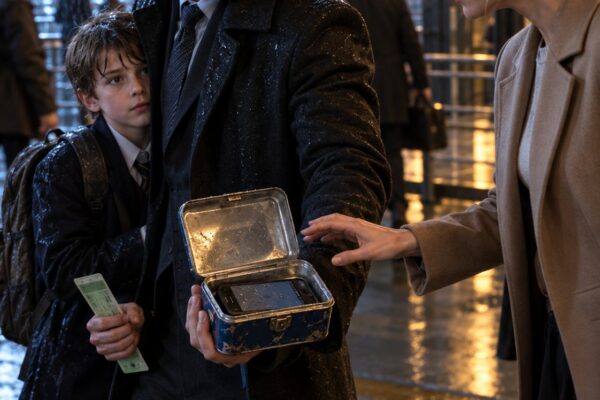
Eli pulled his half of the map through the bars.
The torn edges met in the rain.
Blue arrows led to Harbor House’s dry rear ramp.
A red cross marked the flooded east entrance.
Beside it, someone had written: CLOSED BY ORDER — 6:10 P.M.
Marla’s signature sat beneath the note.
Bell reached the gate.
“I’m Celeste Bell, city emergency services.”
“Then tell her to open it,” Eli said.
“I will.”
Bell faced Marla.
“Open the gate.”
Marla kept her grip on the map.
“I need to verify the child’s registration.”
“You can verify it inside.”
“I have procedures.”
“Follow the emergency protocol.”
Marla glanced at Bell’s tablet.
Eli followed her gaze.
“You know the order is on there,” he said.
“Your daughter needs medical care,” Bell said.
“She needs the door open.”
“Agreed.”
Bell tapped her screen.
The gate’s indicator stayed dark.
“Manual release,” she said.
Marla tightened her hold on the paper.
“It’s jammed.”
Kim stepped toward the wall.
“Don’t,” Marla warned.
Kim pulled the red emergency lever.
The steel bolt lifted with a heavy clank.
The gate swung inward.
Eli gathered June into his arms.
“Take the dry ramp,” Bell said.
“Go straight through.”
Marla blocked the opening.
“Wait. I haven’t confirmed—”
“Move,” Bell said.
June wheezed against Eli’s shoulder.
Marla stepped aside.
Kim ran ahead.
Eli carried June inside.
* * *
The clinic smelled of bleach and wet wool.
Kim laid a towel on the exam cot.
Eli eased June down.
Her fingers clung to his sleeve.
“Stay,” she whispered.
“I’m not going anywhere.”
A nurse named Tomas came in with a nebulizer.
“Can she sit upright?”
“She can try.”
June struggled upright.
Tomas fitted the mask gently over her face.
The machine began its soft hiss.
Eli watched her shoulders rise and fall.
Bell stood near the open door, speaking into her radio.
“Need an ambulance at Harbor House,” she said.
“Child with acute asthma symptoms.”
She listened.
“Yes. Rear access is clear.”
Marla appeared behind her.
“The family isn’t registered.”
Eli looked up.
“She’s been here before.”
“Not under the correct program.”
“We came in September.”
“Different funding stream.”
“That’s the first time I’ve heard that.”
Bell ended her radio call.
“How many times has June stayed here?”
“Three,” Eli said.
“Twice,” Marla said.
Eli turned toward her.
“She stayed both nights.”
“One night was a medical transfer.”
“She slept in the family room.”
“That room is for confirmed placements.”
“Her coat was still on the hook.”
Marla went still.
June’s breathing rasped through the mask.
Tomas kept a hand near the tubing.
Bell stepped closer to Eli.
“Do you have the dates?”
“I have the discharge cards.”
He reached into his jacket’s inner pocket.
The cards were damp but intact.
Bell read each one.
September fourth.
October nineteenth.
November seventh.
All three bore Harbor House’s intake stamp.
All three assigned a family bed.
Bell compared the dates to her tablet.
“Your system says the September stay never happened.”
“It did,” Eli said.
“Who signed the card?”
“I didn’t notice.”
Bell held it to the light.
A narrow initial appeared beside the stamp.
M.V.
Marla took half a step forward.
“That could mean anything.”
Bell checked the next card.
The same initials.
Then the third.
June’s fingers loosened.
She closed her eyes.
Tomas glanced at Eli.
“She’s responding. Keep talking to her.”
“June, remember the blue line?”
Her eyes opened slightly.
“The ramp?”
“That’s right.”
“You drew it?”
“I drew the whole map.”
“Your lines were crooked.”
“They got us here.”
Bell lowered the cards.
“These stays weren’t misplaced,” she said.
Marla shook her head.
“You can’t know that from three cards.”
“I can check the audit history.”
“The database had a migration last month.”
“Then the audit history will show it.”
“You don’t know what you’re looking at.”
“Then I’ll bring someone who does.”
Marla glanced at the map in Bell’s hand.
“You should be careful believing a man who ignored intake rules.”
Eli looked at June.
“She had an inhaler this morning.”
“Then you should have checked it.”
“I did.”
“And still brought her out in the storm.”
“I followed the published shelter list.”
“That list was outdated.”
“Who made it outdated?”
No one answered.
Tomas finished the treatment.
June’s breathing eased.
The ambulance was still coming.
Eli held the cards while Bell studied the torn map.
“Where did this approval stamp come from?” she asked.
“It’s routine,” Marla said.
“Who gave it to you?”
“The operations office.”
“Which person?”
“I don’t remember.”
Bell studied the time and signature.
“Your initials are on the intake cards.”
“Initials aren’t proof.”
“Then help us find the original.”
Marla’s face closed.
She turned toward the door.
Bell watched her leave.
Eli folded his half of the map along its wet crease.
The faded pencil marks on the reverse became visible.
Bell leaned closer.
“What are those?”
“Shelter codes,” Eli said.
He recognized them from his delivery shifts.
Harbor House.
The church gym.
A motel on the highway.
Numbers appeared beside each code.
“Bed counts from the public line,” he explained.
Bell checked her tablet.
“The official report lists more beds.”
“The church was closed at noon. Broken boiler.”
“And the motel?”
“Full. They turned away a family at four.”
Bell scanned the report.
Its listed capacity was nearly twice the number of usable beds.
“What happens when a shelter reports more capacity?” Eli asked.
“It receives a different allocation. More funding, sometimes more flexibility.”
“Could that affect an entrance closure?”
“Yes.”
“Who decides that?”
“Several offices. The final approval sits with emergency operations.”
“Could Marla approve it?”
“Not alone.”
“But she could request it.”
Bell looked toward the corridor.
“She could.”
* * *
June went to the hospital with the paramedics.
Eli sat beside her while a doctor listened to her lungs and gave her another treatment.
The doctor said she needed observation for several hours.
She did not need intensive care.
“I hate hospitals,” June murmured.
“I know.”
“They always smell like pennies.”
“That’s the medicine.”
“Do I have to go back to Harbor House?”
“Not tonight.”
“Are we still in trouble?”
“No.”
“Ms. Voss said we weren’t on the list.”
“You were on the list.”
“Then why did she keep us out?”
“I’m trying to find out.”
Bell arrived with a paper cup of coffee.
“June’s staying overnight,” she said. “A social worker is arranging a safe placement afterward.”
“Can we go home tomorrow?” Eli asked.
“If it’s safe to return.”
“It’s safe. The landlord fixed the radiator.”
“What about the mold?”
Eli paused.
June looked between them.
“It’s only one corner,” he said.
“Have you reported it?”
“Yes.”
“Did anyone inspect?”
“They called it condensation.”
Bell pulled over a chair.
“I need to understand what led you to make that map.”
Eli told her about his meal deliveries, the calls he’d made, and the families he’d directed toward closed shelters.
“I drew the route so nobody else would waste time,” he said.
“Did anyone ask you to collect those counts?”
“No.”
“Did anyone pay you?”
“No.”
“Did anyone at the city tell you what to mark?”
“No. I checked it myself.”
Bell looked at the map.
“This could be more than an intake dispute.”
“It was one locked door.”
“It was one locked door during an emergency.”
“What do you need from me?”
“The original map. Any messages you received. Delivery records that show where you went.”
“I can give you the route.”
“Keep the map dry. Don’t write on it.”
“Why?”
“If the records show misconduct, the map may become evidence.”
Eli nodded.
“I’m going to ask for an independent review,” Bell said.
“Who does that?”
“The city auditor’s office. They can preserve the data before it changes.”
“Can Marla change it?”
“Maybe. That’s why we move quickly.”
“And Kim?”
“I’ll take her statement with a representative present.”
“Can you protect her from being punished for telling the truth?”
“I can put that request in writing.”
“Do it.”
Bell tapped a note into her tablet.
“I will.”
The doctor returned to say June was stable.
Eli’s hand rested over hers.
Bell traced the faded marks without touching them.
“The map shows what people could reach,” she said.
“It shows what I could reach.”
“That may be the same thing.”
He looked at her.
“What was the first thing you saw when you entered?”
“The signature.”
“Before that?”
“The gate.”
“Before the gate?”
Eli glanced at the dark window.
“Her hand on the lock.”
Bell nodded.
“She knew you were there.”
“She knew June was struggling.”
“And she still held it.”
“Yes.”
“What if the order came from above her?”
“Then someone still chose to keep the door locked.”
“Fair.”
Bell went to preserve the records.
Eli folded the map along its original crease.
A second mark appeared beneath the city seal.
A tiny date stamp.
September 2.
The date of the first shelter audit.
* * *
June was sitting up without coughing the next morning.
A hospital social worker arranged a room for them at a family center.
It was warm, clean, and temporary.
Bell called as Eli buckled June into a city-provided car.
“I have the first audit,” she said.
“What did it show?”
“Harbor House reported twenty-four beds open.”
“How many were usable?”
“Eleven.”
“Why did the system still show twenty-four?”
“Some rooms were listed as active, but nobody checked them.”
“Who certified the count?”
“Marla signed the monthly sheet.”
“She knew?”
“The room logs suggest she knew at least some were closed.”
Eli glanced at June.
“Can we come by?”
“Only if she’s comfortable.”
“I want to know why she lied,” June said.
The social worker agreed to a brief visit.
At Harbor House, the rear gate stood open.
A maintenance worker had removed the bolt.
Bell met them in a conference room near the front desk.
Marla sat at the table with a union representative.
Kim waited by the window with a steward.
The city auditor, Norman Price, had two laptops open.
“Thank you for coming,” Bell said.
Marla glanced at June.
“I’m glad she’s better.”
June’s expression stayed unreadable.
“Why did you lock the gate?”
“I was following protocol.”
“Which one?” Bell asked.
“The shelter was at capacity.”
“Your report showed twenty-four beds,” Bell said.
“We had twenty-four beds assigned.”
“Not usable beds.”
“Some rooms were under maintenance.”
“When did you report that?”
“I believe the forms were submitted.”
Price turned his laptop.
“They weren’t.”
“Then they were misplaced.”
“The server shows no submission. Network logs show the system was active.”
“Maybe someone else used my account.”
Price displayed the change history.
Each alteration had a timestamp and a device identifier.
Every deletion had come from the intake terminal.
Kim spoke from the window.
“I saw Ms. Voss remove the cards.”
Marla turned toward her.
“You weren’t at the desk.”
“I was collecting the overnight binder.”
“You were in the lobby.”
“I heard you say the beds were being held.”
“Held for whom?” Bell asked.
“For no one,” Kim said. “Families were waiting.”
Marla stood.
“Those entries were duplicates.”
“The families weren’t duplicates,” Kim said.
“I had to manage limited resources.”
“By erasing occupied nights?” Bell asked.
“By controlling the numbers.”
The room quieted.
Price opened another screen.
The city had received a grant for emergency shelter capacity.
Harbor House’s reported count affected its funding.
A high count helped the program appear efficient.
A low count might trigger a compliance review.
“Your report kept Harbor House above the required threshold,” Bell said.
“It kept the shelter open.”
“Even when beds weren’t usable?”
“Every shelter had deficiencies.”
“Did the city know?”
“The city knew what it needed to know.”
Eli watched her.
“What does that mean?”
“It means the system wasn’t clean before I got here.”
“We’re not pretending it was clean,” Bell said.
Marla faced Eli.
“You wanted a bed. You got one.”
“After I drew a map.”
“You got an ambulance and a hospital visit.”
“After I stood outside your locked door.”
“You knew the east entrance was closed.”
“I knew the east road was flooded.”
“You assumed someone would break the rules for you.”
“I assumed the shelter was open.”
Marla looked at June.
“You’re old enough to understand that rules exist for a reason.”
June leaned against Eli.
“I understand doors exist for a reason.”
Price enlarged the city stamp on the map.
The approval line carried two sets of initials.
M.V. and D.K.
“Who is D.K.?” he asked.
Marla looked away.
Bell followed her gaze.
“Who?”
“Director Daniel Kessler.”
* * *
Daniel Kessler ran the city’s emergency operations division.
He had approved the shelter closure order.
He had also signed the monthly review that accepted Harbor House’s inflated bed count.
Bell issued a preservation notice before noon.
Kessler’s office replied that the closure had been a temporary safety measure.
No inspection report supported it.
The dry ramp had passed inspection that month.
The gate’s lock was designed to open from inside.
Marla had authorized the extra bolt.
By afternoon, the auditor froze all edits to Harbor House’s records.
A team began interviewing staff.
Kim gave a signed statement.
The overnight binder showed two families had been turned away while Eli’s entries were deleted.
One family had been sent to the church, which was already closed.
The other had slept in a car.
Bell asked whether Eli wanted to know the details before she told him.
He said yes.
June listened, rubbing the map’s edge.
“Did those kids get sick?”
“I don’t know,” Bell said.
“Can we find out?”
“The review team can contact the families.”
“Will they get help?”
“If they want it, the city can connect them with services.”
“Could we leave food?”
“Only if they want us to.”
They arranged meal vouchers through the family center.
Eli paid for the first set from his own cash.
It left him eight dollars.
June noticed.
“You need bus fare.”
“I’ll pick up a delivery shift.”
“You said your wrist still hurts.”
“It can hurt on a bicycle.”
“You said you wouldn’t do that again.”
“I said I’d be careful.”
“You always say that.”
Bell offered emergency assistance.
Eli accepted a bus pass and left the meal vouchers untouched.
At the family center, June slept almost ten hours.
The next day, Eli answered questions from Vera Holt, an investigator.
She asked for his delivery logs and route notes.
He brought his notebook.
For each delivery, he recorded the apartment, time, and payment.
Some nights, he also marked which shelter entrances were open.
He had begun after his wife died.
He’d returned to work too soon and delivered groceries that evening.
His wife called from the roadside after her car was struck.
He was two blocks away.
By the time he reached the intersection, an ambulance had taken her.
For years, he had treated those two blocks as his fault.
The route notes helped him believe he could arrive in time for someone else.
Holt read the September pages.
“You marked Harbor House open at 7:20, then closed at 8:05.”
“A worker told me the east entrance flooded.”
“Did she mention the rear ramp?”
“No.”
“Could you identify her?”
“Maybe.”
Holt showed him a photograph.
“That’s Marla’s assistant, Jo Feld.”
“She told me about the flood.”
“Did she say the rear entrance was open?”
“No.”
“Did you see Kessler that night?”
“No.”
“Did anyone ask you to make a map?”
“No.”
“Did anyone offer money?”
“No.”
Holt checked his route notes against the public route history.
“Your timestamps were entered before the city changed the status.”
“So I wasn’t late.”
“No.”
He looked through the office window.
June sat in the hall, drawing on the back of a brochure.
“She thought I was.”
“You did what you could with what you knew,” Holt said.
“I should have checked her inhaler.”
“You did check it.”
“I heard it puff.”
“That doesn’t mean you knew it was empty.”
“It was my job to know.”
“Was it?”
He didn’t answer.
Holt slid the map sleeve toward him.
“We verified the stamp. It was issued by emergency operations.”
“Who signed it?”
“Director Kessler.”
“What does that prove?”
“He authorized the gate order.”
“Does it prove he told Marla to lock us out?”
“Not by itself.”
“What will?”
“We’re looking for the message thread.”
“Can he delete it?”
“Not now. The records are preserved.”
Holt pointed to the order’s timeline.
“It was drafted at 5:42 p.m.”
“The map says 6:10.”
“Marla signed the closure at 6:10.”
“So Kessler told her before the order was official.”
“Possibly.”
“Why?”
“That’s the next question.”
* * *
Two days later, the city said Harbor House had faced a possible structural problem.
No inspection report accompanied the statement.
The public website changed the shelter’s status to temporarily closed.
The family center moved Eli and June to another room.
Eli’s delivery work dried up after a local article called him a “shelter critic.”
The article didn’t mention June’s empty inhaler or the bolt.
He refused two interviews.
On the third morning, a plain envelope appeared under their door.
Inside was a photocopy of the map.
Someone had drawn a line across the rear ramp.
Beside it, they had written:
STOP DRAWING ATTENTION.
Eli photographed it and called Holt.
She arrived within twenty minutes.
“Did anyone see who left it?”
“No.”
“Did you touch it?”
“Only at the corners.”
“Good.”
June stood behind him.
“Are we in trouble?”
“No,” Holt said.
“Then why send that?”
“We’re going to find out.”
“Can they find us here?”
“The center’s location is confidential.”
“They knew which door.”
“We’ll move you to another site tonight.”
Eli looked at the envelope.
“Does this change the case?”
“It gives us a threat to document.”
“Could Kessler have sent it?”
“We don’t know.”
“Could Marla?”
“We don’t know.”
“Could someone be trying to make me stop talking?”
“That’s what it suggests.”
“Then we keep talking.”
Holt nodded.
“But carefully.”
Police photographed the envelope.
The center changed its entry codes.
Eli and June moved to a private nonprofit apartment.
Eli asked whether they could keep the map.
Holt said it would remain in evidence until the review was complete.
June asked if they could make another one.
At the library, she drew blue arrows on a copy of their route.
“Where does this go?” she asked.
“Apartment to school.”
“And this?”
“Bus stop.”
“Can we mark safe places?”
“Only the ones we checked.”
They added the clinic, the family center, and a grocery store that let people wait inside during storms.
June marked Harbor House with a black star.
“Why black?” Eli asked.
“Because I don’t know if it’s safe yet.”
“That’s fair.”
They would mark it again after checking.
The next day, Bell called.
“We found the message thread.”
“What does it say?”
“I need to tell you in person.”
“Why?”
“It identifies who designed the closure.”
* * *
Bell met Eli and Holt in the auditor’s office.
June stayed with a caseworker.
At 5:38 p.m., Kessler had messaged Marla that Harbor House needed to reduce “visible overflow” before a foundation visit the next morning.
Marla replied that families were waiting.
Kessler said the rear entrance could be temporarily restricted.
At 5:51, Marla asked if the restriction would affect the grant count.
At 5:56, Kessler answered that the documented capacity would stand.
He attached the closure form bearing his approval.
“Who was visiting?” Eli asked.
“A representative from a private foundation,” Bell said.
“They fund Harbor House?”
“They fund the city’s shelter expansion program.”
“Would they cut funding if they saw the shortage?”
“Their rules require the city to disclose bed shortages.”
“So Kessler kept the numbers high.”
“Yes.”
“Why did Marla go along?”
“Her program was due for a compliance audit. Accurate numbers might have brought it forward.”
“Did she know families were being turned away?”
“The messages show she told Kessler the waitlist was growing.”
“Then she knew.”
“Yes.”
Bell hesitated.
“Kessler initiated the closure. Marla chose how to carry it out.”
The next message came at 6:18.
“If Navarro is there, document him as a refusal,” Kessler had written.
Marla answered: He is here with his daughter. She is sick.
Kessler replied: Then he becomes the reason we needed the gate.
Eli stared at the screen.
“What happened next?”
“Marla replied, ‘Understood.’”
“So he knew she was sick.”
“Yes.”
“And he wanted the report to say I refused help.”
“Yes.”
“Was that in the final report?”
“No. It described an unauthorized entry attempt.”
“I was outside.”
“Yes.”
“The gate camera shows that.”
“The footage was retained,” Bell said.
“He knew about the camera?”
“He may have assumed it wouldn’t be available.”
Eli touched the table.
“What was the lie meant to protect?”
“The contract,” Bell said.
“Who got paid?”
“The city’s vendor, Northline Systems.”
“Who owns it?”
Bell opened a file.
“Kessler’s brother-in-law.”
The connection explained the inflated reports.
Northline had sold the city a system for reconciling shelter occupancy.
The system did not work.
The city had paid for data validation Harbor House never received.
Kessler needed the foundation’s renewal.
Marla needed the audit delayed.
Families became cover for both.
The auditor found a spreadsheet on the intake terminal showing actual room use.
Kim had made it because the official totals never matched the beds she prepared.
“Why didn’t you report it?” Eli asked her later in a library meeting room.
“I did. Twice.”
“Who did you tell?”
“My supervisor first. Then the city hotline.”
“Did anyone answer?”
“My supervisor told me to stop embarrassing the shelter.”
“And the hotline?”
“I got a ticket number. No one called until this week.”
“Why did you stay?”
“People needed the beds.”
“That doesn’t answer it.”
“It does for me. A mother with a newborn was sleeping in the laundry room. If I quit, she’d have been alone with a broken heater.”
“Did Marla know?”
“She knew the heater was broken.”
“Did Kessler?”
“I don’t know.”
Kim had copied the nightly log before leaving.
“Why?” Eli asked.
“I thought somebody might ask.”
“Did you send it to the auditor?”
“Yes.”
“Then it mattered.”
“I hope so.”
Eli pushed the map sleeve toward her.
“Your name isn’t on it.”
“I didn’t draw it.”
“You opened the door.”
“I pulled a lever.”
“You chose.”
Kim’s eyes shone.
“I almost didn’t.”
“Why did you?”
“Your daughter looked at me. She didn’t beg. She just watched. I thought I’d remember it every time I passed the gate.”
Eli nodded.
“You shouldn’t have had to risk your job.”
“Neither should you have had to hold a map in the rain.”
* * *
The auditor’s records showed that Kessler had concealed the relationship with Northline and approved payments despite warnings that the occupancy data was unverified.
The city’s ethics office opened a review.
Kessler was placed on administrative leave.
Marla remained on leave.
The city reopened Harbor House under temporary oversight and removed the rear bolt.
A reporter called Eli.
He agreed to one interview, with June’s consent and Bell present.
The segment showed the torn map, the dry rear ramp, the changed records, and the message directing staff to label Eli a refusal.
It did not identify June by her full name.
By morning, the city manager had placed Kessler on leave pending the ethics review.
Northline issued a statement saying the contract had followed standard procedures.
The statement omitted Kessler’s family connection.
The auditor found that the actual bed count had been recorded in Kim’s spreadsheet while the official system reported nearly twice as many.
A vendor technician had warned the city twice that the figures were unverified.
Kessler had approved the payments anyway.
Bell called Eli.
“The exposure hearing is next Tuesday.”
“Who has to attend?”
“Kessler, Marla, the auditor, Kim, and several city officials.”
“Will the map be shown?”
“Yes.”
“And the messages?”
“Yes.”
“What if Kessler blames Marla?”
“He’ll have a chance to respond.”
“What if Marla blames him?”
“She’ll have a chance too.”
“Then what happens?”
“The record decides.”
Eli turned the map over.
The old shelter codes showed faintly through the paper.
“Does the hearing decide whether the gate was wrong?”
“The hearing establishes what happened. Then there are employment and ethics reviews.”
“Criminal charges?”
“The prosecutor is examining the contract records. I can’t promise an outcome.”
“Can you promise a public record?”
“Yes.”
“Then we’ll be there.”
* * *
The hearing room was smaller than Eli expected.
The city seal hung behind the dais.
Folding chairs filled quickly.
Reporters stood along the back wall.
Harbor House staff sat together near the front.
June sat beside Eli with the newer map she had drawn.
Bell waited at the side table.
Holt sat near the clerk.
Kessler arrived with a lawyer.
He was in his early fifties, with neat gray hair and a careful blue tie.
Marla came separately, wearing no uniform.
The city manager opened the hearing.
“This proceeding concerns the temporary closure of Harbor House, the accuracy of its occupancy reports, and related actions.”
Kessler’s lawyer called the closure an emergency decision made amid an uncertain safety concern.
Marla’s representative argued that she had acted under a superior’s direction.
Both arguments sounded orderly.
Neither mentioned the gate.
The auditor presented the timeline.
At 5:42, Kessler requested an entrance restriction.
At 5:51, Marla asked whether the grant count would change.
At 5:56, Kessler approved the order.
At 6:10, Marla signed it.
At 6:18, Kessler told her to describe Eli as refusing help.
The gate stayed locked after the alarm sounded.
The official capacity remained twenty-four.
The usable capacity was eleven.
Nine people were inside.
That left two empty beds.
Kessler’s lawyer stood.
“Two beds are not necessarily available placements.”
“Why not?” Bell asked.
“They may have required special accommodation.”
“Had those rooms been inspected?”
“No.”
“Were they assigned?”
“No.”
“Were they blocked by equipment?”
“No.”
“Then what made them unavailable?”
“Program criteria.”
“Which criteria?”
“We are not prepared to answer today.”
The city manager turned to Kessler.
“Did you know the occupancy report included rooms that weren’t usable?”
“I knew the system reflected total approved capacity.”
“Did you know rooms were closed?”
“I knew maintenance was ongoing.”
“Did you know intake records showed more occupied nights than the official system?”
“No.”
The auditor displayed Kim’s spreadsheet.
“Had you seen this?”
“No.”
“Would these entries change the city’s reported count?”
“They could.”
“Did anyone ask you to review them?”
“No.”
Marla shifted in her seat.
The auditor displayed her old email.
The message said the official total was not available capacity and she could not keep signing it.
Kessler had replied, “Keep the summary consistent. The grant visit is tomorrow.”
The email had been sent the night of the closure.
“That message concerned a draft report,” Kessler said.
“It was sent before the closure order,” the auditor replied.
“We were trying to preserve funding during an emergency.”
“For whose benefit?” Bell asked.
“For the shelter.”
“For Northline Systems?” Bell asked.
His lawyer objected to the insinuation.
The city manager looked to the ethics officer.
“Is the ownership connection documented?”
“Yes. Director Kessler’s spouse owns forty percent of Northline Systems.”
Kessler took off his glasses.
“That company provided a service the city needed.”
“Did you disclose the relationship?”
“No.”
“Did you participate in contract approvals?”
“I reviewed the operational proposal.”
“Did you understand Northline was owned by your spouse?”
“Of course.”
“And you did not disclose it.”
“I didn’t believe the relationship created a conflict.”
“The disclosure policy says otherwise,” the ethics officer said.
Kessler looked across the audience.
His gaze stopped on Eli.
“This situation has been reduced to one locked gate.”
“It was one gate,” Eli replied.
Kessler’s lawyer leaned toward him.
“Mr. Navarro, address the chair.”
“I’m answering him.”
The city manager allowed it.
“Your daughter received care,” Kessler said. “No harm was done.”
“She was frightened.”
“She was treated.”
“She was outside in a storm.”
“For several minutes.”
“Long enough for you to call her a reason.”
Kessler turned away.
The city manager raised a hand.
“Stay with the question, Director.”
Bell carried the map to the exhibit table.
The clerk verified the seal and date.
She fitted the torn halves together.
Kessler’s approval aligned across the rip.
Marla’s handwritten signature sat beneath it.
The map was not the only proof.
The preserved gate camera footage appeared on the screen.
It showed Eli arriving with June.
It showed Marla sliding the bolt shut.
It showed June coughing.
It showed the volunteer stepping toward the gate, then stopping when Marla raised her hand.
Eli offered the map.
Marla took it.
The emergency lever lifted.
The gate opened.
The video had no audio, but its timestamps matched the emergency call.
The room stayed quiet until the screen went black.
The clerk displayed a still frame of the bolt across the gate.
Kessler’s lawyer stood.
“The video cannot prove intent.”
“The messages establish intent,” the auditor said.
“Taken together, they still don’t prove Director Kessler ordered Ms. Voss to deny this family entry.”
The city manager turned to Marla.
“Did he?”
Marla looked at her hands.
“He told me to document Eli as refusing help.”
“That was after the gate was locked.”
“Yes.”
“Did he tell you to keep the rear entrance closed?”
“He approved the closure.”
“Did you have authority to release the gate?”
“Yes.”
“Why didn’t you?”
Marla looked at June.
“I thought the order required me to keep it shut.”
“Did it?”
“It said restrict access.”
“Did it say to deny emergency entry?”
“No.”
“Did you ask Director Kessler?”
“No.”
“The commissioner?”
“No.”
“Did you see the child was in distress?”
“Yes.”
“Why didn’t you open it?”
Marla’s mouth tightened.
“I was afraid the occupancy numbers would be reviewed.”
“Were you protecting the shelter or your position?”
“Both.”
Kessler’s lawyer stood.
“Ms. Voss is shifting responsibility.”
“She can answer,” the city manager said.
Marla turned toward Kessler.
“He told me to keep the figures consistent. He said the grant would disappear if the visit saw the waitlist.”
“I never said that.”
“You did.”
“You were responsible for intake.”
“And you were responsible for the order.”
“You signed it.”
“You approved it.”
“You wrote the reports.”
“You wrote the counts.”
The city manager struck the desk.
“One at a time.”
The auditor displayed a second document.
It was a draft report from the previous month.
Marla had noted that the east rooms were unusable.
Kessler had deleted the note before submission.
His account had made the change.
The independent confirmation came from Northline’s vendor log.
A technician had twice flagged the capacity figures as unverified.
The city had received both warnings.
Kessler had approved payment anyway.
Now the case did not rest on two people blaming each other.
The records showed a chain.
The contractor knew the counts were unverified.
The director knew rooms were closed.
The shelter manager knew families were waiting.
The grant reviewer had been shown numbers the city could not support.
The city manager called a short recess.
When the hearing resumed, the city suspended Kessler with pay pending the ethics review.
Marla remained on leave pending an employment decision.
The contract materials would go to the county prosecutor.
The auditor would issue a public report.
Harbor House’s funding would continue under outside oversight.
Staff would receive protection from retaliation.
The city would publish usable-bed counts daily.
No one cheered.
Eli was glad they did not.
“Mr. Navarro, do you wish to make a statement?” the city manager asked.
He stood.
“I didn’t make the map to accuse anyone. I made it because people were getting sent to places that were closed.”
He looked across the room.
“I knew which roads flooded. I knew where a ramp stayed dry. I knew June’s breathing was getting worse.”
He paused.
“I thought if I gave someone the right route, they would open the door.”
No one interrupted.
“The person with the key still had to choose.”
He sat.
The hearing ended.
Reporters gathered near the hall, but Eli and June left through the side entrance.
The rear ramp remained open.
A temporary sign read: EMERGENCY ACCESS — KEEP CLEAR.
June stopped beside it.
“Is the gate going to stay open?”
“It has to.”
“That’s not the same as wanting to.”
“No.”
She looked through the doorway.
“You can see inside.”
“Yeah.”
“Will there be beds?”
“Some.”
“Will they tell us how many?”
“They’re supposed to.”
“Will you trust them?”
“Not until we check.”
She nodded.
“That makes sense.”
A maintenance worker carried the removed bolt past them.
June pointed.
“Is that the one?”
“Yes.”
“Can I touch it?”
The worker held it out.
June turned the bolt in her hands.
“Keep it where people can see it,” she said.
The worker lowered it into a labeled evidence bin.
“We will.”
* * *
The prosecutor reviewed the procurement records for seven weeks.
Kessler resigned before the ethics hearing concluded.
The city report found that he concealed a financial conflict and approved payments despite warnings about Northline’s data.
The county prosecutor charged him with procurement fraud and falsifying public records.
He entered a plea agreement the following spring.
The court ordered restitution and barred him from public contracting.
His sentence included probation, community service, and a fine.
He did not go to prison.
His public service career ended.
Northline repaid part of the contract.
The city recovered the rest through insurance and a settlement.
The shelter board terminated Marla after a separate review found she had altered records and blocked emergency access.
She did not face criminal charges.
The board’s letter cited her cooperation during the investigation.
Kim returned to work as Harbor House’s intake coordinator under the new oversight plan.
The actual bed count stayed visible beside the entrance.
Every room was listed.
Every closure was dated.
Families no longer had to ask whether the public website was correct.
Eli and June returned to their apartment.
The landlord repaired the radiator.
A housing inspector found mold behind the kitchen cabinet and required its removal.
The landlord still tried to call it condensation.
The city issued a written correction.
For several months, Eli avoided Harbor House.
He took delivery work across town.
He used the bus pass until it ran out.
The nonprofit offered to pay for repairs to his bicycle.
He accepted a new brake cable and refused the rest.
June stayed out of the hospital that winter.
She carried a spare inhaler in her school bag.
Eli wrote its expiration date on the case in black marker.
At night, she drew maps.
One showed the family center.
Another showed school and the clinic.
The third showed the route to Harbor House.
She marked the rear ramp with a blue star.
“Why a star?” Eli asked.
“Because we checked it.”
In April, the city offered Eli a paid job as a community route advisor.
He would help check shelter access in bad weather and update public maps.
The salary was steady and the hours flexible.
The contract included a clause waiving any future claim related to the shelter incident.
Eli took it to Andrea Chu, a public-interest lawyer who had reviewed the Northline contract.
“You should not sign this version,” she said.
“Can they change it?”
“They can.”
“Would I lose the chance to ask for a public correction?”
“Yes.”
“Then no.”
“Tell them to remove the waiver.”
“Will they?”
“If they want you for the work.”
The city revised the contract.
It removed the waiver.
Eli accepted the job.
He used his first paycheck to replace the bicycle tire he had worn thin during the winter.
He saved the rest.
The city asked him to speak at staff training.
He agreed on one condition.
He would bring the paper map.
The original remained in evidence.
Bell arranged a high-quality copy and returned the clear sleeve.
“You can keep this,” she said.
“I thought it belonged to the city.”
“It’s a copy. The original stays with the public record.”
“Can I see it?”
“Any resident can request it.”
“Then it still belongs to people.”
“Fair.”
June came in from school.
“Did you bring it?”
Bell handed her the envelope.
June opened it carefully.
The seal and signature showed clearly.
She traced the route in the air above the page.
“This is where we waited.”
“Yes,” Bell said.
“And this is where the gate opened.”
“Yes.”
“Why does the map have a stamp?”
“Because the city used it as evidence.”
“It wasn’t a city map.”
“No.”
“It was mine and Dad’s.”
Bell looked at Eli.
June answered before he could.
“We should get it back.”
Bell smiled.
“I think you have a good claim.”
* * *
A month later, Harbor House held a public meeting about its access plan.
The meeting took place in the same loading bay where Eli had stood in the rain.
A row of chairs faced the rear ramp.
The steel bolt was gone.
The latch opened with one simple pull.
A glass panel beside the door held a laminated copy of the emergency map.
The city’s route map hung below it.
Blue meant open.
Red meant closed.
Every mark carried a date.
People came with questions about hours, the family room, and whether the shelter accepted pets.
Kim answered each one.
She did not claim the system was perfect.
She told people who to call when it failed.
A mother with two boys asked where to go if the buses stopped.
“Start with the clinic,” Kim said.
“What if it’s closed?”
“The alternate is the community center.”
“What if that’s closed?”
“There’s a number on the board.”
“Does anyone answer at night?”
“Yes. If no one answers, the call routes to dispatch.”
The mother studied the board.
“Who checked this?”
“I did,” Kim said.
“Anyone else?”
“Eli checked the walking routes. The fire department checked the buildings.”
“And the website?”
“Updated every morning.”
“Can I trust it?”
Kim considered the question.
“You can check the date.”
The mother nodded.
It wasn’t a perfect answer.
It was one she could use.
June leaned toward Eli.
“She knows.”
“She has to show them.”
“Do you think they’ll listen?”
“Some will.”
“Is that enough?”
“It’s a start.”
The meeting ended after sunset.
Eli stood under the open gate.
The air was mild.
The metal no longer held the storm’s cold.
June looked at the map.
“Do you still remember the route?”
“Every turn.”
“What about the part we didn’t know?”
“We ask.”
“And if nobody answers?”
“We look for someone who will.”
She rested her hand against the door.
It opened without resistance.
Then she stepped through.
* * *
Two years passed.
Eli’s work changed the city’s shelter map.
It did not make every road safe.
It made closures visible sooner.
The program added an overnight phone line.
The fire department checked ramps during flood season.
Harbor House posted the number of actual open beds.
Kim became its director after the board finished restructuring.
She kept the intake desk in the lobby.
Nobody had to go around back to ask for help.
June grew taller.
She joined the school robotics club and learned to read a transit grid.
Her asthma stayed manageable.
The spare inhaler rode in a bright orange case.
The map traveled with her to a youth forum at city hall.
She spoke for three minutes about how a paper map had helped her find a dry ramp.
She did not tell the whole story.
She did not need to.
Eli sat in the last row.
Bell sat two seats away.
Afterward, a council member offered June a scholarship from a private donor.
June asked whether the donor chose the students.
The council member said a committee would decide.
June asked whether the application required a public statement about the shelter case.
It did.
She declined.
Eli asked why.
“I don’t want them to buy my story.”
“That’s your choice.”
“I’ll apply somewhere else.”
“Good.”
She saved money from a summer job and applied for a city youth fellowship.
The application asked what local problem she wanted to solve.
She wrote: People need to know which doors are open.
The fellowship accepted her.
She chose to update accessible routes, including doors open after business hours.
The city paid her a small stipend.
She put half toward a laptop and saved the rest for college.
* * *
Seven years after the storm, Harbor House opened a new family wing.
The city named it for no politician.
The staff called it the Open Door wing.
June was twenty now.
She stood at the rear ramp with a stack of printed maps.
The old route hung behind glass inside the lobby.
After the case closed, the original paper had been returned to Eli.
He kept it flat in a frame at home.
For years, he thought the mark across its center was only damage.
Now he saw a line showing where someone had tried to tear one person’s experience away from the record.
The tear had not erased the seal.
It had made the mark easier to see.
Eli arrived with his old bicycle.
The frame had been repaired twice.
The bell still worked.
June stepped down from the ramp.
“You brought that?”
“It still rides.”
“It sounds like a shopping cart.”
“It has character.”
“It has a loose chain.”
“I fixed the chain.”
“Did you check it?”
“I did.”
“Then I trust you.”
She handed him a new map.
It had a clear legend.
Blue meant open.
Red meant closed.
Yellow meant call first.
A black star marked Harbor House.
“Why black?” he asked.
“Because it’s not a promise.”
“What is it?”
“A place we checked.”
He studied the small star.
“Good.”
“Would you like to walk the route with me?”
“Are you asking for work?”
“I’m asking you.”
“Then yes.”
They crossed the parking lot together.
The ramp stayed clear.
The gate stood open.
Inside, a young father held a toddler on his hip.
A volunteer offered him a dry blanket.
The child reached for the map.
The father smiled and let her touch its edge.
June looked back at Eli.
He folded the new map carefully.
The old line had become a route.
The locked gate had become a way in.
The people who had waited outside had found places on the board.
The hidden rooms were counted.
The calls once ignored were answered.
June’s inhaler was full.
Eli’s bicycle carried him home.
And the door stayed open.
THE END