She Waited at the Auction Gate for Years—Then a Stranger Tied a Familiar Knot Before the Last Bus Left
Chapter 1: The Last Sale
The stranger pressed his thumb twice into his palm, and Mara nearly dropped a box of auction tags.
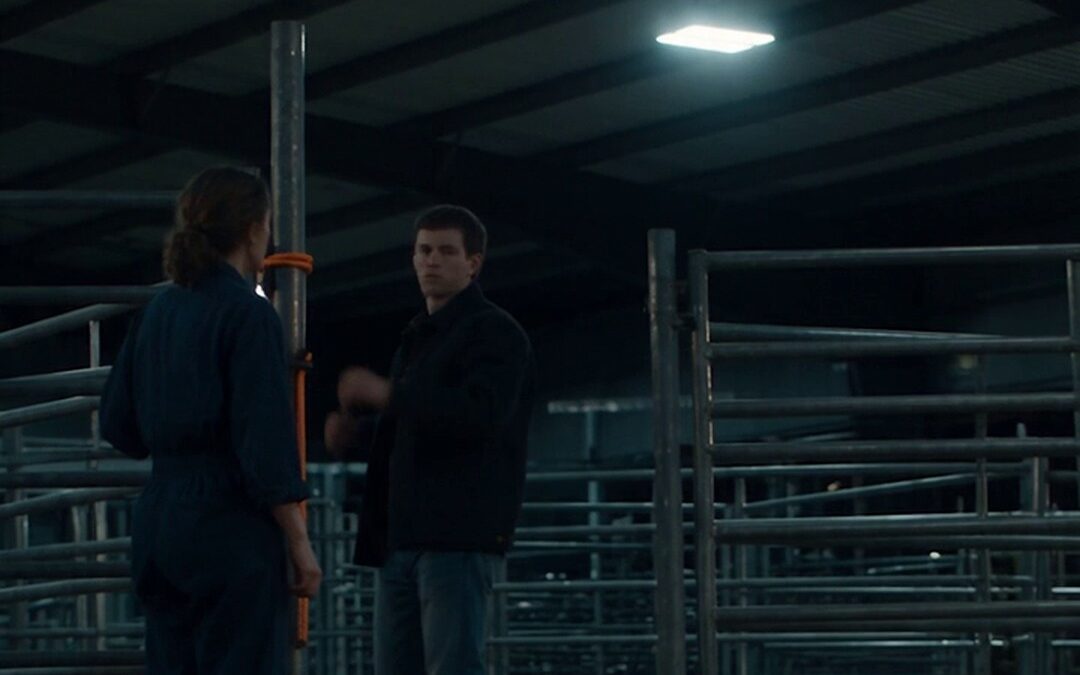
He stood beyond the sale ring with orange baling twine looped around one wrist, watching cattle move through the back pens. From where she stood, she could see only his profile and that small, private motion. She pressed her own thumb into her palm before she could stop herself.
“You all right?” he asked.
“Fine.”
Mara carried the tags to the clerk’s desk. The auction barn had been sold, and tonight’s cattle sale would be its last. At eleven, a crew would start taking down the pens. At dawn, Mara would drive to her new job three counties away.
She had packed everything except the length of orange twine tied to an empty hook by the back gate. Every September, she replaced it. She had never told anyone why she waited there afterward, looking down the gravel road.
The stranger had a bus ticket folded in his shirt pocket. His name was Eli, and he had come to the barn because its painted roof was the one place from his early childhood he could still picture clearly. June, the mother who raised him, had found the address. She had offered to come, but he had asked her to let him try alone.
He checked the gate, then pressed his thumb into his palm again.
Mara saw it. She thought of the false leads, the photographs of men who were the wrong age, the strangers she had frightened by asking too much.
“A latch sticks,” she called. “Lift it first.”
Eli lifted it. The gate swung free.
“Thanks,” he said.
She went back to the desk, but when a truck driver asked who could secure the gate, she looked up.
Eli took the loose twine from his wrist. He wrapped it twice around the post, tucked the short end beneath both turns, and pulled.
Mara’s hand stopped over the tags.
She had taught that knot to a little boy who used to worry that gates opened while people slept. She had taught it to other children, too, she reminded herself. The gesture could mean nothing. The knot could mean nothing.
Across the yard, a bus sighed against the curb. Eli glanced at it and reached for his bag.
Mara crossed the sale ring while the bid spotter called the final lot. Eli stood with one hand on the gate, ready to leave.
She touched the tucked end of the twine.
“Who taught you to hide the tail?”
Chapter 2: What the Gate Kept
“Who taught you to hide the tail?” Mara asked.
Eli looked at her hand on the twine, then toward the bus.
“I don’t know.”
The driver shut the luggage compartment with a hollow clap.
Mara withdrew her hand.
“That was a strange thing to ask,” she said.
“No, it’s a strange thing to do.” Eli touched the knot. “Most people leave the end out.”
A steer knocked against a panel behind them, and the bid spotter called for help at the scale.
“Mara,” the spotter shouted, “I need the next lot card.”
She turned toward the ring. By the time she looked back, Eli had lifted his bag.
“Sorry,” he said.
She could have asked him his age or where he had lived as a child. She had asked questions like that of four men in the last six years. Two had been kind; one had walked away; one had told the barn manager she was using county records to bother customers.
“It’s a useful knot,” she said.
Eli gave it a gentle pull.
“It is.”
Mara went to the scale because the sale could not stop for a feeling. A number on a lot card was wrong, and she had to compare it with the weight ticket before the clerk could settle the account. When she came out again, the bus was gone.
The gate remained closed.
She put two fingers beneath the tucked end, testing his work. The knot held. Her first impulse was to untie it and keep the twine; instead, she left it where he had put it.
Across the road, Eli sat by the bus window and watched the auction barn disappear behind a grain elevator. He had heard the spotter call her Mara.
That had been the name of the girl in his earliest clear memory, though he had never been sure it was a name. For years he had heard it in dreams as *Ma, run*, two words shouted over a gate.
He pressed his thumb twice into his palm.
June had noticed that habit the first week he lived with her. She had never asked him to stop. When he was little and afraid to enter a new classroom, she had pressed her own thumb against his palm once and said, “I’m here.”
His phone lit up with her message: *Did you find what you wanted?*
He typed *No*, erased it, and wrote, *I found the barn.*
The bus would take him to Wichita, where he had a morning shift at the repair shop. He had paid for a round trip because he could only miss one day of work. He had told June that seeing the place might settle an old question.
Now he had two more questions, and the woman at the gate had asked one of them first.
At the scale, Mara corrected the lot card and watched the clerk stamp the seller’s copy. She liked the exactness of the job. A steer went across the scale once; the weight belonged to that animal, on that day, however loudly anyone argued.
“Who was the guy at the gate?” she asked the clerk.
“Customer?”
“I don’t know.”
The clerk looked toward the road.
“Then I can’t tell you.”
Mara knew that. The barn kept buyer numbers and settlement records, not a list of everyone who stood beside a fence. Asking the clerk to dig through accounts because a stranger tied a knot would be unfair to the stranger and to the clerk.
She took the corrected card to the ring.
The final lot sold before nine. By ten, buyers had backed trailers into the loading alley, and the air carried the familiar sounds of chains, engines, and people calling for one another through the pens. Mara took her lunch from the office refrigerator and found that she could not eat it.
Cal, the barn manager, came in carrying a stack of unsold lot cards.
“You packed your apartment?”
“Most of it.”
“Then go home. We can finish.”
She looked toward the back gate.
“I’ll stay through close.”
Cal set the cards down.
“You always do.”
Every September, on the date she had marked inside her kitchen cupboard, Mara tied fresh twine to the empty hook beside that gate. At first Cal had assumed it was a marker for a damaged latch. Years later, when he learned what day it was, he stopped asking her to remove it.
He did not know she waited after each anniversary sale until the yard emptied. She knew waiting had never brought anyone down the road. Still, she found herself listening for footsteps.
“Did you know him?” Cal asked.
“No.”
Cal glanced at her.
“All right.”
Mara went outside. Eli’s knot was separate from the twine on the hook. She stood between the two lengths of orange for a long time.
At four, Eli had been frightened of a back gate that rattled in the wind. Mara could still hear him asking if it would open while they slept. She had wrapped twine around the post twice, tucked the end in, and shown him how hard he could pull.
Two turns. Hide the tail.
She had learned the knot from a pen worker. During the years she had stayed at the barn, other workers and their children had learned it from her. Anyone could have shown Eli, if he had spent time there.
That thought should have helped. It made her want to know when he had been here.
She went inside for her phone, then stopped with it in her hand. A photograph of his back would tell her nothing. The bus had gone, and she did not know his surname.
In Wichita, Eli reached June’s house after midnight. Light showed beneath the kitchen door, and he found her at the table with a bowl of cut peaches she had not touched.
“You didn’t need to wait up,” he said.
“I was awake.”
She looked at his face.
“How was it?”
“Smaller.”
June nudged the bowl toward him. He took a piece to give his hands something to do.
“There was a woman working there,” he said. “Someone called her Mara.”
June set down her spoon.
“Lots of women are named Mara.”
“I know.”
He told her about the gate and the knot. He left out the way the woman’s hand had stopped when she saw it, because he could not say what that meant.
June listened without interrupting.
“You taught me that knot?” he asked.
“No. You already knew it.”
“You never wondered where I learned it?”
“I wondered about everything you brought with you.”
When Eli was five, June and her husband, Arthur, had taken him home through an adoption arranged after he had spent months in foster care. Arthur had died three years ago. Eli missed the way his father would admit uncertainty without trying to fill it.
June could sit beside an unanswered question, too, but tonight she looked as if the chair were uncomfortable.
“You said I was four when they first placed me,” Eli said.
“Almost five.”
“Was there a girl?”
June’s hand went to the edge of the table.
“The paperwork mentioned an older sibling.”
“You knew her name?”
“I knew there was a sibling.”
Eli looked at the peaches. He had asked about a sister when he was young, once at seven and again at fourteen. At seven, June had said she did not know where the child was. At fourteen, she had offered to help him ask the agency.
He had refused. Arthur was ill then, and Eli had been afraid his questions would sound like a wish for another family.
“I heard her name tonight,” he said.
“You heard a name at a barn.”
“Her name was Mara?”
June did not answer quickly.
“I think so.”
He stood up, then sat down again.
“Why didn’t you tell me?”
“You asked where she was, and I didn’t know.” June folded her napkin once. “That isn’t the whole answer.”
Eli waited.
“I was scared you’d spend every year looking for a door I couldn’t open.”
“You could have told me the name.”
“I could have.”
She did not ask him to forgive her. Eli was grateful for that, though it did not make the withheld name smaller.
“Do you still have my papers?” he asked.
“Yes.”
“Can I see them?”
June went to the hall closet and brought back a flat document box. She set it on the table but kept a hand on the lid.
“Some things were kept from us, too,” she said. “The agency gave us a short history. Your adoption papers have your new name.”
“Then let me see what they gave you.”
She took her hand away.
The history listed Eli’s age at placement, two moves between foster homes, and a note that he became distressed when doors or gates were left open. It did not list the older child’s name. Someone had written *sibling contact to be assessed* beside a date in September 2005; the copy ended there.
Eli read the line twice.
“What was assessed?”
“I asked. They told us there would be no visits arranged.”
“Why?”
“They didn’t give me a reason.”
“Did you ask again?”
June looked directly at him.
“No.”
Eli closed the folder. He wanted to say that she should have. He also remembered being eight years old, waking at night to check every lock, and June following him from room to room without once calling him difficult.
“I’m going to find out,” he said.
“I know.”
Mara did not leave at dawn.
She drove her packed car to a county office instead of the highway and stood in line behind people renewing registrations and asking for copies of property records. The woman at the counter directed her to the child welfare records desk on another floor.
There, Mara asked for access to her own case file.
The worker gave her a form and explained that the office would review what it could release. Other people’s information might be withheld. The process would take time, and some older records might have to be retrieved from storage.
Mara had requested a copy once, years before. She had received a thin packet describing her placements and her eventual discharge from care at eighteen. Eli appeared only as *younger child* in the pages she could see.
“This time I want to know whether there’s a way to request sibling contact,” she said.
The worker pointed out a separate consent form.
“You can leave permission for someone to pass along your contact information if he asks,” the worker said. “I can’t promise he’ll ask, or that his records are held here.”
Mara filled in her phone number and current address. She crossed out the address when she remembered she was moving, then wrote Cal’s office number with his permission noted beside it. Finally, she added an email account she had kept for years because Eli, if he ever searched, might know her childhood surname.
She signed both forms.
She had missed the first morning at the new barn, and her new manager’s message waited on her phone when she came out. Mara called from the parking lot.
“I’ll be there tomorrow,” she said. “I’ll take the late shift.”
“You all right?”
“I had something to do.”
The manager gave her the shift. It meant unloading trailers until midnight on her first day. Mara accepted before she could talk herself into driving back to the old gate.
In Wichita, Eli used his lunch break to call the agency named on June’s copy. The person who answered explained that the agency had merged with another organization. She could tell him how to make a request for his records, but she could not discuss another person’s file over the phone.
He wrote the instructions on the back of a parts invoice.
“Is there a way to leave my information for a sibling?” he asked.
She gave him another form to request.
He spent the next evening gathering identification, filling out what he could online, and reading the few dates June’s folder contained. His birth month was February. He had entered his first foster home in September 2005 and moved to June and Arthur the following spring.
His earliest memory of the barn came in pieces: an orange line crossing a post, boots on gravel, a girl’s voice promising that the gate would stay closed.
He had long believed she made the promise because she was going away. He could not remember whether she had gone through the gate or whether he had.
On Thursday, he took the city bus to June’s house. She had spread the remaining papers across the table.
“I found the envelope they came in,” she said.
The return address belonged to the agency. Inside was a receipt for clothes and a handwritten list of things Eli had carried from his foster placement: two shirts, a pair of boots, a stuffed dog, and a piece of orange twine.
“I don’t remember the dog,” he said.
“You wore it out.” June gave a small smile. “Your dad mended one ear twice.”
Eli held the list.
“Why keep the twine?”
“You wouldn’t let anyone throw it away.”
“Where is it?”
“It broke when you were nine. I put the pieces in your keepsake box.”
She brought down a smaller box from the closet. Eli found school photographs, a paper badge from a pretend fire station, and two short strands of faded orange twine in an envelope.
One strand had a tight turn at its end. He could not tell whether it had once been part of a knot.
June watched him rub it between his fingers.
“I should have said her name,” she told him.
“Yes.”
“I thought if I gave you a name without a way to find her, you’d think I was keeping the rest.”
“You were keeping one part.”
“I was.”
Eli put the twine back in the envelope. June reached across the table and stopped short of touching his hand.
“If you find her,” she said, “you don’t have to make my place smaller.”
“I don’t know what finding her would do.”
“Neither do I.”
He had expected her fear to make him angry. It did. It also sounded familiar: the fear he had carried into the auction barn, where asking one direct question might have changed the life he knew.
He submitted the records request that night.
Mara’s first week at the new barn left her shoulders aching. She learned a different scale, a different clerk’s shorthand, and which pen latches needed a hard lift. Each evening, she checked the email account from the county form.
Nothing came.
Cal called on Sunday while she was eating noodles over her sink.
“The demolition crew wants the back pens clear Tuesday,” he said. “There’s a toolbox with your name on it.”
“I can get it Monday.”
“Also, somebody left a message asking who worked the last sale.”
Mara set down the fork.
“Who?”
“A man. Said he’d been at the gate.”
“Did he leave a number?”
“He asked if I could pass his along. I told him I’d ask you first.”
She closed her eyes.
“Give it to me.”
Cal read the number. Mara wrote it on a carton because all her notebooks were still packed.
“He sounds young,” Cal said.
“That doesn’t tell me anything.”
“No.”
“Did you tell him my name?”
“He remembered it.”
Mara stared at the number until Cal asked if she was still there.
“I’ll come for the toolbox,” she said.
After she hung up, she opened a blank message on her phone. She typed, *You asked for me?* and erased it. Then she typed, *This is Mara from the sale barn*, but did not send it.
At the last sale, the stranger had answered her question with *I don’t know*. A week later he had called Cal, and the space between those two things frightened her more than a false lead would have.
She put the phone on the counter and went back to the noodles. They had cooled.
Eli had called the barn after his agency request was acknowledged. He told Cal only that he wanted to speak with the woman who had asked him about a knot. Cal had offered to pass along his number.
Eli waited three days. At work he replaced a belt in a customer’s dryer, checked his phone, and lost his place among the screws. At night he drafted messages he had no way to send.
On the fourth day Cal called.
“She got your number,” he said.
“Did she say anything?”
“That she’d come for her toolbox Monday.”
“I could come there.”
“The sale’s over. It’s a work site now.”
“I understand.”
Eli did not tell Cal that a Monday trip meant losing another day’s pay. He had enough saved for the bus fare. He could stand outside the property and ask Mara if she would speak to him, if she had not called first.
He did not go.
June had asked him what he would say if Mara was a stranger who happened to work at the barn. Eli could not answer. He imagined telling a woman who had merely shown him a gate latch that she might be the sister who disappeared from his childhood. He imagined seeing the careful kindness people used when they wanted a conversation to end.
Instead, he mailed the contact form to the agency and went to work.
Monday morning, Mara drove back across the county line. Yellow barriers closed the driveway to the pens. She parked beside Cal’s pickup and followed him through the office to the loading alley.
The empty ring looked larger without cattle in it. Lot numbers remained chalked on the board, and the clerk’s window was still lined with pencil marks from people waiting to settle accounts.
“Toolbox is in the scale room,” Cal said.
Mara stopped by the gate.
The orange twine she had tied to the empty hook was gone. Eli’s knot remained on the post.
“Who took mine down?”
“Crew cleared the hooks.”
“Did they throw it out?”
“Probably.”
She nodded. It had been one year’s length among many. She could tie another at the new barn, though she had never wanted to. The hook itself would come down tomorrow.
Cal watched her touch Eli’s knot.
“I should tell you something,” he said.
Mara looked up.
“That fellow came for a reason. He called again on Friday, asked whether we kept old sale records.”
“What did you say?”
“That I wouldn’t search buyers or employees for him. I told him he could ask the county about records from when he was a child.”
“Did he say when?”
“Two thousand five.”
Mara gripped the gate post.
“That’s when—”
“I know what year it was for you.”
“Why didn’t you call me?”
“I did. I told you he’d left a number.”
“You didn’t tell me that part.”
Cal removed his cap.
“He sounded as if he was trying to find a childhood place. I wasn’t going to hand him your story, or hand you his, before either of you chose it.”
Mara wanted to argue. Cal had been the one who gave her a job when she was nineteen, after she had shown up at the barn with no experience and asked whether the old gate was still there. He knew how much the possibility cost her. He also knew what had happened after she stopped strangers in the yard.
“Does he know about me?” she asked.
“He knows your first name and that you asked about a knot.”
She looked at the number on her phone. She could call while Cal stood there. She could let it ring and learn whether Eli answered.
The sound of a truck backing into the alley made her flinch.
Mara put the phone away.
“I need my toolbox.”
In the scale room, she found her father’s old hammer, two pairs of gloves, and a coil of twine she had bought for the final sale. Cal stood in the doorway.
“I’m not telling you what to do,” he said.
“You have a talent for it anyway.”
“Fair.”
She closed the toolbox.
“When he was taken, I told him to hold on to the gate,” she said. “For years I thought that was what he remembered about me.”
Cal did not speak.
“I can’t ask a stranger whether he remembers the worst day of his life.”
“You can ask him about the knot.”
“I did.”
“Then you can ask again.”
Mara carried the toolbox to her car. She sat behind the wheel with the phone in her hand, then drove to the county records office instead.
The worker could not give her an answer that day. Mara added a written request asking whether her own case file contained a contact history concerning her sibling. She included the date and location of the separation and paid for copies of the releasable pages.
She asked whether the agency had ever sent her a message from him.
The worker checked what she could and shook her head.
“If anything is in the archived file, you’ll see what can be released. I don’t want to guess.”
Mara respected that answer. She hated carrying it back to the car.
Eli’s records arrived eleven days later. They were thinner than he had hoped and more than he had known. A placement summary described him as a four-year-old boy who referred to an older sister called Mara. Her surname was withheld in the copy, but her age was given as nine.
He called June from the sidewalk outside work.
“She was nine,” he said.
June inhaled quietly.
“Yes.”
“You knew that?”
“I knew there was an older child. I didn’t know her age.”
He looked at the page again.
“There’s a note about the gate.”
“What does it say?”
Eli read it aloud: “Child repeatedly asks whether sister remains at previous location.”
June was silent.
“I thought she left me,” he said.
“I know.”
The summary explained that the children had first entered emergency care together. Mara had stayed with Eli through an intake visit at the auction barn because a temporary shelter was operating nearby after an apartment fire displaced several families. Their mother had survived and was receiving treatment for injuries and other health problems, but she was unable to care for them at that time. When separate placements became necessary, workers had moved Eli first.
There was no finding in Eli’s copy that Mara had chosen the separation. There was no account of what happened after the van took him away.
He folded the page along an old crease in the sidewalk light.
June asked, “Are you all right?”
“I have to call someone.”
He called Cal because Cal was the only route he had to Mara. The call went to voicemail. Eli left his name, his number, and one careful sentence: “I have a record saying a girl named Mara was there with me in September 2005.”
Then he caught the last bus home.
Mara received her copies on a Friday when the new barn was preparing a special sale. She took the envelope into an empty pen and sat on an overturned bucket. The pages recorded her first foster placement, the move she had requested after six months, and the years she spent with the family who had cared for her through high school.
She turned to the September entry.
It said Mara had objected to being separated from her younger brother and had tried to follow the vehicle taking him. A worker had kept her at the gate until the vehicle cleared the yard. The next line stated that contact would be reviewed when each child’s placement stabilized.
Mara looked for the review.
There were notes from meetings about school, health, and her next placement. There was no completed sibling contact plan in the pages released to her. She could not tell whether one had been attempted and withheld or never finished.
She had known that she tried to follow. What came back now was the feel of the gate under her hands and the certainty she had carried as a child: if she remained by the knot, Eli could find the place where she waited.
Her phone rang. Cal.
“Eli called,” he said.
Mara stood so quickly the bucket tipped.
“He gave me his name this time. He got some records.”
“What did he say?”
Cal repeated the voicemail without adding a word. Mara leaned against the pen rail.
“He said he was there?”
“He said a record put him there.”
“Can you send me his number again?”
“You still have it?”
“Yes.”
“Then you decide.”
She thanked him and ended the call. The sale crew came into the alley, and someone asked her to move the bucket. She picked it up, returned to work, and kept the phone in her pocket all afternoon.
She knew why Cal had left the choice with her. Eli might be her brother. He might be another boy whose story passed through the same emergency shelter. A case note could make the possibility stronger; it could not make two adults family before they spoke.
At dusk she walked outside and called.
The line rang once, twice, then connected.
“Hello?” a woman said.
Mara looked at the screen. She had dialed the number Cal gave her.
“Is Eli there?”
“He’s at work,” the woman said. “This is his mother.”
Mara’s throat tightened. She had imagined his mother often. Sometimes she had made the woman cruel so that losing him felt easier to explain. Sometimes she had imagined someone who loved him well enough that he no longer needed to look back.
“I’m Mara,” she said. “From the auction barn.”
The woman took a breath.
“He told me about you.”
“Could you ask him to call?”
“Yes.”
Mara waited for another question. None came.
“Thank you,” she said.
“You’re welcome,” June answered.
At the repair shop, Eli’s phone was locked in a drawer while he worked under a washer. He found three missed calls when his shift ended: one from June and two from an unknown number.
He called June first.
“She called you,” June said.
“Did she say anything?”
“She gave me her name and asked you to call.”
He sat on the edge of a workbench.
“Were you kind?”
“I hope so.”
“She may not be—”
“I know.”
June hesitated.
“I was afraid she’d ask what I knew,” she said. “I would have told her.”
“You can tell her if she asks.”
“I’ll tell you everything first.”
Eli looked at the orange twine he had looped around his wrist again since the trip. He had cut it from a new spool at work, but the knot was the old one.
“Did you ever get a message from her?”
“No.”
“Would you have given it to me?”
June answered slowly.
“When you were small, I might have waited until you were older. I can’t promise I would have handled it well. After you were grown, yes.”
Eli wanted a cleaner answer. He knew better than to ask her for one.
“I’m calling her,” he said.
Mara had driven halfway home when the phone lit up. She pulled into a closed farm-supply lot.
“Hello?”
“It’s Eli.”
For a few seconds they listened to one another breathe.
“I called your mother,” Mara said.
“She told me.”
“Sorry I startled her.”
“You didn’t.”
Mara watched a car pass on the road.
“You got records,” she said.
“Some.”
“Mine came today.”
“Did they say—”
He stopped.
“What?” Mara asked.
“I’m afraid to put it into words.”
“So am I.”
The quiet between them had room for the sound of a turn signal ticking in Mara’s car. She switched it off.
“There was a little boy at that barn with me,” she said. “His name was Eli.”
“I know.”
“He was four.”
“I know.”
She pressed her thumb twice into her palm. Across the state, Eli did the same.
“Can we meet?” he asked.
“Yes.”
They chose a public library halfway between Wichita and her new job, on Sunday afternoon. Eli offered to come to the barn, but Mara did not want the sound of a sale beneath their first careful conversation. She told him she would bring the pages she had received. He said he would bring his.
After they hung up, Mara sat in the darkening lot for fifteen minutes. She called the woman who had raised her through high school.
Ruth answered on the second ring.
“Are you driving?”
“Parked.”
“What happened?”
Mara had lived with Ruth from sixteen until she left for a training program. Ruth knew how to hear the difference between a problem at work and the thing Mara rarely named.
“I think I met Eli.”
Ruth did not speak for a moment.
“Tell me why.”
Mara told her about the last sale, the knot, the records, and the call. Ruth listened through all of it.
“Do you want me to come Sunday?” she asked.
“I don’t know.”
“Then I’ll keep the day free.”
Mara rubbed at a speck on the steering wheel.
“I thought you might be upset.”
“I might be,” Ruth said. “I can be upset and come with you.”
Mara began to answer, but her voice would not hold. Ruth stayed on the line until she could speak again.
“Did I tell you how long I waited at the gate?” Mara asked.
“You told me you went back.”
“Every year.”
“I knew about the twine.”
“You did?”
“You carried a piece in your coat pocket when you first came to us. You’d tie it on things and take it off before bed.”
Mara looked at her empty hand.
“I thought it had been thrown away.”
“You wore it through.”
After the call, Mara drove home and laid her records on the kitchen table. She read the September entry again, searching for something she had missed. The pages did not say what Eli saw from the van, or whether he had looked back.
Eli spent Saturday with June going through his childhood box. They found drawings of houses with fences around them, a photograph of him beside Arthur at a school fair, and the envelope with the broken twine. Nothing in the box identified Mara. He put the envelope beside his records anyway.
June watched him pack a folder.
“You can bring me with you,” she said.
He looked up.
“I thought you didn’t want to go.”
“I didn’t want to crowd her.”
“Or me?”
“Either of you.”
Eli considered it. He had planned to walk into the library alone because he feared June would feel replaced if Mara was his sister. Now he saw that leaving her at home might make the fear worse.
“Come as far as the parking lot,” he said. “Then we’ll see.”
June nodded.
“And if this isn’t her,” he added, “I may need a ride home.”
“You’ll have one.”
That night he could not sleep. He looked up the library hours twice and set three alarms. Around two, he took the old twine from its envelope and tried to join the broken strands.
The fibers were too short. He laid them side by side instead.
He remembered a girl’s hands around his, larger than his but still small enough to fit between the gate post and the latch. He remembered pulling until the twine bit his fingers. He remembered her saying something about morning.
He did not remember her face.
Sunday came clear and quiet. Mara arrived twenty minutes early, parked where she could see the entrance, and put her records in her bag. Ruth texted that she was at a café across the street. She would come over if Mara asked.
Eli arrived ten minutes later with June. He saw Mara’s car before he saw Mara, though he could not have known it was hers. She was sitting behind the wheel with one hand wrapped around the other.
June parked two rows away.
“That’s her,” Eli said.
“How can you tell?”
“I can’t.”
He opened the door. June touched his sleeve.
“Eli.”
He waited.
“You’re allowed to come back to the car at any point.”
“So is she.”
Mara watched him cross the parking lot. At the barn he had seemed taller, perhaps because the gate stood between them. He wore the same brown jacket and carried a thin folder under his arm.
She got out before he reached her.
“Hi,” he said.
“Hi.”
They stood beside her car like people about to exchange directions.
“Your mother’s here?” Mara asked.
“In the car. Ruth’s across the street?”
Mara raised her eyebrows.
“You told me she might come.”
“I did.”
Neither family had hidden as well as they thought.
They went inside and found a table near a window. Children worked on a puzzle at the far end of the room. A librarian rolled a cart past them and asked if they needed help finding anything.
“No, thank you,” Mara said.
The question followed them into silence.
Eli opened his folder first. He slid the placement summary across the table but kept his fingers on one edge.
“It says I asked if my sister was still there.”
Mara read the line.
“I was.”
“I thought you’d gone.”
“I tried to go after you.”
She showed him the entry from her file. Eli read it once, then again more slowly.
The pages came from separate files. They recorded the same month, the same place, and two children with the same first names and ages. Mara did not need the margins to line up perfectly to feel what they meant. Still, she wanted certainty that would hold after they left the library.
Eli looked at her.
“I’m sorry they took us apart,” she said.
He shook his head.
“You were nine.”
“I told you to stay by the gate.”
“I don’t remember that.”
“You were afraid it would open.”
“I remember the knot.”
Mara took a length of orange twine from her bag. She had bought it from the old barn’s supply shelf before the last sale. She laid it on the table between them.
“I learned it there,” she said. “From a worker who used it when a latch wouldn’t hold.”
Eli picked up the twine but did not tie it.
“I’ve done it my whole life.”
“I taught other kids.”
“That’s what you said at the barn.”
“I almost called you from the county office. Then I thought about every person I’d frightened with a guess.”
“I didn’t call right away, either.”
They looked at the twine.
Mara told him about returning to the barn at nineteen. She had asked Cal for work because the building was still there and she wanted to be close to the last place she had seen Eli. Cal had trained her on lot cards and settlement sheets, then trusted her with the scale.
“You stayed there because of me?” Eli asked.
“I stayed because I had a job.” She held his gaze. “I took the job because of you.”
He turned the twine in his hands.
“Every September?”
“Every September.”
At the last sale, he had seen her old twine on the hook. He had thought it marked the gate for the crew. He remembered how carefully she had looked at it before she asked him about his knot.
“That’s why you checked the gate after I tied it,” he said.
“I wanted to know if you’d come back.”
“I had.”
For the first time since arriving, Mara smiled. It hurt enough that she had to look away.
Eli reached into his folder for the small envelope June had kept. He set the faded strands beside the new twine.
“She saved these,” he said. “I carried them until they broke.”
Mara touched one piece with a fingertip. Its color had worn almost to brown.
“I didn’t know you had any,” she said.
“Neither did I.”
A child at the puzzle table called for a missing corner piece. Mara and Eli both turned, then turned back at the same time. Eli pressed his thumb twice into his palm.
Mara saw it.
“You did that before the van,” she said.
“I still do it when I’m trying to stay.”
“I used to press your hand like this.”
She reached across the table, then stopped.
Eli opened his palm. Mara pressed her thumb into it twice.
He closed his fingers gently around hers.
For a moment, neither spoke.
Then Eli asked, “What happened to our mother?”
Mara let go, though she left her hand near his.
“She got better enough to live on her own. I saw her a few times as a teenager.”
“Where is she now?”
“In another state. I haven’t spoken to her in years.”
“Did she look for me?”
“I don’t know what she was able to do.” Mara kept her eyes on him. “I won’t make up an answer.”
Eli nodded. He had questions about their mother that Mara could not carry for him. He was relieved she understood that.
“June raised me,” he said. “Arthur, too.”
“Cal and Ruth helped raise me.”
“We both have people waiting outside.”
“We do.”
The librarian passed with the cart again. Eli moved their papers out of its path.
“We should check the records another way,” he said.
“Yes.”
“June found a lab that does sibling tests. It takes a few weeks after they get the samples.”
“I looked it up, too.”
“Of course you did.”
Mara laughed once, surprised by it.
They talked for another hour. They compared the dates in their records and the things each remembered about the barn. Eli remembered a stuffed dog, though not its name. Mara remembered sewing an ear back on it before the separation; she did not know Arthur had done the same years later.
She remembered a red cup Eli insisted on using at breakfast. He remembered refusing a blue one at June’s house without knowing why.
Neither memory could verify a relationship. Together, they gave the years a shape.
At the library entrance, June was waiting by the car. Ruth had crossed from the café and stood a few steps away, her hands around a paper cup.
Mara slowed.
“That’s June?” she asked.
“Yes.”
Eli introduced them. June’s eyes moved from Mara to the twine in Eli’s hand.
“I’m glad you called,” June said.
“I’m glad you answered.”
Ruth handed Mara the cup.
“It’s gone cold,” she said.
Mara took it anyway.
For an awkward minute the four of them stood together in the parking lot. June and Ruth knew different versions of the same lost years. Neither tried to tell the other what those years meant.
Ruth looked at Eli.
“She’s good with a gate,” she said.
“She showed me,” he answered.
Mara shook her head at Ruth, who gave her a look that said she would stop before she said too much.
Eli had to return to Wichita for work. Mara had a late shift. They agreed to arrange the sibling test that week and to call after they had spoken with the lab about samples and timing.
Mara wanted to hug him before he left. She could see that he did not know whether he wanted the same thing.
“Can I call tonight?” she asked.
“Yes.”
“Even if we don’t have anything new?”
“Especially then.”
He stepped toward her, and she put her arms around him. He stood stiffly for one breath, then rested a hand between her shoulders.
It was brief. When they separated, both looked embarrassed, and both were smiling.
The test took longer than either expected. Eli had to reschedule his appointment when the repair shop’s only other technician became ill. Mara drove forty miles from her new barn to a collection site that could arrange the samples the lab required. They signed the forms and waited.
During those weeks, they spoke most evenings. Some calls lasted an hour; others lasted less than five minutes. Mara learned that Eli repaired appliances because he liked problems he could take apart. Eli learned that she could identify a nervous buyer by the way he held his number card.
They also found limits.
Eli did not want to talk about the separation every night. Mara sometimes forgot and asked what he remembered of a day before he could tell her how his current day had gone. Once he said, “I’m twenty-five now,” more sharply than he intended.
“I know,” she said.
“I don’t think you do yet.”
She ended the call early. The next evening she called back.
“You were right,” she said. “I keep trying to ask the four-year-old.”
“He’s the part you knew.”
“You’re the part I can know.”
Eli sat with that for a moment.
“I had a bad day at work,” he said.
“Tell me.”
He did.
Mara had her own difficult call with Ruth. She said she felt disloyal each time she told Eli a story Ruth had not heard first.
“Stories aren’t rations,” Ruth said. “You can give him one without taking it from me.”
“I’m trying to do twenty years in a month.”
“I can hear that.”
“How do I slow down?”
“Ask him what time he gets off work tomorrow.”
Mara followed the advice. Eli sounded pleased that she remembered his schedule. They began with ordinary things after that, and the old questions found their way in when there was room.
June asked Eli whether he wanted her to meet Mara again. He said yes, but he wanted to wait for the result. June accepted that, though he could see how often she checked her phone.
“You can talk to her without me,” he said.
“I don’t want to put her in that position.”
“You’re allowed to know her.”
“I know.” June closed the drawer she had opened twice without taking anything out. “I’m learning where to stand.”
“So am I.”
The lab’s report arrived on a Tuesday. Eli was at work, and Mara was in the scale room. They had agreed that whichever saw it first would call the other before opening it.
Eli’s phone buzzed while he was tightening a panel on a dryer. He wiped his hands, saw the sender, and carried the phone outside.
Mara answered beside the scale, with cattle shifting behind the wall.
“It’s here,” he said.
“Mine too.”
“Do you want to wait until we’re together?”
Mara looked through the window at the yard.
“I want to know.”
“Me too.”
They opened their reports. The lab’s finding was clear: the results strongly supported that they were full siblings.
Mara read it aloud because Eli asked her to. When she finished, he could hear her put the phone down and pick it up again.
“Are you there?” he asked.
“Yes.”
“What are you thinking?”
“That I missed the bus.”
“You found the number.”
“I should have asked sooner.”
“I should have called sooner.”
“We’re going to spend all day doing this, aren’t we?”
“Probably.”
He leaned against the brick wall outside the shop.
“Mara?”
“Yes?”
“I’m glad it was you.”
Inside the scale room, she gripped the edge of the desk.
“I’m glad it was you, Eli.”
They did not see each other that day. Mara had a sale to finish, and Eli had promised a customer a repaired dryer. Both went back to work carrying the news. Mara entered weights in the ledger; Eli found that he had installed one screw in the wrong hole and fixed it.
That evening they told their families.
June cried when Eli showed her the report, then apologized for crying. He told her she did not have to apologize. He also told her again that withholding Mara’s name had hurt him. June said she knew. They sat together long enough for both things to remain true.
Ruth read Mara’s report at her kitchen table.
“You’re taking Friday off,” she said.
“I can’t keep taking days off.”
“You’ve covered every late shift they gave you. Ask.”
Mara did. Her manager gave her Friday, and she took the bus to Wichita so Eli would not have to make another hurried trip between shifts.
They met at his apartment. He showed her the dryer he had repaired for himself, the shelf Arthur had built, and a photograph of June and Arthur at his high school graduation. Mara showed him the dent in her toolbox where Cal had backed a cart into it.
They made lunch badly together. Eli burned one side of the sandwiches while Mara was looking through his photographs. They ate them anyway.
In the afternoon they went to June’s house. June brought out the stuffed dog. Its fabric had faded, and its ears were uneven from repairs made by three different people over the years.
“I know that one,” Mara said.
Eli watched her hold it. He had expected a rush of childhood memories when she came into his home. Instead, he noticed small things about the woman in front of him: that she read the spines of books on a shelf, that she asked June before opening a drawer, that she liked the burnt half of a sandwich.
June set a box of old photographs on the table.
“You don’t have to go through them today,” she said.
“We can look at a few,” Eli answered.
Mara sat beside him. He showed her Arthur teaching him to ride a bicycle. Mara told him about the first time Ruth let her drive her truck. Their histories did not join neatly. By evening, they had begun learning where each one turned.
A month later, Mara and Eli visited the old auction site. The building was gone. Gravel covered most of the yard, and a temporary fence stood where the sale ring had been.
Cal met them at the road with the gate post in his pickup. The crew had let him keep it before they cleared the pens. Eli’s knot was still tied around the wood.
“I thought you might want it,” Cal said.
Mara ran a finger along the tucked end. Rain and sun had faded it, but it held.
“Can we take it?” Eli asked.
“It’s yours to sort out.”
They loaded the post into Mara’s car, where it stuck out farther than either expected. Cal found a red cloth in his truck and tied it to the end so other drivers would see it.
Eli looked at the post, then at Mara.
“Where will we put it?”
“I don’t know yet.”
“That’s becoming our answer.”
“It’s an honest one.”
On the drive back, Mara told him she had once imagined bringing him to the barn and showing him the hook where she tied twine each September.
“I saw it,” he said. “At the last sale.”
“You did?”
“I thought it was there for the crew.”
“It was there for you.”
Eli turned in his seat to look at the post between them. He remembered Mara crossing the ring toward him while the bus waited, the question she had managed to ask, and all the years she had gone to that gate before he came.
At a stoplight, he put one hand around the wood to keep it steady. Mara reached back and did the same.
The light changed. She drove on, and the knot stayed between their hands.








