She Was Leaving Town That Night, but Two Knots on an Old Toy Made a Stranger Afraid to Let Her Go
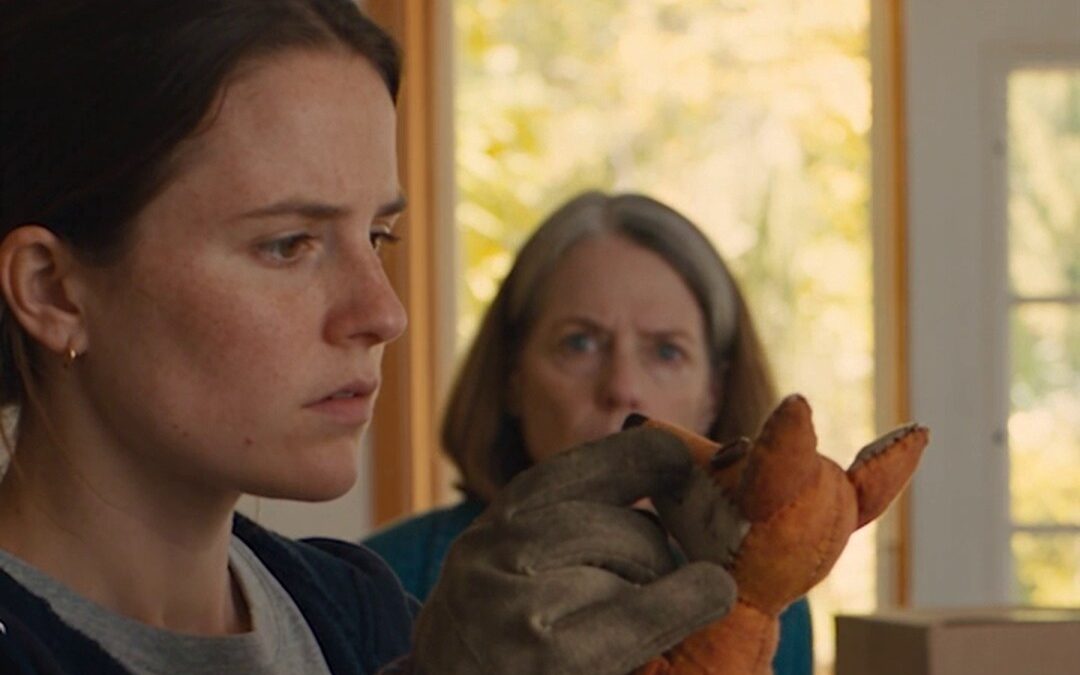
Chapter 1: The Fox in the Box
The woman packing Ruth Bell’s kitchen hummed four notes Ruth had made up for a little girl twenty-six years ago.
Ruth’s hand stopped over the estate-sale form.
Across the room, the woman wrapped a chipped serving bowl in paper, unaware that the sound had reached anyone.
She was twenty-nine, perhaps, with dark hair clipped above her neck and a pencil tucked behind one ear.
On the floor beside her sat a stuffed cloth fox Ruth had pulled from the back of a closet that morning.
Every December, Ruth bought two tangerines, though she lived alone.
She ate one and left the other on the windowsill until it went soft, because her little sister had once called them tiny suns and insisted they came in pairs.
That morning, Ruth had thrown both away before the woman from the estate-sale company arrived.
The house was being emptied after Ruth’s foster mother moved into assisted living, and the sale company needed its final inventory by five.
Ruth had a train ticket for the following morning.
The woman lifted the fox by its faded orange cord.
“Keep or sell?” she asked.
“Keep,” Ruth said too quickly.
The woman set it on the hold table, where customers’ purchases would never go.
She rubbed the rim of her left ear with her thumb, then caught herself and lowered her hand.
Ruth knew that gesture.
She also knew how many strangers had reminded her of someone she had lost.
Once, she had asked a woman in a grocery line whether she had ever lived in Crawford County.
The woman had taken her children and walked away.
“Long day?” the packer asked.
Ruth looked at the open boxes.
“Longer than I expected.”
The woman gave a small nod and checked the time on her phone.
“My last shift,” she said.
“Where are you going?”
“Vermont. Truck leaves tonight.”
Outside, a cargo van backed toward the porch, its reversing signal cutting through the quiet house.
The woman picked up the fox again to move it clear of the door.
Her thumb found the two knots in the cord around its neck.
Ruth had tied them there when she was nine, one knot for herself and one for the child who could never keep track of her toys.
The woman held the fox close to her face.
For the first time, she looked frightened.
“Why did you tie it twice?”
Chapter 2: What Stayed Tied
“Why did you tie it twice?”
Ruth looked at the woman’s hand on the cord.
The van sounded again outside.
For one suspended second, Ruth was nine years old on a vinyl couch, pulling an orange shoelace through a toy fox’s torn collar while her little sister waited with both hands open.
“Ruth?” the woman said.
Ruth had forgotten they were wearing name tags for the inventory.
“She lost things,” Ruth said.
“Who did?”
“My sister.”
The woman’s fingers loosened.
From the porch, her coworker called that the van had to leave space for the delivery truck.
The woman put the fox on the hold table and reached for the next box.
“Sorry,” she said.
“You don’t have to be.”
“It looked like something I used to have.”
Ruth could have asked her name then.
It was written on the tag pinned to her shirt, but the tag had folded under the strap of her apron, and Ruth could see only the first two letters.
She had learned what happened when she asked strangers to account for their childhoods.
The woman had a job to finish and a truck leaving that night.
Ruth picked up the estate-sale form instead.
“Keep,” she said again.
“I marked it.”
The woman pressed a yellow sticker against the table, away from the fox’s worn fabric.
She went outside carrying a box of plates.
Ruth watched her through the front window until the van blocked the view.
At the kitchen sink, Ruth turned on the tap and held her hands beneath water she did not need.
The four notes were still in her head.
She had invented them because a song with words made her sister ask for the words again, and Ruth never remembered them the same way twice.
Four notes required nothing from either of them.
The packer returned with an empty carton.
“Is there another room?” she asked.
“The bedroom.”
“Yours?”
“It was Helen’s.”
The woman waited.
“My foster mother,” Ruth said.
The packer’s eyes moved briefly toward the fox.
“I can start there.”
Ruth pointed down the hall and stayed where she was.
She had searched for her sister for twenty-six years, then spent the last four persuading herself to stop.
The county office had told her long ago that adoption records belonged to the people named in them and that a former foster child could request only what the office was permitted to release about her own case.
Ruth had sent forms anyway.
She had placed her name with a search registry, paid for a consumer DNA test, and left the results available for relatives who might someday do the same.
She had found distant cousins and a man who wanted money to look for a sister he could not prove he knew.
She had never found Nora.
In Helen’s bedroom, the packer slid books from a shelf into a carton.
Ruth walked to the doorway.
“What’s your name?” she asked.
The woman turned.
“Nora.”
The name struck Ruth so hard she gripped the doorframe.
Her sister had been named Nora.
Ruth had seen the name on a dozen women, in newspapers and on receipts and on the side of a bakery truck.
It was a common enough name to make hope feel foolish.
“Nora what?”
The woman’s expression changed.
“Mercer,” she said.
Ruth let go of the frame.
“Sorry,” she said.
Nora looked at her for a moment, then folded the top of the carton.
“People ask me that a lot at sales.”
“I’m sure they do.”
“They want to know where their things are going.”
Ruth understood the explanation Nora had offered her.
She accepted it because she had no right, yet, to demand another.
At five, Nora’s coworker came in with a clipboard.
The last inventory box was sealed, the house key was logged, and the fox was listed among the items Ruth would collect from the hold table at the warehouse.
Ruth disliked letting it leave the house even for a night.
Nora noticed.
“I can put it back in your car.”
“My car’s in the shop.”
“The warehouse is open at eight tomorrow.”
“My train is at nine.”
Nora looked at the address on the form.
“We’re ten minutes from the station.”
“I’ll come early.”
Nora clipped the pen to the board.
“I’m leaving before sunrise.”
“Then good luck in Vermont.”
“Thanks.”
Nora took one step toward the door, stopped, and turned back.
“Was your sister little when she lost it?”
“Three.”
Nora pressed her lips together.
“That’s little.”
“It was.”
Outside, the coworker called again.
Nora went.
Ruth stood in the emptied bedroom until she heard the van doors shut.
She remembered the fox’s collar, the tune, the ear.
Then she remembered the woman in the grocery store who had asked her to leave her family alone.
Ruth had no photograph of Nora as an adult and no reliable way to know what name she used.
She would not run into the street after an employee and shout a question about her birth.
At the window, she watched the van pull away.
Nora sat in the passenger seat with her hand against her left ear.
Ruth stayed inside.
The next morning, Ruth woke before her alarm.
She took her train ticket from the bedside table, opened the company’s pickup instructions, and found a phone number for the warehouse.
A man answered over the sound of carts moving across concrete.
“Estate department.”
“I’m Ruth Bell.”
“Fox on the hold table?”
“Yes.”
“It’s here.”
“I need to ask about one of your workers.”
The carts stopped.
“If there’s a complaint, I can take it.”
“There isn’t.”
“What do you need?”
Ruth closed her eyes.
“Could you give her a message?”
“Which worker?”
“Nora Mercer.”
There was a pause.
“She’s done with us.”
“I know.”
“I can pass it to the manager.”
Ruth gave her number and asked him to say only that the owner of the fox wished to speak with her.
He repeated the number back.
The warehouse could not give Ruth Nora’s contact details, and Ruth was relieved that someone there understood why.
She dressed, carried Helen’s old canvas tote to the bus stop, and rode to the warehouse.
Inside, numbered lots stood in rows beneath high lights.
A young man at the counter checked her receipt against the hold ledger and brought out the fox.
He did not touch the cord.
Ruth put the toy in her tote.
“Did Nora hear my message?” she asked.
“The manager has it.”
“Could you tell me whether she came in today?”
“I haven’t seen her.”
That was all he would say.
Ruth thanked him and stepped aside for a customer collecting a sideboard.
Outside, she looked at the time.
The train would take her to Philadelphia, where a friend had offered a room while Ruth decided what to do with Helen’s house and with herself.
She had told her friend she was coming.
She had also promised Helen she would visit before leaving Erie.
The bus for Helen’s assisted-living residence arrived first.
Ruth got on it.
Helen was eating toast at a small table by the window when Ruth arrived.
She had moved three weeks earlier and still referred to the residence as “the place with the good elevator.”
Ruth set the fox between them.
Helen looked down at it.
“You brought him.”
“He was in the closet.”
“I know where I put him.”
Ruth sat.
“A woman at the house knew the tune.”
Helen put down her toast.
“What woman?”
“One of the people packing.”
“Did you ask her?”
“I asked her name.”
“And?”
“Nora Mercer.”
Helen looked at Ruth’s face, then at the fox.
“That could be anyone.”
“I know.”
“Did you tell her about your sister?”
“Yes.”
“Did she say anything?”
“She asked why I tied the cord twice.”
Helen touched one knot with a bent finger.
Ruth had never told Helen the answer.
When Ruth first came to her house, she had hidden the fox beneath her mattress and refused to let anyone mend it.
Helen had seen it only after Ruth was old enough to leave it on a shelf.
“What did you tell her?” Helen asked.
“That Nora lost things.”
“True enough.”
“I didn’t tell her about the knots.”
“Perhaps you should.”
Ruth looked toward the window.
“Perhaps I should have told the woman at the grocery store something else, too.”
Helen remembered that day.
Ruth had come home shaking because the woman had been carrying a child with hair the same color as Nora’s had been at three.
She had watched Ruth approach and then walked away before Ruth could explain.
“You didn’t hurt that woman by asking,” Helen said.
“I frightened her.”
“You might frighten this one.”
“That’s what I mean.”
Helen took the fox onto her lap.
“You cannot decide what she can bear before she knows what you’re asking.”
Ruth rested her elbows on the table.
Helen had been her foster mother from age ten until she turned eighteen.
She had not pretended to know things she did not know, and she had never told Ruth to stop searching.
That made Ruth trust the words more than she wanted to.
“I have a train,” Ruth said.
“I heard.”
“I can change it.”
“Yes.”
“And if she’s somebody else?”
Helen lifted the fox’s ear, which had gone flat under a stack of books.
“You’ll still have done one honest thing.”
Ruth called the train company from the hall and moved her ticket to the following evening.
She paid the difference with money she had set aside for the trip.
Then she went back to Helen’s table.
“I need my file,” she said.
Helen reached for her water.
“You requested it years ago.”
“I asked whether they could find Nora.”
“That’s different.”
“I want everything they can give me about my own placement.”
Helen nodded.
“There was a caseworker called Ms. Voss,” she said.
“She left.”
“People leave files behind.”
Ruth took out her phone and found the county office.
She asked which form an adult former foster child should use to request available records from her own case.
The woman on the phone explained that the office would review the request, remove information it could not release, and respond in writing.
It would not be done that afternoon.
Ruth knew that.
She filled out the form in Helen’s room, attached a copy of her identification, and sent it through the county’s secure portal.
The confirmation came while Helen was trying to get the fox to sit upright against the sugar bowl.
Nora, meanwhile, was twenty miles away at her father’s house, carrying a box that would not fit in her truck.
Her father, David Mercer, opened the garage door with a remote and watched her park.
“You said one box,” he called.
“It is one box.”
“It’s the size of a refrigerator.”
“It’s a sewing machine.”
“It’s a sewing machine in a refrigerator box.”
Nora laughed, and for a moment she sounded like the child who had raced through this garage in socks.
David caught the back end while she lowered the box from the truck.
Her move to Vermont had been planned for six months.
She had taken a job helping run an estate-sale company near Burlington, and she had found a small apartment within walking distance of its warehouse.
David had helped her compare health plans and had bought her winter tires before she asked.
He could be tender in ways that required tools.
He could also become very still when Nora asked about the years before she came to him and his late wife.
That afternoon she had meant to load the sewing machine, drink coffee, and go.
Instead she found him staring at the small cloth fox key chain hanging from her truck mirror.
She had made it in a middle-school art class, from a memory of a toy she could never quite describe.
“You’re taking that?” he asked.
“It weighs nothing.”
“I thought you’d thrown it out.”
“Why would I?”
He looked away.
Nora pulled a strap tight across the sewing-machine box.
“There was a fox at work yesterday,” she said.
“People own foxes.”
“This one had an orange cord around its neck.”
David checked the strap, though it was secure.
“Maybe yours did.”
“I’ve told you that before?”
“Once or twice.”
Nora leaned against the truck.
“I remembered more when I held it.”
David’s fingers stayed on the strap.
“What?”
“A house with steps that creaked.”
“Lots of houses.”
“A girl tying two knots.”
David shut the tailgate too hard.
Nora flinched.
“Dad.”
“Sorry.”
“You know something.”
“I know children build memories out of stories.”
“You used to say mine were worth hearing.”
“They are.”
“Then hear this one.”
David pressed the tailgate latch with his thumb until it clicked.
Nora watched him.
She had known she was adopted for as long as she could remember.
Her parents had told her that being adopted was part of her story, and when she was young they let her tell it as often or as little as she wished.
What they had said about the beginning was narrow.
Her birth parents could not care for her, she had spent time in foster care, and David and his wife, Caroline, had become her parents when she was four.
When Nora asked whether there had been other children, they had said the paperwork did not tell them of any.
She had stopped asking at fifteen.
Caroline had died seven years earlier after a long illness, and Nora had been careful with the questions she thought might make David feel he was being asked to surrender her too.
“I worked in a house yesterday,” she said, “with a woman who said her sister lost a fox.”
David went to the side of the truck.
“Did she ask you anything else?”
“My name.”
“Nothing about where you were born?”
“No.”
“Then let it go.”
“You’re scared.”
“I don’t want you hurt.”
“By a toy?”
“By somebody who sees what she wants to see.”
Nora folded her arms.
“She didn’t chase me.”
“Good.”
“She looked like she wanted to.”
David picked up the loose end of the strap.
Nora had never seen him struggle to meet her eyes over a work story.
She let him finish tucking the strap away because she needed time to think.
“Did Caroline know more?” she asked.
“We told you what we knew.”
It was an answer David could say without raising his voice.
It was also the first time Nora had heard him say “we” as if Caroline might defend him from the room she was no longer in.
Nora carried her overnight bag inside.
In her old bedroom, the shelf above the desk still held a row of ceramic horses she had refused to pack at nineteen.
She sat on the bed and played the four notes into her phone’s voice recorder.
The house in Erie came back to her in pieces: the yellow hold sticker, a woman gripping a doorframe, a fox with one flattened ear.
She had hummed those notes all her life.
Caroline used to answer them from another room when Nora was little, but when Nora asked where the tune came from, Caroline said Nora had brought it home with her.
Nora had understood that as a sweet story.
At the house, the tune had made Ruth look as though someone had spoken through a wall.
Nora searched the sale company’s shared schedule.
Ruth Bell’s pickup was listed for eight the next morning.
That was this morning.
Nora had spent it packing.
She found the warehouse number and called.
Her former manager answered.
“Did a customer leave a message for me?” she asked.
“She did.”
Nora stood.
“What did she say?”
“Owner of the fox wants to talk.”
“Did she leave a number?”
“Yes.”
“Send it.”
The manager did.
Nora stared at the number before adding it to her phone.
Then David knocked.
“Coffee’s ready,” he said.
She turned the screen down.
“Coming.”
David remained in the doorway.
“I didn’t mean to cut you off.”
“I know.”
“The woman from that house could be mistaken.”
“She could.”
“People see family everywhere after they lose someone.”
Nora looked up.
“Did I lose someone?”
David’s face tightened.
He did not answer at once.
Nora had never asked him that exact question.
She had asked who her birth mother was, whether she had been sick, whether the foster home had been kind.
She had never asked whether there was a particular person missing from the story he told her.
“I can’t do this while you’re leaving,” he said.
Nora stood so quickly the bed frame knocked the wall.
“Do what?”
David moved aside from the door.
“You should eat before you drive.”
She walked past him.
At the kitchen table, she drank coffee that had gone lukewarm and waited for him to sit.
He remained at the counter, cutting an apple into pieces he did not eat.
“You said there were no other children in the paperwork,” Nora said.
“That is what I said.”
“Was it true?”
David set down the knife.
“I need to find the folder.”
“Where is it?”
“I have it.”
“Then find it.”
He rubbed his forehead.
“We can look after you get settled.”
Nora pushed back her chair.
“That’s two answers I’ve waited for since breakfast.”
She went outside without her coffee.
In the truck, she called Ruth’s number.
The call went to voicemail.
“Hi,” Nora said after the tone.
“It’s Nora Mercer, from the house.”
She watched David through the kitchen window.
“I got your message.”
She stopped, unsure what to ask a woman she had known for one afternoon.
“Please call me when you can.”
Ruth’s phone was in her tote while she waited at the county office reception desk.
She had decided that a submitted request was not enough for the day she had bought herself.
She wanted to know whether the office held records of the day she and Nora were separated and whether she had asked the right questions on her form.
The receptionist checked Ruth’s identification and called a records worker who could explain the process.
Ruth did not ask to see a sealed adoption file.
She asked what parts of her own foster case might be available and how a request for contact could be made without putting a stranger’s address in anyone’s hands.
The worker gave her a printed explanation and the name of the state’s confidential intermediary program.
The program could, under its rules, try to carry a message if both sides were eligible and willing.
It could not promise that Nora would be found or would answer.
Ruth folded the paper and put it beside the fox in her tote.
“Would my old requests still be in my case file?” she asked.
“If they were filed with your case, perhaps.”
“I wrote every year.”
“We’ll review what we hold.”
“Can I tell you why I’m asking again?”
“You can.”
Ruth described the woman at the house.
She kept her voice steady through the tune and the ear and lost it at the two knots.
The worker listened without telling her what any of it meant.
“If you know how to reach the woman,” she said, “you can speak with her directly.”
“I left a message.”
“Then you’ve done something today.”
Ruth thanked her and left.
Outside, she found Nora’s missed call.
She listened to the voicemail twice.
The second time, she paid attention to the space before “Please call me.”
Nora sounded like someone standing on the edge of a question.
Ruth called back.
David had followed Nora into the driveway by then.
He stood near her truck holding a flat cardboard folder.
When the phone rang, Nora looked at Ruth’s name on the screen, which she had entered moments earlier.
David saw it.
“I found the papers,” he said.
Nora silenced the call.
“Show me.”
He held the folder but did not give it to her.
“It’s not all of it.”
“What’s in it?”
“Things your mother and I were given when you came home.”
“You mean the things you had while telling me there was nothing about other children?”
“I never said there was nothing.”
“You said it didn’t tell you of any.”
David looked down at the folder.
“I was afraid you’d spend your life thinking you had to choose.”
“Choose what?”
“Us, or people we couldn’t find.”
Nora’s phone rang again.
Ruth had tried a second time because she feared her first call had failed.
David stepped back.
“You should answer,” he said.
Nora looked from him to the phone.
She wanted the truth from the person who had put her to bed when she was sick.
She also wanted to hear what the woman with the fox might say.
The ringing stopped.
Nora took the folder.
“You could have told me and still been my dad.”
“I know that now.”
She opened it against the truck’s hood.
There were copies of placement summaries, forms with dates, and a page headed with information intended for her parents when she was adopted.
Some identifying details had been withheld.
She read slowly.
The page said she had been separated from an older sibling during foster care.
It gave the older sibling’s age but not a name.
Nine.
Nora felt the edge of the hood against her palms.
“Did Mom know?”
“Yes.”
“Why didn’t either of you tell me?”
David’s voice was thin.
“At first, we thought we would when you were older.”
“And then?”
“You were happy.”
Nora looked up.
“I was happy with you.”
“That’s what I mean.”
“It isn’t what I mean.”
He let the answer stand.
On the page was a short note about the belongings that had come with Nora from the foster home.
One toy had been described as a fabric fox.
Nora touched the line.
“Where is it?”
“We never received it.”
“Did you ask?”
“Caroline did.”
“What did they say?”
“It had gone with your sister.”
Nora turned toward the truck, where her little cloth key chain swung beneath the mirror.
The fox in Ruth’s house was not a toy like hers.
It was the toy.
Ruth had called again while Nora read.
Now she left a message.
“It’s Ruth,” she said.
“I don’t know what you remember.”
She looked across the county office parking lot at a row of cars.
“I would like to tell you about the fox.”
Nora listened to it with David beside her.
“What are you going to do?” he asked.
She put the phone in her pocket.
“Find out what she knows.”
She was not ready to say sister.
The paper had given her an older sibling, and Ruth had given her a toy and a tune.
All of that could fit together, but Nora wanted to hear Ruth describe the day the fox left her hands.
David nodded.
“I can come.”
“I need to go alone.”
He accepted that, though he looked hurt.
Nora took a picture of the page about her belongings and returned the folder to him.
“Keep the rest safe,” she said.
“I will.”
“And don’t put it away again.”
He held the folder against his chest.
“No.”
Nora drove toward the warehouse because she knew Ruth had collected the fox there and might have returned with a question.
Ruth drove from the county office toward Nora’s father’s town, using the address Nora had mentioned on the phone’s public caller information.
Neither had confirmed where the other was going.
At a four-way stop near the warehouse, Nora waited behind a delivery truck while Ruth crossed in front of it.
Ruth’s fox lay in the passenger seat, hidden by the canvas tote.
Nora was looking at her navigation screen.
They passed without seeing each other.
Ten minutes later, Ruth parked outside a coffee shop and called again.
Nora pulled into the warehouse lot as the phone rang.
“Hello?”
“Nora.”
“I’m at the warehouse.”
“I’m not.”
“I thought you might be.”
“I was there this morning.”
Nora shut off the engine.
“Can we meet?”
“Yes.”
“Where are you?”
Ruth looked at the map on her dashboard.
“Halfway to your town.”
“Why?”
“I wanted to speak with you before you drove tonight.”
Nora glanced at the sewing machine visible through her rear window.
“I’m still going.”
“I know.”
“Then come here.”
“I can be there in twenty minutes.”
Nora breathed out.
“All right.”
Ruth turned her car around.
At the warehouse, Nora went inside and found her former manager taping lot labels to a cart.
“You got the number?” he asked.
“Yes.”
“Good.”
“Did you see the fox?”
“He gave it to her.”
“Did it have two knots?”
The manager looked over his glasses.
“I didn’t inspect it.”
Nora almost smiled.
“Right.”
She sat on a metal bench near the loading bay.
The warehouse carried the smell of cardboard and furniture polish.
Carts rolled by with lamps wrapped in brown paper.
Through the open bay, she could see her truck, pointed toward a state she had spent months preparing to reach.
She called David.
He answered on the first ring.
“I’m meeting her.”
“I thought you would.”
“Tell me something true before I do.”
“All right.”
“Did my sister ask about me?”
David sat down somewhere on his end of the call.
“We got one contact inquiry when you were eight.”
Nora watched a worker tighten a strap around a dresser.
“From her?”
“From an intermediary.”
“What did you say?”
“Caroline and I asked them to wait.”
“How long?”
“We said until you were older.”
“And when I was older?”
“We didn’t follow up.”
Nora gripped the phone.
“You let me think nobody had asked.”
“Yes.”
“Why?”
“Because every time we tried to bring it up, we imagined you wondering why we hadn’t done it sooner.”
“That’s what I’m wondering now.”
“I know.”
Nora closed her eyes.
David waited through the silence.
“I’m still your daughter,” she said.
“I know that, too.”
“Then trust me with the rest.”
“I should have.”
When the call ended, she remained on the bench.
She could love him and be angry with him in the same breath.
Caroline had taught her to thread a sewing machine, to check the seams on secondhand coats, and to leave a bowl of water outside for delivery drivers in August.
The page in David’s folder did not take those things away.
It changed the shape of the silence around them.
Ruth arrived as the warehouse clock reached noon.
Nora saw her through the open bay.
Ruth carried the canvas tote in both hands, as if it held something that might tip over.
Nora stood.
They met beside the long hold table.
Neither reached for the other.
“I’m sorry I missed your calls,” Nora said.
“I was asking about my old case file.”
Nora looked at the tote.
“Did they tell you anything?”
“They told me how to ask.”
“My dad had papers.”
Ruth’s face tightened.
“About you?”
“Yes.”
Nora took out her phone and showed Ruth the photograph.
Ruth read the line about an older sibling and then the description of the fox.
She handed the phone back.
“That’s more than I had yesterday,” she said.
“It says nine.”
“I was nine when they took us to different homes.”
Nora pressed the phone against her palm.
“Why?”
“Our mother couldn’t keep us safe then.”
“Was she cruel?”
Ruth considered the word.
“She was ill a lot, and the adults helping her couldn’t leave us there.”
“That’s different.”
“It is.”
“Did you know where I went?”
“No.”
“What did they tell you?”
“That you might be adopted.”
Ruth rested the tote on the table.
“For years I thought someone would ask whether I wanted to see you.”
“Someone did.”
Ruth looked up.
“When?”
“When I was eight.”
“I sent a request through a program that year.”
“My parents asked them to wait.”
Ruth put one hand flat on the table.
Nora watched her.
“Did you hear anything back?” Nora asked.
“Only that no contact had been arranged.”
“I thought there wasn’t anybody asking.”
Ruth gave a short, disbelieving laugh.
“I thought you didn’t want me to find you.”
Nora rubbed the rim of her left ear.
Ruth saw it and looked away.
The gesture was familiar, but Nora had done enough explaining to strangers for one day.
Ruth could wait.
“Why did you tie it twice?” Nora asked.
Ruth drew the fox from the tote.
Up close, Nora could see that one eye had been repaired with a smaller button.
The orange cord had darkened where little fingers had rubbed it.
“I told you that you kept losing him,” Ruth said.
“I remember that part.”
“I tied the cord so I could put him over your wrist.”
Nora looked at her own hand.
“You didn’t like it around your wrist.”
“No.”
“You said he needed a collar.”
Nora’s eyes lifted to Ruth’s.
Ruth could not tell whether Nora remembered or was following the story.
She went on.
“I tied one knot and you wanted another.”
“Why?”
“You said he’d get away while we slept.”
Ruth touched the first knot, then the second.
“I told you one was mine and one was yours.”
Nora reached toward the cord but stopped.
“That isn’t how I remember it.”
Ruth’s stomach sank.
“All right.”
“I remember someone saying we could each hold one end.”
Ruth’s mouth opened.
She had forgotten those words.
She could see the bedroom floor now: her sister sitting in striped pajamas, pulling against the cord with all the solemn strength a three-year-old could summon.
Ruth had held the other end and told her the fox could not get lost while they both had hold of him.
“You did,” Ruth said.
Nora took one end of the cord.
Ruth held the other.
For a moment they stood on opposite sides of a warehouse table with a toy between them.
A cart passed behind Ruth.
Neither moved.
“I’m not asking you to believe me because of this,” Ruth said.
“I know.”
“We can test.”
“I want to.”
“So do I.”
Nora looked at the two knots.
“Did you keep him all this time?”
“Yes.”
“I thought he got away.”
“No,” Ruth said.
The words were so small that Nora almost missed them.
Ruth had carried a different account of that day.
She had believed she had failed to keep her sister close, and the fox was the one thing she had managed to hold.
Nora set the cord down.
She did not hug Ruth.
She asked, “What happened after I left?”
Ruth pulled out a chair from the table.
They sat.
For the next hour, they told each other what they knew and what they had only been told.
Ruth remembered the foster house with creaking steps.
Nora remembered standing at the bottom of them in socks.
Ruth remembered a woman offering her a paper cup of water in the county office.
Nora remembered a car seat that smelled of warm plastic and a woman who kept saying her name softly, giving her room to say it back.
They disagreed about the fox’s missing button.
Ruth thought Nora had pulled it off.
Nora thought Ruth had cut it away because it scratched her cheek.
Ruth said she had a photograph somewhere from before the repair, but she did not need them to settle it.
Some memories had been handled too often to keep their original shape.
“I had a good childhood,” Nora said.
“I hoped you did.”
“I think I needed you to hear it.”
“I do.”
“Mom and Dad loved me.”
Ruth nodded.
Nora looked at the table.
“I’m angry at Dad right now.”
“You can be both.”
“That sounds like Helen.”
“It probably is.”
Ruth told Nora about Helen’s toast, her good elevator, and the fox propped against a sugar bowl that morning.
Nora laughed before she could stop herself.
“She knew about me?”
“She knew I had a sister.”
“Did she help you look?”
“She drove me to three county offices and waited in the car when I was too proud to ask her to come inside.”
Nora ran her thumb along a seam in the table.
“I wish I’d known someone was doing that.”
“I wish you had, too.”
The warehouse manager came over to ask whether they needed the table for the afternoon.
Ruth started to apologize.
He looked at the fox, then at Nora.
“Take your time,” he said, and returned to the lot labels.
Nora checked her phone.
She had planned to leave by four to reach a motel she had booked halfway to Vermont.
The booking allowed her to arrive late.
The clock still mattered, but it no longer held the whole decision.
“I’m driving tonight,” she said.
“I heard.”
“I don’t want this to become a reason I stay here.”
Ruth felt the old reflex to agree before Nora could think she was asking.
“You should go to your job.”
Nora studied her.
“I want to know you.”
“I want that.”
“I don’t know what it looks like yet.”
“Neither do I.”
Nora put her phone beside the fox.
“I can order a test now.”
Ruth told her which company held her existing results.
They read the instructions together.
The kit would be mailed to Nora’s new address, and the result would take weeks after she sent it back.
They both understood that the fox, the tune, the papers, and their memories made a strong case.
They also understood why a clear answer mattered.
Nora ordered the kit.
Ruth showed her the family matching setting she had kept active for years.
Nora looked at the date beside Ruth’s original result.
“You tested six years ago.”
“Yes.”
“And you kept checking?”
“At first.”
“What about later?”
“On your birthday.”
Nora lifted her eyes.
“How did you know my birthday?”
“I was there for the first three.”
“That was a foolish question.”
“It wasn’t.”
Nora wanted to ask what Ruth had done on those birthdays.
She was afraid the answer would make the years feel heavier before she had room to carry them.
Ruth did not offer it.
They exchanged phone numbers and checked that each had received the other’s message.
Nora took a photograph of the fox with the two knots visible.
Ruth tucked the toy into her tote.
At the warehouse door, Nora stopped.
“I need to talk to my dad again.”
“You do.”
“I don’t know what I’ll say.”
“You don’t have to decide before you call.”
Nora nodded.
“Will you tell Helen?”
“If you’re comfortable with it.”
“Tell her I’m going to Vermont.”
Ruth smiled faintly.
“She’ll approve of the winter tires.”
Nora’s hand rose toward Ruth’s shoulder, then fell.
Ruth noticed and did not move closer.
They walked to their cars.
Nora turned her truck toward David’s house to return the folder before leaving town.
Ruth drove back to Helen with the fox on the passenger seat.
Neither called the other on the road.
At David’s house, the garage door was open.
He stood inside beside an empty shelf where Nora’s boxes had been.
She parked and went to him.
“I met her,” she said.
David looked over her shoulder toward the truck.
“How was it?”
“We sat in a warehouse.”
“That tells me very little.”
“It told me a lot.”
He nodded and waited.
“She has the fox.”
David covered his mouth with one hand.
“Caroline looked for it,” he said.
“I know.”
“I should have told you about your sister.”
“Yes.”
“I thought if you met her, you might learn I’d stood in the way.”
“I did learn that.”
David lowered his hand.
Nora let him see that she was still there.
“I’m going to Vermont,” she said.
“I know.”
“I’m going to keep talking to her.”
“I hope you will.”
“I need you to answer me when I ask about the past.”
“I will.”
She handed him the folder.
“I took pictures of what I need.”
“You can take all of it.”
“I don’t have to decide that today.”
David nodded.
They loaded the last small box into the truck together.
When Nora shut the tailgate, he checked the latch as he had always done.
She let him.
Ruth found Helen in the common room, arguing gently with a man about the rules of a card game.
Helen looked up when Ruth came in.
“Well?”
“We met.”
The man gathered his cards and excused himself.
Ruth sat beside Helen.
“I think she’s Nora.”
“Does she?”
“She’s finding out.”
Helen looked into Ruth’s tote.
“You brought the fox back.”
“She remembered the knots.”
Helen took Ruth’s hand.
“Did you tell her what they meant?”
“Most of it.”
“What’s left?”
Ruth looked at the fox.
“Why I kept tying things after she was gone.”
Helen did not ask her to explain.
Ruth had fixed torn hems with knots too large to hide, secured boxes with twice the string they needed, and checked door latches even after hearing them catch.
She had called it being careful.
Helen had never corrected her.
That evening, Ruth took the later train to Philadelphia.
Nora drove north.
At a gas station near the state line, she called Ruth.
“I stopped for coffee,” she said.
“Are you tired?”
“No.”
“You can tell me if you are.”
“I will.”
A truck rolled past Ruth’s train window on a parallel road.
She could not see its driver.
“What did you want to ask?” she said.
“How old were you when you learned to sew?”
“Nine.”
“Because of the fox?”
“Because nobody would fix him the way I wanted.”
Nora laughed softly.
“I do estate sales for a living, and I still keep broken things.”
“Some are worth keeping.”
The line went quiet.
Nora looked at the little fox hanging from her mirror.
“My mom taught me to sew,” she said.
“I’d like to hear about her.”
“You will.”
They ended the call when Nora reached the highway.
Over the next weeks, they spoke every few days.
The first calls were careful and full of practical questions: where Ruth worked, whether Nora’s apartment had heat, what Helen liked to eat.
The later calls made room for irritation.
Ruth asked twice whether Nora had mailed the test kit, and Nora told her she had.
Nora asked why Ruth had waited so long to call after their first day at the house, and Ruth told her about the grocery store.
Neither liked the answer, but each understood a little more of the person who had made the choice.
Nora mailed her sample from Vermont.
While they waited, she put a photograph of the fox on her kitchen shelf.
She did not call Ruth her sister at work.
Ruth told Helen about Nora’s new apartment but did not show her coworkers the photograph Nora had sent from the doorway.
They were learning which parts of the story belonged to both of them before they gave it to anyone else.
One afternoon, the test result appeared in their accounts.
The match was close enough to confirm they were full sisters.
Ruth was at Helen’s table when she opened it.
Nora was on a warehouse floor in Vermont, holding her phone while a coworker waited for a decision about a dining set.
Ruth called first.
“Did you see?” she asked.
“Yes.”
Neither spoke for several seconds.
The coworker pointed toward the dining set.
Nora raised one finger, asking for a moment.
“I thought I’d feel different,” she said.
“I feel about the same.”
“Me too.”
Then Nora sat down on a closed cardboard box because her knees had begun to shake.
Ruth heard the sound and stood, as if she could reach through the phone.
“Nora?”
“I’m here.”
“So am I.”
They stayed on the call until Nora had to return to work.
The result answered the question they had put to it.
It could not tell them how quickly to become part of each other’s days.
In November, Nora visited Erie for a long weekend.
She stayed at David’s house.
Ruth did not ask her to stay elsewhere.
They met Helen for lunch, where Helen ordered soup and asked Nora what she liked about Vermont.
Nora talked about the company’s warehouse and a neighbor who repaired bicycles in the hallway.
Helen listened.
When Ruth reached across the table for the salt, Nora moved the bread basket out of her way without being asked.
Ruth noticed, but she said nothing.
After lunch, Nora and Ruth went to the nearly empty house to collect the last things Helen wanted.
The hold table was gone.
Dust had settled in the outline of the kitchen bowl Nora had wrapped on her first day there.
Ruth opened the canvas tote and took out the fox.
“I meant to ask if you wanted him,” she said.
Nora held out her hands, then hesitated.
“You kept him for twenty-six years.”
“I know.”
“You don’t have to give him away to prove anything.”
Ruth considered that.
She set the fox on the kitchen counter between them.
“We could leave him here while we pack.”
Nora smiled.
“That we can do.”
They worked in the same room, passing cups and folded towels from one to the other.
When the last box was closed, Nora picked up the fox.
One knot held beneath her thumb.
The other rested against Ruth’s hand.
Neither of them untied it.








