The Aquarium Worker Held Up a Rusted Cylinder, and the Crime Boss Said He Had Watched Her Burial
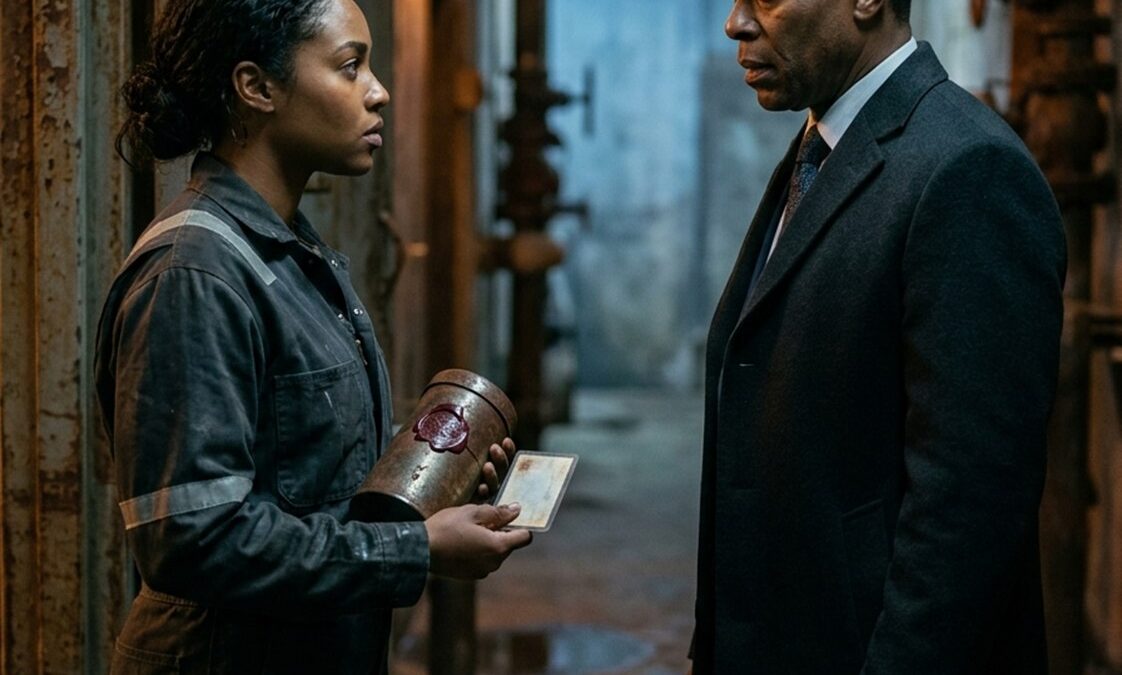
Chapter 2: What the Water Kept
The service corridor shook.
Water struck the closed door.
Gideon grabbed the manual wheel.
“It won’t hold long.”
Bellini took off his coat.
He put it around Tessa’s shoulders.
She wanted to refuse it.
Her teeth would not stop chattering.
“Who opened the valve?” she asked.
“The panel logs each command,” Gideon said.
“Where?”
“In the control room.”
Bellini looked at his guard.
“Call the fire department.”
The guard raised his phone.
Elias moved toward the stairs.
“Someone must secure the paperwork.”
“Stay,” Bellini said.
“I’m protecting you.”
“Then stay where I can see you.”
Elias stopped.
Tessa pressed the hospital card flat.
The word DECEASED remained.
It had a physician’s initials.
A tiny blue line crossed the lower corner.
She had seen a line like that before.
Her mother used to draw it beneath figures in the aquarium’s old accounting books.
It meant a total had been carried forward.
“What did you bury?” Tessa asked.
Bellini’s face tightened.
“A sealed infant coffin.”
“Did you see inside?”
“No.”
“Did my mother?”
“They told me she died too.”
Tessa felt the corridor tilt.
“My mother lived another twenty-six years.”
“I know that now.”
“Who told you she died?”
Bellini looked past her.
At Elias.
Elias spread his hands.
“The hospital notified the family.”
“You notified me,” Bellini said.
“I brought you their documents.”
The door groaned.
Gideon tightened the wheel.
“Argue upstairs.”
Bellini stepped aside.
Tessa went first.
They climbed the concrete stairs.
Her wet boots squeaked against each tread.
At the landing, the aquarium director waited with a phone.
“The fire crew is coming,” he said.
“The valve controls are locked.”
“By whom?” Tessa asked.
“We don’t know.”
Elias reached for the cylinder.
“I can preserve the seal.”
Tessa pulled it away.
“The seal is broken.”
“All the more reason.”
“I’ll hold it.”
Bellini opened the stairwell door.
“Get a bag from your office,” he told the director.
“A clean one.”
The director hurried off.
Tessa studied the cylinder.
Its brass cap carried three stamped letters.
N.Q.B.
Nora Quinn Bellini?
Her mother had never used that name.
The final letter sat apart from the others.
B might stand for a bank.
Or a person.
“Why did she hide it here?” Bellini asked.
“She told me where.”
“When?”
“In a note she left.”
“May I read it?”
“Later.”
He nodded.
There was no demand in it.
That frightened Tessa more than an order would have.
The fire crew arrived with equipment.
They sent everyone outside the restricted corridor.
A firefighter asked Tessa what she had done inside.
She told him.
She had opened the third drain.
She had removed a cylinder.
She had not touched the supply valve.
He wrote each answer down.
Gideon confirmed the last point.
Bellini gave the firefighter his name.
Elias supplied his business card.
When the firefighter asked who had requested the morning inspection, Elias said his office had coordinated it.
The firefighter wrote that down too.
They waited beside a wall of dark tanks.
A small school group passed at the far end of the hall.
The children pressed their palms to the glass.
A ray turned beneath the water.
Tessa remembered her mother’s hand over hers against that same glass.
It had been the one time Nora came inside.
She had left before they reached the shark exhibit.
“My mother was scared of you,” Tessa said.
Bellini looked at the passing children.
“She had reason.”
“That’s an answer with no facts.”
“I made choices that hurt people.”
“Did you hurt her?”
“No.”
Elias gave a quiet sigh.
Tessa turned to him.
“Then why did she run?”
Elias said nothing.
The director returned with a clear evidence bag.
Tessa placed the cylinder inside.
She kept the card in her hand.
Bellini watched her protect it.
“I told Nora I would leave the business,” he said.
“Did you?”
“No.”
“Then she had reason.”
“Yes.”
The firefighter came back.
“The tank’s isolated.”
Gideon leaned against the wall.
“The valve had a remote command.”
“From where?” Tessa asked.
“The building network.”
“The logs?” Bellini asked.
“We’ve secured the panel.”
Elias checked his watch.
“The sale meeting starts in forty minutes.”
“It can wait,” Bellini said.
“The city won’t appreciate delay.”
Tessa held up the card.
“Neither will a false death record.”
The director looked ill.
He had never asked about her family.
Now he knew more than she did.
The firefighter approached Tessa.
“An investigator will need that document.”
“I want a receipt.”
“You’ll get one.”
“And a photograph before it leaves my hand.”
He gave a small nod.
She photographed both sides.
Then she watched him seal it.
Bellini stood close enough to help.
He did not touch her.
“I watched a coffin go underground,” he said.
“I believed Nora was in the next grave.”
Tessa looked at him.
“She wasn’t.”
“No.”
“Then someone arranged two funerals.”
Elias’s gaze dropped.
Bellini saw it.
The firefighter carried the card away.
For a few seconds, nobody spoke.
Then Bellini said the sentence Tessa would remember longest.
“Nora didn’t leave me with our child.”
“She was told we were both dead.”
* * *
Tessa went to the city records office that afternoon.
Bellini offered a car.
She took a bus.
He followed in his own.
She could see it two vehicles behind at every stop.
At the records desk, she requested her birth certificate.
She had a copy at home.
She wanted the oldest version the office held.
The clerk explained the process.
Tessa filled out the form.
Bellini waited across the room.
Elias had gone to his office.
He said he would send over hospital files.
Tessa did not believe he would.
A records supervisor brought the certified copy.
It named Nora Quinn as mother.
The father’s field was blank.
The date matched the hospital card.
The place of birth was a private clinic that had closed in 2007.
“There’s an amendment reference,” the supervisor said.
“Where?”
“At the bottom.”
A small filing number appeared beside the seal.
Tessa wrote it down.
The supervisor could not release the underlying document at the counter.
She explained how to request it.
Bellini called his attorney.
Not Elias.
A woman named Priya Shah arrived an hour later.
She wore a raincoat and carried no briefcase.
Bellini introduced her.
“She handles my legitimate companies.”
Priya gave him a level look.
“I handle the companies that keep records.”
Tessa liked her immediately.
Priya read the certificate.
“Have you spoken to police?” she asked.
“The fire investigator took the card.”
“We should make a separate report.”
“About the false death?”
“About the card and the tank.”
Tessa pointed to the amendment number.
“I also want this.”
Priya wrote it down.
“We can petition for the source file.”
Bellini looked at Tessa.
“Will you agree to a DNA test?”
“Yes.”
“Use a laboratory you choose.”
Priya added her name to a list of accredited facilities.
Tessa chose one across the river.
Bellini scheduled his own collection there.
They arrived separately.
They gave identification.
They signed consent forms.
The staff collected cheek swabs.
No one announced a family in the waiting room.
The result would take days.
Tessa found that delay almost merciful.
There were other records to read.
Her mother had kept every pay stub in shoeboxes.
Tessa had cursed the boxes when she moved them after the funeral.
That night, she spread them across her kitchen table.
Gideon came over with takeout soup.
He still had his aquarium badge.
“They suspended me,” he said.
Tessa stood.
“Because I opened the drain?”
“Pending an inquiry.”
“You should tell them I did it.”
“I did.”
“They still suspended you?”
“Because I helped.”
She pressed her hands to the table.
“Your pension—”
“I asked for a written reason.”
He set down the soup.
“I also kept copies of the service schedule.”
Gideon had worked with Nora years earlier.
He had never mentioned Bellini.
Now he explained why.
“Nora asked me to leave her past alone.”
“She told you about the cylinder?”
“No.”
“She told you anything?”
“She once asked how long those drains would last.”
“When?”
“The year you graduated high school.”
That was nine years ago.
Nora had been thinking about the cylinder for a long time.
Gideon unfolded the schedule.
The tank’s water supply had no planned work that morning.
The city inspection covered the viewing glass and structural supports.
Someone had added a network test at 7:14 a.m.
The note carried an administrator code.
Tessa recognized its first three digits.
They belonged to the temporary accounts created for the sale team.
She knew because she issued access badges.
“I can identify who requested this account,” she said.
“Is that legal?” Gideon asked.
“I can give investigators the access register.”
She photographed the schedule.
Then she put it in a folder.
The soup cooled.
She ate it anyway.
Priya called at ten.
The hospital file Elias had promised had arrived.
It contained a death certificate for Nora.
It was dated April 18, 1999.
Nora’s actual death certificate sat in Tessa’s desk drawer.
It was dated February 3, 2026.
“What does Bellini say?” Tessa asked.
“He’s with me.”
A pause.
Then his voice came through.
“I kept the original document Elias brought.”
“Why?”
“I keep everything.”
“Even when it hurts?”
“Especially then.”
Priya arranged a meeting at her office.
The next morning, Tessa brought Nora’s real certificate.
Bellini brought his file.
Two women with the same name had supposedly died twenty-seven years apart.
The old certificate named a physician.
The clinic’s stamp sat crooked.
Priya photographed everything.
She called the state vital records office through formal channels.
The office confirmed that the old certificate’s serial number belonged to a different filing.
They would provide written confirmation to investigators.
The physician’s name matched a doctor who had worked at the clinic.
Priya found his current practice.
He was retired.
He agreed to speak with a detective.
Not with Bellini.
“He knows your name,” Priya said.
Bellini accepted that.
Tessa examined the old document.
Her mother had taught her to read figures from both ends.
That habit found errors a calculator would not.
The certificate’s typed date had a faint second strike beneath it.
April 18 covered April 16.
Two days before Tessa was born.
“Look at this,” she said.
Priya brought the page under a lamp.
The typed number had been changed.
Bellini’s hands curled.
“What does that mean?”
“It was prepared early,” Tessa said.
They took the file to the district attorney’s intake office.
A detective met them.
He asked separate questions.
Tessa described the note, the drain, and the valve.
Bellini described what Elias had told him in 1999.
Priya supplied copies.
The detective requested the originals through proper evidence intake.
He gave each person a receipt.
When he asked why Tessa had waited months to open the drain, she answered honestly.
“I needed authorized access.”
“Did you get it?”
“To service the drain, yes.”
“To remove a sealed cylinder?”
“No.”
He wrote that down.
“I’d rather have the truth,” he said.
“So would I,” Tessa replied.
By evening, the amendment source arrived.
A court order from 1999 had changed Tessa’s first name from Theresa to Tessa.
Nora had filed it three weeks after the birth.
The petition said the father’s identity was withheld for safety.
It included a sworn statement.
Tessa read her mother’s words slowly.
I was told the child’s father died on April 16.
I have since learned he may be alive.
I am leaving this city because I was warned that contact would put my daughter in danger.
The witness signature beneath Nora’s belonged to Elias Voss.
Tessa looked up.
Priya checked the page twice.
Bellini sat down.
The lie had followed Nora into the courthouse.
* * *
At 6:20 the next morning, Tessa’s apartment lock jammed.
She knew its ordinary resistance.
This was different.
The deadbolt turned halfway, then stopped.
A neighbor came downstairs carrying a laundry basket.
She saw fresh scratches around the plate.
Tessa called the police.
She did not enter.
The responding officers found no one inside.
They found a broken piece of metal in the lock.
A locksmith replaced it.
Nothing had been taken.
On the kitchen table, however, her shoeboxes stood in a new order.
Tessa had stacked them by year.
Someone had put the oldest on top.
The officers photographed the room.
They asked what she thought the visitor wanted.
“The papers my mother kept,” Tessa said.
“Are they missing?”
“No.”
She had moved them to Priya’s office the night before.
Bellini arrived while the locksmith worked.
He did not cross the tape at her doorway.
“I heard,” he said.
“From whom?”
“Priya.”
“She shouldn’t have called you first.”
“She called the police first.”
Tessa checked her phone.
Priya had sent a message to her too.
Bellini saw her expression.
“I should have asked before coming.”
“Yes.”
“I’m asking now.”
Tessa considered the broken lock.
“You can stay until they finish.”
He stood against the opposite wall.
The locksmith worked in quiet bursts.
Across the hall, her neighbor offered Tessa tea.
Bellini declined when she offered him some.
Tessa accepted both cups.
He held one while she signed the police report.
His hand shook.
She pretended not to see.
The district attorney assigned the case to Detective Maren Holt.
Holt requested the aquarium access records.
Tessa showed her the badge system.
Every temporary account required a sponsor.
The remote command came from a sale team account.
The sponsor was listed as Voss Legal.
That alone did not identify the person at the keyboard.
The command had originated from a workstation in a conference room.
Security footage showed the room’s door.
At 7:11, Elias entered.
At 7:17, he left.
The command had been sent at 7:14.
Holt said the timing supported a warrant request.
She did not promise an arrest by lunch.
Tessa appreciated that.
Gideon’s suspension continued.
The aquarium director said the city had frozen all sale activity.
He also said his board wanted a disciplinary hearing.
Tessa asked for the policy in writing.
Gideon did the same.
Then she went back to work on a different tank.
Holt had told her not to handle the old exhibit.
The sea lions needed their pumps checked.
She checked them.
On Thursday, the DNA result arrived.
Tessa opened hers at Priya’s office.
The laboratory reported a parent-child relationship with Bellini.
The conclusion was clear.
Her body seemed to understand before her mind did.
She sat very still.
Bellini remained across the table.
He had waited for her to open the envelope.
“What do you need?” he asked.
“Time.”
“You have it.”
“And the truth.”
“I’m trying to find it.”
“Try where it hurts.”
He nodded.
Later, when Priya stepped out, he told Tessa about 1999.
He and Nora had met through the aquarium’s education fund.
His companies supplied equipment.
She managed its accounts.
He had promised to make his holdings lawful before their child was born.
He had started.
He had not finished.
Nora learned one of his shipping firms still moved goods for men she feared.
She demanded he cut them off.
He delayed.
They argued in the parking lot behind the aquarium.
Then she stopped returning his calls.
Three days later, Elias brought him the deaths.
“I believed him,” Bellini said.
“Because he had papers?”
“Because I had given Nora reason to leave.”
Tessa let the words settle.
Outside Priya’s window, a bus lowered for a passenger.
Nora had ridden buses while Bellini owned cars.
That fact would remain true.
Bellini looked at Tessa.
“I cannot give those years back.”
“No.”
“I can answer for mine.”
“Start with the companies.”
“I have been.”
“I want to see more than a promise.”
“You will.”
She could not decide whether she wanted him nearby.
She could decide what she would accept.
That afternoon, Holt called.
The retired physician had spoken.
He recognized neither the infant death card nor Nora’s certificate.
His initials were wrong.
He had been away from the clinic that week.
His travel records supported it.
A former clinic administrator had also agreed to speak.
She remembered Elias visiting twice.
The second visit came after Nora fled.
She had kept copies of visitor sign-in sheets because the clinic closed under a records retention order.
Holt obtained them.
Elias had signed under his own name.
The card had not appeared from nowhere.
Somebody at the clinic had helped him.
The administrator named that person.
A records manager called Owen Pike.
Pike had died six years earlier.
His bank statements, preserved in an old fraud inquiry, showed payments from a company controlled by Elias.
Priya called it a trail.
Holt called it grounds for more subpoenas.
That evening, Tessa found Gideon on his porch.
He was repairing a child’s wooden model boat.
His granddaughter had broken the mast.
“You could come back once the board settles,” she said.
“Maybe.”
“You sound doubtful.”
“They like a simple story.”
“A worker broke a rule.”
“And an old worker helped.”
Tessa sat beside him.
She took the mast.
The wood had split along its grain.
Her mother had fixed things like that with patience and too much glue.
Gideon handed her a clamp.
For a while they worked without speaking.
Then he said, “Nora made me promise something.”
“What?”
“If you ever came asking about that drain, I was to help you reach it.”
“Why didn’t you tell me?”
“She said only after you asked.”
Tessa stared at the boat.
Nora had planned for the day.
She had also feared it.
“What else did she say?”
“That you were braver than either of us.”
Tessa swallowed.
Gideon waited.
She repaired the mast.
When Holt called again, Tessa answered with glue on her fingers.
The bank subpoenas had revealed a current shell company.
It stood to buy the aquarium land at a reduced price after Bellini’s bid closed.
The same company had paid for the temporary network account.
Its beneficial owner appeared in a confidential filing.
Elias Voss.
* * *
The city postponed the sale hearing.
Elias demanded that it proceed.
He sent a letter accusing Bellini of inventing a family dispute to escape a signed purchase agreement.
He accused Tessa of stealing documents from the aquarium.
He accused Gideon of helping her damage city property.
His letter reached the aquarium board, the mayor’s office, and two newspapers.
By noon, Tessa’s face appeared online beside the word sabotage.
The photograph showed her leaving work in a wet uniform.
She had not agreed to it.
At the grocery store, a stranger stared.
Tessa bought milk and went home.
She called Priya.
“Can I answer publicly?”
“Yes,” Priya said.
“Stick to what you know.”
“I know he opened the valve.”
“We have strong evidence.”
“Is that enough?”
“Say the investigation has the records.”
Tessa wrote a statement on her phone.
She read it twice.
Then she posted it.
I opened a drain under a scheduled maintenance permit.
The tank filled because someone issued a remote command.
Investigators have the access logs.
I will answer for what I did.
I expect everyone else to do the same.
Her supervisor called ten minutes later.
The board had moved her hearing to Friday.
Gideon’s hearing would follow.
Priya offered representation for both.
Gideon accepted.
Tessa accepted after Priya said the fee came from an independent fund, not Bellini’s company.
“I still want to know who pays,” Tessa said.
“Bellini does.”
“Then tell him I’ll repay what I can.”
Priya sighed.
“I’ll tell him your terms.”
Holt met Tessa the next morning.
She had more questions about the cylinder.
“How did Nora seal it?”
“I don’t know.”
“Did she ever mention a bank?”
“No.”
“Look at the cap.”
Tessa saw the letters again.
N.Q.B.
Holt pointed to the spacing.
“The B is a maker’s mark.”
The first two letters were Nora’s initials.
The third belonged to a metal workshop that had made waterproof field containers for the aquarium in the 1990s.
Holt had found an invoice.
Nora bought one in March 1999.
She had prepared the hiding place before Tessa’s birth.
“Was she expecting trouble?” Tessa asked.
“It looks that way.”
“What else was in it?”
Holt could not discuss everything during the active investigation.
She could tell Tessa what had been photographed.
The rolled papers included copies of education fund ledgers.
They showed a large transfer ordered by Elias.
Nora had marked the entry in blue ink.
Carry forward.
The same line appeared on the hospital card.
Tessa felt the connection click.
Nora had handled both papers.
Or had seen both before hiding them.
“She marked the false document,” Tessa said.
“Why?”
“So she could identify it later.”
Holt nodded.
There was also a signed letter.
Nora had addressed it to the attorney general.
She had never mailed it.
In it, she described a plan to transfer the aquarium’s education endowment into a holding company controlled by Elias.
The transfer required Bellini’s consent.
His signature appeared on a form.
Nora believed it had been copied from a different document.
She had challenged the form.
Then Elias told her Bellini had been killed.
Two days later, he told Bellini she had died.
“Nora kept the evidence,” Holt said.
“She ran because of me.”
“She wrote that she ran to keep you alive.”
Tessa sat with that sentence.
Her mother had not been perfect.
She had kept a father from her daughter.
She had also tried to outlast a man who controlled every route back.
At Friday’s hearing, the aquarium board met in a room above the main entrance.
The director read the maintenance policy.
Tessa had permission to open the drain.
She had failed to list removal of a concealed object.
She accepted that finding.
Gideon had assisted under her permit.
There was no evidence either had opened the valve.
Holt’s written notice confirmed the remote command.
The board lifted Gideon’s suspension.
It gave Tessa a formal warning.
Tessa asked about his lost wages.
The director promised back pay.
Gideon asked for the promise in the minutes.
It went in.
Elias watched from the back row.
He had come with two attorneys.
When the hearing ended, he approached Tessa.
Bellini stepped forward.
Tessa raised a hand.
“I can speak for myself.”
Elias stopped two feet away.
“Your mother understood consequences,” he said.
“She wrote them down.”
“Some records can be read many ways.”
“Then read them under oath.”
His smile thinned.
“You think this ends cleanly?”
“I think it ends in public.”
He turned to leave.
Holt stood by the door.
She had heard enough to take notes.
She had not yet arrested him.
Tessa knew investigations moved slowly.
That no longer felt like failure.
It felt like building something that could stand.
That night, Bellini came to her building.
He called from the sidewalk.
She went down with her coat on.
“I have something to tell you,” he said.
“Priya knows you’re here?”
“Yes.”
“Then tell me.”
“I signed a document in 1999.”
“Which one?”
“A blank authorization page for the education fund.”
Tessa stared.
“Why?”
“Elias said a grant needed my signature before the board met.”
“Did you read the packet?”
“There was no packet.”
“You made it easy for him.”
“Yes.”
“Did you know Nora objected?”
“Not until today.”
He had brought her copies of the legitimate fund charter.
It named public education as its purpose.
It also contained a clause Nora had proposed.
No sale of the aquarium property could redirect the fund without independent review.
Bellini had signed that page too.
Elias had kept it out of later packets.
Tessa held the copy beneath a streetlight.
Her mother’s handwriting sat in the margin.
For the children who cannot pay admission.
“She wanted this place kept open,” Tessa said.
“She wanted it honest.”
Bellini put his hands in his pockets.
“I helped build the thing he used.”
“Yes.”
“I’ll say that in court.”
“Even if it costs you?”
“Especially then.”
The street was cold.
Tessa stayed until the bus passed.
She did not invite him upstairs.
He did not ask.
* * *
The public hearing on the land sale took place six weeks later.
The city had suspended the contract.
Elias petitioned to reinstate it.
His lawyers argued that the aquarium was failing.
They brought maintenance reports.
Some were real.
The roof leaked.
The old shark tank needed major work.
The city could not wish those costs away.
Elias offered a buyer with financing ready.
He said the education fund had been exhausted years ago.
He said Tessa’s recovered cylinder contained copies that proved nothing.
Then he said Bellini’s sudden interest in a daughter was a way to avoid scrutiny of his own signatures.
That argument landed.
Several board members looked at Bellini.
Tessa looked too.
He did not look away.
Priya called the city’s attention to the original fund charter.
The clerk displayed it.
Elias objected that a private document could not control a municipal sale.
Priya agreed that it could not by itself.
It could show where the endowment money was meant to go.
A state investigator then summarized bank records obtained by subpoena.
The education fund had paid Elias’s holding company over several years.
The payments had been labeled consulting fees.
There were no matching services.
Elias’s attorney disputed intent.
He said accountants had approved the transfers.
He said Bellini had signed authorization.
Priya displayed that page.
The signature was real.
Bellini stood.
“I signed it blank,” he said.
The room turned toward him.
“I was careless.”
Elias folded his arms.
“You approved years of payments.”
“I approved a grant request.”
“You signed the page.”
“I did.”
The board chair asked Bellini to sit.
He obeyed.
Tessa could feel her pulse in her wrists.
Elias had one good fact.
Bellini had signed.
A criminal case could be complicated by that truth.
A public decision might be easier for Elias to sway.
Priya called Tessa.
She had not planned to speak long.
She described the drain.
She described Nora’s note.
She described the blue line on the hospital card.
Elias’s attorney objected to the card.
Priya said the original was with investigators.
She showed a certified photograph.
Then she showed Nora’s ledger.
The same blue line appeared beside the unauthorized transfer.
Tessa explained her mother’s habit.
“She used it when a figure was carried forward,” she said.
“What was carried forward here?” the chair asked.
“A lie.”
Elias shook his head.
“An ink mark is a story.”
“Yes,” Tessa said.
“So let’s use records.”
Priya called a forensic document examiner retained by the state.
The examiner had compared the card, ledger, and Nora’s known writing.
The blue marks alone could not identify a writer.
The handwritten notes beside them could.
They were consistent with Nora’s hand.
More important, the examiner found that the transfer authorization had been assembled from two different pages.
Its staple holes did not align.
The top page’s paper stock dated from a later printing run.
The lower signature page matched the earlier grant packet.
Elias’s lawyer questioned the examiner.
The examiner answered each question.
Then the state investigator displayed the bank filing.
It identified Elias as the beneficial owner of the company receiving the funds.
That filing was independent of Nora’s papers.
Elias’s posture changed.
He looked toward the exit.
Holt stood there.
She had a warrant.
She did not interrupt the hearing.
The board chair asked Elias whether he wanted to respond.
He did.
He said the aquarium would close without investment.
He said he had kept it alive with private money.
He said Bellini had spent decades enjoying the reputation of a benefactor while other people made hard decisions.
Some of that was true.
Tessa knew it.
Then Elias looked directly at her.
“Your mother knew this building would fail.”
Tessa gripped the table.
“She knew the fund was being drained.”
“She hid papers in a tank.”
“Because you controlled the files.”
“She hid you too.”
Bellini moved.
Tessa stopped him with a glance.
“She raised me,” Tessa said.
“She also wrote down what you did.”
The board chair called for order.
Elias sat back.
The city attorney recommended against reinstating the sale.
The board voted to keep it suspended.
The state had also placed a hold on the disputed endowment assets.
That was a temporary measure.
The criminal case would take longer.
Outside the hearing room, Holt served the warrant.
Elias asked for counsel.
She let him call.
He walked out between officers.
There were no cameras inside the corridor.
Tessa was grateful for that.
The newspaper called the next day.
She gave one sentence.
“The aquarium deserves an honest accounting.”
She declined every other question.
The legal outcome came in stages.
The state filed fraud and forgery charges.
Federal investigators reviewed the bank transfers.
Pike’s old records showed he had helped create the false hospital documents.
The payments from Elias’s company matched the dates.
The retired physician gave sworn testimony that his initials had been copied.
The clinic administrator produced her visitor logs.
The DNA result established Bellini as Tessa’s father.
It did not prove the fraud.
The documents and money did that.
Eight months later, Elias pleaded guilty to financial crimes and falsifying records.
He received a prison sentence.
The court ordered restitution from his seized assets.
The city recovered enough to restore the education fund.
The false death records were formally corrected.
Tessa attended that hearing.
Bellini sat two rows behind her.
Elias turned before he was led out.
“You got a father and a building,” he said.
“Enjoy the bill.”
Tessa met his eyes.
“I’ve paid bills my whole life.”
He had no answer.
* * *
By spring, the aquarium smelled of fresh paint.
It also still smelled faintly of salt and wet concrete.
Tessa liked both.
The old shark exhibit remained closed.
Engineers had found deeper damage behind the wall.
The city approved repairs in phases.
School visits continued in the smaller galleries.
The recovered fund paid for buses and admission.
A public board controlled it.
No single donor could redirect it.
Tessa accepted a new job managing maintenance records.
It paid more.
It also gave her a desk too close to the printer.
Gideon visited daily.
He claimed he came to check the pumps.
He usually brought pastries.
“You retired,” Tessa reminded him.
“I retired from payroll.”
He took a pastry from the bag.
“Pumps can’t read calendars.”
She laughed.
The sound surprised her.
For months, laughter had felt like a door she had forgotten how to use.
It returned in small places.
A schoolboy asked whether the sea stars could tell time.
Gideon said they were better at it than the staff.
The printer jammed every Tuesday for reasons nobody found.
The director learned to make coffee strong enough for the overnight crew.
Ordinary problems reclaimed their proper size.
Bellini came by appointment.
At first, he spoke to Tessa in her office.
He brought records she had asked to see.
His companies had hired an outside firm to review old transactions.
Several contracts ended.
Some buildings were sold.
He reported what he had done without asking her to applaud.
One afternoon, he brought a proposal.
He wanted to pay for the shark tank restoration.
Tessa read the amount.
It could cover most of the work.
“No,” she said.
He blinked.
“You haven’t read the terms.”
“I have.”
“There’s no naming requirement.”
“I know.”
“Then what concerns you?”
“You could pay the city directly.”
“Yes.”
“I want the public board to choose the work.”
He considered that.
“You can submit the offer to them,” she said.
“They may take it.”
“You won’t decide?”
“I work here.”
“You know the place.”
“That’s why I won’t be your shortcut.”
Bellini took back the proposal.
A week later, he submitted it to the board.
They accepted part of it.
They required competitive bids and public reports.
He agreed.
Tessa watched from the back of the room.
Afterward, he came to her.
“You were right,” he said.
“I know.”
He almost smiled.
“I’m learning how much that sentence costs.”
“Consider it a family expense.”
They both went quiet.
Family was still a word with rough edges.
Tessa had not decided when to use it.
Bellini never pushed.
On Nora’s birthday, Tessa went to the cemetery alone.
She brought a small paper bag of lemon cookies.
Nora had loved them stale.
Tessa set one beside the stone.
“You could have told me more,” she said.
The wind moved through the grass.
“You could have trusted me sooner.”
There was no answer.
Tessa had expected none.
She told Nora about the repaired school buses.
She told her about Gideon’s granddaughter.
She told her Bellini had finally learned the difference between a gift and a decision.
Then she ate a cookie.
It had already gone soft.
That evening, she called Bellini.
“Would you like to have dinner?” she asked.
“Yes.”
“At the diner near my apartment.”
“Tell me when.”
“Tomorrow.”
He paused.
“May I bring something?”
“An appetite.”
He arrived five minutes early.
He wore a plain dark jacket.
Nobody from his staff came inside.
Tessa ordered grilled cheese.
He ordered the same.
The waitress called him sweetheart without recognizing him.
He looked startled.
Tessa enjoyed that more than the meal.
Halfway through, he set down his sandwich.
“I owe you an apology.”
“You’ve apologized.”
“Not for this.”
She waited.
“I let Elias become the person who told me what was true.”
“Yes.”
“I did that because it was convenient.”
“Some of it was grief.”
“Some of it was cowardice.”
Tessa looked at the rain beyond the window.
“Thank you for saying it.”
“I won’t ask you to forget.”
“Good.”
“What can I do now?”
“Tell me things yourself.”
“I will.”
“And ask before you send a car.”
“I will.”
“And if you learn something about my mother, give it to me first.”
Bellini nodded.
He reached for the water glass.
His hand was steady now.
Weeks later, Priya delivered the last recovered document.
It was a letter Nora had mailed to an attorney who retired before answering.
The envelope had been returned.
Nora had kept it unopened in a file.
Priya’s team found it while sorting the boxes.
Tessa read it at her kitchen table.
Nora wrote that she did not know whether Bellini had betrayed her.
She knew Elias had lied.
She feared that going back would place Tessa between two men with too much power.
She wanted her daughter to grow up where a lost shoe was the day’s worst crisis.
Tessa folded the letter.
That had not always been their life.
It had been enough of it.
She placed the letter beside a photograph of Nora laughing on a beach.
The photograph had sand in its corners.
Gideon had taken it when Tessa was twelve.
Bellini had never seen it.
She sent him a copy.
He called instead of replying.
“She looks happy,” he said.
“She was.”
“I’m glad.”
Tessa listened to the traffic outside her window.
“There are things I want to ask you,” she said.
“Whenever you’re ready.”
“Would you show me where you grew up?”
“Yes.”
“Just you and me.”
“Yes.”
They went the following Sunday.
He showed her a narrow row house.
A bakery had replaced the shop on its ground floor.
He bought two rolls.
He told her which window had been his bedroom.
He told her where his mother had kept a jar of coins.
He did not turn the walk into a story about fate.
At the end, he asked permission to take a photograph with her.
Tessa thought about it.
Then she stood beside him.
“Just one,” she said.
He took one.
* * *
Four years later, children pressed their palms to the shark tank glass.
Water filled the repaired exhibit.
Two sandbar sharks moved through it.
Tessa stood inside the service corridor, dry and wearing a maintenance badge.
Her daughter, June, stood beside Gideon on the public side.
June was three.
She believed every fish recognized her.
Bellini waited behind them with a paper cup of coffee.
His hair had gone almost white.
He still arrived early.
He no longer assumed that meant anyone should hurry.
Tessa opened the service door.
Gideon lifted June over the threshold.
“No touching the equipment,” Tessa said.
June put both hands behind her back.
They lasted six seconds.
Bellini handed Tessa the coffee.
“I watched them bury you,” he said quietly.
It was the first time he had repeated those words.
Tessa looked at June.
The child was asking Gideon whether sharks slept.
“They buried a lie,” she said.
Bellini nodded.
The brass cylinder sat in a display case upstairs.
The court had returned it after the trial.
Tessa had given it to the aquarium with Nora’s ledger and a copy of the corrected record.
A small label told visitors what the papers had protected.
The education fund.
The building.
A woman and her daughter.
The original hospital card remained in a sealed archive.
Tessa could request it.
She rarely did.
June knew Nora from photographs.
She knew Gideon could fix almost anything.
She knew her grandfather brought too many oranges.
She knew the aquarium belonged to the city.
Those were the facts Tessa wanted her to carry first.
The fund paid for buses.
Gideon had his pension.
The false records were corrected.
Bellini kept his appointments.
Tessa kept her own name.
Beyond the glass, a shark turned through blue water.
June pressed one small hand to the window.
Bellini waited beside her.
Tessa placed her hand over June’s.
This time, no one needed to open the door.
THE END








