The Boy at the Restaurant Table Knew Why Thomas Had Stopped Asking His Mother for Help
Chapter 1: The Untouched Plate
Thomas stood between his mother and the boy he had brought to Bell Street Grill, while a full plate of spaghetti cooled beneath the boy’s folded hands.
Valerie had come from her print shop to meet her twelve-year-old son for lunch, and she had assumed the second plate meant Thomas had invited a friend without asking.
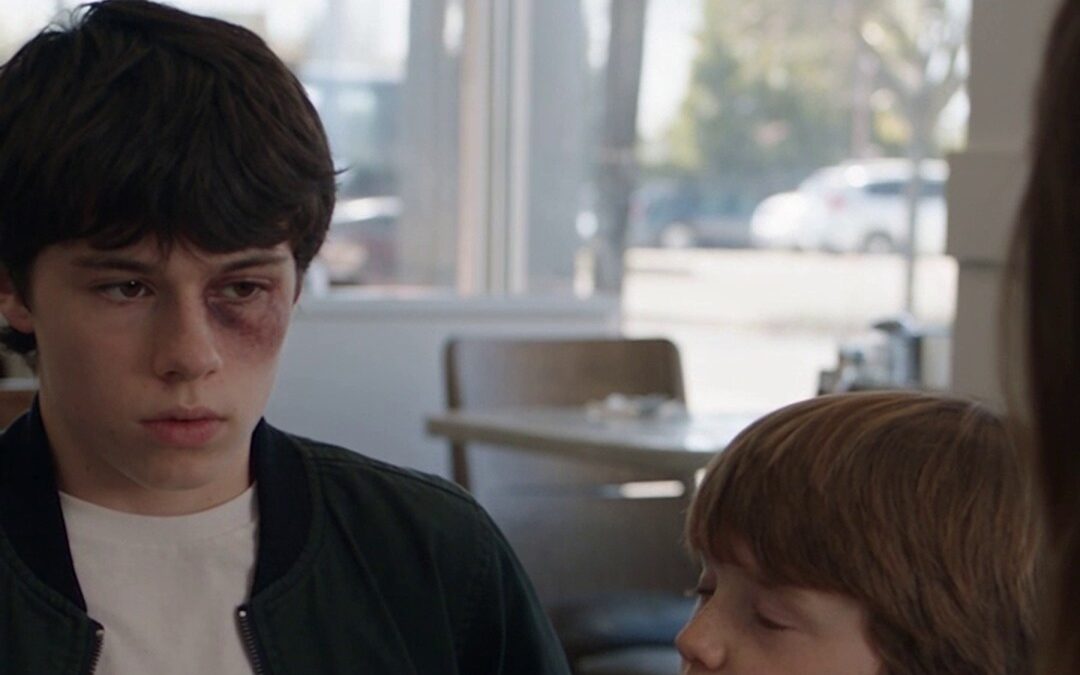
Then she saw the fading bruise below the boy’s eye and the way he watched the front door.
“Nick took the blows Dad meant for me last night,” Thomas said, loudly enough that the server setting down Valerie’s water stopped beside their table.
Valerie looked at Thomas’s pale face, then at the spaghetti Nick had not touched.
“What happened?” she asked.
Nick pushed his chair back an inch.
“I can go,” he said.
“Please stay if you want to,” Thomas said, leaving a clear path to the aisle.
Nick was thirteen, Thomas told her, and they had met at the public library’s chess table the week before.
Yesterday evening, Daniel had taken Thomas through the parking garage beside the library after a school robotics meeting.
“Dad got mad because I saw something on his tablet,” Thomas said, his eyes fixed on the table.
Nick said he had been crossing the garage when he heard Thomas shout.
“He had Thomas against the wall,” Nick said.
Valerie remembered Thomas refusing Daniel’s offer of a ride to practice last month, and the sleeve he had pulled over a wrist Daniel said he had sprained in gym.
Nick’s hand slipped inside his jacket, where the cracked corner of an old phone showed above his pocket.
A security guard had come, Thomas said, but Daniel had taken him home before he could speak to his mother alone.
“Why didn’t you tell me when you got home?” Valerie asked.
Thomas glanced toward the entrance.
“Dad said you believed him when I told you about my wrist,” he said, “and he said you’d believe him again.”
Valerie had called the gym teacher about that wrist but had accepted Daniel’s explanation when the teacher said he knew of no accident.
She had never gone back to Thomas.
“I asked Nick here because I promised him lunch,” Thomas said, “and because I thought you’d listen if he was here.”
The bell above the door rang, and Daniel entered in his navy work coat, smiling at the hostess until he recognized Nick.
He came toward the table without hurrying.
“That’s the kid from the garage,” he said, turning to Valerie. “I told you someone jumped us, and now he’s brought that kid to you to make sure you don’t hear what really happened.”
Chapter 2: A Place Kept Open
Valerie rose before Daniel reached Thomas’s chair.
“Stay there,” she said.
Daniel stopped with one hand on the empty chair across from Nick.
“Val, I’m trying to explain.”
“You can explain from there.”
The server, Elena, still held the water pitcher, and Valerie asked her to get the manager and leave the plates where they were.
Thomas stood close enough to Nick that their shoulders almost touched, while Nick watched the side aisle as if measuring the distance to it.
Daniel followed Valerie’s glance to the bruise below Nick’s eye.
“That’s what happens when you charge a grown man in a parking garage,” he said.
Nick’s hand closed around the phone in his pocket.
Valerie wanted to demand an explanation, but Nick’s chair scraped backward.
She turned to him instead.
“You can sit somewhere quieter, or stay here, and you don’t have to answer him,” she said.
“I’m not answering him,” Nick said, though his fingers had gone white.
Lena, the manager, came from the kitchen and took in the untouched meal, the two boys, and Daniel’s hand on the chair.
Valerie knew her from years of lunches between print jobs, but she had never asked Lena to handle anything harder than a late order.
“Could we use the small room by your office while you call emergency services for a medical check and an officer?” Valerie asked.
Daniel lifted his hand.
“Over a misunderstanding?”
“Over what the boys have told me and what I can see,” Valerie said.
Lena said the room was free and asked Elena to make the call away from the dining tables.
Thomas looked up at Valerie.
“Are you coming?”
“Yes.”
Daniel stepped aside as they passed, though he looked directly at Nick.
“He knows what he did,” Daniel said.
Nick flinched, and Valerie stopped.
“Give us space,” she told Daniel.
Lena directed him toward the front of the restaurant, where he could wait if he wished, and he followed her with the composed expression he used on angry customers at Valerie’s print shop.
The small room held four mismatched chairs and shelves of spare menus.
Valerie let the boys choose seats before taking one near the door.
Nick remained standing.
“Is he coming in?” he asked.
“No, and Lena knows we need the room to ourselves,” Valerie said.
“I don’t want him seeing me leave.”
“We can ask the officer to help us leave separately.”
She wanted to tell him he was safe, but Daniel was still in the building and Nick had no settled place to go afterward.
Elena brought water, asked whether they needed anything else, and left when both boys shook their heads.
Thomas held his glass without drinking, and Valerie noticed a red mark at the base of his neck.
“Does that hurt?” she asked.
“A little.”
“We’ll have someone look at it.”
Thomas nodded, then glanced at Nick as if he needed permission to admit pain when Nick looked worse.
Valerie kept her hands on her side of the table.
“I’m sorry I asked why you didn’t tell me before I told you I would help,” she said.
Thomas studied the water.
“I thought you were going to call Dad.”
“I’ve done that before when you told me something felt wrong, and I should have listened to you longer first.”
Nick finally sat, keeping his jacket zipped.
Outside, someone asked for extra bread, and plates struck the service counter.
The ordinary noise let the boys sit without explaining themselves to the dining room.
Two paramedics arrived before the officer, and Valerie asked Thomas whether he wanted her beside him while they checked his neck and shoulder.
“Yes,” he said.
Nick said no when a responder asked to look beneath his jacket.
She accepted his answer, explained why pain after a blow could matter, and asked whether there was another adult he trusted.
“I know Marisol at the library,” Nick said. “She works the desk on Thursdays.”
It was Saturday.
“We can try to reach her,” Valerie said.
Nick allowed the responder to check his eye and the visible part of his forearm, but he pulled away when she came near his ribs.
She stopped and recommended that both boys be examined at the hospital that afternoon.
After she stepped out, Thomas whispered, “Dad’s going to say Nick started it.”
“He already has,” Valerie said.
“I didn’t hit anybody.”
“I hear you.”
Officer Price arrived and asked Lena for a place to speak with Daniel apart from the boys.
Lena offered the far end of the dining room and closed the office door between them.
Price introduced herself to the boys, then explained that she would speak to each of them separately and contact a child services worker about Nick’s care.
“They’ll send me back,” Nick said.
“I can’t decide where you stay, but I can make sure the worker hears why you’re worried,” Price said.
Valerie nearly offered Nick a bed at her house, then remembered that Daniel had access to that house.
“Would you like me here while you talk?” she asked him.
“No, and Thomas can’t be here either, right?”
Price said she wanted to hear from each boy separately.
Nick rubbed the cracked corner of his phone.
“I’ve got something on this,” he said.
Thomas looked at him quickly, and Valerie remembered seeing the phone before Daniel entered.
Nick set it on the table but kept two fingers on the case.
“It isn’t the whole thing.”
Price asked when he had started recording.
Nick said he had been walking across the garage’s lower level toward the library stairwell when he heard a man tell a boy to stop talking about his mother’s money.
“I knew Thomas’s voice from chess, and I thought the man might stop if he saw me with a phone,” Nick said.
“Did he see it?” Price asked.
“I don’t think so.”
Nick’s aunt had given him the old phone two birthdays earlier, and Marisol sometimes let him charge it at the library desk while he played chess.
He had unplugged it before the library closed the previous evening, leaving enough battery to make the recording and keep the phone with him overnight.
Price offered to listen after Nick explained it or to hear it with him present.
Nick chose to stay, but asked that Valerie and Thomas wait outside.
Thomas rose immediately, and Valerie followed, though she wanted badly to hear the file beside Nick.
Lena found them chairs in the hallway.
Across the restaurant, Daniel spoke to another officer with his palms open and his head tilted, a pose Valerie had long mistaken for patience.
Thomas saw him and turned his chair toward the wall.
“Dad said he knew the guard,” Thomas said.
“Did he?”
“I don’t know.”
“What did the guard say to you?”
“He asked if I was okay.”
“And what did you say?”
“Yes, but Dad was right there.”
Valerie thought of Daniel’s account over breakfast: a boy had demanded money, Thomas had panicked, and a guard had separated them before anyone was badly hurt.
Daniel had said Thomas was asleep when Valerie left for the shop.
She had looked toward their son’s closed bedroom door and gone to work.
“I heard what your father told me,” she said. “I didn’t open your door.”
“I wasn’t asleep.”
Price called them back after Nick agreed Valerie could hear the recording.
The file lasted less than two minutes.
At first Valerie heard cars and footsteps, then Daniel’s distant voice saying, “You tell her about that screen, and she’ll think you went through my things.”
Thomas answered too faintly to understand.
Daniel came closer to the microphone.
“I said give me the tablet.”
A scrape and a burst of wind obscured the next sounds, followed by Thomas crying out.
Nick’s voice sounded close to the phone.
“Let him go.”
Daniel said, “Get away from us.”
Cloth rubbed against the microphone, footsteps struck concrete, and Nick made a short startled noise.
A man farther away shouted, “Hey, break it up,” before a thud, another scrape, and the end of the file.
Valerie had to unclench her jaw to speak.
“What happened after that?” Price asked Nick.
“The guard came over, and Mr. Daniel let go of my wrist when the guard told him to.”
Nick showed her his left wrist.
The responder had noted swelling there, though Valerie knew the swelling alone could not identify who had caused it.
Price asked whether Nick had changed the file.
“I stopped it when I picked the phone up, and that’s all I did.”
She documented its time and name, then explained how she could arrange a copy while preserving the original.
Nick agreed when she said he could keep the phone for now.
Price named the limits plainly: the file captured Daniel demanding the tablet and Nick telling him to let Thomas go, but it did not show anyone’s position or identify the source of every sound after the microphone was covered.
Valerie had wanted the recording to leave no room for doubt.
Instead it exposed the question Daniel had avoided when he told her a stranger had demanded money: why had his own voice been demanding something from Thomas?
When Price stepped out to contact the garage guard, Nick tapped the phone.
“I need this because my aunt’s number might be in it,” he said.
“Then we’ll tell the care worker,” Valerie said.
“She changed numbers.”
“We can give them her name.”
Thomas returned from his separate conversation with Price and sat farthest from the door.
He said he had given his account but worried he had misunderstood what he saw on Daniel’s tablet.
“Dad was showing me a picture from robotics, and a message popped up with forty-eight thousand dollars and your shop name,” Thomas said.
“That would frighten me too,” Valerie said.
“It said Harbor Ledger underneath.”
The name meant nothing to her.
“Dad swiped it away, and when I asked if you knew, he said I was reading business I didn’t understand.”
“Did you see money move?”
“No.”
Valerie was relieved that he had not tried to turn a glimpse into certainty.
“He said you’d ask him about the shop if I made you worry, and then he’d tell you I’d been snooping again,” Thomas said.
“Again?”
“Like with my wrist.”
Valerie remembered the gym teacher saying he knew of no accident, and Daniel’s irritation that she had called him.
That night Daniel had said Thomas was embarrassed after roughhousing and had lied to avoid trouble.
Valerie had told Thomas to be honest next time.
“He used what I said to make you afraid of telling me,” she said.
Thomas nodded.
“I should have asked you what happened when your father wasn’t there,” Valerie said. “I’m sorry I didn’t.”
“Would you have believed me?”
She could not give him a repaired version of last month.
“I don’t know what I would have done then, but I’m listening now and I’ll keep listening,” she said.
Thomas looked at Nick.
“Dad will say Nick wanted money.”
From the dining room came Daniel’s voice, raised enough to carry through the door.
“He met my son at the library, got him to invite him to lunch, and followed us into the garage.”
Nick stood so fast his chair struck the wall.
“I should leave.”
Valerie stayed clear of the doorway.
“You can choose where you sit, and Officer Price can help us arrange for you to leave without seeing him,” she said.
“He’ll say I planned it.”
“We’ll tell them what each of you remembers, and they’ll check what they can.”
“I don’t want to be checked like a package.”
“I’m sorry, that was a poor way to say it.”
Nick gripped the chair back.
Thomas said, “You can have my spaghetti.”
“I’ve got my own,” Nick said.
Lena came in with the covered plates and asked whether the boys wanted them now or later.
Nick said later, then asked whether she had garlic bread.
She did, and Valerie watched him make the request without looking toward Daniel’s voice.
Price returned with a name: Ellis, the evening guard at the garage.
His log recorded a disturbance at 6:18 p.m., two boys, one adult, and a call to his supervisor.
He had not called police.
Daniel had identified himself as Thomas’s father and said Nick had grabbed at his son.
Ellis was working across town, but he had agreed to speak with Price.
“He should have called,” Price said.
“Why didn’t he?” Valerie asked.
“He says both boys said they were okay and the father said he was taking his son home.”
Thomas turned toward the wall.
Price did not ask him to defend what he had said with Daniel beside him.
Ellis’s log also said that when he arrived, Nick stood between Thomas and Daniel, who was holding Nick’s left wrist.
Ellis saw Daniel release it after being told to.
He had not seen who first struck whom.
“I rushed in,” Nick said. “Thomas was against the wall.”
Price wrote that down.
Daniel could use the same movement to claim Nick had attacked him, and Valerie understood why its order mattered.
Ellis had separated them and offered to call someone for Nick, but Nick had refused to give a name.
“I thought they’d send me back,” Nick said.
Price said the care worker would need to hear why.
Daniel had driven Thomas home and kept his tablet overnight, saying he needed to check what Thomas had read.
Thomas’s own phone had been broken since spring, and Valerie had worked at the shop until after nine.
When she came home, Daniel had met her in the kitchen with his account before she reached Thomas’s room.
“I heard your keys,” Thomas said. “I waited.”
Valerie gripped the table.
“I should have come upstairs.”
“You had work.”
“That explains where I was, but it didn’t make finding me your job.”
Nick did not give a full account of where he had slept, telling Price only that he had spent part of the night at the downtown transit building.
He had come to Bell Street Grill at noon because Thomas had written its name on a library checkout slip after Ellis separated them.
“I said he could come even if he didn’t want to talk about the garage,” Thomas said.
“You said the garlic bread was good,” Nick added.
“It is.”
Nick pulled the folded slip from his phone case and laid it on the table.
Valerie recognized Thomas’s uneven block letters: the restaurant name and Saturday at noon.
The note did not prove what happened in the garage, but Nick had come to a meeting Thomas had arranged.
It was a part of Daniel’s story the boys could answer without asking anyone to guess at their motives.
Renee Ward, the child services worker, arrived while they ate the garlic bread.
She introduced herself to Nick first and asked where he wanted to speak.
He chose the small room with its door open, and Valerie waited outside with Thomas.
She resisted the urge to tell Renee that Nick was brave, as if that made his need for a safe place more urgent.
After speaking with him and checking his file, Renee said Nick had left a temporary foster home two nights earlier.
He reported that the carer’s visiting adult brother had cornered him during an argument and grabbed his backpack hard enough to tear its strap.
The carer had been out, and Nick feared she would believe the brother’s claim that Nick had stolen from him.
Renee would verify the account and arrange for Nick to stay elsewhere while it was reviewed.
“I won’t go back there tonight?” Nick asked from the doorway.
“You won’t be sent there tonight, and I’ll tell you where you’re going as soon as it’s arranged,” Renee said.
Nick looked at Valerie, as though waiting for a bigger promise.
She did not make one.
Renee asked about the aunt Nick had mentioned.
Nick gave her aunt’s full name, a Pennsylvania town, and a red porch swing that had broken when he was eight.
He did not know her current number.
“A family search worker can check your file and contact her if we find her,” Renee said.
“She wanted me before,” Nick said.
“We’ll ask her and find out what happened,” Renee said.
Valerie wished she could hand Nick a plane ticket and end the waiting.
Instead she asked whether he wanted her to call Marisol.
He did.
Marisol answered on the third ring, knew Nick immediately, and confirmed she had helped him charge his phone at the library’s chess table.
She knew nothing about the garage.
“Did you finally beat Thomas?” she asked Nick.
“Twice.”
“Once,” Thomas said, leaning toward the phone.
Renee arranged for Nick to be examined at the hospital with a worker accompanying him, while Valerie would take Thomas.
Price needed a few more questions answered before they left.
Daniel asked to speak with Valerie in the dining room.
Neither boy was asked to join them.
Price stood a few tables away while Valerie sat across from her husband.
“I know how this looks,” Daniel said.
“Tell me what you say happened.”
“I found Thomas looking at a payment screen he wasn’t supposed to touch, and I took the tablet back.”
“What payment?”
“An ordinary shop expense I’m helping you handle.”
After Valerie’s office manager went on leave in June, Daniel had been given access to prepare payments to approved vendors, though Valerie had to authorize new payees and transfers above five thousand dollars.
He handled invoices competently enough that the arrangement had seemed sensible.
“What was Harbor Ledger?” she asked.
“A vendor.”
“For what?”
“I don’t carry every invoice with me.”
“Was it forty-eight thousand dollars?”
“I don’t remember what Thomas saw.”
Valerie had heard him recall the exact cost of a supply order days earlier.
She kept that thought to herself.
“The boy followed us after Thomas and I disagreed,” Daniel said. “He came at me, I put an arm out, and the guard arrived.”
“The recording starts before Nick approaches you.”
“A recording made by someone who wanted something from us.”
“Thomas invited him to lunch.”
“Thomas had known him a week.”
Valerie herself had assumed Nick’s presence meant Thomas had invited a friend without asking, and she still knew little about him.
Neither fact explained Daniel’s demand that Thomas keep quiet about a screen.
“Why did you tell me Nick demanded money?” she asked.
“He asked our son for food, didn’t he?”
“That isn’t the same thing.”
“Thomas gets attached fast.”
Valerie thought of Thomas waiting upstairs for her keys.
“He needed me last night.”
“He had a father taking him home.”
“That didn’t answer me.”
Daniel sat back.
“You’re going to let a stranger use our son against us.”
Valerie could not settle every fact at a restaurant table.
She could decide Daniel would have no more private access to Thomas while those facts were checked.
“Thomas is leaving with me, and you can speak with the officer,” she said.
“You know I’ll contest anything you do.”
“I know.”
She returned to the small room and told Thomas they would go to the hospital.
“I told Dad you’re coming with me,” she said.
Thomas nodded.
“Is he going to lose his job at the shop?”
“He doesn’t have a job there, but I gave him account access and I’m reviewing it.”
“Because of what I saw?”
“Because it’s my responsibility to check.”
Lena put the boys’ meals and two pieces of garlic bread in paper bags.
At the back service entrance, Price confirmed Daniel was still with the other officer and would remain apart from the boys while they left.
The officers had not arrested him.
Thomas’s face briefly showed disappointment, then guilt.
“The interviews are happening, and the rest will take time,” Valerie told him.
Nick raised his garlic bread toward Thomas.
“Don’t let the noodles get weird.”
“They’re already weird.”
Renee walked Nick to her car, and Thomas watched until it turned onto Bell Street.
“Will he have to tell it again?” Thomas asked once he was in Valerie’s car.
“Probably, and the adults should make that as careful as they can.”
“I made him come there.”
“You invited him to lunch, and Daniel chose what he did in the garage.”
“He came between us anyway.”
Valerie could not make Nick’s choice safe or erase what it had cost him.
At the hospital, a clinician documented the mark on Thomas’s neck and the soreness in his shoulder.
When asked how he had been hurt, Thomas looked at Valerie.
“You can tell her in your own words,” she said.
He did.
Valerie called her office manager from the waiting room and asked her to hold new payments until she could review them with the bank and their accountant.
She gave no account of the garage to shop employees.
Then she called her sister June and asked whether she and Thomas could stay for several nights.
June lived across town and said yes before asking why.
“Are we going home for our stuff?” Thomas asked.
“We have enough for tonight, and I’ll ask an officer how to collect the rest safely.”
At June’s house, Thomas chose the room with the old model trains on its shelf.
He declined dinner, ate his garlic bread an hour later, and asked if Daniel knew where they were.
“Not from me,” Valerie said.
She sat on the floor beside his bed, leaving room for him to ask her closer.
“Will you have to tell Dad I lied about the wrist?”
“You told me what happened, and you don’t have to explain my part to him.”
“You said I should be honest.”
“I did.”
“I thought that meant I’d done something bad.”
“I’m sorry I left you with that,” Valerie said. “I was wrong to assume I understood.”
Thomas turned toward the wall.
Before she left, he asked if Nick had eaten any spaghetti.
“I don’t know, but we can ask Renee tomorrow if Nick wants us to.”
The next morning Valerie met her accountant, Priya Shah, at the print shop.
They reviewed the vendor list, pending payments, and drafts prepared through Daniel’s account.
Two entries named Harbor Ledger Services.
One proposed a new vendor for a forty-eight-thousand-dollar transfer, while the other attached a smaller draft payment to an equipment-maintenance invoice the shop had not ordered.
Neither payment had been authorized or sent.
Priya showed Valerie the approval history, which contained no confirmation from her.
“These records show what he prepared, but they don’t tell us why,” Priya said.
Valerie asked the bank to suspend Daniel’s access and preserve the records, using her authority as the business owner.
Priya documented what they had reviewed and gave her the name of a lawyer who could advise on the business records.
Only after that call did Valerie look around the shop: Monday’s school programs waiting by the press, paper stacked for an order Daniel had helped bring in, and a photograph of Thomas at the counter when he was six.
Daniel knew their suppliers and the customers who called him when Valerie was busy.
Removing his access would slow work and invite questions.
When the office manager arrived, Valerie said, “Daniel won’t handle shop accounts while we review payment records, so send anything he asks for to me.”
Her manager studied her face.
“All right.”
Thomas should never have had to weigh his safety against how well the shop ran.
Price called that afternoon after a fuller interview with Ellis.
The guard had been at the garage desk when a vehicle sensor chimed from the lower level, and he heard a boy call for help while going down.
When he reached the lane, Nick stood between Thomas and Daniel, and Daniel held Nick’s left wrist.
Ellis saw Daniel release it only after he told him to.
He saw Nick’s phone near a painted yellow line and watched Nick pick it up.
Daniel had said Nick attacked him, Nick had said Daniel was hurting Thomas, and Thomas had said he was okay while standing close to his father.
Ellis had written down those competing statements, then allowed Daniel to take Thomas home.
“I should have called an officer and medical help,” Ellis told Price.
His admission did not turn him into a witness to what he had missed.
The garage camera covered the entrance gate rather than the lower lane, and its time stamp placed Daniel’s car entering before Nick came down the public stairwell.
It could not show what happened between them.
Price asked Valerie to provide the shop records through the appropriate process, and Valerie said she would.
Thomas had seen enough to ask a frightening question, but not enough to establish that money had left the business.
Later Renee called with a medical update she was permitted to share.
Nick had bruising and a sore wrist, but no injury requiring admission.
He was staying in a temporary placement Renee had visited, with a carer who knew he needed quiet and a way to contact trusted people.
Nick had asked twice whether Thomas could send a message.
Valerie let Thomas dictate one for Renee’s work phone.
“Did you eat the spaghetti?”
Nick’s reply came minutes later.
“Tell him it was better cold than his chess openings.”
Thomas smiled for the first time since lunch.
On Monday, the bank confirmed it had preserved the pending-payment records, and the shop’s lawyer said Harbor Ledger’s contact details did not match any supplier they had used.
The lawyer advised Valerie to leave questions about the proposed payee to investigators.
That separation irritated her because she wanted one clear finding that would settle what Thomas had suffered.
It also kept her from making him responsible for proving a business case from a momentary glance at a tablet.
Daniel sent three messages that day.
The first asked to see Thomas, the second accused Valerie of damaging the shop over a boy she did not know, and the third offered to explain the invoice if she called him privately.
Valerie saved the messages and sent them to her lawyer.
She did not show Thomas.
That evening, June drove her to the house after an officer explained how she could collect necessities while Daniel was away.
Valerie packed Thomas’s school things, medication, blue sweatshirt, and chess set, along with her own clothes and business laptop.
She did not search Daniel’s drawers.
In the hallway she saw Thomas’s broken phone in a basket of keys and wondered briefly whether fixing it months ago would have changed Saturday.
The phone had been broken a long time.
Thomas’s silence had come from fear and from what Daniel had taught him to expect when he spoke.
At June’s house, Thomas asked whether they were moving out forever.
“I don’t know where we’ll live later, but we’re staying here while I work out what comes next,” Valerie said.
“Dad says Aunt June hates him.”
“June is helping us.”
“He’ll say she made you do this.”
“He can say that, but these are my decisions.”
Thomas turned a chess knight in his fingers.
“Do I have to hate him?”
“No.”
“Do you?”
“I’m angry at what he did, and you don’t have to feel exactly what I feel.”
A week later, Price arranged an interview for Thomas at a child advocacy center.
Valerie waited in a separate room while a trained interviewer spoke with him.
She had been told not to rehearse his answers, though in the car Thomas asked what he should say about the tablet.
“What you remember, and it’s okay to say when you don’t remember,” she told him.
Afterward Thomas said he had described Daniel’s shoes near Nick’s phone when it fell.
He had also told the interviewer he did not see Daniel strike Nick’s face because he had covered his own head.
Valerie thanked him for telling her and left it there.
She was beginning to hear how often her old questions had carried the answer she wanted.
Priya helped provide the account records to the investigator handling the financial complaint.
The investigator later told Valerie that Harbor Ledger had been created recently and was linked through records to an account Daniel controlled with another person.
More review was needed to determine what either person meant to do with the money.
Valerie knew Daniel had prepared a transfer she had not approved, and she knew his voice on Nick’s phone told Thomas to keep quiet about the screen.
She did not ask Thomas to carry either investigation beyond what he had already said.
Daniel’s lawyer sent a letter disputing both accounts.
Daniel maintained that Harbor Ledger was legitimate and that he expected Valerie to approve an equipment purchase after he explained it.
He also claimed Nick had befriended Thomas for free meals and provoked the confrontation.
The equipment named on the invoice was absent from every purchase order, and the shop had no place for it.
Priya noted those facts, then let Valerie’s lawyer handle the letter.
That evening Valerie told Thomas only that adults were checking the records.
“Will Dad be arrested?” he asked.
“I don’t know.”
“Would it be my fault?”
“No.”
“You say that every time.”
“Because you keep having to ask.”
He turned the crooked knight in his hand, then set it down.
Renee’s family search worker found Nick’s aunt through an old contact in his care file.
Tessa Moreno lived outside Harrisburg, Pennsylvania, and Nick had spent several summers with her while his mother was alive.
After his mother died, Tessa had asked to care for him, but his first county placement began before the process for moving him across state lines was completed.
Tessa later moved for work, and her updated address reached one office but not the worker handling Nick’s subsequent moves.
Renee was checking the file, speaking with Tessa directly, and arranging the assessment required before Nick could live in another state.
Tessa remembered the broken porch swing.
She also remembered that Nick ate the middle of a sandwich first and saved the crusts.
Nick asked to speak with her alone.
Afterward he told Renee he wanted to go if she still wanted him.
Renee said Tessa did, and explained that wanting each other was the beginning of the process.
Workers in Pennsylvania would assess her home, and Tessa would need a plan for Nick’s school and care.
Nick asked how long it would take.
Renee gave him a range of weeks and warned that it could take longer.
“I can count weeks,” Nick said.
Valerie heard about the conversation in a permitted update and did not ask for what Nick had kept private.
At Bell Street Grill, Lena offered to save a table if the boys wanted to meet.
Valerie thanked her, then waited until Renee had checked with Nick and his carer.
Their first visit, three weeks after the disclosure, took place at the library instead.
Valerie sat where she could see the chess table without hearing every move they disputed.
Nick wore a green jacket that fit him.
She stopped herself from making it the first thing she mentioned.
“You brought the crooked knight,” Nick said when Thomas opened the board.
“You kept complaining about it.”
“It’s a bad piece.”
“You still lose to it.”
Nick grinned, noticed Valerie watching, and looked down.
She returned to her book.
After the game, Nick asked if Daniel had come near Thomas.
“No,” Thomas said.
“Good.”
Thomas moved a pawn between two squares.
“I miss when he used to take me to baseball.”
Nick did not tell him he shouldn’t.
“We can play next week,” he said.
Thomas looked relieved that he could miss his father and remain Nick’s friend.
The next week Daniel’s lawyer challenged the garage account again.
Daniel said Nick’s recording omitted his first request that Nick leave, and he claimed Ellis had seen Nick rush toward him.
He also suggested Thomas’s neck had been marked when he stumbled after Nick startled them.
Price asked Ellis whether he had seen Nick rush at Daniel.
Ellis said he had arrived after Thomas called for help and had seen Nick already between them.
Nick himself had said he rushed in, but Ellis could not claim to have seen that movement.
The mark on Thomas’s neck could not identify its cause by itself.
Thomas had told the interviewer Daniel held him against the wall before Nick approached, while Nick’s recording began with Daniel demanding silence about the screen and then the tablet.
The timing of the file, the boys’ separate accounts, and Ellis’s later observations supported an order in which Daniel confronted Thomas before Nick intervened.
There was no perfect view of every second.
Valerie learned to trust the connected evidence without asking any one piece to do more than it could.
Price later told her prosecutors had filed charges related to the garage assault and intimidation.
The filing was not a conviction, and the financial inquiry continued separately.
An interim court order limited Daniel’s contact with Valerie and Thomas while family proceedings moved forward.
Valerie filed for separation and sought a temporary parenting arrangement.
Her lawyer told her hearings and decisions would take time.
At one meeting, Valerie was asked why she had not reported Thomas’s wrist injury weeks earlier.
“I accepted Daniel’s explanation after the gym teacher said he knew of no accident, and I never asked Thomas again when Daniel was out of the room,” she said.
She could have described the shop’s rush orders and her habit of trusting Daniel with practical things.
Those details were true, but they did not replace the opening she had missed.
Thomas found another opening for her after school one afternoon.
Someone had called his father a criminal, and Valerie began to ask who had said it so she could call the school.
“I don’t want you to fix them,” Thomas said. “I want to be mad.”
She sat at the kitchen table.
“Okay.”
He stood for a moment, uncertain what to do with permission.
“Sometimes I’m mad at Nick too,” he said.
Valerie waited.
“If he hadn’t come, maybe Dad would have stopped before anybody saw.”
“Do you think so?”
“I don’t know.”
“You can be angry about what happened without deciding what it means about Nick tonight,” she said.
Thomas went to his room and returned ten minutes later for a snack.
“Does Nick like peanut butter crackers?” he asked.
“I don’t know.”
Thomas wrote it down to ask him.
Nick had a difficult care meeting of his own.
The carer from his earlier placement disputed his account of her brother’s visit, saying she had not known about the torn backpack and had never allowed her brother to discipline children.
Renee was checking who had been in the home and when.
Nick feared that one adult’s disagreement would convince Tessa he was troublesome.
At the next library visit, he showed Thomas the sewn backpack strap.
“They think if it’s fixed, it didn’t happen,” he said.
Thomas looked at Valerie.
“Renee is still checking, and the repair doesn’t erase what you reported,” Valerie said.
Nick pushed the bag under his chair.
“Tessa asked if I want blue walls or white walls.”
“What did you say?” Thomas asked.
“Neither.”
“Then what?”
“Yellow, maybe.”
“Yellow’s terrible for chess.”
“Good, maybe you’ll lose there.”
They returned to the board.
Valerie thought of the adults who called Nick a witness, a placement, or the boy who had helped Thomas.
None of those descriptions included his dislike of blue walls.
She asked Renee what support Nick would have whether or not he could continue with the garage case.
“His care plan doesn’t depend on being a witness,” Renee said.
Valerie offered to help with a practical barrier if the care team identified one.
Renee thanked her and said the current needs were steady contact with Tessa and time for the assessment.
Valerie could make sure Thomas was available for agreed calls and visits.
She could not buy the weeks away.
In late November, Tessa came to town for an in-person visit arranged through the care team.
Nick chose the library as their meeting place, and Valerie was not part of it.
Later Renee said Nick had shown Tessa the chess table and complained about its missing black pawn.
Tessa had brought one from a travel set she bought on her way.
Nick had not hugged her on arrival.
He had hugged her before she left.
He told Thomas afterward that Tessa smelled like oranges because she kept one in her coat pocket.
“That’s weird,” Thomas said.
“I know,” Nick said.
Valerie heard affection in both answers.
The Pennsylvania assessment took several more weeks.
Tessa provided references, met with workers who would support the move, and discussed a school transfer.
Nick remained in his temporary placement while the checks were completed.
His previous placement received a separate review of the visiting brother and Nick’s report.
Valerie was told only that Nick would not be returned there and that the agency was addressing what it could establish.
The limited answer frustrated her, but the rest of that account belonged to Nick and the people responsible for his care.
Meanwhile the print shop kept running.
Valerie paid Priya for extra hours, handled approvals herself, and lost one customer who preferred dealing with Daniel.
She explained the slower invoice process to her employees without sharing Thomas’s story.
The pending Harbor Ledger transfer never left the account.
Investigators continued examining the invoice and proposed payee, while Daniel’s lawyer maintained he had intended to discuss the expense with Valerie.
A later records review found no equipment order or delivery arrangement, along with messages in which Daniel pressed the other account holder to have the account ready before the week ended.
Through her lawyer, Valerie learned those findings supported an attempted diversion of shop money.
They did not determine what had happened in the garage.
Priya suggested separate folders, one for the business records and one for Thomas’s safety arrangements.
The folders sometimes sat side by side on Valerie’s desk, but Thomas was not asked to carry either.
In December, Daniel requested contact with Thomas through the family case.
A counselor explained the request to Thomas and asked how he felt.
He came home quiet.
“I want to see him someday, but I don’t want to be alone with him,” he told Valerie.
“I’ll pass that on through the people making the contact plan.”
“Will you be mad if I want to go?”
“No.”
“Will Nick?”
“You can ask him if you want, but you don’t need his permission to have feelings about your father.”
“I don’t think I’ll ask him.”
Thomas went to his room with the crooked knight.
The interim limits remained in place while the allegations and any contact plan were assessed.
Valerie told Thomas about changes that affected him and let him keep the rest of his day.
Near the end of the year, Renee called to say the Pennsylvania assessment had been approved.
Nick would move after his school and medical records and travel plan were ready, with Tessa coming to bring him home.
Renee had asked Nick about the timing.
He wanted to finish the library chess tournament first.
“That sounds like him,” Valerie said.
“He asked if Thomas could watch,” Renee said.
Thomas did.
The tournament used folding tables and a whiteboard for the players’ names.
Nick lost his first game, won two after it, and argued with Thomas about whether his final move had been brave or foolish.
Valerie stood at the back beside Tessa, who wore work boots and had an orange in her coat pocket.
“I’m grateful to your son,” Tessa said.
“I’m grateful Nick is here,” Valerie answered.
Tessa watched the boys.
“He thinks I’ll change my mind when he has a bad week.”
“What do you tell him?”
“That we’ll have bad weeks, and then I tell him what time I’m picking him up.”
Valerie liked that Nick could check whether the promise held.
Before the move, Thomas gave Nick a travel chess set with its pieces counted twice.
Nick gave Thomas the black pawn Tessa had brought to the library.
“She said I could,” he added.
They arranged to play online on Sundays when Nick’s schedule allowed it.
Thomas promised to keep the crooked knight for their next game in person.
Nick called the knight a disgrace to horses everywhere.
They hugged quickly, each looking over the other’s shoulder.
Tessa waited near the door with Nick’s coat.
“Does Lena still make that garlic bread?” Nick asked Valerie.
“Yes.”
“When I visit, I want the whole basket.”
“We can ask her.”
He looked satisfied with the size of the promise.
Three months after the first lunch, Nick returned to Bell Street Grill with Tessa for a weekend visit.
The garage case was still proceeding, and Valerie’s separation had not become a final divorce.
Those unfinished things came with them, along with an argument about their last online chess game.
“He touched the piece and changed his mind,” Nick told Tessa.
“I touched the table,” Thomas said.
“With the piece.”
Lena led them to a booth near the window.
Tessa sat where she could see Nick without crowding him, and Valerie sat beside Thomas.
Nick ordered spaghetti and a whole basket of garlic bread.
He ate several bites before the bread arrived.
Thomas noticed but did not announce it.
Halfway through lunch, the front door opened hard enough to ring its bell twice.
Nick’s fork paused above his plate.
A delivery driver came in carrying a box of paper towels.
Tessa asked if Nick wanted more water, and he said yes.
He put down his fork while Elena filled the glass, then picked it up at his own pace.
Thomas slid the crooked knight across the table.
“You left this at my house,” he said.
Nick examined it.
“Keep it, because I need something easy to beat next Sunday.”
Thomas set the piece beside Nick’s plate anyway.
When they got up to leave, Nick wrapped the remaining garlic bread in a napkin and tucked the knight beside it, leaving the seat across from Thomas open for their next game.








