The Boy Outside My Daughter’s Private School Wore a Hospital Wristband With the Name of the Son I Buried
Chapter 1: At the Iron Fence
The boy in the gray hoodie ducked as a red-striped paper cup emptied across his blue backpack.
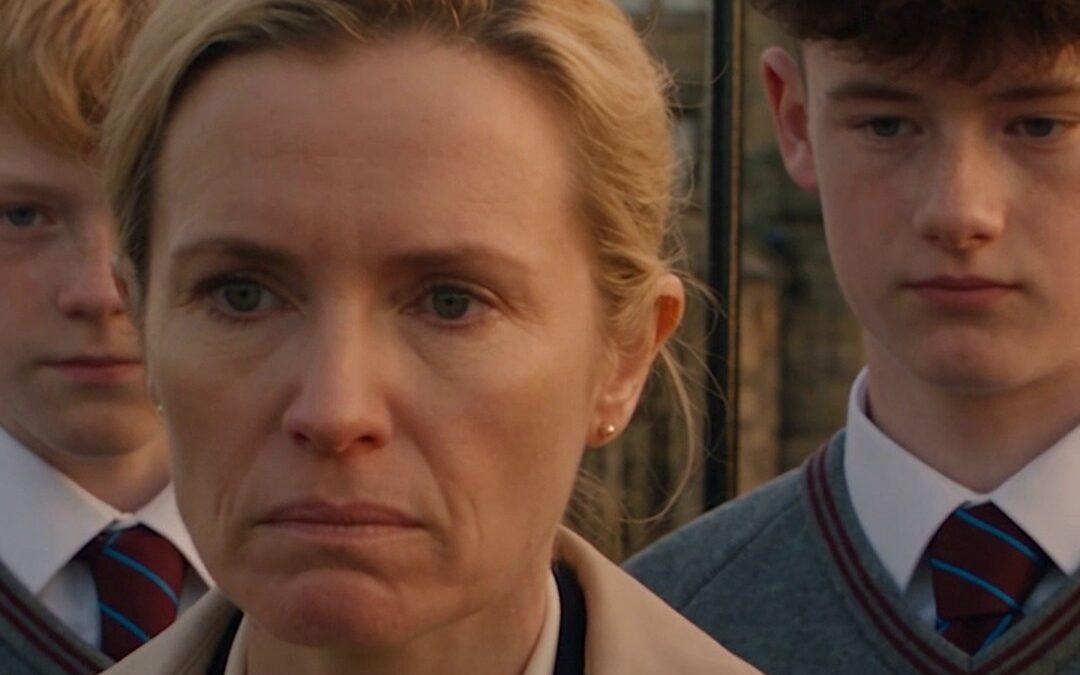
Three boys in navy blazers stood over him beside Bellweather Academy’s black iron fence, their school crests bright against the stone pillars.
“Pick it up with your teeth,” one said.
I had come for my daughter, Lily, who caught my hand as I moved toward them.
“Mom, that’s Noah,” she whispered.
The boy’s messy brown hair fell across his face, but something in his eyes stopped me before I reached him.
I knew those eyes, or thought I did.
“Move away from him,” I told the boys.
One laughed until he recognized Lily’s mother, and then all three remembered appointments elsewhere.
Noah stayed crouched over his bag, gathering a notebook whose pages had gone translucent with juice.
“I can buy you another,” I said.
“I didn’t ask,” he replied.
Lily slipped off her blazer and held it above the notebook to shade it from another dripping cup.
Noah looked at her, then back at me, suspicious of the resemblance he might have noticed too.
When he pulled the notebook free, his sleeve slid up.
A blue plastic band circled his wrist.
NOAH — ST. MATTHEW HOSPITAL.
The letters seemed to lift off the band and strike me.
Thirteen years earlier, I had carried a baby named Noah out of St. Matthew in my arms; three months later, I had carried his ashes home in a cardboard box.
I reached into my handbag for the black-and-white photograph I kept behind my wallet.
It showed me at twenty-three, blonde hair pinned badly, holding my newborn son while his father leaned into the edge of the frame.
I had carried it so long that the corners felt soft as cloth.
Noah rose slowly, his gaze fixed on the photograph instead of my face.
“Where did you get that?” I asked, pointing to his wrist.
“At a hospital,” he said.
“When?”
“Yesterday.”
I heard myself say, “Who are your parents?”
His expression closed.
A school security officer came through the gate and asked Noah to leave the entrance clear.
I said he could stand with us, but Noah backed away before the officer finished speaking.
Then Lily touched the photograph.
“That’s Dad’s watch,” she said.
Noah looked at the thin silver watch on the man at the photograph’s edge.
“He still has it,” he said.
Chapter 2: What the Records Held
Noah pulled his sleeve over the band, but he kept looking at the photograph.
I wanted to ask how he knew Daniel’s watch, but the school security officer stood beside us with his radio against one shoulder.
“Claire, dismissal has to keep moving,” Mr. Ortiz said.
“The boys poured a drink on his things,” I said.
“I saw the end of it, and I have their names.”
Noah tightened his grip on the wet backpack strap.
“I can go,” he said.
“No one is asking you to go because of them,” Mr. Ortiz replied.
Noah’s expression told me the distinction did not matter from his side of the fence.
Lily still held her blazer above his ruined notebook.
“Can he sit inside while you call someone?” she asked.
“No calls,” Noah said quickly.
The hospital band was too new for the rest of him, and I had already asked more than he wanted to answer.
“I won’t call anyone without telling you who,” I said.
“You already asked about my parents.”
“I’m sorry.”
He looked toward the buses pulling away from the curb.
“Then you know enough.”
He walked off with juice dripping from his backpack, and I stopped Lily when she started after him.
Whatever I suspected gave me no right to collect him from a sidewalk.
Mr. Ortiz watched Noah reach the corner.
“He’s been here three afternoons this week,” he said.
“Why?”
“He told me he was waiting for somebody.”
“Did he say who?”
Mr. Ortiz glanced at Lily.
“He asked what time your father usually picks you up.”
Lily’s hand went rigid in mine.
Daniel had stopped collecting her on weekdays after our divorce, though he still came for some Fridays and school events.
He served on Bellweather’s fundraising committee, and his photograph appeared regularly in the school newsletter.
We watched Noah board a city bus.
Inside, I reported the boys, and the head of the lower school promised to preserve Mr. Ortiz’s account and contact their families.
The school could address what its students had done, but it could not tell me where Noah slept.
In the parking lot, Lily climbed into the back seat with my photograph on her knees.
“You thought he was your Noah,” she said.
I started the car, then turned it off.
“I thought something impossible for a minute.”
“Because of his name?”
“Because of his face.”
She studied the baby tucked against my chest.
I had shown her the picture before, but never explained why I carried it on ordinary days.
“Your brother died when he was three months old,” I said.
“I know.”
“His name was Noah.”
“I know that too.”
She placed the photograph between the pages of a library book so its corners would not bend.
“You don’t have to tell Dad yet,” she said.
“Why would you say that?”
“Because that boy knew Dad’s watch, and you looked scared when I said it.”
That evening, after Lily went to bed, I called Daniel.
He answered from his car, judging by the hollow sound behind his voice.
“Did you go to Bellweather today?” I asked.
“No.”
“Has a boy named Noah tried to reach you there?”
The hollow sound vanished as he stopped moving.
“Why?”
“There was a boy outside the gate, and he knew your watch.”
“Claire, you’ve had a shock.”
“That isn’t an answer.”
“Do you know how long I’ve worn that watch?”
“Thirteen years.”
“Exactly.”
I looked at the photograph on the kitchen table.
In its black-and-white grain, his watch was a pale slash beneath his cuff.
“Who is he?” I asked.
“I don’t know who you met.”
“His name is Noah.”
Daniel was silent.
Then he said, “Keep Lily away from him until you know what he wants,” and ended the call.
I sat beside the old refrigerator while it rattled through its cooling cycle.
Daniel had offered a warning instead of surprise.
That established nothing about the boy, but it gave me a reason to keep asking.
I took the metal file box from beneath my bed and found my son’s birth certificate, pediatric appointment cards, death certificate, and cremation receipt.
Our Noah, Noah Bennett Hale, was born in April 2013 and died that July of a congenital heart condition.
St. Matthew had treated him from birth, and I had held him there for the last time.
The boy at the fence looked about twelve.
He could share a name and hospital with my child, but he could not be the baby whose death a physician had pronounced in front of me.
Grief had reached for his familiar face before reason did.
The next morning, I called St. Matthew and asked how to request my maternity records and my son’s pediatric records.
The clerk explained the forms and warned me that older paper files might take time to retrieve.
She would not discuss a current patient over the phone.
I ran a small print and binding shop two blocks from the county courthouse, where missed deadlines cost me customers I needed.
I let Tessa open, then drove to the hospital records office with my license and the documents showing I was my son’s mother.
At the counter, I asked whether a photograph of a wristband could tell me anything about a child.
“If it’s his record, the right person can request it,” the clerk said.
“I’m trying to find the right person.”
She looked sympathetic, but she did not turn the hospital into a search service.
Outside, I called the county child welfare hotline.
I described Noah’s approximate age, the recent band, the bullying, and his repeated visits to the gate.
I said he appeared to need adult help; I did not claim to know where he lived.
The worker took the report and warned me that I might not be told what the agency did.
At pickup, Noah was gone.
Mr. Ortiz came through the gate carrying a folded incident form.
“The three boys have meetings with their parents,” he said.
“Have you seen Noah?”
“Not today.”
He looked toward the curb where Noah had crouched.
“He knew one of the committee fathers drives a silver car.”
Daniel’s car was silver.
“He asked whether that father came on Fridays,” Mr. Ortiz said.
That night I searched Bellweather’s public newsletters.
The September issue showed Daniel presenting a check from his real estate firm beside the head of school.
His watch faced the camera, and the caption identified him as Lily’s father.
Noah had not needed anyone’s private records to find him.
He had needed a library computer and the school’s name.
I printed the newsletter the next morning, finishing the menus due at noon before I went back to Bellweather.
Noah appeared across the street shortly before dismissal.
His gray hoodie had dried stiff around the cuffs, and he held his blue bag against his hip.
I crossed at the signal and stopped several feet away.
“I’m Claire,” I said.
“I heard.”
“I reported what those boys did.”
“I didn’t tell them to do that.”
“I know.”
He watched a bus pass without stopping.
“Did you find Daniel?” I asked.
“Your husband?”
“My former husband.”
That brought his eyes back to mine.
“Does Lily still see him?”
“Yes.”
He rubbed his thumb against the wristband.
“Did they leave that on at St. Matthew?” I asked.
“They forgot to cut it off.”
“Was someone there with you?”
“Aunt Renee.”
“Is she the person I should call if I’m worried about you?”
“She’s my aunt.”
“That wasn’t quite what I asked.”
He bent to adjust his backpack zipper.
“She took me in.”
I could hear Lily’s classmates gathering beyond the fence.
“Where is she now?”
“At work.”
“Noah, I’m asking because you were on the ground yesterday and nobody came when those boys poured a cup on you.”
“I got up.”
He said it as though getting up settled the matter.
“If you ever need a phone, you can use the one at my shop,” I said.
I wrote the number and address on a clean business card.
He put it in the side pocket of his bag.
“Tell Lily her blazer didn’t get wet,” he said.
Then he crossed away before she came out.
That night Daniel called to ask why Lily had asked whether he knew a boy in a gray hoodie.
“She heard us talk,” I said.
“She’s ten, Claire.”
“I know exactly how old our daughter is.”
“Then act like it.”
“What would you have me tell her?”
“That adults sometimes make mistakes about strangers.”
“Do you know Noah?”
“I’ve told you I don’t know the boy you met.”
The wording bothered me enough that I wrote it down after we hung up.
Daniel and I had once made a life from careful wording.
After our baby died, he handled the insurance calls because I could not bear to repeat the account of Noah’s last day.
Later, careful wording became how he won arguments without answering questions.
On Friday, the first packet from St. Matthew arrived.
It held my discharge notes from April 2013 and a hospital photographer’s order tucked among the copied pages.
I had forgotten that we bought a printed picture through the hospital’s family album service.
Both parents’ names appeared on the order, and the box beside “additional copies” was checked.
I remembered Daniel saying his mother wanted one.
She had died five years later, and I had never seen that second print.
I took my photograph from my handbag.
Daniel stood mostly outside the frame because I had wanted the baby close, but his hand rested beneath our son’s head.
On the back, in pencil so faint I had stopped seeing it, someone had written “Copy 1 of 2.”
The order proved that two photographs existed.
It did not tell me where the other had gone.
Lily came home while I was looking at it.
“Did they send you something about the boy?” she asked.
“Old records about your brother.”
“Are they the same person?”
“No.”
“Then why are you still looking?”
“Because the boy at school seems to know your father.”
“That matters even if he isn’t our Noah.”
“It does.”
She sat beside me.
“Dad told me to stay away from him.”
“When?”
“This morning.”
“Did he say why?”
“He said the boy might be trouble.”
“What do you think?”
“I think the boys with the cups were trouble.”
I put an arm around her shoulders.
“You can tell me what you notice, but you don’t have to find answers for me.”
She nodded without looking convinced.
On Monday and Tuesday, Noah did not come to the gate.
Mr. Ortiz told me he had reported his concerns to the same county hotline, but he could say nothing about any response.
I checked the bus stop on my way home and hated that I expected a child to make himself visible so I could feel useful.
A public court search under Daniel’s name gave me nothing relevant.
It could not tell me whether he had acknowledged a child in records I had no right to open.
I called him again.
“Where is Noah?” I asked.
“I don’t know.”
“He hasn’t been at school.”
“Perhaps somebody told him to stop loitering.”
“He was looking for you.”
“He was looking for a man whose picture he found online.”
“That man is you.”
“Claire, a child with a hard life can decide a stranger owes him something.”
“You know his mother?”
“I don’t know which boy you mean.”
I had not supplied Noah’s surname because I did not have it.
I ended the call before Daniel could learn anything else from my questions.
On Wednesday, the school called.
A parent had complained that I was questioning a child outside the gate and making claims about Daniel’s family.
The head of school asked me to keep personal inquiries away from dismissal.
I agreed, then asked him to keep Noah’s safety in view if he returned.
He said the school had followed its safeguarding process.
He would not name the complaining parent, which left me angry without making him wrong.
At home, Lily stood beside the sink while I rinsed her lunch container.
“A boy said you think Dad has another kid,” she said.
I turned off the tap.
“I’m sorry that reached you.”
“Is it true?”
“I don’t know.”
“Could it be?”
“Yes.”
She pulled the container from my hands and dried it herself.
“If he’s my brother, is Dad going to stop being my dad?”
“No.”
“Would Noah want me to be his sister?”
“I can’t answer for him.”
“Then please don’t tell everybody he is.”
“I won’t.”
I had frightened her with a question I could not yet support.
The next afternoon, I stayed at the shop through dismissal.
I cut programs, bound reports, and did not drive past Bellweather.
At five, my phone rang from an unfamiliar number.
“This is Renee Morales, and my nephew has your card,” a woman said.
I stood behind the counter while Tessa turned down the laminator.
“Is Noah with you?”
“He’s sitting right here.”
“Is he all right?”
“He doesn’t want you calling people about him.”
“I reported my concern about his safety.”
“You didn’t tell him first.”
“No,” I said.
“I should have.”
I heard a television behind her.
“The hospital gave him that band because he fainted,” Renee said.
“He hadn’t eaten, and he got sick at a bus stop.”
“Did they help him?”
“They helped with the part they could treat.”
I asked if I could meet her.
“Why?”
“Because I think Daniel Hale knows Noah, and I want to understand what Noah needs.”
“Daniel Hale told me you might call.”
“What did he say?”
“That you lost a baby named Noah and seeing my nephew would be painful.”
“That part is true.”
“He said you might frighten the boy into thinking he belonged to you.”
“I told Noah I didn’t know who he was.”
Renee let out a long breath.
“You have a daughter in a good school, Ms. Bennett.”
“So I do.”
“Please don’t turn my nephew into a question you can solve and leave behind.”
She ended the call.
Her anger had a fair reason.
She had a boy in her care, and a stranger with a private-school daughter had called an agency about him.
She did not owe me trust.
Two days later, a county family services worker named Ms. Okafor called to ask where I had seen Noah and whether I had observed any adult threatening him.
I answered what I had seen and separated it from what I guessed.
She asked why I thought Daniel might be involved.
“Noah recognized his watch in a photograph of my late son,” I said.
“That’s a reason to ask a question,” she replied.
“It isn’t a reason to identify a parent.”
“I agree.”
I gave her the public newsletter link and explained why Noah might have gone to Bellweather.
She wrote it down, then told me she could not discuss his family with me.
That was both her limit and mine.
The following week, Noah came to my shop alone.
The bell rang ten minutes before closing, and he stood beside the wedding invitation display with his bag against his chest.
Tessa was counting the register, so I asked her to finish in the back.
“Renee said you called some lady about us,” Noah said.
“Yes.”
“She came to the motel.”
“Did she listen?”
“She asked a lot.”
“That sounds like her job.”
“She said Renee could get help with a place if we showed her papers.”
“Does that sound useful?”
“It sounds like people deciding whether Renee did enough.”
I came around the counter but left space between us.
“Is she your guardian?”
“Yeah.”
“Then she can show them the papers about you.”
He studied the sample menus.
“She hates papers.”
“Most people do.”
“You print them all day.”
“That’s why I know.”
He gave a reluctant snort, then took a folded page from his backpack.
It was Bellweather’s newsletter, worn white along the creases.
Daniel’s face showed through the fold.
“I wanted to know if he picked Lily up today,” Noah said.
“He didn’t.”
“Does he come Fridays?”
“Sometimes.”
“Will you tell him I was here?”
“I won’t contact him about this visit.”
Noah looked up sharply.
“But I already asked him if he knew you, and he knows I’m concerned.”
“He said he didn’t.”
“He said he didn’t know the boy I met.”
“That sounds like him.”
I offered Noah a chair and a glass of water.
He took the water but stayed standing.
“Why are you going to the school?” I asked.
“Because he doesn’t answer the phone.”
“Whose phone?”
“Renee’s.”
“Does she know you go?”
“She knows I want him to talk to me.”
“That’s different.”
He shrugged and creased the newsletter again.
“On the computer, it says he helps the library,” Noah said.
“He has time to stand in pictures.”
“What would you ask him if he were here?”
Noah watched the clock above my worktable.
“I’d ask if he knew Mom was sick.”
“Was she?”
“She died in May.”
“I’m sorry.”
“She was sick for a while.”
“Is Renee her sister?”
He nodded.
“Did Daniel know your mother?”
Noah pressed the paper against his leg.
“He says he didn’t.”
A customer rang the bell to collect invitations.
Noah stepped aside while I took payment, and when I turned back, he was at the door.
“You can come back,” I said.
“I know where it is.”
He left the empty glass on the counter and took the newsletter with him.
After I locked up, I wrote down his exact words.
His mother had died in May, Renee had taken him in, and Daniel’s denial mattered to him.
Those facts mattered more than the resemblance that had first stopped me.
Renee called the next morning.
“He told me he went to your shop.”
“He asked about Daniel.”
“He shouldn’t have put you in the middle.”
“He came because he wanted an answer.”
“We all want one.”
She said it so quietly that I asked if we could meet without Noah.
She chose a diner near the bus depot, between her cleaning shift and a meeting with Ms. Okafor.
Renee arrived with a folder she kept closed beside her coffee.
“I’m his legal guardian,” she said.
“Elena asked me to be named when she got ill.”
“How long has Noah been with you?”
“Most nights since April.”
“Where were they before?”
“In Elena’s apartment across town.”
The waitress left, and Renee wrapped both hands around her cup.
“Elena kept things private,” she said.
“I knew Noah had a father who sent money when Elena pushed hard enough, but she never gave me the whole story.”
“Did she name him?”
“She said Daniel Hale.”
“Why call me if you already knew?”
“Because he told me you would think Noah was your dead baby.”
“I did, for one minute.”
“Then why keep asking?”
“Because Noah is standing outside Lily’s school trying to reach him.”
Renee opened her folder.
She showed me the cover of her guardianship order, a St. Matthew letter about Noah’s recent visit, and appointments for housing assistance.
She kept the papers on her side of the table.
“Elena signed the guardianship paperwork so I could make decisions if she couldn’t,” she said.
“She planned for him.”
“As far as she could.”
Renee told me their apartment lease had been in Elena’s name and the rent was already late when she died.
Renee could not afford it on her wages, and the motel was paid for only through the weekend.
“The county has a temporary place we can go,” she said.
“I’m talking to the worker.”
“Does Noah know?”
“He knows I’m trying.”
I thought of the bag, the bus rides, and the band he had kept on his wrist.
“He said St. Matthew forgot to cut it off.”
“They offered,” Renee said.
“He wouldn’t let them.”
“Why?”
“He said it was the first time in weeks someone put his name on something and asked if he was okay.”
I looked at the folder because I could not bear to make her watch my reaction.
“What do you need from me?” I asked.
“Stop asking him about his father at your shop.”
“I asked why he went to the school.”
“He heard something else.”
“All right.”
“And don’t show him that baby photograph again.”
“Why?”
“He saw another copy when he was little.”
I leaned toward her.
“Where?”
“Elena had a box with things Daniel gave her.”
“Was the photograph in it?”
“It was when I last saw it, but I don’t know what else she kept.”
“Elena was my sister,” Renee added before I could ask another question.
“I know.”
“No, you don’t.”
She paid for her coffee and left me with a truth I had no right to simplify.
Elena had raised Noah for twelve years.
Whatever Daniel had done, my search might expose choices she made under circumstances I did not know.
I spent the afternoon making errors on ordinary orders.
Tessa caught two wrong dates before they reached the cutter.
“Can this wait until you sleep?” she asked.
“Some of it has waited twelve years.”
“That wasn’t what I asked.”
She took the proofs from me, and I went home.
Lily sat at the kitchen table with her math homework.
“Did Noah come back?” she asked.
“Yes.”
“Is he okay?”
“He has an aunt who cares about him, and they’re having a hard time.”
“Are you one of the adults helping?”
“I’m trying to be useful without deciding for him.”
Lily drew a square around one of her answers.
“Dad said you were upsetting a family.”
“I met his aunt today.”
“Was she upset?”
“Yes.”
“Was she right?”
“About some things.”
Lily set down her pencil.
“Is Noah my brother?”
“I have a reason to think Daniel knew his mother, but I don’t have proof about Noah.”
“I keep thinking about the cup.”
“So do I.”
“Somebody said he came for money.”
“He came to see your father.”
“Dad has money.”
“That doesn’t tell us what Noah wanted.”
She erased the square.
“I want to tell those boys they got it wrong.”
“The school is handling their behavior.”
“I know.”
She returned to her homework, and I was glad she could still choose a math problem over the question in our house.
Three days later, Daniel came to my shop.
He wore a dark suit and the silver watch.
Tessa had gone to lunch, and I was folding menus at the long table.
“I need you to stop,” he said.
“Renee asked me to stop questioning Noah about you, and I have.”
“Then why did a county worker call my office?”
“Because I told her you might know why he was at Bellweather.”
“She asked if I was his father.”
“Are you?”
He loosened the watch clasp, then fastened it again.
“I have never been recognized as that child’s father by a court.”
“That isn’t the question.”
“It is the question that matters if you plan to make this public.”
“His mother told Renee your name.”
“Elena and I dated while we were separated.”
Daniel and I had separated for four months after our son died, then reconciled before Lily was born two years later.
I knew he had seen other people during those months.
I had not known Elena’s name.
“Did you know she had a baby?” I asked.
“She said she might.”
“Did you meet him?”
“Once, years ago.”
“Why tell me you didn’t know who he was?”
“Because I still don’t.”
Noah could be another man’s child.
Elena might have believed Daniel was the father and been wrong, and Daniel might have given her money for reasons I could not judge.
I held those possibilities in place because Noah deserved facts more than my anger.
“Tell the county what you know,” I said.
“I did.”
“What did you tell them?”
“That I have no legal obligation I’m aware of.”
“Did you tell them you dated Elena and met her with a child?”
“Yes.”
I watched his fingers find the watch clasp again.
“What do you want from me?” I asked.
“To let Renee care for her nephew without putting Lily in the middle.”
“Renee is losing her motel room.”
“Then the county can place them.”
“She’s asking you for help.”
“People ask for things when they think I can pay.”
He heard himself and rubbed his forehead.
“That sounded ugly.”
“It did.”
“Elena had years to bring a claim if she believed I was his father.”
“Maybe she had reasons not to.”
“Maybe she knew I wasn’t.”
He laid one hand on the menus.
“You are not his mother, Claire.”
He was right.
Noah had a mother who had died and an aunt who was working through grief, rent, and an agency that moved by forms.
I could not make him mine because I loved a resemblance.
But Daniel’s argument did not answer whether Noah was his son.
“I know whose mother I am,” I said.
“Good.”
“Lily asked if telling the truth would make you stop being her dad.”
His expression changed.
“I would never leave Lily.”
“She didn’t ask if you intended to.”
After he left, I shut the shop for fifteen minutes and sat on the back steps.
I had opened a door for Lily onto her father’s possible other life, and I could not promise what she would see.
That evening I told her Daniel had dated Noah’s mother during our separation.
“Was that after my brother died?” she asked.
“Yes.”
“Did he love her?”
“I don’t know.”
“Did he love Noah?”
“I don’t know if he is Noah’s father.”
She frowned.
“You know a lot of things you don’t know.”
“I’m finding out how many.”
“Can you stop finding out?”
I took time to answer.
“I could stop asking, but Noah is asking too.”
“He’s the one who should get answers,” Lily said.
“Yes.”
“And he should choose whether I know.”
“Yes.”
“Then don’t make me the reason you keep going.”
“I won’t.”
The next morning, Renee brought a folder to the shop.
Noah was at a county day program while she met Ms. Okafor about temporary housing.
“I was angry at you,” she said.
“You had reason.”
“I still am.”
She took out a copy of Noah’s birth certificate.
The space for father carried no name.
Renee watched me read it.
“Elena kept things private,” she said.
She showed me an old St. Matthew bill addressed to Elena for care when Noah was born.
It confirmed his birth date, which made him twelve, and the hospital where he had recently been treated.
It did not establish his father.
“Why show me?” I asked.
“You keep asking for facts.”
She closed the folder.
“Elena told Noah Daniel was his father when she got sick.”
“Did she say why she waited?”
“She thought Daniel would do right by him if she couldn’t.”
“Did she have proof?”
“She said there was paperwork, but she was exhausted by then.”
I asked whether Renee wanted help searching Elena’s belongings.
“No,” she said.
“I want to know what kind of paper to look for.”
I wrote down birth records, a court order, any signed acknowledgment of parentage, and records of support payments.
I told her a lawyer should say what each meant.
Renee took the list.
“Daniel said there was no court order.”
“Maybe there isn’t.”
“I’ll ask Ms. Okafor about the rest.”
She let me keep the copy of Noah’s birth certificate.
It had been issued two years earlier for a school transfer, so Elena had been gathering records before she became too ill to manage them.
At lunch, I retrieved my photograph from the glove compartment.
I had taken it out of my handbag after Renee asked me not to show it to Noah, but I still kept it close.
The pencil mark “Copy 1 of 2” remained on the back.
The hospital order showed that two prints were bought, and Renee remembered another among things Daniel had given Elena.
He might have shared the picture while speaking about his grief.
It proved no more than that.
Then I noticed a white strip along the photograph’s lower edge.
The photographer had printed our son’s full name there: NOAH BENNETT HALE.
My thumb had worn part of it pale over the years.
If Elena had the second print, she had seen the name Daniel and I gave our baby.
I took the hospital order to the records office and asked whether the old billing packet showed who collected the extra photograph.
“No,” the clerk said.
“It shows that two were purchased during your admission.”
The order had survived because it was filed with my maternity billing records.
It established the second print’s existence, and I had to leave its later path unproven.
I called Renee from the parking lot.
“Does Elena’s photograph have a name printed along the bottom?”
A drawer scraped on her end of the line.
“I don’t have it here.”
“My copy names my son, and the hospital order says Daniel bought two.”
Renee was quiet.
“Elena told Noah the picture showed a baby he was named after,” she said.
“Did she tell him who the man beside me was?”
“Yes.”
“She showed him Daniel’s watch?”
“She showed him the whole picture.”
I looked at the school newsletter on the seat beside me.
“Elena wanted him to find Daniel,” I said.
“When she knew she was dying, she told him where to start looking,” Renee replied.
The boy at the fence had been following directions his mother gave him.
Those directions led to Bellweather because Daniel had not answered Renee’s calls.
“Will you tell Ms. Okafor about the photograph?” I asked.
“I will.”
The following day, Ms. Okafor called.
Renee had permitted her to discuss a limited family meeting, and Noah had asked whether I could attend.
I would be there as Lily’s mother and a witness to what happened at Bellweather, with no authority over Noah’s care.
The meeting would include Renee, Noah, Daniel, Ms. Okafor, and an attorney representing Noah’s interests.
They set it for the following week so the adults could bring records.
Ms. Okafor did not disclose what the county had learned.
She did tell me that Renee and Noah had moved together into temporary family housing while Renee worked with a housing counselor.
“They’re together?” I asked.
“Yes.”
I sat on the shop stool.
“Thank you.”
“That detail is shared with their permission,” she said.
“Please respect what they haven’t shared.”
I told Lily that Renee and Noah had a place together and that adults were checking the question Noah had been asking.
She was glad about the first part.
She let the second rest.
On the morning of the meeting, Daniel waited outside my shop with a paper cup of untouched coffee.
“Renee found a photograph,” he said.
“She did.”
“You think it proves something.”
“I think it explains the name.”
“Elena knew I had a child who died.”
“Did you give her the picture?”
He looked toward the courthouse across the street.
“Yes.”
“Why?”
“She asked about him.”
I had expected a lie, but the truth hurt in a way I had not prepared for.
“You told her about our son.”
“I was grieving him.”
“So was I.”
“I know.”
“You came back to me later and never said she had a child.”
“She had a child months after we stopped seeing each other.”
“That reaches right up to the question and sits down.”
Daniel stared at his coffee.
“She said I didn’t need to be involved.”
“Did you believe the boy was yours?”
“I believed it was possible.”
“Did you sign anything?”
His hand tightened around the cup.
“Ask Renee what she found.”
“I’m asking you.”
“I’ll speak at the meeting.”
He walked away with the coffee still in his hand.
For the first time, I thought he feared a document rather than a rumor.
The family services office occupied the second floor of a county building with plastic chairs and a mural painted by local students.
Noah sat beside Renee in the waiting room, his backpack between his shoes.
The blue band still circled his wrist, and he had written his name in dark marker over the fading print.
I sat several chairs away.
“Lily okay?” he asked.
“She is.”
“Did the boys get suspended?”
“They had consequences, but I don’t know all of them.”
“Good.”
He rubbed the corner of his bag with his shoe.
“She didn’t do anything.”
“I know.”
He looked toward the meeting room.
“Don’t tell her what I say in there.”
“I won’t.”
“I told the lawyer she can ask me later.”
“Then she can.”
Renee touched his shoulder when the door opened.
Inside, Ms. Okafor introduced Noah’s attorney, Ms. Price, and explained that we were there to share information and plan for Noah’s immediate needs.
This was not a court hearing, and no one could change custody around a conference table.
Daniel arrived last.
He paused when he saw Noah, then sat across from him.
Ms. Okafor asked Renee to describe their living situation since Elena’s death.
Renee spoke about the apartment, the motel, and the temporary placement.
She described her work hours and the housing counselor’s appointments without pretending everything had been stable.
“I wanted him with me,” she said.
“I still do.”
Ms. Price asked Noah why he went to Bellweather.
He looked at Daniel.
“I called first.”
“Whose number?” Ms. Price asked.
“The one Mom had for him.”
“And when he didn’t answer?”
“I found his picture with Lily’s school on the computer.”
“Did your aunt know you went?”
“She knew I wanted to.”
“I should have watched the bus rides better,” Renee said.
Noah shook his head.
“I didn’t tell you every time.”
Ms. Okafor asked what I had seen at the gate.
I described the cups, the backpack, the band, and the photograph I showed Noah.
I said his face and name had reminded me of my late son and made me ask questions too quickly.
I did not describe him as my child.
Noah glanced at me when I said that.
Daniel waited until Ms. Okafor asked him about Elena.
“We had a relationship while Claire and I were separated,” he said.
“Elena later told me she had a son.”
“Did she say you were Noah’s father?” Ms. Okafor asked.
“She said it was possible.”
“Did you meet him?”
“Once, when he was very young.”
“Did you provide support?”
“I gave Elena money at times.”
“Was there an agreement?”
“Nothing formal that I recall.”
Daniel turned to Noah.
“I’m sorry you lost your mother,” he said.
Noah watched him without answering.
“I came to ask if you knew she was sick.”
“I heard after she died.”
“You had Aunt Renee’s number.”
“Many people have numbers for me.”
The answer was polished, and it landed badly.
Daniel turned back to Ms. Okafor.
“I’m concerned this meeting is pushing Noah toward a conclusion no one has verified,” he said.
“Elena and I never established that I was his father.”
He looked at me.
“Claire’s grief made the encounter more charged, and our daughter has heard speculation at school.”
That part was true.
I had helped bring Lily into the story before I could tell her what it meant.
“Renee has cared for Noah,” Daniel continued.
“My sudden appearance as a disputed parent could upset the relationship holding him steady.”
Renee looked down at her hands.
For a moment, I wondered whether finding an answer had made life harder for the person who had stayed.
Daniel leaned forward.
“If the county needs resources, I’m willing to contribute without confusing Noah about my legal status.”
“What sort of contribution?” Ms. Price asked.
“We can discuss housing or school expenses.”
Noah’s shoe stopped rubbing the backpack.
“I didn’t ask you for a fund.”
“I know.”
“I asked if you knew Mom was sick.”
Daniel opened his mouth, then closed it.
Ms. Okafor let the silence stand before turning to Renee.
“You said you found documents after our last conversation.”
Renee took a flat envelope from her folder and passed it to Ms. Price.
“Elena kept a copy with Noah’s hospital papers,” she said.
“I didn’t understand it because his birth certificate doesn’t name a father.”
Ms. Price looked at Daniel.
“With Renee’s authorization as Noah’s guardian, we obtained a certified copy directly from the state registry using the filing number on Elena’s copy,” she said.
She placed the certified record in front of him.
It was an acknowledgment of paternity signed by Elena and Daniel within weeks of Noah’s birth.
The state certification showed that the form had been filed and retained, though Renee’s copy of the birth certificate did not display Daniel’s name.
Ms. Price said the discrepancy would have to be addressed through the state records process.
Daniel read his signature.
I knew its long upward stroke from years of school forms and checks.
“Did you sign this?” Ms. Price asked.
“Yes.”
The word was so quiet I almost missed it.
“I believed I was helping Elena get benefits for the baby.”
“You signed an acknowledgment identifying yourself as Noah’s father,” Ms. Price said.
“I understand what it says.”
“Did you tell the county about it when they contacted you?”
“I did not remember filing it.”
Renee’s fingers tightened around her folder.
“You knew there was paperwork,” she said.
Daniel looked at her.
“Elena said she would take care of it.”
“You told me she had no proof.”
“I told you I didn’t know what she kept.”
Ms. Okafor wrote a note.
The record answered the legal question Daniel had urged us to leave open.
It did not tell Noah whether Daniel wanted him or decide where he would live.
“A filed acknowledgment can be challenged in limited circumstances,” Daniel said.
“I want counsel before anyone treats it as the last word.”
“That is your right,” Ms. Price replied.
“Today, it is the state’s current record of parentage.”
Daniel looked at me as though I had made the state keep his signature.
I had not found the form.
Elena had kept her copy among Noah’s papers, Renee had preserved that folder, and Ms. Price had obtained the certified record through a request Renee was entitled to authorize.
My work had established why two photographs existed and why Noah had gone to Bellweather.
The acknowledgment existed because Daniel and Elena signed and filed it when Noah was born.
Daniel’s gaze moved to the photograph beside my hand.
“You’ve been telling people I named him after our baby,” he said.
“I told Renee what the photograph showed.”
“Elena chose the name.”
“I don’t know which of you chose it.”
“I gave her the picture because she asked about our son.”
“That’s what you told me.”
“It’s the truth.”
Ms. Price asked whether the photograph mattered to Noah’s present needs.
Noah answered before I could.
“Mom told me who the baby was,” he said.
“She said he was my brother.”
He kept his eyes on the table.
“I knew Daniel was in it because she showed me his watch.”
“When did she tell you?” Ms. Price asked.
“Last winter.”
“Why then?”
“She was getting sicker.”
Noah lifted his head.
“She said I could find him if I ever had to.”
For thirteen years, I had carried that photograph as proof my first son had lived long enough to be held.
Elena had kept its twin as a way for her own son to find the family she could no longer reach for him.
The baby in my arms was not the boy at the fence.
The boy at the fence had been named for his brother and had recognized their father at the edge of the picture.
He looked familiar because he had Daniel’s eyes and the same slight tilt to one eyebrow that Lily had.
Grief had led me to the wrong resemblance.
Daniel had known enough to recognize the possibility from the start.
Noah waited until Ms. Price turned back to him.
“Did you hear Mom was sick?” he asked Daniel again.
Daniel removed his watch and set it face up on the table.
“Elena told me last October that she was in treatment.”
“Did you call her?”
“Once.”
“Did you ask about me?”
“I asked how you were doing.”
Noah nodded, but there was no comfort in it.
“Did you know she died?”
“Renee left a message.”
“You told Claire you didn’t know who I was.”
“I didn’t know the boy she described was you.”
“You knew I was looking for you.”
Daniel did not answer.
The silence settled what his earlier wording had tried to avoid.
Ms. Okafor looked around the table.
“We need to focus on what Noah wants and what each adult can provide.”
Daniel picked up the watch but did not put it on.
He said he would consult an attorney about the acknowledgment, address the birth record as required, and discuss support through proper channels.
Those promises were less than an apology.
They were more than he had offered at the gate.
Renee asked whether Noah could stay with her in the temporary placement while she worked with the county.
“That is the current plan, subject to our usual review,” Ms. Okafor said.
“No one is moving him from you today because of this document.”
Noah’s shoulders eased a fraction.
Ms. Price asked whether he wanted contact with Daniel soon.
“I wanted answers,” he said.
“I need to think about the rest.”
For once, nobody asked him to be grateful.
After the meeting, Renee gathered her papers slowly.
“I’m sorry I treated the photograph like a key I was entitled to use,” I said.
“You noticed something important,” she replied.
“Then you kept asking.”
“I frightened you too.”
“Yes.”
She zipped the folder.
“Elena loved that picture because she said both boys deserved to know each other existed.”
I looked toward Noah in the hallway.
“He knew about my son before I knew about him.”
“That was Elena’s choice.”
“I won’t argue with it.”
Renee hesitated.
“She didn’t want Daniel near Noah while she could care for him herself.”
“Did she say why?”
“She said he was good at making promises sound like decisions already made.”
I thought of the money Daniel had offered before answering his son.
“I can’t prove every conversation they had,” Renee said.
“You don’t have to.”
There were questions Elena could no longer answer, and I had enough verified facts to stop filling those gaps with guesses.
Outside, Noah stood under the mural’s overhang with his backpack.
I stopped a few feet away.
“You were right to ask him,” I said.
“He still didn’t say much.”
“He answered some things.”
Noah picked at the edge of the wristband.
“Is Lily mad?”
“She knows you haven’t done anything to her.”
“I didn’t mean to make school weird.”
“The boys did that.”
He studied my face.
“Do I look like him?”
I knew which Noah he meant.
“A little,” I said.
“You look like Lily too.”
“Renee says I look like Mom.”
“I’d believe her.”
He gave me a brief, guarded smile.
“I don’t want everybody at school knowing.”
“I won’t tell them.”
He noticed the photograph halfway out of my handbag.
“You can keep that one.”
“I planned to.”
“Mom’s copy is mine.”
“It should be.”
Renee called him, and he went with her.
No one asked me to follow.
Over the next month, Renee and Noah moved from temporary rooms into an apartment near her job and his school.
Renee told me herself when she called the shop to ask for copies of housing forms.
The county continued reviewing Noah’s situation on its own schedule.
Daniel’s lawyer examined the acknowledgment, and the state records office began its process for correcting the birth certificate.
Daniel began making support payments under an interim agreement arranged through counsel while the formal matters proceeded.
He sent Noah a letter.
Renee told me Noah had received it and chosen to put it away unread for now.
I respected what she did not tell me.
At Bellweather, the boys’ families attended meetings, and the school assigned consequences that included an apology Noah could accept or refuse.
He refused the first version because it called the cup “a joke.”
The boys wrote it again, describing what they had done without asking him to forgive them.
Mr. Ortiz began directing children seeking adults to the office instead of leaving them waiting at the fence.
A changed instruction could not undo what happened to Noah, but the next child would have a door to ask someone to open.
Lily and Noah met for lunch one Saturday at a public library café, with Renee and me at the next table.
Lily brought a book about bridges because Noah had told her he liked drawing them.
He brought the notebook the boys had soaked.
Its pages had dried wavy, and he had filled the clean half with sketches of roofs, bus stops, and a bridge wide enough to cross a river.
Lily said one of his buses looked angry.
“It is,” he told her.
“Buses hate stopping.”
They argued about whether a bridge needed people in the drawing to show its size.
Neither asked the other to act like a sibling.
Renee and I let them have the argument.
In November, Noah asked whether Lily could come watch him play in a school concert.
Renee sent me the time, and Daniel received the information through Ms. Price.
He came and sat three rows behind us.
Noah glanced his way before lifting his instrument.
Afterward, he went to Renee first.
Daniel waited until Noah looked at him.
“You played well,” he said.
“Thanks,” Noah replied.
That was the whole exchange, and it belonged to them.
On a cold afternoon in December, I collected Lily from Bellweather and found Noah standing beside a stone pillar.
He had come with Renee, who was talking to Mr. Ortiz about a print order for the community center.
Noah was waiting for Lily.
His blue backpack sat on a bench instead of beneath him on the pavement.
When she came through the gate, she waved her concert program and asked whether he wanted to see a mistake in the school’s printed schedule.
He laughed because he knew I would find it before dinner.
I reached into my handbag for the old black-and-white photograph.
Its corners were still soft, but I no longer held it up to compare one child with another.
I showed Noah the full image, including Daniel’s watch and the baby’s name along the bottom.
“That’s your brother,” I said.
“I know,” he replied.
Lily came between us to look.
For a moment, the three of us stood together beside the black iron fence, while the blue hospital wristband rested loose in Noah’s open hand.








