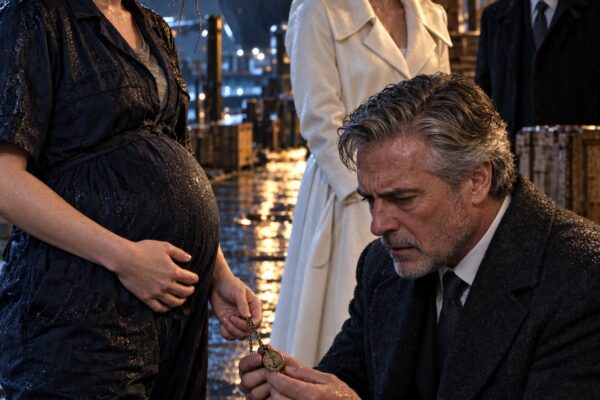
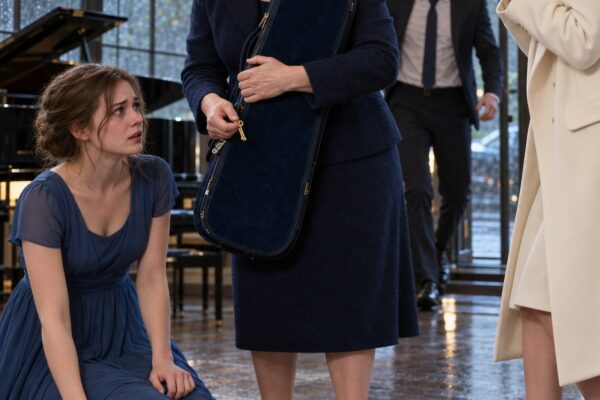
The County Said the Ferry Was Empty—Then a Girl Raised the Brass Bell That Proved Who Was Still Aboard
Chapter 2: The Door Beneath the Deck
The radio shrieked again.
Ellis Ward caught it before it slid off the counter.
“Say again.”
“Lower window.”
“Light moved.”
“Ferry turning east.”
Marlowe held the brass bell.
The folded label lay open on the counter, but her fingers covered its last line.
“Give it back,” Nora said.
“That’s county property.”
“It belonged to my dad.”
“Your father signed an evacuation form.”
“He didn’t write it.”
Ellis set the radio down.
“We need to get to the pier.”
“You’re not in charge here,” Marlowe said.
“The coast crew saw a light.”
“They may have mistaken a reflection.”
“In this weather?”
“Go verify it.”
Ellis looked at Nora.
“Stay here.”
“No.”
“You’re not going on the boat.”
“I know where the lower locker is.”
“You were there?”
“I heard Dad ring the bell.”
“Then someone’s aboard.”
“I know Dad wouldn’t abandon Mr. Alvarez.”
Marlowe pulled the report closer.
“The vessel was inspected.”
“By you?” Ellis asked.
“By the harbor crew.”
“Which crew?”
She didn’t answer.
Nora tried to lift the label.
Marlowe knocked her hand away.
“You’re making this worse for your father.”
Nora stepped back.
Her father had taught her not to start a fight she couldn’t finish. He had also taught her how to tie a knot that would hold under strain. Both lessons had come aboard the ferry.
Ellis grabbed his rain jacket.
“Someone may be hurt.”
“Then let the coast crew handle it.”
“They’ll need a pier contact.”
Marlowe reached for the telephone.
Ellis blocked her.
“Don’t.”
Nora looked down at the report.
The ferry had been logged empty at 8:12 p.m. The storm warning had come at 8:26. Her father’s signature sat beneath the earlier time.
“Dad was at the school gym at 8:12.”
“How do you know?” Ellis asked.
“He called me from there.”
“That’s not proof,” Marlowe said.
“I wrote down the call.”
“You keep notes?”
“I keep the grocery money in the same notebook.”
The cheap kitchen clock ran four minutes fast. Nora had checked it against the school bell when she called her father, then written down the time.
Marlowe pulled the form closer.
“You’re a child.”
“I can read a clock.”
The radio crackled.
“Harbor office, this is Coast Two.”
Ellis pressed the transmit button.
“Go ahead.”
“Green light blinking through the east lower-deck window.”
Nora knew the ferry’s emergency lanterns. The green light meant someone had pulled the manual release.
“Can you raise Captain Bell?” Ellis asked.
“Negative.”
“Any movement?”
“Affirmative. One figure, possibly two.”
Marlowe snatched the radio.
“Coast Two, stand by. No one boards without county authorization.”
Ellis stared at her.
“Are you ordering them to wait?”
“I’m protecting public safety.”
“You’re delaying a rescue.”
“I’m managing the incident.”
The radio hissed.
“Second light spotted.”
Nora leaned toward the microphone.
“Dad, if you can hear us, ring twice.”
Ellis took the radio from her.
“Nora.”
“Please.”
He pressed the button.
“Captain Bell, if you can hear this, ring twice.”
The office waited.
A faint metal note came through.
Once.
A pause.
Twice.
Nora shut her eyes.
“That’s him.”
Marlowe let the bell fall. It struck the counter with a hollow clang.
Ellis picked it up.
“Now we go.”
Marlowe stepped between him and the door.
“You don’t leave with that.”
“I’ll leave with the radio.”
“You cannot take county equipment.”
“You just ordered a rescue crew to stand down.”
“I did not.”
“You said it on an open channel.”
Marlowe looked at the radio. Its red light blinked.
Ellis unclipped his portable set.
“Coast Two, proceed to the vessel. We’re coming to the pier.”
“Copy.”
Marlowe stepped aside.
Nora grabbed the bell. Marlowe caught her sleeve.
“You stay here.”
Nora pulled free.
“If he’s down there, I’m going.”
“You don’t know what you’ll find.”
“I know what I heard.”
Ellis opened the door.
“Stay behind me.”
They ran into the storm.
* * *
The harbor pier shook under the wind.
Ellis drove the county truck while Nora clutched the bell. Fog swallowed the road lights.
The Coast Two crew had already launched an orange rescue boat. A second boat waited with its engine running. Beyond the breakwater, the ferry’s navigation lights blinked weakly.
The green light flashed below the passenger windows, then vanished.
“Put on the life vest,” Ellis said.
“I can help.”
“Put it on first.”
Nora pushed her arms through the straps. Ellis tightened them.
“If we get aboard, you stay with me.”
“Okay.”
“You don’t go below.”
“Okay.”
“Say it like you mean it.”
“I won’t go below.”
The boat crew waved them over.
“Captain Bell’s aboard!” Ellis called.
“We know.”
“How many passengers?”
“Unknown.”
“Lower door may be jammed.”
“We’re setting a line.”
Ellis turned to Nora.
“You stay with the crew.”
“I can hold the light.”
“From here.”
She wanted to argue, but the crewman looked frightened and busy. She handed him the flashlight.
“Use this.”
“Thanks.”
The rescue boat pulled away. Ellis stayed at the pier with the radio. Nora stood beside him as rain ran down her neck.
The ferry’s foghorn sounded once, long and low.
Her father used it to signal a safe approach. When she was little and waiting on the dock, one blast meant he was coming home.
“Coast Two, at stern,” came the radio.
“Copy.”
“Deck crew sighted at the rail.”
“Captain?”
“Unknown.”
Ellis paced three steps, then stopped.
“Why did Marlowe make them wait?” Nora asked.
“I don’t know yet.”
“She said nobody could contradict the report.”
“I heard.”
“She already knew Dad was there.”
“She may have known he was missing.”
“Why lie?”
“I don’t know.”
A light swung toward the deck. Another swept down the ferry’s side. A figure appeared at the rail.
“Is that him?”
Ellis raised the radio.
“Coast Two, identify the person at the stern.”
“Captain Bell. Conscious. Wet and cold.”
Nora made a sound that wasn’t a word.
“Any other persons?” Ellis asked.
“Searching.”
The crew climbed aboard with a safety line. The ferry rocked, then steadied.
“Captain says there’s one passenger below.”
Nora moved toward the water.
Ellis caught her arm.
“Stay here.”
“Mr. Alvarez can’t use the stairs.”
“The crew is going down.”
“Dad can’t carry him alone.”
“We don’t know that he’s alone.”
The radio snapped.
“Need a second crew at the lower-deck entrance.”
Ellis swore.
“I can hold a rope,” Nora said.
“No.”
“On the pier.”
“Stay by the truck.”
A crew member ran toward them.
“Ward, we need your hands.”
Ellis glanced at Nora.
“Stay here.”
“I will.”
He sprinted to the second boat. Nora watched him climb aboard and disappear into the fog.
She stood where he had left her.
The bell was heavy in her hands.
* * *
The bell had no clapper.
Nora turned it over. The blue cloth hid a narrow slot beneath the handle.
She pulled the cloth aside.
A folded paper slipped into her palm.
“Lower door release inspected,” read the first line, dated three weeks earlier. Her father’s signature sat below it.
The third line was written by someone else.
“Do not reopen before transfer.”
Beneath it were the initials M.V.
Marlowe Vance.
Nora called Ellis over the radio.
No answer.
She tried the county office channel.
Static.
The ferry channel was open.
“Dad, can you hear me?”
A pause.
“Nora?”
“Dad.”
“Are you safe?”
“I’m at the pier.”
“Ellis?”
“He went to the boat.”
“Good.”
“What does ‘do not reopen before transfer’ mean?”
The radio went quiet.
“Dad?”
“Where did you find that?”
“Inside the bell.”
“Keep it.”
“I am.”
“Don’t give it to Marlowe.”
“I won’t.”
“Get it to Ellis.”
“What transfer?”
Static swallowed the answer.
Then his voice returned.
“Ask him about the blue crate.”
“What blue crate?”
“Ask Ellis.”
The connection dropped.
The rescue boat moved alongside the ferry. Crew members helped a man from the lower deck and secured him in a chair.
Mr. Alvarez.
A second crew member followed. Then Nora’s father appeared at the rail, his jacket soaked and one sleeve hanging loose.
He saw Nora.
She raised the bell.
He lifted a hand.
The boat brought him to the pier. He stepped onto the boards with help, and Nora ran to him.
He wrapped both arms around her.
For a moment, she was eight again, waiting for him after his night shift. Then she felt him shaking.
“You’re cold,” she said.
“So are you.”
“What happened?”
“Not here.”
Ellis climbed from the second boat.
“Captain, the passenger’s going to the clinic.”
“Thank you.”
“Was he injured?”
“His chair jammed at the lower door.”
“Did someone lock it?”
Her father looked at Nora.
“Yes.”
“Who?”
“I don’t know.”
“You said to ask Ellis about a blue crate.”
Ellis’s expression changed.
Nora showed them the note.
“I found it in the bell.”
Her father leaned close.
“That’s my handwriting at the top.”
“You signed the inspection line?” Ellis asked.
“Yes.”
“But not the rest.”
“No.”
Marlowe’s voice came through the pier loudspeaker.
“Ward, bring the girl and Captain Bell back to the office.”
Ellis looked up.
“Who connected her?”
“County dispatch,” the speaker replied. “She wants the report resolved.”
“She wants the paper,” Nora said.
Her father rubbed his wrists.
“She’s been asking about that bell for months.”
“Why?”
“Because it wasn’t supposed to be here.”
Ellis looked between them.
“Let’s get you both warm.”
“No,” Nora said. “She wants us back in that office.”
Her father’s face softened.
“You don’t have to fight every battle.”
“I’m not fighting.”
She lifted the bell.
“I’m keeping the evidence.”
A coast crew member brought a waterproof evidence pouch. Ellis placed the note inside and wrote the time and location on the label.
“Now we can go.”
“Where?” Nora asked.
“To the county investigator.”
Marlowe’s voice cut through the loudspeaker again.
“Ward, return immediately.”
Ellis lifted his radio.
“Not until an independent investigator takes custody.”
A new voice answered.
“This is Deputy Marshal Chen. Keep the evidence sealed. I’m five minutes away.”
Marlowe’s silence carried across the open channel.
Nora felt her father squeeze her shoulder.
The ferry’s empty report had been a lie.
The question was who had ordered it.
* * *
Deputy Marshal Chen arrived in an unmarked sedan, raincoat over a gray suit.
She showed Ellis her credentials, photographed the note inside its pouch, and recorded the harbor office transmission. She asked the coast crew to preserve its boat camera footage.
No one asked Nora to guess. Chen wrote down what each person knew and how they knew it.
Nora described the office, the report, its time stamp, Marlowe’s hand over the note, and the live radio. She told Chen about the grocery notebook where she had recorded her father’s call.
Chen asked to see it.
Nora called home. The neighbor watching their apartment found it on the kitchen counter. Ellis went to retrieve it while Chen interviewed the crew. The coast workers confirmed the green light and the two bell strikes. A medic checked Nora’s father’s temperature and wrist.
Nora stayed beside him.
She didn’t want anyone sending her home before she knew what would happen next.
Chen sat beside her on a bench.
“You did the right thing preserving the note.”
“I almost gave it back.”
“Almost isn’t the same as doing it.”
“She said I was making things worse for Dad.”
“Did you believe her?”
“For a second.”
“That’s what those words are for.”
Nora watched rain slide down the shelter window.
“Why would someone put Dad’s signature on that form?”
“That’s what we’re finding out.”
“Can you promise he won’t get blamed?”
“I can promise to check the records.”
“Can you promise it’ll be fair?”
“I can promise I won’t decide before I have evidence.”
Nora accepted that. It was more than Marlowe had offered.
Ellis returned with the grocery notebook. On the page for that date, Nora had written a list of bread and milk, then: “8:16—Dad called from school gym.”
The gym had a landline. Its clerk confirmed the call log.
Nora’s father had called at 8:16.
The evacuation report claimed he signed at 8:12.
“Four minutes,” Chen said.
“He couldn’t be at the school and the ferry,” Nora replied.
“Correct.”
Marlowe might argue that the time was wrong, or that the form had been scanned later. Chen examined the report number.
“Where did you get this copy?”
“On the office counter,” Nora said.
“Was it signed before the storm?”
“According to the report,” Ellis replied.
Chen called the county records clerk. The original digital upload had been submitted at 8:49. The printed time did not match the upload time.
The signature image had been inserted.
The clerk could not say who had done it, but the county system kept an audit trail. Chen asked for the full log through the official evidence channel.
Nora’s father stared at the water.
“I told them I wasn’t leaving Mr. Alvarez.”
“When?” Chen asked.
“At 8:31. I called the harbor desk from the wall phone by the stairwell.”
“Who answered?”
“Marlowe.”
Nora turned to him.
“You didn’t tell me.”
“I didn’t want you worrying.”
“I was already worried.”
“I know.”
The hurt in his face wasn’t from the storm. His silence had not protected her.
Nora passed him the notebook.
“You can tell me things before they get this big.”
“I will.”
He took her hand. His fingers were cold, so she wrapped them in the bell’s blue cloth.
“You taught me how to keep a record.”
“I taught you how to balance grocery money.”
“You taught me both.”
He gave her a tired smile.
Chen returned to her call.
The records clerk found that the evacuation form had been created at 8:46. Its signature image had been copied from another document. The edit came from a county account assigned to the harbor administration office.
Marlowe’s office.
The ferry had not been falsely cleared by mistake.
Someone had built the report after the fact.
* * *
At the clinic, Mr. Alvarez’s daughter sat beside him while a doctor checked his blood pressure. He was tired and angry, but stable.
Nora’s father gave Chen a fuller account. The storm had cut power to the pier lights. Mr. Alvarez’s wheelchair jammed at the lower exit, so the captain went down to help. Then the door shut behind them.
The manual release wouldn’t work.
They couldn’t raise anyone on the main radio.
They found an emergency lantern. The bell should have been in the lower locker, but its clapper was gone. Nora’s father struck the bell’s body against the steel rail. The sound carried through the hull.
“You tied the blue cloth there?” Nora asked.
“Your mother did.”
“Why?”
“So I could feel which way was up when the lights failed.”
“That doesn’t make sense.”
“I was kidding.”
“You’re not supposed to joke during a statement.”
“I wasn’t.”
Chen almost smiled.
“Where did you find the bell?”
“In the office after I got back. Someone had moved the emergency kit.”
“Who had access?”
“Harbor staff, maintenance, the deputy director.”
“Did you file a complaint?”
“I wrote a maintenance note. I left it in the office binder.”
“Can we get it?”
“Maybe.”
Ellis shifted in his chair.
“The blue crate might matter.”
Chen turned to him.
“What crate?”
“Three weeks ago I saw a county truck at the maintenance bay. A blue cargo crate was on it.”
“What was unusual?”
“It had an emergency locker seal.”
Nora’s father nodded.
“That’s where the bell came from.”
“How do you know?” Ellis asked.
“The locker inventory number is stamped inside the handle.”
Nora turned the bell over. A number had been scratched beneath the cloth.
“F-17.”
Chen photographed it.
“Who manages the inventory?”
“Deputy Director Vance,” her father said.
Harbor records showed crate F-17 held a portable emergency bell, two lanterns, a spare marine radio, and a red door-release tool. The system said it had been transferred to the county training depot.
The depot had no record of receiving it.
The transfer had been entered under Marlowe’s authorization three weeks earlier, at 4:08 p.m. Ellis had seen the crate on the truck at 4:20.
The county fleet system recorded the truck leaving at 4:12 and returning at 4:44. A south-gate camera caught its plate. A maintenance worker remembered loading the crate, believing it was headed to the depot.
No delivery receipt existed.
“What was inside?” Nora asked.
“Possibly the emergency gear,” Chen said.
“Could the release tool have kept Mr. Alvarez inside?”
“It could have prevented the manual release.”
“Then someone took it.”
“Maybe.”
Chen asked Ellis to explain the lower door. It could be closed from either side. A safety pin kept it from latching while someone passed through. The pin had been missing before the storm. Without the pin or the release tool, someone trapped below could not force the mechanism.
“Could the door have jammed by itself?” Chen asked.
“It could jam if the safety pin failed,” Ellis said.
“But the pin was gone,” Nora’s father replied.
“Could it have fallen out?”
“Not without someone taking it.”
Chen recorded the distinction.
Mr. Alvarez gave a statement. He said he reached the lower landing at 8:28. A woman told him to wait by the stairs because the door was safe. He didn’t see her face, but he recognized the voice.
“Deputy Director Vance,” he said.
His daughter leaned toward him.
“You’re sure?”
“I know the voice. She came to my building for the lift inspection.”
“Did you tell anyone?” Chen asked.
“I told the captain when the door stuck.”
Nora’s father looked down.
“Why didn’t you tell me it was her?”
“I thought I might have mistaken her.”
“You saw her?”
“No.”
“Then why are you sure?”
“She called me by my first name.”
Chen recorded that as a lead, not an identification. A technician could compare the ferry radio recording with Marlowe’s public statements. A voice match might place her nearby, but it would not prove who shut the door.
The ferry service camera had been offline. Marlowe had cited an electrical failure, though the maintenance log showed it working at 7:55. A county employee disconnected it at 8:03. Investigators had not yet identified that employee.
“Whoever sealed the lower deck knew the emergency system,” Nora’s father said.
“Or had the inventory,” Ellis replied.
Chen looked at the note again.
“Do not reopen before transfer.”
“What was being transferred?” Nora asked.
“We don’t know yet.”
Marlowe’s name now appeared beside the forged report, the crate authorization, and the order to delay the rescue.
The reason remained hidden.
* * *
Nora woke the next morning on her aunt’s couch. Her father slept in the adjoining room, his phone charging beside a cup of tea. The clinic had released him after monitoring his wrist. Mr. Alvarez had gone home with his daughter.
Nora’s aunt made oatmeal. Nora ate two bowls.
Her father joined them in a clean sweater.
“You’re supposed to rest,” Nora said.
“I’m sitting down.”
“You were trying to stand.”
“I wanted tea.”
“You can ask.”
He looked toward her aunt.
“Could I have some tea?”
“Now you’re learning,” Nora said.
Her aunt hid a smile.
Chen knocked at the door with another investigator. She had obtained a warrant for harbor office records and found the crew’s original inspection binder. Marlowe had been suspended from administrative duties.
The county had arranged a public safety review that afternoon. It was an administrative meeting, not a criminal trial, and Marlowe would have a chance to respond.
“You don’t have to attend,” Chen told them. “But the county shouldn’t rely on the edited report alone.”
“Will they let Nora speak?” her father asked.
“I can’t promise the board’s procedure,” Chen said.
“I can submit the radio record,” Ellis offered. “I witnessed the transmission.”
Nora looked at her father.
“Do you want me there?”
“I want you safe.”
“That’s not an answer.”
He studied her face.
“I want you there if you want to go.”
“I want to hear what she says.”
“Then stay beside me.”
Investigators took control of the harbor office computer and sealed its filing cabinet. The clerk confirmed that the evacuation report did not exist before 8:46. The signature had come from an old attendance form. Network logs placed the alteration on Marlowe’s workstation.
The report was false.
The crate authorization was also false. It claimed the emergency gear had gone to the training depot. The truck camera showed it had driven to a private storage lot owned by Eastline Recovery.
Nora recognized the name from old ferry invoices. Eastline managed surplus equipment for the county. Its contract was due for review in two months. The company director, Peter Vale, was Marlowe’s brother-in-law.
County plans included consolidating two harbor routes. The ferry served a working-class neighborhood and a senior housing complex. It was the only direct crossing after the buses stopped running at six. If it closed, Eastline stood to win a contract for a smaller private shuttle. The county had not approved the change, but Marlowe had been preparing the case.
“She needed the ferry to look unreliable,” Nora said.
“She needed the county to think it was unsafe and underused,” Chen replied.
“Did she lock Mr. Alvarez inside for that?”
“We don’t know that yet.”
“She said the ferry was empty.”
“That’s the part we can prove she knew was false.”
Investigators found an unsent email draft on Marlowe’s computer. It was addressed to the county board chair, with the subject “Emergency basis for immediate suspension.”
The draft said the lower deck had been vacant when the door failed. It described Captain Bell as negligent and recommended suspending the route. It also claimed Mr. Alvarez had been found safely on shore, though the rescue crew had not yet brought him off the ferry.
The draft was saved at 8:54 p.m.
Another file valued the ferry’s route as low-performing. It excluded evening workers and the senior housing stop. Ticket counters had been manually reset after each trip, a practice authorized by the harbor office. The actual passenger totals were on hand tally sheets.
Marlowe had ordered those sheets archived as “duplicate scraps.” A storage company had collected them with surplus documents. Investigators suspected they were at the same private lot as the crate.
Chen requested the contract files. The county auditor began an independent review.
The hidden crate, missing passenger counts, and false evacuation form all pointed toward the harbor office. Marlowe’s motive reached beyond a bad report.
It involved money and control.
* * *
The public safety review drew families from the south harbor. The rescue crew sat near the front. Mr. Alvarez arrived with his daughter and wheelchair. Nora sat beside her father, while Ellis stood near the aisle.
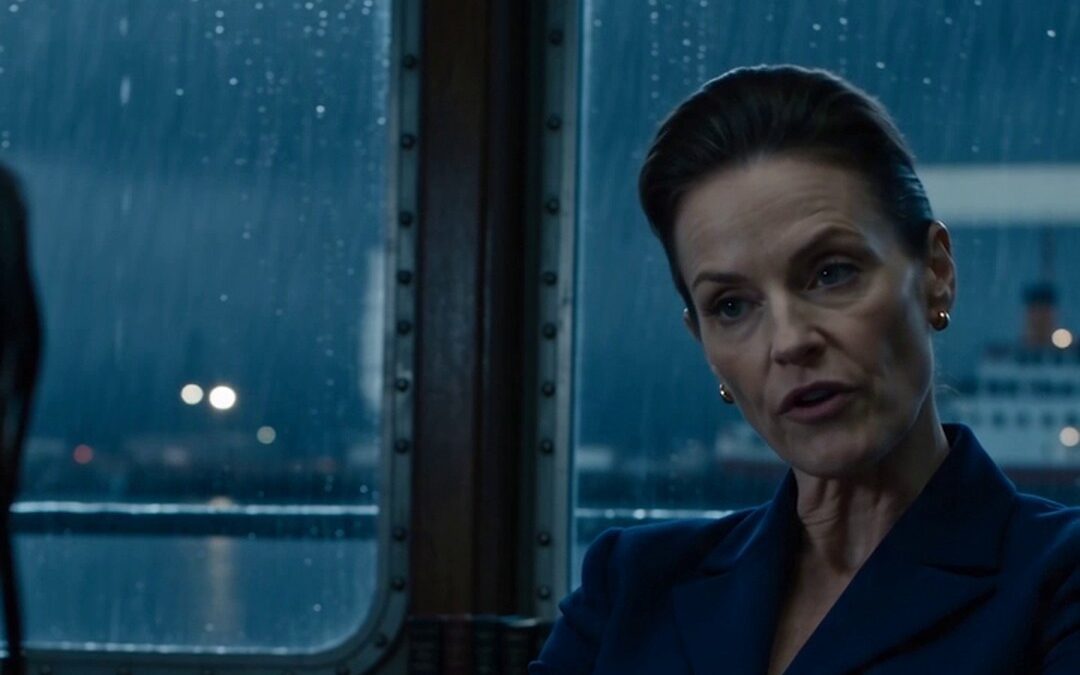
Marlowe sat at the staff table with her lawyer. She wore a navy suit. Mud still marked the hems of her shoes.
The board chair opened the meeting.
“This review concerns the evacuation report, the lower-deck door, and the response time.”
Marlowe’s lawyer objected that his client had not been charged.
“This is an administrative review,” the chair said. “She’ll have a chance to respond.”
Chen submitted the radio recording and explained its chain of custody. The county clerk described the upload log. The original inspection binder entered the record.
Nora’s father described the missing safety pin and the failed door.
Mr. Alvarez spoke from his chair.
“I asked to wait inside until the ramp was safe.”
“I was told the lower door would stay open.”
“Then it shut.”
“I called for help.”
“I heard the captain ring the bell.”
Marlowe’s lawyer questioned him.
“Did you see my client?”
“No.”
“Then you can’t identify her.”
“I can identify her voice.”
“You’re not a voice analyst.”
“I’m a man who heard her speak to me.”
“Could you be mistaken?”
“I could be.”
“Then you can’t say she was there.”
“I can say what I heard.”
Marlowe looked at the documents instead of Mr. Alvarez.
The board chair called Ellis. He described Marlowe’s order for the coast crew to stand by after they reported a light and possible movement.
Her lawyer said the instruction was meant to prevent an unsafe boarding.
“Did you ask whether the passenger was conscious?” the chair asked.
“I don’t recall,” Marlowe said.
“Did you ask whether the captain was injured?”
“No.”
“Did you ask how many people were aboard?”
Marlowe looked down.
“I don’t recall.”
The chair turned to Nora’s father.
“Why did you ring the bell twice?”
“To let them know I could hear.”
“Why use the emergency bell?”
“The radio was dead below deck.”
“Why was it in the county office?”
“I don’t know.”
The crew camera had shown a green light. The radio had captured two rings. No one in the room could credibly claim the ferry had been empty.
Chen asked the chair to review the note from inside the bell.
The board read the line: “Do not reopen before transfer.”
Marlowe’s lawyer objected that the author was unverified. Chen agreed. The note was a lead, not a conclusion.
The copied signature had been verified. The computer audit had been verified by the county clerk. The passenger totals had been checked by the auditor. The voice recording was still under review.
The chair questioned Marlowe.
“Did you write the transfer note?”
“I did not.”
“Did you authorize crate F-17 to Eastline Recovery?”
“I authorized a routine surplus transfer.”
“Was the crate routine surplus?”
“I believed it held outdated equipment.”
“Did you open it?”
“No.”
“Did you confirm delivery?”
“The contractor handled that.”
“Did you prepare Captain Bell’s evacuation report?”
“I supervised the filing.”
“Did you insert his signature?”
“No.”
The chair read the system log.
“Your account created the file.”
“Other staff used my account.”
“Did you report unauthorized access?”
“No.”
“Did you ask the clerk to enter the report?”
“I don’t recall.”
The county attorney summarized the clerk’s statement. Marlowe had asked her to complete the evacuation record from the emergency binder. The clerk refused because she had not seen Captain Bell sign it. Marlowe took the document back, and seven minutes later it appeared on her workstation.
Marlowe’s lawyer said the clerk was protecting herself. Her own login history showed she had not accessed the workstation.
The chair turned to Marlowe.
“Why was the signature copied?”
“It was a temporary placeholder.”
“Why submit it as a signed report?”
“I intended to replace it.”
“When?”
Marlowe didn’t answer.
The chair asked about the crate. Chen presented gate footage showing it loaded onto a county truck. The same truck reached Eastline Recovery, where a worker signed the entrance log.
“Was your relationship to Mr. Vale disclosed?” the chair asked.
“It was,” Marlowe said.
County records showed no disclosure.
Her lawyer argued that Eastline had received no special treatment and that the contract was only being reviewed.
The auditor read from a draft proposal recommending that the ferry route be shifted to an Eastline shuttle. Its passenger counts excluded late trips and the senior housing stop. Marlowe had certified the data.
“Did you know the totals were incomplete?” the chair asked.
“They reflected the official system.”
“Who ordered the hand tally sheets archived?”
“Operations staff.”
“Who approved the order?”
Marlowe looked to her lawyer.
The chair waited.
“I did.”
“Those sheets contained passengers missing from the official totals,” the auditor said.
“I didn’t know that.”
“Did you review the Eastline proposal?”
“Yes.”
“Did you tell the board the totals were incomplete?”
“No.”
Marlowe’s lawyer stood.
“This meeting has turned into an accusation.”
“It’s a safety review,” the chair replied.
Then the chair turned to Nora.
“Would you like to say anything?”
Her father looked at her. Nora had not planned a speech. She stood.
“Can I show the bell?”
The chair nodded.
Nora set it on the table. The blue cloth hung from its handle.
“My mother tied this on before she died.”
Her father’s fingers tightened around his cane.
“I knew it as the emergency bell.”
“I thought Dad kept it because he missed the boat.”
The room quieted.
“Someone took the bell and release tool from the ferry.”
“The report said everyone was safe.”
“My father was still below.”
“Mr. Alvarez was still below.”
“Then the rescue crew turned around.”
She looked at Marlowe.
“I brought the bell because I wanted someone to listen.”
“You said I was making it worse for my father.”
“I was trying to protect him from speculation,” Marlowe replied.
“You were trying to get the bell back.”
“I had no idea what you were holding.”
“Then why did you take it?”
“I was preserving evidence.”
“You didn’t put it in a bag.”
“You weren’t an investigator.”
“You didn’t call one.”
The lawyer objected, but the chair let her continue.
“You kept the paper under your hand.”
Marlowe said nothing.
“My dad’s name was on a report he didn’t sign.”
“My dad’s voice was on a radio nobody was supposed to hear.”
“The passenger list was missing.”
“The emergency door was shut.”
Nora rested her hand beside the bell.
“I don’t know what the county will do.”
“But I know who was trapped.”
“I know who stayed to help.”
“And I know the report was false.”
Marlowe’s lawyer stood again.
“Could you identify who shut the lower door?”
“No.”
“Who disconnected the camera?”
“No.”
“Who removed the safety pin?”
“No.”
“Then your statement doesn’t prove my client did those things.”
Nora met his eyes.
“It proves I heard the truth.”
The chair placed Marlowe on administrative leave, suspended the route closure proposal, and ordered the county to preserve its records. An outside auditor would review the passenger totals. The public integrity office would examine the forged report and missing equipment.
The board would not decide criminal responsibility.
Marlowe leaned toward her lawyer. She whispered, but the chair heard her last word.
“Temporary,” Marlowe said.
“The suspension remains until the review is complete,” the chair replied.
Marlowe turned toward Nora.
“This town will always remember your father as the captain who left passengers behind.”
Nora’s father started to rise. She touched his sleeve.
“They’ll remember what happened,” she said.
“Reports can be corrected.”
“So can records.”
“You think this fixes anything?”
“No.”
Nora looked at Mr. Alvarez.
“I think it lets us start.”
The chair called a recess. The meeting ended without a verdict. Marlowe had not confessed, and the evidence had not been tested in court. But her report was no longer the only account in the room.
The brass bell had carried the first record back into public view.
* * *
The county’s first review took six weeks.
Investigators confirmed that Marlowe’s account created the evacuation form. The signature image came from an old attendance sheet, and the clerk’s statement matched the file history.
Marlowe was charged with falsifying a public record and obstructing an emergency response. Prosecutors did not charge her with locking the door. The available evidence could not establish who physically removed the safety pin. The ferry camera had been disconnected, and the lower-deck recording was unavailable.
The exterior crew camera showed Marlowe boarding earlier that evening, but not near the lower door. Mr. Alvarez’s testimony placed her voice near the stairwell. It supported the investigation without identifying the hand that shut the door.
The blue crate turned up at Eastline Recovery. The release tool, two lanterns, and portable marine radio were inside. The bell had been removed from its bracket. Its clapper lay in a cardboard envelope with a purchase order for replacement safety pins.
The order had been canceled by Marlowe’s office.
Eastline claimed the crate arrived as surplus and returned it to the county. The company denied knowing the equipment was still needed.
Investigators found the missing passenger tally sheets in a locked file bin labeled “duplicate archives.” The auditor compared them with the ticket-counter data. The ferry carried more than twice as many passengers as the official reports showed. Most of the difference came from evening trips: port workers traveling after the buses stopped and residents crossing from the senior housing complex.
The route had not been underused.
Eastline’s shuttle contract went under review. Peter Vale was not charged. Investigators found no direct evidence that he had ordered the door shut. The county did find that Marlowe had concealed her relationship to him while approving an award recommendation that would benefit his company.
The proposal was canceled.
Marlowe pleaded guilty to falsifying the evacuation form and obstructing the rescue response. Her lawyer said she wanted to avoid a lengthy trial. The court gave her probation and community service, barred her from county safety work, and ordered her to repay the audit costs. The county dismissed her.
The criminal case never answered who had physically shut the door.
The independent safety review did establish that it had been deliberately disabled. The safety pin was missing. The release tool had been moved. The camera had been disconnected. The report had been falsified after the fact.
The board changed its procedures. Emergency transfers needed two signatures. Passenger totals went to an independent server. Disconnecting a safety camera triggered an alert. Ellis supervised the equipment inventory.
Nora’s father returned to work after three weeks. The lower door was rebuilt, and Mr. Alvarez began using the new lift platform.
He refused to call it a ramp.
“Ramps go uphill,” he said. “This thing goes sideways.”
His daughter laughed.
Nora did too.
It was her first laugh since the storm.
* * *
The county offered Nora’s father a settlement for lost wages, medical costs, and the false report. He had a lawyer review it. The lawyer explained that accepting payment would not stop the criminal case.
The county also offered money for a public statement.
Her father declined.
“They don’t get to buy a nice statement,” he said.
“What do you want?” Nora asked.
“A safe ferry.”
“That’s it?”
“That’s a lot.”
The county funded repairs and a public assistance program for evening passengers. Mr. Alvarez’s daughter helped organize residents. Nora’s father joined them, not to become the face of the case, but to keep the route running.
Nora had school, her bakery shifts, and grocery errands with her father. She also had a new notebook. She recorded repairs, board votes, passenger counts, and the dates officials promised to return.
Her father asked if she planned to become a clerk.
“No.”
“An auditor?”
“Maybe.”
“An investigator?”
“Maybe.”
“What are you sure about?”
“I want people to write things down correctly.”
He nodded.
“That’s a good job.”
The county offered to pay for high school classes through a youth civic program. Nora could learn how public records worked. She asked her father before accepting.
He told her the choice was hers.
She accepted.
Marlowe sent Nora a letter three months later. Her father asked whether Nora wanted him to read it first.
“No.”
She opened it alone at the kitchen table.
Marlowe apologized for accusing Nora of making things worse. She wrote that she had been afraid of losing her job.
She did not say whether she had locked the lower door. She did not explain why the emergency crate went to Eastline. She did not ask for forgiveness.
Nora read the letter twice, then placed it in her notebook.
“Do you forgive her?” her father asked later.
“I don’t know.”
“You don’t have to decide today.”
“I don’t want her to think a letter fixes it.”
“Then tell her that.”
Nora wrote back. She said she had read the apology and hoped Marlowe would tell investigators the whole truth. She said they could not speak privately while the case remained open and that she would not meet Marlowe alone.
She didn’t say she hated her.
She didn’t say it was all right.
She sent the letter through the county attorney.
That was her boundary.
Her father read it only after she chose to show him.
“You said what you meant,” he told her.
Nora put the brass bell on a shelf. Its clapper had been restored, and the blue cloth remained around its handle.
The ferry had a new bell. The county asked whether Nora wanted the old one displayed in the harbor office.
“No,” she said. “It belongs on the ferry.”
Her father agreed.
The old bell was mounted near the lower-deck exit. The blue cloth sat behind glass beside it. The county added a plaque saying it had been used to call for help during the storm.
Nora liked that it didn’t name Marlowe or turn the bell into a trophy.
Mr. Alvarez was the first passenger to read it.
“Now it has a job,” he said.
“It always had one.”
He smiled.
“So did you.”
“I was just there.”
“That’s what people say when they do something brave.”
“I was scared.”
“Those things can happen together.”
Nora watched her father check the rebuilt door. Ellis stood beside him with a clipboard. They had added a second release pin and tested it three times.
Evening passengers formed a short line: a bakery worker, a nurse, two high school students, an older man carrying a paper sack.
The route stayed open.
The numbers were counted.
Nora still reminded her father to take his medication. He still tried to carry the heavy grocery bags. Her aunt still visited on Sundays and criticized his soup.
Marlowe’s punishment had not made the world fair.
But the people had a record now.
They had a working door, a public route, and a way to report trouble outside the office that had mishandled it.
* * *
Two years later, Nora stood on the lower deck with a group of students.
The youth civic program had asked her to explain how public records worked. She chose the ferry because it was where she had learned the difference between a report and the truth.
Her father watched from the upper deck. He had returned to full shifts. Ellis was harbor supervisor. The ferry had new lights, a modern radio, and a separate equipment log. The county auditor checked passenger totals every month.
Nora showed the students the original brass bell. Its cloth had faded from blue to gray, and its clapper carried a small dent.
One student asked why the county kept it.
“It helped someone hear us,” Nora said.
“Who?”
“Everyone who was listening.”
Her father came down the steps.
“Ready?”
“Almost.”
“You said that ten minutes ago.”
“I’m checking the microphone.”
“It works.”
“How do you know?”
“I heard you asking.”
The students laughed. Nora smiled. They weren’t laughing at anyone.
She lifted the old bell from its display case. The county had made a replica for the ferry. The original was heavier than she remembered.
The blue cloth was still tied to its handle. A tiny white stitch held it together.
Nora had missed it during the storm.
Her father touched the thread.
“Your mother fixed that before she tied it on.”
“I thought it was part of the knot.”
“It was.”
The bell had begun as a family object. Then it became evidence, and then a warning. Now it belonged to a story the county could not edit alone.
Nora handed it to the student.
“Hold it by the handle.”
The student did.
“Don’t ring it,” Nora said.
“Why not?”
“Because we have a microphone.”
The student set it down carefully.
Nora looked through the lower-deck window. Water moved beyond it. Her father stood beside her.
“Do you still think about that night?” he asked.
“Yes.”
“Every day?”
“No.”
“Good.”
A wheelchair rolled through the lower door. The door stayed open until everyone had passed. Then the attendant checked the pin.
The light above it turned green.
The ferry left the dock.
The bell gave a soft clink as the vessel moved.
“Your problems don’t make you invisible,” Nora said.
Her father looked at her.
“Where did that come from?”
“I changed the words.”
“Good.”
The bell rested in its case.
The blue cloth held.
The door stayed open.
THE END