The Custodian’s Daughter Was Shamed Before the Museum’s Wealthiest Patrons… Then One Blue Tile Exposed Who Built Their Famous Hall
Chapter 2: The Names Beneath
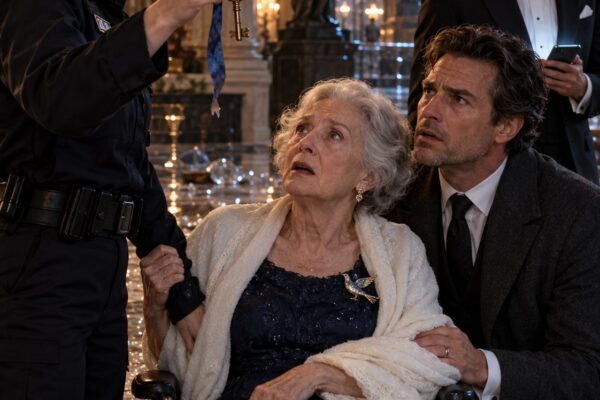
Adrian put himself between Nell and the guard.
The guard stopped.
Celeste had never needed to raise her voice inside the Bell Museum. Her name appeared on the director’s office, the annual appeal, and the invitations in every donor’s hand. One movement of her fingers usually settled any dispute.
This time, Adrian kept his eyes on Nell.
He asked whether the guard had seen her take anything.
The man said he had only answered the director’s call.
Nell tightened her grip on the tile. Its edges had left pale squares in her palms.
Celeste said the child had brought museum property into a crowded gallery and should surrender it before someone damaged it.
Adrian asked her to wait.
The musicians near the entrance had fallen quiet. Guests turned toward the child beneath the mural, then toward Celeste, looking for a cue. Celeste gave them none.
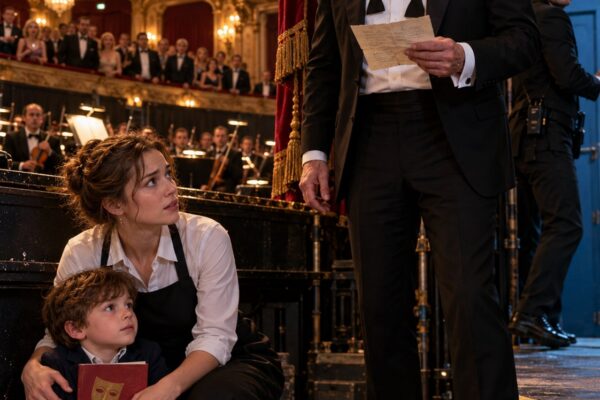
Nell was ten. Her winter coat had a repaired cuff, and her shoes squeaked on the polished floor. She had come straight from the apartment where her aunt had helped her finish homework before the bus ride downtown.
She had expected to speak to one person.
Instead, half the museum was watching her.
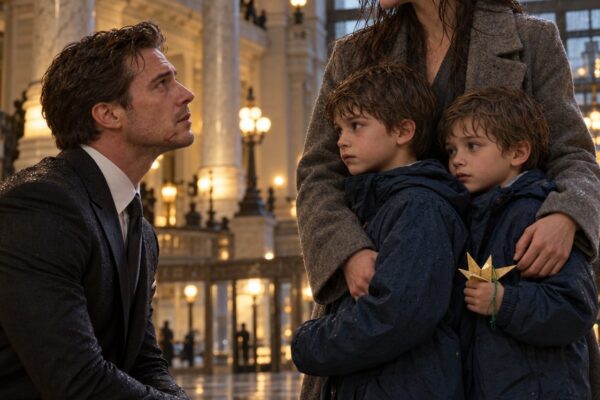
Adrian crouched so she would not have to look up at him.
He asked where she had found the tile.
Nell glanced at Celeste.
Adrian moved slightly, putting his shoulder between them.
Nell said her mother had shown her a loose panel in the service corridor years earlier. Two mornings ago, the panel had shifted while Nell’s aunt cleaned nearby. The tile had fallen into the gap below it.
Her aunt had been afraid to touch it.
Nell had picked it up.
Celeste said a child’s account could hardly establish where an object belonged.
Nell turned the tile over.
The back held a shallow mark pressed into the clay: a small open hand inside a circle.
Adrian knew it.
His grandfather had kept a folder in a locked cabinet at home. Among its papers was a drawing of that same hand. Adrian had asked about it when he was young and received an answer so abrupt that he had never asked again.
He straightened.
His grandfather, Edmund Bell, had founded the museum with money from his manufacturing business. The mural overhead was its most celebrated work. Tour guides called it the first great commission of the Bell family.
Adrian had repeated that story himself.
He asked Celeste for the installation records.
She said the archive office was closed.
He asked for the registrar.
Celeste glanced toward the donors.
Then she agreed to call her.
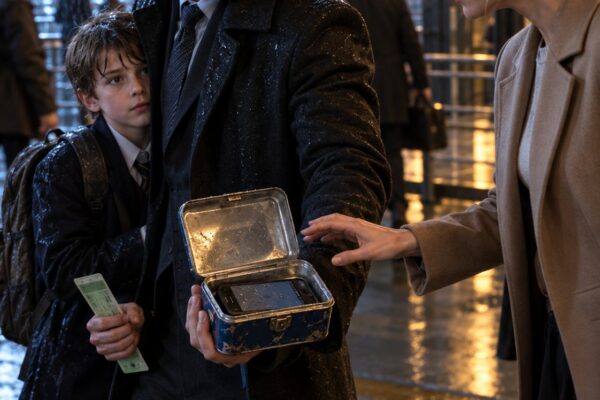
Nell’s fingers had gone cold around the tile. Adrian took a clean handkerchief from his pocket and offered it without reaching for her. She set the tile inside it herself.
The mark remained visible.
Celeste’s phone was already in her hand.
She said Nell’s mother had entered restricted rooms before her dismissal. She suggested that the tile might have been removed then.
Nell’s face changed.
Her mother had died in March. She could not answer an accusation now.
Adrian asked Celeste to stop.
The director drew herself upright, wounded in exactly the way she knew wealthy people expected her to be. Around them, a few guests began to move away. Others stayed close enough to hear.
Nell looked at the mural.
Her mother had told her that every tile had been shaped by hand. Nell had thought the open hand meant that somebody had wanted future visitors to touch the work, though the museum signs forbade it.
Now she asked Adrian whether her mother could get in trouble.
He told her they would find the records before anyone made claims about her mother.
He meant it.
The registrar arrived through a side door, carrying her access badge and wearing a black coat over her evening dress. Her name was Helen Cho. She had worked at the museum for fourteen years and had learned to look at an object before listening to anyone explain it.
She examined the tile without lifting it from the handkerchief.
Then she asked where Nell had found it.
Nell repeated the location.
Helen looked toward the service corridor.
Celeste said she had already explained the likely theft.
Helen did not answer.
She turned the tile slightly under the gallery light. A line of dried mortar clung to one edge. The other edges were clean. On the back, beside the hand, a number had been scratched into the clay before firing.
Helen read it twice.
Adrian asked what it meant.
Helen said the museum’s published inventory had begun with tile thirty-one.
The number in her hands was four.
Celeste said early studies often received separate numbers.
Helen looked at her.
The museum had no record of early studies.
A chime sounded near the entrance. The donors’ dinner was supposed to begin in five minutes.
Celeste asked everyone to move toward the dining room. She promised Adrian that the matter would receive proper attention in the morning.
Nell stayed where she was.
Adrian remembered the sealed folder. He remembered his grandfather’s anger. Most of all, he remembered the drawing of a hand that no museum guide had ever mentioned.
He told the guests that dinner would wait.
Then Helen looked at Nell and asked one more question.
Had her mother ever told her whose hand it was?
Nell nodded.
She said her mother called it Ida’s hand.
Helen went still.
Ida Mercer had built the mural.
* * *
The museum closed to the public at six the next morning.
By then, pictures of Nell beneath the mural had appeared on local news sites. The photographs showed her holding the tile. They also showed Celeste standing over her.
Adrian had not slept.
He arrived with the folder from his grandfather’s cabinet, still sealed in a stiff envelope. His grandfather had died eleven years earlier. Adrian had become chair of the museum board the following spring, inheriting a title he had never examined closely enough.
Helen met him at the archive door.
She had brought her assistant, a conservator named Luis, and a camera used for condition reports. Nell came with her aunt Tessa, who held her hand through the lobby.
Tessa worked evenings cleaning offices in the building next door. Nell’s mother, Dana, had been a custodian at the museum for seven years. After Dana’s death, Tessa had taken Nell in.
Tessa made clear that Nell would not be questioned alone.
Adrian agreed before she finished speaking.
A museum lawyer joined them by video call. She advised that the tile be photographed, measured, and placed in a secure room while its ownership was checked. Tessa asked for a receipt identifying Nell as the person who had brought it.
Helen wrote one.
Only then did Nell let go of the handkerchief.
The tile was no larger than a sandwich. Its blue surface showed the corner of a painted river, crossed by three fine gold lines. The glaze had darkened at one edge where it had rested against old mortar.
Luis photographed every side.
Helen opened the accession database.
The mural was listed as an original design by Edmund Bell’s commissioned studio. Its first inventory number was thirty-one. Every number before that had been left blank.
Adrian placed his grandfather’s envelope on the table.
Inside were two letters, a pencil drawing of the open hand, and a small ledger page. One letter came from Ida Mercer. It was dated three years before the museum opened.
Ida wrote about the kiln she rented in the east side factory district. She described a design of a river running through a city, made from hundreds of individually painted tiles. She asked Edmund Bell to pay the balance owed for the work already completed.
The other letter was Edmund’s reply.
He disputed the amount. He also told Ida that the finished work would carry the Bell studio name, as agreed in the contract.
No contract was in the envelope.
Adrian read the reply again.
His grandfather’s familiar signature sat beneath words Adrian could not defend.
Helen examined the ledger page. It listed small payments to Ida over nineteen months. The final column showed a balance larger than all the payments combined.
Tessa asked whether the museum had known about these papers.
Adrian said he had found them in his grandfather’s cabinet years before but had never taken them to an expert. He had seen the hand drawing and remembered it. He had not read the letters carefully.
Tessa looked at him for a long moment.
Dana had tried to tell the museum, she said.
Three years earlier, while cleaning near the service corridor, Dana had noticed a strip of old wall behind a maintenance panel. She saw blue glaze through a crack. She reported it to a supervisor, then asked why the museum’s mural labels never mentioned Ida Mercer.
Her grandmother had told stories about Ida’s workshop. Dana had grown up believing those stories were family memory, not proof of anything.
When Dana asked for the museum’s records, Celeste told her that employees should use the public research desk on their own time.
Dana filed a request anyway.
She was dismissed two weeks later.
Celeste’s written reason was repeated entry into a restricted area.
Tessa had kept Dana’s copy of the dismissal letter. She brought it from her bag, folded inside a plastic sleeve.
Helen checked the date.
The letter came four days after a maintenance crew had sealed the service corridor panel.
Nell knew because her mother had complained that the new wall color did not match the old one. She had held Nell’s hand as they waited for the bus and described the streak of paint around its edges.
Nell had remembered the place.
She remembered everything her mother told her about it.
Helen asked Luis to inspect the corridor. The museum lawyer advised that the wall be photographed before anyone opened it. Adrian called the facilities manager and requested the work orders.
They walked through a staff passage that smelled faintly of floor wax. Tessa knew every turn. Nell kept close to her.
The panel stood behind a rolling display case. A narrow band of newer paint framed it.
Luis took photographs.
The facilities manager arrived with a tablet. His records showed that Celeste had ordered the panel closed after a donor reception three years earlier. The stated reason was draft control.
The receipt named a contractor. It did not mention the mural.
Helen asked the manager for earlier photographs of the corridor. He found an inspection image taken before the repair. The panel had then covered an opening large enough for a person to reach through.
Inside was the back of a second tiled wall.
Nobody opened it that morning.
Helen contacted a specialist in architectural ceramics. Adrian’s lawyer contacted counsel for the museum board. Tessa asked an attorney at a neighborhood legal clinic to represent Dana’s estate and Nell’s interests.
By afternoon, they had three separate routes toward the truth.
The tile itself could be studied.
The wall could be examined under an agreed plan.
The surviving records could be checked against one another.
Nell sat at the archive table drawing the open hand on scrap paper. She made the thumb too long, rubbed it out, and tried again.
Adrian brought her a cup of water.
She asked why his grandfather had wanted somebody else’s name on the wall.
Adrian said he did not know what Edmund had told himself. The letters showed what he had done.
Nell asked whether saying Ida’s name now would fix what happened to her.
He answered carefully.
It would not give Ida back the money or the years she had spent without credit. It might help the people who came after her know what she had made. They would also find out what else the museum owed.
Tessa heard him from the doorway.
She said Dana had wanted that more than anything.
Late that afternoon, Helen found an accession note in an old paper index. Someone had tucked it behind a card for a different exhibit. It described twenty-seven unmounted tiles delivered from Ida Mercer’s kiln, each numbered on the back.
The card carried a date.
It also carried a handwritten instruction directing staff to keep the delivery outside the public catalog.
Helen recognized the handwriting.
Celeste’s father had written it.
* * *
Celeste’s father, Martin Rourke, had managed the museum collections for thirty-two years.
He had retired eight years earlier and died the previous winter. Portraits of him still hung in staff corridors. He was remembered for preserving the mural during a roof leak, raising money for its restoration, and teaching young registrars to handle fragile objects.
Celeste had been director for five years.
Adrian had appointed her.
When he asked her about the index card, she said she had never seen it. She also said Martin’s note could reflect a routine inventory correction.
Helen copied the card for the board’s counsel.
The ceramic specialist arrived the next morning. Dr. Priya Shah had no connection to the Bell Museum. She had studied tiled walls in schools, stations, and public buildings across the country.
She inspected Nell’s tile first.
Then she examined samples from known sections of the mural, using photographs and the museum’s conservation reports. The glaze, clay body, and firing marks were consistent with the original installation.
The numbered back was more useful.
A maker could number pieces for assembly before anyone attached them to a wall. Dr. Shah explained that a number did not establish who owned a tile. It could establish where the tile had been meant to go.
At the service panel, she found traces of the same mortar on the hidden wall.
The board authorized a small opening under her supervision.
Tessa and Nell watched from behind a clear barrier. Adrian stood beside them.
Luis removed the panel. Behind it, a run of blue tiles curved away from the public mural. They had been hidden when a storage room became a corridor decades earlier.
Some were plain.
Others carried parts of a painted scene.
At the bottom, an open hand appeared in blue glaze, larger than the mark on the loose tile.
Nell stepped closer to the barrier.
She had seen her mother sketch that hand on the backs of grocery receipts.
Dr. Shah studied the numbered gaps. The loose tile belonged in a space beside the riverbank, near the hand. Someone had removed it long ago without breaking its painted face. It had likely rested behind the panel ever since.
That explained how Nell had found it.
It did not explain why it had been removed.
For that, Helen needed the older files.
She located a box of conservation records Martin had sent to offsite storage. The box had never been entered into the digital catalog. It contained invoices, photographs, and correspondence from the museum’s first renovation.
One photograph showed Ida Mercer standing before a row of unfinished tiles.
She wore a work apron and held a small brush.
The photograph’s back carried her name, the kiln address, and a date in a studio assistant’s neat handwriting.
Adrian looked from the photograph to the wall beyond the barrier.
Ida had painted the river.
The evidence was growing.
So was the pressure.
A reporter called Tessa at home. Another waited outside Nell’s school. The principal moved pickup to a side door for a few days. Tessa missed a shift because she would not leave Nell to face cameras alone.
Adrian offered to pay for the lost wages.
Tessa declined until her attorney could put the offer in writing. She did not want Celeste calling it a purchase of silence.
Adrian respected that.
He paid the legal clinic’s invoice into an account controlled by the clinic, with no conditions attached. The attorney confirmed the arrangement to Tessa before accepting it.
Celeste called an emergency board meeting.
Her memo arrived the next day. It warned that public claims about the mural could damage the museum, threaten grants, and expose staff to harassment. It also described Nell’s possession of the tile as an unresolved security issue.
Adrian read that sentence twice.
He asked the security supervisor for the original incident report from the gala.
The guard had written that Nell held the tile throughout the encounter. He had seen no evidence of theft. He had also recorded Celeste’s order to remove the child before Adrian intervened.
The supervisor had not altered it.
Celeste’s memo omitted it.
At school, Nell found that other children had seen her picture. One asked if she had stolen the museum. Another wanted to know if her family would become rich.
Nell came home and put her coat on the floor.
Tessa sat beside her.
They ate toast because neither wanted the dinner she had prepared. Nell said she wished she had left the tile behind the panel.
Tessa told her she was allowed to be tired.
Then Tessa brought out Dana’s sketchbook.
Most pages held quick drawings: bus seats, lunch bags, window frames, Nell asleep under a blanket. Near the back were three studies of the open hand.
Under one, Dana had written a date and a note about Martin Rourke’s old storage box.
Dana had found a reference to it in a repair schedule. She had copied the box number before she was dismissed.
Tessa photographed the page for the attorney.
Helen used the number to check the offsite storage records.
The box had been requested twice in the last three years.
The first request came the day after Dana asked for the mural files.
The second came the morning after Nell appeared at the gala.
Both requests had been made under Celeste’s credentials.
Celeste told the board she had been checking the records for accuracy.
Helen asked why she had never updated the catalog.
Celeste said the work was unfinished.
That evening, the museum lawyer received a message from an unknown sender. It included a scan of an agreement supposedly signed by Ida Mercer. The agreement assigned all credit and future claims to the Bell studio in exchange for a final payment.
If genuine, it would complicate everything.
Adrian wanted it examined before anyone used it to accuse Ida’s descendants of making a false claim.
Tessa’s attorney agreed.
The document’s date was six weeks after Ida had died.
* * *
The board meeting moved to the public lecture room.
Adrian had asked for an independent review, and most trustees wanted a quick private decision. Celeste argued that the museum could investigate quietly while keeping the exhibit open. She said donors had supported the institution for generations and deserved stability.
Tessa’s attorney asked that Ida’s descendants be heard before the board voted on any account of her work.
The trustees agreed.
Nell did not have to attend. Tessa made sure she knew that.
Nell chose to come for the first hour. She wanted to see the tile returned to its handkerchief after the specialist spoke.
The lecture room had none of the gala’s music or glitter. Folding chairs filled the back. On the front table lay copies of documents, each labeled and numbered. The original tile remained in secure storage; Dr. Shah had brought photographs and measurements.
Celeste sat beside her counsel.
She spoke first.
Martin Rourke, she said, had saved the mural when the museum nearly closed. He had found money for repairs, hired conservators, and kept its public reputation alive. A disputed credit line could undo years of work and invite claims the museum could not pay.
She acknowledged that Ida had supplied tiles.
She disputed the idea that Ida had designed the whole mural.
The photograph showed a worker at a kiln, Celeste argued. The letters showed a payment dispute. Neither alone proved creative authorship. She asked the trustees to remember how many people had contributed to the museum over its history.
Several nodded.
Adrian understood why.
Celeste offered them a way to believe the institution had made a small clerical mistake. A footnote could name Ida as a craftsperson. A plaque could thank her descendants. The gala photographs would fade.
The museum could continue as before.
Helen took her place at the table.
She showed the original accession note for tiles one through twenty-seven. She showed the delivery log from Ida’s kiln, the conservation photographs, and the hidden section of wall. Dr. Shah explained how the numbers on the backs aligned with Ida’s surviving design studies.
Then Helen presented a tracing from the hidden wall.
It showed the open hand surrounded by tiny initials worked into the glaze.
I. M.
Those initials were on tile four as well.
They had been mostly concealed by old mortar until Dr. Shah cleaned a narrow edge under magnification. Nell’s tile had shown them to the room all along. Nobody had known where to look.
Celeste’s counsel asked whether another person could have copied Ida’s mark.
Dr. Shah said that was possible in the abstract. In this case, the mark had been fired beneath the glaze along with the painted design. It appeared on tiles documented as delivered from Ida’s kiln before the museum opened.
Adrian then placed his grandfather’s letters before the board.
He read aloud the sentence in which Edmund had insisted that the Bell studio name would appear on the completed work. He read Ida’s request for the balance owed. He showed the ledger with that balance still open.
His voice held steady.
He did not defend his grandfather.
Celeste argued that the unsigned agreement might explain the credit. The board’s counsel reported that the copy they had received could not serve as proof. Its date fell after Ida’s death, and no original had been produced.
Celeste suggested a typing error.
Tessa’s attorney asked who had sent the scan.
Celeste said she did not know.
The lawyer had already requested the museum’s document logs. The file had been exported from a computer in Celeste’s office on the morning it reached them. That fact did not establish who created it, but it gave the board a reason to secure the computer and refer the matter for further review.
Celeste’s fingers closed around her pen.
For the first time since the gala, she looked at Nell.
Nell sat between Tessa and her attorney. She had promised Tessa she would leave if the room became frightening. She wanted to stay.
Celeste said that Dana had caused this confusion by entering spaces she knew were off limits. She said a child should never have been brought into a dispute between adults.
Tessa rose.
She had written her remarks on one sheet of paper. She read them without looking at Celeste.
Dana had requested records through the museum’s own process. She had kept copies. She had been dismissed after asking for them. Nell had brought an object to the museum because the adults responsible for its history had refused to answer her mother.
Tessa sat down.
Nell slipped her hand into hers.
Celeste turned back to the trustees. She warned that accepting Tessa’s account would invite a claim that the museum had knowingly hidden evidence.
Helen opened the last record.
It was an email from Dana to Celeste, sent three years earlier. Dana had included the box number from the repair schedule and asked whether its contents might help identify Ida’s work.
Celeste had answered.
She told Dana that the material had been reviewed and that no change to the mural label was needed.
The offsite storage log showed the box had been retrieved the day before that answer.
Celeste had seen it.
Nobody spoke while the trustees read.
Adrian asked Celeste whether she had another explanation.
She said she had been protecting the museum from an unverified claim.
Adrian looked at Ida’s photograph. Then at Nell’s tile, enlarged on the screen. Then at the unpaid balance his grandfather had left behind.
The claim had been verified well enough to require an honest review years ago.
He called for the vote.
The board suspended Celeste pending investigation, directed the museum to preserve its files, and authorized an independent provenance review. It also withdrew the dismissal finding from Dana’s personnel record while counsel examined the circumstances.
The votes were recorded.
The museum issued a public correction that evening. It named Ida Mercer as the mural’s documented designer and principal maker. It said the extent of her work, the unpaid balance, and the later concealment were under review.
The story reached more people than the gala photograph had.
Some donors complained.
Others asked why the museum had waited so long.
Over the following months, lawyers worked through the contracts, estate records, and correspondence. Tessa’s attorney located Ida’s probate file and traced the family line to Dana and Nell. The museum’s counsel confirmed it independently.
A forensic review found no original agreement matching the scan sent before the board meeting. Investigators also found evidence that the file had been assembled from old forms on Celeste’s office computer. Celeste denied creating it, but she could not account for its source.
Her employment ended after the board’s review.
The police referred the document matter to prosecutors. Months later, Celeste entered a plea to a misdemeanor charge connected to submitting the false record. The court imposed a fine and community service. A separate civil settlement resolved Dana’s dismissal and the museum’s treatment of Ida’s work.
No court could restore Ida’s lifetime credit.
The settlement could provide compensation to her heirs, correct the public record, and require the museum to preserve the evidence that had been hidden.
Celeste gave one final statement through her lawyer. She said the museum owed its survival to people willing to make difficult choices.
Tessa read it once.
Then she folded the page and put it away.
Nell’s mother had made a difficult choice too.
She had asked for the truth while her job depended on remaining quiet.
* * *
Spring arrived before Nell went back to the museum.
She had passed it often on the bus. Sometimes she looked out the other window. Sometimes she counted the steps from the entrance to the corner where her mother used to buy them hot pretzels after late shifts.
On a Saturday in April, Tessa asked whether she wanted to see the new exhibit.
Nell said she wanted to see the wall first.
The service corridor had been opened to visitors under supervision. A low barrier protected the tiles. New lighting revealed the section once hidden behind paint and paneling.
Nell’s tile was back in place.
Dr. Shah had overseen the work. The museum had photographed and measured it before reattaching it with materials conservators could remove if needed. The old mortar fragments were saved with the records.
Nell touched the barrier with one finger.
She could see where tile four met tile five. The blue river joined cleanly. Under its curve, Ida’s open hand faced outward.
Helen stood nearby in ordinary clothes, carrying a paper cup of coffee.
She said the mural now had a new label.
Nell read it.
The label named Ida Mercer first. It described her workshop and the years she spent making the tiles. It also explained that the museum had credited the work to the Bell studio for decades despite surviving evidence of Ida’s authorship.
Nell read her mother’s name farther down.
Dana Mercer had preserved the location of the hidden wall and asked the questions that led to its examination.
Nell read that sentence twice.
Tessa waited.
Nell asked whether Dana would have liked it.
Tessa said Dana would probably have corrected the spelling of something, even if everything was spelled perfectly. Nell smiled before she could stop herself.
Adrian arrived without a group of trustees behind him.
He wore a dark jacket and carried a folder. He asked Tessa whether they had a few minutes. She said they did.
The settlement had provided money for Nell’s future. Tessa and the attorney had arranged for it to be managed for her benefit, with clear records and independent oversight. Adrian had brought the final plain-language summary they had requested.
He handed it to Tessa.
Nell asked if the museum had paid Ida everything it owed her.
Adrian said the exact old balance could never tell the whole story. The settlement included money for the family, but it also paid for conservation, an archive of Ida’s work, and a free workshop program for local students.
Tessa had helped shape the terms.
She had refused a larger private payment in exchange for keeping Dana’s dismissal out of the public account. The museum’s first proposal had offered that. Its second proposal did not.
Dana’s name remained on the label.
Nell looked at Adrian.
She asked if he had brought the tile back because he felt bad about the gala.
He said he felt bad about it. He had brought the tile back because the evidence showed where Ida intended it to be.
Nell considered that.
Then she asked if people could still see the back.
Helen answered from beside the wall.
They could see photographs of the mark and the number in the exhibit case. The original had to stay fixed in the mural now, but its story would remain visible.
Adrian asked Nell’s permission for one more thing.
The museum planned to make a short film about the mural’s history. He wanted to include Dana’s sketches and Nell’s account of finding the tile. Nell could choose whether to appear. She could also say no, or change her mind before anything was released.
Tessa said they would discuss it at home.
Adrian accepted that.
There was no camera waiting.
Over the next few months, the museum changed in ways visitors could see. The public catalog gained Ida’s name. Helen moved the old index card into a properly described archive. The wall behind the service corridor became part of a guided tour.
Other changes took longer.
Trustees reviewed how staff could report concerns without asking permission from the person they concerned. The museum hired an outside archivist to examine collections records Martin Rourke had handled. Most yielded ordinary errors. A few required corrections. Each correction appeared in the catalog with its source.
Adrian attended those meetings.
He also visited the east side factory district with Helen and Tessa. Ida’s kiln building had become a repair shop. The owner let them photograph an old patch of brick where the firing door had once stood.
Nell came along because it was a school holiday.
She asked the owner whether the kiln had been hot enough to melt the whole building.
He said he had no wish to test it.
They ate lunch at a diner across the street. Nell ordered pancakes though it was nearly two. Tessa said that her mother had done the same whenever breakfast was offered all day.
That was how Dana came back into ordinary conversation.
At first, Nell had guarded each memory as if saying it aloud might wear it out. She began telling small stories again. Dana once forgot where she had parked and searched the wrong level for twenty minutes. Dana sang badly while washing dishes. Dana could spot a loose wall panel across a room.
Tessa had stories too.
They did not always agree on the details.
Nell liked that.
At school, her teacher asked whether she wanted to give a presentation about Ida’s mural. Nell chose to talk about the kiln instead. She drew the firing door and explained why the numbers on the tiles helped workers put a large design together.
She did not mention Celeste.
The other children asked practical questions. How heavy was a tile? How many broke? Could Ida make mistakes?
Nell said she probably did.
That answer pleased her more than the questions about money.
Ida had become a person who worked, learned, and sometimes began again. She was more than a name the museum had withheld.
One afternoon, Adrian met Tessa outside the museum after a board meeting. He told her that his grandfather’s letters would be displayed with a full explanation. He wanted to make sure she had seen the text first.
Tessa read it.
The label stated that Edmund Bell had accepted Ida’s completed work, disputed her final payment, and directed that another studio receive public credit. It did not call him a visionary while asking readers to overlook the letters.
She handed the draft back.
Adrian apologized for his own delay in opening the folder. He said he had treated his grandfather’s anger as a reason to avoid the question.
Tessa told him Dana had not been given that choice.
He agreed.
She thanked him for putting the letters on display, then reminded him that she would keep checking the museum’s work.
Adrian said he hoped she would.
That was as much forgiveness as the day required.
When the short film came up again, Nell decided she would lend Dana’s sketchbook but would not appear on camera. She wanted her mother’s drawings shown. She did not want strangers to watch her talk about losing her.
The filmmaker followed her terms.
At the end of the film, the camera held on Dana’s sketch of the open hand. Her note appeared beneath it, in her own handwriting. She had written the storage box number beside a grocery list because that was the paper available during a shift.
Nell watched the finished film with Tessa at home.
When the screen went dark, she asked to see it once more.
* * *
Five years later, Nell returned to the gallery with blue clay beneath one thumbnail.
She was fifteen and had spent the morning helping younger children press patterns into small squares at the museum workshop. She had learned to keep her own tools clean. She had also learned that eight-year-olds could ask more questions about glaze than most trustees.
The mural stood at the far end of the hall.
Visitors moved toward it slowly, following the painted river from one wall to another. The section behind the old service panel was now easy to find. Children liked to search for Ida’s open hand.
Nell still found it first.
Tessa joined her with two paper cups of lemonade.
She had taken over the free workshop program the year before, after completing a training course the museum paid for under the settlement. She loved the work and argued with the supply budget every month.
Adrian came through the entrance carrying a box of new brushes. He set it on the workshop cart and asked Tessa where it belonged. She pointed him toward the storage room.
He had learned to ask.
Nell looked at tile four.
The river crossed its face. The mark on its back could no longer be seen from here, but a photograph hung nearby. Visitors could read its number, Ida’s initials, and the story of how it had returned to the wall.
A small boy stopped beside Nell.
He pointed at the open hand and asked why it was there.
Nell told him Ida had put her mark on the work she made.
He asked whether Ida knew people would find it.
Nell looked at the wall, the label, and her mother’s sketch beside them.
She said Ida must have hoped someone would look.
The boy went to find his own mark in the clay square he carried. Tessa handed Nell a cup.
Across the hall, a guide began the afternoon tour. She spoke Ida Mercer’s name clearly. She named the workshop where the tiles were fired. She named Dana Mercer, who had kept asking about the hidden wall. She told visitors why the museum’s earlier account had been wrong.
Nell listened as she drank her lemonade.
The guide invited the group closer.
Nobody told the children to step away.
THE END