The Door She Thought Would Close Behind Her Before Anyone Could Ask Why
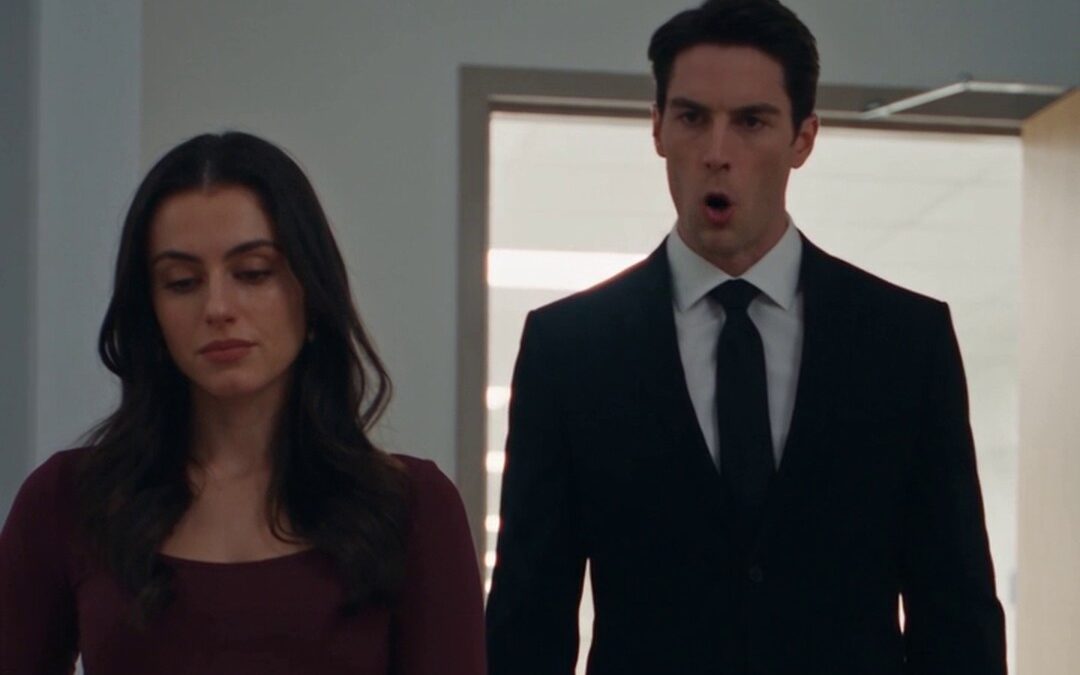
Chapter 1: The Quiet Suite
Khloe Thorne had just reached for the call button beside the sofa when Isabella Rossi stepped between her and the door.
“You were supposed to give Marcus a child and then disappear,” Isabella said, her crimson gown brushing the white silk stretched over Khloe’s seven-month belly.
Khloe steadied herself against the sofa, still feeling the tightening that had sent her away from the hospital’s charity gala and into a suite the maternity nurse had approved for rest.
“I’m calling the nurse,” she said.
Isabella shoved her before she could reach the button.
Khloe caught the marble edge of the coffee table with one hand, and the crystal water glass on its corner tipped, shattered against the floor, and sent water across the tile.
Her wrist slipped on the wet marble as Isabella came toward her again.
Khloe turned sideways, held both arms over her abdomen, and felt another hard push drive her to her knees beside the broken glass.
The suite door opened while Isabella was still standing over her.
Marcus stopped in the doorway, with event coordinator Elaine Parker close behind him, and Khloe saw his gaze take in the red gown, her white dress against the wet floor, and the glittering pieces between them.
“Call maternity now,” Marcus told Elaine.
Elaine was already speaking into her phone as Marcus knelt where staff could reach Khloe without moving her across the glass.
“Tell me where it hurts,” he said.
Khloe tried to answer, but another tightening seized her attention and she could only point toward her side.
“She attacked me,” Isabella said from beside the table, lifting a scratched wrist with remarkable care.
Marcus looked up without leaving Khloe.
“She threw the glass when I asked her to calm down,” Isabella said, her voice level enough to sound rehearsed only to someone who knew her well.
Elaine glanced at the broken pieces, then at the open door, as if measuring how much of either claim she had actually seen.
Footsteps sounded in the corridor, followed by the brisk voice of Dr. Daniel Vale, Khloe’s uncle and the hospital’s director of patient safety.
He had introduced himself to the gala staff that evening because the wing remained open for clinical use, and now he stopped short when he saw Khloe on the floor.
“The response team is coming,” he said, keeping his hands clear of the staff rushing past him.
Isabella lowered her wrist.
Daniel looked at the call button beside the sofa and then toward the corridor camera over the doorway.
“Preserve the door record and the call alert,” he told the security supervisor arriving behind him.
Chapter 2: What the Records Could Hold
A nurse stepped into the space Marcus had left beside Khloe, asked her name, and waited for her answer before another nurse eased a clean sheet between her and the glass.
Khloe wanted to say that Isabella had pushed her twice, but the pressure in her abdomen returned, and getting air past it took everything she had.
“Seven months,” Marcus told the nurse, keeping his voice low and useful.
“Twenty-nine weeks and four days,” Khloe managed, irritated that even now she needed to correct him.
The nurse gave her a brief nod, as though that small correction mattered, and asked where Khloe had struck the table.
Khloe touched her left side without lifting her arm far from her belly.
Staff brought a stretcher through the doorway, checked the floor beneath its wheels, and moved her with directions she could follow one at a time.
Marcus rose when they asked him to, though he stayed close enough that Khloe could see his shoes while they guided her into the corridor.
Isabella started to speak as the stretcher passed her, and Daniel asked the security supervisor to keep the two women apart while the clinical team worked.
He said it without declaring who was right, which made Khloe angry for half a second before she understood that he was protecting her from another conversation she could not bear.
At the nurses’ station, a woman in blue scrubs took over from the gala responder and asked Marcus about Khloe’s prenatal care, medications, and the reason she had come upstairs.
“She’d had tightening after standing all evening,” he said, then turned to Khloe for confirmation.
“I asked for somewhere to sit until the nurse could check me,” Khloe said.
The nurse noted her answer and told her she was going to be assessed in the maternity unit, where they could watch both her and the baby over time.
Khloe caught sight of Elaine near the far wall, holding the event phone against her chest with both hands.
“Please don’t let her come in,” Khloe said.
“She won’t,” the nurse replied, and asked the supervisor to confirm that Isabella would remain outside the clinical area.
The elevator doors closed before Khloe could see whether Marcus followed.
In the examination room, the ordinary sounds of care gradually separated themselves from the scene upstairs: a blood pressure cuff, paper moving under a pen, a nurse asking whether the tightening had started before or after the fall.
Khloe could answer that it had started before the suite, had eased while she sat, and had returned after she hit the table.
She could not say whether it had become stronger or whether fear had made each wave harder to endure.
A clinician examined her sore side, checked for other injuries, and explained that the first reassuring signs were only a beginning.
“We’ll keep watching,” she said.
Khloe stared at the white curtain around the bed, suddenly furious at the color.
She had chosen her dress because Marcus said she looked comfortable in it, and now a damp gray stain spread across one hip where the water and floor dust had found the silk.
When he came in, he stopped at the foot of the bed until the nurse told him where he could stand.
“I told them what I know,” he said.
Khloe looked at him.
“Only what I know,” he added.
She did not ask what he believed, because Isabella had made sure the question would be waiting for them.
Marcus took the chair and set his phone face down on his knee.
“Elaine said she saw you on the floor and Isabella beside the table,” he said.
“That’s what she saw.”
“She said she didn’t see either of you touch the other.”
“That’s true too.”
Marcus nodded once, with the care of a man stepping where the floor might break.
“She said you were trying to cover your stomach when we came in,” he said.
Khloe watched the nurse adjust a monitor at her bedside.
“I was,” she said.
Beyond the curtain, Daniel’s voice reached them as he introduced himself to the charge nurse and then, more quietly, explained that he was Khloe’s uncle.
He did not enter until Khloe said he could.
His gala jacket was still buttoned, but his badge had swung forward on its cord, and the familiar angle of his shoulders made her eyes sting.
“I’ve asked security to retain the corridor video and access records through the normal incident process,” he said.
“Did you see it?” Khloe asked.
“No,” Daniel said.
“Can anyone see into the room?”
“Only a narrow slice when the door is open, and I haven’t reviewed it.”
He told her the camera existed to monitor movement in the corridor, the access reader recorded credential use at the suite door, and the staff call system kept the time of an alert.
The room itself had no camera, and none of those records could hear a conversation behind its closed door.
Daniel’s job was to coordinate patient safety reviews, he explained, but because Khloe was family, he had referred the incident assessment to another director and limited himself to requesting preservation.
“I can make sure the right people know what might be lost,” he said, “and I can’t decide what happened for them.”
Khloe had never heard him sound so much like the uncle who once fixed her bicycle and so much like a hospital officer at the same time.
“Make sure they keep the card records,” she said.
“I did.”
He glanced at Marcus and then back at her.
“Rest first,” he said.
A nurse came in to ask whether Khloe wanted her husband to stay while they discussed the next part of her care.
She said yes, though she wondered whether he heard the condition inside that answer.
Two hours passed in increments measured by questions, monitor adjustments, and the occasional ache along her left side.
The clinician told her the baby’s tracing was reassuring so far, her own vital signs remained stable, and they would continue observation because symptoms after a fall could change.
She did not offer Khloe a finish line or a promise.
That restraint frightened Khloe more than false comfort would have, but it also gave her a way to trust the woman.
When the tightening eased and she could think beyond the next minute, Khloe asked for her phone.
Marcus said Elaine had it.
“I gave it to her when I went upstairs,” Khloe said, remembering the awkward pocketless dress and the small silver bag she had left at the gala desk.
Marcus looked surprised.
“Isabella said you sent her a message asking her to come up,” he said.
“I didn’t.”
The nurse had been writing at the counter, and Khloe saw her pause without turning around.
Marcus placed his hands flat on his knees.
“I haven’t seen the message,” he said.
“Then don’t repeat it as if you have.”
“You’re right.”
Khloe closed her eyes, not because she wanted him gone, but because the apology was too small for the size of the opening Isabella had found.
A knock came from the door, and Elaine entered only after the nurse confirmed Khloe wanted to speak with her.
She carried the silver bag in a clear hospital property envelope and held it where Khloe could see the intact clasp.
“I kept it at the event desk,” Elaine said.
“Since when?” Khloe asked.
“Just after nine, when you asked me to find a quiet place.”
Elaine glanced at Marcus.
“I didn’t know Isabella was going to the suite,” she said.
Marcus leaned forward.
“Did Isabella use a visitor card?”
Elaine nodded, looking miserable.
“She had an event liaison credential for the donor tour, and the suites on that wing were included in the tour route until ten.”
“The room was occupied by a patient,” Khloe said.
“I know,” Elaine replied.
Elaine had arranged the nurse’s approval for Khloe to rest in the suite, but she had not understood that the event credential still opened the outer door after the tour ended.
She explained that the hospital’s event team had issued a small number of temporary credentials for escorted donors and contractors, while clinical rooms inside the wing remained separately controlled.
The quiet suite was not a patient room, she said, but it was in a clinical corridor where a pregnant guest should have been able to rest without gala visitors walking in.
“I should have had the event access switched off when I brought you up,” Elaine said.
Khloe could see that Elaine wanted to offer a larger confession, one that would make a mistake feel equal to Isabella’s choice, but Khloe had no room for that.
“Please tell them exactly when I gave you the bag,” she said.
“I have.”
“And don’t improve what you saw inside.”
Elaine’s eyes filled.
“I won’t.”
After she left, Marcus asked whether Khloe wanted him to step out too.
She watched the monitor’s paper creep along and thought about the weeks when she had asked for far less than this.
“Stay,” she said, “and listen without translating me into someone easier for you to believe.”
He turned his phone over, looked at its dark screen, and put it in his pocket.
“All right,” he said.
Khloe began with the suite door.
She remembered hearing the latch, turning from the sofa, and finding Isabella inside with her red gown gathered in one hand so it would clear the threshold.
She remembered thinking that Isabella had come to apologize for telling three donors Khloe’s pregnancy made her too tired to understand foundation accounts.
“She said she had been protecting me,” Khloe said, “the way she always says she is when she’s just taken something away.”
Marcus did not interrupt.
Khloe described the sentence about giving him a child and disappearing, the first shove, the glass falling, and her attempt to reach the button beside the sofa.
She had managed to press it only after she was down, stretching across the rug with her right hand while Isabella stood near the table.
“That’s why I know the call happened after the glass broke,” she said.
Marcus looked toward the nurse, who kept working without comment.
“She said you threw it at her,” he said carefully.
“The glass was full when it went off the corner.”
Khloe could still feel cold water spreading under her palm.
“I didn’t pick it up.”
She stopped before adding the second push, trying to place the order without letting the feeling of it swallow the order itself.
“The glass fell when I hit the table,” she said, “and she came around the table after that.”
Marcus repeated the sequence back to her, asking only where each person had been.
Khloe corrected him twice, and the act of correction steadied her.
By the time she reached the door opening, she could describe Isabella’s raised wrist without claiming to know where its scratch came from.
“I saw it when she showed you,” Khloe said.
“That’s all I know about it.”
Marcus looked at the stain on her dress.
“I should have come when you first said she was following you,” he said.
Khloe felt her patience narrow.
“You’re skipping several weeks.”
He accepted that and fell silent.
The next morning, the maternity team told Khloe that the hours of observation had shown no new warning signs, though her bruising and soreness would need follow-up and she should return for any concerning change.
They gave her a plan for the next several days, arranged a prenatal visit, and made clear that leaving the hospital did not turn the night into a harmless one.
Khloe listened, asked her own questions, and decided she would stay with her sister that night rather than return immediately to the house where Isabella had been welcomed so often.
Marcus offered to take her there.
“My sister can,” she said.
He nodded, though she could see the answer hurt.
After the clinician left, a patient advocate named Nora Chen came in with a safety plan and a choice about whether Khloe wanted to speak to hospital security or police.
Nora said Isabella had been moved from the clinical wing, her event access was disabled, and staff had been told to direct any contact attempt through the advocate.
“The hospital is reviewing how an event credential stayed active after that wing was used for clinical rest,” Nora said.
“Who is reviewing what she did?” Khloe asked.
“Security is gathering the records and accounts, and an independent patient safety director is looking at the access failure.”
Nora explained that Khloe could give a statement when she felt able, could have an advocate with her, and did not need to watch footage or sit with Isabella.
Khloe asked for time to read the written account she had dictated earlier.
She found one phrase saying she had “fallen against the table,” and asked Nora to add that Isabella’s shove had caused her to strike it.
Nora made the amendment with the time and Khloe’s initials, leaving the original wording visible.
That small, unglamorous correction felt like the first thing Khloe had been allowed to do for herself since the door opened.
By noon, Marcus had received a request from the hospital investigator to provide his own account and preserve his communications with Isabella.
He told Khloe before he answered it.
“She’s been texting me about you for weeks,” he said.
Khloe sat against the raised pillows, her sister’s arrival still an hour away.
“I know she has,” she said.
“You knew?”
“I knew she was talking to you after I asked her to stop commenting on my work.”
“I thought you were angry because she made a clumsy joke at dinner.”
Khloe remembered the dinner: Isabella placing a hand on Khloe’s chair and telling the table that the pregnancy had made her “mercifully less interested in numbers.”
“She told you I was jealous,” Khloe said.
Marcus did not deny it.
“She told me you thought she was trying to replace you.”
“And what did you tell her?”
“I said she should give you space.”
Khloe waited.
“I also told her you were under pressure and I’d handle it,” he said.
The words landed harder than she expected because they were so ordinary.
“Handle me.”
“I meant the conflict.”
“You let her hear that you thought I was the conflict.”
Marcus rubbed his thumb against the seam of the chair.
“I did.”
He showed her the messages without asking her to look at all of them.
One from Isabella described a luncheon where Khloe had supposedly snapped at a waiter, although Khloe remembered correcting an invoice total in front of him because the event firm had charged for tables the hospital had supplied.
Another said Khloe had become “fixated” on the event accounts and was frightening Isabella with threats of an audit.
“Was there an audit?” Marcus asked.
“There was a request for supporting invoices,” Khloe said.
She chaired a small foundation committee that checked whether gala costs were paid from the right funds, and she had asked Isabella’s event company to explain two charges for the same lighting rental.
That was work, not an attack, and Khloe had copied the foundation treasurer on the request.
Marcus knew she held the committee seat, but he had treated the disagreement as a social dispute because Isabella had described it to him first.
“The contract renewal is next month,” he said.
“Yes.”
“You think this was about that?”
“I think she wanted you to believe I couldn’t be trusted with it.”
Khloe watched him examine the messages again.
“She sent me a photograph of a broken water glass at the planning lunch,” he said.
“I moved it when the waiter needed room.”
“She said you slammed it down.”
“It didn’t break.”
Marcus enlarged the photograph, and Khloe recognized her own hand withdrawing from an untouched glass while Isabella’s caption supplied all the violence.
The image had seemed too petty to fight over when Khloe first learned Isabella had circulated it.
Now she saw its shape beside the crystal on the suite floor.
“Keep that,” she said.
“I will.”
“Give them the whole thread, not just the parts that make her look bad.”
Marcus looked up.
“The parts where I agreed with her are in it.”
“I know.”
For the first time since the assault, he seemed to understand that his discomfort was evidence of something he had done, not a reason to stop.
He forwarded the export to the investigator while Khloe watched, including the messages he had sent Isabella and the photograph from the lunch.
No one at the hospital promised her that the messages would settle what happened in the suite.
Nora explained that they could show what Isabella had been saying beforehand and what Marcus had been led to expect, but they could not by themselves prove who pushed whom.
Khloe appreciated the distinction even as she resented needing it.
That afternoon, the investigator, a former police detective named Leah Ortiz who now worked for the hospital’s security office, came to take Khloe’s fuller account.
Daniel did not attend, and Ortiz told Khloe she would review the routine records with the access administrator and a second investigator because of his family connection.
“Your uncle asked for preservation,” Ortiz said, “and that request is logged alongside the others.”
“Has he watched anything?”
“No.”
Ortiz sat where Khloe could see the door and placed her notebook on her lap rather than on the bed.
She asked Khloe to start at the point she had entered the suite, and she listened when Khloe said she needed to begin a few minutes earlier.
At the gala desk, Isabella had brought her a printed rest card, cream stock with the hospital crest, and had said Elaine had arranged Suite Four for her.
Khloe had thanked her despite weeks of tension because the tightening had made standing difficult and because a quiet room sounded kind.
“I found out later Elaine had arranged it,” Khloe said, “but Isabella handed me the card.”
Ortiz asked whether Isabella had offered to escort her.
“She did, and I said no.”
“Why?”
“Because she had followed me twice that month after I tried to leave conversations.”
Ortiz wrote that down.
Khloe recalled another detail she had overlooked the night before: Isabella had asked whether Marcus knew Khloe was going upstairs, and Khloe had said Elaine would tell him.
“She said, ‘Good, I don’t want him to worry,’” Khloe said.
Ortiz asked whether Khloe still had the card.
“It may be in my bag.”
Nora brought the property envelope, and Khloe found the card tucked behind a gala program.
On the back, in Isabella’s neat handwriting, were the words REST WHEN YOU NEED TO; I’LL KEEP THEM AWAY.
The phrase had comforted Khloe for perhaps thirty seconds the previous evening.
Ortiz photographed the card and noted where it had been kept.
“This tells me she knew the room you were going to,” Ortiz said, “but I’m not going to infer from it that she intended violence.”
“I’m not asking you to.”
Khloe looked at the handwriting again.
“She made sure I would be alone.”
Ortiz asked what made her say that.
“She asked Elaine for the room, then offered to walk me there, then came after me when I refused.”
Ortiz marked those as separate claims to check.
When Khloe’s sister arrived, she brought a soft sweater and enough anger to make Khloe tired before she had even spoken.
Khloe asked her to save the anger for the car ride and help her stand.
The walk from bed to wheelchair hurt along her side, and she hated that Marcus saw her flinch.
He stayed back while the nurse checked that she was ready to leave.
“I’ve arranged for a car,” he said.
“My sister’s here.”
“I know.”
He took a folded paper from his pocket.
“It’s the number for the advocate and the follow-up appointment, in case your bag gets lost again.”
Khloe accepted it because the appointment was hers, then handed him the silver bag so he could put the paper inside without treating her pocketless dress as an invitation to manage everything else.
At her sister’s apartment, she slept in pieces.
Each time she woke, she heard Isabella’s calm voice finishing the false account in a room Khloe could not enter.
A hospital social worker called the next morning to ask about practical safety, and Khloe answered carefully: Isabella knew their home, their usual driver, and the charity calendar.
The social worker helped her ask for a temporary restriction on Isabella’s access to hospital events and for a single contact person if the hospital needed more from her.
Khloe declined an offer to see the video then.
She had enough images of the doorway in her head.
Three days later, Ortiz called with an update that was both less and more than Khloe wanted.
The corridor camera showed Khloe entering the suite alone at 9:36, followed by Isabella using her own event credential at 9:39.
The door closed behind Isabella, and the camera could not see into the room.
At 9:43, the staff call system logged an alert from the suite, and at 9:44 Marcus and Elaine reached the door.
“Does it show when the glass broke?” Khloe asked.
“No,” Ortiz said.
“Does it show Isabella leaving?”
“She did not leave between entering and the call.”
Khloe had not thought she did, but hearing it confirmed was different from knowing.
Ortiz said the video was retained through the hospital’s ordinary security system, while the door event came from the access reader and the call time from the nurse response system.
The preservation hold kept those limited records from cycling out on their normal schedule; it did not expand what they recorded.
“What is Isabella saying now?” Khloe asked.
“She says you invited her up by message, grew angry about the foundation invoices, picked up the glass, and threw it when she tried to leave.”
“She told Marcus she came because she heard the glass.”
“Her written account says she heard a noise from the corridor, entered to check, and then you threw the glass.”
Khloe sat down slowly on her sister’s sofa.
“That isn’t the order she gave him in the room.”
“We have his account and Elaine’s account of what she said there.”
Ortiz did not tell Khloe how to feel about the change.
“She may say she was shaken,” Ortiz added, “and I need to assess that fairly.”
Khloe pressed her fingertips against the rest card lying on the coffee table.
“She used her badge before any noise,” she said.
“Yes, but that alone doesn’t tell us why she entered.”
After the call, Khloe called Marcus herself.
He answered on the first ring and did not ask whether the baby was all right before asking how she felt.
It was a small adjustment, though she could hear him working at it.
“Ortiz says Isabella changed the order,” Khloe said.
“She told me she hadn’t.”
“Did she tell you there was a message from me?”
“She showed me a screenshot.”
Khloe waited while he found it.
The image showed a text bubble under a contact name, KHLOE, saying, Could you come up to the suite and talk before Marcus gets here?
There was no visible phone number, no surrounding conversation, and no timestamp on the crop Isabella had sent him.
“Did you ask to see it in her messages?” Khloe asked.
“No.”
“Could be from anyone she named Khloe.”
“It could.”
Marcus sounded ashamed, but shame had begun to bore her when it arrived without action.
“Tell Ortiz exactly what she showed you,” Khloe said.
“I already sent it.”
“Good.”
He paused.
“Isabella says the scratch on her wrist came from you grabbing her when she tried to leave.”
Khloe looked at the pale mark on her own palm where marble had scraped it.
“I didn’t touch her wrist.”
“I told Ortiz I couldn’t see that part.”
Khloe heard something in his voice she had waited for: a refusal to fill a gap with either woman’s preferred answer.
“Thank you,” she said, though the words felt insufficient and too generous at once.
A day later, Isabella’s attorney sent the foundation board a letter calling the incident a private dispute and requesting that Khloe step aside from the vendor review while the hospital investigated.
The board chair forwarded it to Marcus and Khloe, saying no decision would be made until the committee could discuss it without the parties involved.
Khloe had worked for months to make the gala accounts readable to the donors who paid them.
The request to remove her from that work made the assault feel like a door Isabella was still trying to close.
Marcus called from his office after reading the letter.
“I can tell the board I support you,” he said.
“That will make it look like a marriage vote.”
“What would help?”
“Ask the treasurer to continue the invoice review with the outside accountant already retained for the annual audit.”
Marcus let out a slow breath.
“That review could reach my sponsorship agreement with Isabella’s firm.”
“I know.”
He had sponsored the gala for six years through his company, and Isabella’s firm had been his preferred event contractor long before Khloe joined the committee.
If the accountant found problems, Marcus would have to answer for why he had recommended the renewal while ignoring Khloe’s concerns.
“I’ll ask the treasurer,” he said.
“And recuse yourself from the contract vote.”
“I was going to.”
Khloe looked out at the street below her sister’s window.
“You weren’t going to last month.”
“No,” he said.
Their marriage had often survived because Marcus could make a problem disappear behind a call, a payment, or a room with fewer people in it.
This problem stayed in the room when he stopped speaking.
Khloe’s follow-up appointment came on a rainy Monday.
The clinician said her soreness and bruising were healing as expected, the baby’s evaluation remained reassuring, and she should keep her regular prenatal care and return if symptoms changed.
Khloe had slept poorly and still braced herself whenever a door clicked behind her, so “healing” felt like a word for only one part of her.
She asked for a referral to someone she could talk to about the fear.
The clinician gave her one without making it sound like evidence for or against anybody’s story.
Outside the clinic, Elaine waited by the window with a folder she was not holding out.
“I can leave this with Nora if you’d rather,” she said.
“What is it?”
“My statement and the event desk log.”
Khloe took the folder but did not open it there.
Elaine had not become her friend overnight because she had made a mistake with access, yet she had kept answering questions that made her own work look bad.
“Did Isabella ask you for the suite?” Khloe asked.
Elaine nodded.
“At eight fifty, she said you looked exhausted and asked if I could arrange a place where you wouldn’t be interrupted.”
“And the rest card?”
“She printed it from the event desk template while I called the nurse.”
Khloe remembered Isabella’s handwritten promise on the back.
“Did she know her credential opened that door?”
“She asked me whether donor tour cards still worked on the wing,” Elaine said.
“What did you tell her?”
“I said they worked for the tour spaces until ten, and I thought she meant the lounge where the portraits were stored.”
“Was that in your statement?”
“Yes.”
Elaine looked toward the elevator.
“She also asked whether the corridor camera faced the suite door because a donor had misplaced a necklace during the tour.”
Khloe felt the air change around her.
“When?”
“Before the gala started.”
“Did you tell Ortiz?”
“I did, and she asked me not to interpret it.”
Khloe nodded.
“Don’t.”
Elaine met her eyes.
“I’m not saying I know what she planned.”
“I know.”
The elevator arrived, but Khloe let it go.
She opened the folder and found Elaine’s neat account of the room arrangement, the card, and the moment she had entered behind Marcus.
Elaine had written that Isabella stood near the table with her right wrist raised; Khloe lay on her left side with her arms over her abdomen; and Elaine saw broken glass between the table and Khloe.
She had not written that Khloe looked innocent.
She had written what she saw.
At the end was an acknowledgment that Elaine had failed to ask facilities to narrow the event credential before Khloe used the suite.
Khloe closed the folder.
“You may lose your job over the card,” she said.
“I may,” Elaine replied.
Khloe could hear how much it cost her to leave the sentence there without asking for comfort.
That evening, she read the statement again beside the rest card and the screenshot Marcus had forwarded.
The apparent message from Khloe asked Isabella to come before Marcus arrived.
Isabella had handed her a card promising to keep others away, then had sent Marcus a message telling him to come up because Khloe was frightening her.
The two versions of “before Marcus” bothered her.
She called Ortiz.
“Can you check when Isabella first told Marcus to come?” Khloe asked.
“We have his message thread.”
“Compare it to when she asked Elaine whether the suite corridor camera faced the door.”
Ortiz was quiet for a moment.
“Elaine gave me that statement.”
“Isabella said I wanted to talk before Marcus came, but she was the one arranging who came and when.”
“That may speak to planning,” Ortiz said.
“I think there’s something simpler.”
Khloe looked at the rest card.
“She told Elaine she wanted me uninterrupted, and she told Marcus she was worried enough to send him upstairs.”
Ortiz asked her to explain.
“If she was worried before she entered, why did she make sure no nurse or event staff came with me?”
“That is a fair question,” Ortiz said.
“It doesn’t prove the shove.”
“No,” Khloe replied, “but it tells you where to look for the lie.”
Ortiz said she would compare the original messages, credential times, and event desk log, then call back when she had a verified sequence.
She did not promise the answer Khloe wanted.
The next morning, Marcus came to her sister’s apartment with a paper copy of the full thread he had given the investigator.
Khloe let him in because she had asked to see it, not because she had decided to come home.
He sat across the table while she read.
At 9:38, Isabella had written, Khloe went up alone and seemed upset with me; I’m going to check on her.
At 9:41, after her credential had opened the suite door, she had written, Please come now, she’s frightening me.
Khloe read those lines twice.
“She sent the second message while she was inside,” she said.
“Or from the doorway,” Marcus replied.
“She told you I threw a glass when she asked me to calm down.”
“That’s what she said when I came in.”
“And at nine forty-one she was already writing the feeling she wanted you to find.”
Marcus looked at his own response: On my way.
“You were at the gala desk with Elaine,” Khloe said.
“I’d just asked her where you were.”
“So Elaine can say when you left.”
“She has.”
Khloe put the pages down.
“Isabella needed you to arrive after she had a story and before I could give mine.”
Marcus did not argue.
He reached toward the photograph from the luncheon, then stopped before touching it.
“That picture was a rehearsal,” he said.
“I don’t know if it was a rehearsal for the shove.”
“No,” he said, “but she taught me what to expect if I saw a broken glass.”
His voice had gone rough.
“I let her.”
Khloe wanted to tell him that regret could not travel back into the suite and stand beside her, but she had said versions of that enough times.
“What are you going to do with that?” she asked.
“I’ve given Ortiz every message, and I’ve told the board chair I’m stepping away from the contract review.”
“Those are two things you should have done anyway.”
“Yes.”
He folded his hands.
“I’m going to tell the board how I treated your invoice concerns, including the times I dismissed them as a personal quarrel because Isabella said they were.”
The words cost him something she could see.
His reputation with the foundation rested partly on being the donor who recognized good partners before anyone else did; he would be admitting that loyalty to an old friend had made him a poor judge of one.
“I’m also ending my company’s preferred contractor agreement with her firm when the current term allows it,” he said.
“That decision needs its own review.”
“I know.”
Khloe studied him.
“What happened to saying you’d handle it?”
“I finally understand that meant keeping you quiet while I kept both relationships.”
She looked toward her sister’s kitchen, where an ordinary glass stood upside down on a towel.
“I don’t know when I’ll be ready to come home,” she said.
“I won’t ask you to set a date.”
“Don’t tell the staff where I’m staying.”
“I haven’t.”
“And if Isabella contacts you again, tell Ortiz before you answer.”
Marcus nodded.
She had expected him to bargain for more time with her, and the absence of a bargain made her feel both relieved and sad.
Two days later, Ortiz and Nora met Khloe in a small conference room away from the gala wing.
Khloe’s sister came with her and waited outside at Khloe’s request.
Ortiz said the hospital had completed its initial security review, while the patient safety review of the access failure remained open.
She laid out a printed timeline with sources labeled beside each entry, and she invited Khloe to stop her whenever a description exceeded what the record could show.
The corridor video showed a cream rest card in Isabella’s hand when she approached the suite, though it could not show the writing on its back.
The badge reader logged her credential opening the door at 9:39.
The camera showed the door close, then Marcus and Elaine enter at 9:44; between those moments, it showed no one else crossing the threshold.
“That excludes an unknown visitor in the corridor,” Ortiz said, “but it doesn’t tell us what happened behind the door.”
Khloe nodded.
The call system recorded one press at 9:43 from the button beside the sofa, and the responding nurse’s note recorded Khloe as the caller based on what she said when staff arrived.
The system could not identify whose finger pressed it.
Elaine’s event desk log placed Khloe’s bag and phone with her before Khloe went upstairs, and a separate camera covering the staffed desk showed the bag remaining behind the counter until Elaine took it to maternity.
Khloe felt the significance before Ortiz said it.
“She couldn’t have sent that text from my phone,” Khloe said.
“Her screenshot did not show a number,” Ortiz replied.
Isabella had provided no original message for inspection after the investigator asked for it, saying she had deleted the conversation in distress.
Ortiz said deletion was possible, but the screenshot alone did not establish that Khloe had contacted her.
The hospital could not search Isabella’s private phone without consent or legal process, and Ortiz had not pretended otherwise.
“Marcus has the screenshot she sent him,” Khloe said.
“Yes, and we’ve preserved that copy.”
Ortiz moved to a second page.
“The event desk printer log shows one rest card printed at 8:52, and Elaine confirms Isabella took it.”
Khloe remembered accepting it with gratitude.
“Elaine’s statement says Isabella asked whether the corridor camera faced the door and whether tour credentials remained active,” Ortiz said.
“She could say she was doing her job,” Khloe replied.
“She does.”
Isabella’s attorney had provided a revised account that described the camera question as routine event planning and the credential question as a concern for donor access.
The attorney also said Isabella had entered because Khloe had invited her, that Khloe grew angry about the invoices, and that the broken glass and wrist scratch were the result of Isabella defending herself.
“She says I picked up the glass?” Khloe asked.
“She says you lifted it, she raised her arm, and it broke during the struggle.”
“Then why did she first say I threw it?”
“She says she used the nearest words she had while she was shocked.”
Khloe could imagine a reasonable listener accepting that explanation.
Her own first account had needed correction, and she would not demand a standard for Isabella that no frightened person could meet.
“What else?” she asked.
Ortiz said Isabella claimed the scratch came from Khloe’s fingernail as she tried to get past her.
A clinician had documented the superficial mark later that night, but its appearance could not establish who caused it or exactly when.
Khloe appreciated that Ortiz did not make a doctor into a witness to an event the doctor had never seen.
“The room photographs show broken glass by the table, the sofa, and the place you were found,” Ortiz continued.
“The pattern is consistent with a glass falling from the table, but people moved during the response and we’re not treating it as a precise reconstruction.”
Khloe stared at the photograph long enough to recognize the table’s pale vein in the marble.
She remembered her left palm sliding across that vein and the cold water under her right hand when she reached for the button.
“Is there anything that tests whether I held the glass?” she asked.
“Nothing reliable from the photographs alone.”
Ortiz did not soften the answer.
“The stronger issue is the sequence of what each person said, did, and arranged.”
She showed Khloe the original screenshot Isabella had sent Marcus at 9:46, two minutes after he entered the suite.
It displayed only the bubble asking Isabella to come up before Marcus arrived.
Then Ortiz showed a still from the event desk camera at 9:35, with Khloe leaving her bag behind and Elaine placing it under the counter.
“Isabella says you may have sent the message before you gave Elaine the phone,” Ortiz said.
“I didn’t.”
“The screenshot lacks a visible time, so that possibility is difficult to rule out from the image itself.”
Khloe leaned back.
“Can you ask the phone company?”
“Phone records may show whether your number sent a message, but that process takes consent and time, and message content is another matter.”
“You have my consent.”
Ortiz said she would document it and explain the request through the appropriate channel.
Khloe had expected a revelation in that room and found instead a set of careful edges.
She was disappointed, then ashamed of the disappointment, because each edge kept someone from declaring certainty where none existed.
Nora asked whether she wanted a break.
Khloe shook her head.
“Tell me what you can conclude today.”
“We can conclude Isabella entered using her event credential, her account of entering after a noise does not fit the door time if the noise was the glass, and the screenshot does not verify an invitation from you.”
Ortiz paused.
“We can also conclude she arranged the room card, knew how access worked, and gave Marcus a warning from inside before the staff call was made.”
“That’s a plan,” Khloe said.
“It supports planning,” Ortiz replied.
“Her self-defense claim still has to be assessed.”
Khloe left with a copy of the timeline she was permitted to receive, with other patients and staff information excluded.
In the hallway, her sister asked whether the meeting had proved it.
“It proved some things,” Khloe said.
The distinction felt heavy, but it was honest.
On the drive home, she thought about the only part of Isabella’s account Ortiz had not yet tied to a record: the claim that Khloe had lifted the glass and scratched her.
She had been at the table, and a desperate movement could look aggressive from the wrong doorway.
Marcus and Elaine had arrived after the serious movement was over.
Khloe did not need their arrival to mean more than it did.
She needed someone to see why Isabella’s account of the minutes before it kept moving.
The following week, the foundation committee met without Khloe or Marcus to review the vendor invoices.
Khloe received minutes afterward, including a request for Isabella’s firm to explain the duplicated lighting charge and a second charge for hospitality staff already paid by the hospital.
The accountant had not concluded that fraud occurred.
There were possible bookkeeping explanations, and Khloe wanted them tested as much as she wanted Isabella kept away from her.
Yet the letter asking the board to remove Khloe had gone out before the firm answered any of those questions.
That timing mattered to her more than the amount.
When Marcus visited her sister’s apartment again, he brought the board minutes because he knew she would ask.
He also brought the first letter he had written to the board chair, signed and sent.
Khloe read his admission that he had called her accounting concerns “personal” in private conversations and had recommended renewal without reviewing the invoices himself.
“You could have said less,” she told him.
“I did for months.”
He sat by the window, keeping enough distance that she did not have to ask for it.
“The board may ask me to leave,” he said.
“Will you fight that?”
“No.”
His company’s gift would continue under a separate representative, but he had offered to resign as sponsor liaison until the review finished.
For Marcus, who had spent years turning personal loyalty into influence, that was a loss no check could repair.
Khloe saw it without feeling obliged to reward him.
“Why was she so sure you’d believe her?” she asked.
“She knew I wanted to avoid a fight between you.”
“That sounds generous.”
“It wasn’t.”
He looked at her directly.
“I wanted you to stop asking questions that made my oldest friend uncomfortable, and I wanted Isabella to stay useful to me.”
“Useful how?”
“She built the gala into something donors came to, and she knew people my company wanted in the room.”
“And I was the problem because I could leave the room and read the invoices.”
Marcus gave a pained half smile.
“You were the problem because you wouldn’t pretend a nice evening made the numbers true.”
Khloe was not ready to take his hand, but she let the silence stay between them without forcing it into forgiveness.
Later that day, Ortiz called with the result of the phone records request.
Khloe’s carrier record showed no outgoing message from her number to Isabella’s number in the period Isabella described, though Ortiz cautioned that an app or another device might not appear in that record.
Khloe had not used another device, and Isabella had identified the screenshot as an ordinary text.
Ortiz had asked Isabella’s attorney to provide the original thread or explain the discrepancy.
The reply said Isabella might have mistaken which messaging service carried the invitation.
“Could she?” Khloe asked.
“People can mistake apps,” Ortiz said, “but the screenshot is cropped so closely that it cannot verify the sender or the service.”
The record would be part of the package given to police if Khloe chose to report the assault.
Khloe had been delaying that choice until she could stand through a shower without remembering the tile.
Now she asked Nora to join a call and help her make the report.
The police officer who took her statement did not promise a charge.
He asked her to describe the sequence again, told her the hospital would provide preserved material through the proper request, and said he would seek Isabella’s response.
Khloe signed her statement after correcting the spelling of Elaine’s name and the time she had given up her phone.
When the officer left, she felt neither triumphant nor clean.
She felt as though she had placed an account where it could be challenged by someone other than Isabella and Marcus.
A week later, Ortiz invited Khloe to a final hospital interview, explaining that Isabella and her attorney would be interviewed separately and that Khloe would not be asked to confront her.
Khloe chose to attend with Nora and her own attorney, whom she had hired after the letter to the foundation board.
She wanted the hospital to hear, from her, why the rest card had not simply been a kindness.
Ortiz began by reviewing what the independent director could decide: whether hospital access rules had failed, whether a credential had been misused, and what restrictions or policy changes the hospital should impose.
Criminal responsibility belonged to the police and prosecutors; the hospital could not settle it with an internal finding.
Khloe placed the rest card on the table.
“Isabella offered to keep people away from me,” she said.
“She knew I had gone up for a clinical reason, and she knew Marcus would have to come through the same corridor.”
Ortiz asked what Khloe meant by the phrase on the back.
“At the time, I thought she meant donors,” Khloe said.
“Now I think she meant witnesses.”
She kept her voice even because anger would make it too easy for someone to discuss her tone instead of the card.
Ortiz asked whether the words themselves proved that interpretation.
“No,” Khloe said.
“The timing does.”
Isabella had asked Elaine about the camera and credentials before the gala, helped direct Khloe to an isolated suite, entered on her own card after Khloe declined an escort, then told Marcus from inside that Khloe was frightening her.
When the staff call sounded, Isabella’s first account made the broken glass the reason she had come in.
Her later account made the glass something Khloe had lifted after Isabella entered.
The badge time did not tell Ortiz who had pushed whom, but it fixed Isabella inside the suite before the call and before Marcus arrived.
Elaine’s testimony fixed Isabella’s role in arranging the quiet room.
Marcus’s thread fixed the warning Isabella had sent him before Khloe could speak to him.
Khloe’s phone record left Isabella’s claimed invitation without the ordinary support Isabella said it had.
“It’s one story she kept changing around facts she couldn’t change,” Khloe said.
Ortiz did not write immediately.
“What did she expect Marcus to do?” she asked.
“Believe the version she’d been giving him for weeks,” Khloe said.
“And then?”
“Get me off the foundation review and out of her way.”
The room was quiet enough for Khloe to hear the hall cart roll past.
She thought of Isabella’s words in the suite, the ugly fantasy that Khloe could provide a child and vanish.
“I think she also wanted him to choose her over me,” Khloe said, “but the contract gave her a reason to make that choice urgent.”
Nora asked if Khloe needed a break.
“No,” Khloe said.
She had come to say the part that hurt.
“Marcus made it possible for her to think that would work.”
Ortiz’s pen moved then, recording the sentence as Khloe’s assessment rather than as a finding.
When the interview ended, Khloe’s attorney told her she had done enough.
Khloe believed him for the first time because she had not tried to answer what only other people’s records could answer.
Outside, Daniel waited by a vending machine with a paper cup he had forgotten to drink.
“I wasn’t in there,” he said.
“I noticed.”
He walked with her toward the exit.
“I heard the independent director has the access report,” he said.
“Do you know what it says?”
“Only the process issues I need to fix after the review.”
Khloe stopped.
“You can tell me when that’s finished.”
“I can.”
He looked tired.
“I’m sorry the credential worked.”
“You didn’t hand it to her.”
“No, but my department should have had a clearer handoff between an event and a clinical use of that wing.”
He did not try to make that the same as Isabella’s decision.
Khloe loved him for knowing the difference.
The hospital sent its written interim findings ten days later.
Its review concluded that the event credential had remained active for the suite corridor after donor touring ended and that staff lacked a clear step to revoke temporary access when a guest used a suite for clinical rest.
The hospital changed the handoff procedure, disabled Isabella’s event access, and required future gala personnel to use escorted entry in that wing.
It also concluded that Isabella had given inconsistent explanations for her entry and had used a credential outside the purpose for which it was issued.
The hospital did not claim that its camera proved an assault inside the closed room.
Khloe read that sentence twice, then read the rest.
A separate letter from the foundation said Isabella’s firm would not receive a renewal vote until the invoice review was complete, and Isabella would have no role at hospital events while the security investigation continued.
The accountant later found that the duplicate lighting charge resulted from an invoice her firm had submitted twice, while the hospitality charge lacked the supporting schedule required by the contract.
The firm repaid the duplicate amount and disputed the second charge through counsel.
Khloe did not need the accounting dispute to become a grand conspiracy.
It was enough to understand why Isabella wanted the person asking for receipts removed before anyone finished looking.
The police investigation moved more slowly than the hospital’s access review.
An officer obtained the original hospital records, interviewed Elaine and Marcus, and sought Isabella’s version through her attorney.
Khloe gave an additional statement when he asked about the rest card and her earlier invoice request.
Weeks later, the prosecutor filed an assault charge and sought a court order limiting Isabella’s contact with Khloe while the case proceeded.
The charge was an allegation to be proved, and Khloe understood that the first court date would not end the story.
Her attorney explained what a hearing would involve without pressing her to perform certainty she did not feel every morning.
Some days she could say what happened in the suite from beginning to end.
Other days a dropped glass at her sister’s table made her sit down until her hands stopped shaking.
Her prenatal appointments continued.
The clinicians monitored the pregnancy for its own sake, rather than treating each visit as a measure of whether Khloe had been right about Isabella.
Marcus drove her to one appointment after she asked him, waited in the lobby when she wanted privacy, and brought the car around only when she texted.
He had moved Isabella’s company out of his own firm’s event planning process and had given the foundation all of his communications relevant to the contract review.
At the next board meeting, he resigned as sponsor liaison instead of asking Khloe to defend him.
He told her afterward, without asking for credit.
“I’m staying with my sister a while longer,” Khloe said.
“I know.”
“You can keep coming to appointments if I invite you.”
“I’d like that.”
She looked at him across the car roof.
“You need to keep telling me when something involves us, even if you think you can spare me an argument.”
“I will.”
She had no way to verify a promise in that moment, but she could watch what he did with the next difficult thing.
By early winter, the prosecutor and Isabella’s attorney were preparing for a hearing, and the hospital’s revised access rules had survived their first large event.
Daniel told Khloe that fact over lunch because it was the only part of the case his office owned.
She was further along in her pregnancy, moving carefully but on her own terms, and she asked him to stop checking her face every time she shifted in her chair.
“I’m allowed to be uncomfortable,” she said.
“I’m allowed to be your uncle.”
“You can be my uncle without auditing my eyebrows.”
He laughed and finally ate his soup.
Later, at home, Khloe found the cream rest card in the folder her attorney had returned.
The hospital had photographed and documented it, and the original was hers to keep.
She had been tempted to throw it away, but that would not make Isabella’s handwriting less real or the evening less hers.
Marcus came in from the kitchen carrying a plain glass of water and stopped when he saw the card.
“Do you want me to put that somewhere?” he asked.
Khloe thought of the old way he would have taken it from her hand, eager to remove the thing that hurt.
“No,” she said.
She slid the card into the folder, closed it herself, and reached for the water he held out.








