The Heiress Was Strapped to a Hospital Chair When Her Father Heard Her Beg for the Truth
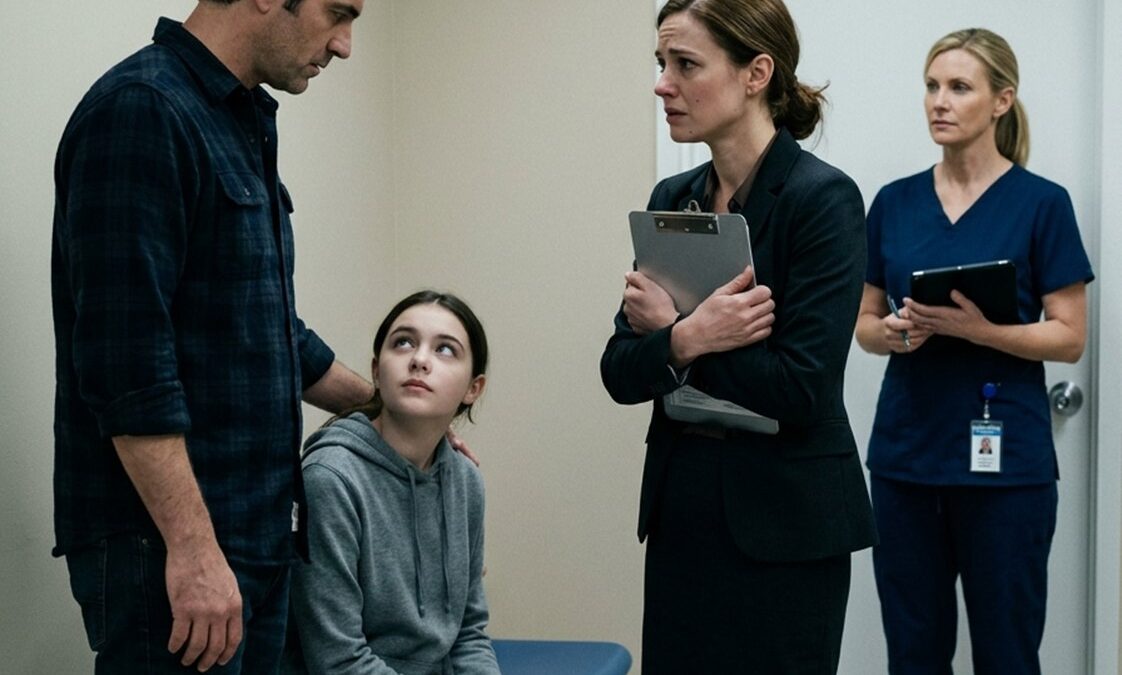
Chapter 2: The Name on the Form
Nico did not let go of Celeste’s wrist.
He did not squeeze.
The nurse’s tablet showed a red recording dot.
Wren stared at the signature on the clipboard.
“Dad, you signed it?”
“No.”
Celeste turned toward him.
“You were traveling.”
“I was in Newark.”
“You authorized emergency care.”
“I authorized a doctor to examine her.”
Nico released Celeste and removed the restraints himself.
Wren pulled her hands against her chest.
He crouched in front of her.
“Can I touch your shoulder?”
She nodded.
He rested one hand there.
The nurse stayed by the door.
“Keep recording,” he said.
Celeste held the clipboard against her body.
“That is not a medical order.”
“It is a record of a forged signature.”
“It is a signature.”
“Then you won’t mind an examiner.”
Wren looked between them.
“Are you angry with me?”
Nico’s expression softened.
“No.”
“Your face says you are.”
“I’m angry at whoever put you here.”
Celeste smoothed her coat.
“She was disoriented. She tried to leave.”
“From where?”
“Her room.”
“She has a name.”
“She has a psychiatric history.”
“She has a mother’s death certificate.”
Celeste’s eyes narrowed.
Nico remembered the night he nearly lost both of them: a stalled ambulance, a surgeon asking which room he would enter first, and his wife dying before he could return.
Since then, every “for her own good” had sounded like a door closing.
“Where is her attending physician?” he asked.
“Unavailable.”
“Call him.”
“He’s off shift.”
“Call the hospital administrator.”
Celeste glanced at the nurse.
The nurse’s thumb kept moving across the tablet.
“Did you record the intake?” Nico asked.
“Yes.”
“Every word?”
“Since Ms. Bellandi arrived.”
Celeste looked at the nurse’s badge.
“You have no authority to release that.”
“I’m preserving it.”
“You could lose your job.”
“I could lose it anyway.”
Wren stood. Her knees wobbled.
Nico offered his arm.
She took it.
Celeste stepped toward the door.
“Where are you taking her?”
“For an independent examination.”
“She isn’t stable.”
“Then her doctor can document that.”
“You’re not thinking clearly.”
“I’m thinking about the child who asked me for the truth.”
The nurse introduced herself as Tasha Greene.
She explained that Wren had arrived two hours earlier with Celeste and a driver.
No ambulance.
No parent.
No emergency physician.
The intake form claimed Nico had given telephone consent.
The listed number was his old office line, disconnected eighteen months ago.
“I asked to call you,” Wren said.
“Celeste told me you were on a plane.”
Nico looked at his daughter.
“Were you sick?”
“My heart was going fast.”
“Did you faint?”
“No.”
“Did you hurt yourself?”
“No.”
“Did you tell them you wanted to hurt yourself?”
“No.”
Tasha’s mouth tightened.
“The intake note says she made a threat.”
“What threat?”
“‘If I tell him, he’ll come for me.’”
Wren shook her head.
“I said, ‘If I don’t tell him, she’ll come for me.’”
Nico looked at Tasha.
“Can we correct that?”
“I can add a factual note. I can’t change the original.”
“Keep the original intact.”
“That’s what I’m doing.”
The on-call pediatrician arrived twenty minutes later.
He examined Wren with Tasha present, checked the marks on her wrists, and asked clear questions.
He found no reason to restrain her or admit her for psychiatric care.
He recommended a full evaluation the next morning.
The hospital supervisor arrived soon after.
His name was Martin Kell.
“We’ll review the record,” he said.
“Who accessed her chart?” Nico asked.
“We can’t discuss that without a formal request.”
“Then I’ll make one.”
Kell looked toward the tablet.
“You know the process.”
“I know what happened in that room.”
Wren stood beside Nico.
“Can I go home now?”
“Yes,” Kell said.
Nico read every line of the discharge form.
He left his signature box blank.
At the exit, Tasha handed him her card.
“If the record changes, call me.”
“Will you be safe?”
She looked toward the security desk.
“I’m going to document everything.”
He gave her Mara Ellison’s number.
Mara had represented the Bellandis for fifteen years.
She had taught Nico that a lawful record could be harder to erase than a threat.
Rain ticked against the awning.
Wren closed her eyes to listen.
Her mother used to name storms after music.
“Do you want the car?” Nico asked.
“Can we walk to the garage?”
“Yes.”
They crossed the covered passage together.
“Did you know she said that about Mom?” Wren asked.
“What did she say?”
“That Mom didn’t want me.”
“No.”
“Did Mom?”
“I heard her say your name before she could say mine.”
Wren looked at him.
He had kept that memory to himself for years, as if it belonged only to him.
“Then why did Celeste know that?”
“I don’t know.”
“She said you told her.”
“I didn’t.”
“She said you signed something.”
“I didn’t sign anything about you being sick.”
“What if the signature looks like yours?”
“Then someone copied it.”
“Could it be a mistake?”
“It could.”
“Could you have forgotten?”
“No.”
Wren studied his face.
He let her.
“I’m sorry I didn’t come sooner,” he said.
“You didn’t know.”
“I should have known you were upset.”
“I thought you’d believe her.”
The rain tapped above them.
“I’m sorry,” Nico said.
Wren looked toward the garage.
He put his coat around her only after she nodded.
The doctor’s note appeared on his phone as they reached the car.
Wren had been oriented and responsive.
There was no self-harm statement.
The original intake remained under review.
A second person had called the hospital before Wren arrived.
The caller claimed to be Nico’s family counsel.
He had confirmed that Nico wanted Wren held overnight.
His name was Adrian Vale.
Nico’s lawyer.
* * *
The forged consent had come from his own office.
* * *
Nico sat beside Wren in the car.
“You need sleep,” he said.
“I need the truth.”
“You’ll get it.”
“Promise?”
“I promise I’ll tell you what I learn.”
“That’s not the same as fixing it.”
“No.”
“Can you?”
“I can try.”
The drive home took twenty-two minutes.
Wren fell asleep with her hands tucked inside his coat.
At home, Nico carried her upstairs.
“Don’t leave,” she said.
“I won’t.”
He sat beside her bed until she closed her eyes.
Mara arrived at 1:18 a.m.
“Did you authorize Adrian to consent to treatment?” she asked.
“No.”
“Did you authorize Celeste?”
“No.”
“Did you ask anyone to have Wren admitted?”
“No.”
Mara wrote it down.
“We preserve the form, the recording, the access logs, and your phone records.”
“Get the hospital video.”
“Through the proper request or subpoena.”
“Do it.”
She sent a preservation request before dawn.
At 6:30, Adrian called.
Nico put him on speaker.
“Where are you?” Nico asked.
“Home.”
“Did you call St. Catherine’s about Wren?”
“I heard she was having a difficult night.”
“From whom?”
“Celeste.”
“Did you tell them I consented to an admission?”
A pause.
“I told them you’d want her protected.”
“That wasn’t my question.”
“I did what seemed best.”
“You signed my name?”
“I did not sign anything.”
“Your name is on the call log.”
“Then someone used my number.”
“Who gave them my old office line?”
“I don’t know.”
“Did you speak to Wren?”
“No.”
“Then you don’t know what she needs.”
Adrian exhaled.
“I was trying to prevent something worse.”
“What could be worse?”
“I don’t know yet.”
The answer came too quickly.
“What do you know?”
“Nothing.”
“You just said you were preventing something.”
“I was speaking generally.”
“Don’t call again without Mara present.”
Mara closed her laptop after the call ended.
“Don’t go to his home,” she said.
“I wasn’t going to.”
“Don’t contact Celeste.”
“I wasn’t going to.”
“Don’t send anyone to either place.”
“I know the rules.”
“Grief makes urgency feel like certainty.”
“Wren needs a safe adult.”
“She has you.”
“She has Celeste in the house.”
“Then we set a documented boundary.”
Nico ordered the household access logs preserved and the codes changed.
Celeste had already left the previous afternoon, saying she would stay with her sister.
Her suite was packed.
“Did she take anything from the office?” Nico asked the household manager.
“I don’t know.”
“Preserve the door logs.”
“Yes, sir.”
Mara reviewed the household, school, and medical contacts.
Celeste’s name appeared on several forms.
Adrian was listed as a backup contact on one.
Nico had approved many of those changes electronically.
Not the hospital form, Mara said. Those signatures were different.
At the top of the stairs, Wren appeared in a sweatshirt and socks.
“Is she coming back?”
“Not today,” Nico said.
“Is she still my stepmother?”
“No.”
“Did you know she was going to be?”
“I thought we would be married.”
“Did Mom say it was okay?”
“Your mother died before Celeste and I met.”
“I know.”
“Your mother would have wanted someone kind.”
“Do you know Celeste was kind?”
Nico could not answer.
“No.”
Wren came downstairs.
“Do I have to go to school?”
“Not today.”
“Do I have to talk to a therapist?”
“Only if you want.”
“What if I want to talk to somebody who knew Mom?”
“I can find someone.”
“You could ask Aunt Robin.”
Robin lived in Maine and had been close to Wren’s mother.
Nico called her.
“Birdie, are you all right?” Robin asked.
“Not really.”
“What happened?”
“Celeste lied about Mom.”
Robin went quiet.
“What did she say?”
“That Mom didn’t want me.”
“Your mother wanted you so badly she argued with three doctors about your name.”
Wren’s eyes filled.
“She did?”
“She picked it before she knew you were a girl.”
“Why did Celeste say it?”
“I don’t know, sweetheart.”
“Why do you always say sweetheart?”
“Would you like me to stop?”
“No.”
“Then I’ll keep saying it.”
The call helped.
It did not explain the form.
The family office administrator, Jonah Kells, arrived that morning with an old authorization packet.
“I found the original,” he said.
“Where?” Nico asked.
“Offsite archive. Adrian asked us to store it.”
The document was dated eight months earlier.
It named Celeste as authorized to make decisions for Wren if Nico could not be reached.
His signature sat at the bottom.
“I did not sign this.”
Jonah looked pale.
“It came through the office.”
“From whom?”
“Adrian.”
“Did I approve it?”
“I didn’t ask.”
“Did you check the signature?”
“No.”
“Preserve every copy.”
“Yes.”
The verification code showed that the signature image had been applied through the family’s electronic service, from a computer at Adrian’s firm.
Mara photographed the packet.
“We need to compare this with authenticated signatures,” she said.
Nico recognized the rounded capital N and the dragging final stroke.
It matched an old marina lease.
A second version of the proxy had been submitted to the hospital.
The signature was printed, not handwritten.
The document’s upload history linked it to Celeste’s company.
The company, Northstar Patient Advocacy, had been incorporated three months before the first altered school form.
It had no staff and no office beyond a mailbox.
Its bank records showed consulting payments from a hospital vendor.
The payments did not prove a referral fee, but Celeste had not disclosed the relationship.
Nico asked Wren about the forms.
“She photographed my school card last week,” Wren said. “She said your office needed it.”
“What did you write on it?”
“My name and birthday.”
Mara wrote it down.
Wren looked at the papers.
“Can I read them?”
“Not yet,” Nico said. “They have your private information.”
“Is that why she kept my school forms?”
“We don’t know what she kept.”
“She took pictures.”
“Did she say who asked?”
“She said it was for your office.”
“It wouldn’t have been.”
“I knew that.”
Nico moved around the desk.
“Was I supposed to tell you sooner?”
“No.”
“Are you sure?”
“Yes.”
“She said it was boring paperwork.”
“Adults say that when they don’t want to explain.”
“Do you do that?”
“Sometimes.”
“You’ll stop?”
“I’ll try.”
“That’s not a promise.”
“It’s the honest answer.”
Wren asked for toast and orange juice.
She ate half the toast, then asked whether she could go to Robin’s for a few nights.
“Yes,” Nico said.
“Will the case go away if I leave?”
“No.”
“Will I have to talk to police?”
“Only if you choose, or if a lawful process requires it.”
“Will you make me?”
“No.”
She decided to visit Robin.
Nico took her himself.
Mara stayed behind to request the hospital’s original intake, the call recording, visitor logs, and system audit.
The privacy officer later confirmed the caller had used Adrian’s office number.
The recorded voice sounded like Adrian.
He had told the hospital Nico was “unavailable but supportive of an overnight hold.”
He gave the old office line for verification and claimed Wren had made repeated threats at home.
The recording ended with a request to keep the matter quiet because of the family’s public profile.
The call proved it came from Adrian’s office.
It did not, by itself, prove he had made it.
Mara requested the office records and carrier logs.
Tasha called with another concern: her supervisor wanted her to amend the intake note to say Wren’s words could reasonably be read as a self-harm threat.
Tasha refused.
She had added a factual note recording exactly what Wren said and who claimed to have consented.
Nico listened to her account.
He did not ask her to do more than report what she had seen.
The hospital audit found two other cases in which Celeste had contacted the intake desk before a family arrived.
The patients’ identities remained private.
Neither case had a physician order for restraints.
The hospital referred the findings to its compliance committee and the state licensing authority.
A hospital camera showed Wren seated quietly when Celeste approached the clerk.
The form had already been signed before Wren entered the room.
The video had no sound, but it showed Celeste speaking to the clerk and then placing Wren in the chair.
The hospital acknowledged that a staff member had relied on Celeste’s claimed consent under a generic safety protocol.
The process had failed.
A document examiner compared the proxy with Nico’s authenticated signatures.
The signature image was pixel-for-pixel identical to the one on the marina lease.
It had been copied into the proxy.
The examiner’s report went to the district attorney.
Nico gave a statement with Mara beside him.
He described the hospital visit, the old office number, and the family office’s access to his electronic signature.
He provided phone records and the original lease.
He did not speculate about motive.
The prosecutor arranged a child-sensitive interview process for Wren.
She could choose whether to participate.
Nico explained that to her.
“Would it help?” Wren asked.
“It could.”
“Would it hurt?”
“It might feel hard.”
“What would they ask?”
“What you remember.”
“Would they ask if Mom wanted me?”
“I don’t know.”
“I don’t want to talk about Mom with strangers.”
“Then tell them that.”
“What if they don’t listen?”
“Mara will make sure they do.”
“Will you be there?”
“If you want.”
“I don’t.”
“I’ll wait outside.”
Wren chose to speak once.
With a child specialist and her therapist nearby, she described the chair, Celeste’s words, and the form.
She did not discuss her mother’s private life.
No one pressed her.
She also remembered that Celeste had asked her to write her name and birthday on a blank card the day before the hospital visit.
The family office found the image in a temporary upload folder.
The metadata placed it on Celeste’s phone.
A limited phone-data extraction, authorized by a judge, found draft messages to Adrian.
“Your form is ready. I can get her to St. Catherine’s if she refuses.”
Another read: “The evaluation will establish the pattern. The board can move once she is deemed unstable.”
The messages raised a new question.
The family trust held Wren’s inherited voting shares.
A clause allowed the board to appoint a temporary guardian over her assets if Nico became unable to act as guardian.
Two independent medical opinions would be required.
A single hospital assessment would not suffice.
Still, the hospital form could create the first official record.
The trust minutes showed Adrian had asked for a review of the guardianship contingency months earlier.
He had billed the trust for “succession planning.”
The independent trustee, Elise Hart, had asked for supporting documents.
Adrian had called the matter confidential.
The invoice showed he had spent forty hours studying the clause.
Nico had approved the bill without reading its detail.
Mara laid out the evidence.
“The plan may have been to create a record that you were unable to protect Wren,” she said. “But we need proof of motive.”
The threat arrived in a letter from Adrian’s lawyer.
It accused Nico of intimidating hospital staff and interfering with care.
It claimed Wren needed a stable environment away from “volatile influences.”
It asked the trust board to convene and appoint a temporary guardian.
Mara read it once.
“They’re moving now.”
“Can they get a guardian?”
“Not with this letter. But the board can meet.”
The chair, Nico’s cousin Paolo, called.
“I need to hear your side.”
“You should read the records first.”
“Adrian says Celeste acted with your authority.”
“She did not.”
“He says Wren is unwell.”
“She was examined by an independent physician.”
“Can we see the report?”
“With Wren’s permission.”
“Then the board has incomplete information.”
“The board has the hospital record, the disputed consent, and the preservation notice.”
“Adrian calls those procedural.”
“Ask him why he prepared the proxy.”
Paolo went quiet.
The board meeting was set for Friday.
The licensing authority issued a temporary order suspending Celeste’s referral work during its review.
The school also forwarded a message Celeste had sent to Wren: “I hope you understand I was trying to help.”
Wren read it.
“Does she want me to forgive her?”
“I don’t know,” Nico said.
“Do I have to answer?”
“No.”
Wren typed a reply herself: “You did not ask me if I wanted help. Do not contact me again.”
Mara sent it through the school’s official channel.
Celeste replied, “I understand.”
Wren did not answer.
That night, she made pancakes with Nico.
The first burned.
The second tore.
The third came out round.
“Do you think she meant it when she said she was helping?” Wren asked.
“I think people can believe a story that benefits them.”
“That sounds like yes and no.”
“It is.”
“Do you believe her?”
“No.”
“Why?”
“She used a false form and stopped you from leaving.”
“She said I was dangerous.”
“She had no evidence.”
“She had the chair.”
“She made the chair part of the evidence.”
Wren set down her fork.
“Are you going to shout at her at the board?”
“No.”
“Are you going to say she’s evil?”
“No.”
“Why not?”
“Because the records can speak.”
“Can records feel sorry?”
“No.”
“Can people?”
“Yes.”
“Does being sorry fix it?”
“No.”
“Then what should happen?”
“A boundary. And a consequence.”
“Good.”
The board meeting took place in the north conference room.
Wren sat with Robin in the back row.
She wanted to be present but not speak unless asked.
Adrian joined by video.
Celeste’s lawyer sent a written statement.
The chair called the meeting to order.
Mara presented the original hospital intake and the alleged consent.
She showed the signature beside Nico’s authenticated signature from the marina lease.
They were identical.
“That proves the signature was copied,” Adrian said. “It does not prove I copied it.”
“Correct,” Mara replied.
She presented the access log.
Celeste’s company had created the proxy.
Adrian’s office had sent it to her six weeks before the hospital visit.
Adrian called it a draft.
The hospital’s upload record showed it had been submitted.
The chair asked Nico to respond.
“I traveled too much,” he said. “I missed school events. I let other people handle decisions I should have made myself. Wren told me she thought I would believe Celeste. She had reason to think that.”
Wren sat beside Robin.
“I will answer for that,” Nico continued. “I will not let it excuse a forged consent.”
Adrian leaned toward the camera.
“I never authorized a restraint.”
“You told the hospital Nico consented to an overnight hold,” Mara said.
“I said I thought he would want an evaluation.”
“You said Wren had made repeated threats.”
“I had been told that.”
“By whom?”
“Celeste.”
“Did you speak to Wren?”
“No.”
“Did you ask Nico?”
“No.”
“Why not?” the chair asked.
“I thought he would say no.”
The board reviewed independent confirmation from the phone carrier and Adrian’s assistant, Lorna Park.
The records placed the call at Adrian’s desk.
Lorna said Adrian had instructed her to tell the hospital that Nico supported an overnight hold.
She had also prepared the proxy at Adrian’s request and sent it to Celeste.
“He said the board would need a record if Nico became unfit to manage the family,” she testified.
Adrian’s lawyer called her testimony unreliable because of her employment dispute.
Mara noted that Lorna had sent the relevant emails to the firm’s compliance partner before the hospital inquiry began.
Adrian’s lawyer asked for a recess.
Wren left with Robin.
In the hall, she asked Nico, “Did he say something bad?”
“Yes.”
“Was it true?”
“It matched what Lorna heard.”
“Could she be wrong?”
“She could be mistaken about a detail.”
“Could she be lying?”
“She could.”
“Do you believe her?”
“Yes. It matches the emails, the call, and the form.”
“Will they believe her?”
“They have to decide.”
“Do I have to go back in?”
“No.”
“I want them to see me.”
“Are you sure?”
“I want to.”
They returned together.
When the meeting resumed, Adrian argued that he had acted out of concern.
He said Nico’s travel schedule had left a vacuum.
He said Wren had been grieving.
He said Celeste had persuaded him she needed help.
Each point had a polished explanation.
Then the chair asked him one question.
“Why did you tell the hospital Nico consented?”
“I believed he would.”
“Did you ask him?”
“No.”
“Why not?”
“I thought he would say no.”
The board denied the petition for a temporary guardian.
It suspended Adrian from all trust work pending investigation and referred the evidence to independent compliance counsel.
The board did not decide the criminal case.
Adrian sent one last message through counsel, accusing Nico of using Wren as a weapon in a corporate dispute.
Nico did not reply.
“What did he say?” Wren asked.
“That I used you.”
“Did you?”
“No.”
“Did anyone?”
“Yes.”
“Can you stop them?”
“I can stop them from contacting you.”
“Can you make them understand?”
“No.”
“Then don’t make me do it.”
“I won’t.”
The district attorney’s inquiry continued for five months.
Celeste said she believed Nico had approved the evaluation.
The audit showed she had asked the intake clerk to keep Wren in the chair until the physician arrived.
The draft messages showed she had planned to bring Wren to the hospital.
The licensing authority found that she had used misleading documentation and failed to disclose her financial relationship with the hospital vendor.
Her license was suspended for six months, and she permanently lost her referral role.
The district attorney charged her with filing a false instrument and making a false statement to a hospital.
Adrian faced charges involving the forged proxy and false statements.
After the phone records, emails, and Lorna’s testimony were admitted, he entered a plea.
He paid restitution for legal and medical costs, received supervised release, and was barred from advising the Bellandi trust.
Celeste pleaded no contest to the false statement charge.
She received probation, community service, and a permanent no-contact order with Wren.
Wren did not attend the hearings.
She asked Mara to tell her when the decisions were final.
She read the summary at the kitchen table.
“Do they go to jail?”
“No,” Mara said.
“Is that fair?”
“The judge imposed the lawful sentence available under the agreements.”
“That’s not what I asked.”
“No,” Mara said. “It may not feel fair.”
“Will they do it again?”
“They’re barred from contacting you.”
“That doesn’t answer.”
“No,” Mara said. “We can’t know what anyone will do.”
“Can you tell me if there’s anyone else?”
“We checked the trust, hospital, and school records,” Nico said. “We found no one else involved.”
“That sounds better.”
“It’s honest.”
Wren asked Nico to fund an independent school counselor for students whose records had been altered or ignored.
She wanted the money from her settlement used, not a program bearing the family name.
“You don’t get to name it,” she said.
“I won’t.”
“Do you promise?”
“Yes.”
The school accepted the gift under conditions Mara wrote.
The counselor would report to the school, not the family office.
The program was called the Student Records Project.
It offered private counseling and a clear way to challenge an incorrect record.
Wren missed the opening ceremony for a math test.
Nico attended and corrected the principal when she credited the gift to the family.
“It came from Wren’s settlement,” he said.
The principal changed the wording.
The money could not repair Wren’s trust in adults.
It could give the next child a better chance of being heard.
* * *
Ordinary life returned in small demands.
Wren needed a winter coat.
The school bus ran late.
The kitchen sink leaked.
Nico learned which bread she liked and which pears she refused.
He began attending school meetings.
He still got it wrong.
One Tuesday, Wren told him another student had taken her seat.
Nico called the principal.
Wren came home furious.
“I wanted to tell you,” she said.
“I thought you wanted help.”
“I wanted to talk.”
“I’m sorry.”
“You always go straight to the person with power.”
“I’ll ask first next time.”
“You said that before.”
“I did.”
“What will you do now?”
“Listen.”
The student had not been trying to hurt her; the teacher had moved the class to another room.
Wren only wanted Nico to understand she could handle an ordinary problem.
He listened without calling the school again.
The next week, she asked him to help build a shelf.
He followed the instructions upside down.
“It’s leaning,” she said.
“I followed the picture.”
“The picture is upside down.”
She laughed.
They rebuilt it together.
The shelf stood straight enough.
“Could hold books,” she said.
“Could hold a cat.”
“We don’t have a cat.”
“Could start.”
“We are not getting a cat.”
“Noted.”
“That was almost a joke.”
“I’m improving.”
Nico changed the household rules.
No one could remove Wren from school without calling him or Robin directly.
No employee could access her medical records.
Security protected the house but did not follow her through the school day.
Wren chose which staff members knew the details.
She chose what to tell her friends and when to discuss her mother.
The family office also changed its signature system.
No employee could apply Nico’s signature to a document.
Every authorization required a second verification through his personal device.
The audit found no other altered forms.
It did find that Adrian had requested early access to Wren’s inheritance schedule.
He had not taken money.
He had studied the trust’s voting structure.
That clarified the motive.
If Nico were declared unable to act, a temporary guardian could seek a board seat and access to Wren’s shares.
Adrian wanted influence over the trust.
Celeste wanted access to the family.
Their goals overlapped long enough to hurt a child.
Records also showed Celeste had asked Adrian for a larger share of the trust if she became guardian.
Adrian called the terms premature.
He had also asked the family office to remove her from a draft trust plan.
He had been prepared to use her and discard her.
It did not make her innocent.
It explained the fracture.
There was no hidden accomplice, secret account, or second guardianship petition.
The inquiries reached an end.
Wren never received an apology that named the harm.
Celeste’s lawyer sent a letter saying she regretted “any distress caused by the misunderstanding.”
Wren read it once.
“Is this an apology?”
“No,” Nico said.
“What would make it one?”
“She would have to name what she did.”
“Could she?”
“She could.”
“Will she?”
“I don’t know.”
Wren put the letter in a drawer.
“I don’t want to answer.”
“You don’t have to.”
“Can you tell her that?”
“Mara can.”
“Tell her I don’t hate her.”
Nico looked at her.
“Do you?”
“Sometimes.”
“That’s allowed.”
“I don’t want to spend time hating her.”
“You don’t have to.”
“Tell her I won’t see her. And she can’t use Mom’s name.”
“I will.”
The boundary was delivered.
No meeting followed.
No forgiveness was demanded.
Wren eventually shredded the letter.
She asked Nico to help with the machine.
The loud grinding startled them both.
Then Wren laughed.
The signed no-contact order stayed in a folder with her school records.
The hospital kept the original consent form.
Wren never asked to see it again.
Two years later, the hospital invited Nico to meet with its compliance committee.
Tasha had kept her job and become a charge nurse.
The hospital had changed its intake rules.
A restraint order required an immediate documented assessment.
A claimed consent from an absent parent had to be verified through a direct call to a known number.
The original intake record could not be overwritten.
The committee asked Nico what else should change.
“Make every patient complaint visible to a second person,” he said. “Keep the original record. Don’t let family status shorten a process.”
The hospital added an independent reporting contact.
Wren chose not to attend.
She sent one sentence through Tasha.
“Listen to the person in the chair.”
The hospital chair had never belonged to Wren.
It was just one of its chairs, later replaced.
The thing the family kept was the forged consent.
The court held the original.
The trust kept a certified copy.
It had carried Nico’s name where his voice had been missing.
Wren knew where it was.
She did not need to see it again.
* * *
Five years after the hospital night, Wren graduated from high school.
She was studying public policy at a university two hours away.
She called home every Wednesday.
Sometimes she talked about class.
Sometimes she talked about nothing.
Nico answered on the first ring.
At graduation, he sat beside Robin, as Wren had asked.
After the ceremony, she hugged him.
“You came.”
“I said I would.”
“You missed the ceremony in seventh grade.”
“I did.”
“You’re not allowed to pretend that didn’t happen.”
“I won’t.”
“Good.”
Wren had prepared a presentation about how records could fail.
She called it “The Name on the Form.”
She did not name Celeste or Adrian.
She described how a false authorization became a medical order.
She described how a nurse preserved the original record and how an independent exam corrected the story.
A student asked if she hated the person who had done it.
“I don’t have to decide that every day,” Wren answered.
Another asked whether her father had fixed things.
“He showed up afterward.”
It was not absolution.
It was true.
Nico waited near the auditorium door.
“Did you like it?” she asked.
“Yes.”
“Was it too personal?”
“No.”
“You would say that.”
“I would.”
She smiled.
“That was honest.”
They walked across campus as rain began.
“Do you remember the first night?” Nico asked.
“I remember the lights.”
“I remember the form.”
“I remember being scared you’d be angry.”
“I remember wishing I’d come sooner.”
“You did come.”
“After you called.”
“I called because I thought you’d believe me.”
“I’m glad you did.”
She stopped beneath a stone arch.
“Would you fund a scholarship for students who report record problems?”
“Yes.”
“Not one named after us.”
“Fine.”
“Not one with your company on it.”
“Fine.”
“Would you do it without asking the school to put me in a brochure?”
“Yes.”
“Then I’ll help design it.”
“Only if you want.”
“I do.”
The scholarship would be administered by an outside organization.
It would support students challenging false school, medical, or custody records.
Applicants would not need to tell their story publicly.
Wren wrote the first draft.
Nico funded it without his name.
It paid for books, transport, and legal advice.
It did not solve everything.
It helped one student at a time.
When Wren graduated from university, she invited Nico.
He brought flowers in a paper sleeve.
She took them to her mother’s grave.
The grass was wet.
Wren placed the flowers beside a small bronze bird at the base of the headstone.
She told her mother about her classes, the scholarship, and a friend she had started dating.
Nico waited by the path.
When Wren returned, she said, “She would have liked you being there.”
“I hope so.”
“She would have told you to stop standing in the rain.”
“She would.”
“She would have made you carry her umbrella.”
“She would have.”
They walked to the car together.
Eight years after the hospital night, Wren joined the city’s child records advisory panel.
At her first meeting, she asked whether families could request an audit log.
The panel said no.
She asked why not.
They had no good answer.
The rules changed.
She asked whether a child could submit a statement privately.
The panel said it depended.
She asked them to write the process down.
They did.
Nico watched from the visitor seats.
Wren came out with a folder.
“Can you believe they didn’t have an audit request?”
“I can.”
“That’s depressing.”
“They’re fixing it.”
“Can we go eat? Somewhere with pie.”
“I know a place.”
“Do they have apple?”
“They do.”
“Thin slices?”
“I can ask.”
She shook her head.
“Don’t ask. It’s pie.”
He didn’t.
They sat by the window.
Wren ordered apple pie.
The conversation moved in both directions.
No one had to earn the right to speak.
At thirty-two, Wren returned to the hospital with her own three-year-old, Miles.
He had a fever and a cough.
Nico met them at the entrance.
He did not rush past the desk or announce who he was.
He stood beside Wren and asked what she needed.
“I need him checked,” she said.
“Okay.”
The receptionist offered a chair.
Miles climbed into it.
The chair was blue.
Wren’s face changed.
Nico noticed.
“Do you want to wait somewhere else?”
“No.”
She lifted Miles into her arms.
The chair stayed empty.
A nurse asked about his fever and medication.
Wren answered and signed the intake herself.
The nurse checked the form with her.
“Is this correct?”
“Yes.”
“Do you want your father listed as an emergency contact?”
“Yes.”
Nico did not reach for the form.
The signature belonged to Wren.
A doctor checked Miles.
It was a virus.
They received care instructions and went home.
In the car, Miles fell asleep against Wren’s shoulder.
Nico drove.
At the house, Wren carried him upstairs.
Nico made tea and brought it to the nursery.
Wren sat beside the crib.
“Do you remember the line you said?” Nico asked.
“At the hospital?”
“You asked whether I was angry with you.”
“What did you say?”
“I said I was angry at the person who put you there.”
“Did you mean it?”
“Yes.”
“Are you still angry?”
“No.”
She watched her son sleep.
“You didn’t tell me I had to forgive you.”
“No.”
“Why not?”
“Because it wasn’t mine to ask.”
“Thank you.”
Wren pulled a drawing from her desk drawer.
It was not the forged form.
It was the first picture she had made after the hospital: a blue chair, a little girl beside it, and a tall figure in the doorway.
Nico had kept it framed in his study.
Now she wanted it back.
“I think Miles would like this,” she said.
“Would he understand it?”
“Not yet.”
“Why give it to him?”
“Because it isn’t frightening anymore.”
She placed it on the shelf above the crib.
The chair had once meant an adult could make a child feel trapped.
Now it meant Wren had seen her father enter.
It meant he had listened.
It meant she had grown up and chosen what the image would become.
Miles stirred.
Wren touched his blanket.
“Shh,” she whispered.
“He’s okay,” Nico said.
“I know.”
Rain began at the window.
Wren opened the curtain a little.
A child safe in his bed.
A daughter beside him.
The truth kept where it belonged.
The paper had not saved her.
The people who kept it had.
The name on the form was no longer the loudest one in the room.
Wren’s was.
THE END








