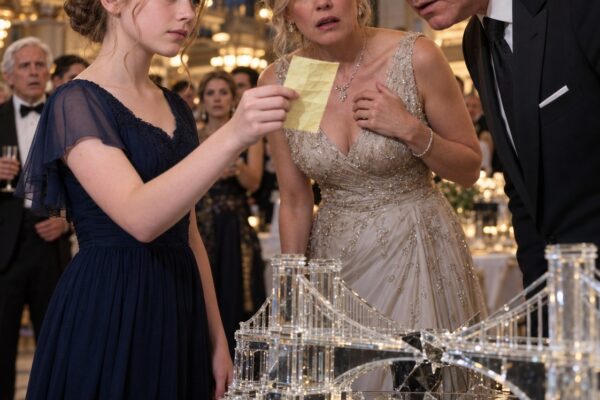
The Hotel Owner Stopped When My Daughter Held Up Her Hospital Bracelet and Asked Why It Carried Her Name
Chapter 2: The Name They Buried
Elise kept the bracelet in her open hand.
She did not try to keep it.
That mattered to Wren.
It mattered to me, too.
Across the driveway, a driver waited beside the car.
My manager remained under the hotel doors.
Neither came closer.
“Did you say your baby died?” Wren asked.
Elise’s fingers curled around nothing.
“Yes.”
“When?”
Elise looked at me first.
I gave her a small nod.
“Eleven years ago,” she said.
Wren counted silently.
She had turned eleven in April.
Her birthday had always been a happy day at our apartment.
There were pancakes shaped like terrible animals.
There were paper crowns.
There was usually a fight over candles.
Now she stood in the rain, measuring her life against a stranger’s grief.
“That’s when I was born,” she said.
Elise swallowed.
“I know.”
“You don’t know anything yet,” I said.
My voice came out harder than I meant it to.
Elise accepted it.
“You’re right.”
Wren took the bracelet from her.
She slipped it into her coat pocket.
It had never fit her wrist.
She wore it only in her hand.
For months, she had asked about her first mother.
I had given her everything I knew.
A name.
A date.
The county listed on her birth certificate.
An agency file that said the mother had requested privacy.
That morning, she had found the bracelet in a box while looking for photographs of herself as a baby.
I had meant to explain why I kept it.
Then my shift changed.
The sitter canceled.
The hotel let Wren wait in a staff room until I finished.
I should have gone home when she asked her first question.
Instead, I had promised later.
Later had arrived beneath a glass canopy.
“Are you cold?” Elise asked her.
“I’m wet.”
Elise gave a startled laugh.
Then she stopped.
Wren rubbed her sleeve across her face.
My manager called my name again.
I turned.
“I’m taking her home,” I said.
“You’re still on the clock.”
“I’ll sign out.”
He looked toward Elise.
She said nothing.
He went back inside.
Elise watched him leave.
“I can call someone about your shift.”
“Please don’t.”
“I only meant—”
“I know.”
I put my hand on Wren’s shoulder.
The rain had soaked through her thin coat.
“We need to go.”
“Wait,” Elise said.
It was quiet.
There was no command in it.
“What hospital?” she asked.
“It’s printed on the band.”
“I want to hear what the agency told you.”
I could have lied.
I wanted one more hour before Wren heard the rest.
But she had already read the name.
“The file said you signed consent,” I told her.
Elise shook her head once.
“I never signed away a child.”
Wren looked between us.
“Could there be two babies?”
“There could,” I said.
Elise turned the bracelet toward the hotel light.
The name had faded.
The number had not.
A blue ink star marked one corner of the clasp.
“Why did you draw that?” Wren asked.
“My father called every baby in the family a star.”
“That’s a weird thing to do.”
“He was a weird man.”
For a moment, Elise smiled.
Then a phone rang inside her evening bag.
She glanced at the screen.
Her smile vanished.
“Who is it?” I asked.
“My sister.”
She let it ring.
Wren sneezed.
I guided her toward the covered entrance.
Elise followed at a distance.
“Will you call the hospital?” Wren asked her.
“Yes.”
“Tonight?”
“Yes.”
“Will they tell you?”
“Probably very little.”
Wren considered that.
“Then call anyway.”
Elise nodded.
We went into the lobby.
Warm air smelled of polished wood and cut flowers.
I found a towel at the concierge desk.
The clerk handed it over without asking why Wren was dripping onto the marble.
Elise waited while I dried her hair.
She stood near enough to speak.
Far enough to let me work.
“I need your number,” she said.
I looked up.
“For updates,” she added.
I gave it to her.
She called me immediately.
My phone lit in my pocket.
“Now you have mine,” she said.
Her sister called again.
Elise silenced the phone.
“Did anyone at the agency tell you why I wanted privacy?” she asked.
“They said it was painful.”
Elise looked at Wren.
“It was.”
Then she looked at me.
“But I never asked for privacy.”
* * *
The next morning began with a burnt waffle.
Wren insisted she liked it.
She ate around the black edges.
I had slept for two hours.
My phone had been beside me the whole time.
Elise had sent one message at 1:14 a.m.
The hospital could not release records by phone.
She had an appointment with its records office that morning.
She asked whether I would come.
I said yes.
Then I called the hotel.
My manager answered.
He told me not to worry about yesterday’s shift.
I worried immediately.
He explained that Elise had asked him to let me take personal leave.
I closed my eyes.
“She shouldn’t have done that,” I said.
“She didn’t ask me to fire you, Ruth.”
“That isn’t what I meant.”
“I know.”
He had a daughter Wren’s age.
He gave me the day.
I used the train fare I had set aside for groceries.
At the hospital, Wren stayed with our neighbor, Mrs. Park.
She knew where we were going.
I told her she would hear anything we learned before anyone else.
She made me promise twice.
Elise arrived without a driver.
She wore jeans and a dark coat.
She carried a canvas bag with a broken zipper.
That surprised me more than it should have.
At the records desk, she presented identification.
She requested her own admission records from eleven years earlier.
The clerk explained the process.
There would be forms.
Some files might be archived.
Anything relating to a child would require separate authorization.
Elise completed what she could.
She did not mention Wren’s name to the clerk.
I was grateful.
Afterward, we sat in a waiting area beside a vending machine.
Its lights buzzed.
“Why did they tell you she died?” I asked.
Elise stared at her hands.
“They said there had been complications after birth.”
“What kind?”
“I was recovering from surgery.”
She paused.
“I was awake when she was born.”
“You saw her?”
“For a moment.”
She opened her canvas bag.
Inside was a small photograph.
It showed Elise in a hospital bed.
A newborn lay against her chest.
Only the baby’s cheek was visible.
“My father took it,” she said.
“He got in trouble for using his phone.”
“Where was he afterward?”
“He died the next year.”
She put the photograph away.
“They told me she had trouble breathing,” she said.
“They took her to the nursery.”
“Did you see her again?”
Elise shook her head.
“I was given papers before I left.”
She searched her bag.
There were folded copies in a yellow envelope.
A hospital summary.
A certificate showing an infant death.
I did not know whether either was genuine.
Neither did she.
“I spent years believing those pages,” Elise said.
I thought of Wren at seven, asking whether babies could remember music.
I thought of her at nine, refusing a school family tree because every branch ended in a question mark.
“I believed my pages, too,” I said.
Elise looked at me.
“What did you get?”
“A private agency file.”
It listed Wren as an infant placed for adoption.
The mother’s name was Elise Voss.
There was a signed consent.
I had a copy at home.
The file also described a period for the birth mother to reconsider.
By the time Wren came to me, it said that period had passed.
I had been waiting nearly three years to adopt.
I was a library assistant then.
My husband, Jonah, was alive.
We had painted the small bedroom yellow.
Six months after Wren came home, Jonah died from a sudden illness.
I had raised her since.
None of that made the paperwork true.
It made my belief in it understandable.
“I don’t think you did anything wrong,” Elise said.
“You don’t know yet.”
“I know you brought her into that lobby.”
“She ran.”
“You stayed.”
I looked at the vending machine.
A packet of crackers hung behind the glass.
“Staying is the easy part,” I said.
Elise said nothing.
The records clerk called her back.
An archived index was available.
The full chart would take longer.
The index showed a live birth.
A female infant.
A weight.
A time.
No infant death appeared in the hospital’s digital register under that admission.
The clerk warned us that old entries could be incomplete.
She suggested requesting certified copies.
Elise did.
We left with a receipt and a case number.
On the sidewalk, she called the county vital records office.
They could explain how to request a certified death record.
They could not discuss one over the phone.
Elise wrote everything down.
Her handwriting was small and slanted.
I recognized it from the agency consent.
That realization made me stop walking.
“What?” she asked.
“I have the signed form.”
“Can you send me a picture?”
“I want a lawyer to see it first.”
“That makes sense.”
She did not ask again.
At home, I took Wren’s file from the cupboard.
I had opened it so many times that the paper folder no longer held its shape.
There was the birth certificate.
There was a copy of the adoption order.
There were six pages of agency notes.
The consent sat between a medical summary and a letter about privacy.
Elise’s name was printed beneath the signature.
The handwriting looked close.
Too close for me to tell.
I noticed something else.
The consent had been witnessed at 8:10 in the morning.
The hospital summary said Elise had been discharged at 2:30 that afternoon.
That seemed possible.
Then I saw the date.
The consent was signed the morning after the birth.
The summary said Elise was still receiving treatment then.
I called the number on the agency letter.
It had been disconnected.
Wren sat at the kitchen table drawing the hotel.
She gave the canopy sharp angles.
She drew herself beneath it.
She drew Elise outside in the rain.
She drew me between them.
“Did they find anything?” she asked.
“A record says a baby was born alive.”
“I already knew that.”
“Sometimes records matter even when you know.”
She set down her pencil.
“Did Elise sign?”
“We don’t know.”
“Does she want me?”
I pulled out the chair beside her.
“She wants the truth.”
“That’s not what I asked.”
“No,” I said.
“It isn’t.”
I could not answer for Elise.
I would not turn Wren into a prize someone might claim.
“We’ll ask her when you’re ready,” I said.
Wren looked at the drawing.
“I’m ready now.”
We called Elise together.
Wren held the phone on speaker.
“Would you want to know me?” she asked.
Elise took a breath.
“Yes.”
“Even if I’m not your baby?”
“Yes.”
“Why?”
“Because you asked me to find out what happened.”
Wren considered that.
“That’s a good answer,” she said.
It was.
After the call, I studied the consent again.
The witness’s signature was a looping C.
I turned to the agency cover sheet.
It carried the name of a contact who had arranged the placement.
Celia Voss.
Elise’s sister.
* * *
Elise met us at a public library the next day.
It was my choice.
Wren liked the children’s room.
There were quiet corners if she needed one.
There were doors she could walk through.
Elise arrived early and waited near the circulation desk.
She brought no gift.
I had asked her not to.
Wren went straight to the table where Elise sat.
“Ruth says your sister arranged my adoption,” she said.
Elise looked at me.
I showed her the cover sheet.
She read it twice.
“Celia handled my paperwork,” she said.
“What paperwork?” I asked.
“Everything after the hospital.”
She rubbed her thumb along the page.
“I couldn’t bear phone calls.”
Celia was older by five years.
She had managed their father’s company while Elise worked in its charitable foundation.
After his death, Celia took over the business.
Elise remained on the foundation board.
They lived in different parts of the city.
They still had dinner twice a month.
“Did you tell her about us?” I asked.
“I told her about the bracelet.”
“When?”
“After I left the hospital.”
I sat back.
“She called me at two this morning,” Elise said.
“She wanted the name of your agency.”
“Did you give it?”
“No.”
Wren watched us both.
“Is she bad?” she asked.
“We don’t know what she did,” Elise said.
“I know what her name is on,” I replied.
A librarian wheeled a cart past our table.
We waited until she was gone.
Elise opened her phone.
She showed me a message from Celia.
It said she could help protect everyone from a public mistake.
It suggested Wren might be frightened by strangers making claims.
I read it again.
“She knows Wren’s name?” I asked.
“I didn’t tell her.”
The agency cover sheet had it.
So had the adoption file.
Elise’s hand tightened on the phone.
“We need an attorney,” she said.
“I’ve called one.”
That surprised her.
A woman I knew from the library had referred me to a family lawyer named Patrice Wynn.
She had agreed to meet us that afternoon.
I had also asked whether Wren should come.
Patrice said the first meeting could be adults only.
Wren had chosen to stay at the library with Mrs. Park.
We walked her to the children’s room.
She picked a book about ships.
I knew she would not read it.
Elise stopped beside her chair.
“May I call you later?” she asked.
Wren nodded.
“You can ask Ruth first.”
“I will.”
At Patrice’s office, we placed both sets of papers on her desk.
She listened without interruption.
Then she separated them into three piles.
Hospital records.
Agency records.
Court records.
“Each may tell a different story,” she said.
“We need originals where possible.”
Elise asked what happened to an adoption if the consent was forged.
Patrice did not offer a simple answer.
Courts considered many things.
The passage of time mattered.
The child’s established home mattered.
The truth of the original placement mattered.
“So can someone take her?” I asked.
“Nothing happens today,” Patrice said.
“We will act to protect her while we investigate.”
I wrote that sentence down.
Patrice asked Elise to retain separate counsel.
Their interests might align.
They were not identical.
Elise agreed.
Patrice called the agency’s successor organization.
A receptionist confirmed the old agency had merged into a larger nonprofit.
Archived files existed.
Access required a formal request.
Patrice prepared it.
Then she looked at the consent.
“Do you recognize the witness?” she asked Elise.
“Only the first name.”
The printed line read Cynthia Bell.
It did not match Celia.
Patrice asked whether Celia used any other names.
“Her middle name is Cynthia,” Elise said.
“No one calls her that.”
The room seemed smaller.
Patrice did not call it proof.
She asked for samples of Celia’s signature.
Elise had business documents.
She would send them to her own lawyer.
On the way out, my phone rang.
It was the hotel.
My manager sounded uncomfortable.
Someone had called human resources asking for my schedule.
They had claimed to represent the Voss family.
He had refused.
I thanked him.
Elise stopped beside the elevator.
“I didn’t authorize that.”
“I know.”
“You don’t have to believe me.”
“I do.”
She looked relieved.
Then she looked angry.
That evening, Wren found a white envelope under our apartment door.
There was no return address.
Inside was a copy of a photograph.
It showed our building from across the street.
A note said attention could make Wren’s life difficult.
I called Patrice.
She told me to photograph the envelope and note.
She told me to keep the originals untouched.
Then she advised me to report it.
The police officer who took the report could not say who had left it.
She logged the photograph.
She asked about the calls to my workplace.
My manager confirmed them by phone.
After she left, I checked every lock twice.
Wren stood in the hallway.
“Are we moving?”
“No.”
“Should we?”
“Not tonight.”
She came into my room carrying the hotel drawing.
She had added a fourth figure.
A small blue star hovered above the canopy.
“Who’s that?” I asked.
“Whoever knows.”
We slept with the hall light on.
The next morning, Patrice called.
The successor agency had found its archive index.
The original placement file was sealed pending review.
But its transfer log listed the person who delivered the infant.
Not a nurse.
Not an agency worker.
Celia Voss.
* * *
Elise’s attorney was named David Kwan.
He was careful with every sentence.
Patrice liked him for that.
I did, too.
He secured a meeting with the successor agency’s counsel.
Patrice came for me.
Elise came with David.
Wren stayed at school.
We sat around a table with water nobody drank.
The agency produced copies from its archive.
There was an intake sheet.
There was a consent.
There was a receipt for a blanket and hospital bracelet.
There was a note saying the birth mother had chosen to avoid direct contact.
The name beside that note was Cynthia Bell.
Celia’s middle name.
The agency counsel said the original worker had retired.
They had located her.
She was willing to speak through counsel.
Patrice asked how Celia had been permitted to deliver a newborn.
The counsel read from the intake sheet.
“She represented that she had temporary authority under a signed hospital release.”
“Do you have that release?” David asked.
The counsel turned a page.
“No.”
“Did you ever have it?”
“We’re still checking.”
No one raised a voice.
The questions became sharper anyway.
The agency had called the hospital.
The hospital confirmed a birth.
Someone had faxed a discharge authorization.
The fax header named a machine in the Voss family company’s office.
That was in the file.
I looked at Elise.
She stared at the page.
Patrice asked who at the agency had checked the mother’s identity.
The answer was not in the archive.
The retired worker might know.
David asked for copies.
The counsel agreed to a controlled release after reviewing privacy requirements.
I waited while the lawyers discussed dates.
One page bothered me.
It was the inventory of items sent with Wren.
A blanket.
A cotton cap.
A hospital bracelet.
No photograph.
No note.
Elise had said her father took a picture in the room.
Had he taken more?
I asked.
“He did,” she said.
“He printed one for me.”
“Where are the others?”
“His old phone was lost after he died.”
I pointed to the inventory.
“The bracelet came through the agency.”
“Yes.”
“It still had the star.”
“Yes.”
“If someone wanted you to believe the baby died, why leave it?”
Elise looked at me.
“Maybe they never noticed.”
I had washed Wren’s blanket by hand for years.
The star was easy to miss.
It was tiny.
Blue ink on white plastic.
The baby’s printed number had drawn my eye.
I had not noticed the star until Wren did.
The agency counsel was listening.
“The retired worker remembered the bracelet,” she said.
“She mentioned it when we contacted her.”
“Why?” Patrice asked.
“She said the woman delivering the baby asked them to discard it.”
The room went still.
“She refused,” the counsel added.
“Agency practice was to preserve identifying items.”
I looked at the receipt again.
Someone had signed for the bracelet.
Cynthia Bell.
The signature matched the witness on the consent.
We left with copies and a list of records still needed.
Outside, Elise leaned against the wall.
“She held my daughter,” she said.
There was no anger in her voice yet.
Only disbelief.
I knew something about the weight of Wren as a baby.
She had slept with one fist against her cheek.
She had hated the red cap in the inventory.
She had pulled it over her eyes and cried.
I told Elise that.
It was a small thing.
It gave her somewhere to put her hands.
“She still hates hats,” I said.
Elise laughed once.
“She got that from me.”
Then she straightened.
“Celia says she can explain this.”
“She called you?”
“She came to my apartment.”
“What did she say?”
“That our father wanted discretion.”
“About a living baby?”
“She said the hospital made an error and she helped correct it quietly.”
Elise saw my face.
“I didn’t believe her.”
“Then why tell us now?”
“Because she wants me to meet her tonight.”
David advised against a private meeting.
Celia had asked Elise to come to the Voss company’s annual board reception.
Investors and trustees would be there.
So would a photographer.
It was a room where Celia knew how to control a story.
Patrice thought the invitation could matter.
If Celia made a claim in front of witnesses, it might be useful.
David called a prosecutor’s office contact to discuss the records.
He did not promise an arrest.
He did not promise anyone would even open a case that day.
He asked us to preserve everything.
Meanwhile, Patrice arranged for the retired agency worker to give a formal statement.
Her name was Denise Alder.
She lived two counties away.
She remembered the infant because of the bracelet.
She also remembered the woman who delivered her.
“She was impatient,” Denise told Patrice on speakerphone.
“She kept asking when the placement would be final.”
“Did you meet the birth mother?”
“No.”
“Why not?”
“I was told she was recovering.”
“By whom?”
“The woman who brought the baby.”
“Did you verify her authority?”
A long pause followed.
“I thought the hospital had.”
Denise sounded older than the mistake.
She had kept a desk diary.
She still had it.
On the day of Wren’s placement, she wrote that Cynthia Bell had called three times before noon.
The first call came before the hospital’s recorded discharge time.
Denise agreed to provide the diary to her lawyer.
After the call, Patrice asked me what I wanted.
“I want Wren safe.”
“And after that?”
“I want her to decide who belongs in her life.”
Patrice nodded.
“That is a useful answer.”
At home, Wren had questions of her own.
“Is Celia my aunt?”
“Biologically, she may be.”
“Did she hold me?”
“Yes.”
“Did I cry?”
“I don’t know.”
Wren frowned.
“I bet I did.”
She was trying to make a baby’s protest count.
I let her.
That night, Elise called with another fact.
Her father’s trust had been amended shortly before Wren was born.
It gave a portion of the family company to his first living grandchild.
Celia had told everyone the child died.
After their father’s death, Celia controlled the shares that would otherwise have been held for that child.
She had used that control to approve a sale of company property to a developer she knew.
David was reviewing the records.
“She did it for money,” I said.
“She did it for control,” Elise answered.
There was a difference to her.
To me, Wren had been taken for both.
* * *
The board reception took place in a glass room above the river.
Elise did not ask me to attend.
I asked Patrice whether I should.
She said I could, as long as I understood that a public argument would not replace evidence.
Wren stayed with Mrs. Park.
She wanted to come.
I told her adults owed her answers first.
She accepted that for exactly five minutes.
Then she asked me to send a picture of the room.
I did.
It looked like a place where nobody spilled anything.
Elise met us near the elevator.
David stood beside her.
Patrice had brought a folder.
I had brought Wren’s bracelet.
It was sealed in a clear sleeve.
Patrice had photographed it and recorded when she received it from me.
The original would be available if investigators requested it.
Until then, it stayed close.
Celia crossed the room before we had taken off our coats.
She looked enough like Elise to make the resemblance uncomfortable.
Same dark eyes.
Same straight posture.
A different use for both.
“Ruth,” she said.
She knew my name.
“I’m glad you came.”
“I’m here for Wren.”
“Of course.”
Her smile reached Elise.
“I told you we could resolve this privately.”
Elise did not answer.
Celia lowered her voice.
“There are children in this room.”
“There’s one who isn’t,” Elise said.
Celia’s smile thinned.
Around us, board members moved toward a table for the scheduled meeting.
The reception was about to become a vote on a new property sale.
David had requested time to address the board first.
Celia had agreed.
She might have expected a plea.
She stood at the front beside a screen showing the company logo.
David spoke for less than a minute.
He said new records raised a serious question about ownership of shares currently voted by Celia.
He asked that the property vote be postponed.
A trustee asked what kind of records.
Celia answered before David could.
“A family matter,” she said.
“One involving an old adoption.”
She looked toward me.
“A loving home may have been built on incomplete documents.”
It was a careful sentence.
It placed the weight on my home.
I felt it.
Then I saw Elise watching me.
She had heard it too.
David asked Celia whether she had arranged an adoption eleven years earlier.
“Yes,” Celia said.
She sounded almost relieved.
“My sister was unwell after the delivery.”
Elise stood.
“I was recovering.”
“You were grieving,” Celia said.
“There was confusion at the hospital.”
“Who told you the baby died?” David asked.
Celia looked at him.
“That was the hospital’s conclusion.”
“Did you tell Elise it was wrong?”
“I attempted to spare her another shock.”
“When?”
“I don’t have the date in front of me.”
A board member set down his glass.
Celia turned to him.
“Imagine discovering that a child you had mourned was alive and already with a family.”
“That isn’t what happened,” Elise said.
“You don’t remember every hour of that week.”
“I remember asking where my daughter was.”
Celia’s jaw tightened.
“You remember what you can bear.”
For one moment, the room tilted toward her.
She spoke with authority.
She knew the family.
She made cruelty sound like concern.
I wanted to shout.
Patrice touched the folder.
I waited.
David asked whether Celia had signed the agency consent as a witness.
“I may have,” she said.
“You used the name Cynthia Bell.”
“It is my name.”
“Why Bell?”
“My married name at the time.”
That was true.
She had an answer ready.
David asked why the bracelet traveled with the child.
“Sentiment,” Celia said.
“It was among the baby’s belongings.”
“The agency worker says you asked her to discard it.”
Celia turned toward him.
“Then she misunderstood me.”
Patrice opened the sleeve.
She held up the bracelet.
The printed hospital number faced the room.
The blue star sat on the clasp.
Elise had marked it in the recovery room.
A small thing.
Proof that she had held a living baby.
Celia looked at it.
For the first time, she seemed uncertain.
A trustee asked what the number proved.
Patrice answered carefully.
“On its own, identity needs confirmation.”
She placed copies of certified records on the table.
“The hospital archived the infant admission under that number.”
“The infant was discharged alive.”
“The county has no corresponding infant death record.”
Celia folded her arms.
“Administrative errors happen.”
“They do,” David said.
“That is why we requested independent records.”
He handed the board secretary a copy of the archived agency inventory.
The bracelet’s number appeared there.
So did Celia’s signature.
A medical identification test was pending.
We had not told the board it was done.
Elise and Wren had both agreed to it through their attorneys.
The laboratory had completed the report that morning.
Patrice had called Wren at school.
She had told her the result before we came.
Wren had asked for time.
Then she had said we could tell the adults.
David placed the report beside the bracelet.
“The test confirms Elise is Wren’s biological mother,” he said.
Nobody made a sound.
The room had enough air for everyone.
I still found it difficult to breathe.
Celia looked at the report.
Then at Elise.
“You let them test her?”
“She chose to,” Elise said.
“She is eleven.”
“She understood what the question meant.”
“She cannot understand the consequences.”
“I’m still learning them,” Elise said.
Celia faced the board.
“You see the problem.”
David did not let the conversation move.
“The ownership question remains,” he said.
“A child was alive when the trust vested.”
“I acted under the records available,” Celia replied.
“Records you supplied,” Elise said.
Celia’s composure cracked.
“Your father was going to hand the company to a baby.”
“He was going to set aside shares.”
“Shares I had spent twenty years earning.”
“You could have challenged his will.”
“He was dying.”
“You took my daughter.”
Celia looked at me then.
“She had a good life.”
“Yes,” I said.
“She did.”
I kept my voice steady.
“You don’t get credit for it.”
The board secretary asked to recess.
Two trustees supported a postponement.
The vote on the sale was suspended.
David and Patrice had already given the records to investigators.
The board’s action would not determine whether Celia had committed a crime.
It would prevent another company decision while ownership was examined.
That was enough for that night.
Celia came toward me as people began to leave.
“You may lose the child you raised,” she said softly.
I had feared that since the rain.
I looked at her.
“Wren isn’t property,” I said.
Celia had no answer for that.
The legal process took months.
An investigator interviewed Denise.
The hospital produced archived discharge records.
A document examiner compared signatures.
The agency’s old fax copies led to a machine log from the Voss office.
Celia had requested the fax on the day Wren left the hospital.
Her lawyer disputed what the log meant.
The prosecutor filed charges concerning forged records and fraud.
Celia denied them.
A court froze the disputed share voting rights while the civil case proceeded.
Later, Celia entered a plea to some of the charges.
She lost her board position.
The court ordered financial restitution and imposed a sentence.
The details took pages.
Wren cared about one question.
“Does she get to decide where I live?”
“No,” Patrice told her.
“She never did.”
* * *
Winter came slowly.
Wren decided she wanted to meet Elise at the library.
She chose the table.
She chose the time.
She asked me to stay.
Elise arrived carrying two paper cups.
One was hot chocolate.
The other was coffee for me.
Wren inspected hers.
“No marshmallows?”
“I didn’t know if you liked them.”
“I do.”
“I’ll remember.”
Wren sat down.
They spoke about school first.
Then books.
Then the photograph of the day she was born.
Elise asked if she could show it.
Wren nodded.
For a long time, she looked at the baby’s cheek.
“You look tired,” she told Elise.
“I was.”
“The baby looks annoyed.”
“She probably was.”
“That sounds like me.”
Elise smiled.
Wren kept the photograph for a week.
Then she asked for a copy.
Elise made one.
She did not ask for anything in return.
That became the pattern.
They met when Wren wanted.
Sometimes at the library.
Sometimes at a diner near our apartment.
Once at a park where Wren spent twenty minutes showing Elise how to throw a ball badly.
Elise was excellent at it.
She threw directly into a trash can.
Wren laughed so hard she had to sit down.
There were harder days.
Wren asked why Elise had stopped looking for her.
Elise told the truth.
She had been given a death certificate.
She had visited a small memorial at the cemetery.
She had kept the hospital photograph in a drawer because she could not bear to put it away.
“I should have asked more questions,” Elise said.
Wren traced a circle on the diner table.
“You were sick.”
“I was recovering.”
“You trusted your sister.”
“Yes.”
“I don’t know if that’s worse.”
“Neither do I.”
Wren nodded.
It was not forgiveness.
It was a conversation.
I had my own conversation with Elise.
We sat outside the school after a meeting with Patrice.
The legal status of the adoption remained under review.
The attorneys had reached an agreement about daily care while the court considered it.
Wren would stay with me.
Elise would have regular contact with her consent.
Both of us would return to court if anything changed.
It sounded simple on paper.
It had taken weeks to write.
“I’m sorry,” Elise said.
“For what?”
“For speaking to your manager.”
“You meant to help.”
“I made your work life my business.”
“Yes.”
She accepted that.
“I won’t do it again.”
“Good.”
She waited.
I had something else to say.
“I’m sorry I thought you might take her without listening.”
“I might have thought the same thing in your place.”
“That doesn’t make it fair.”
“No.”
We sat through a school bell.
Children poured onto the sidewalk.
Wren emerged carrying a cardboard model of a bridge.
It had survived the school day.
Barely.
“Don’t touch the left side,” she warned.
Elise held up both hands.
I opened the car door.
The bridge lost one paper support anyway.
Wren looked offended by gravity.
Elise offered to fix it.
Wren told her she was unqualified.
Elise had built three hotels.
None of that counted.
In February, the Voss company’s lawyers contacted Patrice.
They proposed a settlement for Wren’s share of the family trust.
It was a large amount.
I read the first page three times.
Then I put it face down.
“Does she know?” I asked.
“Not the figure,” Patrice said.
“She knows there may be money.”
Wren had heard enough adults discuss shares.
She knew they were more than paper.
Elise had told her a fund might pay for education later.
She had not promised a castle.
Patrice explained how a court could oversee an account for Wren.
I asked for independent financial advice.
We got it.
The eventual agreement placed the restored shares in a trust for Wren.
Celia had no role in managing it.
Elise could not spend from it for Wren without oversight.
Neither could I.
The arrangement protected Wren from adults who might confuse affection with access.
I did not want the money in my account.
Elise understood before I said why.
“You’ve paid for everything,” she said.
“I paid for my daughter.”
“That’s still something.”
“Yes.”
She looked down.
“I can help with her life now.”
“You can.”
“We should agree on how.”
So we did.
Elise covered the costs of a summer art program Wren had chosen.
I continued paying our rent and groceries.
When Wren needed a new bike, we bought one together.
She insisted on choosing the color.
It was an astonishing orange.
She loved it.
Mrs. Park said it could be seen from space.
Wren considered that a compliment.
In spring, the court held a hearing.
Patrice explained Wren’s wishes.
Wren spoke privately with the judge through the process arranged for her.
I did not hear every word.
That was her right.
The court recognized the fraud in the original consent.
It also recognized the life Wren had lived.
The final order preserved my legal parenthood and established Elise’s legal relationship and agreed contact.
The lawyers had spent months working toward it.
No one walked out having won a child.
Wren walked out asking for lunch.
We went to the diner.
She ordered fries and a milkshake.
Elise ordered a salad.
Wren took half her croutons.
Elise let her.
Afterward, Wren asked us to walk to the river.
At the railing, she took the bracelet from her backpack.
She had asked Patrice for it after the proceedings ended.
It was still in its clear sleeve.
“I want to keep it,” she said.
“It’s yours,” I told her.
“I know.”
She looked at Elise.
“Can I put the picture with it?”
“Of course.”
“I want both beginnings.”
Elise pressed her lips together.
Wren slipped the photograph behind the bracelet.
Then she zipped the backpack.
A week later, Elise came to our apartment with a question.
She stood in the doorway.
She had learned not to arrive with a plan disguised as a favor.
“May I come to Wren’s school concert?” she asked.
Wren heard from the kitchen.
“Yes,” she called.
“But you have to clap for the whole orchestra.”
“I can manage that.”
“Even the drums.”
“I was especially planning to clap for the drums.”
Wren appeared with flour on her cheek.
We had been making cookies.
Elise looked at me.
“May I come in?”
I stepped aside.
She took off her shoes.
Wren handed her an apron.
It read WORLD’S OKAYEST COOK.
Elise wore it.
Our cookies came out uneven.
We ate them anyway.
* * *
Five years later, the hotel canopy still leaked in heavy rain.
The management had repaired it twice.
Water found a narrow seam each spring.
Wren noticed it before anyone else.
She was sixteen and taller than I was.
She had my habit of checking bus times early.
She had Elise’s dark eyes.
She had a laugh that belonged entirely to her.
We had come for a community scholarship dinner.
Wren was receiving an award for a student project that helped local families find free legal records.
She had designed the website after watching three attorneys spend months asking for papers.
She said the site was easier than explaining our family at school.
It was also useful.
People told her so.
Mrs. Park attended in a bright green jacket.
Elise brought her partner, who knew enough to sit quietly during Wren’s speeches.
I brought a camera with a stubborn flash.
Wren told me to stop testing it in the lobby.
“I’m documenting history,” I said.
“You’re blinding a waiter.”
I lowered the camera.
The waiter winked at her.
After dinner, rain started.
We stepped beneath the glass canopy.
Water ran down the same corner where Wren had stood at eleven.
She pulled something from her coat pocket.
The hospital bracelet sat in a small case.
Beside it was the photograph.
She kept both at home now.
She had brought them because the dinner was here.
“Why?” I asked.
“I wanted a picture.”
Elise came to stand on her other side.
Wren handed the case to Mrs. Park.
“Can you hold this?”
Mrs. Park took it with both hands.
Wren stepped into the space between Elise and me.
The rain made silver lines beyond the canopy.
I lifted the camera.
Elise tucked one wet strand of hair behind Wren’s ear.
Wren rolled her eyes.
She stayed where she was.
Five years earlier, she had asked why the bracelet carried Elise’s name.
Now it rested beside a photograph that answered how they began.
The rest of her story had other names.
Mine.
Jonah’s.
Mrs. Park’s.
The people at her school.
The lawyers who kept asking for the next record.
The woman who marked a tiny star because her father loved strange little traditions.
No one had erased a name to make room for another.
“Ready?” I asked.
“Take it before I’m thirty,” Wren said.
I pressed the button.
The flash worked.
Behind us, rain fell into the old puddle.
In front of me stood my daughter.
She was smiling.
THE END