The Key for the Empty Chair
Chapter 1: Room for One More
Wren hooked the blue motel key tag over the back of an empty school chair so her mother would know which seat was hers.
The tag had once belonged to Room Eight, back when the motel still used metal keys.
Wren, who was seven, liked the worn white number and the way its blue plastic made a soft clack against a chair.
She liked other things about the motel, too: warm towels from the dryer, the little bell on the desk, and guessing where travelers were headed by the mud on their shoes.
That morning, her class was showing models of places in town, and Wren had made the motel from a cereal box.
She had cut twelve square windows and put a tiny paper dog in one of them.
“He’s the manager,” she told her friend, making them both laugh.
Her mother had promised to come see it.
Before school, Wren found her in the motel office sorting keys while her older brother, Eli, described the welcome speech he would give at Saturday’s fortieth-anniversary open house.
“Will you see my dog?” Wren asked.
“I’ll see the whole thing,” her mother said.
Then a guest rang the desk bell, and her mother turned away.
Wren waited beside the rack until Eli said, “Mom, listen to my first line.”
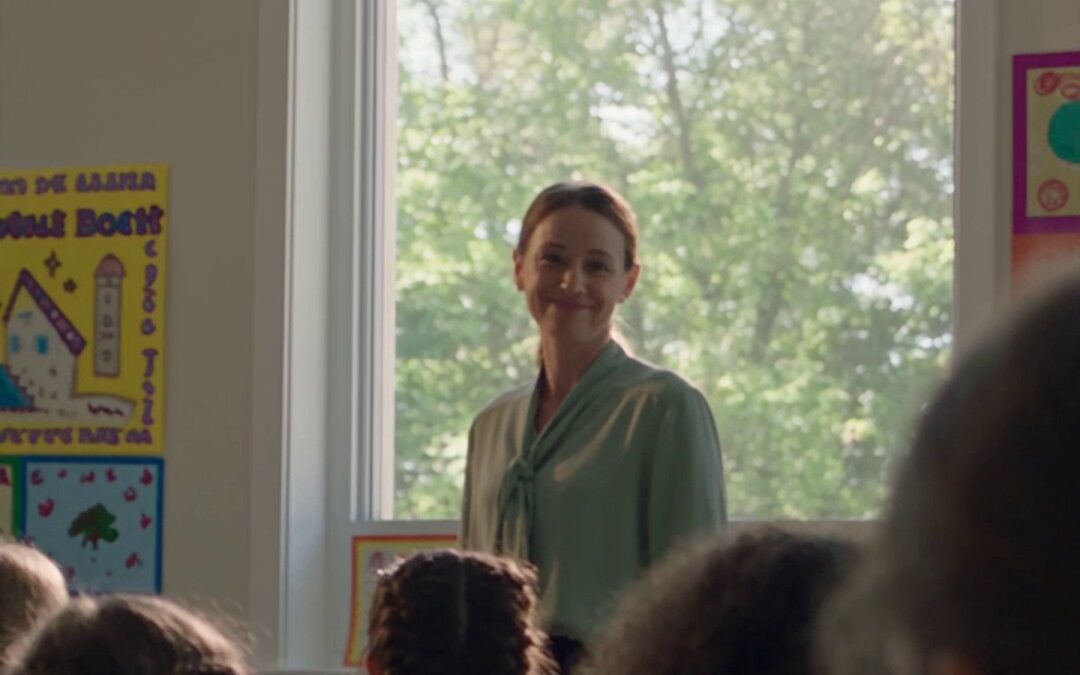
At school, Wren showed her teacher how the paper dog could peek through the window.
She kept one hand around the blue tag.
Her mother had missed the practice display the week before because a guest had arrived early, but today there was plenty of time.
Just before the doors opened, the classroom phone rang.
Wren watched her teacher listen.
Her teacher covered the receiver and said gently, “Your mom says a hiking group got in early.”
Wren looked at the empty chair.
“Grandma’s at the desk,” she said.
“She says Grandma needs help with the rooms.”
Wren nodded because she knew where the clean pillowcases were kept, and because knowing things usually made adults smile.
“She said she’ll try to get here,” her teacher added.
Wren took a folded registration card from her pocket.
On its back, she had drawn two chairs beside the cereal-box motel, with a person in each one.
She folded it smaller before her teacher could see.
When the other families came in, Wren stood by her model and told the paper dog to keep watch.
Then her teacher called the children forward for a photograph with their guests.
Wren slid the blue tag off the empty chair.
“Is she still coming?” she asked.
Chapter 2: The Place She Saved
“Is she still coming?” Wren asked.
Her teacher glanced toward the classroom door, where two late parents were squeezing past a row of damp coats.
“I don’t know, honey.”
Wren put the tag in her pocket and joined the other children.
Her teacher did not make her stand beside an empty chair for the photograph.
She placed Wren between two classmates whose families had come, and Wren smiled when everyone else did.
Afterward, she returned to her model and showed a little boy how the paper dog moved if he pressed the cardboard from behind.
“That’s a good trick,” he said.
“It’s a secret door.”
She showed him where she had cut the flap.
By the time the last family left, the dog had lost one of its paper ears.
Wren tucked the ear inside her pocket with the blue tag.
Her teacher helped carry the cereal-box motel into the hallway.
“You can take it home tomorrow,” she said.
“Can I leave it here today?”
“Of course.”
Wren looked once more toward the door.
Then she went to the bus line without asking to use the classroom phone.
At the motel, her mother was behind the desk with a stack of registration cards.
Three guests waited by the brochures, and Grandma Jo was carrying clean sheets toward the ground-floor rooms.
“There’s my builder,” her mother said when Wren came in.
“Did you have fun?”
Wren nodded.
“Was the dog a hit?”
“He lost an ear.”
“We’ll fix him.”
Her mother reached across the counter to smooth Wren’s hair, but the desk bell rang before her hand got there.
Wren stepped back to give the guest room.
She knew the guest needed an answer right away.
That evening, her mother found the blue tag on the kitchen table.
“I thought this was on the spare-key rack,” she said.
“It was.”
“Did you take it for your model?”
“For a chair.”
Her mother turned the tag over.
“Did somebody need to know where to sit?”
Wren picked at the loose corner of its white number.
“No.”
Her mother accepted that answer.
Wren had been quiet all evening, but she was often quiet after a busy school day.
When Eli asked if he could borrow tape for his open-house speech cards, Wren fetched the roll from the drawer.
“Thanks, Bean,” he said.
He called her Bean because she used to hide under the front desk when she was small enough to fit.
She stuck the tape to his card without wrinkling it.
Their mother watched them work together and felt the pleasant relief of a day settling down.
“She’s easy,” she told Grandma Jo as Wren carried the tape back.
Grandma Jo looked at the blue tag still lying on the table.
“She was waiting for you,” she said.
“I know.”
Their mother lowered her voice.
“I told her I’d try once the group came in.”
“You told her you’d come this morning.”
“I meant to.”
Grandma Jo had been at the desk when the hikers arrived.
She had needed help assigning their rooms because the group leader changed the list twice, and Wren’s mother had stepped in before the line reached the door.
That part was true.
Grandma Jo also knew the list had been settled before the school display ended.
Wren’s mother could have left then, though she would have arrived late.
“I thought a late entrance might make it worse,” her mother said.
Grandma Jo set a towel down.
“Did you ask her?”
Wren’s mother looked toward the kitchen, where Eli was practicing his first line aloud.
“No.”
On Friday after school, Wren sat on a low stool in the motel office and made a welcome drawing for the anniversary.
She drew the building with all twelve doors the same size, though the end rooms were bigger in real life.
She added a dog near the office and a small bird on the roof.
“That bird lives there now?” Grandma Jo asked.
“He pays rent with songs.”
“That’s a good deal.”
Wren grinned and colored the bird’s tail orange.
Saturday’s open house was for the motel’s fortieth year.
Grandma Jo had run it with her husband when Wren’s mother was a girl, and she still knew which room smelled faintly of cedar when the heat came on.
They had put out an old guestbook, washed the striped awning, and asked a neighbor to take a family photograph for the local paper.
Eli had volunteered to welcome people.
He was twelve and liked speaking into the little microphone Grandma Jo used for trivia nights in the breakfast room.
He had practiced his speech so often that Wren knew where he planned to pause.
“Can I say the bird part?” she asked him.
“What bird part?”
“The bird pays rent with songs.”
Eli laughed.
“That’s your joke.”
“Then can I say it?”
He looked toward the desk, where their mother was answering a question about parking.
“You should ask Mom.”
Wren had asked about the microphone once already.
Her mother had said they would see how crowded it got.
Wren knew that meant she could keep hoping, so she did.
On Saturday morning, she put on the green cardigan Grandma Jo had washed for her.
She carried the blue key tag in one pocket and the mended paper dog in the other.
Her mother had promised that after Eli’s welcome speech, they would all stand together beneath the awning for the photograph.
“Even the dog?” Wren asked.
“The dog can watch from your pocket.”
Wren pushed him down so his repaired ear showed.
The open house began with neighbors and former guests drifting through the breakfast room.
Wren enjoyed showing a man the old wall map with pins for places people had traveled from.
She enjoyed it even more when he let her guess his state from the dust on his boots.
“You came from somewhere with red dirt,” she said.
“Close enough.”
She went to tell Grandma Jo that guessing could count as a game even when you got it wrong.
Near noon, a family with two little children came to the desk while their room was being cleaned.
Wren found the basket of crayons for them.
Their mother thanked her, and Wren showed the smaller child how to draw a square window without lifting the crayon.
Across the room, Eli held his speech cards.
Wren moved closer to hear him.
Their mother caught her eye and pointed toward the crayon basket.
“Could you stay with them a minute?”
Wren looked at the microphone.
“Their mom’s right there,” she said.
“I know.”
“I wanted to hear Eli.”
“You’ll hear him from here.”
That was true, too.
The breakfast room was small, and Eli’s voice carried through the open door.
Wren sat with the children and heard him thank the guests, Grandma Jo, and their mother.
He thanked Wren for drawing the little bird on the welcome sign.
Wren’s face warmed.
When the speech ended, she put the crayons away quickly.
The neighbor with the camera was waiting beneath the awning.
Wren hurried outside and found a place next to Grandma Jo.
Her mother and Eli stood on the other side.
“Can everybody come a little closer?” the neighbor asked.
A car pulled beneath the awning before anyone could move.
The arriving driver lowered his window and asked whether he was in the right place for check-in.
Wren’s mother went to answer him.
Grandma Jo stepped forward, but her daughter waved her back toward the camera.
“I’ve got him,” she said.
“Take one with the kids while the light’s good.”
Wren stayed beside Grandma Jo.
Then another car came up behind the first, and the driver called that she had already reserved two rooms.
Wren’s mother glanced back.
“Jo, could you help me for a second?”
Grandma Jo crossed to the desk.
The neighbor lowered the camera.
“We can wait,” he said.
“It’ll only be a minute,” Wren’s mother called.
Wren put her hand in her pocket around the blue tag.
Eli came over.
“You’re in the picture with me,” he said.
“Mom said all of us.”
“Yeah, when they’re done.”
He held out his speech cards so she could see the corner where he had drawn her orange bird.
She liked that he had put it there.
The drivers came inside, and more guests gathered at the breakfast-room door.
The neighbor asked whether Eli could give him a hand positioning the anniversary banner.
Eli stood beneath it while Wren held one edge straight.
The neighbor raised the camera.
“Just a quick one of our speaker.”
Wren let go and moved aside.
Eli looked at her, uncomfortable.
“Come in,” he said.
“The banner will fall.”
“I can hold it.”
“The pin’s right behind you.”
She held the edge and watched him smile.
When their mother returned, the neighbor showed her the picture on his camera.
Eli was beneath the banner, with Grandma Jo just visible in the doorway behind him.
Wren’s hand and the edge of her green sleeve were at the side.
“That’ll work for the paper,” the neighbor said.
Wren’s mother looked at the line of waiting guests.
“We still need the family one.”
The neighbor’s own daughter called from his car that she was late for practice.
He apologized and said he could come back the next week.
Wren’s mother thanked him for staying as long as he had.
By then the children with the crayons had gone up to their room.
Wren folded the welcome drawing and put it into her pocket with the key tag.
“Did we miss it?” she asked.
“We’ll take our own,” her mother said.
“Under the awning?”
“When things slow down.”
“Okay.”
The motel did slow down after the open house.
It was nearly dark, and the striped awning light buzzed faintly over the door.
Wren’s mother remembered the photograph while she was counting the desk drawer.
“Tomorrow morning,” she said.
Wren was sitting on the floor, putting crayons back into their paper sleeves.
“Okay.”
“You understand why today got away from us?”
Wren pressed a blue crayon all the way to the bottom of its sleeve.
“There were cars.”
“That’s right.”
Grandma Jo sat nearby, rubbing her tired feet.
She wanted to say there were always cars.
Instead, she said, “I’ll take it in the morning.”
Wren looked up.
“With everybody?”
“With everybody.”
Eli heard them from the stairwell.
“I’ll wear the same shirt,” he said.
That made Wren laugh because he had dropped a small blob of jam on the cuff at breakfast.
“You have to leave the jam,” she told him.
“It proves it’s the same shirt.”
He held the cuff away from his body.
“I’m taking my chances with the washing machine.”
On Sunday morning, a guest checked out early and needed help finding the rail trail.
Grandma Jo walked him to the wall map.
Wren’s mother went upstairs to see why Room Six had no hot water.
Eli had stayed at a friend’s house after the open house and would not be back until lunch.
No one was trying to avoid the photograph.
By the time everyone was home, the light beneath the awning had gone flat and Wren’s cardigan was in the wash.
Her mother said they could do it after school on Monday.
Wren did not remind her on Monday.
She left the blue tag on the office shelf next to the spare keys.
At school, her teacher gave the children their models back.
The paper dog’s ear had been repaired with a narrow strip of tape.
Wren carried the motel against her chest on the bus.
A corner bent when she tried to get off, and she stopped on the first step to straighten it.
The bus driver waited.
“Got it?” he asked.
“Mostly.”
At the motel, Eli opened the office door for her.
He had found the local paper folded on the counter.
His photograph was in it, beneath the anniversary banner.
“That’s my jam shirt,” he told Wren.
“You can’t see the jam.”
She studied the picture.
The blue edge of her cardigan appeared beside the banner, but her face did not.
“You can see where I was,” she said.
Eli looked again.
“Only if you know.”
“I know.”
He folded the paper smaller and set it down.
Their mother came through the back door carrying a basket of clean towels.
“The article’s nice, isn’t it?”
Eli nodded.
Wren said, “My hand was there.”
Her mother looked at the picture.
“Oh, honey.”
“It’s okay.”
“We’ll take ours tonight.”
Wren held the cereal-box motel a little tighter.
“Can the dog be in it?”
“Sure.”
The towels had to be put away, then a guest asked for another blanket.
After supper, Wren’s mother found her in the office with the model on the floor.
Wren had lined up four tiny cardboard people outside it.
“Ready for our picture?” her mother asked.
Wren looked at the office clock.
Eli was upstairs doing homework, and Grandma Jo had gone to lie down.
“They’re busy,” Wren said.
“I can get them.”
“The light’s gone.”
“We can take one inside.”
Wren moved one cardboard person behind a window.
“It doesn’t look like the motel inside.”
Her mother sat on the edge of the desk stool.
“We’ll get the awning picture on Saturday.”
Wren nodded.
The cardboard person stayed behind the window.
That night, her mother put the paper aside so she could ask the neighbor about another photograph.
By morning, it had slipped beneath a stack of invoices.
On Tuesday, Wren’s teacher called the motel.
She did not call to complain.
She asked whether Wren could keep her model at school one more week for a display in the county library.
“She’s excited about the dog,” the teacher said.
“That’s wonderful,” Wren’s mother answered.
“The library is doing a walk-through next Wednesday.”
“I’ll put it on the calendar.”
After a pause, the teacher added, “Wren saved you a seat at our first display.”
Wren’s mother looked at the registration cards beneath her hand.
“I know I missed it.”
“I thought you should know she had a place ready.”
“I’ll be there Wednesday.”
When the call ended, she wrote LIBRARY on the square paper calendar beside the desk.
She underlined it twice.
Wren came home and found her cereal-box motel gone from the office floor.
“The teacher took it?” she asked.
“The library wants to show it,” her mother said.
“Do they know the dog has a door?”
“You can show them.”
“Are you coming to see him?”
“I put it right here.”
Her mother pointed to the calendar.
Wren could read LIBRARY, and she could see the two lines.
She nodded, but she did not ask what time her mother would leave the motel.
On Wednesday of that week, Eli had a soccer practice across town.
His mother had arranged for another parent to drive him, but the ride fell through that afternoon.
Wren was helping Grandma Jo fold towels in the laundry room when their mother came in.
“I need to take Eli,” she said.
Grandma Jo put down a towel.
“I can keep Wren here.”
Wren had been invited to spend that hour making paper houses with her friend after school.
Her mother had said yes that morning.
Wren held the towel by two corners.
“I can stay,” she said.
“I thought you wanted to go to your friend’s.”
“It’s okay if I don’t.”
Their mother smiled with relief.
“I’ll owe you one.”
Wren laid the towel on the stack and took another.
Eli came to the laundry-room door with his cleats in his hand.
“I can miss practice,” he said.
“You’ve already missed one,” their mother told him.
“Wren has a thing.”
“It’s just paper houses,” Wren said.
Eli glanced at her.
She had spent breakfast telling him she knew how to make a roof open.
“You sure?” he asked.
She folded one side of the towel over the other.
“Yep.”
After the car left, Grandma Jo drove Wren to her friend’s house.
She knew the friend’s mother and had spoken to her at the school display.
When they arrived, the girls still had plenty of time to make their houses.
Wren ran up the path with her paper under one arm.
Grandma Jo watched her disappear inside, then sat a moment before driving back.
She had not done anything difficult.
The two children had wanted to see each other, and someone had needed to take Wren there.
At dinner, Wren showed everyone a roof that lifted on a paper hinge.
Their mother praised it.
She did not ask how Wren had got to her friend’s house.
Grandma Jo said, “I took her.”
Wren’s mother looked up.
“You were supposed to rest your knee.”
“My knee was fine.”
“I would’ve taken her after practice.”
“She would’ve had twenty minutes.”
Their mother opened her mouth, then closed it.
Eli used the hinge to lift the roof.
“There’s a table inside,” he said.
“And two chairs,” Wren told him.
Over the next few days, Grandma Jo began to notice the chairs.
They appeared on the back of a receipt Wren used for drawing.
They appeared beside a paper cabin she made from a soap box.
At breakfast, Wren arranged the salt and pepper shakers with an empty space between them, then moved the pepper closer when her mother sat at the desk instead of the table.
Grandma Jo had seen Wren draw chairs before.
She had thought the girl liked making small rooms.
Now she watched how long Wren left one empty.
That Friday, the neighbor came by with a printed copy of the anniversary photograph.
He had trimmed the edge of the frame to center Eli and the banner.
The sliver of green cardigan was gone.
Wren’s mother set the print on the counter to show Grandma Jo.
“We can put this by the guestbook,” she said.
Eli was beside her.
“Wren isn’t in it.”
“I know.”
“Then it isn’t everybody.”
“It’s a picture of the speech.”
The neighbor had already left, and their mother was looking for a frame.
Eli followed her to the shelf.
“People will think that’s the family.”
“We’ll put up the other one when we take it.”
Wren came in carrying clean hand towels.
She saw the print.
“It’s nice,” she said.
Eli turned toward her.
“We still have to take the one with you.”
Wren stacked the towels.
“You don’t have to.”
Their mother looked at her.
“Of course we do.”
Wren shrugged in the small way she had learned when adults were busy.
“I know where I was.”
Grandma Jo saw Eli stare at the cropped photograph.
For the first time, he seemed to understand that a person could be there and still be missing from what everyone kept.
Their mother set the print face down.
She did not frame it.
That evening, Wren was allowed to choose a movie after supper.
She picked an animated story about a goat who wanted to fly.
Eli had watched it with her three times and liked to complain that goats were terrible pilots.
Their mother sat down beside Wren on the sofa.
The opening had just begun when the office bell sounded through the open kitchen door.
“I’ll be right back,” she said.
The guest needed help with a door that would not latch.
Grandma Jo was upstairs bringing in laundry, so Wren’s mother went to look at it.
Eli paused the movie.
“Want to wait?”
Wren watched the frozen goat on the screen.
“She’ll miss the funny part.”
“Then we wait.”
“She might be a long time.”
“I’m making popcorn anyway.”
He went to the kitchen.
Wren kept her finger on the pause button, though the movie was already stopped.
When their mother returned, Eli’s popcorn had cooled.
“I’m sorry,” she said.
“Was it the door?”
“The strike plate was loose.”
“We waited,” Eli told her.
Their mother sat again.
Wren moved closer but did not lean against her.
They watched the goat fall out of a tree, and Wren laughed so hard that she slid sideways on the sofa.
Her mother laughed with her.
For a while, the room was easy.
On Sunday, Eli’s team was invited to have an end-of-season supper at the motel’s breakfast room.
It was good business for the family, though Grandma Jo said twelve boys could eat like twenty.
Their mother asked Eli to help put extra tables together.
“Can Wren make the paper place cards?” he asked.
“She’d love that.”
Wren did.
She drew a different little animal on each card, including a goat with wings.
She did not put names on them because she wanted the boys to choose an animal they liked.
The team arrived before she finished the last one.
Eli carried the cards to the tables while Wren held the box.
One boy took the winged goat.
Another asked whether there was a dog.
“I can draw you one,” Wren said.
Their mother came in from the kitchen with a pitcher of water.
“Wren, could you take Grandma the clean cups?”
Wren looked toward the boy waiting for a dog.
“I’m doing this.”
“It’ll be quick.”
Eli took the box from her.
“I can hand out the cards, Mom.”
“She knows where the cups go.”
“I know where cups go.”
Their mother stopped.
The boy held up his blank card.
Wren looked from him to her mother.
“You can finish the dog,” her mother said.
“I’ll get the cups.”
Wren sat down and drew two pointed ears.
Her hand shook a little because so many people were watching.
The boy liked the dog anyway.
Later, Eli asked why she had needed to take the cups when he was standing there.
“I didn’t think,” their mother said.
He was wiping a table.
“That keeps happening.”
She carried the empty pitcher to the sink.
“I listened, didn’t I?”
“Yeah.”
She had.
Eli went back to wiping, and his mother stood at the sink longer than the pitcher required.
On Monday after school, Wren could not find the blue key tag.
She checked the desk, the kitchen drawer, and the pockets of her green cardigan.
Grandma Jo found her under the office counter, looking between the legs of the stools.
“What have you lost?”
“Room Eight.”
“The key?”
“Just the blue part.”
Grandma Jo helped her check the key rack.
Room Eight’s old tag was not there.
They looked in the crayon basket and among the paper houses on Wren’s shelf.
Wren’s mother came in while they were searching.
“I put it in the box with the old keys,” she said.
“You left it by the register.”
Wren came out from under the counter.
“Can I have it?”
“Sure.”
Her mother lifted a small tin from the high shelf.
Wren watched her take out the tag.
The white number had gone gray from years of fingers.
“You really like this thing,” her mother said.
“It’s for a place.”
“What place?”
Wren reached for it.
“Just a place.”
Her mother handed it over.
Grandma Jo watched Wren close both hands around it.
At supper, Wren asked whether Wednesday at the library was still on the calendar.
“It is,” her mother said.
“Even if guests come?”
“We have guests every day.”
Wren knew that.
She looked down at her peas.
“Then how will you come?”
“I’m going to arrange it.”
“What if they come early?”
“Grandma and I will make a plan.”
Grandma Jo looked up from her plate.
“We will.”
Wren ate three peas and set her fork down.
Eli said, “I can carry towels that day.”
Their mother smiled at him.
“You have homework.”
“I can do both.”
Wren lined the remaining peas along the rim of her plate.
She had heard everyone offer something.
She still wanted to know who would sit with her.
The next afternoon, Grandma Jo went looking for blank registration cards in the office cabinet.
She found the package beneath a cereal box filled with folded paper.
At first she thought it was recycling Wren had saved for crafts.
Then she saw a small drawing of the school display, with two chairs beside the cardboard motel.
A person sat in one chair.
The other person was drawn in pencil but not colored in.
Grandma Jo recognized the folded card Wren had carried to school.
Below it were more cards.
On one, two figures stood beneath the motel awning, with a third squeezed into the edge.
On another, a goat flew over a sofa with an empty cushion.
There was a paper house with its roof open, and beside it Wren had drawn one car going away and another coming back.
Some cards had been folded into tiny rooms.
Inside each room, Wren had drawn a blue rectangle on a chair or a doorstep.
Grandma Jo sat on the office floor and opened them one at a time.
She had watched Wren make welcome drawings for guests for years.
These were the places Wren had been saving for her family.
“Jo?”
Wren’s mother stood in the office doorway with a bag of groceries.
Grandma Jo held up the card with the school display.
“I was looking for blank cards.”
Her daughter set the bag down.
“Those are Wren’s.”
“I know.”
Wren’s mother crouched beside her.
Grandma Jo handed her the card.
She knew the classroom chairs from Wren’s account of the day.
Her daughter opened the paper house next.
“She drew me here?”
“Look at the blue marks.”
There was one beside every place Wren had hoped someone would come.
Wren’s mother unfolded the picture of the awning.
The little figure at the edge was not holding the banner.
It stood with its hand stretched toward the others.
“I told her we’d take another picture,” she said.
“She believed you.”
“I still mean to.”
Grandma Jo picked up the card with the goat.
“And you did sit with her.”
“After she waited.”
Neither of them said anything for a while.
The desk bell rang, and Grandma Jo stood to answer it.
Wren’s mother remained on the floor with the cards in her lap.
When Wren got home, the cereal box was back where it had been.
Her mother had put every folded card inside.
She met Wren at the kitchen table.
“I saw your drawings,” she said.
Wren stopped halfway to the sink.
“Were they in the way?”
“No.”
“I can move the box.”
“You don’t need to.”
Wren glanced toward the office.
“Grandma was looking for cards,” her mother explained.
“Oh.”
Her mother had imagined Wren might ask why she had looked through them.
Wren only stood there, waiting to hear whether she had done something wrong.
“I should have come to your school display,” her mother said.
Wren touched the edge of the table.
“The hikers needed rooms.”
“They did, and I could have asked Grandma to finish.”
“She had lots of papers.”
“She did.”
Her mother pulled out a chair but did not ask Wren to sit.
“I could have been late and still come.”
Wren looked at the chair.
“Everybody had already taken pictures.”
“I know.”
The kitchen door opened, and Eli came in with his backpack.
He saw their faces and stopped.
“Did something happen?”
“We’re talking,” their mother said.
Wren slipped past him toward the sink.
“I have to wash my hands.”
Eli moved out of her way.
After the water started, he sat across from his mother.
“Is this about the library?”
“It’s about more than the library.”
He glanced toward the sink.
“She really wanted you at school.”
“I know that now.”
“She told me about the dog all week.”
“I knew about the dog.”
“Then you knew.”
His mother looked at the open box of drawings on the table.
“I knew she cared about the model.”
Eli pulled the card with the awning picture closer.
“What’s this?”
“Things she saved places for.”
He opened it.
His mouth tightened.
“I asked her into the photo.”
“You did.”
“She was holding the banner.”
Their mother nodded.
“I asked her to help with it.”
“Couldn’t I have held it?”
“Of course.”
Eli put the card down carefully.
At the sink, Wren turned off the water.
They stopped speaking before she came back.
She dried her hands on the towel and asked whether there were apples.
Her mother cut one for her.
She did not make Wren stay for another conversation.
On Tuesday night, Grandma Jo and Wren’s mother made a plan for the library walk-through.
The school had given each child a twenty-minute turn at their display.
Wren’s was at four o’clock.
Grandma Jo would manage the desk from three until five.
Eli would bring in the clean towels after school and then do his homework in the office.
Wren’s mother would leave at three-thirty.
Her mother wrote the times on the calendar.
Grandma Jo called a nearby cleaner who sometimes helped with the rooms and asked whether she could be available if checkouts ran late.
The cleaner could come if needed.
Wren heard the call from the kitchen.
She did not ask why so many people were talking about twenty minutes.
She sharpened three colored pencils for the library.
One was for the dog’s repaired ear.
Wednesday came with a steady stream of guests using the rail trail before the leaves were gone.
A pair checked out late because one of them could not find a glove.
Grandma Jo located it beneath a chair in the breakfast room.
By lunch, the last empty room had been cleaned.
Wren’s mother checked the desk calendar twice.
At two-forty, a call came from the leader of a hiking group.
Their bus had taken a shorter route and would arrive at three-twenty instead of five.
There were fourteen guests, and the leader wanted the room keys together so nobody had to wait.
Wren’s mother wrote the new time beside the old one.
Grandma Jo read it over her shoulder.
“I can check them in.”
“You haven’t seen the changed room list.”
“Show me.”
Her daughter found the list.
Two guests wanted rooms near the front, and one needed the ground floor.
Grandma Jo knew which keys belonged to those rooms.
Still, the group was large, and the arrival would fall just as Wren’s mother had planned to leave.
“Stay until they’re settled,” Grandma Jo said.
“I can get to the library by four if they’re quick.”
“That isn’t what you told Wren.”
“I told her I’d come.”
“You told her when.”
Wren’s mother watched a car pull into the lot.
“Let’s get the keys ready,” she said.
At school, Wren held the blue tag in her palm while her teacher helped pack the models for the library.
The paper dog rode inside the cereal-box motel.
Wren had added a table in its office and two small chairs.
“You brought the key,” her teacher said.
“It’s for Mom’s chair.”
“Would you like me to put one beside your display?”
Wren thought about the classroom chair with the tag on it.
“Maybe leave it in my pocket.”
Her teacher nodded.
At the library, the models filled three low tables.
Wren’s friend had made a bakery with cotton-ball rolls.
Another child had made the small bridge over the creek from folded cardboard.
Wren liked looking at the things they had noticed on the same streets she walked.
When the doors opened, she showed the paper dog to two grandparents and a little girl who wanted to know where he slept.
“In the office,” Wren said.
“He’s supposed to work, but he takes naps.”
The girl laughed.
Wren laughed with her.
At three-twenty, the bus reached the motel.
Grandma Jo stood behind the desk with the room list, the keys arranged in small piles.
Wren’s mother greeted the group leader and showed her the ground-floor rooms.
Eli took towels from the laundry cart to the storage closet.
The line moved steadily until a guest said her room had been promised near her sister’s.
The list in the leader’s hand said something different.
Wren’s mother compared both copies.
“I’ll sort this out,” she said.
Grandma Jo looked at the clock.
“You have ten minutes before you leave.”
“This will take two.”
It took six.
The guest thanked her, and the next person came to the desk with a question about breakfast.
Grandma Jo stepped forward.
“We open at six-thirty,” she said.
The guest had another question about where to park the bus.
Eli came in from the closet.
“I can show him the lot.”
“You need to finish those towels,” their mother said.
“The towels are finished.”
He had placed the last stack in the closet.
Wren’s mother saw that he had.
Outside, the bus engine was still running.
Inside, three guests waited for keys.
Grandma Jo set the room list in front of herself.
“Go,” she said.
“I should at least get these three through.”
“They’ve waited two minutes.”
Wren’s mother picked up a key, then looked at the calendar.
LIBRARY was underlined twice.
She thought of Wren standing beside her model, ready to explain a paper dog.
She thought of the cardboard person Wren had moved behind the motel window because the light had gone.
The guest at the front of the line smiled.
“We’re in no rush,” he said.
Wren’s mother set the key back down.
“Jo has your rooms ready,” she told him.
“She’ll take good care of you.”
Grandma Jo did not tell her daughter to hurry.
She handed the guest his key and asked whether he needed help with his bag.
Eli walked their mother to the door.
“Tell her I’ll come after I put my shoes on,” he said.
“You don’t have to.”
“I want to see the dog door.”
Their mother touched his shoulder.
“Then come.”
At the library, Wren’s teacher checked the wall clock.
Four o’clock.
Wren looked at the entrance but kept talking to a couple who had stopped at her display.
“This window’s for the dog,” she said.
“People think he’s a guest.”
The woman bent to look.
“Does he pay for his room?”
“He pays rent with songs.”
Wren smiled at her own joke.
The couple moved on, and Wren’s turn began.
Her teacher brought an empty chair beside the table.
Wren took the blue tag out of her pocket.
She held it above the chair back, then brought her hand down.
“I can keep it,” she said.
Her teacher had not asked her to do anything.
“You can.”
A door opened near the front of the library.
Wren looked up.
Someone in a tan coat came in, shook rain from an umbrella, and went toward the circulation desk.
Wren rubbed the blue tag with her thumb.
Her teacher stayed beside her.
“What would you like to show me first?”
“The dog’s door.”
They bent over the model together.
Wren opened the flap, but she could not stop watching the entrance.
At the motel, Wren’s mother pulled into the library parking lot just as Eli came out of the motel office carrying his jacket.
He climbed into the car.
“You’re late,” he said.
“I know.”
“Is her turn over?”
“Not yet.”
She parked crookedly between the painted lines and corrected it.
Eli waited while she made the car straight.
Neither of them ran through the lot.
Inside, they could hear children talking before they saw the tables.
Wren was pointing to the motel roof when her mother reached the room.
She stopped at the end of the aisle.
Eli nearly bumped into her.
“Go on,” he whispered.
Wren looked up.
For a moment, she did not move.
Her mother came to the table and crouched so their faces were level.
“I’m here,” she said.
Wren looked past her at the entrance.
“Is Grandma okay?”
“Yes.”
“The hikers?”
“Checked in.”
“All of them?”
“Grandma’s taking care of them.”
Wren watched her mother’s face.
“Are you going back?”
“After your turn is over.”
The teacher quietly moved the empty chair closer.
Wren still held the tag.
Eli came around the other side of the table.
“You fixed his ear,” he said.
“Tape,” Wren told him.
“Show me the door.”
Wren opened the flap for him.
Her mother stayed crouched beside her until Wren began to explain the rooms.
There were twelve, but only one had a paper dog.
Room Eight had the biggest window because Wren liked the way it looked when the morning sun reached its curtains.
The tiny office had two chairs.
“One’s for someone waiting,” Wren said.
Her mother nodded.
“Can I sit in it?”
“You’re too big.”
“I meant the real one.”
Wren glanced at the chair her teacher had brought.
She took the blue tag and hooked it over the back.
“Yes,” she said.
Her mother sat.
She listened while Wren showed the model to the next visitor, and when that visitor left, she asked to see it again.
Wren opened the dog’s secret door a second time.
Her smile came slowly.
She did not lean against her mother, but she let her mother hold the model while she adjusted its bent corner.
Eli stood nearby until Wren asked him to go see the bridge.
When the walk-through ended, their mother helped carry the motel to the car.
Wren carried the paper dog separately so his ear would not catch.
On the way home, a guest called the motel asking for more towels.
Grandma Jo answered before Wren’s mother could reach for her phone.
“She knows where they are,” Wren said from the back seat.
“She does,” her mother said.
Eli turned around.
“Did you see the bakery?”
“The rolls looked real,” Wren said.
“They were cotton balls.”
“I knew that.”
“You asked if you could eat one.”
“I wanted to see if the baker knew.”
Her mother laughed.
Wren laughed too, looking out at the familiar turn toward the motel.
The next morning, the anniversary photograph was still face down on the office counter.
Wren’s mother put it in a drawer.
She called the neighbor and arranged a time for the family picture beneath the awning.
This time she asked Wren when she wanted to take it.
“After breakfast,” Wren said.
“Before the sun gets in my eyes.”
“After breakfast it is.”
Grandma Jo agreed to cover the desk.
Eli offered to hold the banner if it slipped.
Wren wanted the banner to stay down.
They took the photograph on Saturday after breakfast.
The neighbor’s daughter was not waiting in the car, the guests who passed beneath the awning were checked in by Grandma Jo, and nobody asked Wren to hold anything outside the frame.
She stood between her mother and Eli with the paper dog in her hand.
When the neighbor lowered his camera, Wren asked to see.
All three faces were there.
Grandma Jo came out from the desk for one more picture, and Wren made room for her without being asked.
The printed photograph went beside the guestbook a week later.
It did not make Wren stop checking whether plans would hold.
For a while, she still asked what would happen if a guest arrived early.
Her mother answered with the name of the person covering the desk, then came when she said she would.
Some days Wren needed to hear the plan twice.
No one told her she was worrying too much.
On a quiet afternoon, her mother found the blue tag beside Wren’s paper houses.
“Do you want this back on the key rack?” she asked.
Wren shook her head.
“Can it stay here?”
“It’s yours.”
Wren set it over the back of a tiny cardboard chair.
Her mother sat down beside her on the floor.
“Who’s that chair for?”
Wren opened the paper house’s roof and moved another chair close to it.
“You,” she said.
Then she placed a third chair beside them, for herself.








