The Kitchen Porter’s Son Pricked the Mafia Boss’s Finger… And Revealed Why His Family Wanted Him Declared Unfit
Chapter 2: The Breakfast Tray
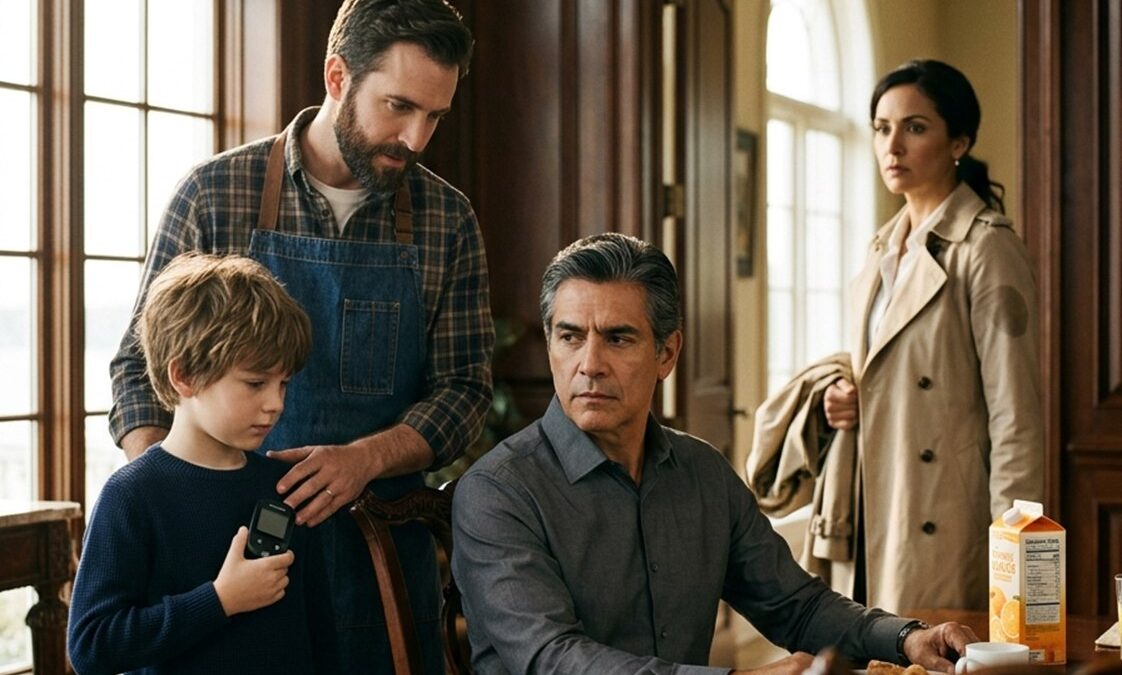
Celeste Varela stood in the doorway with her coat over one arm.
She looked at the juice carton first.
Then at the meter.
Rafael kept drinking.
Eli’s father, Owen, took the carton when Rafael’s hand began to slip.
“Small sips,” Owen said.
“I heard you.”
Rafael sounded furious.
He also sounded frightened.
Celeste crossed the dining room.
“What happened?”
“The boy checked me,” Rafael said.
“With that?”
“With a meter.”
Celeste glanced at Eli.
“Where did you get it?”
“It’s my mom’s.”
“Is it clean?”
“Yes,” Eli said.
“He used a new lancet,” Owen added.
The guard, Tomas, held up the ambulance dispatch screen on his phone.
“They’re four minutes out.”
Celeste put her coat down.
“We have a physician on call.”
“He’s coming too,” Tomas said.
Eli watched Rafael’s hands.
The shaking had slowed.
His eyes followed the room again.
When he looked at the spoon, he seemed to recognize it.
“Can he have a cracker?” Eli asked.
“We’ll ask the medics,” Owen said.
Rafael gave him a hard look.
“Your son just made that call.”
“He made the right call.”
Celeste reached for the meter.
Eli pulled it against his chest.
“Give that to me,” she said.
“It belongs to my mother.”
“I need to see the number.”
“I can show you.”
Eli turned the screen.
Forty-one remained there.
Celeste’s face changed for a moment.
Then she looked at Rafael.
“You hardly ate yesterday.”
“That doesn’t explain forty-one,” Owen said.
“You’re a kitchen porter.”
“And you’re his sister.”
Tomas moved between them.
“Everyone can talk to the medics.”
Celeste took her hand back.
Owen noticed then that her sleeve was damp.
A small, dark mark stained the cuff.
She saw him looking.
“Coffee,” she said.
Nobody had asked.
The ambulance crew arrived through the side entrance.
A paramedic checked Rafael with a second meter.
The reading had begun to rise.
It was still too low.
They gave him glucose and asked about his medications.
Rafael answered the first few questions himself.
No diabetes.
No insulin.
No pills for blood sugar.
He had taken his usual heart medication that morning.
His physician had recently adjusted one dose.
Celeste supplied the physician’s name.
The paramedic wrote it down.
Then she looked at the breakfast tray.
“Did anyone else eat this?”
“No,” Celeste said.
Owen pointed to the empty plate.
“Only Mr. Varela.”
Rafael touched his forehead.
“Don’t let them throw it away.”
The paramedic looked at him.
“We’re taking you to the hospital.”
“Take the tray too.”
“We don’t collect evidence.”
“Tomas can keep it.”
Tomas nodded.
He photographed the tray where it stood.
Then he covered it without touching the dishes.
Celeste watched him.
“You’re treating breakfast like a crime scene.”
“I’m treating it like his breakfast.”
Rafael looked at Eli.
The boy stood beside Owen, both hands around the meter.
“Your mother uses that?”
“Every day.”
“Is she all right?”
“Usually.”
Rafael closed his eyes briefly.
“Good.”
They wheeled him toward the door.
Celeste followed.
At the threshold, Rafael stopped them.
“Owen.”
“Yes, sir?”
“What time did my breakfast arrive?”
“Seven twelve.”
“You remember?”
“I carry the kitchen log.”
Celeste’s jaw tightened.
Rafael looked toward the covered tray.
“My sister told the doctor I’d become confused before sunrise.”
* * *
At the hospital, Rafael asked for Owen and Eli.
He had the authority to ask.
That did not make the visit easy.
Owen was due back in the kitchen by noon.
Missing a shift meant losing pay.
He had thirty-eight dollars left after rent and his wife’s prescriptions.
The parking garage charged eighteen.
He went anyway.
Eli walked beside him, holding the meter case.
His sneakers squeaked on the hospital floor.
Owen had bought them used in August.
One lace had already frayed.
He had intended to replace it on Friday.
Instead, he had spent Friday evening at an urgent care clinic with his wife, June.
Her blood sugar had dropped during a stomach virus.
Eli had watched the nurse help her.
That morning, he had recognized the same sweat on Rafael’s face.
Rafael sat upright in a private room.
A nurse was drawing blood.
Celeste occupied the chair beside him.
So did her lawyer, a narrow man with a leather folder.
Rafael’s physician stood near the window.
He introduced himself as Dr. Nikhil Shah.
“The hospital will monitor him,” Shah said.
“We’re checking several possible causes.”
“Could someone have given him medicine?” Owen asked.
“That’s one possibility.”
Celeste leaned back.
“Are we accusing people already?”
“No,” Shah said.
“We’re testing.”
Rafael pointed at the meter.
“Show him.”
Eli approached the bed.
He scrolled to the saved reading.
The date and time appeared beneath it.
Shah wrote them down.
“Does it keep earlier results?” he asked.
“Yes,” Eli said.
“Those are my mom’s.”
“We only need this one.”
Eli’s finger hovered over the buttons.
He knew how to find the reading because he logged June’s numbers in a ruled notebook.
On bad mornings, Owen cooked and Eli wrote.
On good mornings, June checked the notebook and corrected his spelling.
Shah looked at the screen again.
“The paramedics got a similar result.”
The lawyer opened his folder.
“Mr. Varela’s health decisions have become urgent.”
Rafael turned toward him.
“Close that.”
Celeste touched the lawyer’s arm.
“He needs to explain.”
“I know why he’s here.”
The lawyer held up a paper.
Celeste had asked a court to appoint her as Rafael’s temporary guardian.
Her filing described three weeks of confusion.
It listed poor judgment.
It listed difficulty managing ordinary decisions.
It said Rafael had become unable to recognize people he trusted.
“I recognize him,” Rafael said.
He pointed at the lawyer.
“He charged me six hundred an hour to insult me.”
Eli almost smiled.
Nobody else did.
Shah read the filing.
“Were you told about today’s episode?”
“I was told he collapsed,” the lawyer said.
“After a documented low glucose reading,” Shah replied.
Celeste folded her arms.
“One episode doesn’t explain three weeks.”
“Neither does a petition,” Rafael said.
The nurse finished the draw.
Shah stepped outside to speak with her.
Owen waited until the door shut.
“Your sister said you were confused before breakfast.”
“I was.”
“When?”
“During a call.”
Owen looked at Celeste.
She looked back.
“Six forty,” she said.
“He asked me where we were going.”
Rafael frowned.
“I asked what meeting you’d arranged.”
“You asked twice.”
“Because you didn’t answer.”
The lawyer wrote something down.
Owen remembered that morning.
He had clocked in at six.
At six twenty, the kitchen supervisor had found a tray ticket already printed.
At six thirty-five, Celeste had collected the tray herself.
Owen had carried bread upstairs afterward.
He had passed Rafael’s door.
The room had been quiet.
He could not say what Rafael had done before breakfast.
He said only what he knew.
“The tray left the kitchen at six thirty-five.”
Tomas appeared at the open door.
“Seven twelve was when it reached his table,” he said.
Celeste stared at him.
“I stopped to talk to you.”
“For less than a minute.”
“I also took a call.”
“Then we’ll check the calls.”
Rafael shifted in the bed.
He was accustomed to people obeying before he finished speaking.
Now he watched other people compare times.
The effort seemed to cost him.
Owen moved the water closer.
Rafael looked at his hand.
“Thank you.”
Celeste stood.
“I’m going home.”
Rafael did not ask her to stay.
She paused beside Eli.
“You did help him,” she said.
“I know.”
The boy’s answer was plain.
It made her turn away.
After she left, Shah returned.
The first tests showed that Rafael’s glucose had stayed low longer than expected.
Shah had ordered a test for medication that could lower it.
The result would take time.
Rafael looked at Owen.
“Why did my breakfast take thirty-seven minutes to reach me?”
Owen had an answer.
He wished he did not.
“The elevator was working.”
Tomas checked his phone.
“The hallway camera covers the service door.”
Rafael looked toward the window.
Celeste had always insisted on carrying his tray herself.
* * *
Owen went back to the house for his shift.
Rafael remained in the hospital.
Eli stayed with June, who had come to collect him.
She wore a faded green coat and carried her own glucose tablets in the pocket.
When Eli told her what had happened, she hugged him.
Then she checked the meter case.
“Your spare strips are almost gone.”
“I used one.”
“I know.”
“I cleaned his finger.”
“I know that too.”
She kissed his hair.
Owen watched them from the kitchen doorway.
June had once worked there with him.
A damaged knee had ended her long shifts.
Then a cleaning company closed without paying its staff.
They had spent a winter choosing which bills could wait.
Rafael’s house had offered Owen steady hours.
That was why he had kept them.
Now a kitchen supervisor met him beside the prep sink.
“Celeste says you made accusations.”
“I answered questions.”
“She says the boy caused a scene.”
“He checked a sick man.”
“You brought him into the dining room.”
“My childcare fell through.”
The supervisor looked uncomfortable.
“You’re off the schedule tomorrow.”
“For how long?”
“I don’t know.”
Owen took off his apron.
Tomas entered before he reached the door.
“Mr. Varela wants you paid.”
“The supervisor said—”
“I spoke to payroll.”
Owen shook his head.
“I want my job.”
“I know.”
Tomas lowered his voice.
“I also need your log.”
The kitchen used a digital system for orders.
Owen kept a paper copy because tickets sometimes vanished from the screen.
He wrote down times, changes, and who collected trays.
A manager had mocked the habit.
That same manager had once blamed Owen for a missing order.
His notebook had settled it.
Owen took it from his locker.
Tomas photographed the morning’s page.
At six twenty, the ticket had printed.
At six thirty-five, Celeste had signed for the tray.
At seven twelve, Owen had seen it on Rafael’s table.
There was a mark beside the order.
Two short pencil strokes.
Owen pointed to them.
“What does that mean?” Tomas asked.
“Someone changed the meal after the ticket printed.”
“What changed?”
“The drink.”
Rafael usually had black coffee.
That morning, the ticket had said coffee.
The cup on the tray had held tea.
Tomas looked at the page.
“Who made it?”
“I don’t know.”
“Could the kitchen have changed it?”
“Maybe.”
Owen took him to the service counter.
A whiteboard listed each room’s preferences.
Rafael’s line still said black coffee.
Owen photographed it.
Then he called Shah.
The doctor asked them to preserve the tray and avoid handling it further.
He also asked whether Rafael had consumed anything else that morning.
Owen checked the kitchen record.
No food from them.
Tomas checked the house phone log.
One outgoing call at six forty.
Celeste had called Rafael from the east wing.
It lasted forty-three seconds.
That did not prove what either had said.
Tomas wrote it down anyway.
They requested footage from the camera outside Rafael’s dining room.
The company managing the system could export it.
Its technician said she would arrive that afternoon.
Until then, Tomas kept the tray in the locked pantry.
He logged every person who had access.
Celeste called him twice.
He did not answer.
At three, the technician arrived.
Owen stood with Tomas while she opened the recordings.
The camera showed Owen entering with bread at seven eleven.
It showed him leaving.
It showed Eli running past him later.
It showed the medics.
It did not show the earlier delivery.
“The file jumps,” the technician said.
“From when?”
“Six twenty-nine to seven ten.”
“Was the camera off?”
“No.”
She turned the monitor.
The system recorded an export at eight oh six.
Someone had used an administrator account to delete that stretch afterward.
Tomas asked whose account it was.
The technician looked at the record.
It belonged to the household office.
Three people had the password.
Tomas.
Celeste.
And Rafael’s business manager, Adrian Kessler.
Owen had seen Adrian in the house for years.
He handled bills, staff contracts, and repair budgets.
He also arranged Rafael’s doctor appointments.
Tomas called the hospital.
Shah answered.
The medication test was still pending.
But the hospital had received Rafael’s recent clinic records.
Shah sounded troubled.
“The guardian petition cites a memory evaluation.”
“Yes,” Tomas said.
“The clinic has no record of performing one.”
* * *
By evening, the story had traveled through the house.
No one knew who had started it.
The version in the staff kitchen said Owen had planted something in Rafael’s tea.
Another said Eli had brought a broken meter.
A third said the boy had pricked Rafael without permission.
Owen heard them all.
He stood at the sink until the dishes were done.
Then he walked out.
The supervisor met him at the rear door.
“I can’t let you work until this settles.”
“I already finished my shift.”
“We’ll pay you.”
“That’s a change.”
She looked away.
June waited in the car with Eli.
The heater barely worked.
When Owen got in, Eli held up a drawing.
Three people stood around a square table.
One had a juice carton.
One had very large hands.
The smallest held a black rectangle.
“Is that me?” Owen asked.
“You’re the one with the juice.”
“That’s a good part.”
“I made you tall.”
June smiled.
Owen folded the drawing carefully.
Then he saw a second sheet.
It was the back of an old appointment notice.
Eli had written a number across it.
41.
“You don’t have to keep thinking about it,” Owen said.
“I know.”
“Are you scared?”
Eli considered that.
“I’m scared he’ll get sick again.”
“So am I.”
June reached back and held his knee.
“Mr. Varela has doctors now.”
“He had doctors before,” Eli said.
None of them answered.
At home, June made tomato soup.
Owen told her about the deleted footage.
He told her about the clinic record.
He did not tell Eli about the rumors.
The boy heard enough while Owen spoke.
“Will you lose your job?”
“I don’t know.”
“Because I touched him?”
“Because some adults are making poor choices.”
Eli studied his spoon.
“That includes me?”
“No.”
June moved her chair beside him.
“You saw someone who needed help.”
“You would have checked him.”
“Yes.”
“Even if he was scary?”
June looked at Owen.
“Especially then.”
Later, Owen’s phone rang.
Tomas had called.
Someone had left a sealed envelope in Owen’s locker.
The locker was locked.
The envelope contained a copy of a prescription.
It bore Owen’s name.
It was for a medication that could lower blood sugar.
Owen had never taken it.
He told Tomas so.
Tomas had already photographed the envelope where he found it.
He had called the police.
“Don’t come back tonight,” Tomas said.
“Is Rafael all right?”
“He’s stable.”
“Does he know?”
“Yes.”
“What did he say?”
“That this is why you keep a notebook.”
Owen stared at the dark kitchen window.
Across it, he saw June cleaning Eli’s bowl.
“Who put the envelope there?”
“I don’t know.”
But Tomas had found one more thing.
The prescription’s pharmacy address was on the east side of the city.
Adrian Kessler owned that building.
Owen had never known.
Tomas had checked the property record himself.
The pharmacy was a tenant.
That proved no crime.
It gave police a place to begin.
The next morning, two detectives visited Owen.
They took his statement.
They asked for his notebook.
They asked about his shift, the tray, and the envelope.
One detective, Ruth Calder, listened while he explained the pencil strokes beside the order.
“You remember every changed drink?” she asked.
“I write them down.”
“Why?”
“Because I used to get blamed when wealthy people changed their minds.”
Calder turned a page.
Dates filled it.
Small corrections.
Initials.
Nothing dramatic.
A year of ordinary meals.
She asked to make a copy.
Owen agreed.
The second detective asked whether he knew Celeste well.
“Only at work.”
“And Adrian?”
“He pays us.”
“Who would benefit if Mr. Varela were declared unable to manage his affairs?”
Owen looked at the copy of the guardianship filing.
“I thought his sister.”
Calder closed her pen.
“So did we.”
She laid a document on the table.
It was a proposed management agreement.
Celeste had signed it the previous week.
If appointed guardian, she would hand control of Rafael’s waterfront properties to Adrian’s firm.
* * *
Rafael left the hospital two days later.
Shah wanted him to stay longer.
Rafael wanted to see the detectives.
They compromised.
He gave a statement in the hospital first.
He returned home with written instructions, follow-up appointments, and a nurse for the first week.
The medication test had found a drug used to lower blood sugar in his blood.
It was not among his prescriptions.
The level supported recent exposure.
It could not say who had given it to him.
Police collected the cup and remaining tea from the dining room.
They sent them for testing.
The results would take longer.
Rafael asked to meet Owen at a municipal office.
The building had cameras and public entrances.
Owen arrived with June.
Eli stayed with a neighbor.
Rafael stood when they entered.
He moved slowly.
“You owe them an apology,” June said.
Rafael looked at her.
“Yes.”
He turned to Owen.
“My house repeated an accusation against you.”
“Your house?”
“I let people speak for me.”
“You did.”
“I’m sorry.”
Owen nodded once.
He did not say it was all right.
Rafael seemed to understand.
“I asked payroll to restore your shifts.”
“That won’t fix it.”
“What would?”
“A statement to the staff.”
“You’ll have one.”
“And I want my son left alone.”
Rafael’s face tightened.
“Has someone approached him?”
“No.”
“Then no one will.”
June raised a hand.
“Don’t make promises for people you can’t control.”
Rafael looked at her for a long moment.
“You’re right.”
Calder entered with another detective.
They asked Rafael to identify his signature on the management agreement.
He had never seen it.
The signature was not his.
The agreement did not need his signature yet.
It would take effect if Celeste gained authority.
Adrian’s firm would receive a management fee from the properties.
The fee was large.
So was the debt against his firm.
A lender had filed a claim six months earlier.
Calder had found it in public court records.
“Did Celeste know about the debt?” Rafael asked.
“We’re investigating that.”
Rafael rubbed his thumb against his forefinger.
The mark from Eli’s lancet had almost disappeared.
“What does my sister say?”
“She says she wanted proper care for you.”
“She may believe that.”
“Do you?”
He did not answer.
The guardian hearing was set for the following week.
His lawyer had filed a response.
Shah would supply medical records.
The court would hear about the low glucose episodes.
Rafael had passed a decision-making assessment once his sugar stabilized.
He had asked for it.
He wanted an independent record.
Calder also had news about the missing camera footage.
The administrator account had been used from a computer in Adrian’s office.
The computer was shared.
They still needed to establish who used it.
Rafael looked at Owen.
“Did you ever see Adrian carry a tray?”
“No.”
“Celeste?”
“Many times.”
Rafael lowered his eyes.
June leaned forward.
“Who changed the drink?”
“We don’t know,” Calder said.
Owen thought of the two pencil strokes.
He thought of the thirty-seven minutes.
Then he remembered the damp mark on Celeste’s cuff.
Coffee.
She had called it coffee.
She had carried tea.
He told Calder.
She wrote it down.
Rafael looked toward the glass wall of the office.
Outside, people waited with parking tickets and permit applications.
No one lowered their voice for him.
It seemed to calm him.
“Adrian arranged my appointments,” he said.
“He spoke to the clinic?”
“Always.”
“Did he tell you a memory evaluation was done?”
“Yes.”
“Did you ask for the report?”
“He said it would come.”
Calder watched him.
“When did you first feel confused?”
“Three weeks ago.”
“Was it every day?”
“No.”
“Any pattern?”
Rafael frowned.
“Mornings.”
Owen looked up.
“After breakfast?”
“Usually.”
Calder wrote that too.
Her phone rang.
She stepped into the hall.
When she returned, she had the answer from the lab.
The drug was in Rafael’s tea.
His breakfast food tested clear.
Someone had put it in the cup.
* * *
The court hearing took place on a Thursday.
It was open to the people involved.
Owen did not need to attend.
He went because Celeste’s lawyer had listed him as a possible witness.
June came with him.
They sat on a wooden bench outside the courtroom.
Eli was in school.
He had asked whether Rafael was still sick.
“Better,” Owen had said.
“Are the grown-ups done?”
“Not yet.”
Inside, Rafael sat with his lawyer.
Celeste sat across the aisle.
Adrian stood behind her.
He wore a dark suit and looked as if he had slept well.
The judge reviewed the emergency petition.
Celeste’s lawyer spoke first.
He described Rafael’s collapse.
He described earlier confusion.
He argued that one medical explanation did not settle every concern.
Rafael had missed meetings.
He had signed the wrong page of a contract.
He had called a longtime employee by the wrong name.
Celeste looked miserable while the lawyer spoke.
Owen believed that part was real.
She had watched her brother decline.
Whether she had helped cause it remained unanswered.
Rafael’s lawyer asked Shah about the hospital tests.
Shah explained the low glucose readings.
He explained the medication found in Rafael’s blood.
He said repeated low blood sugar could affect speech, memory, balance, and judgment.
He did not claim it explained every mistake Rafael had made.
The judge appreciated the limit.
Then Calder testified about the tea.
The court had received a laboratory report.
A medication Rafael did not take had been found in the cup.
The judge asked who put it there.
“We have not established that,” Calder said.
Adrian’s attorney rose.
He represented Adrian on the management agreement.
He said the investigation could take months.
He said the court’s duty was to protect Rafael now.
The agreement, he argued, would keep the properties operating.
Workers depended on those buildings.
Tenants depended on repairs.
A delay could damage people who had never entered the courtroom.
It was a strong argument.
Owen knew some of those workers.
He knew the people who cleaned the ferry terminal.
He knew the mechanic whose shop stood on Rafael’s land.
He watched the judge consider it.
Then Rafael took the stand.
He answered questions about the properties.
He knew the rents.
He knew a roof repair was overdue.
He knew which parcel had a disputed boundary.
When Celeste’s lawyer asked about his recent mistakes, Rafael admitted them.
“I was ill,” he said.
“Could you become ill again?”
“Yes.”
“Should someone be ready to act for you?”
“Yes.”
“Who?”
“My lawyer has a limited medical authorization on file.”
“Your sister?”
Rafael looked at Celeste.
“I haven’t decided.”
Adrian’s attorney returned to the management agreement.
He said Rafael had discussed it months before.
Rafael said he had discussed repairs.
They argued over words.
The judge asked for the document.
Calder watched from the back row.
Owen saw her check her phone.
She had been waiting for something.
During a recess, she stepped toward Rafael’s lawyer.
They spoke quietly.
When the hearing resumed, the lawyer asked to introduce a newly obtained record.
Adrian’s attorney objected.
The judge read it first.
It was a visitor log from Rafael’s home.
A security company had stored it separately from the household computers.
On the morning of the collapse, Adrian had entered the east wing at six twenty-seven.
He had left at six fifty-eight.
He had told police he was across town until nine.
“That proves nothing about the tea,” his attorney said.
The judge agreed.
It did prove Adrian had lied about where he was.
Calder then introduced the technician’s report.
The deleted video had been removed from Adrian’s office computer at eight oh six.
The technician had verified the account and device records.
His attorney argued that others used the computer.
Again, the judge agreed it was possible.
Owen felt the case slipping into possibilities.
Then Calder asked to recall him.
He brought his notebook to the stand.
She asked about the two pencil strokes.
He explained the drink change.
He showed the order ticket.
Black coffee had been printed at six twenty.
At six thirty-five, Celeste had signed for the tray.
At seven twelve, it had arrived with tea.
Adrian’s attorney stood.
“Anyone could have changed it.”
“Yes,” Owen said.
“Your log doesn’t identify who.”
“No.”
“Then you cannot accuse my client.”
“I haven’t.”
Owen looked at the judge.
“I can say the change happened after the kitchen made it.”
Calder gave the court one final record.
It was the meter reading Eli had saved.
The device’s date and time matched the paramedics’ record.
The number did not identify a culprit.
It did something more basic.
It fixed the moment Rafael became visibly ill.
The low reading came after the tea.
The court had been asked to judge his capacity using the behavior that followed.
Adrian’s attorney challenged the meter’s reliability.
Shah pointed to the paramedics’ second reading and the hospital tests.
Independent checks supported Eli’s first result.
The judge denied the emergency guardianship petition.
She said Rafael could make his own decisions on the evidence before her.
She also made clear that the criminal investigation belonged to police.
No one in the courtroom had been convicted.
Celeste sat still.
Adrian closed his folder.
As people rose, he spoke to Owen.
“You’ve turned a child’s guess into a public scandal.”
Owen faced him.
“My son saw a sick man.”
He picked up his notebook.
“I wrote down breakfast.”
They left through the main doors.
Adrian did not follow.
Three weeks later, police charged him with evidence tampering and with placing the medication in Rafael’s drink.
They had obtained a warrant for his office computer.
The computer held an earlier draft of the guardian petition.
It also held a file from a pharmacy account Adrian had accessed without authority.
Records showed he had bought the drug through another person’s prescription.
A fingerprint on the tea container’s lid was consistent with his.
The case still had to be tried.
His attorney disputed the evidence.
Celeste was not charged.
Investigators found messages showing Adrian had given her false summaries of Rafael’s appointments.
He had told her the clinic feared dementia.
The clinic had told him to bring Rafael in for blood tests.
He had never passed that message along.
Celeste had signed the management agreement believing it would protect the properties if her brother declined.
She had not read its fee schedule closely enough.
That failure was hers.
The drug in the tea was Adrian’s.
Months later, he pleaded guilty to the charges.
The agreement was voided.
His firm lost its contracts.
Rafael sat through the hearing.
Owen did not.
He took Eli to school.
* * *
Winter came early that year.
The kitchen windows fogged each morning.
Owen returned to work after Rafael issued a written correction to every member of staff.
It stated that Owen and Eli had helped him.
It stated that no evidence supported the rumors against them.
The supervisor apologized in person.
Owen accepted the apology.
He also asked for a new policy.
If a worker was removed from the schedule during an investigation, the worker would receive written reasons and pay until the facts were checked.
Rafael agreed.
The supervisor asked whether Owen had written that down in his notebook.
“Page forty-six,” Owen said.
She laughed despite herself.
The kitchen changed in smaller ways too.
The service tickets could no longer be altered without recording who made the change.
Trays received time stamps at departure and arrival.
Tomas disliked the extra steps for two days.
Then a guest complained about a late lunch.
The log showed the guest had ordered it after lunch service ended.
Tomas became fond of the system.
June visited one afternoon to collect Owen.
She had started part-time work at a library.
The hours suited her knee.
She liked the quiet.
Eli liked the books she brought home.
He did not like being called a hero.
A local reporter had used the word after court records became public.
Eli had asked June what it meant.
“Someone who helps,” she said.
“Then Dad’s a hero too.”
“He is.”
“Why doesn’t he get a headline?”
“Ask the reporter.”
Eli did.
The reporter wrote a second story about the kitchen log.
Owen was embarrassed.
June bought three copies.
Rafael invited them to dinner.
Owen refused twice.
On the third invitation, Rafael wrote it himself.
No staff.
No lawyers.
No questions about the case.
June wanted to go.
Eli wanted to see whether Rafael could lift a spoon.
Owen agreed.
They ate in the same dining room.
The long table had been shortened with leaves removed.
The chairs stood closer together.
Rafael served soup from a bowl in the center.
His hand was steady.
Eli watched him.
“You’re better.”
“I am.”
“Do you still check?”
“Sometimes.”
“Good.”
Rafael slid the bread toward him.
“Your mother told me you lost a test strip.”
“I used it.”
“I thought I could replace the box.”
June smiled.
“You can.”
Rafael looked relieved.
“I brought one.”
He placed a sealed box beside her plate.
Then he placed a second envelope beside Owen.
Owen did not open it.
“What is that?”
“A job offer.”
“I have a job.”
“This is different.”
Rafael wanted him to manage household operations.
The salary was much higher.
The position came with an office.
It also came with authority over staff schedules.
Owen read the first page.
He looked at June.
Then at Rafael.
“I don’t want the office.”
“Why?”
“I like the kitchen.”
“You’d still oversee it.”
“I’d be away from it.”
Rafael nodded.
The refusal seemed to surprise him.
Owen turned to the last page.
“The pay could fund two more kitchen workers.”
“That was not the offer.”
“It could be.”
Rafael considered it.
“Two full-time positions?”
“One full-time.”
“And?”
“One training place with pay.”
“For whom?”
“Whoever needs a start.”
Rafael took the pages back.
“I’ll ask payroll to price it.”
“Ask the staff too.”
“I will.”
Eli reached for another roll.
“Are you allowed to say no to him?”
Owen looked at Rafael.
“Yes.”
Rafael held Eli’s gaze.
“He is.”
They ate the rest of dinner without discussing money.
Afterward, Celeste arrived.
Rafael had told the Wards she might.
June had said that was his choice.
Owen had said they could leave if Eli felt uncomfortable.
Celeste stopped beside the door.
“May I come in?”
Rafael looked at June.
June looked at Eli.
The boy nodded.
Celeste sat at the far end of the table.
She had brought no papers.
No lawyer.
No gift.
“I owe you an apology,” she said to Owen.
“You gave me one at the hospital.”
“That was before I knew what Adrian had done.”
“You didn’t know then.”
“I knew I’d blamed your son.”
Eli looked at her.
“You said my meter was dirty.”
“I did.”
“It wasn’t.”
“I know.”
“You tried to take it.”
“I did that too.”
Celeste folded her hands.
“I was scared for my brother.”
Eli waited.
“That doesn’t excuse it,” she said.
“Okay.”
Rafael said nothing.
Celeste turned to him.
“I should have told you about the petition.”
“Yes.”
“I let Adrian answer every question for us.”
“Yes.”
“I believed you were disappearing.”
Rafael looked at his soup bowl.
“I was.”
“For a while.”
“Every morning,” he said.
Celeste’s eyes filled.
“I’m sorry.”
He reached for his glass.
He did not reach for her hand.
“I’m willing to have dinner again,” he said.
“Would you like that?”
“Yes.”
“I’ll arrange my own appointments.”
“I understand.”
“And you won’t bring Adrian’s name into this house as an explanation for every choice you made.”
Celeste nodded.
June quietly helped Eli with his coat.
They left the siblings at the table.
Outside, cold air struck their faces.
Eli took Owen’s hand.
“Did they fix it?”
“They started.”
“Will they finish?”
“I hope so.”
June unlocked the car.
“Some things take longer than soup.”
Eli looked back at the bright dining room window.
Rafael and Celeste sat across from each other.
Neither was speaking.
Neither had left.
The new kitchen position began in January.
Owen helped interview candidates.
He chose a woman who had worked nights in a hospital cafeteria.
For the training place, they hired a young man leaving foster care.
Owen taught him the ticket system.
Then he taught him how to make coffee Rafael actually liked.
“Black,” the young man said.
“Unless he asks for tea.”
“And then?”
“Write it down.”
In spring, Rafael came to the kitchen.
He carried two forms.
One established a small fund for workers facing a sudden medical bill or lost shift.
The other named a committee to run it.
Staff members would hold most seats.
Rafael asked Owen to join.
Owen read the forms.
He asked who could approve payments.
He asked whether workers had to reveal diagnoses.
He asked what happened if Rafael changed his mind.
Rafael answered every question.
Then he waited.
“I can do it for one year,” Owen said.
“That’s enough.”
“After that, they choose someone else.”
“That’s their decision.”
Owen signed.
Rafael offered him the pen as a gift.
It was expensive.
Owen gave it back.
“I lose pens.”
Rafael laughed.
It startled both of them.
That evening, Owen told Eli about the fund.
“Will it buy test strips?” Eli asked.
“If someone needs them.”
“Good.”
He went back to his homework.
June watched him for a moment.
Then she opened her meter case.
The black meter still worked.
Its plastic edge had a nick from the day Eli dropped it beside the dining table.
She had thought about replacing it.
She kept it.
* * *
Five years passed.
Eli grew tall enough to reach the top shelf in the Ward kitchen.
June worked four days a week at the library.
Owen still carried a notebook.
Its cover changed every few months.
The habit did not.
Rafael sold several properties and kept others.
The people who rented them still needed repairs.
He learned to ask before promising them.
Celeste ate dinner with him twice a month.
Some evenings were easy.
Some ended early.
Neither pretended otherwise.
One Saturday, Rafael held a meal for the household staff and their families.
The long dining table filled again.
Owen arrived late from a training session.
June saved him a chair.
Eli sat beside Rafael, explaining a science project with too much enthusiasm to notice the food cooling.
Rafael listened to every word.
He asked where the project would be shown.
“At school on Friday.”
“May I come?”
Eli looked at Owen.
Then at June.
“If you can stand through forty posters.”
“I’ve survived longer meetings.”
“That’s not the same.”
“No,” Rafael said.
“It sounds more interesting.”
After dinner, Eli took a box from his backpack.
Inside lay June’s old meter.
They had replaced it that week.
The screen had grown dim.
Eli wanted to use it for a display about how measuring something could change what people believed they saw.
He had cleaned the case.
The nick remained.
Rafael held it carefully.
“That little thing caused a great deal of trouble.”
“People caused the trouble,” Eli said.
Rafael looked at him.
“You’re right.”
Eli took the meter back.
“The number helped.”
“It did.”
“I was scared you’d be mad.”
“I was.”
“You looked mad.”
“I felt terrible.”
Eli considered that with the patience of someone nearly thirteen.
“You look different now.”
“I feel better.”
“That’s why you’re shaking,” Eli said.
Rafael glanced at his hand.
It was steady.
Eli grinned.
“You’re shaking because Dad made you wash dishes.”
Rafael looked toward the kitchen.
Owen stood there with his sleeves rolled up.
June handed him a towel.
Celeste carried a stack of plates through the doorway.
Tomas argued gently with the new trainee about where the bowls belonged.
For a moment, Rafael stayed seated.
Then he rose and carried his own plate to the sink.
Eli followed with the meter in its box.
The dining room lights glowed behind them.
The table was empty.
The kitchen was full.
THE END








