The Little Girl Drew a Water Tower Falling on Their Bus, Then Drew the Doors of Their Last Clinic Opening
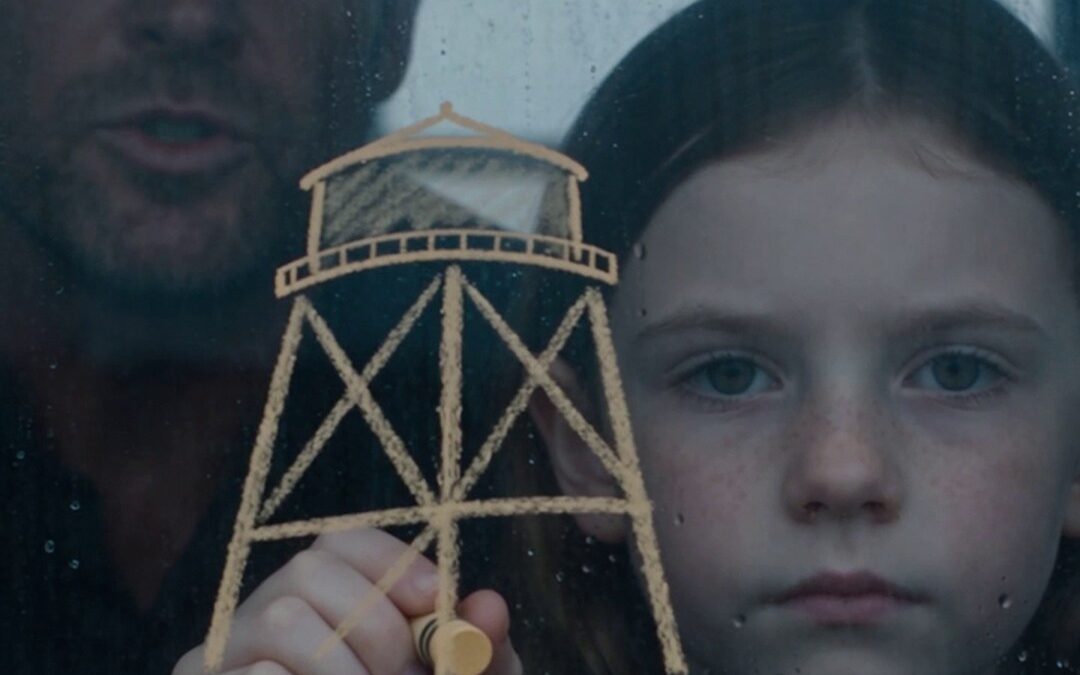
Chapter 2: The Door From Inside
The tower kept falling.
Its tank struck the road.
Water burst across the windshield.
Owen Pike held the brake down.
The bus rocked once.
Then the sound reached them.
Steel folded against steel.
Nell sat behind him.
Her grease pencil rested against the glass.
She had drawn the tower tilted.
She had drawn its ladder bending.
She had drawn the bus beneath it.
Only the bus had stopped.
Tessa Marr wiped the wet windshield.
The tower lay across both lanes.
Beyond it stood Mercy Clinic.
Its red roof showed through the rain.
Nobody had answered their radio calls.
Nobody had answered in six days.
“We turn around,” Owen said.
Nell pressed her pencil to the window.
“The heater stopped,” Tessa said.
Owen glanced at the gauge.
The needle had fallen to zero.
The tower’s water had flooded the engine.
The bus carried nineteen people.
Three had fevers.
One had a bandage turning gray.
They had come eighty miles for medicine.
There was no road behind them after dark.
Owen looked at Nell’s second drawing.
Two tall doors.
A chain across their handles.
A narrow rectangle of light beneath them.
One door opened outward.
A hand appeared in the gap.
Nell had drawn six fingers.
Owen leaned closer.
“It’s a glove,” Tessa said.
She pointed at the thick shape around each finger.
The person wore a work glove.
“Who’s inside?” Owen asked.
Nell watched the clinic.
She was eleven.
She had said four words since winter.
“Don’t know.”
Owen felt the old injury in his left knee.
He had driven through its pain all morning.
Before the Fall, he repaired county power lines.
Afterward, he kept buses moving with wire and prayer.
Two months earlier, he had sold his wedding ring for diesel.
His wife had been dead four years.
He still reached for the ring when frightened.
“Doors don’t open themselves,” he said.
Tessa touched the silver whistle at her neck.
She had taken it from a missing nurse.
The nurse had been Nell’s mother.
“Someone survived,” Tessa said.
“Someone stayed hidden.”
“Both can be true.”
A weak cough came from the rear.
Owen looked back.
The boy with the gray bandage had fallen asleep against his father.
That settled it.
Owen took the tire iron.
Tessa took the clinic key.
Nell caught his sleeve.
Her pencil left a black mark there.
“Wait,” she said.
They did.
Across the flooded road, the clinic’s front doors moved.
The chain hung outside them.
One door pushed against it.
Once.
Twice.
A hand appeared through the narrow gap.
It wore a thick work glove.
The fingers gripped the chain.
There were six.
The last was a sewn leather loop.
Tessa made a small sound.
She knew that glove.
Owen knew its owner.
Three winters earlier, Halden Voss had worn it while sending rescue crews toward a poisoned well.
Halden had died the next morning.
At least, that was what his daughter had told everyone.
* * *
The chain snapped under Owen’s tire iron.
The door opened halfway.
A woman stood behind it.
She wore Halden’s glove.
A scarf covered her mouth.
“Close it,” she said.
Tessa pushed past Owen.
“Ruth?”
The woman looked at her.
For one moment, neither moved.
Then Tessa embraced her sister.
Ruth Marr held on with her bare hand.
Her gloved hand stayed raised toward Owen.
“Close it,” she repeated.
“Why?”
“Because they watch the entrance.”
Owen pulled the door shut.
A bell rang somewhere inside.
Ruth flinched.
“Was that an alarm?” he asked.
“An old school bell.”
“Who rings it?”
“I do.”
Ruth lowered her scarf.
Her face was thinner than Owen remembered.
A white scar crossed her chin.
Nell came through the door.
Ruth saw her and stopped breathing.
The girl ran.
Ruth dropped to her knees.
She gathered Nell into both arms.
The grease pencil rolled across the tile.
Nobody spoke.
Then Nell said, “I saw you.”
Ruth shut her eyes.
Owen felt Tessa’s grip tighten on his arm.
Outside, the bus passengers waited in the rain.
“We need the medicine,” Owen said.
Ruth looked at the doors.
“How many?”
“Nineteen.”
“How sick?”
“Three fevers.”
“One infected cut.”
“We have beds for twelve.”
“They can share.”
“We have medicine for eight.”
Owen set the tire iron down.
“Tell me where the rest went.”
Ruth stood with Nell against her.
“Someone counted it yesterday.”
“Who?”
“I didn’t see his face.”
“Did he take it?”
“He marked the cabinets.”
She pointed toward the hall.
A strip of red paper crossed the medication room.
A seal held its ends together.
The seal bore the mark of the Ridge Council.
Owen had seen that mark on food stores.
Nobody broke it without answering to the council.
“I’ll answer,” he said.
Ruth blocked his path.
“That isn’t the danger.”
Tessa touched Ruth’s gloved hand.
“Why are you wearing his?”
Ruth studied the extra leather loop.
“Halden made it for his bad thumb.”
“We buried him.”
“You buried his coat.”
Owen stared.
He remembered the closed wooden box.
He had carried it.
“Where is he?”
Ruth looked toward the dark stairwell.
“Under the clinic.”
A door closed below them.
Nell pressed her face into Ruth’s coat.
Owen picked up the tire iron.
Ruth gripped his wrist.
“He isn’t our prisoner,” she said.
“We’re his.”
* * *
The clinic had been built above a cold-storage cellar.
Its generator still worked.
The stairwell smelled of diesel and bleach.
Owen took the lead.
Tessa carried a lantern.
Ruth carried Nell.
At the bottom stood another door.
A new padlock hung from it.
Owen examined the hinge.
The screws were bright.
“Installed recently,” he said.
“Four days ago,” Ruth answered.
“Who brought supplies?”
“Council trucks.”
“Who signed for them?”
“I wasn’t allowed upstairs.”
Tessa looked at the padlock.
“You stayed here three years?”
“No.”
Ruth shifted Nell’s weight.
“I stayed here six months.”
“Before that?”
“At the reservoir station.”
Owen turned.
Everyone in the valley believed Ruth had died during the first fever season.
Tessa had mourned her.
Nell had stopped speaking.
“Why didn’t you send word?” he asked.
Ruth’s eyes moved to her daughter.
“I tried.”
She held out her bare wrist.
A pale strip showed where a band had been.
“They kept me as a patient.”
“For what?”
“For knowing what made people sick.”
Owen’s jaw tightened.
The first fever season had emptied four towns.
His crew had carried water to the shelters.
They had been told the river carried disease.
He had watched people refuse safe water.
Some had died waiting for a delivery.
“What made them sick?” he asked.
Ruth pointed at the locked door.
“The records are in there.”
“Then we open it.”
“The council keeps a guard.”
“Where?”
The answer came from above.
Footsteps crossed the clinic floor.
A man called Ruth’s name.
It was Halden’s voice.
Owen had known him since they were boys.
He knew the drag on the last syllable.
Ruth took Nell behind a storage shelf.
Tessa blew out the lantern.
Owen pressed against the wall.
The stairwell light came on.
Halden descended slowly.
He wore a council coat.
He carried no weapon.
His right hand was bare.
Its thumb ended at the first joint.
He saw Owen before Owen could speak.
“Well,” Halden said.
“The road worked.”
Owen did not move.
“You knew we were coming?”
“I knew someone would need the clinic.”
Halden looked toward the shelf.
“Nell.”
Ruth stepped out.
Halden’s expression hardened.
“Back upstairs.”
“You took the medicine,” Ruth said.
“I moved it.”
“The boy outside needs it.”
“Then bring me his name.”
Owen stepped between them.
“You said Ruth was dead.”
“I said she was lost.”
“You let Tessa bury a coat.”
Halden glanced at his daughter.
Tessa’s face had gone pale.
“The valley needed calm,” he said.
Tessa raised the lantern.
She struck its glass against the lock.
It cracked.
Halden caught her wrist.
Owen pulled him away.
The men stumbled against the wall.
A loose sheet of paper slid from Halden’s coat.
Ruth picked it up.
It was a transfer list.
Ruth’s name appeared under PATIENTS.
So did five others.
Beside each name stood a date.
The dates ran back three years.
“These were the people who questioned the water,” she said.
Halden straightened his coat.
“They were exposed.”
“They were witnesses.”
Owen reached for the paper.
Halden let him take it.
“Read the bottom.”
Owen did.
AUTHORIZED BY: RIDGE COUNCIL CHAIR.
The signature belonged to Tessa.
She stared at it.
“I never signed that.”
Halden looked almost sorry.
“You signed the blank forms when you took the records job.”
Tessa had worked twelve-hour shifts that first winter.
She had approved fuel, food, shelter beds.
She had signed stacks without reading every line.
The page was real.
The use of it was not.
Ruth touched her sister’s shoulder.
“I knew you hadn’t seen the names.”
Tessa swallowed.
“How?”
“Because you kept asking where I was.”
Above them, someone tried the clinic’s front doors.
Once.
Then again.
Halden looked up.
His face changed.
“That is not my driver,” he said.
* * *
The visitor wore a white council armband.
Owen watched him through the stairwell window.
The man held a clipboard.
Another stood beside the front door.
Neither carried a visible weapon.
Halden whispered to Ruth.
“Hide the list.”
She folded it beneath Nell’s coat.
Owen noticed.
Halden noticed him noticing.
“Who are they?” Owen asked.
“Inspectors,” Halden said.
“From whom?”
“The council.”
“You chair it.”
“I used to.”
The front bell rang.
Three short pulls.
Tessa led Nell toward the cellar.
“Stay with your mother.”
Nell resisted.
She pointed her grease pencil at the floor.
Then she drew a circle on the tile.
Inside it, she drew two straight lines.
“Later,” Ruth said softly.
Nell shook her head.
A second bell sounded.
Owen opened the front door a hand’s width.
Rain ran down the visitor’s face.
He introduced himself as Elias Crane.
He carried papers from the regional health board.
“Routine inventory,” Crane said.
“During a storm?” Owen asked.
“We received a report.”
“From whom?”
Crane smiled.
“Someone careful.”
His companion looked at the bus.
“Those people need treatment.”
“Then let them in,” Owen said.
“After inspection.”
The boy’s father appeared behind Owen.
He had carried his son from the bus.
The child’s bandage needed cleaning.
Crane saw the boy and stepped back.
“Possible fever?”
“An infected cut,” Owen said.
“We’ll check.”
Crane reached for the door.
Owen held it.
Tessa came down the hall.
She wore an old clinic badge.
“I can examine him,” she said.
“You are not licensed.”
“Ruth is.”
Crane’s eyes sharpened.
“Ruth Marr died.”
“She’s upstairs with the supplies.”
Tessa gave him the wrong location.
Owen understood.
Crane looked at his companion.
The companion walked toward the rear entrance.
“Your companion can wait here,” Owen said.
Crane’s smile vanished.
“You don’t direct this clinic.”
“Neither do you.”
“Until the inventory is complete, I do.”
He produced a stamped order.
Owen read it.
The order permitted inspection.
It did not permit seizure.
He had learned to read work orders carefully.
A line crew that missed a word could lose power for a county.
“You may inspect,” Owen said.
“You may not close the clinic.”
Crane leaned closer.
“We can stop your bus here.”
“On what grounds?”
“Exposure.”
“Test us.”
Crane said nothing.
The boy’s father stepped forward.
“I’ll be first.”
Others gathered behind him.
Rain dripped from their coats.
Crane looked at their faces.
He saw how many witnesses there were.
“Fine,” he said.
“Bring everyone inside.”
Tessa’s eyes met Owen’s.
She needed time.
He gave it to her.
Crane’s companion set up a screening table.
The bus passengers entered one by one.
Ruth came upstairs through the back hall.
She wore a mask and fresh gloves.
She examined the boy’s cut.
She cleaned it.
She gave him an antibiotic from an unsealed drawer.
Crane watched the labeled cabinets.
“You broke the inventory seal.”
“I used clinic stock,” Ruth said.
“That stock belongs to the council.”
“It was delivered for patients.”
Crane wrote something down.
Owen saw him make a small mark beside Ruth’s name.
Not a check.
A circle.
Nell stood near the rain-streaked window.
She drew on its glass.
A long table.
A seated man.
An empty chair.
Owen followed her pencil.
“Who sits there?” he asked.
Nell added a woman’s braid.
Tessa’s braid.
Then she drew a hand placing paper before her.
The hand wore a signet ring.
Crane wore that ring.
He closed his clipboard.
“Chairwoman Vale wants you,” he told Tessa.
“When?”
“Tomorrow morning.”
“For what?”
“To explain the signatures.”
Tessa’s face went still.
Crane had come to collect the list.
He already knew where it was.
Halden appeared behind Ruth.
Crane looked startled.
“You were told to remain below.”
“I changed my mind,” Halden said.
Crane’s companion moved toward him.
Owen stepped between them.
The room tightened.
Then Nell tapped the window.
Her drawing showed Tessa at the table.
Crane’s hand held the papers.
Behind him stood a figure in a council coat.
Nell had drawn its face.
Owen recognized Chairwoman Vale.
At the bottom, she had written one word.
BURN.
* * *
Tessa refused Crane’s car.
She would appear before the council.
She would bring witnesses.
Crane left with his companion.
Owen watched their truck disappear.
Only then did he let his hand shake.
Ruth saw it.
She put a cup of water beside him.
“Drink.”
“I’m fine.”
“You’re shaking.”
He drank.
The water tasted faintly of iron.
“Where did this come from?”
“The clinic well.”
“Is it safe?”
“I test it every week.”
He set the cup down.
“Show me.”
Ruth led him to the lab.
The room held old glassware, paper logs, and a battery lamp.
She laid out test strips.
The clinic well had stayed clear.
The reservoir station had not.
“Halden was right about exposure,” she said.
“He was wrong about its source.”
“What source?”
“Industrial solvent.”
She opened a ledger.
Dates filled its pages.
So did measurements.
The first contamination appeared before the fever season.
Ruth had recorded it.
She had reported it.
Her report had vanished.
“Who checked your readings?” Owen asked.
“County lab.”
“Does it still exist?”
“The technician does.”
“Where?”
“North Farm.”
Owen knew the place.
It was a day’s drive in good weather.
The bus might move by morning.
He looked at the ledger.
“Why didn’t Vale destroy this?”
“She thought it burned.”
Ruth touched the spine.
“I copied it on the night she ordered the station cleared.”
She opened a hidden flap.
Inside were narrow sheets of carbon paper.
The copied readings sat beneath them.
One page bore a county lab stamp.
Tessa came in.
She held Nell’s grease pencil.
“The signature forms,” she said.
“Do you have an original?”
Halden followed her.
He carried a metal file box.
“I kept every order,” he said.
Owen looked at him.
“You helped hide people.”
“I was told they were dangerous.”
“You saw Ruth.”
“After six months.”
“You still stayed quiet.”
Halden accepted the blow.
“I did.”
He placed the box on the bench.
“There are orders here I signed.”
Tessa opened it.
The first pages showed clinic transfers.
The next showed sealed water reports.
The last held a contract.
Ridge Council had granted Vale’s company control of the only clean aquifer.
The contract took effect after the valley declared its wells unsafe.
It carried the date of the first contamination report.
The same day.
Owen traced the ink.
“Vale knew.”
“Vale arranged the declaration,” Ruth said.
Tessa read farther.
The company could charge for every delivered gallon.
It could seize pumps from towns that fell behind.
That explained the dry school shelter.
It explained the food lines.
It explained why crews had driven past working wells.
“What did they dump?” Owen asked.
“Solvent from an old plant,” Ruth said.
“Into the reservoir?”
“Into a drainage ditch above it.”
“Why?”
Halden answered.
“They needed enough bad readings.”
“People drank that water.”
“Vale said the intake was closed.”
Ruth shook her head.
“It wasn’t closed for two days.”
Halden looked at the floor.
Nell came into the doorway.
She held a clean sheet of acetate.
She had found it in the lab.
She placed it over Ruth’s ledger.
Her pencil traced a shape through the clear sheet.
A round valve.
A small crack in its housing.
Owen recognized it.
“The north intake,” he said.
“I repaired that housing.”
“When?”
“Three weeks before the fever.”
He remembered the repair order.
The cracked valve had been marked OPEN.
The next day, another crew had marked it CLOSED.
He had argued with their supervisor.
The supervisor had told him the readings came first.
Owen stared at the drawing.
Nell had never seen the intake.
The station was fenced.
She drew a second shape.
A bent piece of pipe.
Water rushed through it.
Then she drew tomorrow’s rain.
Owen checked the old map.
The ditch above the reservoir flooded during heavy storms.
If the valve still leaked, the next storm could carry the buried solvent into the water again.
“It can happen again,” he said.
Ruth touched the forecast pinned to the wall.
The storm had already begun.
* * *
They left before dawn.
The bus engine started after Owen dried the ignition leads.
He drove it to the reservoir station.
Halden followed in the clinic truck.
Ruth stayed with the patients.
Tessa brought the copied ledger.
Nell insisted on coming.
Owen wanted her safely inside.
She touched the grease pencil to his sleeve.
The black mark from yesterday remained there.
“Please,” she said.
Tessa opened the bus door.
“Stay beside me.”
The reservoir stood beyond a field of dead grass.
Rain darkened the soil.
The north intake sat under a concrete platform.
Its old gate was chained.
A new sign called it safe.
Owen inspected the valve housing.
The crack ran exactly where Nell had drawn it.
He placed a strip of paper beneath the seam.
A drop soaked through.
Then another.
He photographed it with the clinic’s instant camera.
He placed a numbered sample jar beneath it.
Tessa wrote the time.
Halden signed as witness.
“Will that be enough?” Tessa asked.
“Enough to make them test it.”
Owen looked at Nell.
She drew no new warning.
He climbed to the control wheel.
It would not turn.
A steel pin held it open.
The pin bore a fresh council stamp.
Tessa photographed that too.
A truck appeared at the fence.
Crane got out.
His companion stayed inside.
“You’re trespassing,” Crane said.
“This was my work site,” Owen answered.
“Your access expired.”
“The intake is leaking.”
“Then step away.”
Owen held up the sample jar.
Crane looked at it.
His face revealed nothing.
“Hand that over.”
“I’ll take it to the regional lab.”
“There is no regional lab.”
“There’s a technician at North Farm.”
Crane’s glance flicked to Tessa.
He had not expected her to know.
Halden came around the truck.
“Let them finish.”
Crane’s hand tightened around his clipboard.
“Your chairmanship ended.”
“My memory didn’t.”
“You approved this valve.”
“I approved a repair.”
“You approved keeping it open.”
Halden shook his head.
“I signed a form Vale prepared.”
“Your signature is still there.”
“Yes,” Halden said.
“It is.”
He looked at Owen.
“I’ll testify to what I did.”
Crane stepped aside.
For a moment, Owen thought he would let them leave.
Then the companion drove the truck across the gate.
It blocked the bus.
Crane spoke quietly.
“You are carrying restricted samples.”
Tessa took out the clinic radio.
“You are blocking nineteen patients from care.”
“You brought a child to a hazardous site.”
“Then clear the exit.”
A faint voice answered the radio.
Ruth had kept its channel open.
She had heard everything.
Crane heard her too.
The storm came harder.
Water ran along the ditch.
Owen left the sample with Tessa.
He went back to the valve.
The steel pin had a cotter key.
He could pull it.
Then the wheel might close.
He had the right tool in his pocket.
Crane saw what he meant to do.
“That seal belongs to the council.”
“The leak reaches their homes.”
“The investigation can wait.”
“The rain can’t.”
Owen pulled the cotter key.
The pin came free.
He turned the wheel.
His bad knee nearly gave out.
Halden caught the handle.
Together they forced it shut.
Water stopped dripping through the crack.
Tessa took a final photograph.
Nell drew a short line through her valve.
She capped the grease pencil.
Crane’s companion moved his truck.
Nobody ordered him.
Nobody thanked him.
At North Farm, the technician accepted the sample.
His name was Arthur Bell.
He had tested Ruth’s first report.
He still had his original carbon copy.
He tested Owen’s jar while they waited.
The same solvent appeared.
He signed the result.
He sealed a second sample for review.
“Who ordered the intake opened?” Owen asked.
Arthur took a folded work order from his files.
Vale’s signature stood beneath the instruction.
Below it was a second line.
PURPOSE: DOCUMENTED RESERVOIR FAILURE.
* * *
The council met in the old high school gym.
Its roof leaked into buckets.
People came anyway.
They filled the folding chairs.
They stood against the walls.
Some had buried family during the first fever season.
Some had paid for water with their tools.
Some had blamed the crews that delivered it.
Owen saw men he had worked beside.
He saw the boy from the bus.
The bandage on his arm was clean.
Ruth sat with Nell near the exit.
Tessa sat at the long table.
The empty chair beside her stayed empty.
Crane placed a packet before her.
Just as Nell had drawn.
He wore the same ring.
Chairwoman Ada Vale entered through the side door.
She wore a plain coat.
She carried no guards.
That made her look certain.
Crane began with Tessa’s signed transfer forms.
He showed the names.
He showed the dates.
He asked whether the signatures were hers.
“Yes,” Tessa said.
People shifted in their chairs.
“Did you authorize those transfers?”
“No.”
“Then why did you sign?”
“The forms had blank name lines.”
Crane held up a page.
“The names are printed.”
“They were printed later.”
“Can you prove that?”
Tessa looked toward Owen.
He rose.
He had kept work orders from the first winter.
The county had run short of paper.
Clerks had reused carbon sheets.
Tessa’s signature had impressed the paper beneath each form.
Owen laid one original on the table.
The pressure marks ended before the patient names.
A later machine had printed those names over flat paper.
Crane leaned forward.
“That proves an order of printing.”
“Yes,” Owen said.
“The order matters.”
Ruth spoke next.
She described the station reports.
Arthur Bell confirmed his test.
He had kept the dated carbon copy because Ruth had asked him to.
Crane questioned the chain of custody.
Arthur explained his log.
Owen explained his sample.
Halden explained the valve pin.
Vale let them finish.
Then she stood.
“The valley needed water,” she said.
“We had one clean aquifer.”
“We needed funding to guard it.”
“A temporary closure made that possible.”
The room listened.
She knew their winters.
She knew the empty tanks.
She knew what fear could make sound reasonable.
“I did not order anyone poisoned,” she said.
“The intake was supposed to be closed.”
Halden lowered his eyes.
Vale pointed at him.
“He chaired the council then.”
“His approval is on the valve order.”
Halden rose.
“My approval was forged.”
Crane reached for a paper.
Halden lifted his bare right hand.
“My thumb was gone before the Fall.”
He held up the work order.
Its inked thumbprint was complete.
For the first time, Vale lost her place.
The gym stayed quiet.
Owen could hear rain in the buckets.
Vale recovered.
“A clerical error.”
“Then there are two,” Tessa said.
She laid out the aquifer contract.
Vale’s company had signed it before the closure vote.
Its payment schedule began the morning after the first bad test.
Arthur’s carbon copy proved the first bad test came later that afternoon.
Vale had arranged the contract before she could know the result.
Crane closed his packet.
Nell stood.
She carried the acetate sheet.
On it she had drawn the valve.
The crack.
The pin.
The rain.
Owen took it gently.
“This drawing sent us there,” he said.
“She had never seen that station.”
Vale looked at the child.
“You expect the council to accept that?”
“No,” Owen said.
“I expect them to accept the photographs.”
He laid them beside the drawing.
The image matched.
It explained why they had checked.
The samples and records explained what they found.
Nobody asked Nell to prove anything else.
The regional magistrate, present for the hearing, took the records.
He ordered the intake kept closed.
He ordered independent testing of every active well.
He suspended the aquifer contract pending review.
Crane objected.
The magistrate recorded the objection.
He did not return the papers.
Vale rose to leave.
At the door, she stopped beside Owen.
“You stopped one valve,” she said.
“Winter will ask more of you.”
Owen met her eyes.
“We know where our water comes from now.”
Three months later, the review ended.
The contract was voided.
Vale was removed from the council.
A regional court found that she had falsified public records and confined witnesses without lawful authority.
Crane lost his appointment.
Halden admitted his part.
He served a sentence at the regional work camp.
He also gave investigators every order he had kept.
No verdict returned the people lost to the first fever season.
Their names remained in the court record.
Ruth read each one aloud.
* * *
Spring came late.
The clinic doors stayed open.
A new chain hung inside a cupboard.
Ruth used it to hold a shelf level.
The bus stood behind the building.
Owen repaired it when parts arrived.
Most mornings, he drove patients between towns.
On other days, he repaired pumps.
The valley paid him in fuel, food, and occasionally money.
He kept the fuel in a locked shed.
He kept the food where everyone could see it.
Nell spent afternoons at the clinic.
She drew on its windows.
Ruth gave her acetate when rain blurred the glass.
Some pictures showed ordinary things.
A kettle.
A pair of boots.
The clinic cat asleep on clean linen.
Others made Owen stop.
A loose stair board.
A child about to drop a jar.
A truck arriving before its engine could be heard.
He checked what he could.
Nell never liked an audience.
She liked being asked whether she wanted lunch.
She liked choosing the bus seat with the best view.
She liked when people spoke to her first.
Tessa knew that.
She had learned it slowly.
One afternoon, she found Nell drawing the clinic’s front doors.
Both stood open.
People carried chairs outside.
“Is something wrong?” Tessa asked.
“No.”
“Do you know when that happens?”
“Saturday.”
Tessa looked at the calendar.
Saturday was Ruth’s birthday.
They had planned supper.
Nell had drawn too many chairs.
“How many guests?”
Nell counted them.
“More than we have plates.”
Tessa went looking for plates.
Owen found her borrowing six from the school.
“You believe her?”
“I believe we need plates.”
He carried the box.
They walked back through warm wind.
At the clinic gate, Tessa stopped.
“I’m sorry about Ruth,” she said.
Owen turned.
“She was your sister.”
“I should have looked harder.”
“You looked for three years.”
“I believed the funeral.”
“So did I.”
“I also signed those forms.”
He set down the plates.
“You showed people what happened.”
“After she got herself out.”
Tessa stared at the gravel.
Owen knew she wanted him to make it simple.
He could not.
“You signed without reading,” he said.
“Yes.”
“People paid for it.”
“I know.”
“You can keep reading now.”
She nodded.
That was all he could offer.
It was enough for them to walk on.
The regional council offered Owen Halden’s former seat.
The position came with a house.
It came with fuel rights.
It came with a name on every delivery order.
Owen turned it down.
He proposed a public water board instead.
Each town chose one member.
Test results went on clinic doors each week.
No single signature could close a well.
The council accepted after Ruth published the first readings.
Halden wrote from the work camp.
His letter contained an apology to Tessa.
It contained one to Nell.
He asked whether he might visit after his sentence.
Ruth read it twice.
She put it in a drawer.
Nell was outside.
Ruth did not bring the letter to her.
“She may ask someday,” Owen said.
“Then I’ll show her.”
“You don’t owe him an answer.”
“I know.”
Ruth shut the drawer.
The boundary stayed shut with it.
At supper on Saturday, every chair was used.
The boy from the bus arrived with his father.
Arthur Bell brought beans.
Tessa brought the borrowed plates.
The clinic cat sat on the one empty stool and refused to move.
Nobody had the heart to argue.
Ruth brought out a small cake.
Nell had helped measure the flour.
She had put too much salt in the first batch.
Owen ate a piece anyway.
Ruth watched his face.
“It’s the second batch.”
“I knew that.”
“You reached for water.”
“I was thirsty.”
Nell smiled.
It happened quickly.
Then she smiled again.
After supper, Ruth took her to the front steps.
She held out a small brass key.
“I’m putting your room upstairs,” she said.
“You can stay with me.”
Nell looked at the key.
Ruth waited.
“You can keep your bed at the school,” she added.
“You can decide tomorrow.”
Nell took the key.
“Can Tessa come sometimes?”
“Whenever you ask.”
“Can Owen?”
Owen stood in the doorway.
“If you ask,” he said.
Nell closed her hand around the key.
“Then I’ll stay.”
Ruth rested her forehead against her daughter’s.
Inside, the last candle burned low.
Nobody asked Nell to draw tomorrow.
* * *
Five years later, Owen drove the new clinic bus past the old water tower.
Its broken legs still rose from the ditch.
Wild grass grew through the tank.
The road had been moved around it.
Nobody needed the tower anymore.
The towns had repaired their wells.
The water board posted its readings every Friday.
Tessa read every page.
Ruth still ran the clinic.
Arthur still argued over test methods.
The boy with the bandage worked there now.
His scar showed when he rolled up his sleeves.
Nell sat beside Owen.
She was sixteen.
Her grease pencil rested in the glove box.
She had not used it all week.
“Stop here,” she said.
Owen pulled over.
Rain had washed the old road clean.
Nell got out with a sheet of acetate.
She stood where the bus had stopped that day.
Owen joined her.
He could see the curve of the ditch.
He could see how close the tank had fallen.
He had remembered the distance as yards.
It was less.
Nell held the acetate against the sky.
On it, she had drawn the tower upright.
Below it stood the old bus.
Beside it stood three figures.
Owen.
Tessa.
A small girl with a pencil.
“You drew this today?” he asked.
“Last night.”
“Why?”
“I wanted to keep what happened.”
He looked at the picture.
The tower had not fallen yet.
The bus had not stopped.
The road still lay open.
“You could draw what comes next,” he said.
Nell lowered the sheet.
“I might.”
Tessa’s car came around the bend.
Ruth sat beside her.
They had brought lunch from the clinic.
Nell tucked the acetate safely beneath her coat.
They spread a blanket on the grass.
Owen carried the food.
Tessa set four cups beside the basket.
Ruth set out five.
She had counted Owen twice.
They laughed.
Then she found the missing cup.
Nell held it up.
The old tower stood behind them.
The new road curved ahead.
Owen looked at the pencil in the glove box.
He left it there.
Nell had drawn the tower falling across the road.
He had stopped the bus.
Now she chose where they sat.
THE END








