The Little Girl Pointed at the Bride-to-Be—and One Detail Shook His Trust
Chapter 1: The Blue Rabbit
Lila pointed at the peach-dressed woman’s rounded belly. “That’s the blue rabbit room.”
Her mother steadied her shoulder. Mara balanced a tray against her hip, careful not to let the cider glasses shake.
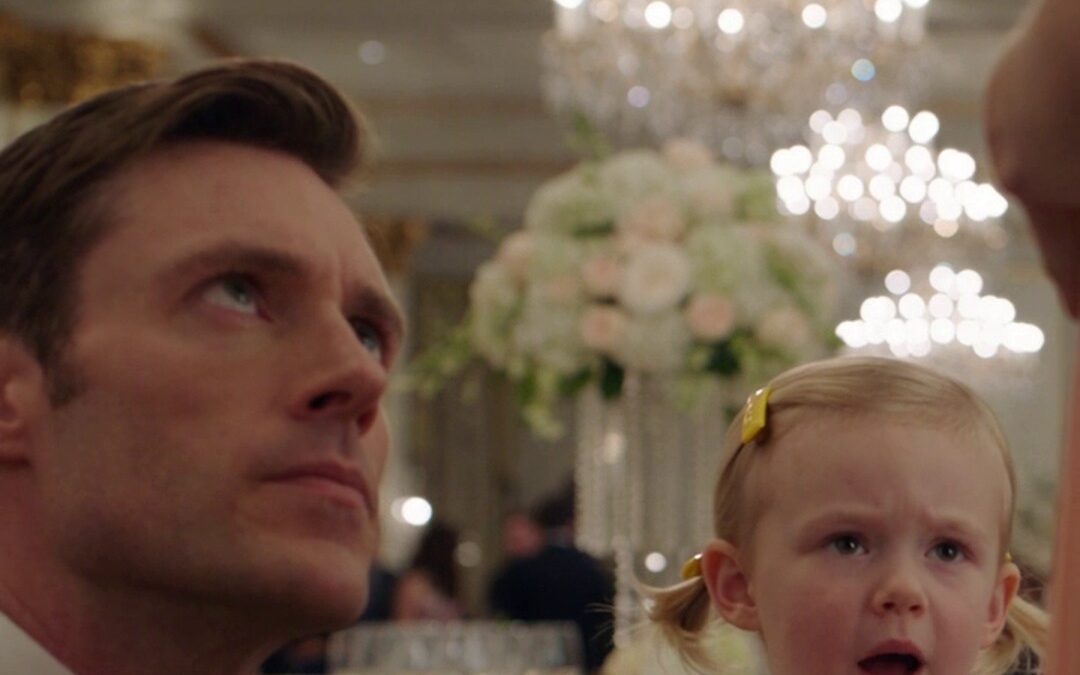
Across the bright reception room, Tessa stopped speaking. Her fiancé, Daniel, turned with her. Daylight filled the cream-walled hall; small white-and-yellow flowers brightened the tables. Lila’s yellow clip shone above her soft chestnut curls.
“Sorry,” Mara said. “Lila, what do you mean?”
Tessa’s smile held. Her dark-blonde hair was in a loose low bun, pearls at her ears. One hand rested over the curve beneath her peach satin dress.
“She probably saw a rabbit decoration in the garden,” Tessa said.
“There aren’t any rabbit decorations,” Daniel replied.
His eyes shifted to Tessa. Mara saw a question break through his composure.
“The clinic appointment was private, Daniel,” Tessa said. “We agreed not to discuss it tonight.”
The words landed oddly. Daniel had told Mara Tessa was nearly twelve weeks along and they would announce the engagement and pregnancy together. Mara had nodded and gone back to work. A server didn’t correct a guest’s story.
“Is that what she meant?” he asked.
Tessa glanced at Mara’s sage vest. “You can take her outside.”
Mara set the tray on a nearby table. “I’ll take her if she wants. But I won’t tell her she’s wrong before I understand.”
Lila pressed against her mother’s leg. “I saw the blue rabbit.”
Daniel’s medium-blue suit looked almost gray beside Tessa’s dress. He took a step, then stopped and crouched several feet away, at Lila’s eye level.
“You’re not in trouble,” he said. “What did you see?”
Tessa’s smile disappeared. “She’s been around the catering rooms. Children mix things up.”
Mara knew Lila had spent Tuesday afternoon coloring beside her while the hotel florist delivered arrangements upstairs. Their supervisor had approved her being there; Mara had kept her close.
Daniel held his hands open. “Just tell me what you remember.”
Lila looked at her mother, then at Tessa. “The blue rabbit was on the bed.”
Tessa’s face tightened. “Daniel, please.”
“What bed?” he asked.
Lila lifted her small finger toward Tessa’s belly. Her voice was certain, almost sleepy.
“You said the baby was in the blue rabbit room,” she said. “But the lady took the pillow out.”
Chapter 2: The Room Upstairs
Daniel stayed crouched, hands still open, while the reception moved around them in careful, bright fragments. Tessa’s fingers tightened around her untouched glass.
Mara slid a hand down Lila’s back. “You can stay with me, honey.”
“I want my crackers,” Lila whispered.
“You can have them.” Mara reached into her sage vest and gave her the small paper bag she had packed in case the reception ran long. Lila took a cracker and leaned against Mara’s knee.
Daniel looked up at Tessa. “What does that mean?”
“It means nothing,” Tessa said. “A pillow, a rabbit print, some silly comment she heard upstairs. She’s a little kid.”
“Blue rabbit pillow,” Lila said around a bite.
Mara kept her eyes on her daughter. “You don’t have to say anything else.”
Tessa’s face flushed. “I never told her about a baby in a room.”
“You said the clinic appointment was private,” Daniel replied. “You also told me there was an appointment.”
“I had one.”
“And you told me the pregnancy was confirmed.”
Tessa glanced at the guests, who were pretending to study the flowers and windows. “Daniel, this isn’t the place.”
“No,” he said, rising without coming closer. “It isn’t.”
The room’s attention settled on Mara’s sage vest. She knew how quickly a server could become the source of a problem. If the couple complained, she could lose the rest of the evening’s hours. Her daughter could be asked to leave. June had approved Lila sitting in the staff lounge because Mara’s neighbor, who usually watched her, had been unable to help that afternoon.
Tessa looked at her. “Did you bring her upstairs?”
“No.”
“Did you tell her what to say?”
“No.”
“Then why is she talking about a bedroom and a pillow?”
“Because she saw one,” Mara said. “I don’t know what it meant until tonight.”
Daniel studied Mara as if measuring her against a story he had already heard. The look stung more than Tessa’s accusation.
“I should have asked you what you knew,” he said.
Mara had no answer ready. She had no interest in making him feel better.
Tessa lowered her voice. “You promised we wouldn’t make private matters public.”
“I’m not asking you for medical records or an examination. I’m asking what you told me and what that child actually saw.”
“She’s three.”
“Yes.” His eyes went to Lila, who had stopped watching the adults and was rubbing a crumb between her fingers. “That’s why I won’t question her again.”
Tessa opened her mouth, then closed it. “You’re letting a toddler disrupt our evening because she mentioned a pillow?”
“I’m stopping the announcement.”
The evening had been arranged around that announcement. The catering team had been told to keep the champagne in the kitchen until Daniel’s toast. Guests expected him to say something about a baby. The engagement party was also meant to celebrate a loan from Daniel’s parents for a small medical practice Tessa hoped to open.
Tessa’s expression changed. Fear, sharp and immediate, crossed her face.
“You can’t cancel it in front of everyone.”
“I can say we’re not making an announcement.”
“People will think—”
“Let them.”
“They’ll assume I lied.”
Daniel looked at her. “Did you?”
Tessa’s eyes shone. “You said you trusted me.”
“I did. That’s why I didn’t check what I should have checked.”
June Alvarez, the banquet supervisor, approached in her navy catering jacket. “Mara? I can take over the floor. Do you want to step into the lounge?”
“Yes. With Lila.”
“Of course.”
Tessa glanced at June. “This has nothing to do with the staff.”
“I’m here to make sure the staff member can do her job without being put in the middle,” June said.
Mara didn’t want that mistaken for rescue. “I’m not leaving because anyone told me to. I’m taking her somewhere quiet.”
Daniel nodded. “That’s fair.”
“Could you stay?” he asked. “Just long enough to help me understand how she had access to the room. I won’t ask her anything else.”
Mara looked at Lila, still working on the crumb. “I’ll explain what I know. Not what I don’t.”
“Agreed.”
June led them through a side corridor. The staff lounge had a long counter, a refrigerator, and windows facing the garden. Lila climbed onto a chair, and Mara poured water into a paper cup. Daniel waited by the open door. Tessa stayed several steps behind him.
“You can come in,” Mara said. “She doesn’t need to be on display.”
Daniel entered alone. Tessa remained in the corridor, arms crossed.
Mara did not sit. “Lila was with me Tuesday afternoon. June approved it because my sitter canceled. I had her in the lounge while I cleared setup. She colored, used the restroom with me. She didn’t go anywhere alone.”
“What was upstairs?” Daniel asked.
“Nothing I knew about. I worked the garden room and the main hall. I didn’t enter the private suite.”
“What do you think she saw?”
“I don’t know.”
He glanced at Lila, who was slowly turning her cup. “May I ask you instead of her?”
“That’s fine.”
“Did you hear Tessa say anything about a blue rabbit?”
“No. I’d never met her before tonight.”
“Did you know she had a clinic appointment?”
“No.”
Daniel took a breath. “I told you she was pregnant.”
“You did.”
“I should have asked what you knew before repeating it as fact.”
“You asked me to set up the announcement table. It wasn’t my place to question your fiancée’s story.”
“It was my place to ask her for clarity.”
Tessa spoke from the hallway. “I told you everything that mattered.”
He turned toward her. “You told me your doctor confirmed it.”
“I said the clinic confirmed the result.”
“You said you had an appointment and everything was fine.”
“The appointment was for follow-up.”
“Did you go?”
Tessa pressed her lips together. “No.”
“When did you cancel?”
“After I told you.”
Daniel nodded slowly. “And the room?”
“That was a staging room.”
“Staging for what?”
“Photos.”
Mara thought of the hotel’s upstairs suite. On Tuesday she had seen a blue rabbit pillow’s ears poking out of a linen cart, though she had not been inside.
Tessa turned toward her. “You may have seen it.”
“I didn’t.”
“You work here.”
“I wasn’t in the suite.”
“Why would a pillow be removed?” Daniel asked.
“Because it was in the way.”
Lila stopped turning the cup. “It was soft.”
Mara rested her hand on her shoulder. “You don’t need to help.”
Tessa’s jaw flexed. “The child was in the hallway?”
“No,” Mara said. “She was with me.”
“Then how did she see a room?”
Mara looked at Lila, not Tessa. “You can tell me if you want, sweet pea. You don’t have to.”
Lila pointed at the garden window. “The cart was there. I saw the door open.”
“Which door?” Mara asked.
“The shiny door.”
There were glass doors on both sides of the corridor. One opened toward the garden; the other led to the suite. Lila called them “garden door” and “shiny door.”
“Did you go inside?”
“No. I was coloring.”
“Was Mommy with you?”
“Mm-hm.”
Mara remembered being called to the loading area and stepping through the corridor to get a replacement box of napkins. She had been gone no more than two minutes. June had stayed with Lila. When Mara returned, Lila had been drawing a blue oval with two long ears.
“June was here,” Mara said. “She was watching her.”
Daniel turned toward the corridor. “Could we ask June what she remembers?”
“Yes, if she’s willing.”
Tessa sighed. “You’re making this sound like an investigation.”
“It is,” Daniel said. “A small one. We need to know whether I misunderstood you or you gave me a false account.”
“You can’t decide that based on what a child says.”
“I’m not.”
“Good. Because she’s three.”
“I agree.”
June joined them after Mara assured her no one expected her to take sides.
“Tuesday,” Mara said. “You watched Lila while I went for napkins. Do you remember anything about the upstairs suite?”
June nodded. “I stayed here with her. She colored.”
“Did I go upstairs?”
“No.”
“Did you see Tessa?” Daniel asked.
June looked at him. “I don’t know who she is.”
Tessa gave a small, humorless laugh. “There were dozens of people in and out.”
“The hotel was closed to guests on Tuesday,” June said. “Only staff and the event planner were on this floor.”
Daniel’s face tightened. “Did you see anyone carrying something?”
“I saw a woman come through the service corridor with a pillow tucked under her arm. She was with the florist, carrying garment bags. I thought she was a stylist.”
Tessa’s eyes dropped.
“The blue rabbit pillow was on top of one of the bags,” June continued. “Lila pointed at it and asked if it was a bunny. I told her it was a rabbit.”
Mara remembered Lila talking about a rabbit at home. She had assumed it was a toy from the lounge.
“Did you hear anything?” Daniel asked.
“No.”
Lila had seen a pillow leave a room. The words she spoke tonight might have joined that memory to something else she heard at the reception. She had not heard a complicated confession. The observation was true; its meaning remained unclear.
Daniel turned to Tessa. “You said the room was where the baby was.”
“I said she said it.”
“You told me the doctor confirmed a pregnancy.”
“Because I had a positive test and symptoms. I believed it.”
“Then why did you stage a room?”
“I didn’t.”
June shifted her weight. “The suite had a photo backdrop. The event planner asked us to leave the pillow in there. It was part of a lifestyle shoot for a local catalog.”
“There was no baby?” Daniel asked.
“Not that I saw,” June said. “The rabbit pillow was a prop.”
Tessa lifted her chin. “I was there for the photos. That doesn’t mean I was faking a pregnancy.”
The distinction mattered. Lila’s words had not established a medical fact.
Daniel opened and closed his hands. “Why did you tell me you were nearly twelve weeks?”
“I never said twelve weeks.”
“You said the appointment confirmed it and you were feeling better.”
“I said I felt better.”
“You corrected me when I said the doctor confirmed it.”
“I said the test was positive.”
“Not in front of my mother.”
Tessa looked toward the door. “Can we not do this here?”
Mara didn’t want to stay, but she didn’t want Lila blamed for a story she couldn’t understand. “I can take her to the quiet room. June can stay with us.”
Daniel looked at her. “Would you prefer that?”
“Yes.”
“Then do that. I’ll ask Tessa privately what she meant.”
Tessa’s face changed. “You’re sending me away?”
“I’m saying Mara and her daughter aren’t part of this conversation unless they choose to be.”
“Daniel, you’re the one who made the announcement.”
“Not yet.”
The radio on June’s belt buzzed. She listened, then lowered it. “The event coordinator wants to know whether we’re serving champagne for the toast.”
“No toast,” Daniel said. “Tell her we’re holding the schedule.”
Tessa’s eyes flashed. “You can’t cancel the whole evening.”
“I’m not. I’m changing the toast.”
“People came because you said there would be an announcement.”
“I said there’d be good news. I didn’t give details.”
“You know what they’ll assume.”
“I do.”
“They’ll think you don’t believe me.”
“I don’t know what I believe yet.”
It was the first honest thing he had said, and it seemed to cost him.
“I thought you were different from your father,” Tessa said.
Daniel’s face went still. “What does that mean?”
“Nothing.”
“You brought him up. Say what you mean.”
“I mean you said you’d trust me.”
“I did. I should have listened more carefully, too.”
“You’re making me sound like a liar because a child saw a pillow.”
“I’m asking if your test was confirmed by a doctor.”
“I have a right to keep my medical information private.”
“You do,” Mara said. “But you also told him a doctor confirmed something. Those are different questions.”
Tessa looked at her, jaw working. For a moment Mara expected another accusation. Instead, Tessa said, “I’m going outside.”
She left without looking at Lila.
Lila slid off the chair. “I want Mommy.”
“I’m here.” Mara crouched beside her. “You’re safe.”
“Can we go home?”
“Soon.”
June remained with them. “I’ll make sure your hours are recorded. You can leave whenever you’re ready.”
“I need to finish my shift, if that’s possible. Rent doesn’t care why a party got quiet.”
“I know,” June said. “We’ll cover the floor. You can work the quieter service station, and Lila can stay here with me until your neighbor gets here.”
“I’ll decide in a minute.”
Daniel waited outside. Near the garden doors, an older man in a charcoal suit spoke to him. He looked like Daniel around the eyes and held a folded program.
“Dad, not now,” Daniel said.
“I only asked what the announcement was.”
“There won’t be one.”
“Is the baby all right?”
Daniel’s expression changed. “I don’t know.”
The older man glanced at Tessa, who stood apart with her glass untouched. “What does that mean?”
“It means I don’t know.”
“Then don’t make a scene. This is a family evening.”
“I’m not making one.”
“People are watching.”
“They can watch.”
The man lowered his voice. “Your mother and I offered the clinic loan because of the baby and the wedding. The clinic plan was Tessa’s, but that was how we agreed to move forward. If you’re unsure, don’t embarrass her in public.”
Mara felt the phrase land. The loan was no vague promise. Tessa had planned to open a women’s health practice in a neighborhood that needed one. Daniel’s parents had offered money for the lease and equipment. His father had linked that offer to the engagement and the baby announcement as proof of a secure future.
Daniel looked at him. “Who told you the pregnancy was confirmed?”
“Tessa did. Last week.”
“When?”
“She said her doctor confirmed it.”
“I heard the same thing.”
His father glanced between Daniel and Mara, then at her service vest. “I don’t see why a child should influence a private family decision.”
“She isn’t influencing it,” Daniel said. “She said what she saw.”
“Children repeat things.”
“Sometimes. I chose to announce it as fact without checking.”
His father’s eyes narrowed. “You’re putting the clinic on hold over a misunderstanding?”
“I’m putting it on hold until I know what I’m agreeing to.”
“That’s a lot to risk for a woman who may have had a positive test.”
“It is. That’s why I’m asking.”
His father looked toward the lounge. “And the server?”
Mara took a small step back. “My name is Mara.”
He looked surprised. “I’m sorry.”
“Just don’t make my daughter carry the consequence of what adults decide.”
The formal announcement never happened. The host announced a schedule change and invited guests to dessert in the garden room. The space filled again with conversation, though people knew something had shifted.
Mara stayed at the service station for another half hour. She refilled water glasses and kept Lila in the lounge, trying not to hear the fragments passing among guests. The job mattered more than the party’s drama. She had accepted the extra shift because Lila’s preschool copay was due Monday.
Daniel stayed near the garden doors with Tessa, speaking quietly. Once, Tessa gestured toward the suite corridor; Daniel shook his head and pointed toward the side exit. When the main service was complete, June told Mara she could clock out.
As Mara tied Lila’s white shoes, Daniel appeared at the lounge door.
“Can I speak with you? Not with her.”
“You can ask. I can leave when I want.”
“Understood.”
“What do you need?”
“I want to establish what Tessa told me and when. Then I’ll decide whether to continue the engagement and whether to release the clinic funds. That affects her, my parents, and people who planned to work at the practice. I don’t want it to become a verdict about her medical privacy.”
Mara watched him. “What do you think happened?”
“I think she had a positive home test, didn’t get the confirmation she described, and let me believe more than she knew. I don’t know why.”
“Do you think she’s pregnant?”
“I don’t know. She can tell me if she wants. I can’t make that answer for her.”
Mara adjusted Lila’s clip. “That’s better than the question you were asking in the hall.”
“I was asking whether she lied.”
“You were also asking whether the kid was coached.”
“I was.”
“Why?”
“Because it was easier than thinking I might have ignored a detail.”
“You did ignore one.”
“Yes.”
“And now you know it.”
“Yes.”
It wasn’t forgiveness. It was recognition.
“Don’t ask her to fix it,” Mara said.
“I won’t.”
He looked toward Lila. “Would it be all right if I said good night?”
“Ask me again when she’s ready.”
“Okay.”
Lila looked up from her shoes. “I want my bunny.”
“Your stuffed one?” Mara asked.
She nodded. Mara took the small gray rabbit from her tote. Lila held it by one ear.
“Not blue,” Lila said.
“No, this one’s gray.”
Daniel smiled faintly. “That’s a good rabbit.”
Lila tucked it under her chin and turned toward her mother.
The next morning, Daniel asked if Mara would meet him at the café across the street from the hotel. She agreed because June would be there too. She did not want a private conversation in a place that belonged to him.
The café had large windows and a chalkboard menu. Lila sat between Mara and June, eating oatmeal. Daniel arrived without Tessa and left a folder closed beside him.
“I spoke with her last night,” he said. “She told me what she could. She didn’t agree to share medical records, and I didn’t ask.”
Mara stirred her coffee. “What did she say?”
“She took two home tests. Both were positive. She called a clinic and made an appointment. She canceled before going.”
“Why?”
“She said she was afraid of the answer.”
“That doesn’t explain the doctor.”
“No. She said she wanted to tell me once she was certain. Then I told my parents. She didn’t correct me because she thought I’d be relieved and because she believed they’d pull the clinic funding if we weren’t moving toward a family.”
“Was funding actually tied to a baby?”
“My father called it a family investment. He said good news would make the commitment feel real. She heard it as a condition.”
“Was she wrong?”
“I don’t know. My parents never said it directly.”
Mara could hear him carefully separating what they had said from what Tessa had understood.
“What did the room have to do with it?”
“The hotel had a catalog photo shoot. Tessa’s practice was meant to be featured in a health-and-home series. She wore the peach dress tonight because she expected to announce the pregnancy. The rabbit pillow was a prop.”
“Did she tell Lila there was a baby in that room?”
“No. She says she never spoke to her.”
“Could be,” Mara said. “Lila saw a pillow leave a room. She heard people say ‘baby’ tonight. She made her own sentence.”
Daniel nodded. “That’s what I think.”
“Then why does her answer matter?”
“Because she was right about the pillow. She didn’t invent the room. It makes me take seriously the possibility that I’ve been smoothing over what Tessa actually said.”
“Take seriously what you heard, not just the part that fits the child’s words.”
“That’s fair.”
June leaned in. “And the loan?”
“I’m not releasing anything until I understand the terms. My parents have a draft. Tessa has her own adviser reviewing it. I don’t want the engagement to become a bargaining chip.”
“Then don’t make it one,” Mara said.
“I’m trying.”
Mara wondered whether he understood that trying was only the beginning. “What if she isn’t pregnant?”
“That’s her private information. She can tell me if she wants. The relationship question is whether she was honest about what she knew and why. The practice-loan question is whether the business plan makes sense without tying it to a baby.”
“Will your parents fund it?”
“They might not.”
“Then Tessa pays the cost for your family’s condition.”
“I’ll offer to separate the loan from the engagement. I can’t promise my parents will agree.”
June folded her arms. “If you correct the story, don’t use Mara or Lila as your evidence.”
“I will.”
“Good,” Mara said. “And no one contacts my daughter about this.”
“Agreed.”
Lila dragged her spoon through the oatmeal. “It’s sticky.”
“You can have toast now,” Mara said.
Daniel watched her, then looked away. The child’s ordinary complaint cut through the adult conversation.
Two days later, Daniel asked if Mara would read a message Tessa had sent him the week before the reception. Mara agreed, provided he did not share medical details beyond their question. He forwarded a screenshot with Tessa’s permission.
“The home tests were positive,” Tessa had written. “I called for a follow-up, but I haven’t gone in yet. Please don’t tell your parents until I know.”
Daniel had replied: “Of course. We’ll wait.”
Three days later, Tessa wrote: “Your mother asked about the announcement. I told her we’d have good news soon.”
The next day, Daniel had messaged: “I said the doctor confirmed everything. Tessa, if I got that wrong, tell me now.”
She had answered: “I’m too tired to fight about wording tonight.”
Mara read the exchange twice. “He started it.”
“I did,” Daniel said. “I told my mother before I knew. Then I put a specific claim in Tessa’s mouth and gave her a chance to correct me.”
“Why?”
“I wanted it to be true. I was excited. My father said a family needed a reason to trust the practice plan. I thought my mother would hear the doctor had confirmed it and stop treating the clinic as a hobby.”
“You made your conclusion sound like hers.”
“Yes.”
“Then you got angry when she didn’t correct you.”
“I did.”
“That isn’t the same as her telling you a doctor confirmed it.”
“No.”
It was the first time Mara heard him name his part without using it to excuse Tessa’s.
“What did she mean by ‘good news soon’?”
“She said she meant she’d tell my mother after the appointment. She hoped the tests were right. She didn’t want my family discussing the practice as if a baby made the plan more legitimate.”
“Then why leave the message alone?”
“She froze. She wanted the loan. She wanted me. She wanted to avoid a fight.”
“Did she think you’d leave if the test was uncertain?”
“She said she did.”
“Would you have?”
“I don’t know. I might have pushed her to decide everything that day.”
“Did you ask about the appointment?”
“Yes. She canceled it after my parents began preparing the funding. She said she was afraid that if the test was wrong, she’d lose the engagement and the practice.”
Mara recognized the calculation: wait, let the next person decide whether what you have is real. Money did not prevent people from making it.
“What did she want from you?” Mara asked.
“Time. She wanted me to stop treating the clinic as conditional on a pregnancy or wedding date. She said she couldn’t discuss the test while my mother was calling her future daughter-in-law and asking about nursery plans.”
“Did she say that before last night?”
“No.”
“Did you ask?”
“No.”
Lila had finished her oatmeal and was making a rabbit from toast crusts.
Mara said, “I can understand how she got there. I can also understand why you feel betrayed. Neither cancels the other.”
“I know.”
“Does she?”
“I think so.”
“Ask her.”
Daniel showed Mara the relevant page of the loan draft, with Tessa’s permission, keeping the rest of the folder closed.
“This doesn’t say baby,” Mara said.
“No.”
“Doesn’t say wedding either.”
“It says the loan comes due if we separate before the practice opens.”
“That’s a marriage condition with cleaner words.”
“Yes.”
“Why is your family lending to her instead of the practice?”
“My father wants control of the property. The loan is secured by the equipment and my personal guarantee.”
“Does she have another option?”
“A smaller community grant application. It would cover some equipment, not the lease.”
“So she thought she was choosing between the clinic and the relationship.”
“Yes.”
“Was she wrong?”
“I’m still finding out.”
Mara watched him. “What would you do if she told you she wasn’t pregnant?”
“I’d end the engagement if she kept lying. I wouldn’t end it because she might not be pregnant.”
“What if she is?”
“That doesn’t erase what she chose.”
“What if she was afraid you’d leave?”
“Then I need to decide whether I can live with how she handled fear.”
It was more honest than Mara expected, though it did not make him fair.
The following afternoon, Tessa asked to meet Mara and Daniel in the hotel’s garden café. Mara agreed only with June present, and Lila stayed home with their trusted neighbor. Mara did not want her daughter within earshot of another adult conversation about pregnancy.
Tessa arrived in a pale blouse and dark trousers, hair down around her shoulders. She looked tired.
“I’m sorry I accused you of coaching Lila,” she said.
Mara waited.
“I was embarrassed and scared. I saw your vest and decided you were the easiest person to blame.”
“You decided that before you asked what happened.”
“Yes.”
“You told Daniel a doctor confirmed a pregnancy when no doctor had.”
Tessa lowered her eyes. “I let him say it and didn’t correct him. I knew he believed that.”
“Why?”
“Because it gave me time. I wanted to go to the appointment, but I was afraid the result would be negative. I was afraid Daniel would think I’d trapped him, and that his parents would pull the loan. I was afraid the clinic would never happen.”
“Did you want him to think you were pregnant?”
“I wanted it to be possible. I wanted to believe the test. I wanted him to stop asking whether I was ready to be a wife before I’d even opened a practice. I also wanted the security that came with everyone believing the next step was already happening.”
“Did you know Lila saw the pillow?”
“No. I didn’t know she was upstairs.”
“She wasn’t,” Mara said. “She was in the lounge. She saw it when the door opened.”
“I understand that now.”
“She had access because you left the suite door open,” June said. “She didn’t hear a secret conversation.”
Tessa nodded. “I believe you.”
Mara did not let the statement close the matter. “You believed I coached her before asking.”
“I did.”
“Why?”
“Because it was easier. You were the person in front of me who didn’t have a name in my world.”
“I have a name in my world.”
“I know.”
“You need to do more than know it now.”
“I will.”
Daniel looked at Tessa. “What happened after the positive tests?”
“Nothing conclusive. I felt sick, but I also had a stomach virus. I was late, but my cycle has been irregular since I changed medication. I didn’t get checked.”
“Are you pregnant?”
“I don’t know.”
Her answer did not settle their future. It clarified what she had known when she let the story stand: she did not know. She had made uncertainty sound like confirmation because certainty was useful.
Daniel lowered his shoulders. “Will you make an appointment now?”
“I’ll decide what to do with my health. I won’t be examined to prove I’m honest.”
“You shouldn’t have to.”
“Then don’t ask it as a condition.”
“I’m not. I asked because I care about you and want to know whether we’re planning for a child.”
“You made it sound like I had to produce an answer before your parents signed the loan.”
“I did.”
“You said the clinic money was separate. Your father said he wanted a family reason to trust the plan. Your mother started planning a nursery. And you announced a baby before I’d seen a doctor. You made your hope my obligation.”
Daniel listened without interrupting. “You’re right about that.”
Tessa continued. “I also lied by omission. I knew you believed the doctor had confirmed it, and I let you keep believing that. I wanted the clinic money. I wanted your family to stop treating my plan like a hobby. I wanted you to keep choosing me.”
“Did you think I’d leave if you said the test was uncertain?”
“Yes.”
“Would you have told me if the tests were negative?”
She hesitated. “I don’t know.”
“Would you have told me if you were pregnant?”
“I would have gone to the appointment.”
“That isn’t what I asked.”
“I don’t know,” she repeated. “I thought I’d tell you when I had something certain. I was afraid that if I said I didn’t know, you’d ask me to decide everything that day.”
“I might have.”
“You did, more than once.”
Daniel looked down. “I did.”
The loan draft, paired with Daniel’s father’s words, gave her fear a fuller context. Pregnancy was not a formal condition, but his family had treated it as proof that she belonged in their future. Daniel had called that excitement. Tessa had taken his assumption and used it as cover. Neither had been the only author of the story.
Mara said, “You both turned a possibility into a promise because it made other things easier.”
Tessa nodded. “Yes.”
Daniel looked at Mara. “What would you do?”
“I don’t know your relationship. I wouldn’t sign a clinic loan tied to a wedding if I couldn’t discuss the terms without being afraid.”
“I wanted the practice more than I admitted,” Tessa said.
“That doesn’t make you bad,” Mara said. “It means you had something to lose.”
“It doesn’t make what I did honest.”
“No.”
Tessa turned to Daniel. “I’ll book an appointment if I choose to. I’ll tell you what I learn if I want to share it. I won’t let your parents use it as a condition for funding.”
“They shouldn’t.”
“Will you tell them that, even if they pull the money?”
“Yes.”
“You don’t know if you mean that.”
“I know I mean it now.”
“That’s not the same.”
“No.”
Mara recognized the gap between a sentence and a choice. Tessa did too.
The next morning, Daniel met his parents and Tessa’s business adviser in a small hotel conference room. Mara did not attend. She had made clear she would not be a witness for their relationship or a bargaining tool. Later, Daniel sent her a brief message asking whether she wanted to know how the job issue had been handled. She replied that she did.
His father began by asking whether the pregnancy had been confirmed. Daniel said he didn’t know and would not ask Tessa to disclose private medical information to settle a family loan.
His mother asked whether the engagement was over. Daniel said they were still deciding what they wanted, and the decision would not be made by a loan deadline.
His father said the loan was a business risk. Daniel agreed. He proposed rewriting it as a conventional small-business loan to the practice, with standard interest, a business-plan review, and no condition tied to their relationship. His father refused.
“You’re asking me to fund a stranger’s clinic,” he said.
“She isn’t a stranger. You agreed her plan was sound.”
“I agreed because you were marrying her.”
“That’s exactly the problem.”
His mother told them both to stop. Daniel didn’t.
“If the practice only makes sense when I’m engaged to the doctor, then it doesn’t make sense as a loan,” he said.
The family withdrew the offer. Tessa lost the immediate chance to open the larger clinic. Daniel lost his parents’ trust for the moment, and the wedding date came off the calendar. Tessa had to decide if she wanted to remain with him without the promised funding or public certainty.
She didn’t answer that day.
The community grant came through the next week, covering equipment and a modest room lease in a shared medical suite. It wasn’t the clinic she had planned, but it was a beginning she could own. Daniel introduced her to an accountant only after she asked. He didn’t lend her money or negotiate on her behalf.
Mara’s job was a separate question. The reception organizer worried that the incident would generate complaints. June told the hotel’s catering manager exactly what had happened: Lila had been present with approval, Mara had kept her supervised, and no work had been disrupted. The manager confirmed Mara’s scheduled hours and asked if she wanted future shifts.
Mara said yes, with a boundary: if her daughter came again, she would stay in the designated staff lounge with a named caregiver, and no guest would question her about an adult dispute.
The manager agreed in writing. The schedule didn’t change. That mattered more to Mara than Daniel’s apology. She could pay the preschool copay without wondering whether a wealthy guest’s embarrassment had quietly erased her hours.
Two weeks later, Tessa called and asked if Mara would meet her alone in a public café. She said she wouldn’t mention Lila unless Mara did.
Mara agreed.
Tessa arrived with a single sheet of paper folded in her purse, but she didn’t take it out.
“I went to the appointment,” she said. “I chose to.”
Mara waited.
“I’m not pregnant.”
The words came without spectacle. Tessa’s eyes were wet, but she didn’t look ashamed. She looked tired.
“I’m sorry,” Mara said.
“I was relieved for a minute. Then I felt foolish. Then I was angry at myself for hoping it would fix the other problems.”
“Did you tell Daniel?”
“Yes. He didn’t ask to see anything. He asked if I wanted him to come with me next time. I said no.”
“That seems fair.”
“We’re not engaged anymore.”
Mara kept her hands around her cup. “I’m sorry about that, too.”
“I don’t know if I am. I cared about him. I still do. But I don’t want to make every uncertainty sound like good news so he’ll hear me.”
“Did he understand?”
“He said he did. He also said he needed time to trust me. I told him I needed time to trust him with the truth.”
That was a resolution Mara could respect: no easy reunion, no public punishment, no stranger deciding that truth entitled him to every detail. They had named what each had done and left the future open.
Tessa folded her hands. “I came to apologize again. Not because Lila helped uncover something. She shouldn’t have to be useful to deserve an apology.”
Mara felt the statement settle somewhere deep. “Thank you.”
“I corrected the story with Daniel’s parents. I told them I hadn’t been medically confirmed and had let them believe I was because I wanted the clinic funded and wanted to feel secure. I didn’t mention your daughter.”
“Good.”
“They still withdrew the loan.”
“That was their choice.”
“Yes.” Tessa looked out at the sunny sidewalk. “I used to think being believed was the same as being loved.”
Mara didn’t offer a lesson. People often knew the shape of their mistake before they knew how to stop repeating it.
“Are you going to open the practice?” she asked.
“In a smaller room. Two days a week at first. I’ll see if the grant covers what I need.”
“That sounds like a plan.”
“It’s less shiny.”
“Plans don’t need to shine.”
Tessa gave a quiet, unforced laugh. “I’m learning that.”
By then, Lila had mostly forgotten the reception. She carried the gray rabbit everywhere and sometimes called it blue. When Mara asked what she wanted for dinner, she always answered “pancakes.”
One Saturday, Mara took her to the hotel garden to visit June while the catering team set up another event. The flowers had changed to orange marigolds, and sunlight filled the corridor through the tall windows. Lila stood near the glass doors with the rabbit under one arm.
She pointed at a flower pot. “Look, Mommy. A bee.”
Mara turned. A bee moved between the blooms.
“You saw it,” she said.
Lila leaned against her leg. “It’s little.”
“It is.”
“Can we go see?”
“We can look from here.”
Lila nodded and stayed close.
Mara rested a hand on her daughter’s shoulder, the same steadying touch she had given her beneath the reception lights. She hadn’t pulled Lila’s finger down then. She wouldn’t teach her that speaking was wrong just because an adult might be embarrassed.
But she would teach her that she didn’t have to keep speaking after the grown-ups had heard.
“Tell me when you’re ready to go,” Mara said.
Lila hugged the rabbit and pointed once more at the bee.
Mara bent beside her. “I see it.”








