The Missing Girl Was Standing on a Frozen Fountain When Her Father Came Home Early
Chapter 2: What the Key Opened
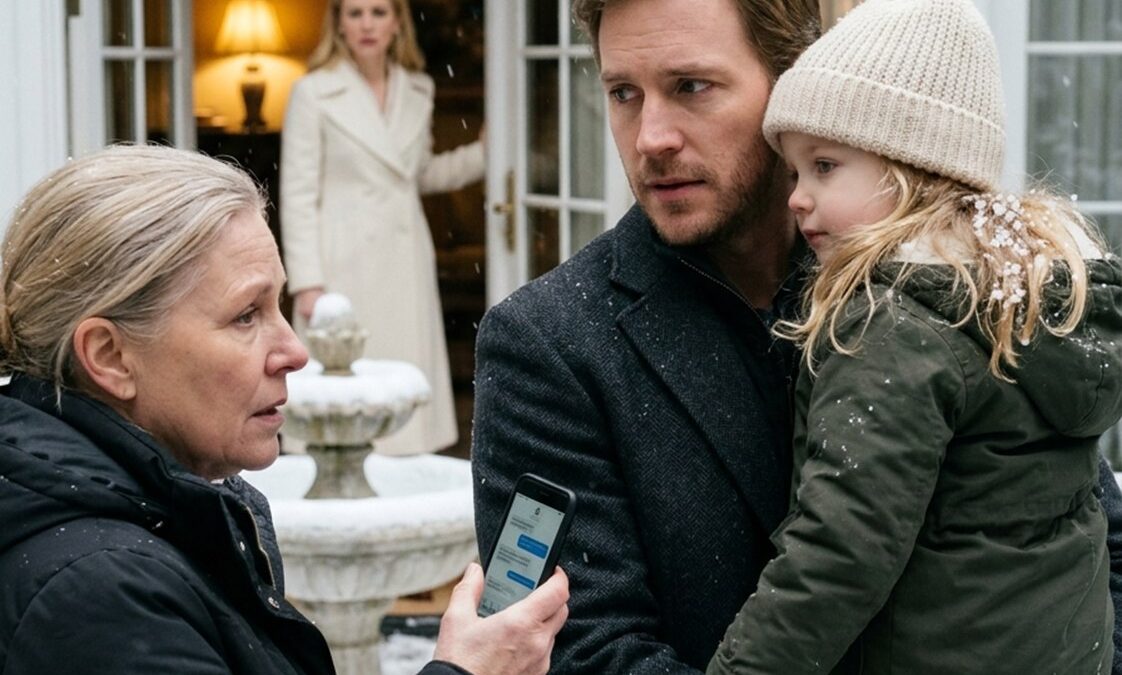
The courtyard doors stood open.
Snow drifted across the threshold.
Adrian held Wren against his chest, the brass key clenched in her hand.
Celeste remained beneath the doorway.
“That video is incomplete,” she said.
Nessa lowered her phone.
“Then let him see the rest.”
Adrian looked at Celeste.
“Call the doctor.”
“I already did. You’re holding a sick child outside.”
“I’m holding my daughter.”
“Bring her in.”
“Move.”
Celeste stepped aside.
Nessa waited near the wall, her face pale.
She had worked in the Vale house for eleven years.
Adrian had seen her almost every day.
He had never asked what she thought.
“Take us upstairs,” he said.
“Not through the main hall,” Nessa replied.
Celeste gave a short laugh.
“Now the staff gives orders?”
“Now the staff tells me where my child has been.”
Wren lifted her head.
“Not the blue room.”
Adrian looked down.
“What blue room?”
“The room with the star curtain.”
Celeste’s face changed for a moment.
Nessa saw it.
So did Adrian.
“Upstairs,” he said.
They used the service corridor.
Adrian carried Wren while Nessa led the way.
Celeste followed several steps behind.
At the top, Wren tucked her face into his shoulder.
“I didn’t break anything.”
“I know.”
“She said I did.”
“Who said that?”
Wren did not answer.
Nessa stopped at the nursery door.
The original lock had been removed two years before.
A fresh brass plate covered the empty space, with a narrow keyhole beneath it.
Adrian held out his hand.
Wren looked at the door.
“Will it stay shut?”
“Not anymore.”
He turned the key.
The lock opened.
The nursery smelled of dust and lavender.
The curtains were closed.
A child’s bed stood beneath the window; puzzles, books, and a wooden train lined the shelves.
Nothing appeared disturbed.
Adrian set Wren on the rug.
Nessa turned on the lights.
Wren took his hand.
“Not in here,” she whispered.
“What happened in here?”
“Nothing,” Celeste said from the doorway. “This was her room. You gave it to her.”
Adrian stared at the pale square on the wall where a picture had hung.
Mara’s watercolor of the garden.
He had assumed it was in storage.
“Where is it?”
“Storage. It made Wren cry.”
Wren looked up at him.
“I cried because she said Mommy left me.”
Celeste’s mouth tightened.
Nessa’s hand shook as she held her phone.
Adrian took it gently.
“Show me.”
Nessa pressed play.
The video showed this room three weeks earlier.
Celeste stood beside the bed.
Wren sat on the floor in her pajamas.
“You need to stop asking for your mother.”
“I want Mommy.”
“She isn’t coming.”
Wren began to cry.
Celeste pointed at a narrow cupboard.
“You can stay in there until you learn to be quiet.”
The clip ended.
Adrian lowered the phone.
Wren watched his face.
“Is Mommy in the garden?”
“No, sweetheart.”
“She was there yesterday.”
“Who told you that?”
“Celeste.”
Celeste stepped forward.
“Children invent things.”
“Did she sleep in that cupboard?”
“No,” Nessa said. “Not overnight.”
Adrian turned to her.
“Where was she?”
“The laundry room. Sometimes the garden shed.”
“This is a lie,” Celeste said.
“I have the dates.”
“You had no right to film a child.”
“I had a duty to keep proof.”
“You were paid to clean.”
“I did that, too.”
The words landed.
Adrian had paid everyone well.
He had asked almost no one how the house felt.
“Why didn’t you come to me?”
“I did.”
“When?”
“October second. Then the ninth. Then the seventeenth.”
He searched his memory.
Those dates had vanished into airports and meetings.
“Your assistant said you were unavailable,” Nessa said.
“My assistant?”
“Grant.”
Celeste watched him.
“He handles your schedule.”
“Not anymore.”
Nessa lowered her eyes.
“Wren’s clinic calls came through him.”
Adrian turned to Celeste.
“You said Dr. Lyle was treating her.”
“He was.”
“Where?”
“At the clinic.”
“What clinic?”
“Northshore Child Recovery.”
Adrian knew the name from the invoices.
He had never visited.
“Call Dr. Lyle.”
Celeste reached for her phone.
“I can get him.”
“No. Nessa, call emergency services. Ask for a pediatric assessment.”
Celeste moved toward the door.
“You cannot drag this into public.”
“I’m not dragging anything.”
“You’re putting her through more trauma.”
“She’s four and locked in a room.”
“She was never locked in.”
Wren touched the key.
“This was for the blue room.”
Adrian knelt beside her.
“Did you use it?”
“Once.”
“What happened?”
“Grant took it.”
Celeste blinked.
“Grant never came here.”
“He came when you went to dinner,” Wren said. “He said Daddy sent him.”
Nessa looked at the child.
“He was here?”
Wren nodded.
Adrian rose.
“Did he tell you to hide?”
“He said I made everything difficult.”
Celeste’s expression sharpened.
“Wren confuses people.”
“Stop,” Adrian said.
“She’s traumatized.”
“She’s telling me something.”
“Your wife’s death confused her.”
The room went still.
Adrian stepped toward Celeste.
“Do not use Mara to excuse this.”
“I loved her.”
“You told my daughter her mother abandoned her.”
“I said her mother was gone.”
“You told her to stop asking.”
“I was trying to help.”
“Then why the cupboard?”
Celeste had no answer.
A siren sounded faintly outside.
Nessa glanced toward the window.
“The ambulance is coming.”
“Good.”
Celeste moved toward the bed.
“This is a private family matter.”
“Wren is the family.”
“You’re making an irreversible mistake.”
Adrian looked at the video still on Nessa’s phone.
Then he crossed to the cupboard.
Its narrow door had been painted to match the wall.
Inside lay a child’s blanket, a paper cup, and a stuffed fox with one missing button.
Wren made a small sound.
Adrian shut the door.
Nessa moved beside her.
“Let’s wait downstairs.”
“Are they taking me away?” Wren asked.
“No,” Adrian said. “Nobody is taking you anywhere without you and me.”
“Will she come?”
“No.”
Celeste softened her voice.
“Wren, I would never hurt you.”
Wren pressed into Nessa’s side.
Adrian turned to Celeste.
“Go to the library.”
“This is my home.”
“Not tonight.”
“My name is on the household trust.”
“We’ll discuss that with counsel.”
“You cannot throw me out.”
“I can ask you to leave.”
“And if I refuse?”
“The police can help you understand the request.”
Celeste stared at him.
Nessa kept the phone raised.
The siren grew louder.
“Adrian, think carefully.”
“I am.”
“You’ll regret choosing a housekeeper over me.”
“I’m choosing my daughter.”
The ambulance crew arrived with a doctor.
They examined Wren in the sitting room.
She was cold, dehydrated, and exhausted, but there was no immediate emergency.
The doctor recommended a full pediatric evaluation and a calm place to rest.
A medic wrapped Wren in a thermal blanket.
“Can he come?” she asked.
“He can ride with us,” the doctor said.
Celeste stood by the staircase.
“You don’t need to make a scene.”
Adrian did not answer.
He rode with Wren to the hospital.
Nessa followed in a car.
Celeste stayed behind.
A social worker met them in a quiet room.
She asked Wren simple questions without pressing her.
A nurse checked her temperature and examined her hands and feet.
Wren sat on the bed, exhausted, while Adrian kept a chair beside her.
Nessa waited in the hallway.
Adrian went out to speak with her.
“Tell me everything.”
“I will.”
“Start with the first time.”
“It began three months after your wife died.”
“Why?”
“Celeste said Wren needed structure. She said Mara had spoiled her.”
“What did you see?”
“Punishment. Meals withheld. Doors closed. Her favorite things taken.”
“Why didn’t you tell me?”
“I did.”
“You said Grant blocked you.”
“He blocked calls. He read the emails, too.”
Adrian remembered reports about Wren’s progress.
He had read summaries, never Nessa’s messages.
“Can you prove that?”
“I saved them.”
Nessa opened her bag and laid a thick folder on the table.
Emails.
Delivery receipts.
Staff schedules.
Dates in blue ink.
Adrian recognized his office letterhead.
Messages addressed to him had been redirected through Grant.
Some carried replies claiming Adrian had reviewed them.
He had not.
“What did you do after that?”
“I started recording.”
“For how long?”
“Five months.”
“Why did Wren have the key?”
“She asked for it.”
“Where did she get it?”
“Your wife’s sewing box.”
Adrian stared at the brass.
Mara had used a similar key for the garden gate.
“Why was Wren in the fountain?”
“Celeste made her stand there.”
“Why?”
“She said Wren ruined a family photograph.”
“Was it an accident?”
“I don’t know.”
“Why was she barefoot?”
“Celeste said her shoes were dirty. She told her to stand still until she apologized.”
Adrian turned away and pressed both hands against the hospital wall.
“I should have been there.”
“Yes,” Nessa said.
He looked at her.
“You could soften that.”
“I could.”
“Why don’t you?”
“Because she needed you.”
He took that without argument.
“I was working.”
“So was I.”
A social worker stepped into the hall.
“Wren is resting. We need to talk with you both.”
The social worker explained that she would make a report.
A child advocacy specialist would interview Wren later.
They would document the conditions and the videos.
She advised Adrian not to confront Celeste again before investigators could speak with her.
“Can Wren come home?” he asked.
“If the home is safe and the person she named isn’t there.”
“She won’t be there.”
“Then the caseworker will assess.”
“Understood.”
The doctor returned with discharge instructions.
Wren needed warmth, hydration, and follow-up.
There was no sign of lasting injury.
“She needs consistency,” the doctor said.
“I can give her that.”
“You’ll need help.”
“I’ll get it.”
Wren opened her eyes.
“Daddy?”
“I’m here.”
“Is the blue room locked?”
“No.”
“Can I see the garden?”
“Yes.”
“Can I see Mommy’s picture?”
“I’ll find it.”
She studied his face.
“Did you forget?”
The question was quiet.
Adrian nodded.
“I did.”
“Will you forget again?”
“No.”
She seemed unconvinced.
He did not ask her to trust the promise.
He stayed beside her.
A nurse brought warm juice.
Wren took two sips.
Nessa sat in the corner.
Adrian did not look at his phone.
By sunrise, Wren was asleep.
The social worker returned with an investigator from the city child protection unit.
They asked for copies of Nessa’s recordings and the household records.
Adrian signed the consent forms.
Then he called his attorney, Priya Shah.
He told her not to contact Celeste.
He asked her to preserve all records and prepare for an emergency custody hearing.
Priya arrived before noon and listened without interrupting.
“Is Celeste Wren’s legal guardian?” she asked.
“No.”
“Does she have custody rights?”
“No.”
“Does she hold a role in a trust?”
“She is a trustee on the family care fund.”
“Who appointed her?”
“I did, after Mara died.”
“Why?”
“She had been Mara’s friend.”
“Did Mara name her?”
“No.”
Priya wrote that down.
“Then we need the trust documents.”
“Grant has them.”
“Your chief of staff?”
“Yes.”
“Can he alter them?”
“He has administrative access.”
“Then we secure the originals.”
Adrian called Grant.
The call went to voicemail.
He tried again.
Still nothing.
Priya took the phone.
“Send a preservation notice by email and courier.”
“Could Grant have helped Celeste?”
“We don’t know yet.”
“What do we know?”
“That the clinic reports may be false.”
“The doctor exists.”
“The clinic exists. The reports may still be fabricated.”
“Find out.”
Priya called the hospital’s compliance attorney with the clinic name and referral code from an invoice.
The hospital could not confirm patient details without authorization.
Adrian signed a release.
An hour later, the compliance attorney called back.
The clinic had no treatment file for Wren.
It had no record of seeing her.
The doctor listed on the reports had been retired for two years.
Adrian stared at the paper.
“Who submitted them?”
The attorney could not identify the source without a formal request.
Priya already had one drafted.
The hospital agreed to preserve the records.
The child protection investigator asked for a copy.
Adrian handed over the invoice.
“Was there ever a clinic?” he asked Priya.
“There may have been a billing shell.”
“Who set it up?”
“We’ll find out.”
That evening, Wren went home with him.
The caseworker first visited, documented the nursery, photographed the cupboard and lock, and spoke with Nessa.
She confirmed Celeste had left the property.
Adrian hired a nurse for the night.
Wren asked to sleep in his room.
He put a small bed beside his.
She kept the brass key in her fist.
He did not ask for it.
A few minutes after midnight, she woke.
“Is the fountain empty?”
“Yes.”
“Can I fill it?”
“When it’s warm.”
“Can it be a pond?”
“Maybe.”
She watched the ceiling.
“Can the fox sleep with me?”
“Of course.”
She held up the stuffed toy.
Its missing button left one eye closed.
“Mommy gave it to me.”
“I remember.”
“Did she say the fox could guard me?”
“She did.”
“Then he should guard the room.”
“He can.”
Wren turned toward the wall.
Adrian stayed awake.
The next morning, Priya came with a private investigator named Reuben Pike.
He was a former financial crimes examiner.
He had requested the fund’s payment history.
The first invoices appeared four months after Mara died.
Each carried the same monthly amount.
Each was approved with Adrian’s credentials.
“Did you sign them?” Reuben asked.
“No.”
“Did you know about them?”
“No.”
“Who had your access code?”
“Grant and my executive assistant.”
“Anyone else?”
“Celeste handled household approvals.”
“Could she access your office?”
“Yes.”
“Could she access the fund?”
“Only through Grant.”
Reuben placed a transaction list on the table.
“The money went to Northstar Family Services.”
“Who owns it?”
“We’re checking.”
“Why?”
“It was formed six months ago.”
“By whom?”
“An attorney in Delaware.”
“Can you get the filing records?”
“Already requested.”
Adrian studied the entries.
The payments totaled just under three hundred thousand dollars.
They were labeled clinical supervision, transport, and private care.
“Where did the money go?”
“We’re tracing it.”
“Move faster.”
“I am.”
Nessa appeared in the doorway.
“Mr. Vale?”
“What is it?”
“I found this under Wren’s bed.”
She held out a folded sheet.
It showed a house, a large man outside it, and a girl in a dark box.
Beside the house stood a woman wearing a crown.
“When did she draw this?” Adrian asked.
“Last week.”
“Why was it under the bed?”
“She hid it.”
“Did she tell you?”
“She said Celeste would throw it away.”
The social worker had advised them not to question Wren about details.
Adrian put the drawing in a sleeve.
“Give this to the investigator.”
Nessa nodded.
“Can you stay with her today?”
“I can.”
“Thank you.”
“I’m staying because I want to.”
“I understand.”
The investigator returned that afternoon and collected the videos, drawing, and emails.
She told Adrian not to speak to Celeste.
She said the city would contact her formally.
“Can she still access the house?” he asked.
“Not without permission.”
“Can she contact Wren?”
“Not while we assess the immediate risk.”
“What happens next?”
“We interview witnesses, compare records, and decide whether a safety plan is needed.”
“Will she be arrested?”
“That depends on the evidence and the prosecutor.”
The answer frustrated him.
It was honest.
He accepted it.
Priya filed a request to remove Celeste temporarily from the family care trust.
The court set a hearing for the following week.
That night, an unknown number sent Adrian a message.
You are letting an employee destroy a family.
A second arrived seconds later.
Ask what your wife hid before she died.
Adrian showed Priya.
“Could be Celeste.”
“Could be someone trying to make you react.”
“Can we trace it?”
“We can preserve it and report it.”
“Do that.”
The investigator documented the messages.
They contained no direct threat and did not identify the sender.
Adrian did not reply.
At dawn, the security system recorded someone at the west garden gate.
A camera showed a dark vehicle waiting beyond the wall.
No one entered.
Police noted the incident and increased patrols.
Adrian moved Wren to another bedroom.
Nessa stayed on the same floor.
They did not tell Wren why.
She noticed anyway.
“Is someone coming?”
“No.”
“Is Celeste coming?”
“No.”
“Is Grant?”
Adrian froze.
“Why did you ask that?”
“Grant said he would come back for the key.”
The brass key lay on the nightstand.
“Did he say why?”
“He said it belonged to Daddy.”
“Did he ask you to give it to him?”
“Yes.”
“When?”
“Last time he came.”
“Did he take it?”
“No. I put it in my sock.”
Adrian covered her hand.
“You did well.”
“I was scared.”
“I know.”
“Can I keep it?”
“Yes.”
She slept.
Adrian stayed beside her until morning.
The next day, Reuben found the owner of Northstar Family Services.
The company was registered to a trust connected to Celeste’s brother.
Payments had moved through two accounts and ended in a property investment partnership.
Grant Halpern was one of its partners.
“Grant owns part of the company?” Adrian asked.
“Through a holding firm.”
“How much?”
“Forty percent.”
“And Celeste’s brother?”
“Sixty.”
“Where is the money now?”
“Some went into a commercial property project in Queens. Some paid a private loan.”
“Can you prove the source?”
“Bank records will.”
“Have you requested them?”
“The investigator has.”
Priya studied the report.
“This changes the case.”
“It gives the prosecutor a financial motive,” she said.
“It gives us a direction.”
“Why was Wren involved?”
“We don’t know yet.”
“Find out.”
Reuben turned a page.
“Northstar also paid for a storage unit in Long Island City.”
“What’s there?”
“We don’t know.”
“Go.”
“The investigator needs to handle it.”
“Then call her.”
They did.
The prosecutor approved a warrant two days later.
The unit held nursery furniture, boxes of Mara’s papers, and a locked metal case.
The case contained trust documents.
Some were originals.
Some were drafts.
One draft amendment would have made Celeste the sole guardian of Wren’s inheritance until she turned eighteen.
It also gave Grant authority to manage the assets.
Adrian had never seen it.
The signature page looked authentic, but its witness line was blank.
A handwriting expert later confirmed the signature had been copied from an older document.
Investigators also found an email exchange between Celeste and Grant.
Its subject was “Continuity Plan.”
One message discussed Wren’s “emotional instability.”
Another proposed moving her to a long-term facility.
A third discussed having Adrian declared unable to manage the family trust if he resisted.
A note at the bottom read: “He won’t challenge a doctor’s recommendation.”
Adrian read it twice.
It explained the false clinic.
It explained the forged reports.
It did not explain how Celeste had become involved.
Reuben called Mara’s former attorney, Elaine Porter.
Elaine had represented the family for twelve years.
She had retired to Vermont but agreed to speak by video.
Adrian asked if Mara had ever expressed concern about Celeste.
“Not about Celeste,” Elaine said.
“What did she say?”
“She worried about Grant.”
“Why?”
“He had become too familiar with the family accounts.”
“Did she tell you?”
“She asked me to review a power of attorney.”
“Which one?”
“The document that let Grant handle your business affairs while you traveled.”
“I signed it years ago.”
“She suspected he had used it beyond its purpose.”
“Did you find proof?”
“No. She decided to wait until she had more.”
“What did she keep?”
“An envelope.”
“Where?”
“I don’t know. She said she’d left it somewhere safe.”
“Did she say where?”
“She mentioned the greenhouse.”
Adrian looked at Nessa.
“Mara’s greenhouse?”
“Yes.”
“It’s at the old estate?”
“Correct.”
The estate had been sold after Mara died.
The greenhouse remained, preserved by the new owner.
The investigator arranged a visit.
The owner let them search.
They checked the benches, shelves, and drain, but found nothing.
Then Nessa remembered.
“Mara kept small things in the blue stone planter.”
It stood by the greenhouse door, its base cracked.
The owner helped them lift it.
A sealed tin sat beneath a false bottom.
Inside lay a flash drive and a handwritten note addressed to Adrian.
If you are reading this, I was right to wait.
The drive held account statements and a recording.
Mara’s voice sounded tired.
She said Grant had shown her altered reports.
He had offered to move money through a care company.
She had refused.
She had not told Adrian because he was already carrying the pressure of his business and her illness.
She had feared he would confront Grant without proof.
The recording ended with her saying, “If he uses Wren to reach the money, the fault is not hers.”
Adrian sat beneath the greenhouse’s cold glass roof.
Nessa stood beside him.
The investigator paused the audio.
Mara had seen the beginning of the conspiracy.
She had tried to stop it.
She had died before finishing.
Adrian shut his eyes.
He had mistaken her silence for trust.
It had been fear for him.
When he opened his eyes, Nessa was watching.
“I should have listened to her.”
“Yes,” Nessa said.
“Do you think she knew what they’d do?”
“I think she knew they were capable.”
“Why didn’t she tell me?”
“She did.”
“Not enough.”
“She tried to protect you from a fight you should have faced.”
Adrian looked at the note.
The past had changed shape.
Mara’s secrecy had not meant indifference.
It was a warning she had not managed to deliver.
The investigator took the drive for forensic verification.
The handwriting expert would test the note.
The prosecutor would seek records from the accounts named.
Adrian wanted to act immediately.
Priya reminded him the evidence had to stand.
He waited.
That evening, investigators found another document: a draft letter to a probate judge.
It described Adrian as emotionally unstable after Mara’s death and proposed temporary guardianship of Wren and trusteeship of her inheritance.
The proposed guardian was Celeste.
The proposed trustee was Grant.
The letter had never been filed.
It was dated four months earlier.
The prosecutor believed it was a contingency plan.
The next morning, the unknown number sent another message.
You found the greenhouse.
Now ask why Mara needed a hidden drive.
Investigators preserved it.
The prepaid account traced to a convenience store near Grant’s office, but the camera footage had been overwritten.
That lead went nowhere.
The case did not depend on the messages.
The prosecutor requested an interview.
Celeste declined.
Grant did not respond.
The trust hearing proceeded.
Celeste arrived with a lawyer, dressed in navy and composed.
Adrian sat beside Priya.
The judge reviewed the trust documents.
The prosecutor described the false invoices and the child protection report.
Celeste’s lawyer argued that the videos lacked context.
He said Wren was confused.
He said Nessa had a grievance.
He said Adrian was using a trust dispute to remove a former friend.
The judge asked whether any treatment record existed.
The lawyer said he had not obtained one.
The judge asked whether the clinic had seen Wren.
He could not confirm.
Priya submitted the clinic’s response.
No patient file.
No doctor.
No treatment.
The lawyer asked for time.
The judge suspended Celeste’s authority over the fund and ordered both sides to preserve records.
He made no final finding about abuse.
He permitted supervised contact only if Wren’s representative approved it.
As they left, Celeste looked at Adrian.
“This is not finished.”
“No,” he said.
“You’re going to lose more than money.”
“I know what I’m protecting.”
“You think Mara would approve of you?”
“I know she would protect Wren.”
Celeste’s smile vanished.
A week later, the city arranged a formal forensic interview for Wren.
Adrian and Nessa waited outside.
A trained interviewer spoke with her using simple questions.
Wren described the fountain, the cupboard, and the locked nursery.
She said Celeste told her the key belonged to Daddy.
She said Grant came twice and told her to hand it over.
The recorded account matched the videos and physical evidence.
The prosecutor began preparing charges.
Grant still had not answered his phone.
Investigators found him at a rental office, packed to leave the state.
He did not resist when police approached.
They arrested him on financial fraud and forgery allegations.
Celeste was not arrested that day.
She returned to the house with a lawyer to collect her belongings.
A detective remained nearby.
Adrian waited in the library so Wren would not see her.
Celeste came in alone.
“You should have asked me directly.”
“I did.”
“You asked after you’d judged me.”
“I asked about the cupboard.”
“You chose her version.”
“She’s four.”
“She has always been difficult.”
“Stop.”
“I gave up my life to care for her.”
“You had paid staff.”
“I was the only one who tried to discipline her.”
“Locking her in a cupboard is not discipline.”
“I never locked her in.”
“The lock is on video.”
“Only once.”
“Your lawyer can explain that.”
Celeste looked toward the windows.
“Do you think I wanted the money?”
“You made fake medical bills.”
“The money was for Wren.”
“Then why did it go into your brother’s property fund?”
“To protect it.”
“From whom?”
“From you.”
The admission escaped before she could take it back.
Adrian did not move.
“Why?”
“You were absent.”
“You could have told me.”
“You were impossible to reach.”
“That does not excuse a fake clinic.”
“You turned the whole house into a shrine to Mara.”
“Wren loved her mother.”
“She needed to move on.”
“You decided that for her.”
“She cried every night.”
“She was four.”
Celeste gave a bitter laugh.
“You think children should rule everything?”
“No.”
“You think she should decide who gets the money?”
“No.”
“Then what did you want from me?”
“I wanted you to stop lying.”
The detective entered.
“Ms. Voss, we need to continue the interview at the precinct.”
Celeste gathered her coat.
“You will regret this.”
“Maybe.”
She glanced toward the hall.
“Wren will grow up and learn what you are.”
“She’ll learn I came home.”
The detective led her out.
Adrian watched through the window as a car waited beyond the gate.
The prosecutor filed charges against Grant and Celeste for fraud, forgery, and conspiracy related to the trust.
Child protection proceeded separately.
The court granted Adrian temporary sole custody.
After Wren refused contact, Celeste’s supervised visits were suspended pending an independent assessment.
The criminal case took months.
Financial records took longer.
The prosecutor traced more than four hundred thousand dollars through Northstar and related accounts.
Some went into the Queens property.
Some paid Grant’s debts.
Some paid Celeste’s legal fees before the case opened.
A forensic accountant confirmed the invoices were approved from Grant’s office terminal.
The electronic signature had been copied from an old trust authorization.
A digital forensic expert confirmed the nursery footage came from the household camera system and had not been edited.
Nessa’s phone clips matched the dates in her written log.
The brass key still held a mystery.
A locksmith examined it.
It had begun as a spare Mara ordered for a small cedar box in Wren’s nursery furniture.
The box was missing from the storage unit.
Investigators asked Wren about it.
She said Celeste had thrown it away.
The key had not been made for the nursery door.
Celeste had filed its teeth to fit the new lock; a locksmith could see the fresh cuts.
The original box turned up in Grant’s office.
Inside was a copy of Mara’s first account review and a note listing accounts she believed Grant had accessed.
Mara had written that Celeste had signed nothing.
At the time, she had not believed Celeste was involved.
The note complicated the story but did not excuse Celeste.
It showed her role had begun later.
At the preliminary hearing, Grant’s lawyer called it a business dispute.
Celeste’s lawyer called the child care decisions private.
The prosecutor showed the court the fake clinic forms, the emails, and the video.
The judge found enough evidence for the case to proceed.
Grant was denied bail because he had tried to leave the state.
Celeste was released with conditions: she surrendered her passport, could not contact Wren, and could not access the trust.
Trial began the following spring.
Wren had turned five.
She was seeing a child specialist and did not have to testify in open court.
The prosecutor used her recorded interview and the videos after a hearing.
Nessa testified about the first time Wren was sent to the laundry room and her attempts to reach Adrian.
She showed the printed emails.
The defense questioned her motives.
They asked if she wanted a raise.
She said she had never asked.
They asked if Adrian had promised her a job.
She said he had offered, and she had refused.
They asked why she had waited.
She said she feared losing access to Wren.
The jury listened.
The former clinic administrator testified that no doctor named on the reports had worked there.
The accountant traced Northstar’s payments.
A bank examiner explained the transfers.
A handwriting expert confirmed the signature had been copied.
A digital forensic expert connected the documents to Grant’s office.
Celeste’s lawyer argued that Adrian had been absent and grief had warped the household.
He said Nessa had recorded a child without permission.
He called the case a private family conflict turned into a criminal spectacle.
The jury heard him.
Then they watched the video.
Celeste stood over Wren.
The child sat beside the cupboard.
Celeste pointed.
Wren moved toward it.
The clip lasted less than a minute, the defense reminded them.
The prosecutor showed the next one.
Wren stood in the fountain, barefoot and shivering.
Celeste watched from the doorway.
Grant’s voice came from off camera.
“Leave the key there.”
Wren hid it in her sock.
The video showed no one touching her.
It did not need to.
The jury saw how she looked toward the door at every footstep.
They returned their verdict after two days.
Grant was guilty of fraud, forgery, and conspiracy.
Celeste was guilty of conspiracy and falsifying financial records.
Child mistreatment was handled separately through family court and child protection.
Grant received a prison sentence and restitution order.
Celeste received probation, community service, and a permanent ban from managing Wren’s trust.
The prosecutor cited her limited prior record and the fact that Wren had suffered no physical injury.
The judge ordered the stolen money returned where possible.
The trust recovered most of it.
The Queens property was sold.
The remaining funds went into a protected account for Wren.
Adrian attended sentencing with Nessa beside him.
No one spoke to Celeste.
Outside, a reporter asked Adrian if he had forgiven her.
He kept walking.
“Forgiveness is not a court order.”
“Will you let Celeste see Wren?”
“Wren’s needs come first.”
He got into the car.
The case was over.
The repair was not.
Weeks passed.
Wren began sleeping through the night.
She still kept the key beside her bed.
She wanted the bedroom door open.
Adrian left it open.
He changed his work schedule, sold his seats on two company boards, and moved meetings to video calls.
He hired a family counselor and a full-time caregiver chosen with Wren’s approval.
Nessa remained head housekeeper because that was the role she wanted.
She accepted a standard pay increase but refused a bonus.
Instead, she asked Adrian to fund legal aid for household workers who reported abuse.
He agreed to support an independent nonprofit.
The fund did not carry his name.
Wren helped choose the first books for its office.
She picked a picture book about a rabbit building a new home.
The house changed slowly.
The cupboard came out.
The wall was repainted.
Mara’s garden watercolor came back from storage.
Adrian hung it at Wren’s eye level.
Wren studied the picture.
“Mommy’s flowers are wrong.”
“They are?”
“She put yellow ones by the fountain.”
“I forgot.”
“I remember.”
He crouched.
“What else do you remember?”
“She had a red scarf.”
“She did.”
“She sang when she made pancakes.”
“She did.”
“Can we make pancakes?”
“Tonight?”
“Now.”
The caregiver glanced at the clock.
“It’s nine in the morning.”
“Then breakfast,” Adrian said.
They made pancakes.
The first batch burned.
Wren called them “crunchy circles.”
Adrian ate two.
Nessa ate one.
The caregiver took the rest home for her dog.
Wren laughed for the first time in months.
Adrian did not tell her she was healed.
He did not ask her to forget.
He let ordinary days collect.
A grocery trip.
A spelling game.
A bad haircut she called “brave.”
A night when she woke frightened and found him in the chair.
A morning when she woke without fear.
The brass key stayed in a small glass box Wren chose.
She wanted it visible.
She did not want it to open anything.
Adrian asked what it meant to her.
“It’s the key I kept.”
“You kept it safe.”
“I kept me safe.”
He accepted her correction.
“You did.”
She asked if they could put the key in the fountain when the weather warmed.
“Why?”
“So it can be outside without being scary.”
They did not turn the fountain into a pond.
They made it a shallow garden pool with stepping stones.
They sanded its marble edge smooth.
The brass key sat in a clear case on the garden wall.
It could no longer lock a door.
A small plate beneath it read: For Wren, who kept the way home.
Adrian did not put his name on it.
That first summer, Wren invited Nessa to the garden.
She brought the stuffed fox, now fitted with a blue button for its missing eye.
Wren placed it beside the water.
“Does he guard the fountain?”
“Of course,” Nessa said.
“From what?”
“Anything that thinks it can scare you.”
Wren considered that.
“Then he needs a chair.”
They found a small wooden chair.
The fox sat there all afternoon.
Adrian watched from the kitchen doors.
Nessa joined him.
“She’s laughing more.”
“Yes.”
“Are you?”
“Sometimes.”
“That counts.”
He looked toward the garden.
“Thank you for staying.”
“I stayed for her.”
“I know.”
“I’m glad you came home.”
“So am I.”
Months later, Celeste sent a letter through her attorney.
She apologized for convincing herself that control was care.
She admitted anger at Mara’s memory and Adrian’s absence.
She said she had used Wren’s grief to make the house easier for herself.
She did not ask to meet.
She wrote that she understood Wren might never want to see her.
Adrian showed the letter to Wren’s therapist first.
The therapist advised him to let Wren choose whether to hear it.
He asked her.
“Do you want me to read the letter?”
“Is it from Celeste?”
“Yes.”
“Does she want to come back?”
“She says she doesn’t expect that.”
“Does she say sorry?”
“Yes.”
Wren thought for a long time.
“Not today.”
“Okay.”
“Can we keep it in the drawer?”
“Yes.”
They put it away.
The apology did not erase the cupboard.
The boundary needed no anger to hold.
Adrian did not tell Wren to forgive or hate.
He told her she could decide when she was ready.
She did not ask to read the letter again.
The following winter, the family care trust offered Adrian a settlement from the recovered property sale.
He could reinvest it or transfer part to Wren’s education fund.
He asked Wren what she wanted.
She was six.
“Can we build a room for kids who need a safe place?”
“What kind of room?”
“A room with windows.”
They asked a nonprofit for a feasibility study.
A child advocacy center needed a family waiting room.
Wren chose green paint.
She insisted on soft chairs and a table for drawing.
Adrian put the trust money toward the renovation.
The room opened the next year with a large window, a low bookcase, and a garden mural.
Wren said the brass key belonged at home.
When the center asked her to name the room, she called it the Fox Room.
The fox with the blue eye sat on a shelf.
The staff let it stay.
Wren returned once a month with new books.
She did not need to tell the other children what had happened to her.
When she was seven, she asked to hear Celeste’s letter.
Adrian brought it out and read it aloud.
Wren listened with her hands folded.
When he finished, she said, “She was mean because she was angry.”
“That may be part of it.”
“Was she angry at me?”
“She was angry at many things. None of it was your fault.”
“Can I still not see her?”
“Yes.”
“Then I don’t want to.”
“Okay.”
Wren put the letter back in the drawer.
She did not hate Celeste.
She did not invite her back.
Both things were true.
When Wren turned eight, Adrian took her to the old estate.
The greenhouse owner had kept the stone planter.
Investigators had returned it after the case closed.
Adrian had asked permission to visit.
Wren carried the stuffed fox beneath the greenhouse’s glass roof.
“Did Mom hide the key here?”
“She hid papers.”
“Why?”
“She was worried someone was stealing money.”
“Grant?”
“Yes.”
“Did she know Celeste was mean?”
“Not at first.”
“Did she know about the fountain?”
“No.”
“Would she have stopped it?”
“Every time.”
Wren watched the greenhouse glass catch the sun.
“Did you know she was worried?”
“No.”
“Why not?”
“I wasn’t listening well.”
Wren looked at him.
“Do you listen now?”
“I’m trying.”
“Good.”
They did not stay long.
The court case was closed.
The trust was repaired.
The house was safe.
The fountain was full.
The room with the stars was open.
Nessa stayed because she chose to.
She trained two younger housekeepers and made sure every employee knew how to report a problem without going through Grant or Adrian.
Adrian hired an independent auditor for the family accounts.
He stopped trusting a signature only because it looked familiar.
He listened to people willing to ask hard questions.
He stopped treating work as a reason to miss every important day.
Some days still hurt.
Mara’s birthday did.
So did the anniversary of her death.
Wren asked about her more as she grew.
Adrian answered what he knew and admitted what he did not.
They kept Mara’s recipe cards in the kitchen.
They made pancakes on Sundays and burned the first batch most weeks.
When Wren was ten, she brought a friend to the fountain.
The friend wore a yellow raincoat.
They made paper boats.
One tipped over.
Wren reached into the shallow water and rescued it.
“You saved it,” her friend said.
“It needed help,” Wren replied.
The brass key remained in its glass case.
Wren had written a note beneath it.
Keys should open doors for people.
Adrian kept the note there.
One evening, years later, Wren came home carrying a small wooden box from a craft store.
“Can I put the key inside?”
“You can.”
“Then it will have a home.”
“Does it need one?”
“Everything important needs somewhere safe.”
He nodded.
She opened the glass case.
The key caught the late light.
Its teeth had been filed unevenly.
The little brass object had once made fear look official.
Now it rested in a box Wren had chosen.
She closed the lid.
The garden pool reflected the house windows.
The fox sat nearby, his blue eye bright.
Nessa called them in for dinner.
Wren carried the box herself.
Adrian walked beside her.
The door stayed open behind them.
She had kept the key.
She had chosen what it meant.
THE END








