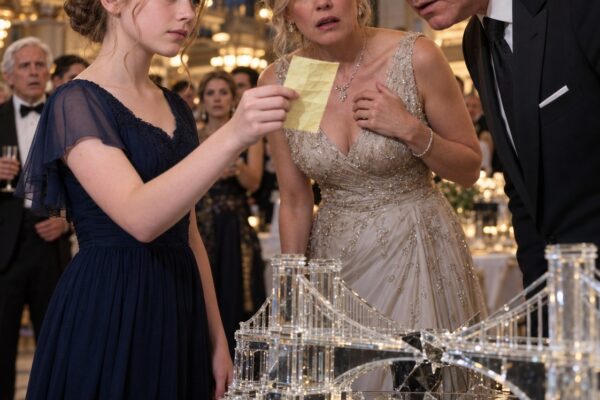
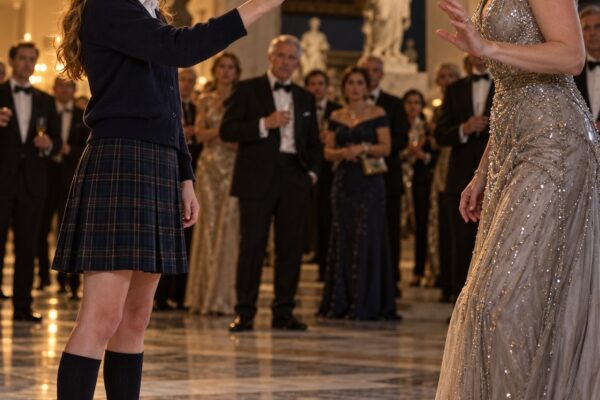
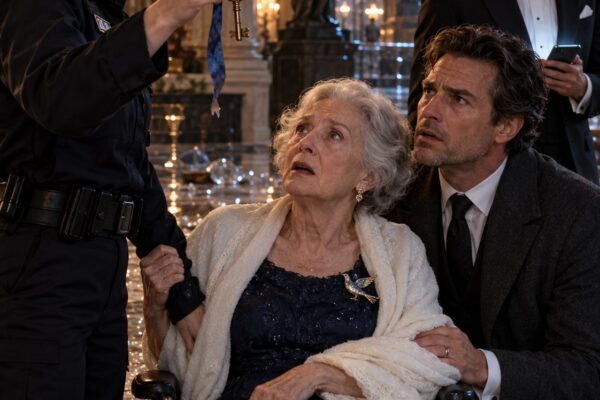
The Museum Director Ordered My Brother Away From Her Gala, Then Froze When He Held Up Our Mother’s Sketchbook
Chapter 2: What the Paint Remembered
Rena did not close the gallery.
She stepped away from the sketchbook, leaving Ellis holding it where everyone could see.
Gideon’s face settled into a familiar calm.
I had seen that expression six years earlier, when he told my mother she had confused a commission with ownership.
“You heard him,” Gideon said.
“This is a private event.”
Rena glanced toward the entrance.
“Keep the doors open,” she told the guards.
Gideon turned to her.
“You’re making a spectacle.”
“No,” Rena said.
“I’m looking at one.”
Ellis lowered the book.
His fingers had gone white around its spine.
Beyond us, gala guests stood beneath the painting with half-filled glasses.
Rena looked at my badge.
“June Bell.”
“Yes.”
“You work in collections.”
“Until tonight, probably.”
“You should have brought this to me.”
“I tried.”
“When?”
“Three weeks ago.”
I had emailed photographs to the director’s office.
An acknowledgment came from Gideon’s foundation instead.
That afternoon, my supervisor moved me to the loading docks.
Rena looked at Gideon.
“My office routes provenance concerns to the lender,” he said.
“He is the lender,” I said.
“And the board treasurer.”
Rena held out her hand to Ellis.
“Will you show me the next page?”
He looked at me.
Mom’s sketchbook had lived in our linen drawer since she died.
Ellis had carried it through the rain inside a grocery bag.
I nodded.
He turned the page.
Another drawing showed the orchard in late afternoon.
Mom had taped a strip of paper beside it.
Fence post too straight. Bend left. Keep blue under gold.
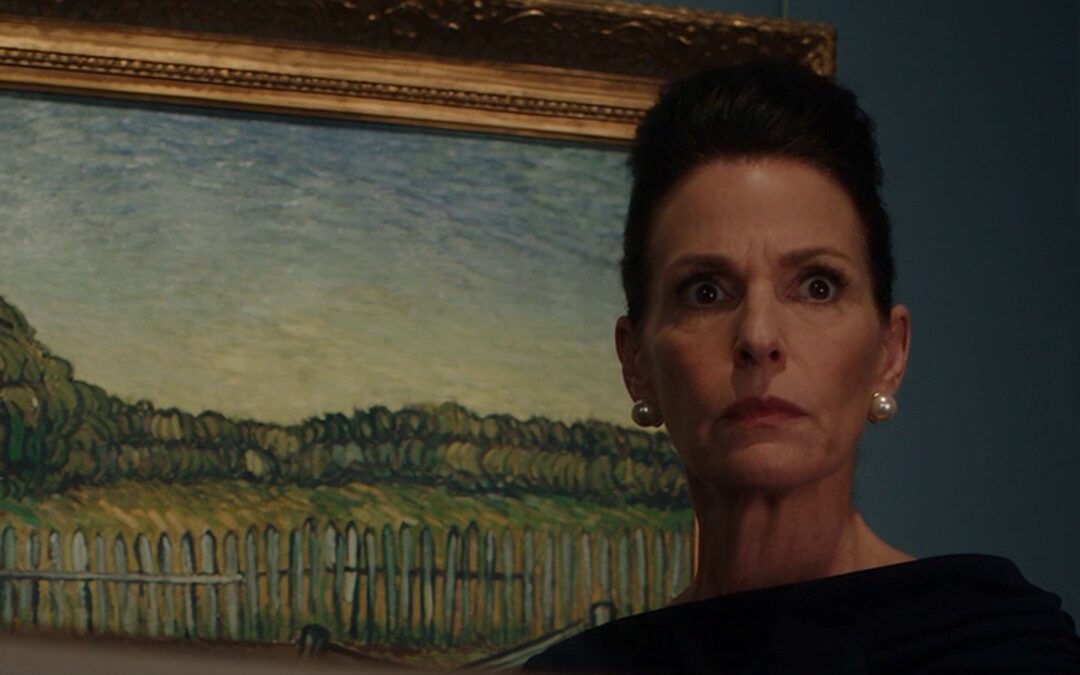
Rena looked at the painting.
Its front fence bent left.
A patch of gold covered pale blue.
“Artists revise things,” Gideon said.
“Of course,” Rena replied.
Ellis touched the strip.
“Mom wrote that when I was six.”
“Your mother worked in Ada’s studio,” Gideon said.
“She had her own studio,” I told him.
“For a while.”
Rena waved over a guard.
“Please bring him a chair.”
“I’m okay,” Ellis said.
“You’re swaying.”
He sat when the chair came.
Rena crouched beside him.
“May I photograph these pages?”
“Not yet,” I said.
She looked up.
“Until we know where the photographs go.”
“Fair.”
She wrote her personal number on a card and handed it to me.
Ellis turned another page.
At the bottom was a small drawing of the fence.
A dark shape curled beneath its lowest rail.
“That isn’t in the painting,” Rena said.
“It is,” Ellis answered.
“You can’t see it.”
He pointed at the gold patch.
Under the drawing, Mom had written two words.
For Ada.
Gideon’s glass tipped in his hand.
Wine touched his thumb.
“What does that mean?” Rena asked.
Mom had never told us.
After Gideon called her a forger, she stopped opening the book.
She could talk about rent and groceries.
The orchard closed her mouth.
“I don’t know,” I said.
“It means Nola admired my daughter,” Gideon replied.
Rena stood.
“Come with me.”
“Where?” I asked.
“My office.”
Gideon stepped toward her.
“Our guests are waiting.”
“They can wait.”
“You have a board to answer to.”
“Yes,” Rena said.
“I do.”
We followed her through a side door.
In the hall, Ellis caught my sleeve.
“Did I mess it up?”
“No.”
“Mom would hate everyone staring.”
“She would.”
“She’d still want the label fixed.”
I squeezed his shoulder.
Rena stopped outside her office.
“You said a conservator found blue beneath the gold,” I said.
“She did.”
“When?”
“Last month.”
“Before my email?”
“Yes.”
She opened the door.
A folder marked Winter Orchard lay on her desk.
Rena faced Ellis.
“Your mother wasn’t pointing to her mistake.”
She looked back at the painting through the open door.
“She was pointing to something Ada asked her to cover.”
* * *
Rena put the sketchbook on a clean table.
Her folder held a close photograph of the fence under ultraviolet light.
A dark curve ran through the gold.
“Our conservator was checking flaking paint,” she said.
“She requested further imaging.”
“Who denied it?”
“The lender.”
“Gideon.”
“Yes.”
The denial was dated eleven days before my email.
Rena had inherited the loan and a board that trusted Gideon.
That explained how he got my message.
It did not excuse it.
“I should have seen the request,” she said.
Ellis studied the photograph.
“It’s a bird.”
Rena leaned closer.
Mom drew birds on grocery lists and birthday envelopes.
When Ellis was scared, she gave them absurdly long necks until he laughed.
This curve had a long neck.
“It’s hers,” I said.
“We need more than that,” Rena replied.
“I know.”
At midnight, the gala ended.
Rena sent us through a staff exit so Ellis could avoid the crowd.
He slept against my shoulder on the train, one hand inside the sketchbook’s cover.
At home, the rent notice lay beneath a salt shaker.
We had nine days to pay the balance.
My museum wages would cover most of it if I kept my job.
I turned the notice face down.
Ellis saw.
“You can say I made you take me.”
“You didn’t.”
“You said we should wait.”
“We waited three weeks.”
“Mom waited longer.”
I put the book in the linen drawer.
The next morning, Rena called.
Her conservator, Dr. Camille Hart, had kept the original images on the museum’s secure server.
Rena had asked museum counsel to preserve those files and the loan record.
She had also told Gideon the painting would stay put during a review.
“Can he take it back?” I asked.
“Not today.”
Then she asked whether Mom had photographed the painting before the museum received it.
I remembered her old phone.
Most of its pictures were of Ellis or tomatoes in plastic tubs.
“I’ll look,” I said.
We spent Sunday opening boxes.
Mom had labeled her receipts in careful block letters.
ELECTRIC.
SCHOOL.
WORK.
There was no box marked PROOF.
Ellis found a framing receipt from May 2018.
It listed an oak stretcher the size of the museum’s painting.
Mom’s card number was on it.
Later, I found a folded letter from Ada.
Nola,
Thank you for letting me see the orchard.
I meant what I said about the bird.
Please don’t paint over it until we talk.
Ada
It had no date.
Ellis read it twice.
“Why did Mom cover it?”
“I don’t know.”
Rena arranged for us to visit Camille on Monday.
I made sure the car she sent was paid for by the museum.
Camille met us behind two locked doors.
Winter Orchard stood on an easel.
Without its frame, it looked smaller.
Ellis stopped at the threshold.
Camille showed us the image on a monitor.
Blue lay beneath the gold.
So did the top of a bird’s head.
Its neck curved toward the fence.
Ellis made a sound between a laugh and a sob.
Camille waited while he rubbed his face.
“Paint layers don’t identify a painter,” she said.
“But your sketch predicts a concealed feature.”
“What would identify her?” I asked.
“Earlier records.”
Rena laid out the loan agreement.
Gideon’s trust had loaned the painting in 2020.
An ownership statement attached to it carried Ada’s signature.
It was dated June 2019.
I stared at the date.
Mom had visited Ada in a rehabilitation hospital that spring.
She went on Thursdays with oranges and clean shirts.
After her final visit, she placed an envelope in our kitchen drawer.
She told me to keep it dry.
When we moved, I packed the drawer into a box labeled KITCHEN SMALL.
I had never reopened it.
“There might be something,” I said.
At home, I pulled the box from behind our winter coats.
I found menus, batteries, and a sealed envelope.
Inside was Mom’s hospital visitor pass.
There was also a photograph.
Ada sat beneath a window.
Mom stood beside her with an unfinished Winter Orchard.
The bird was visible.
The photo kiosk had printed the date: April 23, 2019.
On the back, Ada had written four words.
Nola’s orchard. My favorite.
Ellis held the photograph carefully.
Rena answered my call at once.
“We found Ada,” I said.
Rena went quiet.
Then she asked me to check a document she had found.
Mom’s 2019 complaint to the museum included a second page.
That page withdrew her claim.
Beneath the signature was a witness’s name.
Gideon Pike.
* * *
Rena sent the complaint through a secure link.
I recognized Mom’s handwriting on the first page.
She described the orchard, the stretcher, and the hidden bird.
She asked the museum to pause its planned exhibition until ownership was settled.
The second page said she withdrew her claim.
Its signature looked like hers from a distance.
Up close, the first letter began wrong.
Mom always lifted her pen halfway through the N.
This writer had not.
At the bottom, Gideon had signed as witness.
I read it three times.
“Mom wouldn’t take it back,” Ellis said.
“No.”
“Can we tell the police?”
“We need a lawyer.”
The museum’s lawyer represented the museum.
Rena understood that.
She gave me the number of a local arts clinic, and I called it myself.
Attorney Priya Shah asked for every date and original document we had.
She promised neither a fortune nor an arrest.
A forged withdrawal, if established, mattered.
So did keeping the painting available while we sorted ownership out.
“What will it cost?” I asked.
“The clinic may represent you at no charge.”
“We’ll qualify.”
“I’ll send the form anyway.”
I liked her.
The next morning, my supervisor asked for my museum badge.
My contract had been scheduled through December.
He stared at his clipboard when I asked who ended it.
I set the badge on his desk.
By lunch, Gideon’s lawyer had written to our apartment.
His letter accused me of taking confidential museum information and demanded I stop contacting museum staff.
It said nothing about the sketchbook.
Priya read it once.
“They want you answering the wrong question.”
“What should I answer?”
“Where the painting came from.”
She informed the museum that Rena, not I, had supplied its records.
She demanded preservation of my email, staff assignments, the complaint, and every message concerning Winter Orchard.
That evening, Rena called.
She had not known my contract ended.
“My operations manager says it was reviewed,” she said.
“By whom?”
“I’m checking.”
“I need those wages.”
“I know.”
“No,” I said.
“You don’t.”
Ellis went into the kitchen and rinsed a clean cup.
Rena let me be angry.
Then she said, “You’re right.”
The rent notice was still under the salt shaker.
“I can’t promise you a job tonight,” she said.
“I can document why you lost this one.”
She paused.
“I’m sorry Gideon’s office answered your email.”
“An apology doesn’t pay the rent.”
“No,” she said.
“It doesn’t.”
At the clinic the next day, Rena arrived with Camille and the museum’s lawyer, Tom Baird.
Rena brought records.
Camille brought her imaging report.
I brought the sketchbook, Ada’s letter, the receipt, and the hospital photograph.
Priya asked who had handled each original.
She wrote down every answer.
Tom asked whether Mom could have sold the painting to Ada.
I hated the question.
Then I understood why he had to ask.
“I found no sale agreement,” I said.
“That doesn’t prove there wasn’t one,” he replied.
Ada’s handwriting called the painting Nola’s.
The sketchbook tracked its creation.
Neither fact settled every legal question.
Camille turned its pages.
January held bare trees.
February brought a fence.
March brought pale sky.
Shopping lists and Ellis’s school reminders filled the margins.
Priya wanted someone outside the family who had seen the work.
“Where was your mother’s studio?”
“Above the old Rialto pharmacy.”
“Who owned the building?”
“Bernice Lott.”
Bernice had come to Mom’s funeral with tissues in every pocket.
She stayed until Ellis ate something.
I called her from the conference room.
“June Bell,” she said.
“I wondered when you’d come looking for that orchard.”
She still had the rental ledger.
An insurance dispute had made her save her building’s stairwell camera footage from that period.
The camera could not show anyone painting.
It could show who carried a large canvas in and out.
“Why didn’t you tell us?” I asked.
“Nola told me to keep it safe.”
“She didn’t tell me.”
“She thought you’d go straight to Gideon.”
She was right.
That evening, the museum’s youth program called Ellis.
He had won a place in its winter drawing class.
Now someone had raised a concern about his application.
He had described Winter Orchard as his mother’s painting.
The coordinator asked whether he wanted to revise that statement.
Ellis heard the call.
“No,” he said when I hung up.
“You can think about it.”
“I have.”
He sat beside the open sketchbook.
His voice shook, but he did not move.
I put my arm around him.
I had thought Gideon could only take credit from Mom.
Now he was reaching into Ellis’s future.
Bernice called again before dinner.
She had pulled the ledger from a drawer and found a letter behind it.
The envelope was addressed to my mother.
“Ada sent it,” Bernice said.
“She told Nola her father knew the painting was hers.”
* * *
Bernice arrived at the clinic with a grocery bag printed with onions.
She wore her old pharmacy coat over a purple sweater.
Inside the bag were the rental ledger, electricity receipts, and a drive containing the stairwell footage.
She gave Priya the letter first.
Ada had written it in August 2019.
She said she told Gideon the orchard belonged to Nola.
Gideon had offered to buy it for a museum loan.
Ada urged Mom not to accept less than the price they had discussed.
The letter did not give a number.
It ended with a warning.
If Dad brings paperwork, call me first.
Mom never did.
Bernice had kept a copy outside the apartment at Mom’s request.
We found the original that night in an old recipe book.
The pages smelled of cinnamon.
The handwriting matched Ada’s other notes.
Priya could arrange a formal comparison if needed.
We watched the stairwell footage at the clinic.
On April 7, 2018, Mom carried a covered canvas upstairs.
Ada visited twice that summer.
On August 29, 2019, Gideon and a driver carried the painting down.
Mom followed them with empty hands.
At the bottom step, she reached toward the canvas.
Gideon turned his shoulder.
The driver took it out of view.
Ellis watched once.
Then he asked Priya to stop.
I remembered Mom calling me that day.
When I came home, she was sitting beside the open recipe book.
I thought she had lost a sale.
I did not know Gideon had taken the canvas.
Priya filed for a temporary court order to keep it at the museum while ownership was disputed.
She attached statements from Bernice, Camille, Rena, and me.
The judge scheduled a hearing for the following week.
Gideon’s lawyers answered quickly.
They called the painting a gift to Ada.
They said Mom’s withdrawal was genuine.
They also argued that the museum should remove an object with disputed ownership from public display.
Rena closed the gallery.
A temporary sign said the work was under review.
No artist’s name appeared.
Board members called her.
One asked her to resign.
Another reminded her who funded the building.
She told me she would testify to the records she had seen.
Three days before the hearing, Gideon visited the clinic.
Priya met him in the lobby.
He wanted to talk without lawyers.
She refused.
He left a folder.
The Pike Foundation offered to pay our overdue rent and reimburse my lost wages.
It would fund a scholarship for Ellis.
In return, I had to say Mom made preparatory sketches for Ada’s painting.
I had to withdraw our ownership claim.
The museum could thank Mom on the label for “studio assistance.”
Ellis read the offer.
“They think she helped Ada.”
“They want us to say it.”
He pushed the folder away.
“I don’t want their class that much.”
Priya sent a written refusal.
That evening, Rena came to our apartment.
She asked first.
I made tea.
Ellis worked at the kitchen table, near enough to hear everything.
Rena had investigated the call about his scholarship.
Gideon’s assistant had forwarded our claim to the program office and questioned whether Ellis’s application was accurate.
“I’ve told them to hold your place,” Rena said.
“That sounds temporary,” Ellis replied.
“It is.”
He nodded without thanking her.
Rena saw the rent notice.
She did not offer money.
She asked whether Priya knew about the offer and my dismissal.
“She does.”
“I can testify about the email routing.”
“Will you?”
“Yes.”
Before she left, Ellis showed her a drawing.
He had removed the orchard fence and replaced it with tiny chairs for birds.
“Your mother would have liked these,” Rena said.
“She’d say the legs are wrong.”
“Are they?”
“Very.”
He grinned.
The next morning, Priya called.
Gideon’s lawyers had filed a bill of sale dated September 2018.
It said Mom received twenty-five thousand dollars by bank transfer.
Her signature appeared beneath the amount.
I had Mom’s bank statements.
There was no deposit.
Gideon had supplied no transfer confirmation.
Camille found something else in the museum’s old intake file.
An archived photograph showed the back of the painting.
A label on the stretcher bore Mom’s name, address, and a date from April 2018.
In a later photograph, the label was gone.
Only its outline remained beneath a newer inventory sticker.
At one corner of the original label, Mom had drawn her long-necked bird.
The bill of sale gave Gideon a story for removing her name.
He had created that story after he removed it.
* * *
The hearing was on a Thursday.
The courtroom had worn carpet and no cameras.
Bernice sat behind us with a peppermint in her mouth.
Ellis stayed with our neighbor.
Priya had warned me what this hearing could do.
The judge could preserve the painting.
She could not settle every question of ownership that morning.
Gideon’s attorney called Mom a talented studio assistant.
He described Ada as generous and their work as collaborative.
Then he presented the bill of sale.
The judge asked for proof of payment.
His attorney said the bank records were being retrieved.
Priya showed Mom’s statements for the following sixty days.
No transfer appeared.
Gideon’s attorney suggested another account.
Priya asked what evidence he had for one.
He had none.
Camille testified about the paint layers.
She said the sketchbook accurately predicted a hidden bird.
She did not claim that proved ownership by itself.
The judge looked at the dated pages.
Tom authenticated the museum’s intake photograph.
NOLA BELL was visible on the back of the stretcher.
A later image showed where the label had been removed.
The museum had no record authorizing that removal.
Gideon’s attorney said labels could change.
The judge agreed.
Priya played Bernice’s footage.
Mom carried the canvas upstairs in 2018.
Gideon’s driver carried it away in 2019.
Then Priya showed Ada’s hospital photograph and letter.
She asked for the painting to remain available for a neutral examination.
Gideon’s attorney stood again.
He said the foundation had supported the museum for years.
He said grief could make an ordinary collaboration feel like theft.
He spoke carefully.
For a moment, I was afraid careful words would be enough.
Priya lifted Mom’s supposed withdrawal.
She asked Gideon where he had witnessed the signature.
“At the museum,” he said.
“What room?”
“I don’t recall.”
Tom produced the visitor log.
Mom’s name was absent.
Gideon suggested a staff entrance.
Rena testified that it required a badge or recorded escort.
There was no record of either.
The judge ordered Winter Orchard held in secure museum storage.
No lender could remove it.
An independent conservator could examine it under an agreed protocol.
The court ordered both sides to preserve their records.
It was not a verdict.
It kept the painting where evidence could reach it.
Outside, Bernice pressed a peppermint into my hand.
“You look like Nola,” she said.
“Only when I’m angry.”
“She looked like you when she was brave.”
Within two weeks, the museum board began an outside review.
Gideon stepped down as treasurer while it proceeded.
Discovery brought folders instead of speeches.
Priya obtained emails from the foundation.
Gideon had instructed an assistant to clean up the back label before intake photographs became public.
Another message asked for Mom’s withdrawal form to be completed “from the notes.”
The assistant testified that Gideon gave her a signature sample from Mom’s complaint.
She said she believed he would get Mom to sign the final page.
A document examiner later concluded the withdrawal signature was likely traced.
Priya used the word likely every time.
The bank records answered the bill of sale.
No payment had gone to Mom.
A draft authorization for twenty-five thousand dollars had been canceled.
Beside it, someone had written: seller refused terms.
Gideon kept the form.
Years later, he built a sale around money Mom had never received.
Ada’s estate held another record.
During her final illness, she had made a voice recording for her attorney.
She wanted several works returned to their makers.
Winter Orchard was first.
She said Nola painted it.
Ada explained why she had asked Mom to cover the bird.
The orchard stood beside land the Pike family planned to sell.
Mom had painted it from a public road.
Gideon was negotiating benefits tied to preserving the property’s rural setting while preparing that sale.
Ada feared the recognizable bird and fence would draw questions before the deal was public.
She asked Mom to hide the bird.
“I thought hiding the place would protect her,” Ada said on the recording.
“I was wrong.”
Gideon later saw the painting in Mom’s studio.
He wanted a celebrated final work for Ada’s legacy and a valuable asset under his foundation’s name.
He offered to buy the canvas.
Mom refused the paperwork because it named Ada as the sole artist.
That was the argument on Bernice’s stairs.
After Ada died, Gideon presented the painting as hers.
Mom’s complaint threatened the story.
The forged withdrawal answered her complaint.
The accusation that she was a forger made her harder to believe.
Ada had tried to correct him before she died.
Afterward, her attorney sent Gideon the recording and asked him to address the painting’s ownership.
Gideon never replied.
The attorney kept the correspondence.
He supplied it during discovery.
Months later, at the full civil hearing, Gideon’s lawyers challenged each piece.
Ada had been ill.
Mom had listened to Ada’s advice.
Perhaps a gift had been made aloud.
Each argument had a narrow place to stand.
Priya answered with dates.
Mom’s sketches began before Ada saw the canvas.
Mom paid for the stretcher and rented the studio.
Her note predicted the buried bird.
Ada called the painting Nola’s in a dated photograph, a letter, and a recording.
The promised payment never arrived.
The withdrawal was likely traced.
The museum’s outside reviewers added their findings.
Gideon’s office had intercepted my email to Rena.
His assistant had complained about my “disruptive conduct” shortly before my contract ended.
Rena testified to both findings.
The civil judge ruled that Mom’s estate owned Winter Orchard.
The museum corrected its records.
Gideon’s foundation was ordered to pay damages and legal costs.
The judge referred the suspected document fraud to the district attorney.
Months later, Gideon pleaded guilty to filing a false instrument.
He agreed to restitution and received probation.
He was barred from serving as an officer of a charitable foundation during that term.
I had imagined a louder ending for him.
Instead, it came in signed orders and corrected records.
At the final hearing, Gideon crossed the hall while Ellis and I waited for the elevator.
“You could have taken the scholarship,” he said.
“I could have.”
The doors opened.
I held them for Ellis.
Then I looked back at Gideon.
“My brother gets to know who made that painting.”
He said nothing.
* * *
In January, Rena offered me my museum contract back with lost wages.
Priya reviewed the agreement.
I accepted the money and asked for a different supervisor.
Rena agreed.
She also offered me a permanent job in collections.
I took two days to decide.
Bernice ate a cookie over my kitchen sink while I told her why the building still hurt to enter.
“Take the work if you love it,” she said.
“Buildings can learn new habits.”
I accepted.
On my first morning, the orchard gallery wall was bare.
Camille handed me a condition report for another painting.
She asked me to check a loose corner.
She treated me like a colleague.
That helped more than she knew.
Ellis returned to the youth drawing program.
Rena offered him a private lesson as an apology.
He chose the regular class.
“There are other kids,” he said.
“Also, their pencils are better.”
His scholarship remained in place.
No one asked him to change his application.
The civil payment arrived in stages.
First came my wages and Mom’s legal expenses.
Then came damages owed to her estate.
Priya explained the fees and forms.
We paid the rent.
We replaced a stove burner that worked only when it felt appreciated.
Ellis proposed buying three hundred sketchbooks.
We bought five.
That spring, we moved to an apartment with two bedrooms above a grocery store.
The floors tilted, but Ellis had a desk that was not our dinner table.
Mom’s recipe book stayed in the kitchen.
Her sketchbook went into a protective box at home.
Camille made a digital copy with our permission.
The museum received that copy.
The original stayed with us.
Rena asked whether the museum could buy Winter Orchard.
The estate belonged to Ellis and me.
Her offer was fair.
It was more money than I had ever expected to see.
I asked Ellis what he wanted.
“I want people to see it.”
“We can loan it.”
“What would Mom want?”
I remembered her standing outside the museum in the rain six years earlier.
She had gone there because she believed strangers should meet the painting.
She had expected someone to listen.
Priya helped us arrange a five-year loan.
The museum would insure and care for the canvas.
The label would name Mom as the artist.
We could review the agreement when the term ended.
The museum committed funds for free weekend studio classes.
I asked for that promise in writing where the next director could find it.
Rena signed.
I signed.
Ellis drew a bird on his copy.
“That isn’t legally binding,” Priya said.
“It should be.”
For weeks, Rena and I mostly discussed work.
Crates.
Lighting.
Old inventory photographs.
One afternoon, she stopped me by the freight elevator.
“I owe you a fuller apology.”
“You’ve given several.”
“They were short.”
“That sounds like you.”
“I built a system that sent a complaint about Gideon straight to Gideon.”
“Yes.”
“I’m changing it.”
“I saw the new policy.”
She shifted her weight.
“I also decided you were difficult before I met you.”
“Because he said so.”
“Yes.”
“That part stayed with me.”
“I know.”
The elevator arrived.
I stepped inside, then held the door.
“You can show me what you change,” I said.
“That’s enough for now.”
In June, the museum opened a small exhibition about Winter Orchard.
Reproductions of Mom’s sketches lined the first wall.
Camille’s image of the underpainting hung nearby.
The final label named the people who had checked the record: Bernice, Camille, Ada’s attorney, Priya, and the museum’s reviewers.
Gideon appeared in a short account of the false provenance.
His actions were recorded.
They did not fill the room.
Rena asked Ellis whether he wanted to speak at the opening.
He said no.
Then he asked for a table where he could draw.
He spent the evening sketching visitors looking at Mom’s work.
Bernice wore her purple sweater.
She told three strangers she once fixed Mom’s studio sink with a spoon.
I never learned whether that was true.
Priya brought her father.
Camille answered questions about paint until her voice grew rough.
A woman stopped beside me.
“She must have loved that place,” she said.
“My mother did.”
“I meant the orchard.”
“So did I.”
The woman smiled and moved on.
I stayed in front of the painting.
The bird remained beneath the gold.
Camille advised against removing Mom’s paint.
The work was stable.
Mom had made that choice herself.
Ellis was disappointed at first.
Then he watched people study the sketch and look back at the canvas.
“They have to look harder,” he said.
After the opening, I invited Rena to dinner.
Ellis made noodles with enough garlic for the whole building.
Rena ate two bowls.
At the door, she asked whether he wanted another visit to the conservation room.
“Can June come?”
“Of course.”
“Can I ask stupid questions?”
“Especially those.”
He looked at me.
I nodded.
He gave Rena a solemn thumbs-up.
The next morning, a drawing appeared on our refrigerator.
Three people stood around a painting.
One held a clipboard.
One held a sketchbook.
The third had enormous ears.
“Which one am I?” I asked.
“Clipboard.”
“Who has the ears?”
“Camille.”
“She doesn’t look like that.”
“She listens better than we do.”
I left it there.
Some days, I remembered Gideon’s offer.
The rent.
The scholarship.
How easy signing would have seemed before we knew what else Mom had kept.
Then Ellis came home with graphite on his sleeve and told me about a stranger who had spent fifteen minutes before the orchard.
That stranger had seen Mom’s name.
* * *
Five years later, Ellis was eighteen and taller than me.
He wore a jacket he had bought himself.
It cost more than eight dollars.
He still forgot to button it.
We met at the museum on a cold Friday.
I had been checking crates for a traveling exhibition.
Ellis came from his college studio with blue ink on his fingers.
He studied illustration and worked weekends at a print shop.
Our five-year loan was due for review.
Priya read the renewal.
Ellis and I signed it together.
He drew no bird on the agreement.
“Next time,” he said.
Rena met us outside the gallery.
She would retire at the end of the year.
Her replacement had already visited our apartment and survived Ellis’s noodles.
Inside, Winter Orchard hung where it had hung on gala night.
Its frame was different.
Beside it, a case held a copy of Mom’s sketchbook, open to the bent fence.
Ada’s hospital photograph showed the unfinished painting and its visible bird.
The label told the story plainly.
Nola Bell painted the orchard.
Ada Pike treasured it.
Gideon Pike claimed it.
Records and the people who kept them returned it to its maker’s name.
Ellis stood before the canvas.
For a moment, I saw the thirteen-year-old boy holding the book with both hands.
“Would you like the gallery to yourselves?” Rena asked.
A school group waited outside.
Ellis looked at the children.
“Let them in.”
They entered in an uneven line.
One child asked why the bird was covered.
Ellis answered before the teacher reached the label.
“The artist changed her mind.”
“Then how do you know it’s there?”
He pointed to the sketchbook.
“Someone checked the paint, too.”
The child studied the gold patch.
“I can almost see it.”
“So could my mom,” Ellis said.
The group moved on.
Rena followed them.
Ellis and I stayed near the frame.
“Remember what I asked that night?” he said.
“Why Ada copied Mom’s mistake.”
“I was wrong.”
“You were trying to understand.”
He looked at the crooked fence.
“It wasn’t a mistake.”
The blue beneath the gold.
The bird no one could see from the room.
Mom had left a path through her choices.
Other people helped us follow it.
Ellis took the original sketchbook from his bag.
He had brought it to compare the case copy.
He held it beside the frame, as he had five years before.
No one ordered him away.
Rain tapped the tall windows.
He turned to the page marked For Ada.
For the friend who saw the painting first.
For the brother who refused to change his story.
For the strangers who would know Mom’s name.
Ellis closed the book and handed it to me.
The children came back to look for the bird.
We made room.
THE END