The Night Cleaner’s Daughter Put a Blue Ticket on the Mafia Boss’s Cup… And Revealed Who Wanted Him Helpless
Chapter 2: What Seven Meant
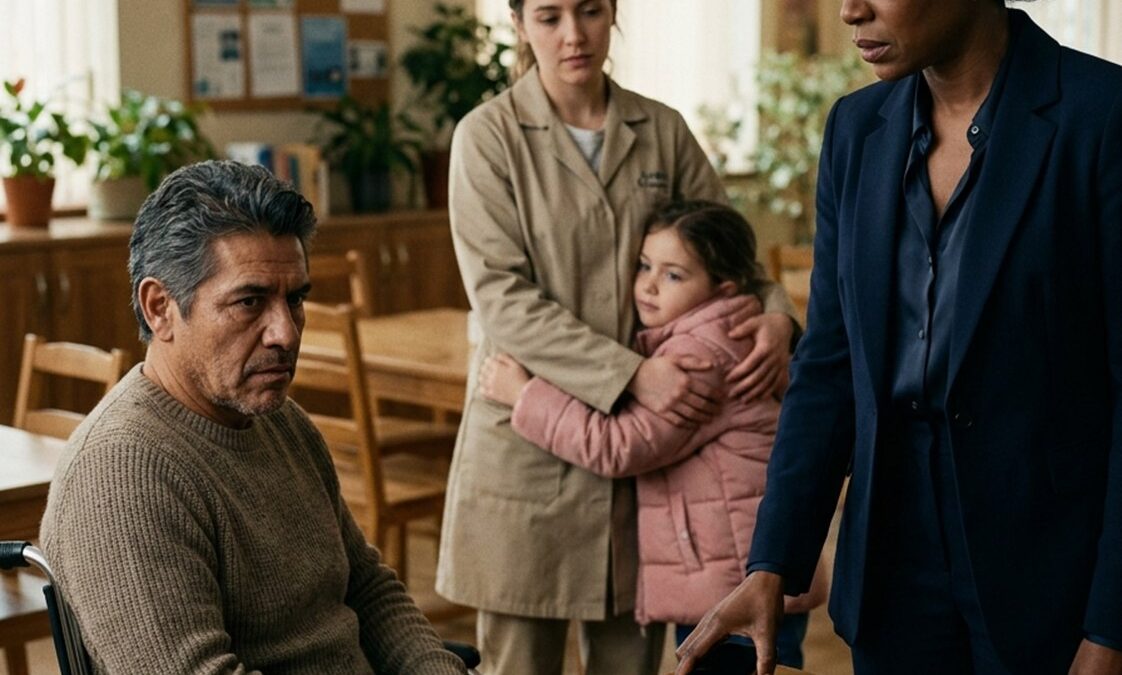
The woman lowered her phone.
Rafael watched her hand.
“Put it on the table, Camille.”
His daughter obeyed.
She was thirty-four.
She ran the clinic’s finances.
She also held the medical authority Rafael had signed after the wreck.
Camille set her phone beside a folded napkin.
“I was calling the nurse.”
“The nurse is here,” Rafael said.
A nurse stood near the service door.
Her name was Beth Arden.
She had stopped when the guard shouted.
Now she came forward.
“What happened?”
“Two tickets,” June said.
Beth looked at the cup.
The blue paper came from the clinic kitchen.
Each ticket carried a meal number.
Seven meant Rafael’s ordinary breakfast.
Nine meant the low-salt meal prepared for another patient.
A second sticker hid the first.
“That cup shouldn’t be here,” Beth said.
Camille folded her arms.
“Then somebody made a mistake.”
Nora reached for June.
The guard stepped aside this time.
June took her mother’s hand.
“She watched the lady do it,” Camille said.
“That doesn’t make it true.”
“I saw her yesterday,” June said.
Camille turned toward her.
“You were supposed to be in the waiting room.”
“I was.”
June pointed at the glass wall.
“I can see the cups from there.”
Rafael looked at his daughter.
“Did you touch my breakfast?”
“I carried your tray.”
“That wasn’t my question.”
Camille’s face tightened.
Beth held out her hand.
“Mr. Serrano, may I take the cup?”
He nodded.
“Bag it.”
Beth asked a staff member for a clean specimen bag.
She photographed the cup first.
Then the tickets.
Then the tray.
Rafael had once given orders that emptied rooms.
Now he needed both hands to steady a spoon.
Nora saw him notice.
She saw him hide it.
Camille moved closer.
“Dad, you’re exhausted.”
Rafael turned his chair away from her.
“That isn’t an answer.”
“It’s tea.”
“Then let Beth check it.”
Camille looked toward the doorway.
“Of course.”
Beth sealed the cup.
She wrote down the time.
She wrote down who had touched it.
Nora recognized the careful routine.
Three months earlier, a missing bottle from Rafael’s medication cart had cost her a better job.
She had cleaned his private floor then.
Camille said Nora had taken it.
The clinic could not prove that.
They still removed her from patient rooms.
The night contractor hired her afterward.
Fifteen dollars an hour.
No paid days off.
June slept at Nora’s sister’s apartment most nights.
This morning the sister had a medical appointment.
Nora had brought June in for twenty minutes.
Twenty minutes had become this.
“I should call my supervisor,” Nora said.
“You should stay,” Rafael replied.
“I can’t lose another job.”
“Because of me?”
“Because of your daughter.”
Camille’s eyes flashed.
Rafael looked at Nora for a long moment.
“I never saw the report,” he said.
Camille spoke quickly.
“You were recovering.”
“I asked for it.”
“I told you what it said.”
“That’s different.”
June tugged Nora’s sleeve.
“The lady has the other number.”
Camille went still.
“What other number?” Beth asked.
June pointed at Camille’s hand.
A strip of blue paper showed between her fingers.
Camille opened her palm.
It was a ticket marked nine.
“I removed it from the tray,” she said.
Beth glanced at the sealed cup.
“The one on the cup is also nine.”
Camille looked at both tickets.
Then she gave a small, disbelieving laugh.
“Kitchen waste gets everywhere.”
Rafael did not laugh.
June pressed against Nora’s side.
Nora put a hand on her shoulder.
“Did you see her put that one on?” Beth asked.
June shook her head.
“I saw her take the seven away yesterday.”
“From a cup?”
“From his picture.”
Everyone looked at her.
“The paper with his food,” June said.
“He had seven by his face.”
Beth took out the meal roster.
A photograph helped kitchen staff identify patients.
Rafael’s meal number appeared beside his name.
It was seven.
Camille managed the dietary accounts.
She had approved a change to his breakfast order that morning.
Beth saw it on the screen.
“What did you change?” she asked.
“Nothing medical,” Camille said.
“Only the delivery time.”
Beth turned the screen toward Rafael.
The order had changed at 6:12.
The new note read: deliver through administration.
That was not how patient meals reached the dining room.
Rafael’s jaw worked.
“Why?”
Camille looked at Nora.
“Because someone on this floor has already stolen medication.”
Nora’s grip tightened around June’s hand.
Beth read the note again.
It carried Camille’s initials.
The order did not prove what was in the tea.
It proved Camille had moved the tray.
Rafael looked back at his daughter.
“You told me Nora stole that bottle.”
“I told you what security found.”
“Where is the report?”
Camille said nothing.
Nora answered instead.
“There wasn’t one.”
Rafael turned his chair toward her.
She stood straight.
“I asked for a copy before they moved me.”
“The director said the matter was closed.”
“Who closed it?”
Nora looked at Camille.
Rafael’s daughter put her phone in her pocket.
“Dad, we should speak privately.”
“We are.”
The guard opened the dining room door.
Two patients waited outside with their breakfasts.
Rafael saw them.
He lowered his voice.
“Beth, take us somewhere quiet.”
Beth nodded.
Camille stayed where she was.
For the first time that morning, Rafael did not wait for her.
The theft that had ruined Nora’s work had never been reported as a theft at all.
* * *
Beth took them to a therapy room.
A wall clock clicked above the parallel bars.
Rafael parked beside a table.
Camille followed him inside.
Nora and June remained near the door.
The guard waited outside.
Beth called the clinic director.
She also called Rafael’s treating physician.
Neither answered immediately.
She left messages with the facts.
A sealed cup.
Two tickets.
A changed delivery order.
A concern about an unauthorized substance.
Camille listened without interrupting.
When Beth finished, Camille said, “You’ve made this sound criminal.”
“I described what happened.”
“You have no test result.”
“That’s why the cup is sealed.”
Rafael looked at Nora.
“How long ago was the bottle?”
“Eleven weeks.”
“What was in it?”
“Nobody told me.”
Camille answered.
“A prescribed sleep medicine.”
Beth frowned.
“His medication cart has no sleep medicine.”
“It did then,” Camille said.
“Briefly.”
Beth had worked there for four years.
She had covered Rafael’s floor that month.
“I would remember,” she said.
Camille straightened.
“You don’t see every prescription.”
“No,” Beth said.
“I see every bottle on my cart.”
The room went quiet.
Rafael rubbed his forehead.
Nora recognized the motion.
It came before the fog settled over him.
He would lose a word.
Then his place in a sentence.
Camille stepped forward.
“Let me get you some water.”
“No.”
“You’re shaking.”
“I know.”
Nora pulled out a chair for June.
June sat down.
Then she slid a sealed packet of crackers toward Rafael.
Nora had packed it for the bus ride home.
Rafael looked at it.
“You need those.”
“I had breakfast,” June said.
“You didn’t,” Nora whispered.
June frowned at her.
“I had half.”
Rafael opened the packet.
He took one cracker.
The simple motion took effort.
Nora looked away to give him privacy.
Beth’s phone rang.
The physician was on his way.
The clinic director wanted everyone kept apart.
Camille objected.
“She’s treating me like a suspect.”
“She’s protecting the record,” Beth said.
“Then I’ll call counsel.”
“You may.”
Camille left the room with the guard behind her.
She did not look at June.
The door shut.
Rafael set the cracker down.
“She told me you asked for money,” he said.
Nora stared at him.
“What?”
“After we moved you off the floor.”
“She said you’d keep quiet for a settlement.”
“I asked for my wages.”
“That wasn’t what she said.”
“I know that now.”
Rafael leaned back.
Before the wreck, Nora had worked at his waterfront house.
She handled laundry and kept the staff calendar.
After the wreck, she came to the clinic.
Rafael trusted the people who stayed.
He thought Nora had used that trust.
Nora had thought he knew the accusation was false.
Neither had spoken to the other.
Camille had carried every message.
June turned the empty cracker wrapper over.
“Is seven his birthday?” she asked.
“It’s his food number,” Beth said.
June looked disappointed.
“Numbers should mean something.”
“They do here,” Nora said.
She took the wrapper.
She needed her hands occupied.
Every night, she cleaned the kitchen after meals.
The cooks left the used tickets on a spike.
She matched each cup to its tray before she washed it.
Last week, Rafael’s ticket appeared twice.
She had assumed a reprinted order.
Yesterday, she found a seven under a nine.
She had thought someone made a mistake.
Today June saw the same thing.
Nora told Beth.
“Why didn’t you say so yesterday?” Rafael asked.
“Because I was a cleaner with an accusation in my file.”
Beth did not defend the clinic.
She wrote down the dates.
She asked Nora which shift.
She asked who else had been there.
Nora named the kitchen worker.
Then she remembered something else.
“The cups with nine never came back through the kitchen.”
“Where did they go?” Beth asked.
“Administration’s sink.”
Camille’s suite had a private kitchenette.
Nora cleaned it every Thursday.
She had found tea stains there.
That had seemed ordinary.
Now Beth wrote it down.
Rafael watched the pen move.
“I thought I was getting worse,” he said.
Beth met his eyes.
“We need the doctor and the test.”
“I know.”
The physician arrived with the director.
Dr. Ellis examined Rafael.
He asked about the dizziness.
The trembling.
The gaps in memory.
He ordered basic blood work and a broader medication screen.
He also asked for a list of everything Rafael had taken.
Camille kept that list.
Beth printed the clinic’s version.
Dr. Ellis compared it with his own notes.
One medication appeared on Camille’s handwritten copy.
It was a mild sedative.
Dr. Ellis had never ordered it.
“Who gave you this list?” he asked Rafael.
“My daughter.”
“Did you take these pills?”
“I took what the nurses gave me.”
Beth checked the administration record.
No nurse had given that drug.
Dr. Ellis kept his voice level.
“The cup may tell us more.”
He arranged for an outside laboratory to test its contents.
The director called the clinic’s legal counsel.
Beth asked that the security footage be preserved.
Camille was told not to change records.
She agreed through a closed door.
Nora waited beside June.
There was no dramatic confession.
Only printers.
Calls.
People checking times.
It felt slower than fear.
By noon, the director brought the old personnel file.
There was a complaint.
It said Nora had been seen near the medication cart.
It did not say a bottle was missing.
There was no inventory discrepancy.
No report to authorities.
No witness statement from a nurse.
Camille had requested Nora’s reassignment.
Rafael read the single page twice.
“You called it a theft,” he said.
Camille stood across the room.
“I thought she was taking something.”
“What?”
“I couldn’t prove it.”
“You told me you had.”
Camille held his gaze.
“You were confused then, too.”
Dr. Ellis looked up.
“He was taking pain medicine after surgery.”
“That’s what I mean.”
“No,” Rafael said.
“It isn’t.”
Beth checked the date of the complaint.
It was filed before Rafael’s wreck.
Nora saw the date and reached for the page.
“No,” she said.
“I was moved after.”
“The complaint came earlier,” Beth replied.
Nora thought back.
That week, she had worked at Rafael’s house.
She had found a grocery receipt tucked into Camille’s laundry.
Three boxes of a sleep aid.
Bought with cash.
Nora had mentioned it to the house manager because Rafael never slept well.
She had not thought of it since.
“Camille knew I saw that receipt,” Nora said.
Camille’s expression did not change.
But Rafael’s did.
The lie about Nora had begun before his car ever left the road.
* * *
The director separated Camille from Rafael’s care.
He suspended her access to patient records.
Her lawyer called within an hour.
The lawyer reminded everyone that Camille had not been charged with anything.
That was true.
Dr. Ellis told Rafael to stay for observation.
That was also true.
Rafael wanted to go home.
He could still choose to.
He stayed because Beth asked him to.
Nora expected her supervisor to call.
Instead, the night contractor sent a message.
Do not report until this is resolved.
No one said fired.
No one promised pay.
Nora showed Beth the screen.
Beth made a copy.
“They can’t punish you for reporting a safety concern,” she said.
“I need them to believe that.”
“They may need reminding.”
Beth gave her the number of a workers’ rights clinic.
Nora put it in her pocket.
June asked if she had done something bad.
“No,” Nora said.
“You saw something important.”
“I made your boss mad.”
“My boss was already mad.”
Rafael heard her from the doorway.
“I am,” he said.
“Just not at her.”
His voice sounded stronger.
The doctor had stopped giving him anything except his prescribed medication.
He had eaten lunch under Beth’s eye.
He still looked exhausted.
June held up the blue ticket.
Beth had given her a clean one to keep her busy.
It said seven.
“You should keep your number,” June told him.
“I intend to.”
Camille’s lawyer arrived that afternoon.
He asked the director for a meeting.
He asked whether the cup had been tested.
It had not.
He asked whether June had been coached.
Nora stood up.
The director stopped her.
“No one is questioning your child today.”
The lawyer smiled thinly.
“I asked a fair question.”
“Then you have your answer,” Rafael said.
The lawyer turned to him.
“Your daughter wants to protect you.”
“She can say so herself.”
Camille stood beside the lawyer.
She wore the same cream coat she had worn at breakfast.
She had been Rafael’s voice to banks.
To doctors.
To his own staff.
Now she looked at him like a difficult stranger.
“You should rest,” she said.
“I’ll rest after you tell me why Nora’s file was false.”
“I made a judgment.”
“About a bottle that never vanished?”
“About someone I didn’t trust.”
Nora felt heat rise in her face.
“Why?”
Camille looked at her.
“You listened at doors.”
“I changed linens.”
“You knew things you weren’t paid to know.”
“What things?”
Camille’s lawyer touched her arm.
She stopped.
The director ended the meeting.
Dr. Ellis had asked for no more arguments around Rafael.
That evening, Nora went to her sister’s apartment.
June slept in the spare room.
Nora sat at the kitchen table with an envelope.
Inside was the grocery receipt.
She had kept it because the house manager had told her to write down anything unusual.
He had died the month before the wreck.
Nora had forgotten the receipt in her old work bag.
It showed three boxes of an over-the-counter sleep aid.
That alone proved little.
Camille could have bought them for herself.
On the back, Nora had written the date she reported it.
She photographed both sides.
Then she called the workers’ rights clinic.
The next morning, she spoke with an attorney named Mara Voss.
Mara listened.
She asked for the personnel file.
She asked Nora not to confront Camille.
“Keep the original receipt dry,” she said.
“Will it help him?”
“It may help establish a timeline.”
“What about my job?”
“We can address that, too.”
At the clinic, Rafael’s tea tested positive for a sedating drug.
The amount was enough to concern Dr. Ellis.
It was not on Rafael’s prescription list.
The lab could not say who had added it.
The cup’s paper tickets had fingerprints from kitchen staff.
There were also prints from Camille.
She had admitted carrying the tray.
That was not enough by itself.
Security footage from the kitchen showed Camille collecting the tray.
A camera in the dining corridor showed her setting it down.
The camera did not show her altering the cup.
There was a blind corner near administration.
The director gave the footage to detectives.
He did not give a copy to Rafael.
Rafael hated that.
Mara told him the detectives needed the original record.
“They’ll ask the questions,” she said.
“I have questions.”
“You can give them those.”
He did.
He told them when the fog began.
He told them which drinks arrived through administration.
He told them what Camille had said about Nora.
The detectives asked about money.
Rafael had plenty of it.
He had also signed a temporary authority document after the wreck.
Camille could pay bills and manage the clinic.
She could not sell it without a second signature.
That signature belonged to Rafael’s younger brother, Tomas.
Tomas lived three hours away.
He called that night.
“I haven’t signed anything,” he said.
“Has she asked?”
“She sent a draft last week.”
“A draft of what?”
“The waterfront property sale.”
Rafael closed his eyes.
The clinic stood on that land.
He had promised his late wife it would stay open.
Camille knew that.
Tomas sent the draft to Mara.
The proposed buyer was a development company.
The price was high.
The terms would close the clinic within six months.
Camille had told Tomas Rafael wanted it.
She had attached a doctor’s note about his declining judgment.
Dr. Ellis had not written it.
The signature looked like his.
The clinic letterhead looked right.
The date fell on a day he was out of town.
Dr. Ellis confirmed that from his schedule.
Detectives received the draft.
They asked the clinic to preserve printer logs.
They asked the buyer to preserve its messages.
Camille did not come to work.
Her lawyer said she was with family.
At nine that evening, someone pushed an envelope under Nora’s apartment door.
It contained a photograph.
June at the clinic’s glass wall.
Taken the morning before.
On the back were six words.
You should have left her home.
Nora’s hands shook.
She called Mara.
Mara told her to call the police.
Nora did.
An officer came, took the envelope, and made a report.
Nora and June stayed with her sister.
Rafael learned about the photograph from Mara.
He offered to send guards.
Nora said no.
“The police know where we are.”
“I could still have someone nearby.”
“Not without asking me first.”
Rafael was quiet.
Then he said, “You’re right.”
He asked whether June needed anything.
“She needs sleep.”
“And you?”
“The same.”
He did not argue.
The next afternoon, June drew him a picture.
It showed the clinic table.
A cup.
A blue ticket.
A very large cracker.
Rafael laughed when he saw it.
Beth heard him from the hall.
It was the first laugh she had heard from him in weeks.
The detectives traced the photograph.
A clinic security employee had printed it.
He said Camille asked for it.
He thought it was for an internal review.
He had not written on the back.
The handwriting would need comparison.
The threat had brought the case closer to June.
The sale draft showed why Rafael had been kept weak.
Camille wanted his clinic sold before he could stop her.
* * *
Three days later, the clinic board met.
The detectives did not announce charges.
They had questions.
So did the board.
Rafael attended with Mara.
Dr. Ellis came as a witness.
Beth brought the meal records.
Nora came because Mara asked her to.
June stayed with her aunt.
Camille arrived with her lawyer.
She sat at the same table where she had approved budgets for six years.
The board chair began with the tea.
Camille said she had not prepared it.
That was true.
She said dietary staff made mistakes.
That was possible.
She said the drug could have entered the cup after she set it down.
The board chair asked how.
“I don’t know,” Camille replied.
“That’s why you investigate.”
Her lawyer produced a statement.
It described Rafael’s recent confusion.
It described the wreck.
It described a daughter trying to keep a clinic solvent while its owner refused to face its debts.
The figures were real.
The clinic had lost money for four years.
Rafael knew.
He had covered the losses.
Camille looked directly at him.
“You built this place for Mom.”
“Yes.”
“You never built a way for it to survive you.”
Tomas shifted in his chair.
Camille kept going.
“The buyer offered enough to pay every employee and retire the debt.”
“The buyer would close the doors,” Rafael said.
“Six months from now.”
“People still come through them.”
“People who can’t pay.”
“That was the point.”
“And everyone else was supposed to keep pretending the numbers worked?”
The room stayed quiet.
For a moment, even Nora could see the shape of Camille’s argument.
The clinic needed a plan.
Rafael had put it off.
None of that explained the tea.
Mara asked to speak.
The chair allowed it.
She laid out the blue tickets.
One marked seven.
One marked nine.
Then she showed the meal records.
Rafael had no order for meal nine.
The kitchen had printed extra tickets only when Camille’s office requested a duplicate tray slip.
Five requests in six weeks.
Each carried the note: deliver through administration.
Each followed a morning when Rafael later reported dizziness.
Camille’s lawyer objected.
“Symptoms aren’t timestamps.”
“No,” Dr. Ellis said.
“They aren’t.”
He handed the chair his chart.
The dates were his own.
He had recorded Rafael’s symptoms before anyone suspected the meals.
The matches were close.
They did not prove every cup had been altered.
They made a pattern worth investigating.
Camille folded her hands.
“I used administration because he hated eating with strangers.”
Rafael looked at her.
“I asked to eat here.”
“You forgot.”
“I didn’t forget every morning.”
Nora watched Camille’s jaw set.
Camille had an answer for every one of them.
Then Beth brought out the cup.
It remained sealed inside its evidence bag.
The police had allowed a photograph for the meeting.
The photograph showed the tickets clearly.
The top ticket was nine.
The lower one was seven.
The glue spread beyond the paper.
Nora recognized it.
“That isn’t kitchen adhesive,” she said.
The chair turned toward her.
“Can you tell?”
“The kitchen uses water-based labels.”
“They lift cleanly after washing.”
“That glue leaves strings.”
She pointed to the image.
“Those strings came from the tape dispenser in administration.”
Camille shook her head.
“Every office has tape.”
“Not that kind.”
Nora had cleaned Camille’s kitchenette.
The dispenser there held double-sided mounting tape.
Camille used it to attach receipts to expense folders.
Nora had scraped it off counters for years.
The detectives had collected the dispenser.
A lab compared the adhesive.
The analyst’s report did not claim one unique source.
It found the same formulation on the cup and the roll from Camille’s office.
That supported Nora’s observation.
It did not finish the case.
The next document did.
Mara gave the board chair a copy of the buyer’s correspondence.
The buyer had kept its messages, as the detectives requested.
Camille had sent an email from her personal account.
It said the owner’s physician would soon certify that he could no longer manage the property.
The email was dated two weeks before the forged note.
The buyer had asked whether Tomas would sign.
Camille wrote that she could “bring him around.”
Tomas looked at his niece.
“You told me Rafael asked for the sale.”
“I thought he would.”
“You sent me his supposed medical note.”
Camille’s lawyer spoke.
“My client did not create that document.”
The board chair held up the printer log.
The forged note had been printed from Camille’s office account.
The account required her badge.
Camille said staff sometimes used her printer.
That, too, could be true.
Then Dr. Ellis spoke.
“Someone copied my signature.”
Camille looked at the table.
He did not raise his voice.
“I was away on the date shown.”
“I did not examine Rafael.”
“I did not write that opinion.”
A detective stood at the back of the room.
He had watched without speaking.
Now he asked Camille to come with him for an interview.
Her lawyer rose.
“She’ll arrange a time.”
The detective nodded.
He did not force the issue in front of the board.
Camille stood as well.
Before she left, she faced Rafael.
“You let her tell you I was dangerous.”
Rafael glanced at Nora.
“She showed me a ticket.”
“She wanted her job back.”
“Yes,” Nora said.
“I did.”
Camille turned.
Nora kept her voice steady.
“I wanted the job I lost over a story you invented.”
“I also wanted June to be safe.”
Camille looked toward the empty chair beside Nora.
“She shouldn’t have been here that morning.”
“No,” Nora said.
“She shouldn’t have needed to be.”
Camille had no answer.
Her lawyer guided her out.
The board voted to suspend her financial authority.
Rafael signed the notice himself.
His hand shook.
The signature held.
The investigation took months.
The detectives obtained bank records and office records.
They found that Camille had spent far beyond her salary.
The sale would have paid off private debts through a consulting agreement she had hidden from the board.
They also found purchases of the sedating drug.
A pharmacy’s records placed those purchases under Camille’s name.
A camera showed her buying one package.
No single record showed her pouring it into Rafael’s tea.
The recurring meal changes, the test result, the adhesive, and her messages formed the case.
Camille’s lawyer challenged parts of it.
The court admitted the evidence after hearings.
Camille pleaded guilty to fraud involving the forged medical note.
She also pleaded guilty to a charge arising from the tampered tea.
The court imposed a prison sentence.
The exact months no longer mattered to Nora.
What mattered was the record.
Camille had lied about her.
She had tried to take Rafael’s choice away.
The photograph’s handwriting was never proved to be Camille’s.
The employee who printed it lost his job for releasing June’s image.
The threat remained in the police file.
Nora did not pretend it meant nothing.
She changed the locks at her apartment.
She kept June’s school pickup list short.
At the final hearing, Camille made one last claim.
“Dad would have sold if he cared about the people here.”
Rafael took time before answering.
“Maybe I should have listened about the money.”
“I’m listening now.”
“But you didn’t let me choose.”
Nora heard the difference.
It was a small sentence.
It was the whole injury.
* * *
By spring, Rafael could walk the therapy room with a cane.
He still used the chair on long days.
He no longer hid either one.
Dr. Ellis adjusted his recovery plan.
Beth tracked the good mornings and the difficult ones.
No one promised he would return to exactly who he had been before the wreck.
The fog lifted enough for him to recognize its absence.
He could finish a page.
He could remember a joke.
He could decide when to rest.
The clinic faced its money problem.
Rafael asked the board to show him every number.
Tomas joined the finance committee.
An outside accountant reviewed the books.
There were debts.
There were also choices.
They changed contracts.
They rented unused office space.
They started a fundraising effort with clear accounts.
Rafael put money into a reserve.
He did not pretend that writing a check solved everything.
The doors stayed open.
Nora received a letter from the contractor.
It called her suspension an administrative error.
Mara read it.
Then she helped Nora answer.
The contractor paid her lost wages.
The clinic removed the false complaint from her file.
Rafael offered her the head housekeeping job.
It came with benefits.
It also meant supervising the same people who had watched her reassignment.
Nora thanked him.
She did not accept at once.
“What do you want?” Rafael asked.
“A schedule I can live with.”
“Tell me.”
“Days.”
“Done.”
“Not from you.”
He stopped.
Nora explained.
“I want to apply like anyone else.”
“I want the director to interview me.”
“And I want my old record corrected first.”
Rafael nodded.
“That’s fair.”
“It’s necessary.”
The director interviewed her the following week.
Beth sat on the hiring panel.
Nora got the job.
Her first change was simple.
Staff who worked late could bring a child during an emergency.
A safe room would be available.
No child would have to wait beside a service door.
June called it the cracker room.
Beth brought crackers for the shelf.
Rafael insisted on proper chairs.
Nora insisted on a sign-out sheet.
They argued about the shelf height.
June settled it.
“I can reach that one,” she said.
The shelf went lower.
Rafael asked Nora to meet him in the dining room one afternoon.
She brought the cleaning schedule.
He had a different paper.
It was an apology.
He had written it himself.
It said he had accepted Camille’s account without speaking to Nora.
It said that had cost her work and pay.
It said he was sorry.
Nora read it standing up.
“You can sit,” Rafael said.
“I know.”
She finished the page.
Then she folded it.
“I accept the apology.”
“Thank you.”
“I’m keeping the letter.”
“You should.”
“And if there’s a problem with my work, you speak to me.”
“I will.”
“No messages through family.”
“No messages through family,” he agreed.
Their boundary made work easier.
He stopped trying to turn every kindness into a favor.
She stopped expecting every closed door to hide an accusation.
Some days were still awkward.
Those days passed.
June visited after school when her aunt’s shift changed.
She had grown out of the coat the guard had grabbed.
Rafael bought a box of blue pens for the cracker room.
June tested every one.
“This one skips,” she told him.
“I’ll return it.”
“You can’t return one pen.”
“Watch me.”
Beth took the pen away before he made a call.
The ordinary arguments mattered.
They gave June something besides that morning to remember.
One afternoon, Rafael found her studying the dining room tickets.
She had sorted them into piles.
“Seven is yours,” she said.
“For breakfast.”
“Not forever?”
“I could ask for another number.”
“You shouldn’t.”
“Why?”
“Because I know where seven goes.”
Rafael considered that.
“Then I’ll keep it.”
He had kept the cup ticket too.
The police returned it after the case.
It was faded.
The corner June had lifted still curled.
He placed it in a small frame in his office.
Nora saw it there.
“That isn’t exactly pleasant,” she said.
“It reminds me to ask.”
“Ask what?”
“Who changed the order.”
She studied him.
“Sometimes it’s just the kitchen.”
“Then the kitchen can tell me.”
That summer, the clinic held a small open house.
Patients brought relatives.
Staff brought food.
Tomas made a speech that was too long.
Beth tapped her watch.
He shortened it.
Rafael asked Nora whether June wanted to help cut a ribbon.
Nora asked June.
June said she wanted to hand out tickets instead.
“There’s no meal service,” Nora told her.
“Then people can keep them.”
The director printed blue cards.
Each carried the clinic’s phone number.
June gave one to everyone who entered.
She gave two to an older man because he had lost the first.
She gave Rafael none.
“You already know the number,” she said.
Rafael leaned on his cane.
“I do.”
A reporter came.
Rafael spoke about the clinic’s accounts.
Tomas spoke about the new reserve.
The reporter asked Nora about the child who had noticed the cup.
Nora said June had seen what was in front of her.
The reporter asked June what she wanted people to learn.
June looked at the blue cards.
“Read your tickets,” she said.
The room laughed.
Nora did too.
Later, Rafael asked whether he could put June’s drawing in the dining room.
He did not want to surprise her.
June wanted to know which drawing.
“The one with the giant cracker.”
“That cracker was normal size.”
“Then you made me very small.”
June thought about it.
“You were sitting down.”
“Fair point.”
She said yes.
Nora said yes after June did.
The picture went near the waiting area.
Rafael did not put June’s name on it.
He asked before doing that, too.
* * *
Four years later, June reached across Rafael’s wheelchair again.
This time she held a blue card.
The clinic dining room had been repainted.
The tables were the same.
Sunlight still landed on the spot where his cup had stood.
Rafael used the chair after long physical therapy sessions.
June was ten.
She was tall enough to see over the table.
“Wrong number,” she said.
Rafael took the card.
It said seventy.
He looked at the cake beside it.
“That sounds about right.”
“It’s sixty-eight.”
“You’ve wounded me.”
“You told me to check.”
“I did.”
June peeled the card from the cake box.
Under it was the right one.
She had put the false card there herself.
Rafael narrowed his eyes.
“You planned this.”
“Maybe.”
Nora entered with a stack of plates.
“Did he pass?”
“Barely.”
Beth came behind her.
Tomas carried the cake.
Dr. Ellis carried a knife because nobody trusted Tomas with one.
Rafael watched them gather.
His clinic remained open.
Its accounts were plain to anyone who needed to see them.
Nora ran a crew with paid leave.
June had a quiet place to wait after school.
Camille served her sentence.
Her name was never used to explain away what Rafael had failed to ask.
He had learned to ask.
Nora had learned she could answer.
On his office wall, the old ticket marked seven stayed behind glass.
It had once meant a warning.
Now it also meant a child had been believed.
Rafael held up the false card.
“Can I keep this?”
June shook her head.
“It’s for the cake.”
“Then may I have the first slice?”
“You have to wait.”
“For what?”
She put the correct number in his hand.
“For everyone.”
Rafael waited.
Nora set down the plates.
June stood beside his chair.
When the candles were lit, she leaned close enough for him to hear her over the room.
“Now you can choose.”
He smiled at the cake.
Then at her.
“Yes,” he said.
“I can.”
THE END








