The Night My Wife Accused Our Nanny, I Found My Name on the Missing Staircase Recording
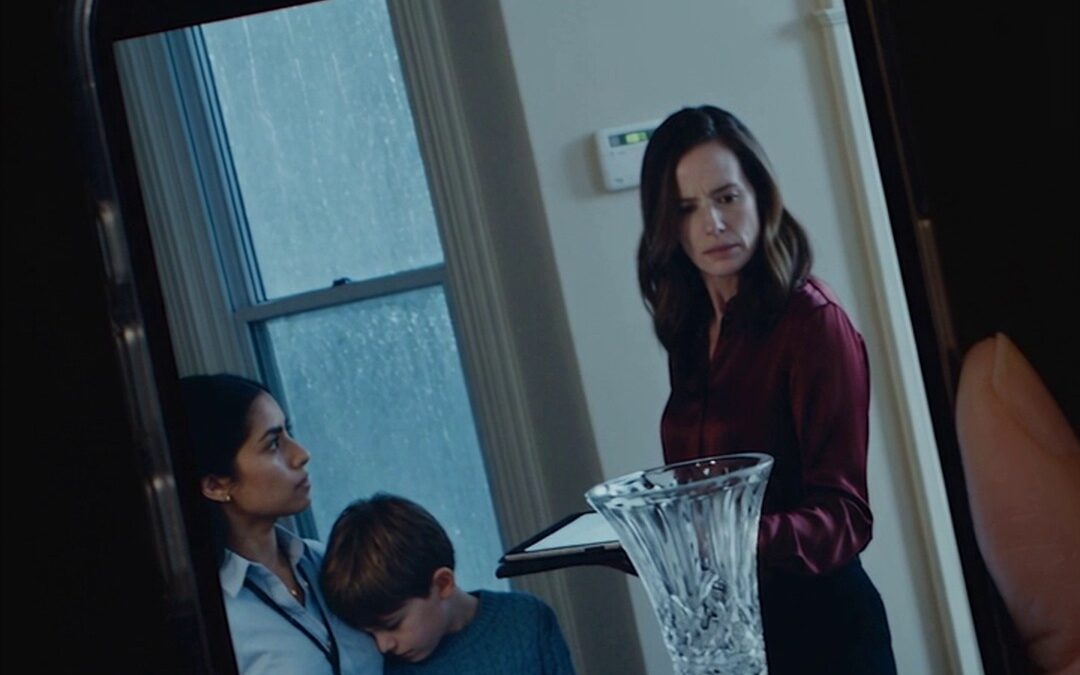
Chapter 1: The Broken Vase
Crystal burst across the marble stairs, and I reached the hallway to find my six-year-old son pressed against our nanny’s knees at the bottom of the flight.
Maya Alvarez had cared for Owen for almost two years, but I had never seen her look so frightened.
“Keep him away from her,” my wife said.
Claire stood four steps above them in a crimson silk blouse, one hand gripping the railing and the other clutching her sleeve against her chest.
“She attacked me when I tried to take him upstairs,” Claire said.
Owen’s socked foot was inches from a shard, so I lifted him onto the bench by the front door.
Maya stayed where she was.
“She pushed your son first,” she said.
Claire turned her reddened wrist toward me.
The glass, her shaking voice, and Maya’s position below her made Claire’s account seem possible, though I had seen none of it happen.
“I caught Owen,” Maya said.
Owen pointed past Claire toward the black security camera above the landing.
Claire’s fingers tightened on the railing, and her eyes went to the camera before returning to him.
“We can check,” I said.
She stepped down, then stopped beside the landing table where we kept the household tablet.
“I don’t want him standing here while you play detective,” she said.
Neither did I, so I carried Owen into my study, settled him on the sofa, and left the door open.
I asked Maya to stay where I could see her through it.
The tablet lay face down on the landing table, a pale smear across its screen.
I opened our security app with the administrator session I kept signed in for maintenance calls.
The staircase camera was active, its green status light steady in the live view.
The recording list ran through the afternoon, then jumped over the minutes when the vase had broken.
“Our connection drops sometimes,” Claire said.
It did, but those failures had their own label.
I opened the separate activity history while she watched from two steps above me.
The missing interval had a deletion event, posted less than a minute before the study door sensor recorded my arrival in the hall, under my own administrator account.
Chapter 2: What the Camera Missed
“Your account,” Claire said from behind me, as though reading the label could settle who had touched the tablet.
I looked again at the two entries, one recording that my study door had opened and the other recording that someone had removed the staircase clip.
The door sensor had given me the time I entered the hall because I had installed it after Owen learned to wander in during work calls, and it had never told me who crossed a doorway.
The security history was no different in that respect: it named credentials, not hands.
“I was in my study,” I said.
“Then Maya used your tablet,” Claire replied.
Maya was still at the foot of the stairs, where I had asked her to wait, and I disliked how quickly I had made that position sound like a condition of trust.
“I don’t know who used it,” I said.
“You know she was angry with me,” Claire said.
Maya looked toward Owen in the study before answering.
“I was angry after you pushed him.”
Owen called my name, and I put the tablet down without closing the activity page.
A thin line of blood showed where a shard had touched his sock, although the skin beneath it was barely broken.
I carried him to the kitchen sink, washed the mark, and asked whether anything else hurt.
“My back,” he said.
He pointed between his shoulder blades, then leaned away when I reached toward the spot.
“I’m going to have a doctor look,” I told him.
Claire came into the kitchen with a towel and a face that looked composed until she saw Owen draw away from her outstretched hand.
“He’s frightened because of all the shouting,” she said.
“Then we can stop shouting,” I said.
Maya asked if she could bring Owen his sneakers from the mudroom because the pair he wore for school had a soft lining he liked when his feet hurt.
Claire opened her mouth, but I said yes.
Maya returned with the shoes, set them by the chair, and asked Owen whether he wanted to put them on himself.
He nodded and took longer than usual with the left one.
I called our pediatrician’s after-hours line while he worked, and the nurse advised an urgent-care examination that evening because of the back pain and the fall we could not yet describe clearly.
The word *fall* made Claire look at me.
“I didn’t say he fell,” she said.
“I said I don’t know what happened,” I answered.
At urgent care, the clinician found a tender bruise beginning high on Owen’s back and a shallow cut on his foot.
She documented both, asked him where it hurt without asking who had caused it, and told me what symptoms would require immediate attention overnight.
Claire offered to take him to the car while I finished the paperwork, but Owen asked to stay beside me.
I signed the discharge sheet with his warm hand inside mine.
On the drive home, Claire said Maya had been resentful since they argued about Owen’s school.
“She thinks every boundary is an attack on him,” Claire said.
“What boundary?”
“The assessment,” Claire said.
Three weeks earlier, Owen’s teacher had suggested an evaluation for attention and anxiety after a difficult first month of school, and Claire had arranged a private appointment before I managed to find an afternoon free.
Maya had told me she wanted to contribute observations from home, where Owen was usually settled if someone gave him warning before a change in routine.
I had agreed in principle and then allowed a week of work calls to pass without arranging it.
“An assessment doesn’t explain what happened on the stairs,” I said.
“It explains why she’s making me the villain.”
In the rear seat, Owen pressed his forehead against the window and asked if Maya had gone home.
I told him I did not know yet.
He wanted to know whether she would be there to make the folded paper boats she had promised him.
“I’ll make sure you know what the plan is tomorrow,” I said.
It was a careful sentence that gave him less than he needed, and I heard it fail as soon as I said it.
At home, I asked Claire to wait in the living room while I spoke with Maya, and I took Owen upstairs to my room with a glass of water and his favorite book.
Claire followed us as far as the hallway.
“I’m his stepmother,” she said quietly.
“I know,” I said.
She had been Owen’s stepmother for three years, and for most of them she had been the person who remembered his dentist visits, the sizes of his winter coats, and how to steady him when I was late.
That history was part of why I had nearly accepted her story before I asked a question.
I sat with Owen until he fell asleep, left my door open, and asked our neighbor Mrs. Bell to come over for an hour because she knew him and was willing to sit nearby while the adults talked.
She arrived in a sweater over her pajamas and accepted my request without asking to hear the accusation.
Maya was in the kitchen with her coat over one arm and her agency badge clipped to the other.
“I can leave if he’s safe,” she said.
“I want to hear what you saw,” I told her.
“I need you to understand something first,” she said.
I pulled out a chair, but she remained standing.
“Claire can end my placement with one call, and the agency asks the family for a final report before they offer me another,” Maya said.
“You think she’ll complain about you?”
“She told me she would,” Maya said.
I asked when, and Maya looked at the badge in her hand.
“Yesterday, after I said I would give the assessor my own notes about Owen.”
I had heard about their disagreement from Claire, but I had not known it had reached that point.
“What did she say?”
“She said families listened to parents, not employees, and she could make sure the agency knew I frightened him,” Maya said.
I asked why she had stayed through another day if she believed that threat was serious.
“Because Owen expected me after school,” she said, “and because I thought you would listen if I spoke to you tonight.”
I remembered the message she had sent asking for ten minutes before my dinner meeting, a message I had marked to answer and forgotten.
“I should have answered you,” I said.
“You should have,” Maya replied.
She laid out the afternoon without filling the uncertain spaces.
Owen had wanted his paper boats before dinner, and she had gone upstairs to get the thick drawing paper she kept in the playroom cabinet.
She had been coming down when she heard Claire tell him the assessor did not need to hear about the mornings when he cried at school.
“Owen said he wanted me to come,” Maya told me.
“Where were they?”
“Claire was on the landing, and Owen was below her on the first stair.”
“Where were you?”
“Near the bottom, coming down the other side of the turn.”
Our staircase was broad enough for an adult to pass a child, with a short upper flight, a landing, and six lower steps facing the front hall.
The camera above the landing looked down both flights, although a decorative column hid one edge of the lower steps.
“I saw her hand on his upper back,” Maya said.
I asked if she had seen the push itself.
“I saw her arm straighten and him come down toward me,” she said.
“That isn’t the same as seeing what she meant to do.”
“No,” Maya said, “but I caught him because he was falling.”
She described catching Owen around the ribs and turning with him onto the lower steps, where his heel struck her knee.
Then Claire had crossed to the landing table, where the shared tablet lay.
“What did she do with it?”
“I couldn’t see the screen from below.”
Maya said she had checked Owen’s head and asked him to wiggle his fingers while Claire stood at the table for a few moments.
She had started up the steps to tell Claire that Owen needed a doctor, and Claire had seized her wrist.
“I pulled away,” Maya said.
I looked at the faint red mark on Claire’s wrist and asked whether Maya’s hand could have made it.
“Yes,” she answered.
The admission came so readily that I had to revise my own unspoken question.
Maya had not come to the kitchen to claim her hands had touched nothing.
“Then the vase?” I asked.
“It came down while I had Owen against me,” she said.
“Did you see Claire touch it?”
“No.”
The vase usually stood on the landing table, far enough from the edge that I had stopped worrying about it when Owen grew taller.
Maya remembered hearing Claire’s hand strike something hard, then seeing crystal tip over the table edge.
Claire had said Maya lunged at her, and Maya had said Claire pushed Owen, and I had reached them after the glass hit the floor.
I wrote those positions on a sheet from the kitchen drawer because I trusted my memory less when I was frightened.
“Is there anything you haven’t told me?” I asked.
Maya looked toward the open doorway.
“I took a picture,” she said.
I waited.
“Of Owen on the steps after I caught him, because I thought I might need to show a doctor where he landed.”
“Why didn’t you tell me when I asked what happened?”
“The family agreement says no photographs of him on personal phones, and Claire had already said I attacked her.”
“That rule is for his privacy.”
“I know,” Maya said.
She unlocked her phone and showed me a single image of Owen seated on the bottom step with his hand against Maya’s sleeve.
His face was turned away, his shoulders were low, and in the upper corner Claire’s crimson sleeve appeared beside the landing table.
The tablet was visible beneath her hand, but the screen was too pale and small to read.
I asked Maya not to send the picture yet, and she put the phone away without argument.
The photo did not show a push, a deletion, or a vase falling.
It did show that Claire had been at the table while Maya was beside Owen below, which made the positions in Maya’s account possible.
“Why did you take only one?” I asked.
“I heard Claire say my name,” Maya answered.
I walked to the landing and looked down at the angle in Maya’s picture.
A person at the table could operate the tablet while a person on the bottom step could not see its screen, and the column hid part of the lower stair from anyone standing near the front door.
I noticed a tiny crimson thread caught under the lip of the vase’s metal stand.
It matched Claire’s blouse in color, although color alone could match half the fabric in our closets.
I left it in place and took a photograph of the whole stand with my own phone.
Claire was waiting in the living room when I came down.
“Maya told me you threatened to complain to her agency,” I said.
“I said I would report her if she kept undermining me.”
“What did she do that frightened Owen?”
“She tells him he doesn’t have to listen when I say it’s time to leave a room,” Claire said.
Maya had described warning him before transitions, and Claire had described defiance; both accounts could grow from the same difficult mornings.
I asked whether Claire had used the tablet after Owen fell.
“He didn’t fall,” she said.
“After the trouble on the stairs.”
“I picked it up because I thought the camera would show you what happened.”
“Did you delete a recording?”
“No.”
She met my eyes while she said it.
“Your admin account is open on that tablet,” I said.
“Then anyone in this house could have done it.”
It was true enough to keep me from calling the event proof of her lie.
Claire glanced toward the kitchen, where Maya could not hear us from her seat.
“You’re questioning me like a suspect while she gets to tell you a story,” Claire said.
“I’m questioning both of you.”
“You’re letting her stay in the house.”
“Owen asked for her,” I said.
“Owen would ask for ice cream instead of dinner if you offered him the choice.”
I had used that same line more than once when I wanted a quick answer to something harder.
“I’ve asked Mrs. Bell to stay while we talk,” I said.
Claire’s face changed at the neighbor’s name.
“You brought someone else into our marriage?”
“I brought someone Owen knows to sit with him.”
The difference mattered to me, but I could see that it offered Claire no comfort.
Mrs. Bell came downstairs a few minutes later to say Owen was awake and wanted me.
I found him sitting in my bed with both shoes still on because I had forgotten to take them off.
“Does my back have a bandage?” he asked.
“No, just a sore spot.”
“Did I break the vase?”
I took off his shoes and set them neatly beside the bed.
“You didn’t,” I told him.
He studied my face long enough to make me wonder who had asked him that question first.
“Can Maya stay until morning?”
“She’s safe,” I said, then corrected myself before another promise escaped me, “and I’m working out where everyone will sleep tonight.”
He accepted the second sentence with a small nod and asked me to read the book from the beginning.
I read three pages before his eyes closed.
When I returned to the kitchen, Maya had her coat on.
“My sister can pick me up,” she said.
“You don’t have to leave because Claire wants you to.”
“I’m not staying in a house where an accusation like that is hanging over me without someone neutral present,” she replied.
“I understand.”
“I’ll answer questions tomorrow, but please don’t ask me to care for Owen as though this never happened.”
I wanted to tell her I would fix it before morning, and I kept that thought to myself.
I walked her to the door, watched her get into her sister’s car, and returned to find Claire beside the landing table.
“What happens now?” she asked.
“I’m preserving what we have, and I’m calling someone who knows this system.”
“Our marriage gets put on hold for a service call?”
I looked at the tablet in her hand.
“Please leave that there.”
She set it down, slowly enough for me to hear its case touch the wood.
The next morning, I kept Owen home from school and arranged for my brother Daniel to spend the day with him at Daniel’s apartment.
Daniel was the emergency contact on Owen’s school forms, and Owen liked his habit of making pancakes shaped like whichever animal Owen named first.
I told Daniel about the injury and the disagreement over what happened, but I did not ask him to investigate Owen while they ate breakfast.
“Do I need to keep him away from Claire?” Daniel asked me at the door.
“Yes,” I said.
He held my gaze for a moment, then said he would.
That answer cost me something I had avoided naming since the glass broke.
By noon, Claire’s version and mine would no longer be a private marital quarrel; my brother would know that I thought she might have hurt my son.
Claire came down while Daniel was buckling Owen into the car.
“You’re taking him away from me?”
“He’s spending the day with his uncle while we sort this out.”
“You have no proof I did anything.”
“I have enough concern to keep him somewhere calm today.”
She followed me inside after the car pulled away.
“If Maya has convinced you I’m dangerous, you’ll regret teaching him to be afraid of me,” she said.
“I didn’t tell him to fear you.”
“You didn’t have to.”
She went to the living room and shut the door, and I called the installation company whose number was printed inside the security panel.
I had designed the electrical plans for three houses before ours, and I knew enough about residential systems to ask useful questions without pretending I knew this one’s storage rules.
The technician who had installed our cameras, Priya Shah, was available that afternoon for a service visit.
I told her a recording had been deleted and asked her to preserve any provider records associated with the event before their routine retention period ended.
“I can tell you what the system recorded about the account and device,” she said.
“Can you tell me who held the tablet?”
“No,” she answered.
It was the first answer I needed.
Before she arrived, I photographed the landing table, the vase stand, the crystal on the stairs, and the route from my study door to the hall.
I left the fragments where they lay, after moving the sharp pieces within Owen’s reach into a labeled box the night before.
I measured the distance between the study and the stairs by walking it at an ordinary pace, then listened to the recording from the study door sensor that saved only opening and closing events.
It had opened after the deletion event, as the app had shown, but the sensor clock could differ from the security provider’s clock by a few seconds.
I wrote that limitation beside the times instead of building a whole accusation from an exact interval neither system could promise.
The first fact I could test without a clock was the one I had ignored at the scene: the vase normally stood at the rear of the table, beside a stack of unopened mail.
Its metal stand had left a clean circle near the front edge, cutting through a thin layer of dust that remained beneath the mail.
Someone had moved it forward recently.
I asked our housekeeper, who came on Tuesdays, whether she remembered where she had left it.
She told me by phone that she always set it back near the wall because she worried Owen would knock it over.
She could verify the ordinary position, not who had changed it.
I thanked her and asked her not to come into the hall until I had finished documenting it.
When Priya arrived, I showed her the tablet, the camera, and the activity page without telling her which person I suspected.
She confirmed that the staircase camera was an installed unit recording motion to the household service, with a separate account history kept for customer review and troubleshooting.
“A green light means the camera has power and is sending activity,” she said.
“It doesn’t guarantee every frame made it into a saved clip.”
“But there was a saved clip?”
“The provider event says one existed and was deleted.”
She used her service access to request a preserved copy of that event record, and she told me the actual footage was no longer available through the system.
I asked whether she could recover it.
“Not from what I can see, and I won’t tell you I can.”
She pointed out that our shared tablet had been named *Hall Tablet* when she installed it, even though we had later begun leaving it on the landing.
That nickname identified the device, not its location.
The provider record said a session on that tablet, already authenticated under my administrator credentials, sent the deletion request.
“A signed-in session can be used by whoever is holding the tablet,” Priya said.
I told her I had been in my study when the vase broke.
“Your door sensor supports when that door opened,” she answered.
“It doesn’t show whether you touched this earlier.”
I appreciated the restraint even as it made my position harder.
She compared the provider clock with the door sensor and found them close enough that the deletion still preceded my entrance into the hall by less than a minute.
The two records did not settle whether the deletion preceded the crash, because I had no recorded time for the crash beyond my own hearing and the few seconds it took me to reach the hall.
Priya asked if there were other cameras in the house.
One watched the driveway, and one watched the back door, neither of which looked into the staircase.
She checked them only to make sure the account event belonged to the staircase unit and that no other clip had disappeared with it.
“Why can I see the deletion event if the clip is gone?” I asked.
“Because the event is a service record of the command,” she said.
“The recording and the command history are stored separately.”
I asked her to email me the service report and give me the ordinary request process for preserving records if an agency or lawyer later needed them.
She did both, then turned toward the landing table.
“Are you going to use the tablet today?”
“No.”
“Then photograph its condition and leave it charged,” she said.
She did not offer to identify fingerprints from a smear or tell me that the image Maya took proved a particular person tapped a particular button.
After Priya left, I called Maya to tell her what the system had established.
She listened without interrupting.
“It says the tablet did it?” she asked.
“It says my session on the tablet deleted the clip.”
“And the tablet was where I saw Claire?”
“That’s what your picture appears to show.”
“Have you looked at the time on my photo?”
“I saw it on your screen, but I need the original file.”
She said she would bring the phone to the agency office, where she already had an appointment with her placement manager.
Claire had filed a complaint that morning.
I sat down on the lower stair with my phone against my ear.
“What did she report?”
“That I grabbed her, scared Owen, broke a valuable vase, and violated the family’s rule about pictures,” Maya said.
“She knew about the picture?”
“I told her I took it while you were reading to Owen last night.”
I had not known she had spoken to Claire again.
“Why did you tell her?”
“Because it was my mistake under the contract, and I wasn’t going to let her find it later and say I hid it.”
I thought of the photo’s upper corner, which had placed Claire at the tablet.
“She complained anyway.”
“Yes,” Maya said.
The agency had paused Maya’s placements until it could speak with us and decide whether the complaint involved a safety concern.
She had a second family lined up for an interview that weekend, and the pause would cancel it if the matter stayed unresolved.
“I’ll call them,” I said.
“I want you to tell them what you actually know,” she replied.
“I don’t need you to say I’m innocent because you feel guilty.”
I went into my study to make the call, passing the door whose sensor had become part of the story.
Maya’s placement manager, Elise Rowan, had supervised her work with us since the previous spring and knew our agreement.
She said she could hear my account but could not share Claire’s written complaint without Claire’s permission while the agency reviewed it.
I told her I had reached the hall after the vase broke, had not witnessed the beginning, and had no basis to say Maya attacked anyone.
I also told her about Owen’s examination, Maya’s account, and the deleted staircase clip.
“Are you retracting any statement you made last night?” Elise asked.
“I didn’t give the agency one last night.”
“Claire said you saw the aftermath and believed Maya had lost control.”
“I saw the aftermath,” I said, “and I nearly believed it.”
Elise was quiet for a beat.
“I need a written statement with those distinctions,” she said.
I sent one that afternoon, along with my request that the agency preserve Claire’s complaint and its submission time.
It did not remove the pause on Maya’s placements.
Elise explained that an accusation involving a child required review even if one parent disputed the other, and I could hear in her voice that she thought I might be protecting an employee from a conflict inside my marriage.
I could not fault her for hesitating.
At Daniel’s apartment, Owen spent the afternoon making paper boats from grocery receipts.
When I arrived, he ran to me with three folded boats cupped in his hands, then stopped short of a hug when he remembered his back.
Daniel said Owen had asked twice whether Maya was in trouble.
I sat beside Owen on the rug and asked which boat he liked best.
“The crooked one,” he said.
He set it in my palm and watched me turn it.
“Is Maya in trouble because I went down the stairs?” he asked.
“Maya is being asked what happened, and I’m helping the grown-ups get it right.”
He considered that.
“Claire said I was being silly about the stairs.”
Daniel lifted his eyes to mine, but neither of us asked Owen to repeat it.
I told Owen he had done the right thing by telling me where his back hurt, and we sailed the boats across a basin of water in the kitchen.
Later, while Daniel made dinner, I called the pediatrician to ask how to handle Owen’s questions and whether the bruise needed another visit.
The nurse reviewed the urgent-care report, advised a follow-up if pain increased, and suggested that we let a child specialist speak with him if an investigation required a fuller account.
“She can document the injury,” the nurse said of the clinician.
“She can’t tell you how it happened from a bruise.”
I wrote that down because I did not want the injury to become another object I forced to say more than it could.
That evening, Claire’s attorney called me.
Claire had consulted her after I kept Owen with Daniel for the day, and the attorney said Claire wanted an agreement about where she would stay and when she could see him.
I told her I would have my own lawyer respond, then asked Claire directly whether she would spend the night at her sister’s house.
“You’ve decided I hurt him,” she said.
“I’ve decided he’s frightened and injured, and I need space to find out why.”
“I was hurt too.”
“I know your wrist was red.”
“Because Maya twisted it.”
“Maya says she pulled away after you grabbed her.”
“You believe that because she told you?”
“I haven’t settled it,” I said.
Claire laughed once, without amusement.
“You’ve already moved him out and put a technician in our hallway.”
It was true, and I could not call those steps neutral to make them easier for her to bear.
“I did those things because I’m responsible for Owen,” I said.
She packed a bag while I waited downstairs, and I heard each drawer open and close above me.
When she left, she put her house key on the landing table beside the tablet.
I did not touch it until the front door closed.
The next morning, my lawyer, Rebecca Vale, listened to the sequence in her office with her pen resting on a blank page.
She asked what I had personally seen, what Owen had volunteered, and whether Maya’s picture had been copied or altered.
I answered the first two questions and told her the original was still on Maya’s phone.
Rebecca explained that a child-protection report might be appropriate if I believed Owen had been harmed, and that an agency complaint was already putting Maya’s work at risk.
She did not promise any quick finding.
“If you bring me a useful record, I can help preserve it and put it before the right people,” she said.
“What I cannot do is make one account become a fact because the family needs a decision today.”
I called the county child-protection intake line from her office and described Owen’s injury, his short statements, the two adult accounts, and my decision to keep him with Daniel.
I told the intake worker that Claire was his stepmother and that I had no evidence of a prior push.
They took the report and said a worker would contact us about next steps.
Rebecca helped me request a temporary parenting arrangement that kept Claire from unsupervised contact while the concern was assessed, without pretending a court had already decided what happened.
By then, Maya was waiting at her agency office with Elise and her phone.
I drove there because I had promised her I would see the original image before making any claim about it.
Elise brought us into a small conference room and set Maya’s placement file on the table without opening it.
“I’ve heard two accounts,” she said.
“I’m here to understand what can be checked.”
Maya unlocked her phone and opened the original picture in the photo app, then showed us the file details.
The image time fell after the deleted clip began and before the study door opened, allowing for the small differences Priya had measured between device clocks.
The phone’s clock had been set automatically, but a timestamp alone could still be changed or misread.
Rebecca had arranged for Maya to export the original file directly to a secure case folder that preserved its metadata, and Maya watched the transfer happen.
She kept the phone.
I enlarged the upper corner without cropping the saved original.
Claire’s sleeve crossed the edge of the landing table, and two fingers rested on the open tablet case.
The visible part of the screen was bright, but no words could be read.
“Could she have been checking the camera?” Elise asked.
“That’s what she told me,” I said.
“Could Maya have set the tablet there before taking the picture?”
“She was below with Owen in the frame, but the picture doesn’t show everything before it.”
Elise looked at Maya.
“Why didn’t you show anyone this at the house?”
“I told Mr. Mercer about it after Owen was asleep,” Maya said.
“I should have told him sooner, and I told Claire I had it before she complained.”
“The photo rule matters,” Elise said.
“I know,” Maya answered.
“I’m asking you to judge that breach separately from an accusation that I hurt a child.”
Elise made a note.
She explained that the agency could document a contract breach without treating it as proof of violence, but Claire’s complaint would remain under review until they checked what they could.
Maya nodded, although her hands stayed clenched around her phone.
On the drive back, I stopped at a red light and realized I had been treating the tablet in the photo as an answer when it was only a question.
Claire had said she picked it up to check the camera after the trouble.
If the photo was taken while Owen sat injured on the step, that might fit.
The inconsistency was elsewhere.
Claire had said Maya attacked her when she tried to take Owen upstairs, then used the tablet to check the camera, yet in Maya’s picture the vase still stood on the landing table and Owen was already down with her.
The vase had broken after whatever first brought Owen to the lower step.
I called Priya and asked whether the deleted interval could have been selected while the camera was still recording the same ongoing motion event.
“It depends on when that segment closed,” she said.
“Someone can delete a saved segment while a later one continues, but the event history should identify the segment’s start and end.”
She checked the provider record she had preserved.
The deleted segment ended before the deletion command, and a new segment had begun around that time but had not been saved because the camera’s motion threshold did not stay active long enough.
The system could tell us those boundaries, not what happened inside either interval.
I thanked her, then asked her to email the ordinary segment rules to Rebecca.
At home, I stood at the bottom stair and looked up at the vase stand.
The clean dust circle near the edge had bothered me because the vase could have fallen accidentally from that position.
What mattered more was that Claire had claimed it broke while Maya attacked her, after Claire reached for the camera, yet Maya’s picture showed the vase intact while Claire’s hand was already at the tablet.
The photograph did not settle who moved it or who knocked it over.
It ruled out one order of events Claire had given me.
I called Claire and asked her to meet with Rebecca and me the next day, with her attorney, to go through the timeline.
“I’ve told you what happened,” she said.
“There are details I need to put beside your account.”
“Then send them to my attorney.”
“I will.”
Before I ended the call, she asked whether Owen had slept.
“He woke twice,” I said.
“Did he ask for me?”
I looked at the folded paper boat on my desk.
“He asked what would happen tomorrow.”
Claire did not answer for a moment.
“I still know how to help him,” she said.
I believed that she knew many things about Owen, which made the uncertainty painful rather than simple.
The child-protection worker came to Daniel’s apartment the following morning, spoke first with me, and then met Owen with Daniel nearby.
She asked about his day, his back, and the stairs in language he could understand.
I did not listen at the door.
When she finished, she told me Owen had given a limited account that would be documented according to their process, and she cautioned me against asking him to repeat it for relatives or for Maya’s agency.
I agreed.
Her report would take time, and she could not give me a finding that morning.
I took Owen home with Daniel, who had agreed to stay until the adults finished their meeting.
Rebecca met us in my study, while Claire and her attorney arrived through the front door Owen had entered only moments before.
I kept the study door closed.
Claire sat in the chair nearest the window, the crimson blouse replaced by a gray jacket.
Rebecca asked permission to record the meeting for an accurate account, and both attorneys agreed.
I began with what I had witnessed.
“I heard the vase break and reached the hall seconds later,” I said.
“I saw Maya and Owen below, Claire above, glass between them, and a red mark on Claire’s wrist.”
Claire looked at me.
“That is exactly what I told you.”
“It is what I saw,” I replied.
“I did not see the start.”
Rebecca asked Claire to describe the order of events from the moment she and Owen reached the landing.
Claire said Owen refused to come upstairs, Maya told him he did not have to, and Maya grabbed Claire’s arm when Claire tried to guide him.
“The vase fell when she pulled me against the table,” Claire said.
I asked where Owen was when she went to the tablet.
“Beside Maya, after the vase broke.”
I placed Maya’s picture on the screen in front of us.
It showed Owen seated by Maya below, Claire’s crimson sleeve at the tablet, and the crystal vase intact on its stand.
Claire leaned forward.
“That could have been taken earlier.”
“It was taken during the interval when the staircase clip was removed,” Rebecca said.
Claire’s attorney held up a hand.
“Can you establish that without relying solely on a phone timestamp?”
Rebecca gave him Priya’s report showing the provider time, the device’s automatic clock setting, and the original file preserved from Maya’s phone.
“The exact seconds have a margin,” Rebecca said.
“The order does not require them to be exact.”
Claire looked again at the picture.
“I went to check the camera before she smashed the vase,” she said.
I heard the change, but I let her finish.
“I saw Maya handling Owen roughly and wanted you to see it, and then she came toward me.”
“You told me last night you went to the tablet after the vase broke,” I said.
“I was exhausted, and I had been grabbed.”
Her attorney said stress could affect sequence without making an entire account false.
I agreed that it could.
Then I asked why the provider recorded a deletion from my signed-in session on that tablet while she was standing there.
“I didn’t delete anything,” Claire said.
“Maya had access to the tablet all day.”
“She did,” I said.
That was the strongest answer Claire had, and I knew I would have offered it myself the night before.
Priya’s report identified the household tablet and my open administrator session, but it could not identify its user.
Maya’s picture placed Claire at the tablet during the relevant period; it did not show her tapping *delete*.
“I’m not asking the picture to prove your finger pressed a command,” I said.
“I’m asking you what you did while Owen sat at the bottom of the stairs.”
“I checked the camera, and the clip was gone.”
Priya had explained that the segment was saved before the deletion event.
Rebecca asked whether Claire had seen the recording while checking it.
“No,” Claire said.
“Did you see a missing interval?”
“I saw a blank place.”
“Then why did you tell me our connection probably failed?” I asked.
“Because that happens.”
“It does,” I said, “and the system labels those failures differently.”
Claire’s attorney asked for the complete service report before discussing the technical history further.
Rebecca gave him the copy Priya had sent that morning.
No one spoke while he read the first page.
He then made an objection I had been unable to answer with the picture alone.
“Even if my client touched the tablet before the vase broke,” he said, “none of this proves she pushed Owen.”
“That’s true,” I said.
Claire turned toward me, and for an instant her expression held something close to relief.
I thought of how badly I had wanted a single device to tell me the whole story.
“The physical event needs its own evidence,” I said.
Maya had asked to attend only the part of the meeting that concerned her accusation, and Rebecca called her in from the dining room.
She sat across from Claire without looking away.
“Tell us where Owen was when you caught him,” Rebecca said.
“Coming down the lower flight toward me,” Maya answered.
“Did you see Claire’s hand?”
“Yes.”
“Could he have stumbled after she touched him?”
“He could have lost balance after a touch,” Maya said, “but I saw her arm drive forward when he was trying to stay on the landing.”
Claire shook her head.
“You saw what you wanted to see because you were angry about the school meeting.”
“I was angry about you telling him not to say he was frightened,” Maya replied.
I had not heard that version of their argument.
Claire’s attorney asked Maya whether she had already decided to complain about Claire before the stair incident.
“Yes,” Maya said.
She reached into her bag and laid her childcare notebook on the table.
“I wrote down what I saw at work because the assessor asked for observations from people who spent time with Owen.”
The pages held ordinary records of meals, naps, school pickup moods, and the words Owen used when he was upset.
Near the back, two entries noted that Claire had told Owen to call his crying “being dramatic” and that Maya had heard Claire warn him the assessment might mean he had to leave his school.
Maya had asked to speak with me because she thought the assessor should hear Owen’s routines directly, including how he settled when given time.
Claire had already sent the assessor a parent questionnaire that described Owen as aggressive toward adults and unable to follow directions at home.
I had skimmed it and assumed Claire knew more because she handled the appointments.
“She was trying to make an honest assessment look like a case for moving him,” Maya said.
Claire’s face tightened.
“I was trying to get him help before the school expelled him.”
The school had discussed support, not expulsion, and I said so.
Claire’s attorney advised her to let Maya finish.
Maya turned to me.
“I wasn’t planning to tell the assessor Claire was evil,” she said.
“I was planning to say what Owen did during a normal week, because those details matter.”
Claire’s hand rested flat on the table.
“And when I told her her notes were incomplete,” Maya said, “she told me an agency complaint would make an assessor question every word I said.”
The motive did not require a secret scheme outside our house.
Claire wanted the assessor and me to accept her account of Owen as a child who needed a more restrictive school plan, and Maya’s daily observations threatened that account.
The push had created a danger Maya witnessed, and the accusation offered a way to turn her from a witness into the person who caused it.
I had given Claire the leverage by treating her careful management of appointments as a reason to stop checking what she told me.
“The complaint was justified,” Claire said.
“She took a prohibited picture and put her hands on me.”
“The picture was taken after Owen was down,” I said.
“Yes, because she was preparing her story.”
It was another possible interpretation of why Maya used her phone, and Maya did not deny she had wanted a record.
“I thought he might need a doctor,” she said.
“I was scared you would say he’d fallen by himself.”
Claire’s voice sharpened.
“That is what happened.”
She looked at me, not at Maya.
“He pulled away when I told him to go upstairs, and I reached for him before he fell.”
For the first time, she described her hand on Owen’s back before the fall.
I asked where she had been standing.
“On the landing.”
“Where was Owen?”
“On the first lower step.”
I pictured the short flight, Owen below her, Maya coming down toward him.
“Did you grab his sleeve or touch his back?” I asked.
“His back.”
“You told me you tried to take him upstairs.”
“I did.”
“From behind him?”
Claire pressed her lips together.
“I was trying to stop him going down.”
Those words could describe a panicked reach after a child slipped, and I did not dismiss them because I wanted certainty.
Rebecca asked whether Claire had told the urgent-care clinician she had touched Owen’s back before he went down.
“No,” Claire said.
“You let me tell her I didn’t know whether he fell,” I said.
“You were already treating me like a criminal.”
“I didn’t learn about the bruise until we washed his foot.”
Claire’s attorney asked whether the bruise’s position could establish a push.
“No,” Rebecca said.
“The clinician documented tenderness and a mark, not a cause.”
I thanked her for saying it plainly.
Maya leaned forward.
“I caught him because I saw him coming toward me,” she said.
“After that, you crossed to the tablet while I was checking his head, and the vase was still standing when I took the picture.”
Claire looked at the photo once more.
“You can’t tell from that angle whether I was using the tablet.”
“No,” Maya said.
“I can tell where you were while Owen was on the step.”
I asked Claire why the vase had been moved to the table’s front edge.
She looked toward the study door, as though the landing might be visible through it.
“I moved it to reach the tablet,” she said.
“When?”
“After he fell.”
That was the second time she had placed an action between Owen’s descent and the crash.
I took out my photograph of the stand and the thread caught beneath it.
“I found this under the stand after the vase broke,” I said.
Claire glanced at the red fiber.
“It could be from my blouse when Maya grabbed me.”
“It could,” I said.
I had shown the thread to Rebecca earlier, and we had agreed it was too weak to identify a person or a movement.
What mattered was Claire’s own explanation that she shifted a heavy vase toward the table edge while a child sat injured below it.
“I moved it out of my way,” she said.
“Why would you check the camera before helping Owen?” I asked.
“Because Maya had him.”
“And after you checked it?”
“I tried to get to him, and Maya came at me.”
Maya’s wrist bore a faint mark where Claire had gripped it, while Claire’s wrist bore the mark Maya said she caused pulling free.
Neither mark by itself settled who began that struggle.
The order now did something the marks could not.
Claire had first told me the vase broke because Maya attacked her while she tried to take Owen upstairs.
The original photo showed Owen already below with Maya, Claire at the tablet, and the vase intact.
Claire had changed her account to place a camera check, a moved vase, and a later struggle between Owen’s descent and the crash.
The deletion event fitted that new interval.
“So the vase didn’t fall during the act that sent Owen down the stairs,” I said.
Claire’s attorney answered before she could.
“That does not mean my client deliberately broke it.”
“No,” I said.
“It means the crash I heard was later.”
I had reached the hall seconds after the vase shattered and treated it as the sound of the danger to Owen.
That was the assumption the scene had given me: glass in the air, Maya below, Claire above, and one violent moment joining them all.
There had been time for Owen to be caught, for Claire to cross to the tablet, for someone to delete a saved clip, and for the vase to fall afterward.
The crash was the beginning of my knowledge, not the beginning of the incident.
Claire looked down at her hands.
“I knocked it over when Maya came toward me,” she said.
“Then the physical question is what happened to Owen before that,” I replied.
The worker’s limited account of Owen’s words was not ours to use as a weapon in this room, and I did not repeat it.
I had Maya’s direct account, Claire’s changing one, Owen’s injury, and evidence that Claire attended to a recording before the glass broke.
I also had a deleted segment whose contents no one in the room could honestly claim to know.
“I’m asking you once,” I said, “did you push him?”
Claire’s eyes lifted to mine.
“I put a hand out because he would not listen.”
“Did that hand send him down the stairs?”
Her attorney spoke softly to her before she answered.
“I did not mean for him to fall.”
Maya closed her eyes for a moment, then opened them.
Claire looked at her.
“You told him I attacked Owen on purpose.”
“I told him you pushed his son,” Maya said.
“I still don’t know what you meant to happen after your hand moved.”
Claire turned back to me.
“You understand the difference, don’t you?”
“I do.”
I understood that intent would be assessed separately from what Claire had done and separately again from what she had said afterward.
“What I can establish today,” I said, “is that you put your hand against Owen while he was on the stairs, he came down toward Maya, and you gave me a false sequence that blamed her for the crash and for frightening him.”
Claire’s attorney objected to my last conclusion, and Rebecca asked me to be precise.
I took a breath.
“You told me Maya attacked you while you tried to take him upstairs, and you let me believe the vase broke in that same moment,” I said.
“The photograph shows the vase standing after Owen was already with Maya at the bottom, and your account of using the tablet changed only when you saw it.”
Claire said nothing.
“The provider record proves my session on that tablet deleted a clip,” I continued.
“The photo places you at the tablet during the relevant interval, and you acknowledge using it, but neither record shows your finger making that deletion.”
I heard Rebecca’s pen stop moving.
“I believe you deleted it,” I said to Claire.
“I’m giving the service records and the original photo to the investigator so that conclusion can be tested.”
Claire pushed her chair back.
“You’re choosing her over me.”
I thought of the first seconds in the hall, when I had almost asked Maya to leave before Owen had even been examined.
“I’m choosing to act on what I know happened to Owen and on the false account you gave me,” I said.
“That choice is mine.”
Maya did not thank me.
She asked whether I would tell the agency, in writing, that the charge of attacking Claire to frighten Owen was unsupported by my observations and contradicted by the timeline.
“Yes,” I said.
“And whether you’ll tell them I disclosed the picture myself, instead of letting that become another accusation.”
“Yes.”
“I don’t want my phone or Owen’s image passed around to win an argument.”
Rebecca said she would request that the agency review the original through a controlled process and keep the child’s image out of routine correspondence.
Claire stood.
For a moment I thought she would go to the door, but she stopped beside Maya’s chair.
“I was trying to help him,” she said.
Maya did not turn.
“Then you should have helped him after he fell.”
Claire left with her attorney, and I stayed in the study until I heard the front door close.
My hands were shaking, which embarrassed me only until I remembered Owen upstairs with Daniel, waiting for lunch and a plan he could understand.
Maya picked up her notebook.
“I need to go,” she said.
“I know.”
At the door, I told her I was sorry I had seen her fear and nearly treated it as evidence against her.
“I saw glass and Claire’s wrist, and I filled in the rest because I trusted the person I knew best,” I said.
Maya adjusted the strap of her bag.
“You knew me for two years,” she replied.
There was nothing useful I could say to that.
I went upstairs and found Daniel sitting on Owen’s floor, holding a paper boat while Owen explained that the broad fold kept it from tipping.
Owen looked up when I entered.
“Is everybody done talking?”
“For today,” I said.
“Can we go outside?”
“Yes.”
We walked in the yard while Daniel folded another boat from a grocery receipt, and I stayed close enough for Owen to take my hand when he wanted it.
That afternoon, I sent Elise a signed statement correcting Claire’s complaint point by point where I had firsthand knowledge.
I wrote that I had not witnessed Maya attack Claire, that the vase had remained intact after Maya caught Owen, that Maya had disclosed the phone picture herself, and that she had urged medical care.
I attached Priya’s service report and offered the original image for supervised review through Rebecca.
I did not describe the deleted footage as recovered or claim the bruise named the person who caused it.
Elise acknowledged the statement and said the agency would interview Maya again before closing its review.
The child-protection worker requested the urgent-care records, the service report, and contact information for the adults present.
Claire’s attorney said she would cooperate with that process.
Rebecca arranged a temporary written agreement under which Owen remained with me and Claire had no direct contact until the worker and our attorneys could advise on safe next steps.
That arrangement was immediate protection, not a final decision about our marriage or her future place in Owen’s life.
Three days later, Elise called to say the agency had removed the safety allegation against Maya from its placement file.
The agency documented the phone photograph as a privacy-rule breach taken during an emergency, with Maya’s prompt disclosure and the restricted handling of the image noted beside it.
Elise offered to reinstate Maya for new placements, including the interview she had missed.
I asked whether Maya wanted a reference from me.
“She wants an accurate one,” Elise said.
I wrote it that evening, describing her two years of care, her attention to Owen’s routines, her request for medical help, and the fact that I had no basis to support the accusation that she harmed him.
I sent it to Maya for her approval before it went to any family.
She changed one sentence that had called her “devoted,” replacing it with “consistent,” and I accepted the edit.
A week after the stairs, the worker told me the inquiry remained open while she reviewed the records and spoke with Claire.
Owen had started meeting with a child counselor recommended by his pediatrician, and the counselor asked us to keep his days predictable and let him decide when to talk.
He still stopped at the foot of the stairs some mornings.
I held his hand if he offered it, and I took the longer route through the back hall when he asked.
Maya came by on a Saturday to collect the paper she had kept in the playroom cabinet.
Owen knew she was visiting because I had told him the day before, and he met her in the kitchen with a boat he had folded by himself.
“Will you take this one?” he asked.
“If you want me to,” she said.
She told him she would be working with another family soon and that leaving our house was her choice, then promised only that we could arrange a visit when everyone knew the plan.
He considered the answer and handed her the boat.
After she left, I carried the last box of crystal fragments from the hall to the recycling bin.
The landing table was bare except for the house key Claire had returned, and the camera above it faced the stairs as it always had.
Owen came to the bottom step while I was sweeping up one piece I had missed.
He waited until I put the broom aside, then held out his hand for mine.








