The Night My Wife Said Our Nanny Had Hurt Her, My Son Pointed Upstairs
Chapter 1: The Broken Vase
The crystal vase shattered across the marble staircase before I reached the hallway, and I found my five-year-old son, Owen, pressed against our nanny at the foot of the stairs.
“Get him away from her,” my wife said from the upper landing.
Mara stood in a crimson silk blouse with one hand against the banister and the other held out as if she had tried to stop a fall.
At the bottom, Leah had an arm around Owen and a shallow cut beneath her eye.
“She attacked me,” Mara said, her voice shaking. “She frightened Owen, and then she threw the vase.”
Leah looked up at me without releasing him.
“She pushed your son first.”
Mara made a sound of disbelief and showed me a red mark on her wrist.
Leah had worked for us for twenty-one months, and I knew how carefully she guided Owen on those stairs, but I also knew my wife’s face well enough to see that her distress was real.
For one awful moment, I let the broken glass and Mara’s trembling hand arrange the story for me.
Then Owen moved against Leah and pointed toward the camera above the landing.
“Up there,” he whispered.
Mara’s fingers closed around the banister, and she glanced toward the narrow console beside it before looking back at Owen.
I could see our household tablet lying on that console, where we left it for the lights, alarms, and security system.
“Stay still,” I told Owen.
I stepped through a clear space at the edge of the debris, lifted him into the hall, and checked his bare feet for glass while Leah kept her cut hand away from him.
Mara started down one step, and Owen gripped my shirt hard enough to stop me breathing.
I carried him into the study doorway, where I could see everyone, and opened the security interface on my phone.
Our system kept hallway recordings for two weeks and showed deletions in a separate activity history, a distinction I had once appreciated only because it made finding accidental deletions easier.
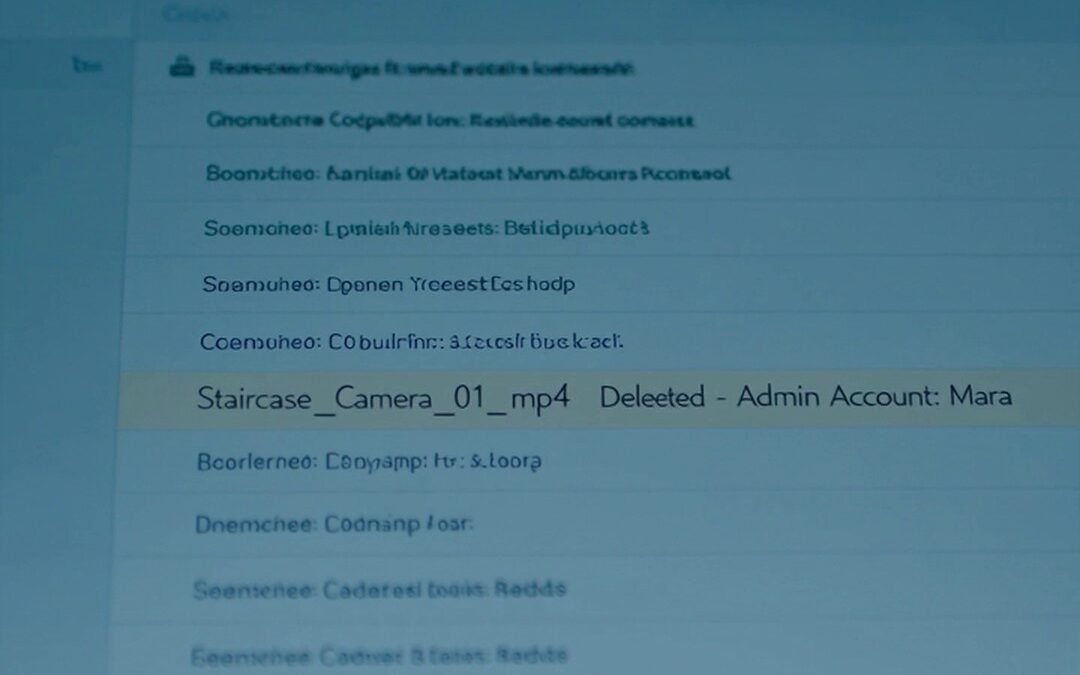
The staircase camera’s timeline had a blank interval covering the last several minutes.
“There was a power flicker,” Mara said.
The other cameras still showed their recordings, and the activity history gave me an entry for the missing staircase clip.
It identified my administrator account and marked the deletion less than a minute before I entered the hallway.
Chapter 2: What the Stairs Remembered
I looked from the deletion entry to Mara, then to the tablet on the upstairs console.
“That says your name,” she said.
“It says my account.”
“You’re the only one with the password.”
“The tablet stays signed in.”
Mara’s gaze moved to the console again.
I took a screenshot of the activity entry while Owen clung to my shoulder, because I knew the name on the screen could tell me which session had been used without telling me whose hand had used it.
Leah stood below the stairs, watching me over the dish towel she had wrapped around her bleeding palm.
“Please take him away from the glass,” she said.
I had carried Owen into the study doorway, but his bare feet were still too close to a shard that had skidded across the hall.
I moved into the kitchen, set him on the counter, and checked both feet under the bright lights.
When I touched his left shoulder through his pajama shirt, he flinched.
A mark was forming near his collarbone.
“We need a doctor,” I said.
“I agree,” Leah said.
Mara came into the kitchen holding her crimson sleeve away from her wrist.
“You’re taking him out because she frightened him?”
“I’m taking him because his shoulder hurts.”
“He’s been clinging to people all week.”
Owen turned his face against my chest.
I asked Mara to wait in the sitting room while I called the pediatric after-hours line.
“You’re separating me from my son on her word?”
“I’m separating the adults while I find out what happened.”
“You heard her attack me.”
“I heard the vase break.”
Mara looked at me for a moment, then walked into the sitting room with a tissue pressed to her wrist.
Leah pulled out a chair across from Owen but did not sit.
“May I?” she asked.
The question landed harder than her accusation had, because she had cared for him for twenty-one months and still needed my permission to rest her injured hand.
“Of course.”
She sat where Owen could see her without having to move toward her, and I made the call.
The nurse asked about his breathing, movement, and alertness, then told me to bring him in for an examination that night.
I said there were conflicting accounts of how he had been hurt.
“Tell the clinician what you saw yourself,” she said, “and keep him with someone you can assure is safe.”
When I hung up, Leah said, “I can tell you my part before we go.”
“Tell me in order.”
She said Owen had come out of his bedroom for water while she was folding his clothes, and she had met him at the turn because he liked carrying his own cup but still needed a hand on the steep section.
Mara had come from her office along the upper hall.
“She wanted me to leave him with her,” Leah said. “I told her I would when he had his hand on the rail.”
“Why was that an argument?”
“She knew I’d called the pediatrician’s office about the bruises.”
I wanted to say I would have noticed unexplained bruises on my son.
Instead, I looked at the mark appearing beneath his collar and asked her to continue.
“Mara took his arm, and he pulled back,” Leah said. “She put her other hand at his shoulder and pushed him away.”
“Toward the steps?”
“Yes.”
“How far did he fall?”
“Two steps, maybe three, before I caught him.”
Leah said she had grabbed the rail with one hand and Owen with the other, striking her face against the newel post as she pulled him in.
The cut below her eye was narrow and fresh.
“Then the vase broke?” I asked.
“No, Daniel.”
She waited until I met her eyes.
“That was afterward.”
I could hear Mara’s shoes crossing the sitting room rug.
“What happened between?”
“Mara went to the tablet,” Leah said. “I was checking Owen’s arm, so I couldn’t see the screen.”
“Did you ask her to call anyone?”
“I asked for a doctor, and she said I had no right to decide that.”
“And the vase?”
“She went back to the console, picked it up, and dropped it toward us.”
“You’re sure she picked it up?”
“I saw it in her hands.”
Leah looked at Owen before she added, “I can’t tell you whether she meant it to hit us.”
I pictured Mara reaching for the tablet in a panic, fumbling with it, and knocking the vase over.
That picture explained her distress more easily than Leah’s did, but it did nothing with the deletion entry on my phone.
“Why would she push him?” I asked.
“I don’t know what she meant to do,” Leah said. “I know what I saw.”
I nearly asked Owen whether his mother had pushed him.
The question was ready in my mouth before I saw him tracing the seam of his pajama pants, listening to two adults discuss his fall as though he were an object on the stairs.
“You don’t have to tell us anything tonight,” I said to him.
He leaned against me.
I told Leah we would collect her phone and bag on our way out.
Mara was waiting at the sitting room door when we passed.
“You’re letting her pack?” she asked.
“She needs her things.”
“She’s already planning to leave.”
“I’m planning to get Owen examined.”
“Daniel, you saw what she did.”
“I saw what happened after the vase broke.”
Mara gripped her tissue.
“The way you’re speaking to me will stay with us.”
“So will whatever happened to him.”
She stepped back, and I went with Owen and Leah to the laundry room.
Leah took her phone from its charger and slipped a small notebook into a canvas bag beside her spare shoes and first-aid supplies.
She used the notebook for Owen’s meals, medicines, naps, and the things he said when I was at work.
Mara called it Leah’s ledger, though she had asked for more detailed notes when Owen recovered from pneumonia.
Leah opened it to the latest pages without my asking.
I saw entries for ordinary meals and a nightmare, then two requests for a private meeting about bruises Leah could not explain.
“I didn’t read these,” I said.
“I know.”
“I usually ask Mara how his day went.”
“I know that too.”
Leah photographed the pages while I watched, and I photographed them myself so the record would show what was there before any later account changed.
Two unanswered calls from Leah were still on my phone from that afternoon.
I had let Mara’s message stand in for a return call: Owen had been difficult, Leah was upset about a rule, and the adults would sort it out.
“Why did you call the doctor before talking to me?” I asked.
“I tried to talk to you.”
“I mean before you had my permission.”
She shut the notebook.
“He had three bruises I couldn’t explain, and he’d started asking if a grown-up could be angry with a child without loving him less.”
I had no answer for that.
At urgent care, Owen held a paper cup of water throughout his examination.
Dr. Patel found tenderness and a developing bruise near his collarbone, but no sign of a fracture or head injury.
She cleaned Leah’s cut hand and the mark below her eye after Leah asked that Owen be settled first.
When Dr. Patel asked him where he hurt, he touched his shoulder.
“How did it happen?” she asked.
Owen looked down at his cup.
“You can say you don’t want to talk,” she told him.
“I don’t want to talk.”
“All right.”
She documented the injury and kept the adults’ accounts separate from what she had observed.
In the hall, she told me the bruise could not identify who had caused it.
“I’m required to report a concern when a child may have been hurt by an adult,” she said. “That starts an inquiry, not a verdict.”
I asked what to do until someone could speak with him appropriately.
“Keep him with an adult you can assure is safe,” she said. “Try not to make him repeat the story.”
On the drive home, Owen slept in his car seat while Leah sat beside him because he had asked her to.
His choice told me where he felt comfort, and I held myself to that limited meaning.
Mara met us in the entryway wearing a sweater over her injured wrist.
“You took her with you,” she said.
“Owen wanted her there.”
“What did she tell the doctor?”
“I told the doctor we had different accounts.”
Mara looked at Leah.
“I called your agency.”
Leah stopped beside the stairs.
“What did you tell them?” I asked.
“That she assaulted me, frightened Owen, and may have caused his injury.”
“I asked you for a fair hearing,” Leah said.
“You can give one to the agency,” Mara replied.
Our contract allowed Leah’s agency to suspend placements while it reviewed a complaint involving a child.
Mara knew that, because she had chosen the agency and negotiated the contract.
“Who did you speak to?” I asked.
Mara gave me the name of the manager, Ruth Bell.
I carried Owen upstairs by the kitchen stairs, settled him in my room, and called Ruth from the study.
I told her I had arrived after the vase broke and could not support an assault allegation as an eyewitness.
“We’ve placed Leah on leave while we review it,” Ruth said.
“She didn’t leave on her own.”
“I’ll note that.”
“I’ll send you what I observed in writing.”
“Please separate it from what anyone told you afterward,” she said.
Leah was in the kitchen with a glass of water she had not touched when I came downstairs.
“They’ve suspended my placements,” she said.
“During the review.”
“I had an interview Friday with a family whose baby is coming home from surgery.”
“I can pay you through the contract.”
“That pays this month,” she said. “It doesn’t take the accusation out of my file.”
“I’ll correct what I can.”
“When you know what happened, tell Ruth the truth with your name on it.”
She looked toward the hall.
“I’m not asking you to believe me because Owen likes me.”
“I know.”
“Do you?”
I thought of how quickly the crimson blouse, the glass, and Mara’s shaking voice had arranged themselves into a story.
“I nearly believed her before I asked you anything,” I said.
“I could see that.”
Upstairs, Owen called for me, and Leah let me go without offering an easy way back into her trust.
I moved a chair and his small lamp into my room so he would not have to cross the hall if he woke.
Mara stood outside the doorway.
“You’re making me ask permission to see my son,” she said.
“You can see him with me here.”
“I’m his mother.”
“I know.”
“You have no idea what Leah says to him while you’re away.”
“Tell me something specific, and I’ll listen.”
Mara held out her wrist.
“She grabbed me here.”
A red band crossed the skin above her palm.
I asked to photograph it, and she agreed.
“You sound like a claims adjuster,” she said.
“I used to be one.”
My old work had taught me that a mark could be real while the story attached to it was incomplete.
It had not prepared me to use that lesson on my wife.
I asked about the blouse because she said Leah had pulled its sleeve, and Mara showed me a split seam near the cuff.
I photographed it without touching her.
“Please don’t send it to the cleaner yet,” I said.
“I can’t believe you’re treating me like evidence.”
She went to the guest room after I told her Owen would sleep with me.
Before I read another message, I wrote down what I personally remembered: the crash, Mara above the stairs, Leah and Owen below, the accusations, and Mara’s glance toward the console when Owen pointed at the camera.
I had not seen the push, the vase leave anyone’s hand, or the tablet in use.
In the morning, I called the security company from our service agreement.
Our household system kept video clips for two weeks and a separate activity history for ninety days, which was why the deletion entry had survived the missing clip.
A support specialist named Aisha Grant located the event identifier I gave her.
“A signed-in administrator session deleted the staircase clip,” she said.
“Was it my phone?”
“It was the house tablet.”
“Can you tell who touched it?”
“No; the event identifies the session and registered device.”
Mara’s power-flicker explanation was still in my mind.
“Could an interruption create the blank recording and a deletion entry?”
“A power problem can interrupt recording,” Aisha said. “It cannot send a deletion request from the tablet.”
She said the event time marked when the service received the request, allowing for a short connection delay, and warned me against using it as a second-by-second account of anyone’s movements.
I requested an export of the activity history and asked her to preserve the connected-device details.
The export could identify the tablet session, she said, but neither its operator nor the contents of the deleted clip.
After the call, I photographed the tablet on its charger beside the empty place where the vase had stood.
I photographed the stairs and the remaining glass from several angles before arranging for cleaners to remove it.
Owen stayed upstairs and used the kitchen stairs to reach breakfast.
He ate one corner of a piece of toast Leah brought him.
“Is the camera angry?” he asked.
“No,” I said. “Cameras don’t get angry.”
“It was blinking.”
“The light was on,” I said, catching myself before I told him it proved the recording had worked.
“Can it stop?”
I disabled live viewing while he was nearby and showed him the status light go dark, leaving the device and existing records in place.
Leah watched him relax his hands around the toast.
“I told him once the light meant the house was checking everyone got home,” she said.
“He believed that?”
“He liked it better than being watched.”
Mrs. Alvarez arrived for her regular morning shift while the cleaning crew was on its way.
She had worked in our house twice a week for six years and asked only what Owen needed from her.
I told her he had been injured, the hall was unsafe, and I wanted her to stay with him in the kitchen while Leah and I checked the stairs.
Leah paused at the kitchen-stair door.
“I don’t want to put myself where Mara stood with him,” she said.
“You can point.”
At the upper turn, she showed me where Owen had held his cup and where she had stood two steps below, ready to guide his hand to the rail.
She pointed to the route Mara had taken from her office to the landing.
“She asked if I’d called the pediatrician,” Leah said. “I told her I’d requested an appointment.”
“Had you told her first?”
“I told her I wanted Owen seen.”
“You made the call without telling me.”
“Yes.”
That omission would matter to anyone deciding whether Leah had followed our usual routine.
It mattered less than her reason, but I could not erase it because I understood her fear of Mara’s complaint.
“I should have told you,” Leah said. “I’d also asked you twice to call me back.”
She showed me the appointment confirmation on her phone.
The message predated the fall and named the reason as unexplained bruising.
I photographed it with her permission and asked her to send the original to Ruth.
At Owen’s height, the upper landing hid most of the console, but the camera above it was easy to see.
I crouched beside the newel post, where a faint mark in the paint lined up with the cut beneath Leah’s eye.
She pointed to the lower turn where she said she had caught Owen.
“What did Mara do after he fell?”
“She held the banister for a moment, looked toward the camera, and crossed to the tablet.”
“How long was she there?”
“I wasn’t counting, Daniel.”
“Could she have been calling for help?”
“She could have tried, but she didn’t tell me she had called anyone.”
At the bottom, she showed me where I had found her with Owen.
The larger crystal pieces lay along the middle steps, with smaller ones scattered toward the lower hall.
I sketched their positions on an envelope, knowing a pattern of broken glass could tempt me into a cleaner answer than it deserved.
Leah saw me looking from the shards to the console.
“You’re wondering if I threw it.”
“I’m checking what the room can tell me.”
“I know.”
She sounded angry and stayed while I finished.
Mrs. Alvarez called from the kitchen because Owen had spilled his water and was frightened by the sound of the cup hitting the counter.
Leah started toward him out of habit, but I reached the doorway first.
“It’s just water,” I said.
“Did it make a crash?” Owen asked.
“No,” Leah said from behind me. “It made a puddle.”
He let Mrs. Alvarez give him a towel and wiped one small circle in the middle.
The fall had lasted moments; his fear had already found its way into breakfast.
I called the pediatrician’s office to confirm Leah’s appointment.
The scheduler could confirm its time, the concern Leah had stated, and that she had asked for a parent to attend.
She could not tell me who had caused a bruise, and I did not ask her to.
Ruth called soon afterward.
“Mara sent a photograph of her wrist,” she said. “She also sent an email from Leah.”
Ruth read the part where Leah said she would take Owen to the doctor whether Mara approved or not, and that she had enough notes to make the family listen.
It sounded threatening without the messages above it.
“Please send Leah the whole thread,” I said. “She can decide whether to share it.”
Leah read it on her phone and forwarded it to me and Ruth.
Her earlier messages asked for a conversation about the bruises and Owen’s growing reluctance to be alone on the stairs.
Mara’s replies told her to stop turning ordinary bumps into accusations.
Leah’s final message was blunt.
“If we won’t discuss his injuries, I’ll bring my notes to a medical appointment,” she had written.
“I should have written it more carefully,” she said.
“Maybe.”
“I was tired of being told every mark was nothing.”
I sent Ruth my account of the hallway with the full thread and the appointment confirmation.
I said the earlier bruises remained unexplained to me, and I did not turn them into proof of what happened on the stairs.
Mara found me in the study after I sent it.
“You’re building a case against me,” she said.
“I’m checking what happened.”
“Ask Leah why she’s taking our son to strangers with a notebook about me.”
“She requested a medical appointment.”
“She wanted a doctor to think I hurt him.”
“Did you push him last night?”
“No.”
“Did you use the tablet after he fell?”
“After Leah lunged at me, I tried to call for help.”
“From the house tablet?”
“It was right there.”
“Who were you calling?”
“I couldn’t make it work with my wrist.”
She lifted the mark I had photographed.
“The system says that tablet deleted the stair clip.”
“Then Leah did it.”
“She was at the bottom with Owen when I came out.”
“She had been upstairs before that, Daniel.”
The activity entry did not give me Leah’s position, and I refused to turn my arrival after the crash into proof of where she had been earlier.
“I’ll check what I can,” I said.
“You can investigate every minute of our lives,” Mara replied, “but he saw someone he trusted lose control.”
The phrase sounded rehearsed for an adult, not remembered by a five-year-old.
I let her leave rather than ask Owen to choose between our versions.
When the cleaners had gathered the larger vase pieces, one worker showed me a red thread caught on a curved shard.
I photographed it where she had found it, then asked her to bag the shard.
It might have come from Mara’s cuff while she handled the vase, or while she passed the broken glass afterward.
I labeled it with both possibilities and set it aside.
Mrs. Alvarez watched the cleaners leave.
“I moved that vase back from the edge yesterday,” she said.
“Why?”
“The tablet cable was close to its base, so I put the vase behind the tablet, nearer the wall.”
“Did anyone see?”
“Mara was there, but anyone could have moved it after I left.”
I wrote down her account while she was present.
Once Owen was napping, I put an empty plastic pitcher where Mrs. Alvarez said the vase had been.
Picking up the tablet and brushing its charging cable did not make the pitcher fall.
Moving it toward the open stair edge did.
The test did not tell me what Mara intended with a heavier object during an argument, but it weakened the picture of a simple bump against the cable.
I carried the pitcher downstairs and found Leah reading a message from Ruth.
The agency had scheduled an interview for the next morning and asked her not to contact other client families until the complaint was reviewed.
“The family I was meeting Friday may hire someone else,” she said.
“I’ll cover the wages you’re losing.”
“Money helps,” she said. “It doesn’t correct what Mara told them.”
“What would help?”
“Write down what you know, and don’t ask me to keep working here because Owen needs me.”
I had been about to ask.
“He does need you,” I said.
“I love him,” she replied. “I’m allowed to leave a house where someone can call me an assailant and have my work stopped before breakfast.”
“You are.”
Leah folded the agency message away.
She did not thank me for acknowledging a right she already had.
At Owen’s follow-up appointment, the clinician documented the shoulder bruise and reviewed the earlier marks Leah had noted where any remained visible.
She said the new bruise was consistent with more than one kind of contact, including a fall or a grip.
Owen asked for a bandage although his skin was unbroken, and she put a small one on his sleeve.
He pressed it there without speaking about the stairs.
A child welfare worker named Elena Park called later to arrange separate conversations with the adults.
She had Dr. Patel’s report and Mara’s account, which Mara had given after learning of the referral.
“Keep the original records,” Elena said. “Send copies and tell me what each one shows.”
I told her I would.
That evening, I asked Mara to stay with her sister while the immediate safety assessment took place.
“You want me out of my house because an employee kept a notebook?” she asked.
“Owen was hurt, and our accounts conflict.”
“Send Leah away.”
“I’m not making her the answer to a question I haven’t resolved.”
Mara said she would speak to a lawyer before leaving.
I said she should.
She packed an overnight bag while Mrs. Alvarez helped Owen eat pasta in the kitchen.
He heard the car leave but did not ask whose it was.
After he went to sleep, Aisha’s export arrived.
It showed the staircase clip deleted through my administrator session on the house tablet during a work meeting I had attended from the study.
The meeting software had recorded the call.
I obtained the recording through my work account and heard my own voice answering a colleague throughout the relevant stretch, until the vase broke and I called out Owen’s name.
The recording did not show my hands every moment, but it placed me on the call while the tablet was upstairs.
I asked the colleague who ran the meeting to preserve her copy without telling her details about Owen.
Then I called Aisha.
“Was the tablet’s security app open?” I asked.
“The session was active when the deletion request came through.”
“Can your records show who opened it?”
“No.”
“Could Mara have tried to call someone from the tablet?”
“Our app has no calling feature,” Aisha said. “I can’t speak for the tablet’s other apps.”
I checked its home profile.
There was no calling app on it, because Mara had removed that function after Owen accidentally called one of her clients from a work device the previous spring.
I had forgotten the restriction.
She had set it herself.
It was possible she had reached for the wrong device in a panic.
That possibility explained an unsuccessful call attempt, but it did not explain a deliberate deletion request from the security app.
I asked Aisha about the small images that sometimes appeared on my phone when the stair camera detected nighttime movement.
“Those are motion notification previews,” she said. “They’re made separately from the full clip and kept on the receiving phone until the notifications are cleared.”
“They might still be there?”
“If you haven’t cleared them, but they’re low resolution and show only instants.”
I had opened the security interface directly after the crash and had not cleared my notifications.
Four previews from that evening remained on my phone.
The first showed an empty landing.
The second showed Mara in her crimson blouse near Owen at the upper turn, one arm extended toward him, while Leah appeared lower on the stairs.
The rail hid part of Owen’s body.
The image could show a push or a reach to steady him.
The third showed Leah bent around Owen at the lower turn, with Mara outside the frame.
The fourth showed a bright blur entering the stairwell from above.
Its long cut-glass neck identified the vase.
Aisha confirmed that the previews came from the stair camera’s motion detection, separately from the stored clip, and explained the limited accuracy of their displayed times.
Together with the deletion event, they put the vase’s fall after the clip had been deleted.
They did not show who held it before it entered the camera’s view.
I saved the original notifications and sent copies to Aisha for confirmation of how her system had made them.
Then I went to the kitchen, where Leah was rinsing Owen’s cup.
“I found images the camera sent to my phone,” I said.
“Do they show her push him?”
“One shows her reaching toward him.”
“That could mean several things.”
“I know.”
She set the cup where Owen could reach it.
“The vase appears after the deletion,” I said.
Leah leaned on the counter.
“She broke it to bring you out.”
“That fits the order.”
“It’s what happened.”
I looked toward the stairs, trying to keep faith with her without claiming the images showed a hand they did not.
“There may be something else,” Leah said.
She had remembered that Owen’s bedside recorder was on when he ran out of his room for water.
I knew the recorder.
After a stretch of bad dreams, his pediatrician had suggested letting him describe them if he wanted to, and Leah helped him make little “morning reports” on a device that stored sound locally until it was copied or deleted.
“He wanted to tell me about a dream,” Leah said. “I switched it on, and he left for water before I switched it off.”
“Did you listen to it?”
“No.”
“Why didn’t you tell me earlier?”
“I saw its light when I put his pajamas away, but after the way Mara used my notebook, I was afraid you’d think I had set it to record her.”
She looked down at her hands.
“I also didn’t want to pass around whatever Owen said when he was scared.”
I remembered the email Mara had stripped from its thread.
“We’ll ask Elena how to preserve it,” I said.
After Owen fell asleep, we photographed the recorder on his shelf and called Elena.
She asked us to keep the original device and file, avoid editing or circulating either, and send a copy through the secure link she provided.
I copied the file to my laptop without changing what remained on the recorder.
Leah sat beside me when I played it.
Owen began with a story about his toy train swimming across a lake.
Then came his footsteps toward the door and Leah’s reminder to hold the rail.
Mara’s voice carried from the upper hall.
“You called the doctor’s office without me,” she said.
Leah answered that she had requested an appointment and intended a parent to attend.
“Cancel it,” Mara said.
“I won’t cancel an examination for bruises I can’t explain,” Leah replied.
Owen asked for his cup, and Mara told him to go back to bed.
A few seconds later, he said, “Don’t pull me.”
“I’m taking him down carefully,” Leah said.
“Then take your hand off him,” Mara said.
There was a scuff, Owen cried out, and Leah shouted his name.
The sound did not let me see whether Mara pushed him or reached for him during a struggle.
It did let me hear what followed while he cried.
“You pushed him down the steps,” Leah said.
Mara told her to stay away from Owen.
Footsteps scraped across the upper hall, and Leah asked him if he could move his arm.
After a few faint taps, Mara spoke again.
“You’ve been writing things down about me for weeks.”
“I’ve been writing down what happened to him,” Leah said.
“If you tell Daniel I hurt him, he’ll hear how you grabbed me.”
“Call a doctor.”
A stretch of crying and distant movement followed.
Then Mara’s voice came from farther away.
“You have no idea what he’ll believe.”
The vase crashed.
I heard myself shout Owen’s name, and I stopped the file.
Leah’s hands lay flat on her knees.
“She told me how she would blame me before you came out,” she said.
“Yes.”
“You can hear me accuse her, but you can’t hear her admit it.”
“Yes.”
I sent Elena the whole file and told her the recorder had been on Owen’s bedroom shelf, outside the stairwell.
Its sound was independent of the camera and tablet, and it corroborated the argument, Owen’s distress, Mara’s fear of Leah’s notes, and her warning about the account she would give me.
It could not show the hands that made him fall.
Leah watched me close the laptop.
“Are you going to ask Owen?” she said.
“Not about what the file missed.”
Elena came the next morning and spoke with me and Leah separately.
Mrs. Alvarez took Owen into the back garden to look for a caterpillar.
I walked Elena through what I personally saw before showing her the screenshots, original notifications, recorder, and tablet.
She listened to the audio with headphones and took copies through her office’s process.
“The records support an immediate safety plan,” she said. “They don’t settle every part of the incident today.”
She asked that Mara remain outside the home while the assessment continued and that I avoid asking Owen to demonstrate anything.
I agreed.
Elena had spoken with Dr. Patel and knew the clinical notes established injury without identifying an aggressor.
She planned to interview Mara and arrange any conversation with Owen through people trained to speak with children his age.
Ruth arrived that afternoon for Leah’s agency interview.
Leah had asked to meet where she could hear how the records were described, and I invited Ruth into the study while Mrs. Alvarez stayed with Owen.
Ruth had read the full email thread.
“I understand why Mara found the last message threatening,” she said to Leah. “I also see now that you were asking for a medical examination.”
“Please put both parts in the record,” Leah said.
“We still have to review the assault complaint.”
“Then review what I did,” Leah replied. “Don’t warn the next family that I may have attacked a parent because I asked a doctor to look at a child.”
Ruth accepted copies through the agency’s secure portal.
Leah’s leave remained in place until Ruth could speak with Mara.
That decision cost Leah the Friday interview, and Ruth did not pretend otherwise.
I called Mara to ask whether she would discuss the records with me before Elena’s separate interview.
Mara would meet only if her attorney attended.
I agreed and arranged a time when Owen could be with my sister, who had returned from her trip.
The next morning, he carried his train to her car.
“Will Leah be here when I come back?” he asked.
“If you want to see her, we’ll ask her,” I said.
Leah knelt beside him.
“I’d like that,” she told him.
“Are the stairs clean?”
“Yes,” I said. “The glass is gone.”
He accepted the answer and went with my sister.
Leah chose to be in the study when Mara came.
“This is my name she gave the agency,” Leah told me. “I want to hear what gets said about it.”
Mara arrived with Claire Moreno, an attorney who asked to see the material before we discussed it.
I gave her the security export, the notification previews on my phone, the recorder file, the full email thread, and my photographs of the hall.
Elena already had copies.
Mara sat opposite Leah and kept her eyes on the desk.
Claire read my timeline.
“Tell us what you think the records establish,” she said.
“The deletion used my account,” I began. “That identifies a session, not a person.”
Mara looked at me.
“You finally understand that.”
“I understood it the first night.”
“Then you can’t say I deleted anything.”
“Not from the account name alone.”
I showed Claire the device identified in Aisha’s export and explained the recorded work call that placed me in the study while the house tablet was upstairs.
“You admit Leah could have used it,” Mara said.
“She could have used it at some point,” I said. “The record alone doesn’t give her position.”
Leah turned toward me.
“You know where I was.”
“I believe your account,” I said. “I’m keeping the records’ limits clear.”
Claire examined the previews.
The image before the deletion showed Mara reaching toward Owen at the upper turn.
A later one showed Leah bent around him below it.
The image after the deletion showed the vase entering the stairwell.
“They’re still images,” Claire said. “They don’t show the movement between.”
“Correct.”
“The first could show Mara trying to steady Owen.”
“Yes.”
“It does not prove a push.”
“No.”
Mara sat back, encouraged by each concession.
Then I played the recorder from the argument over the appointment through the crash.
Her warning about what I would believe sounded plain in the quiet study.
“It sounds awful,” Mara said. “I was scared, and Leah had grabbed my wrist.”
“The recording doesn’t show a wrist,” Claire said to me.
“I know.”
“It also doesn’t have Mara admitting she pushed Owen.”
“I know that too.”
Mara crossed her arms.
“Then you’re trusting Leah’s accusation.”
“I’m listening to what happened before you accused her.”
Mara’s voice on the recorder had threatened to tell me Leah grabbed her before I reached the hall.
The full email thread showed what the threat was meant to stop: Leah’s notes reaching a doctor.
“I was warning her to tell the truth,” Mara said.
“Why did you go to the tablet?” I asked.
“To call for help.”
“You removed its calling function last spring after Owen called your client from another device.”
“I forgot.”
“In a panic, you might have.”
Mara stared at me, unsure whether I was agreeing with her.
“Panic doesn’t send a deletion request through the security app,” I said.
“Leah could have done that before I went there.”
“She was lower on the stairs with Owen in a preview before the request, and the room recorder catches her asking whether he can move his arm while footsteps cross the upper hall.”
“The audio doesn’t name the footsteps,” Claire said.
“No,” I said. “It corroborates the order Leah gave, and it limits the time she had to leave Owen, climb to the tablet, delete a clip, and return below him.”
Mara leaned forward.
“She knew that tablet as well as anyone.”
“That’s true.”
“She could have set all this up because she wanted to make me look dangerous.”
“Then she would need to know I’d left my phone notifications untouched, make the tablet delete a clip while she was with an injured child, and arrange for your voice to warn her what I’d believe before I came out.”
“I never said I’d make anything up.”
“You said I would hear how she grabbed you.”
“Because she did.”
Leah drew a breath.
“I grabbed your wrist after I caught Owen,” she said.
I turned to her.
She had described catching him and demanding a doctor, but she had not told me that part.
“I should have said it the first night,” she told me. “You were reaching down toward us, and I thought you might take him before I knew whether he was hurt.”
Mara looked at Claire.
“She admits attacking me.”
“She admits contact,” Claire said. “The timing matters.”
Leah faced me.
“I thought if I said I’d touched her, you would stop listening to everything else.”
“I might have,” I said.
“I won’t ask anyone to clear my name with an account that leaves out what I did.”
Mara pressed her lips together.
“You choose now to be honest?”
“I’m telling the whole thing now,” Leah said.
The red mark on Mara’s wrist had an explanation that did not require Leah to have attacked her before Owen fell.
That did not excuse Leah’s omission, and Leah did not ask us to excuse it.
I showed Claire the preview with the vase once more.
“Mara told me Leah threw it during an attack that frightened Owen,” I said. “The clip was deleted before the vase fell.”
“I may have confused the order,” Mara said.
“You gave Ruth the same order the next morning.”
“People remember terrible moments badly.”
“I agree,” I said. “That’s why the order in the records matters.”
The vase had been the first thing I heard and the last thing they did before I arrived.
I had treated its crash as the beginning of the incident because it was the beginning of mine.
For Mara, the fall and the missing clip had already happened.
The red thread on a shard could not tell me whose hand released the vase, and I left it on the desk without claiming it could.
Mrs. Alvarez’s account and my pitcher test made an accidental bump at the console less likely, but they could not establish Mara’s intention either.
The order, however, changed the purpose of the crash.
“You said Leah frightened Owen and threw the vase, and that you went to the tablet to call for help,” I told Mara. “The tablet deleted the earlier recording before the vase entered the stairs.”
“You weren’t there,” she said.
“No.”
I looked at the empty place on the console visible through the study door.
“You pushed Owen during an argument over the appointment, Leah caught him, and you used my signed-in tablet to erase the clip before you broke the vase,” I said. “The glass brought me out to a scene where your accusation looked like the explanation.”
“You can’t prove every word of that.”
“I can prove enough of the order to know your account reverses it.”
Claire turned to Mara.
“Is there another reason you went to the tablet before the vase fell?”
“I told you why.”
“Even though it couldn’t place a call?”
“I didn’t remember that.”
Claire made a note without answering for her.
I asked Mara why the appointment had frightened her.
“It didn’t frighten me,” she said.
“On the recorder, you said Leah had been writing things down about you for weeks.”
“She had.”
“She recorded Owen’s bruises and what he said.”
“She was making me sound dangerous in my own home.”
“A doctor would have asked about those marks.”
“Any mother would be angry if her employee went behind her back.”
I could understand anger at being accused.
I could not make that anger explain why Owen was hurt, why the stair recording vanished through the tablet she said she had used, or why she warned Leah how I would hear the story before I reached the hall.
Mara did not confess.
She did not need to for me to act on what the independent records established and on the danger of leaving Owen in the middle of our uncertainty.
“I’ve asked you to remain elsewhere while Elena investigates,” I said.
Mara turned to Claire.
“Can he keep me from my son?”
“You have rights as his mother,” Claire said. “The agency and the court will address contact, and Daniel should follow the immediate safety guidance he’s been given.”
“I have a family lawyer,” I said.
“You’re choosing her over your wife,” Mara told me.
“I’m choosing a safety plan for Owen while the injury and the deleted recording are investigated.”
“You think this won’t hurt him?”
“It already has.”
Mara stood.
“I’ll give Elena my account.”
“You should.”
She left with Claire, who took copies but no original devices.
Leah remained at the study table until the front door closed.
“You’re angry I left out the wrist,” she said.
“I wish you’d told me.”
“I know.”
“I also know I gave you reason to think I’d stop at that part.”
Leah looked at the chair Mara had used.
“Do you believe she meant the vase to hit us?”
“I believe its fall came after the deletion and helped the account she threatened to give,” I said. “I don’t know whether she meant the glass to reach you.”
Leah nodded.
“I don’t know either.”
Elena interviewed Mara separately that afternoon.
I did not sit in or ask Elena to repeat what Mara said.
The immediate safety plan stayed in place: Owen remained with me, Mara stayed outside the home, and contact would be arranged through the proper process while the inquiry continued.
My lawyer helped me seek a temporary court order rather than treating the arrangement in my study as a permanent decision.
She warned me that a hearing would weigh competing accounts and that the outcome could not be promised.
I told her to file anyway.
That night, I sent Ruth a signed correction.
I stated that I had no basis to support Mara’s claim that Leah threw the vase during an assault, that the available records placed the crash after deletion of the stair clip from our house tablet, and that the audio and images supported parts of Leah’s account of catching Owen.
I included Leah’s admission about grabbing Mara’s wrist after he fell.
Leaving it out would have made my correction as selective as Mara’s email to the agency.
A week later, Ruth called us separately.
The agency had closed the assault complaint against Leah without a finding of misconduct and restored her eligibility for placements.
Ruth sent the correction to the staff who had received Mara’s allegation and to the family whose interview Leah had missed.
That family had hired someone else.
Leah accepted the written correction and asked that her full response remain attached to the complaint record.
She did not pretend the week without work or the lost interview had vanished.
I paid what I owed under our contract and another month from my own account, with a letter stating that Leah’s employment ended because the house was no longer a safe workplace for her.
I offered a reference that described what I had observed and the agency’s decision without asking her to soften anything.
“I’ll decide whether to use your name,” she said.
“That’s fair.”
Elena’s investigation continued.
The security company provided its ordinary records to her office, and the room recorder remained available for independent review.
No deleted video returned.
Mara’s attorney disputed my conclusions about the moments the still images could not show.
After hearing both sides, the court made temporary arrangements that kept Owen primarily with me and provided supervised time with Mara while the inquiry continued.
It did not decide our marriage or account for every older bruise.
At home, Owen used the kitchen stairs.
Sometimes he stopped at the foot of the marble staircase even after the glass was gone and the stone had been cleaned.
I did not ask him to prove he was ready to climb it.
Several weeks later, Leah came to return her spare key and collect the last of her books from Owen’s shelf.
She had accepted a position with another family through Ruth’s agency, starting the following month.
Owen showed her the train he had taken to my sister’s apartment.
“Is it going swimming again?” she asked.
“No,” he said. “It learned to use the bridge.”
Leah laughed, and he looked pleased with himself.
At the hallway, Owen reached for my hand.
Leah waited by the front door, leaving him room to choose whether to come closer.
He walked past the clean staircase with me, stopped in front of her, and held up the train.
I took his other hand, and when he was ready, we carried it together across the hall.








