The Quiet Girl Pointed at the Ballroom Mirror and Said Her Mother Was Inside… Then the Glass Began to Knock
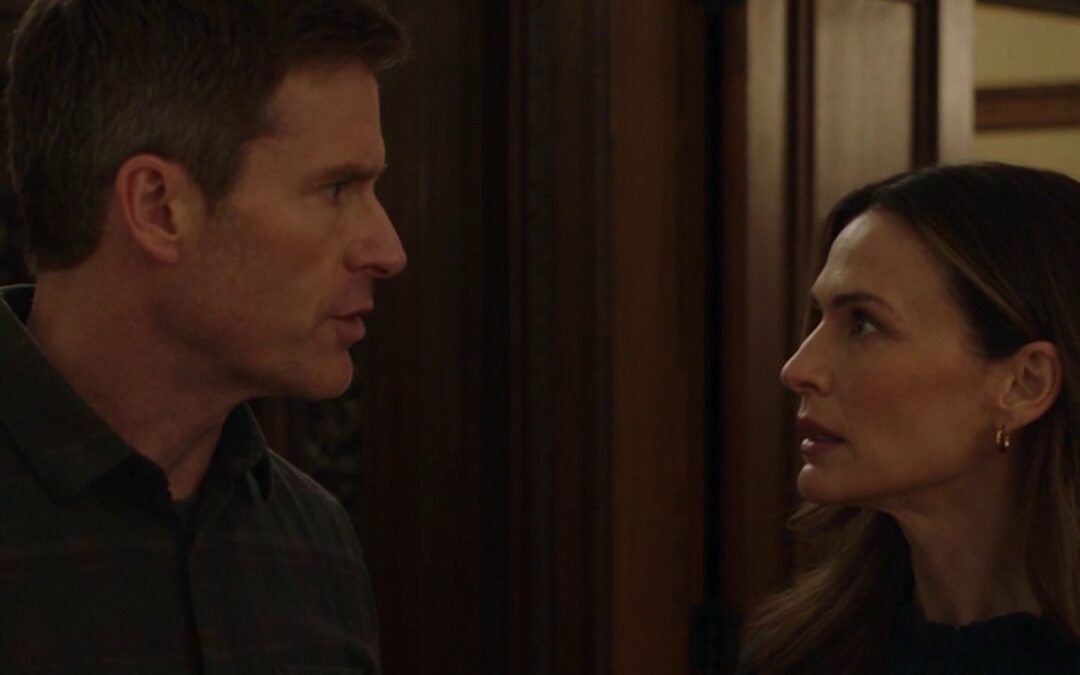
Chapter 2: The Room Behind the Glass
Cal did not strike again.
Wren clung to his wrist.
Vivienne stood between him and the door.
The mirror reflected the ballroom perfectly.
Except for the crack at its base.
“Cal?” the voice came again.
He stepped toward the glass.
“Who is this?”
A pause.
Then a scrape.
“Open it.”
Wren pressed her cheek to his sleeve.
“It’s Mom.”
Cal wanted to believe her.
The wanting scared him.
He turned to Vivienne.
“Unlock it.”
“I don’t have the key.”
The brass key still hung at her waist.
“Then why are you holding it?”
Vivienne looked down.
“I carry it for the restoration rooms.”
“Which room is behind the mirror?”
“There isn’t a room.”
The voice came again.
“Cal, please.”
He recognized Nora’s voice.
He knew grief could make a voice from anything.
He knelt at the seam.
“Tell me something.”
“What?”
“Something only Nora would know.”
The mirror stayed quiet.
Wren looked up at him.
“Dad, don’t make her prove it.”
“I’m not.”
The voice came closer.
“Your left shoe still has the blue paint.”
Cal looked down.
A blue streak marked his old shoe.
It came from the nursery dresser he’d painted the week before Nora died.
He had never mentioned the streak to anyone.
He’d been alone.
He rose too quickly and nearly stumbled.
“Open it,” the voice said.
Vivienne closed her hand around the key.
“Cal, listen to me.”
“No.”
“You don’t know what you’ll find.”
“Then tell me.”
She shook her head.
“Not here.”
“Here is where you brought us.”
“I brought Wren somewhere safe.”
“From what?”
Vivienne glanced at the mirror.
“From a mistake.”
The word made Cal grip the fireplace tool.
“What is behind it?”
She reached for Wren.
The girl recoiled.
That movement decided everything.
Cal held out his hand.
“Key.”
“No.”
“Vivienne.”
“I’m trying to protect her.”
“You’re standing between a child and a voice calling for help.”
“She’s not a child.”
“Then she can tell me herself.”
Vivienne looked at Wren.
Wren stared back.
“You said the room was empty,” Wren said.
“I said it was safe.”
“Those aren’t the same.”
For once, Vivienne had no answer.
Cal moved toward her.
“Unlock it.”
She stepped back.
“Give me a minute.”
“You’ve had eleven months.”
The line cut through the ballroom.
Vivienne’s face crumpled around something older than fear.
Cal took the key from her hand.
She didn’t resist.
Its teeth fit the hidden lock beneath the frame.
He turned it.
A bolt slid back inside the wall.
Then another.
The heavy mirror shifted outward.
He set down the fireplace tool and pulled its edge.
The frame opened like a door.
Behind it lay a narrow passage.
Cold air spilled into the ballroom.
Wren started forward.
Cal put an arm across her.
“Stay behind me.”
The passage ended at a plain wooden door.
It had no handle on the ballroom side.
Cal pushed.
The door opened inward.
A woman lay on a narrow cot, wrapped in a hotel blanket.
Her hair hung in dull waves around a face Cal knew from photographs and nightmares.
Nora.
Alive.
Cal forgot how to move.
She was thinner, but unmistakable.
A white scar crossed the back of one hand.
Her eyes were open.
Wren made a sound too small to be a word.
Nora tried to sit.
Cal reached her first.
He stopped inches away.
His hands hovered, afraid to touch her.
“Is it really you?”
Nora nodded.
“Cal.”
Wren broke free and ran to her.
Nora pulled their daughter close.
The embrace was clumsy, full of trembling arms and apologies.
Cal stood in the doorway.
The room smelled of dust, antiseptic, and old plaster.
A water bottle sat beside the cot.
An unplugged phone lay on a shelf.
A battery clock showed the wrong time.
There were blankets, a portable heater, and a locked cabinet.
Not a tomb.
A prison made comfortable enough to last.
“Call emergency services,” Cal said.
Vivienne nodded once and reached for her phone.
Nora held Wren’s face in both hands.
“I’m sorry.”
“You’re here,” Wren whispered.
“I’m here.”
Cal’s voice went flat.
“Who did this?”
Nora’s eyes shifted to Vivienne.
Vivienne stopped with her phone halfway to her ear.
“I didn’t put her here.”
“Did you keep her here?”
Vivienne lowered the phone.
“I did.”
Nora closed her eyes.
Wren pressed against her.
Cal wanted the years back.
He wanted the truth.
Instead, he called emergency services himself.
The dispatcher asked if there was an emergency.
“Yes. A woman has been confined behind a concealed wall.”
“What is your location?”
He gave the address.
“Is she conscious?”
“She is.”
“Is anyone armed?”
Cal glanced at the fireplace tool.
“No.”
“Can you keep the area secure?”
“Yes.”
Nora asked to speak to the dispatcher.
Her voice was weak but steady.
“My name is Nora Mercer.”
The dispatcher confirmed her identity.
Nora gave her date of birth.
“Do you know how long you’ve been there?” the dispatcher asked.
“Since last November.”
Cal’s knees nearly gave.
Eleven months.
The official death notice had arrived ten months ago.
Nora watched him understand.
“I’m sorry,” she said.
He couldn’t answer.
Sirens sounded beyond the hotel grounds.
Vivienne sank into a chair.
Wren stayed with Nora.
Cal stepped into the ballroom and called the number on the accident report.
His call went to voicemail.
He called the county sheriff’s office.
The dispatcher asked if he was reporting a crime.
“Yes.”
“Is the person in immediate danger?”
“She’s alive and needs medical attention.”
“Can you remain there?”
“Yes.”
“Do not disturb anything else.”
Cal looked at the open panel.
“Understood.”
He photographed the seam, the lock, and the hidden passage.
He took pictures of the cot and supplies.
He photographed the key before Vivienne set it on the table.
Each image felt like a betrayal.
Each might also keep Nora from disappearing again.
Vivienne watched him.
“You think I planned all this?”
“I think you know more than you’re saying.”
“I didn’t know she was alive.”
“You just admitted you kept her here.”
“I thought she’d died when I locked it.”
Cal turned.
“What?”
Vivienne pressed both hands to her mouth.
“I thought she’d died the night of the crash.”
“When?”
“The night it happened.”
“You said the doctors couldn’t save her.”
“I said what everyone was told.”
“Everyone?”
She looked at the floor.
“Your parents. The hospital. The police. Me.”
“Why?”
“Because she asked me to.”
Nora lifted her head.
“I did not.”
Vivienne looked at her.
“You don’t remember.”
“I remember every second.”
Emergency vehicles came through the gate.
A paramedic team entered, followed by a sheriff’s deputy.
They separated the adults to ask questions.
Nora was examined beside the cot.
Wren stayed close, gripping the blanket.
The deputy photographed the lock before anyone touched it.
The medics checked Nora’s pulse and blood pressure.
They asked about food, water, medicine, and pain.
Nora said she’d received meals daily.
She’d been given medication to keep her calm.
She had not been allowed outside.
The medic asked about allergies.
“Penicillin,” Nora said.
Cal knew that.
She always said it when they filled out a form.
He had missed ordinary details like that every day.
The medics helped Nora onto a stretcher.
Wren climbed into the ambulance beside her.
A deputy asked Cal if he wanted to ride along.
He looked at Vivienne in the corridor.
“I’ll follow.”
“You don’t have to stay here,” Vivienne said.
“I do.”
“Cal, I’m not going anywhere.”
“That’s the problem.”
The deputy escorted her to another room.
An investigator arrived and took Cal’s account.
He included the blue paint detail.
“Could your daughter have heard that from someone else?” the investigator asked.
“She could have.”
“Did anyone else know?”
“My sister may have.”
“Did you ever tell her?”
“No.”
“We’ll document it.”
The investigator asked why Cal had believed Nora was dead.
He described the notification call, the insurance paperwork, and the cremation certificate.
There had been no open-casket funeral.
They’d held a memorial at the hotel chapel.
The urn had been sealed.
He’d assumed the medical examiner had released Nora’s remains.
He realized he’d never asked who signed the release.
The investigator requested the certificate.
Cal had a copy at home.
They asked if Nora had enemies or reasons to disappear.
Cal thought of the month before the accident.
Nora had been worried about the hotel foundation’s accounts.
She’d found payments to a company called Halcyon Access.
It appeared on building records, but he’d never looked closely.
The investigator wrote that down.
At the hospital, Nora was treated for dehydration and exhaustion.
The doctors said she had no immediate emergency beyond that.
They kept her for observation.
Cal sat outside the examination room while Wren slept against his shoulder.
Nora asked for him once the nurse stepped out.
He entered and stopped beside the bed.
“I’m sorry,” she said.
“For what?”
“For making you think I was dead.”
“You were missing.”
“I know.”
“You let me bury an empty urn.”
Her eyes lowered.
“I know.”
“Why?”
Nora drew in a slow breath.
“Because I thought Vivienne had paid someone to kill me.”
“You were wrong?”
“Yes.”
“Then why stay hidden?”
“I heard her talking about your insurance.”
Cal gripped the chair’s back.
“What insurance?”
“The policy your father left you.”
“There was no policy.”
“There was one attached to the hotel trust.”
“I never saw it.”
“That was why.”
Nora had found the policy while auditing the foundation’s records.
The trust named Cal as beneficiary, with Vivienne managing the money until Wren turned eighteen.
Amendments would transfer control to Vivienne if Cal died or became incapacitated.
Nora had confronted her about payments that looked like bribes to a construction inspector.
She had spoken to Vivienne two days before the crash.
“Why didn’t you tell me?” Cal asked.
“I did.”
“When?”
“You said I was letting work get into my head.”
Cal remembered. He’d been late for school pickup.
Nora had left the papers on the counter.
He’d promised to read them later.
He hadn’t.
That wasn’t guilt’s fault.
It was still his failure.
“You had evidence?”
“I had a flash drive.”
“Where is it?”
“I don’t know.”
“Did Vivienne take it?”
“I don’t know.”
“She kept you here.”
“She thought I was dead when she put me in there.”
“She just admitted it.”
“I heard her.”
“What does that change?”
“Everything.”
Nora described the crash.
She’d left an evening meeting at the hotel when a delivery truck crossed the center line on the wet road.
She remembered the impact, then waking in a clinic room with Vivienne beside her.
Vivienne said Cal had been told Nora died.
She said police suspected the truck driver had fled.
She said the hotel faced danger from people connected to the construction contract.
Nora had a concussion and broken ribs.
She believed Vivienne.
For the first week, Vivienne brought medication and food.
Then she said police were asking questions.
She said the driver was connected to the foundation.
She said Cal would be safer if he never knew Nora survived.
Nora tried to leave.
Vivienne showed her a newspaper obituary, saying the body had been too badly damaged for Cal to see.
The family held a memorial.
“I thought she was protecting me,” Nora said.
“You said you heard her talking about insurance.”
“I did.”
“Before or after the crash?”
“Before.”
“So you believed her.”
“I was sick. Confused. I wanted her explanation to be true.”
Cal stared at the wall.
“You said she locked you in after she thought you were dead.”
“She said I could never come out once I knew she’d falsified the report.”
“That makes no sense.”
“It made sense to her.”
“She could have called the police.”
“She would have had to explain the accident, the records, and the money.”
“What happened to the driver?”
“I never saw him.”
“What happened to the clinic?”
“I never saw another patient.”
“Was it real?”
“I don’t know.”
The investigator returned and asked to speak with Nora.
Cal stepped out.
Wren woke and asked whether her mother would come home.
Cal told her he didn’t know yet.
He sat beside her on the floor.
“You found her,” he said.
“I heard her.”
“How?”
“I was looking for the star.”
“What star?”
“The silver one from Grandma’s box.”
Wren had carried it into the ballroom.
A paper star had slipped beneath the mirror.
She’d gone close to retrieve it.
The first knock came when she leaned to look under the frame.
“Did you hear a voice before that?”
“No.”
“Did Aunt Vivienne tell you to listen?”
“Not that day.”
“What did she say before we came?”
“She said Mom liked the ballroom.”
“That’s all?”
“She said she wished we could hear Mom again.”
Cal told the investigator.
The next morning, a detective came to the hospital with a forensic technician.
They asked to photograph Wren’s hands and the paper star.
They found nothing on the star.
They did find gray dust on Wren’s fingertips and along the mirror’s lower seam.
The technician bagged a sample.
The room behind the panel had likely been built during the hotel renovation.
The lock and interior latch would be examined.
A maintenance worker recalled installing an access panel behind the mirror.
He’d been told it would hold electrical equipment.
He had never entered the space.
The renovation invoices named the contractor, a small company owned by a family friend.
The foundation had paid them for soundproofing and climate control.
The detective asked who approved the work.
The signature belonged to Vivienne.
Nora said she’d never seen the room until she woke there.
The records supported her account.
They still didn’t explain everything.
Cal searched his home office that afternoon.
The certificate file sat beneath old tax returns.
The cremation certificate listed a funeral home in the neighboring county.
It had closed two years earlier.
The serial number belonged to a cremation performed on another date, for another person.
A state records clerk confirmed the entry was invalid.
The memorial urn had never held Nora’s ashes.
Cal closed the file.
The lie led closer to home.
A county clerk confirmed Nora’s death had never been registered.
The accident report listed her as missing, presumed dead.
Someone attached the fake certificate to the insurance claim.
The carrier had paid an accidental death benefit into Wren’s trust.
Vivienne controlled the account.
The amount was just over two hundred thousand dollars.
Some had gone to the hotel foundation.
Some had gone into Vivienne’s personal account.
The insurance company froze the remaining funds.
A judge would determine repayment.
Nora’s identity was confirmed through fingerprints from an old passport application.
A DNA comparison with Wren matched.
Cal watched the technician deliver the result.
“Does this mean she’s really my mom?” Wren asked.
The technician said the test supported it.
Wren looked at Cal.
“Can we go home?”
“Not today,” Nora said.
“Tomorrow?”
“We’ll see what the doctors say.”
“I want our house.”
Nora squeezed her fingers.
“So do I.”
The detective brought Cal another document.
A staff member had noticed a printer queue connected to an old maintenance account.
The document was a draft instruction for the renovation crew.
It called for a concealed room behind the ballroom mirror.
It listed an interior bell and a service latch.
The document had been created three days after Nora vanished.
The author field showed the foundation’s shared login.
The same user had approved the invoice.
Cal read it twice.
The words were plain.
Install access panel.
Seal frame.
Keep west corridor closed.
He returned to the hospital.
Nora was asleep.
Wren sat beside her, drawing a house with a bright red roof.
Cal kept the document in his coat pocket.
That night, he called a lawyer.
The lawyer recommended a family advocate for Wren and a criminal attorney for Cal.
He advised him not to confront Vivienne.
The sheriff’s office was building a case.
The investigators needed their own statements.
Cal understood.
He also knew it would be hard to follow.
The threat arrived the next afternoon.
An unknown number called his phone.
He answered in the hospital corridor.
“Cal Mercer?”
“Yes.”
“You need to stop cooperating.”
“Who is this?”
“You know what your sister can do.”
“Does she have a name for you?”
“Tell the detective the room was empty.”
Cal looked through the glass at Nora.
“What does that get you?”
“Your family gets to heal.”
“You locked my wife away.”
“I don’t know what you’re talking about.”
“Then why call?”
The line went dead.
Cal handed the phone to the detective.
The number came from a prepaid device bought at a gas station.
The caller couldn’t be identified.
The detective added it to the case file.
They installed temporary security outside Nora’s room.
Vivienne’s lawyer requested a meeting.
The detective refused direct contact.
Cal documented every attempt.
The evidence had to lead.
The next morning, a hospital social worker asked Wren what she wanted.
Wren said she wanted Nora beside her and a moon-shaped night-light.
The social worker arranged a child advocate.
Nora asked for a short walk in the courtyard.
Cal pushed her wheelchair past rain-dark trees.
They stopped beside a stone planter.
Nora laid her hand over his.
“I should have found a way out sooner.”
“You thought she had made us targets.”
“I did.”
“You tried to keep us safe.”
“I kept you grieving.”
“Vivienne did that.”
“I believed her.”
“She made the room.”
“I stayed in it.”
Cal looked at her hand.
The scar from the crash crossed its back.
“I should have listened when you showed me the papers,” he said.
“You were tired.”
“That isn’t an excuse.”
“No.”
“I’m sorry.”
Nora rested her head against the chair.
“I’m sorry too.”
He squeezed her fingers.
“I’m not ready to forgive her.”
“I’m not asking you to.”
The detective called three days later.
They had located the truck driver.
He’d been treated for a broken wrist and had not been charged.
He said the crash came from black ice and a missed turn.
Weather records supported his account.
He had no connection to the foundation.
The crash had been real.
Vivienne had used it.
The detective also located the clinic.
It had been a short-term rehabilitation office that later closed.
Its former director had treated Nora under her real name.
The records said Nora was discharged after three weeks.
The next entry used an alias.
The detective asked whether Nora remembered the director.
She did.
“Did she know you were confined?”
“I don’t know.”
The director said she thought Nora was recovering from surgery and staying voluntarily.
Vivienne had presented herself as a relative.
The files contained no statement from Nora.
Investigators couldn’t establish what the director knew.
The former clinic staff handed over their records.
The foundation accounts clarified Vivienne’s motive.
She had diverted money through the renovation company to cover shortfalls in the hotel’s operating budget.
The trust policy would have made her guardian of Wren’s inheritance if Cal died.
It would also have given her long-term control of the hotel property.
She wanted the hotel and its money under her control.
She believed Nora would report her.
The detective laid out the likely sequence.
Vivienne falsified the death paperwork.
She staged the memorial.
She claimed the insurance payment.
She hid Nora behind the ballroom mirror.
She kept Cal and Wren away for months.
When Cal’s finances forced him to leave his rental, Vivienne invited them back.
She expected him to accept her help and keep Wren occupied.
Wren’s paper star had fallen near the seam.
Vivienne had told her Nora loved the ballroom.
The detective couldn’t prove whether Vivienne meant Wren to hear the room or simply wanted her near the mirror.
The attempt to stop Cal from opening the panel proved the rest of her fear.
The room established confinement.
The records showed planning.
The insurance account established motive.
The threat call suggested help from someone else, but the caller remained unidentified.
The detectives widened their inquiry.
They traced the prepaid phone to retail sales, but the clerk recognized no one.
The threat stayed implied.
The criminal case moved forward.
The lawyer asked Cal to attend a recorded interview.
He brought the invoice and installation instruction.
The detective showed him a photograph of the interior panel.
A second latch had been installed inside.
It could not be opened from the ballroom.
Nora confirmed she could not release it.
The lock report noted an interior bell connected to a silent alert in Vivienne’s office.
The alert had been disconnected during restoration.
The panel had been designed to prevent discovery.
The detective said the case would go to prosecutors.
A week later, Vivienne was charged with unlawful confinement, fraud, and falsifying records.
She was released pending a hearing under a no-contact order protecting Nora and Wren.
Her lawyer challenged the charges.
He called the hidden room a medical retreat and argued that Nora had been confused after the crash.
He claimed the family had agreed to the arrangement.
Nora’s statement refuted that.
So did the interior latch.
So did the draft instruction.
The hearing took place at the county courthouse.
Cal sat beside Nora.
Wren stayed with her advocate in another room.
The judge limited the hearing to evidence for a protective order.
Vivienne arrived in a navy suit.
She looked composed and greeted no one.
Her lawyer argued that Nora had been vulnerable and Vivienne had kept her under care.
He said the family had complicated grief.
He said the room had been safe.
The judge asked why the door had no interior handle.
The lawyer called it a safety measure.
The judge asked why the lock report described a confinement latch.
The lawyer objected.
The judge overruled him.
The prosecutor presented the renovation invoice.
Then the installation instruction.
Then the invalid cremation certificate.
Then the insurance deposit.
Each document connected to another.
Vivienne’s lawyer said the insurance money went to Wren’s trust.
The prosecutor showed the personal account.
The lawyer said Nora’s testimony could not be trusted.
The judge looked at Nora.
“Are you able to answer questions today?”
“Yes.”
“Do you understand you may stop at any time?”
“I do.”
“Do you wish to proceed?”
Nora looked toward Cal.
He gave her a small nod.
She chose to answer.
Vivienne’s lawyer asked whether Nora had been left alone in the room.
“Yes.”
“Were you fed?”
“Yes.”
“Were you given medication?”
“Yes.”
“Did Ms. Mercer physically injure you?”
“No.”
“Then you were cared for.”
“I was confined.”
He held up a photograph of the shelf.
A phone sat there.
“Isn’t that a phone?”
“It was unplugged.”
“Could you have plugged it in?”
“There was no outlet near it.”
“Did you ask for help?”
“Every day.”
“Did you call your husband?”
“I was told he believed I was dead.”
“Who told you that?”
“Vivienne.”
“Did you believe her?”
“For a time.”
“Could your memories be mistaken?”
“Some could.”
“So you may be wrong about Ms. Mercer.”
“No.”
“How can you be certain?”
“Because she told me Cal would never hear I survived.”
The courtroom stayed still.
The prosecutor asked Nora about the hidden bell.
Nora had never heard it ring.
The technician explained it had once connected to Vivienne’s office, but the wire had been cut.
Then the decisive proof arrived.
The forensic lab recovered an audio file from the office system.
It had recorded automatically when the silent alert tripped.
The file had been stored on the server used for building access logs.
A technician found it while exporting the system history.
It recorded the first night Nora was placed behind the mirror.
The judge allowed it into evidence.
The audio crackled.
A chair scraped.
A door opened.
Vivienne’s voice came first.
“She needs to stay until she remembers.”
A man answered.
“She knows enough now.”
“She has a concussion.”
“She can still speak.”
“She won’t.”
“You can’t promise that.”
“I can promise Cal won’t hear it from her.”
The recording ended.
Vivienne’s lawyer asked to strike the file.
The judge refused.
Independent confirmation came from a former hotel accountant.
She had authorized the recording archive as part of the security system.
No one could delete files without leaving a trace.
The recording had not been edited.
The technician confirmed its date and integrity.
Cal felt Nora’s hand tighten around his.
Vivienne’s lawyer stood.
“She may have made a terrible decision under pressure.”
The judge looked at the invoice.
“Who designed the room?”
No one answered.
The prosecutor presented the foundation approval record.
The document bore Vivienne’s electronic authorization.
The audit trail showed who requested the panel.
Vivienne.
She had built the place that held Nora.
The bank records showed her motive: control over the hotel and its trust.
The recording showed she knew Nora was alive.
The judge granted the protective order.
Vivienne could not contact Nora, Cal, or Wren.
The hotel had to be preserved while investigators completed their work.
Outside the courthouse, Vivienne’s lawyer asked for a statement.
Cal kept walking.
A reporter called his name.
He stopped, but not for the camera.
“Do you blame your sister?”
“Yes.”
“Do you forgive her?”
“No.”
“Do you think she deserves prison?”
“I think the evidence should be heard.”
“That’s all?”
“That’s enough.”
Vivienne stood near the courthouse steps.
Her lawyer spoke to her.
She looked past him at Cal.
“Cal.”
He stopped.
The deputy shifted closer.
“You know I kept her alive,” Vivienne said.
“You kept her hidden.”
“She was safer than outside.”
“You decided that alone.”
“She was confused.”
“You decided that too.”
“I did what I had to do.”
“For the hotel?”
“For Wren.”
“No.”
“For all of us.”
“You chose yourself.”
She glanced toward Nora.
Nora stood beside the doorway with a blanket over her shoulders.
Vivienne’s face hardened.
“You think she’ll stay with you now?”
Cal held her gaze.
“She gets to choose.”
Vivienne’s last sting found no opening.
Cal turned away.
Nora waited until the deputies moved Vivienne toward the car.
Then she asked if he wanted to leave.
“Yes.”
They went home together for the first time in eleven months.
The house felt smaller than Cal remembered.
Unopened mail sat on the counter.
Wren’s moon-shaped night-light glowed beside her bed.
Nora stood in the kitchen and touched a chipped blue mug.
“You still use this.”
“Every day.”
“The handle’s loose.”
“I know.”
“I can fix it.”
“Not tonight.”
She nodded.
Wren climbed into her old bed.
She asked Nora to stay until she fell asleep.
Nora sat beside her.
Cal waited in the hall.
When Wren’s eyes closed, Nora stepped out quietly.
Cal made tea.
They sat across from each other at the kitchen table.
The old routines had returned before they were ready.
He set two cups down.
“Do you want to talk about court?”
“Not yet.”
“Do you want to talk about us?”
“Not yet.”
“Okay.”
He left his hand on the table.
Nora rested hers beside it.
They did not touch.
That was enough for the night.
Weeks passed.
Nora attended follow-up appointments.
Cal took leave from work.
Wren returned to school part time.
The family advocate visited twice a week.
Shoes appeared by the door.
A wet umbrella leaned against the wall.
Wren drew on the kitchen calendar.
Nora slept with the hall light on.
Cal never asked her to turn it off.
Vivienne’s case moved through the courts.
The prosecutor filed a broader fraud charge after the insurer supplied account records.
The hidden-room invoice and access log became central evidence.
The contractor agreed to testify.
He said Vivienne told him the room would be archival storage.
He installed the panel and never returned.
He admitted he should have checked the design.
His testimony supported the timeline without proving he knew Nora was inside.
The former clinic director provided her records.
She had documented Nora’s concussion and broken ribs.
She had recorded Vivienne as the primary contact.
She said she believed Nora was receiving family care.
She had no reason to suspect Nora was being held.
The prosecutor did not charge her.
The truck driver gave a formal statement.
The crash had been an accident.
There was no evidence he had been paid or directed.
The false story had grown around a real tragedy.
That made the accident report harder for Cal to look at.
It also meant the answer was clear.
No one had arranged the crash.
Vivienne had used it.
The unknown caller was never identified.
Detectives couldn’t prove whether the caller’s voice belonged to the man in the recording.
They continued investigating the transfers.
A civil hearing recovered the remaining insurance funds for Wren’s trust.
Vivienne’s lawyer argued the money had paid hotel repairs.
The court ordered her to repay what she’d taken.
The foundation placed her on leave and appointed an independent administrator.
Cal gave a statement at the board meeting.
He didn’t ask them to destroy the hotel.
He asked them to stop using it as cover.
The board agreed to preserve records and open the accounts to an audit.
Nora didn’t attend.
She wasn’t ready to sit in the ballroom.
The criminal case took months.
Vivienne pleaded guilty to fraud and unlawful confinement after prosecutors presented the audio, records, and Nora’s testimony.
The plea agreement included restitution and several years in prison, followed by supervised release.
The judge considered the confinement, deception, and danger to Nora.
He also considered the absence of physical violence and Vivienne’s clean record.
Cal attended sentencing.
Nora chose not to.
She had already given her statement.
Vivienne spoke before sentence was imposed.
“I believed I was protecting my family.”
The judge asked whether she understood Nora had never agreed to the confinement.
“I understand that now.”
The judge sentenced her.
A deputy led her away.
Cal did not watch the door close.
Outside, the air smelled like rain.
His lawyer asked if he wanted to appeal the restitution order.
“No.”
“Do you want to pursue the hotel trust?”
“I want it audited.”
“That can be arranged.”
Cal looked at the courthouse windows.
“Put Wren’s share in an account no one can touch.”
The lawyer said he would draft the order.
The offer arrived from Vivienne’s attorney three weeks later.
She wanted to transfer her remaining assets to the family.
Nora read the letter at the kitchen table.
The amount was generous.
It could pay Cal’s debts and cover years of care.
Wren would be secure.
Cal set the letter aside.
“I don’t want money from her.”
“Neither do I.”
“We could use it.”
“We can decide what happens to it.”
Nora turned the page over.
“Give it to the hotel’s worker fund.”
“The foundation?”
“An independent fund. For staff who lost wages.”
Cal watched her consider it.
“Are you sure?”
“I don’t want her money in our house.”
“Then it goes there.”
They asked the lawyer to arrange the transfer under court supervision.
The fund would support hotel staff left unpaid during the investigation.
No family member would control it.
The money became useful without becoming a pardon.
One evening, Nora stood by the front door with her coat.
“I want to go back to the hotel.”
Cal stopped folding laundry.
“Today?”
“Tomorrow.”
“Do you want me there?”
“Yes.”
“Wren?”
“She wants to come.”
“Are you sure?”
“No.”
They looked at each other.
Nora’s mouth shifted.
“That’s still yes.”
He nodded.
They drove to the hotel the next afternoon.
The entrance stood behind its iron gate.
The sign read MERCER HOUSE, the name their father had chosen.
The city had closed the ballroom during the investigation.
A preservation officer met them at the side entrance.
The chandelier was covered.
The mirror stood behind a clear evidence barrier.
The panel remained open.
Nora didn’t approach it.
She looked at the seam from across the room.
Wren held her hand.
“Do you want to leave?”
“Not yet.”
They stood without talking.
After a few minutes, Nora took one step closer.
Cal stayed beside her.
The investigators had removed the panel.
A temporary board covered the opening.
The room behind it had been emptied.
A conservation team would repair the wall once the case ended.
Nora asked whether the mirror could be moved.
The preservation officer explained it could be removed carefully, but the frame was original.
Nora asked for time to think.
The officer gave her a form.
A month later, she requested that the mirror be moved to the hotel archive.
The wall would be closed with ordinary plaster.
The mirror would no longer face the ballroom.
The board approved her request.
Vivienne sent an apology through her lawyer.
It came on plain paper.
I told myself I was protecting everyone.
I know now I was protecting my control.
I’m sorry for taking your choices away.
I’m sorry for the years I stole from your family.
Nora read it once.
She set it aside.
“She wrote what she did,” Cal said.
“She did.”
“Does that help?”
“No.”
“Do you want to reply?”
“No.”
She folded the letter and placed it in a file.
Her boundary was simple.
No visits.
No letters without a lawyer.
No contact with Wren.
The court order already said the same.
Nora wouldn’t weaken it to make Vivienne feel better.
Wren asked about her aunt one night.
“Is she still mad at us?”
Cal thought before answering.
“I don’t know what she feels.”
“Can I see her?”
“No.”
“Ever?”
“Not while the order is in place.”
“What if I want to later?”
“Then we’ll talk about what you want and what feels safe.”
Wren leaned against Nora.
“Okay.”
Months passed.
Nora slept better.
She still woke when pipes knocked.
The family found a different bedroom arrangement.
Wren slept with her door open.
Cal stayed in the room next door.
Nora chose to sleep in her own room again.
Their life did not return to what it had been.
It grew into something else.
One Saturday, Cal tried repairing the blue mug.
He bought ceramic adhesive.
Nora watched him at the kitchen table.
“You’re using too much.”
“I’m not.”
“You are.”
“I’ve watched videos.”
“Those don’t count.”
Wren sat between them, laughing.
“Dad, the handle’s crooked.”
“It’s a repaired handle.”
“It looks like an elbow.”
Nora covered her mouth.
Cal looked at the mug.
The handle did look like an elbow.
He laughed too.
It was the first time the three of them laughed together without checking whether they were allowed.
Cal set the mug on a shelf.
It would never hold coffee again.
Wren decorated it with a paper star.
The adhesive dried clear.
Later, a civil court finalized the trust audit.
The missing funds were repaid in installments.
The hotel workers received back pay from the independent fund.
The foundation hired a new director and published its accounts.
Cal refused a board seat.
Nora agreed to advise the preservation project after the ballroom wall was repaired.
She worked from home at first.
Then she took one meeting at the hotel.
Then two.
She set the pace herself.
The public learned only the facts made available in court.
Some called it a family tragedy.
Others called it a crime.
Cal refused interviews.
The hotel released a statement about restitution and new oversight.
No one used Nora’s name without permission.
A year after Nora’s rescue, the family visited the hotel courtyard.
The ballroom remained closed.
They sat beneath the old clock.
Wren brought the silver paper star from her grandmother’s box.
She’d kept it safe in a kitchen drawer.
Cal asked what she wanted to do with it.
“Put it where Mom can see it.”
Nora looked at the star.
“Do you want it in the ballroom?”
“Maybe.”
“Not today,” Cal said.
Wren nodded.
“Not today.”
A few days later, she placed the star beside the blue mug.
The objects sat together on the shelf.
The star had once fallen under the mirror.
The mug had once sat in their kitchen as if nothing could change.
Now they meant something else.
They meant a family could return to familiar rooms without pretending the past was harmless.
The legal case continued through appeals.
The sentence stood.
The no-contact order remained.
The insurer recovered its payment.
The trust stayed protected.
The unknown caller was never charged.
Detectives closed that lead after exhausting the records.
Cal accepted the limit of what they could prove.
At home, he and Nora began counseling with a clinician who specialized in families after traumatic events.
They didn’t use it to force reconciliation.
They used it to talk without rushing.
Sometimes they left with more questions.
Sometimes they sat quietly in the car.
They learned not to treat quiet as proof of healing.
A year and a half after the rescue, Nora asked Cal to walk with her near the river.
They took the path where they’d gone on their second date.
They’d argued about which way the water flowed.
Cal had been wrong.
Nora remembered.
“You still owe me dinner,” she said.
“I bought you dinner that night.”
“You argued the whole way.”
“That wasn’t part of the bill.”
“It was part of the evening.”
He smiled.
“I can take you somewhere nicer.”
“No.”
“Why?”
“I want the place with the bad fries.”
“The diner?”
“Yes.”
They went the next week.
Wren came along.
She ordered pancakes at seven in the evening.
Nobody corrected her.
Ordinary things began to fill the family’s days again.
Homework.
Groceries.
A school play.
A leaking faucet.
Nora’s appointment reminders.
Cal’s late meetings.
Wren’s paper stars.
They weren’t untouched by what happened.
They were a family that knew what had happened.
They could speak of it when they needed to.
They could also leave it alone.
Vivienne sent a second letter after sentencing.
I understand you may never forgive me.
I will respect the boundary.
Nora didn’t reply.
She kept the letter with the court papers.
That wasn’t forgiveness.
It was recordkeeping.
When Wren turned nine, she asked whether they could visit the ballroom again.
Nora looked at Cal.
He didn’t answer for her.
Nora asked Wren what she wanted to see.
“The star,” Wren said.
“It’s at home.”
“The ceiling.”
Nora considered it.
“Could we go in for five minutes?”
The preservation officer arranged a visit.
They entered through the side door.
The restored wall was plain.
The old mirror had moved to the hotel archive, where it rested behind a sign explaining its history.
The ballroom looked larger without it.
Sunlight reached the floor in long rectangles.
Wren held Nora’s hand.
Cal held a paper star.
They placed it on the window ledge.
The star would not fall through the floor.
“Can we come back?” Wren asked.
“Yes,” Nora said.
“Whenever you’re ready.”
Cal took her hand.
Nora took Wren’s.
They left together.
The star stayed on the ledge until the staff closed the room.
Years later, the ballroom became a public reading room.
The hotel foundation funded it with money no single family member could control.
The wall behind the old mirror held shelves of children’s books.
The former access room was sealed and inspected.
Its plans went into the public archive.
Cal attended the opening with Nora and Wren.
Wren was twelve now.
She chose a book about astronomy.
A paper constellation hung above the children’s table.
The old brass key sat in a glass case beside the renovation records.
Its label explained how the hidden door had been found.
It no longer belonged to Vivienne.
It no longer opened anything.
Wren stood in the center of the room.
“Do you hear it?”
Cal looked at her.
“Hear what?”
“Nothing.”
Nora touched the back of Wren’s head.
They listened.
The pipes clicked once.
The building settled.
Nothing answered from behind the wall.
Wren smiled.
“Good.”
Cal looked at the paper stars overhead.
“Good,” he said.
At the exit, Nora paused beside the new wooden door.
“Do you want to come back next week?” she asked Wren.
Wren held up her book.
“I want to finish this first.”
“Fair.”
Cal took the paper star from his pocket.
It was silver, folded carefully, and softened at the edges.
He set it on the shelf beneath the reading room sign.
A child’s hand could reach it.
No lock held it there.
No one had to listen through glass.
They walked into the late afternoon together.
The door clicked shut behind them.
The quiet stayed quiet.
THE END




