The Server Knocked a Hungry Boy’s Bread Away—Then a Dropped Photograph Stopped the Reception
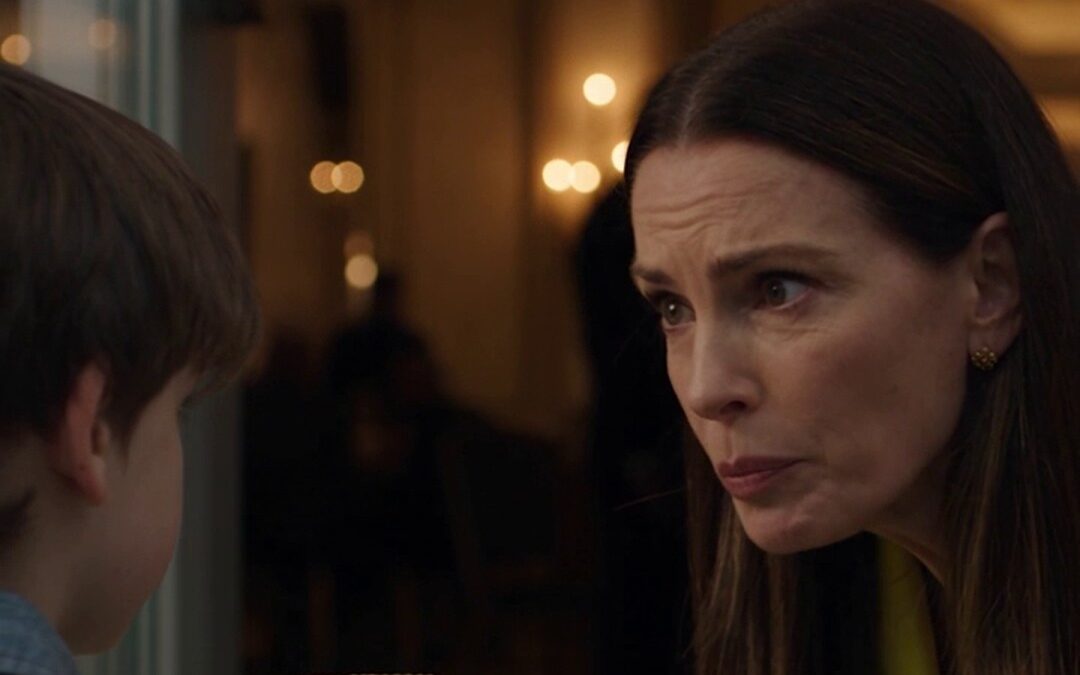
Chapter 1: The Picture on the Paving
The server knocked the roll from Mateo’s hand. “Not in the doorway, kid.”
It struck the pale stone and skidded beneath a brass stanchion. Mateo flinched, then crouched to retrieve it before anyone could step on it. The bread was stale at the edge but still whole. He held it close against his faded blue shirt.
His other hand went to his pocket.
The little black-and-white photograph slipped out anyway, fluttering faceup beside his knee.
“Careful,” said the server, a tall woman in a plum-colored jacket with a silver name tag that read DENISE. She stood between Mateo and the bright reception hall. “Guests only past the doors.”
“I’m not going in,” Mateo said. “I’m waiting.”
“Then wait over there.”
“Please don’t step on that.”
Mateo reached for the photograph. A woman in a lemon-yellow suit reached it first. She had been leaving the reception, where white flowers and green glass caught the afternoon light. Her name was Celia Vale; the small gold pin on her lapel identified her as the hotel’s honored guest.
She lowered herself onto one knee and lifted the worn print by its edges.
“Is this yours?” she asked.
Mateo stood, bread cupped in both hands. “Give it back, please.”
Celia stared at the picture. A younger version of her looked out from it, hair pulled into a loose knot, exhaustion softening her face. She was holding a newborn wrapped in a striped blanket. One corner of the photo had a crescent-shaped crease. Celia’s thumb paused beside it.
“I remember this room,” she whispered. “The hospital had a blue clock. My sister took this.”
Mateo stepped closer. “That’s why I keep it flat.”
Denise glanced toward the open doors. “Ms. Vale, I can have someone find the boy’s—”
“Don’t,” Celia said, still looking at the photograph. Then to Mateo: “Did you find this somewhere?”
“No. It belongs to my grandma June.”
“Your grandma?”
“She gave it to me.” Mateo watched Celia’s fingers. “You have to hold it by the sides. The middle’s rubbed.”
Celia turned the image toward him. “She told you who the woman is?”
Mateo nodded, but his chin quivered once before he steadied it. “She said you were my mom.”
The music inside seemed to go thin. Celia looked again at the tiny bundled baby, then at Mateo’s narrow face. Recognition alone could not tell her who the infant was. She swallowed.
“How old were you when June told you?”
“Last summer. She said the picture was from the day I was born.” Mateo pointed to the newborn’s blanket. “That’s me in there.”
Chapter 2: The Name on the Back
Celia’s fingers tightened around the photograph, then loosened. She stayed on one knee, the picture balanced by its edges, while Mateo stood before her with the stale roll cupped in both hands.
“That’s me in there,” he had said.
The words sat between them, small and certain. Behind Celia, the reception doors stood open to the afternoon light. A string quartet tuned inside; a few notes floated out, bright and unfinished. Denise remained beside the brass stanchion, her plum jacket catching a stripe of sun. The roll lay where it had stopped near the post.
Celia looked from the tiny bundle to the boy’s face. She remembered the striped blanket, the blue hospital clock over her shoulder, and her sister June taking the picture. She did not remember the baby’s name.
“Mateo,” she said. Her voice came out quieter than she intended. “Who told you the baby was you?”
“Grandma June. She said this was the day I was born.”
“Does she know you’re out here?”
“She’s inside, by the fountain. Her knee hurts if she walks too long. She was calling Uncle Ben.”
Celia followed his glance through the glass doors. A gray-haired woman in a rust-red cardigan sat beside the fountain, a folded cane against her chair, phone at her ear. She had one hand cupped over the microphone and was looking toward the staircase, as if expecting someone to appear there.
“Is that June?”
“Yeah.”
“Can we bring her over?”
Mateo’s eyes dropped to the picture. “Can I have it first?”
Celia held it out. Mateo took it with both hands, watching her fingers until the paper was safely in his. He put it against his chest.
“I didn’t bend it,” she said.
“I know. The middle’s rubbed.”
He touched the worn patch through the plastic sleeve, then slipped the picture into his pocket. Celia kept her hands where he could see them. She had the urge to reach for his shoulder, to reassure him with a gesture he had not invited. She let the urge pass.
Denise, the server in a plum jacket, stood beside the stanchion. She glanced at the roll, then at the doorway. “I didn’t know he came with someone. I thought he was reaching for the kitchen tray.”
“I was picking up the bread,” Mateo said.
The roll lay near the brass post. He picked it up and held it close. Celia saw a dark mark on one edge.
“You shouldn’t eat that,” she said. “I can get you something fresh.”
“I wasn’t going to eat it now. It’s dirty.”
“Would you like a sandwich?”
“Can I take it to Grandma?”
“Yes. We can bring her one too.”
“Plain cheese. No green stuff.”
“Cucumber?”
“That’s green stuff.”
A smile tugged at Celia’s mouth. She let it show, then caught herself before reaching for his shoulder. “Plain cheese.”
Denise glanced toward the hall. “The event lead told us to keep the doorway clear.”
“He was outside the doorway,” Celia said.
“I still shouldn’t have knocked it from his hand,” Denise replied. Her face had gone red. “I’m sorry, Mateo.”
He looked at her hand, not her face. “It stung.”
“I’m sorry.”
Mateo did not answer. Celia held the door open. She waited while he decided whether to go inside, and he glanced once toward the fountain before stepping through. He tucked the picture into the inside pocket of his faded blue shirt. The spoiled roll stayed in his other hand.
June lowered her phone when they reached the fountain. Her eyes went first to Mateo, then Celia, then the pocket where the photograph showed beneath the fabric.
“Is he all right?” she asked.
“He’s okay,” Celia said. “He’s hungry. He asked for sandwiches.”
June looked at Mateo. “You found the rolls?”
“One was on the tray.”
“You should have told me.”
“I did. You said Ben had food in his bag.”
“I thought you were beside me.”
“I was, then I wanted a drink.”
June rested her hand on the cane. She did not scold him again. “I looked away too long.”
Celia pulled out a chair but did not sit until June nodded. “May I talk with you both?”
“You can talk here,” June said. “Mateo stays with me.”
“Of course.”
A catering captain in a white-and-coral jacket came over. “I’m Lorna. I’ll bring two plain cheese sandwiches, water, and fruit.” She glanced at Mateo. “Anything else?”
“Apple slices,” he said.
“Coming up.”
June thanked her. Mateo sat beside his grandmother, not beside Celia. He kept his hand over the pocket containing the photo. The position seemed deliberate: his shoulder touching June, his face turned toward Celia, his hand guarding the small rectangle.
Celia watched him for a moment. “June, I need to understand what you believe happened.”
June looked at Mateo. “He knows some of it.”
“I can hear,” he said.
“All right,” June replied. “You can stay.”
“Grandma told me Mom went away when I was a baby,” Mateo said.
Celia flinched at the word, but did not correct him. It was not his word for her; it was a fact someone had taught him. “Did she say why?”
“She said you were far away and couldn’t come back.”
“I told him you were in another state,” June said. “I never said you didn’t want him.”
“What did you believe?” Celia asked.
“That you needed time. Ruth said you were overwhelmed, that you’d asked not to be contacted. She said you’d moved.”
“My mother told you I asked for no contact?”
“Yes. She said you wanted a clean break.”
Celia felt the phrase strike a memory. Her mother, Ruth, had used those words years ago, when Celia was trying to leave a difficult relationship and finish her nursing prerequisites. *You said you needed a clean break from everything,* Ruth had told her. Celia had meant the school, the nights at the clinic, and her former boyfriend’s threats to contest the baby’s paternity. She had not meant her child.
“Did she ever show you a message from me?” Celia asked.
“No.”
“A letter?”
“No.”
“Did you ask me directly?”
June met her eyes. “I should have.”
The catering captain returned with the food. She set down two sandwiches, water, and fruit without making a ceremony of it. Mateo examined his sandwich, lifting one side of the bread to check.
“No green stuff.”
“No green stuff,” Lorna said.
He took a bite, chewed, then let his shoulders drop. The tight set of his jaw eased. Celia asked for water and fruit too. When Mateo packed half a sandwich in a napkin, Celia saw him do it carefully, saving it for later.
“Why are you at the reception?” she asked.
“Uncle Ben works here,” Mateo said. “He fixes the lights. He gave us passes so Grandma could see the flowers.”
“He got called upstairs when a fixture broke,” June added. “We arrived early. I thought Mateo was still beside me when I picked up my phone.”
“Are you staying nearby?” Celia asked.
“On the east side. We have a month-to-month apartment.”
Celia glanced at the cane. “Would a ride home help?”
“Ben will come when his shift ends,” June said. “We can wait.”
“I can call him,” Mateo said. “He knows we’re here.”
June looked at him. “You came out to the entrance without telling me.”
“I told you I wanted air.”
“You said you’d stay by the fountain.”
“I did. Then I got hungry.”
Celia did not interrupt. June’s answer would not erase the boy’s reason or her own part in losing sight of him. Mateo watched both adults, as if their words might decide whether he had done something wrong.
She turned back to the photograph. “May I ask about the writing on the back?”
Mateo touched his pocket. “Grandma said there’s writing. She read it. I can’t read cursive yet.”
“Would you let me see it?”
He considered. “Only by the sides.”
“Only by the sides.”
Mateo drew it out and placed it in Celia’s palm. She turned it without bending the paper. In June’s unmistakable handwriting, beneath a yellowed strip of tape, were the words: *Celia and baby M, 2:14 p.m. June 8.*
The date was Mateo’s birthday. His name began with M. The words fit, but a photograph could not prove who the baby was.
“Did Grandma tell you what the M meant?” Celia asked.
“Mateo. She said Aunt June wrote it while I was still at the hospital.”
“Did she tell you how she got the picture?”
“She had it in her desk. It was with my bracelet and a note.”
“Did you take it from there?”
“No. She gave it to me last summer. She said I could keep it because I was asking about where I came from.”
“What did you ask?”
“Why I don’t look like Uncle Ben.”
Ben was June’s nephew. Celia could see the family resemblance between him and June, but not Mateo. “What did she say?”
“She said she wasn’t my mom. She said you were, and this was you holding me. She said you were my mom even if I didn’t know you.”
“Did you believe her?”
“Yes.”
“Why bring it today?”
“Grandma said we were going to the hotel. I wanted to see if the picture was really from here.”
“It was taken at the hospital,” June said. “Not here.”
“I know that now.”
Mateo took the print back and slipped it into the plastic sleeve June had brought in her bag. The gesture told Celia the photograph was more than a clue. It had belonged to his life before this doorway. He did not look at her for permission to keep it.
“Can I speak with June alone for a few minutes?” Celia asked.
Mateo’s hand tightened on the sleeve.
“You can stay beside her,” Celia said. “Or we can wait until Ben gets here. You choose.”
“I’ll stay.”
“Okay.”
June said, “You can ask what you need to ask.”
“Why did Mateo come to live with you?”
“Ruth brought him to me when he was nine months old. She said she and Paul were separating and couldn’t manage him. She asked me to take him for a week.”
“And he stayed.”
“The week became a month. Then the rest of the year. I was working part-time at the library. My husband was sick. We made it work.”
“Did you know I wanted him back?”
“I knew you’d asked for him at the hospital.”
Celia stared at her. “I did?”
“You asked me to take him for a few days while you recovered. You said you wanted him nearby. Ruth told me you’d changed your mind.”
“I remember asking for help. I don’t remember agreeing to send him away.”
“You said you wanted to rest,” June replied. “I asked if you wanted me to take him for a few days. You said you didn’t want him out of your sight.”
Celia closed her eyes. She remembered a long labor, pain, and fear that she might drop the baby when she lifted him. She remembered Ruth insisting she needed sleep, promising that the baby would be back beside her as soon as she felt stronger. She had signed forms while exhausted and trusted her mother to explain them.
“Did you take him home anyway?” she asked.
“Ruth was holding him. She said you were upset and wanted me to take him. She put him in my arms and told me you’d thanked her for arranging it.”
“I didn’t.”
“I know that now.”
“Why didn’t you come back the next day?”
“Ruth said you were sleeping and asked me not to disturb you. Then she called and said you wanted to be alone. I thought you’d call when you were ready.”
“I called her twice,” Celia said. “I thought you’d taken him to Arizona.”
“I never went to Arizona.”
“My mother said you had.”
June looked down at the table. “She told me you’d moved and didn’t want me to contact you.”
Neither of them had spoken directly. Each had trusted Ruth’s account and treated silence as confirmation.
Mateo put down his sandwich. “So Grandma thought Mom didn’t want me?”
“I thought she needed time,” June said. “I didn’t think you were unwanted.”
“Did you think she didn’t want to see me?”
“I thought she wasn’t ready. I should have checked with her.”
Celia leaned toward him, keeping her hands on the table. “I wanted to see you. I wanted you with me.”
“But you didn’t,” Mateo said.
“No. I didn’t. That’s true too.”
“Why?”
Celia considered telling him everything at once: her mother’s lies, the calls she had made, the years she had believed the child was elsewhere. Instead she answered what he had asked.
“I believed things I should have checked. I let someone else tell me what you needed. I should have gone to the house myself.”
“You didn’t know where I was.”
“I knew your grandmother’s address. I could have gone there.”
June’s expression tightened. “You did come once.”
“When?”
“In the spring. You came to Ruth’s house. I saw you from the porch. Ruth told me to take Mateo through the back door. She said you weren’t ready.”
“I was there for him?”
“I thought you were there to see Ruth. She told me you hadn’t asked about Mateo.”
Celia could picture the house and the wet sidewalk. She remembered leaving flowers on Ruth’s porch and driving away, believing June had moved.
“Neither of us knew the other was there,” she said.
June nodded. “Ruth told us different things.”
Mateo rubbed his thumb along the edge of the photo sleeve. “Was the picture in Grandma Ruth’s house?”
“I think so,” June said. “It was in an envelope with your bracelet and a note when she brought you to me.”
“What did the note say?”
“That’s yours to read,” June replied. “It’s at home.”
“You haven’t read it?”
“No. It was addressed to you.”
“Can I read it today?”
“If you want.”
“I want to.”
Celia’s throat tightened. “I wrote something for you at the hospital. I don’t remember what I said.”
“Then you can read it with us,” Mateo said.
“I would like that.”
A catering captain placed a small paper bag beside him with two sandwiches and fruit. Mateo put one sandwich aside for Ben.
“Can we take one to Uncle Ben?” he asked.
“Of course,” June said.
Celia did not ask about the contents of the apartment, the rent, or what they could afford. June had guarded her privacy, and Mateo was sitting between them, listening to every answer.
“Would a ride home help?” she asked again.
“Call Ben,” Mateo said. “He’ll be here when he’s done.”
June gave him her phone. “You can call.”
He handed it back. “You call. I already talked to him this morning.”
June dialed. Ben answered over a clatter of tools.
“Grandma? Did the lights come back?”
“Not yet. We’re by the fountain. Mateo’s fine. We need a ride when you finish.”
“Is he hurt?”
“No. A server knocked bread out of his hand.”
“What?”
“It’s handled. We’re with Celia Vale.”
A pause. “Celia Vale?”
“His mother,” June said quietly.
“I’m coming down as soon as I can.”
“Finish your job,” June said. “We can wait.”
“I’ll tell the supervisor I need a few minutes.”
“Don’t lose pay because of us.”
“I won’t.”
June ended the call. Celia asked if she could arrange an appointment for June’s knee.
“No,” June said. “I have one next Thursday.”
“Then I won’t change it.”
“You can help with things,” June said, “but you need to understand I’m his grandmother in the ways that count. You can’t make up seven years by deciding you’re in a hurry.”
“I know.”
“And Mateo isn’t a story you get to tell at a fundraiser.”
“I won’t tell anyone. I’ll tell the event manager what happened at the door.”
Mateo looked up. “I want to tell him too.”
“You can,” Celia said. “You don’t have to.”
“I want to say the bread was on the ground and she hit my hand.”
“Then we’ll go together.”
June picked up her cane. “I’ll come.”
They went to a small room near the ballroom. The reception manager, Lawrence, met them there. He lowered himself into a chair so he could speak to Mateo at eye level.
“Lorna told me what happened,” Lawrence said. “I’m sorry.”
“Denise said the rolls were for the kitchen,” Mateo said. “I saw one. She moved the tray, and I reached for it. She knocked it out of my hand. It went under the post. When I picked it up, it was dirty. Her hand hit mine.”
“Did it hurt?”
“For a minute.”
“That shouldn’t have happened.”
“Are you going to say she didn’t do it because I wasn’t supposed to be here?”
“No,” Lawrence said. “You were hungry. She could have found your adult or asked you to wait. She shouldn’t have knocked the bread away.”
Mateo nodded. “Okay.”
Lawrence said the hotel would document the incident and review staff training. He promised a private apology to June and said no public report would use Mateo’s name. The decision about Denise’s job belonged to management, not the boy.
“I can take responsibility without losing my job,” Denise said from the doorway. She had followed them in, then stopped several feet away. “I’m sorry I hit your hand.”
Mateo glanced at her. “Okay.”
Lawrence asked Denise to step away while they completed the review. She did so without arguing. Celia watched her go, then looked back to Mateo. The apology had not erased what happened, and Mateo had not been asked to make it disappear for the adults’ comfort.
Ben came down carrying a coil of cable. He checked on June first, then crouched beside Mateo.
“You okay, champ?”
“Yeah. I got a sandwich.”
“Good.”
Ben’s gaze settled on the sleeve in Mateo’s hand. “Is that the picture?”
“You’ve seen it?” Celia asked.
“June keeps it in a drawer with his hospital bracelet. I know what it is because she told me.”
“Did you know Celia was his mother?”
“Not until today.”
Celia looked at June. “How did you handle his school records?”
“I listed myself as the caregiver. The school accepted a statement that I’d been responsible for him. I didn’t put your name on a form that asked for a legal guardian.”
“Did you ever seek guardianship?”
“I spoke to legal aid once. They said I’d need to notify both parents. Ruth told me you were out of state and didn’t want contact. I didn’t file.”
“Why not?”
“I was exhausted. My husband was ill, and I had Mateo. I thought waiting kept the door open if you came back.”
“You were trying to protect him,” Celia said.
“I was trying to keep things stable. But I should have checked the story.”
Ben’s supervisor called. He had to finish the lighting repair, but promised to meet them in ten minutes. June wanted to take Mateo home and look at the note there. Celia agreed.
At the apartment, Mateo set his food on the kitchen table, then went to his desk and brought back a map covered in straight colored lines. He smoothed its curling corners with the flats of his hands. Celia stood back, leaving space for him to decide how much of it to show.
“This is the bus route to school,” he said. “Red is the one I take with Grandma. Blue is Ben’s route to work. Black is the light rail.”
Celia looked without touching. “You made all of that?”
“It took four days. The six is my favorite. It goes over the bridge, and you can see the boats.”
“I’d like to ride it sometime.”
“Maybe.”
“Okay.”
He pointed to one stop, then traced the route with his finger without dragging it across the paper. “This one’s the library. Grandma says we can go there after school if I finish my reading.”
“I like libraries,” Celia said.
“Do you read books?”
“Yes.”
“What kind?”
“Mostly mysteries.”
“What’s a mystery?”
“A story where someone has a problem to solve.”
“I like those. I solve the bus map.”
“I can see that.”
June took a manila envelope from a desk drawer. “This is the note. You can read it alone, or I can read it.”
“Can you read it? Not fast.”
June opened the envelope. “It says, ‘For the baby, when he asks.’”
“What else?”
June began:
“Dear little one,
“I don’t know when you’ll read this. You have a small hand that closes around my finger, and I keep trying to remember every sound you make. The nurse says you’re patient, but I think you’re saving your complaints for when I’m tired.
“Your name is Mateo because I liked the way it sounded. I hope you get to keep it. I want you to know you were wanted by me, even when I’m scared. If I need help, it doesn’t mean I don’t love you. If you ever live somewhere else for a while, it will be because the grown-ups are trying to figure things out, not because you did anything wrong.
“If you want to know me one day, ask Aunt June. She will tell you the truth as best she can. I’m trusting her to keep this safe until you can read it. I love you. Mom.”
June’s voice had slowed over the last lines. She held the paper by its edges too, though it was not as worn as the photograph. Celia recognized the words, though she had not remembered writing them. She had meant the temporary stay she thought she was arranging, not the years that followed.
Mateo touched the paper. “You wrote that?”
“Yes.”
“You said I could ask Grandma June.”
“I did.”
“You trusted her?”
“I did.”
Mateo looked at June. “You kept it.”
“I did.”
“Why didn’t you read it before?”
“Because you hadn’t asked. I wanted your mother’s words to be yours, not mine.”
“Can I keep it?”
“It’s yours,” June said.
He laid the note beside the photograph, not on top of it. “Does it prove I’m your baby?”
“It proves I wrote to a baby named Mateo,” Celia said. “The picture and hospital records can help confirm the rest. We should check before we call it certain.”
June brought out a wooden box. Inside were the hospital bracelet, knitted booties, and discharge papers. The bracelet read *Baby Vale, June 8*, with *Mateo* written by hand in blue ink. The patient number matched the discharge packet.
Celia recognized the handwriting as hers. “I wrote his name.”
“I saw you do it,” June said.
The blue ink had faded at the edges. Celia could still see the point where her pen had pressed hard on the M. She remembered the nurse asking what she wanted the baby called and the brief, strange certainty of choosing a name for someone she had not yet held long enough to know.
The matching date, inscription, note, and bracelet supported the story. June’s firsthand account gave it context. Celia still wanted the hospital records confirmed through proper channels, with June’s consent and Mateo’s understanding.
“Would you consider a family counselor?” she asked. “Someone who can help us talk without turning it into a courtroom.”
“Would we have to go to court?” Mateo asked.
“No. A counselor helps people work through changes. You can bring your map. June can come too, if you want.”
“I do.”
June opened the discharge packet. One page authorized Ruth to take the baby home for temporary family care, with no end date filled in. Celia’s signature was at the bottom.
“I thought this was a car-seat release,” Celia said.
“Ruth put papers in front of you,” June replied. “You signed while you were in bed. I wasn’t in the room.”
The form allowed routine decisions for up to thirty days. It did not transfer custody.
“This didn’t say I was giving him away,” Celia said.
“No,” June answered.
“Did you see it before you took him?”
“No. Ruth said you had agreed. I trusted her.”
“What did she want?” Celia asked.
June’s eyes moved to the box. “She wanted to be needed. She’d had two miscarriages. She thought you were making bad choices and that she could give Mateo more stability.”
“Did she say I had given up my rights?”
“No. She said you needed distance. She loved him. She also liked being the person he depended on. Both can be true.”
Celia looked at Mateo, who was studying the bracelet. “You didn’t cause any of this,” she told him. “The adults made the decisions.”
“Did Grandma Ruth know we were short on food?”
“I don’t know,” June said. “She helped with rent at first. Later, I managed.”
“Sometimes we have to wait for groceries,” Mateo said. “Grandma says there’ll be breakfast, but I still worry.”
June put her hand over his. “I should tell you more about what we have planned, so you don’t have to guess.”
Mateo did not pull away. “If you tell me there’s breakfast, I want to know what it is.”
June gave a small nod. “That’s fair.”
Celia wanted to offer to pay every bill. Instead she asked, “Would a grocery card for one month help? June would choose what to buy.”
June hesitated. “I don’t want charity.”
“It would be help with Mateo’s care. You’d control it.”
“Just one month,” June said. “Then we’ll talk.”
“Agreed.”
Ben found a handwritten note stapled to the back of the discharge form. Ruth had written: *Celia says she wants a clean break from this whole mess. Do not encourage her to change her mind. I’ll explain to June.*
A second line, in different ink and dated four months later, said: *Called C. She confirmed she wants no contact until she reaches out.*
Celia leaned closer, reading it a second time. The paper smelled faintly of cardboard and old drawers. The handwriting was not part of the hospital form; it had been added in a margin, as if Ruth wanted a private record of a decision she had no authority to make.
“Did she call you?” Celia asked.
“No,” June said.
“Did I?”
“You said you called Ruth for my number.”
Celia remembered. Ruth had told her June did not want to be involved and that she should give everyone space.
The note was not an official record, but it showed what Ruth had told June. The phrase “clean break” had started as Celia’s description of a different problem and become a family instruction. June had accepted it. Celia had stopped checking.
“Can I take a picture of that page?” Celia asked.
Mateo looked at the note. “Why?”
“So I can request my own copy of the records and remember what it says.”
“Don’t send it to anybody.”
“I won’t.”
June agreed to a photo and said she would authorize a request for the hospital records, but not that day.
Then Ben’s phone rang. The caller was the attorney handling Ruth’s estate. He had found a bundle of correspondence in a storage unit, including an envelope addressed to Celia and an unmailed letter addressed to June. The attorney said the Celia envelope appeared to be sealed.
Celia remembered the letter she had sent in 2021. She had found June’s old address and written that she was sorry for disappearing, that she wanted to know if Mateo was safe, and that she hoped to meet him. Ruth later told her June had received the letter and did not want contact.
“Can the attorney bring both letters tomorrow?” June asked.
“He can,” Ben said.
“Don’t open them,” Mateo said.
“We won’t,” June replied.
“Can I see them tomorrow?”
“Yes,” Celia said.
“Even if it’s not the one you sent?”
“Even then.”
The next morning, they met at the estate attorney’s sunlit office. Mateo carried the photo and note in his backpack, zipped into the inside pocket. On the ride over, he had asked twice whether the envelopes would still be sealed. June told him they would. Celia let them choose the seats in the waiting room and remained across from them until the attorney called their names.
Ms. Kaplan had placed both envelopes in clear sleeves. She showed them to June and Mateo without opening them.
“This one is addressed to June,” she said. “There’s no stamp. The handwriting is Ruth’s.”
“And the one to Celia?” June asked.
“It has a postmark from 2021. One end was opened, then resealed with household tape.”
June handed the mail to Mateo. “You decide if you want us to read it.”
“I want to read mine,” Celia said. “But I want June to read it first.”
June opened the letter and read:
“Dear June,
“I’m sorry I disappeared. I’ve spent a long time thinking you took Mateo away. Mom says you moved and don’t want contact, but I don’t know if she’s telling me the truth. If you have him, please tell me he’s safe. I want to meet him, even if you think I’m a mess. I know I have to earn your trust. I don’t want to make you choose between us. Please write to me directly.
“I’m not asking to take him from you. I know you’ve been his family. I’m asking for a chance to know him. If he doesn’t want to see me, I’ll respect that. Please tell him I wanted him from the first day. I wrote him a note, and I hope you still have it. Love, Celia.”
June stopped reading. “I never saw this.”
“Ruth told me you’d received it,” Celia said.
“I didn’t.”
They had each believed the other had chosen silence. This letter showed Celia had tried to reach June directly and had asked to meet Mateo without taking him away.
Celia remembered sitting at her kitchen table with the envelope beneath her wrist, rewriting the first paragraph because the original sounded angry. She had almost not sent it. She had been afraid June would reject her, or that asking to see Mateo would sound like a demand. The letter had been her attempt to leave June room to say no without giving up on contact.
June folded the page again, carefully. Her hands shook once, then steadied. “You asked to meet him.”
“I did.”
“And you said you wouldn’t take him away.”
“I meant it.”
“I should have heard that from you.”
“You should have had the chance.”
Ms. Kaplan slid the second envelope closer. “You may open it if you wish.”
June looked at Mateo. “I’ll read it first.”
He nodded. “Tell me if I need to hear it.”
The short letter was in Ruth’s handwriting. June read:
“Celia has asked me to tell you she wants to know whether Mateo is well, but she is not ready to see him. She said the thought of seeing him makes her panic. I am going to keep him here until she is steady. I know you love him, but I can take care of him better right now. Please don’t contact her directly. It will only make her feel cornered.
“I know I told you she wanted a clean break. She didn’t use those words about Mateo, but I think that is what she meant. I am afraid if she sees him, she’ll bring her old boyfriend back into his life. I have to keep one person from making a choice she’ll regret. I am his grandmother too, and I cannot watch another child get hurt.”
June lowered the page. Ruth had not merely misunderstood Celia’s request. She had read it, understood that Celia wanted contact, and still blocked it. She believed Celia’s former boyfriend might return and harm Mateo. She also wanted to remain the person who could decide what was best.
“She said she was protecting him,” Ben said.
“She did believe that,” June replied. “And she still chose for us.”
Celia read the letter again. She loved her mother, but the letter made the years of silence harder to excuse. Ruth had chosen to control the family’s access to one another. June and Celia had both helped that choice hold by relying on her instead of speaking directly.
Mateo touched the edge of the sleeve. “Did Grandma Ruth know I wanted to meet Mom?”
“We don’t know,” June said. “You were little.”
“Did she know we ran out of cereal sometimes?”
“I don’t know.”
“Why didn’t you ask Mom for help?”
“I was afraid she’d think I was keeping you because I needed money,” June said.
Celia met her eyes. “You never had to prove you weren’t using him. I should have looked for you.”
“I should have called you.”
“Could we set up visits and expenses with a mediator?” June asked. “I want to understand our choices before we change anything formal.”
“That sounds right,” Celia said. “We don’t need to sign anything today.”
Mateo held the photo and the note together. “Do I stay with Grandma?”
“For now, yes,” June said. “Nothing changes today.”
“Can I see Celia?”
“If you want.”
“Saturday. At the library. The train table.”
Celia nodded. “Saturday.”
“Just for an hour.”
“We can do that.”
“Grandma and Ben can come.”
“Yes.”
“And I can change it if I don’t like it?”
“Yes,” Celia said. “You can tell us what feels okay.”
“Can I leave if I get tired?”
“Of course.”
June added, “And I’ll stay with you.”
Mateo looked at Celia. “You won’t be mad if I want to go home?”
“No.”
He held her gaze for a moment, testing the answer against her face. Then he nodded.
The family agreed to meet with a mediator and request the hospital records with June’s authorization. Celia offered to contribute to groceries for one month, with June choosing what to buy. No one treated the photo as legal proof or the day’s conversation as an instant change in custody.
At the library the following Saturday, Celia waited outside until June and Mateo arrived. Mateo brought his bus map and two cookies. He gave Celia one.
“Grandma said you might not like oatmeal.”
“I do like oatmeal.”
“It has raisins.”
“I like raisins too.”
“Good.”
They sat at the train table. Mateo showed Celia how to make a loop around the miniature station and explained which buses crossed the bridge. June settled nearby with her cane. Ben joined them after work.
Mateo did not call Celia Mom. She did not ask him to.
He held the train above the track and stopped at the station. “This one goes to the river,” he explained. “If you turn it here, it goes back downtown.”
“Does the number six go near the river?” Celia asked.
“Not that close. You can see the boats, though.”
“I’d like to see them.”
“Maybe we can ride it sometime.”
“I’d like that.”
Mateo returned the train to the track. “Not today. Today we have the loop.”
“Today we have the loop,” Celia agreed.
June listened but did not step into their conversation. When the hour was nearly done, she tapped her watch. Mateo looked at the clock above the library desk, then put the train back in its place. He had not asked for more time, and Celia did not ask him to stay.
At the end of the hour, he placed his map in his backpack and took out the photograph.
“Can you hold this while I zip it?”
Celia accepted the sleeve by its edges. The pale crease and rubbed middle were exactly as they had been outside the reception doors. The picture had not changed. Mateo had given her one small responsibility: hold it safely while he closed his bag.
When he was ready, she returned it to him. Mateo tucked it into the inside pocket, where it would stay flat, and rested his palm over it for a moment.
Then he offered Celia the last cookie.








