The silent orphan sketched the quarry landslide before the road vanished, and now she sketches the open vault inside the sanctuary.
Chapter 2: The Iron Latch
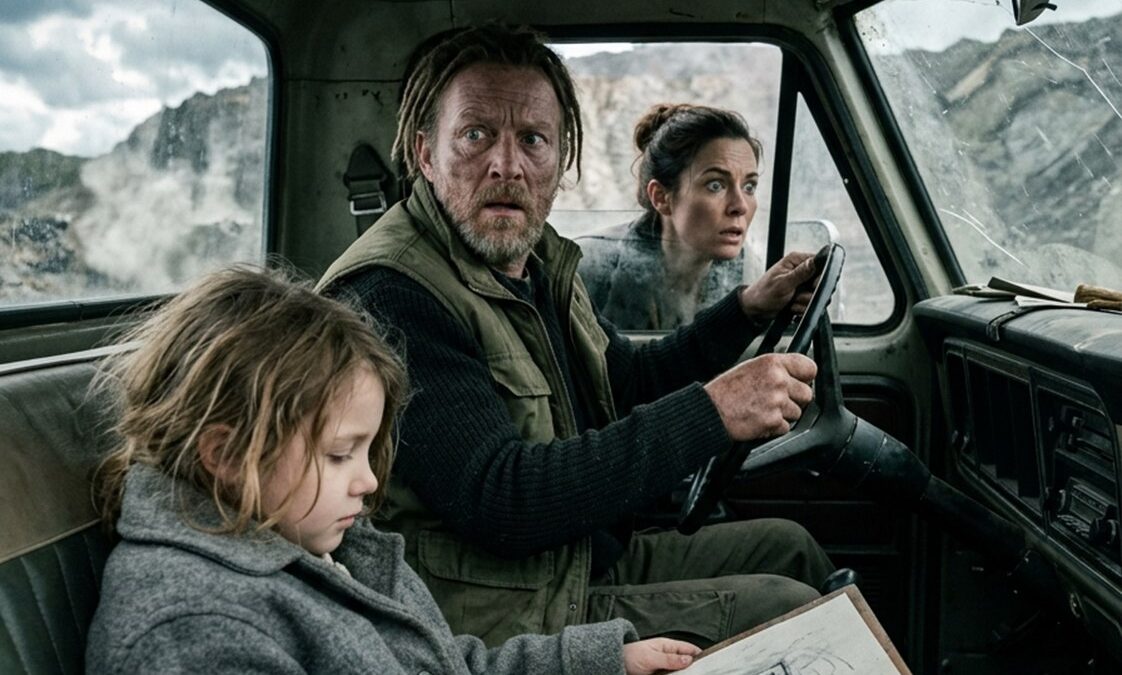
The radiator hissed.
Steam rose in ribbons.
The truck sat dead.
Behind them lay dust.
A mile of stone.
Nothing else remained.
The quarry road was gone.
Garrett turned the key.
The starter clicked twice.
He let go.
The silence rushed back.
It felt heavy.
It smelled of sulphur.
Beside him, Ruth moved.
Her jacket rustled softly.
She checked the side mirror.
Only grey powder hung there.
“Do not look,” Garrett said.
“I am not looking,” Ruth said.
She cleared her throat.
Her fingers were shaking.
She gripped the door frame.
Maeve sat between them.
The cedar board rested across her knees.
Her boots did not touch the floorboards.
Her grey woolen coat was torn at the cuff.
Black dust covered her knuckles.
She held the charcoal stub tight.
Her thumb was stained black.
Her pale face showed nothing.
No tears.
No terror.
Only that flat gaze.
Garrett looked down at her lap.
The sketch was still fresh.
The rough paper held thick black strokes.
It showed the heavy bulkhead.
The five steel locking lugs.
Every lug was drawn retracted.
The central wheel stood turned halfway.
Behind the slab, darkness waited.
A shadow stood in the open gap.
“How far?” Ruth whispered.
“Two hundred yards,” Garrett said.
“Can the truck move?”
“No.”
“Then we walk.”
Garrett reached behind the bench seat.
He took his canvas field bag.
He grabbed the heavy crowbar.
He checked the brass calipers in his vest pocket.
The cold metal felt familiar.
He stepped out into the chalky grit.
The air tasted like crushed slate.
He reached back into the cab.
“Come here,” he said softly.
Maeve did not resist.
She let him lift her down.
She felt light as dry pine.
Her fingers never left the board.
Ruth climbed down after them.
She pulled the canvas tarp over the flatbed.
“Leave the rations,” Garrett said.
“We need the salt,” Ruth said.
“Take only the water,” Garrett told her.
She stared at him.
Then she nodded once.
She swung the twin canteens over her shoulder.
They climbed the gravel shoulder.
The high redoubt sat above them.
It was built into the granite shelf.
Cold fog clung to the rock face.
The concrete entrance looked dead.
No smoke rose from the vents.
No exhaust hummed through the filters.
“It looks empty,” Ruth murmured.
“It is not empty,” Garrett said.
“How do you know?”
“The perimeter wire is clean.”
He pointed with the crowbar.
The low tripwires were clear of brush.
Someone had swept the path that morning.
They reached the concrete apron.
The blast door rose ten feet high.
It was three inches of rolled plate steel.
It was rated for artillery.
It was built to lock out the dead world.
The locking wheel stood vertical.
Just as Maeve had drawn it.
Garrett stopped three paces back.
His heart knocked against his ribs.
“Ruth.”
“I see it,” she said.
The outer seam was open.
A dark slit split the steel frame.
Two inches of cold draft leaked through.
Garrett stepped to the wheel.
He did not touch the iron.
He bent down.
He looked at the bottom locking pin.
The steel pin was sheared clean through.
Not by pressure from outside.
The cut was smooth and bright.
It had been cut with a carbide torch.
From within the threshold.
“Someone opened it,” Ruth said.
“From inside,” Garrett answered.
“Why would they do that?”
“To let someone in.”
“Or to take something out.”
Garrett pushed the slab with one hand.
The four-ton door swung without a sound.
The hinges were freshly greased.
The dark corridor stretched ahead.
A single red emergency beacon pulsed slowly.
Thump.
Thump.
Thump.
The red light washed over the concrete ribs.
It showed wet boot prints on the floor.
Three sets of prints.
Heading outward toward the mountain shelf.
Then a fourth set.
Smaller prints.
Dragging something heavy.
Maeve walked past Garrett’s knee.
She did not hesitate.
She stepped into the red shadow.
“Maeve,” Garrett warned.
She did not turn around.
She walked six paces into the tunnel.
Then she stopped before a dark shape on the floor.
She pointed down with her charcoal stick.
Garrett hurried forward.
He knelt beside her.
He clicked on his small brass inspection penlight.
A tool lay in the dust.
It was an old machinist’s scribe.
Its handle was wrapped in green friction tape.
Three notches were filed into the brass butt.
Garrett froze.
The air left his chest.
His hand hovered over the metal.
“Garrett?” Ruth asked from behind.
He could not breathe.
Not for three seconds.
Not for five.
“What is that?” Ruth asked.
“My brother’s scribe,” Garrett whispered.
“Julian died at the spillway,” Ruth said.
“Three years ago.”
“We found his coat,” she added.
“We found his crushed helmet.”
Garrett picked up the brass tool.
The tape was dry.
The steel point was sharp.
The notches were unmistakable.
Julian never drowned.
* * *
The corridor sloped downward at four degrees.
Water trickled behind the conduit pipes.
The air grew thick with damp lime.
They moved past the dark decontamination stalls.
The pressure showers hung dry and rusted.
Nobody challenged them at the first checkpoint.
The steel grille stood unlatched.
A thermos cup sat on the guard table.
The coffee inside was still lukewarm.
A thin skin of oil floated on top.
“Where is Corin?” Ruth whispered.
“He never leaves the gate desk.”
“He left it today,” Garrett said.
He kept one hand on Maeve’s shoulder.
The girl walked without making a sound.
Her worn boots moved like dry leaves.
She held the sketchbook against her ribs.
They reached the secondary junction.
A green sign pointed left toward Life Support.
A yellow sign pointed right toward the Deep Stores.
From the left came the dull scrape of metal.
Garrett raised his hand.
Ruth stopped instantly.
She pulled Maeve back against the concrete wall.
Garrett leaned around the corner.
A yellow bulb burned in the medical bay.
An old man stood by the metal cabinet.
He was stuffing glass vials into a canvas kit.
His hands shook as he worked.
He wore a stained grey cardigan over wool trousers.
It was Dr. Jesse Finch.
The redoubt’s only surgeon for nine years.
A ledger lay open on the gurney beside him.
Three pages had been torn out cleanly.
Garrett stepped into the light.
His boots clicked on the tile.
Finch spun around with a gasp.
A bottle of saline shattered on the floor.
Water splashed across his boots.
“Garrett,” Finch gasped.
The old man backed into the gurney.
“You were on the low supply run,” Finch stammered.
“The road fell,” Garrett said.
Finch swallowed hard.
His throat clicked.
“The radio said the whole shelf collapsed.”
“We made the crossing,” Garrett said.
“Barely.”
Finch looked past Garrett’s shoulder.
He saw Ruth.
Then his eyes dropped to Maeve.
The old man’s breath caught in his throat.
His face turned grey as ash.
“Dear God,” Finch whispered.
“You brought her back here.”
“We found her at the relay,” Ruth said.
“She was starving.”
“She should have stayed there,” Finch said.
His voice broke.
“Why?” Garrett demanded.
“What happened to the blast door?”
Finch gripped the edge of the gurney.
His knuckles turned white.
“You need to leave,” Finch said.
“Now.”
“Take the truck and go north.”
“The truck is dead,” Garrett said.
“The road is gone.”
“Then walk down the dry wash.”
“Finch,” Garrett said.
His voice stayed level.
It was low and hard.
He placed the brass scribe on the gurney.
It made a sharp click against the enamel.
Finch stared down at the green tape.
He closed his eyes.
A muscle twitched under his left eye.
“Where did you get that?” Finch asked.
“Ten feet inside the blast hatch,” Garrett said.
“Julian dropped it,” Finch whispered.
“Julian is dead,” Ruth insisted.
“He died in the turbine room collapse.”
“You signed his burial record, Jesse.”
Finch did not look at her.
He looked at the floor tiles.
“I signed what I was ordered to sign,” he said.
“By who?” Garrett asked.
“You know who,” Finch said.
“He runs this ridge.”
Maeve walked over to the desk.
She did not look at Finch.
She pulled out a chair.
She climbed onto it and opened her book.
She turned past the sketch of the sheared hatch.
She found a clean page.
She began to draw with fast, firm strokes.
The charcoal scratched against the grain.
Finch watched her small hand move.
Tears welled in the old doctor’s eyes.
“She looks just like Martha,” Finch murmured.
“Julian’s wife,” Garrett said.
“She died during the outbreak.”
“That is what they told you,” Finch said.
Garrett stepped closer to the old man.
He did not raise his hands.
He did not raise his voice.
Power lived in his stillness.
“Talk, Jesse,” Garrett said.
“The basin council had five votes,” Finch said.
“Three years ago, the snowpack failed.”
“The deep wells dropped forty feet.”
“Julian found the drop first.”
“He was the chief hydrological engineer.”
“He told the board the truth.”
“He said the redoubt could not support eighty people.”
“Not through a hard five-year drought.”
“He calculated the maximum capacity.”
“Thirty-two people.”
“No more.”
Ruth took a sharp breath.
“Eighty people live here,” she said.
“Families.”
“Scouts.”
“Children.”
“Julian wanted to begin an orderly evacuation,” Finch said.
“He wanted to move fifty people west to the river.”
“Before the wells ran dry.”
“The council voted him down.”
“Four to one.”
“And then?” Garrett asked.
“Julian refused to falsify the pressure logs,” Finch said.
“He said he would tell the assembly at sunrise.”
“That night, the turbine room flooded.”
“They brought me his crushed helmet.”
“There was no body.”
“They told me to write the certificate.”
“They said panic would kill more people than thirst.”
“I took their ink.”
“I signed the lie.”
Garrett picked up the brass scribe.
“Who took him?”
Finch pointed toward the floor.
“Sub-level four,” Finch said.
“The old pressure vault under the spillway.”
“He has been down there three years.”
“Working on a bypass pipe.”
“A secret line.”
Maeve stopped drawing.
She slid the cedar board across the desk.
Garrett looked down.
The sketch showed a desk in the administrator’s office.
It showed the heavy iron wall safe behind the map.
The safe door was drawn wide open.
Inside lay three thick manila ledgers.
A signature was scribbled across the top cover.
The letters were bold and jagged.
Harlan signed the orders.
* * *
The administrative corridor was lined with cedar panels.
The wood had warped from years of dampness.
A smell of pine oil covered the rot beneath.
Ruth kept her hand inside her coat pocket.
She carried the short steel pry bar.
Garrett held Maeve’s left hand.
Her small palm was warm and dry.
She walked without fear.
She walked like someone returning to an old bedroom.
The administrator’s door was locked.
A brass plate read: COMMISSIONER H. WARD.
Garrett tried the brass lever.
It did not yield.
“Stand back,” Ruth whispered.
She jammed the pry bar into the jamb.
“Wait,” Garrett said.
He looked at Maeve.
The child stepped forward.
She reached up to the molded wooden architrave.
Her fingers felt along the dusty ledge above the door.
She pulled down a small brass key.
It was tied to a red wool thread.
She handed it to Garrett.
“Her father hid it,” Ruth said softly.
“Julian always hid a key above the frame,” Garrett said.
He inserted the key.
The lock turned with a smooth click.
The heavy door swung open.
The office was cold.
A gas fire burned low in the ceramic stove.
Blue flame danced behind the glass.
A large desk of dark walnut dominated the rug.
Behind it hung the regional topological map.
The mountain basin was marked in red wax pencil.
Blue lines traced the hidden aquifer lines.
Garrett stepped behind the desk.
He pushed the map aside.
The steel dial of the wall safe gleamed in the dim light.
It was an old fireproof Diebold.
Four numbers.
“Do you know the combination?” Ruth asked.
“No,” Garrett said.
He looked at Maeve.
The girl did not move toward the safe.
She pointed at the desk drawer.
Garrett pulled the middle drawer.
It held pens, paperclips, and blank ration tokens.
He felt the underside of the drawer bottom.
A false plywood floor slid forward.
Beneath it lay a leather-bound notebook.
Garrett lifted it out.
The cover was stamped with the county seal.
He opened the pages.
The entries were written in blue indelible pencil.
The handwriting was neat and disciplined.
Julian’s hand.
Garrett read the first entry:
“October 14. Ward ordered the third valve closed.”
“He told the lower barracks the line was fouled.”
“The water was diverted to Tank Nine.”
“Tank Nine is off the public manifest.”
Garrett turned three pages.
“November 2. Grain shipment from Valley Redoubt arrived.”
“Twelve tons of winter wheat.”
“Ward recorded six tons received.”
“Six tons transferred to lower service shaft.”
“He is stocking the deep redoubt for twelve people.”
“Only twelve.”
“The rest are marked for phased expulsion.”
“Finch has the medical triage list.”
Ruth read over Garrett’s shoulder.
Her breath came in short, cold puffs.
“Phased expulsion,” she whispered.
“He was going to lock them out.”
“When the first frost came,” Garrett said.
“He would claim the wells dried up completely.”
“He would push forty families down into the valley.”
“To die in the cold.”
“While he stayed down here with the grain and water.”
A floorboard creaked behind them.
Garrett closed the book.
He did not drop it.
He slipped it into his canvas bag.
He turned slowly.
A man stood in the doorway.
He wore a clean sheepskin coat over a wool tunic.
His grey hair was cut short and neat.
His cheeks were freshly shaved.
He carried a leather clipboard under his arm.
It was Harlan Ward.
Behind him stood Corin, the gatekeeper.
Corin held a short wooden riot baton.
His eyes flickered toward the floor.
He looked ashamed.
Ward smiled.
The smile was small and patient.
Like a teacher greeting late students.
“You made good time, Garrett,” Ward said.
“The road fell,” Garrett replied.
“I know,” Ward said.
“The seismic monitors registered the drop.”
“I sent Corin to check the entrance.”
“You did not send Corin,” Garrett said.
“You sent three men with hand carts.”
“They were loading the wheat.”
Ward took off his leather gloves.
He folded them with great care.
He set them on the edge of the desk.
“You are a practical man, Garrett,” Ward said.
“You survived six years in the waste.”
“You know arithmetic.”
“I know theft,” Garrett said.
“Arithmetic is not theft,” Ward said softly.
“Look at the snowline outside.”
“Look at the reservoir gauges.”
“This mountain cannot feed eighty mouths.”
“If we try to feed everyone, everyone starves by March.”
“That is a certainty.”
“Not an opinion.”
“A physical certainty.”
“So you chose yourself,” Ruth said.
Her voice cut through the warm air like glass.
Ward turned his cool grey eyes toward her.
“I built this redoubt, Ruth.”
“My father surveyed the granite.”
“My family bought the turbines.”
“Without this shelter, none of you would have seen thirty.”
“You work the pumps,” Ruth said.
“We bring the fuel.”
“We bleed on the roads.”
“You sit in this chair and steal our bread.”
Ward sighed.
He shook his head slowly.
“You speak from emotion,” Ward said.
“Civilization does not run on emotion.”
“It runs on continuity.”
“If twelve capable people survive, the station endures.”
“The knowledge survives.”
“The blueprints survive.”
“If eighty people starve in a dark hole, everything ends.”
He looked down at Maeve.
The child stared back at him.
Her small face showed neither hatred nor tears.
She simply watched his mouth move.
“Where did you find her?” Ward asked quietly.
“At the Blackwood pump house,” Garrett said.
“Her father was there,” Ward said.
“He broke out of the lower shaft three weeks ago.”
“He took the child.”
“He tried to carry her over the ridge.”
“He knew the winter was coming.”
“Where is he now, Harlan?” Garrett asked.
Ward looked down at his clean fingernails.
“He collapsed in the snow three miles from the gate.”
“He was an engineer, Garrett.”
“Not a woodsman.”
“His heart gave out.”
“Corin brought the child to the relay house.”
“I told him to leave her there.”
“With two tins of meat.”
“I did not want her to suffer in the dark.”
“You left an eight-year-old in the frost,” Ruth said.
Her hand tightened on the pry bar inside her coat.
“I made a choice,” Ward said.
“Leaders make choices.”
He looked directly at Garrett.
“I need an engineer, Garrett.”
“Julian is gone.”
“The turbines need new bearings.”
“You have his hands.”
“You have his discipline.”
“Join the inner manifest.”
“Bring Ruth.”
“Bring the girl.”
“There is room for three more.”
“The lower vault has power, heat, and seventy tons of grain.”
“We seal the shaft on Friday.”
“The rest will be given three days of rations and sent west.”
“They will have a chance.”
“A fighting chance.”
Garrett looked at his brother’s leather book.
Then he looked at Maeve’s small, charcoal-stained thumb.
He thought of the eighty people in the barracks.
Old Mrs. Gable who baked the hardtack.
The three young boys who cleaned the air filters.
The wounded scout who lost his foot to frostbite.
“No,” Garrett said.
Ward’s smile faded.
His eyes grew completely flat.
“Think carefully, Garrett.”
“I have thought,” Garrett said.
Ward turned to Corin.
“Take them to the low holding cells,” Ward said.
Corin did not move.
His baton stayed low at his thigh.
“Corin,” Ward said.
His tone grew sharp.
“Did you hear me?”
Corin looked at Garrett.
Then he looked at the child.
“She was Julian’s girl, Mr. Ward,” Corin whispered.
“Julian taught me how to read the gauges.”
“He gave me his extra coat two winters ago.”
“Corin,” Ward repeated.
“Step out of the way,” Corin said.
His voice was barely audible.
Ward blinked.
A flash of genuine shock crossed his pale features.
“You are throwing away your life, boy.”
“Maybe,” Corin said.
“But I am not starving my sister in the lower barracks.”
Garrett walked past Ward.
He did not touch him.
He took Maeve by the hand.
Ruth followed two paces behind.
At the threshold, Garrett stopped.
He looked back at the man in the sheepskin coat.
“The council meets at dawn,” Garrett said.
“Be there.”
Ward straightened his collar.
He picked up his leather gloves.
His face hardened into stone.
“You will bring panic,” Ward said.
“They will tear this place apart.”
“They will burn the grain.”
“They will kill each other for the last water.”
“You will destroy eighty people with your righteousness.”
“We will see,” Garrett said.
He closed the door behind them.
They walked toward the central barracks.
The redoubt hummed with quiet morning life.
Smoke began to trickle from the communal kitchen stove.
Children’s voices echoed down the ventilation shaft.
They were waking up to the cold.
They did not know their bread was already packed in crates.
He planned the starvation.
* * *
The great atrium was forty paces wide.
It was carved directly from the grey granite.
Six heavy timber pillars supported the ceiling.
At dawn, eighty people gathered on the stone benches.
They wore patched wool coats and quilted blankets.
Breath plumed from their mouths in white puffs.
A single woodstove stood in the center.
Its iron pipe went up through the exhaust flue.
Old women held iron cups of chicory tea.
Men leaned against the timber supports with tired shoulders.
Harlan Ward sat at the high table on the wooden dais.
Four council elders sat beside him.
Finch sat at the far end, his head bowed low.
Ward looked calm.
He had combed his hair with pomade.
A clean wool blanket was draped across his knees.
He held a wooden gavel in his right hand.
He struck the block three times.
The sharp sound echoed against the wet rock.
The chatter died down.
“Neighbors,” Ward began.
His voice was warm and resonant.
It carried to the furthest corners of the stone room.
“We have received grave news from the low pass.”
“The quarry road has suffered a catastrophic collapse.”
“The south shelf fell into the canyon last night.”
A murmur ran through the crowd.
Women reached for their children’s shoulders.
“Our scouts barely escaped with their lives,” Ward continued.
“Garrett Vance and Ruth Mercer have returned safely.”
“For that, we thank Providence.”
“However, the implications are severe.”
“The supply route to the valley is severed.”
“The winter freeze will lock the high crest by Sunday.”
He paused.
He let the fear settle into their bones.
“Our remaining grain stores are dangerously low,” Ward said.
“The summer drought depleted our reserves.”
“The hydrological pumps are failing.”
“If we attempt to hold eighty people through the snows…”
“We will all perish before the spring thaw.”
A woman stood up from the third bench.
Her name was Martha Gable.
Her hands were red and calloused from the laundry tubs.
“What are you saying, Harlan?” she called out.
“Are you cutting the rations again?”
“A cut will not suffice, Martha,” Ward said gently.
His eyes appeared full of sorrow.
“The council has deliberated through the night.”
“We must organize an immediate evacuation.”
“Fifty of our people must move west today.”
“Down the old rail bed.”
“Before the snow blocks the pass.”
“To the river settlements.”
“There is food along the river.”
“There is shelter in the old rail depot.”
A man shouted from the back.
“The river settlements burned two years ago!”
“There is nothing out there but ice!”
“We will freeze in the open!”
Ward raised his hand for silence.
“We will provide rations,” Ward said.
“Three days of grain per person.”
“Two boxes of matches per family.”
“It is our only chance.”
“Those who stay will maintain the infrastructure.”
“When spring arrives, we will send rescue teams.”
“We must be brave.”
“We must make the hard choice.”
The room erupted into shouts.
Women wept into their aprons.
Men cursed and pushed toward the dais.
Two council members stood up, trying to calm the crowd.
Ward sat motionless.
He waited for the panic to exhaust itself.
He knew fear made men compliant.
Garrett stepped forward.
He walked down the center aisle between the benches.
He wore his grease-stained canvas coat.
He carried his heavy field bag over one shoulder.
Ruth walked beside him.
Maeve walked three paces behind.
The crowd parted for them.
Garrett reached the base of the dais.
He did not shout.
He simply stood there until the room noticed him.
One by one, the voices quieted down.
“Garrett,” Ward said smoothly.
“You should be resting in the infirmary.”
“You have suffered a terrible ordeal.”
“The road fell, Harlan,” Garrett said.
“As you said.”
“Then you confirm my report,” Ward said.
“The road fell,” Garrett repeated.
“The grain did not.”
The room fell completely silent.
Ward’s eyes narrowed slightly.
“What does that mean?” an elder asked.
His name was Thomas, a retired surveyor.
“There is no shortage,” Garrett said.
“The grain is in the mountain.”
“All twenty tons of it.”
“Garrett is confused,” Ward told the council.
“The quarry dust has affected his judgment.”
“He lost his brother three years ago.”
“He has never forgiven the council for that loss.”
“Now he sees conspiracies in every corner.”
“Jesse,” Garrett said.
He did not look at Ward.
He looked directly at the old doctor.
“Stand up.”
Finch did not move for three seconds.
His hands gripped his knees.
Then he pushed himself to his feet.
His joints popped in the cold air.
“Jesse,” Ward warned.
His voice dropped an octave.
“Remember your duty to this community.”
Finch looked at the crowd.
He saw the children huddled by the cold woodstove.
He saw Martha Gable watching him with wide eyes.
“The harvest was twelve tons,” Finch whispered.
“Speak up, Jesse!” Thomas demanded.
“Twelve tons of wheat arrived in October,” Finch said louder.
“I signed the intake manifest.”
“Then Harlan ordered me to strike six tons from the public sheet.”
The crowd stirred like dry grass before a storm.
“That is an outrageous lie,” Ward said firmly.
“Finch is seventy years old.”
“His memory has been failing since the fever.”
“Do you have a manifest, Jesse?” Ward challenged.
“Show the council the paper.”
“He cannot,” Ward said.
“Because no such paper exists.”
Garrett reached into his canvas bag.
He did not pull out the notebook.
He pulled out Maeve’s cedar sketchbook.
He set it on the table in front of Thomas.
“What is this?” Thomas asked.
“A child’s drawings?”
“Turn to page fourteen,” Garrett said.
Thomas turned the heavy paper.
The charcoal sketch showed the drainage sluice beneath the deep pumps.
It showed three electric mine carts sitting on the rails.
Each cart was piled high with burlap sacks.
On the side of each sack, a stencil was clearly drawn:
VALLEY MILLS — GRADE A HARD WHEAT.
Beside the carts stood two barrels of kerosene.
And four wooden crates marked: SURGICAL SUPPLIES.
“A drawing proves nothing,” Ward scoffed.
“The child was found wandering the rocks.”
“She has an overactive imagination.”
Maeve stepped onto the lowest step of the dais.
She did not look at Ward.
She looked at Corin, who stood by the side archway.
She pointed her small finger at the gatekeeper.
Corin stepped forward.
He took a heavy iron key from his belt.
He laid it on the council table.
“What is that, Corin?” Thomas asked.
“The key to the third sluice gate,” Corin said.
His voice shook, but he did not look away.
“I helped him load the carts on Tuesday.”
“He told me it was an emergency cache.”
“He told me my family was on the list.”
“He said forty people had to be pushed out.”
A collective gasp rose from the benches.
Three men stood up from the front row.
Their fists were clenched.
“Corin,” Ward whispered.
His knuckles turned white on the gavel handle.
“You fool.”
“Go look,” Garrett told the crowd.
“The third sluice gate is behind the turbine housing.”
“Take lanterns.”
“See for yourselves.”
Four young men broke from the crowd.
They grabbed oil lanterns from the wall hooks.
They ran down the tunnel toward the lower levels.
Nobody spoke.
The room waited in absolute silence.
The only sound was the drip of water from the ceiling.
And the slow, ragged breathing of Harlan Ward.
Ten minutes passed.
Then fifteen.
Footsteps pounded on the wet stone corridor.
The four men returned.
Their coats were drenched in water.
One of them carried a burlap sack over his shoulder.
He threw it down in front of the dais.
The rough canvas split open.
Golden wheat kernels spilled across the grey granite floor.
Thousands of them.
Dry.
Clean.
Enough to feed eighty people for seven months.
The room exploded into fury.
Men surged toward the dais.
“Liar!” a woman screamed.
“You would have sent my babies to freeze!”
“Hang him from the timber!” a man roared.
Garrett stepped between the crowd and the table.
He raised both arms.
His crowbar remained tucked in his belt.
“No,” Garrett said.
His voice was not loud, but it stopped the first wave.
“We are not animals.”
“We do not become what he is.”
Thomas stood up.
The old surveyor’s face was white with rage.
He pointed a shaking finger at Ward.
“Harlan Ward,” Thomas said.
“By authority of the Basin Charter…”
“You are relieved of the commission.”
“You are stripped of your rank.”
“You will be placed under restraint in the dry storage cells.”
“Until a proper tribunal can be held.”
Ward did not flinch.
He stood up slowly.
He brushed an invisible speck of dust from his sheepskin lapel.
He looked at the angry faces surrounding him.
He looked at them with utter contempt.
“You think you have won,” Ward said quietly.
“You think this wheat will save you.”
“The pumps are failing.”
“The bearings in Turbine Two are shattered.”
“None of you knows how to mill a replacement brass collar.”
“Without me, this redoubt will be an ice tomb by February.”
“You will starve in your own filth.”
He turned to Garrett.
“You took away their leader, Vance.”
“Now let us see you keep them warm.”
Garrett met his cold eyes.
He did not blink.
“We built the pumps, Harlan,” Garrett said.
“You only held the keys.”
Corin stepped forward with two other scouts.
They took Ward by the arms.
They did not strike him.
They led him down the dark hall toward the cells.
The crowd began to weep with relief.
Women knelt on the floor.
They scooped the spilled wheat back into their aprons.
Every grain was precious.
Maeve stood by the edge of the dais.
She looked down at the golden pile.
She picked up a single grain of wheat.
She held it in her palm.
The child was the witness.
* * *
Three weeks after the assembly, winter struck.
The temperature plummeted twenty degrees in six hours.
The wind screamed through the granite crags like an iron saw.
Snow drifted twelve feet deep against the outer blast door.
Inside the redoubt, the air was cold but steady.
The communal woodstove burned night and day.
The kitchen smelled of boiled wheat porridge and dried mint tea.
The children sat around the low tables with slate tablets.
Ruth taught them the old alphabet.
Her voice was patient and calm.
She did not talk about the road.
She did not talk about the quarry.
She spoke of rivers, oceans, and orchards.
Garrett lived in the lower machine room.
He slept on a canvas cot beside Turbine Two.
His overalls were black with graphite grease.
His knuckles were raw from the cold iron.
He spent twelve hours a day at the foot-treadle lathe.
He worked with his brother’s brass calipers.
He measured the replacement bearing collar to the tenth of a millimeter.
He had no electric power for the tools.
He turned the spindle with his own leg.
Push.
Cut.
Measure.
Push.
Cut.
Measure.
On a Tuesday evening, Ruth brought him a tin bowl of stew.
The broth was thin, but it had salt and dried carrots.
She sat on a wooden crate beside the lathe.
“You need to sleep, Garrett,” she said.
“The bearing has two hundredths of runout,” he replied.
“It will seize if the pressure rises.”
“The pressure will not rise,” Ruth said.
“Corin bled the line this morning.”
Garrett set the caliper on the greasy bench.
He wiped his hands on a rag.
He took the warm bowl from her fingers.
His hands were stiff from the iron.
“How is the child?” he asked.
“She ate two bowls of grain,” Ruth said.
“She helped Martha fold the blankets.”
“Has she spoken?”
“One word,” Ruth said.
Garrett looked up.
“What word?”
“Fire,” Ruth said softly.
“She pointed at the stove and said fire.”
Garrett looked down at his stew.
He chewed slowly.
A faint smile touched the corner of his mouth.
“It is a start,” he said.
“The council met today,” Ruth said after a silence.
“Thomas asked me to speak with you.”
“About what?”
“They want you to take the administrator’s chair.”
“They want you to wear the key ring.”
Garrett shook his head immediately.
“No.”
“Someone must allocate the fuel, Garrett.”
“Someone must sign the work rotations.”
“Let the council sign them,” Garrett said.
“I am an engineer.”
“If I sit in that chair, who turns the brass?”
“Who fixes the intake when the ice clogs the grate?”
“They trust you,” Ruth said.
“They should trust the work,” Garrett replied.
“Not a man in a chair.”
“We saw where that leads.”
Ruth watched him for a long moment.
Her face softened in the lantern light.
“You sound like Julian,” she said.
Garrett paused.
He looked at the lathe spindle.
“Julian was smarter than me,” Garrett said.
“He tried to warn them three years ago.”
“I was out in the waste hunting scrap.”
“I should have been here.”
“You could not have known, Garrett,” Ruth said.
She reached out.
Her warm fingers touched his grease-stained wrist.
“Stop carrying the dead,” she said gently.
“The eighty people above us are alive.”
“The child is alive.”
“That is enough.”
Garrett looked at her hand.
He did not pull away.
“I suppose it is,” he murmured.
Later that night, Garrett went up to the residential tier.
The barracks were quiet.
A single oil lantern burned low in the corridor.
He walked to the small storage room they had cleared for Maeve.
A wool blanket hung across the doorway for privacy.
He pushed the blanket aside.
Maeve was awake.
She sat cross-legged on her pallet of straw and wool.
The cedar sketchbook lay open on her knees.
A stub of charcoal rested between her fingers.
She was drawing by the light of a tallow candle.
Garrett stepped inside.
He sat on the wooden stool beside the pallet.
“You should be resting,” he whispered.
Maeve did not close the book.
She turned the page toward him.
It was not a drawing of catastrophe.
There were no collapsing bridges.
No sheared bolts.
No open vaults with shadows inside.
The page showed a patch of green dirt.
Small shoots of corn pushed through the black soil.
Above them, a yellow sun was drawn with heavy strokes.
Beside the field stood three figures holding wooden rakes.
A tall man in a canvas coat.
A woman with braided hair.
And a little girl holding a watering bucket.
Garrett looked at the drawing for a long time.
He felt a tightness in his throat.
A knot that had been there for three years began to loosen.
He reached into his pocket.
He pulled out the machinist’s scribe with the green tape.
He laid it on the edge of the blanket.
“This belonged to your father,” Garrett said softly.
“He was my brother.”
“He was the best man on this mountain.”
Maeve looked at the brass tool.
She reached out.
Her small fingers touched the three filed notches.
She traced them carefully.
Then she looked up at Garrett’s face.
She did not flinch from his gaze.
“Keep it?” she asked.
Her voice was tiny.
It sounded like dry leaves scraping over stone.
Garrett shook his head gently.
“It is yours,” he said.
“When you are older, I will teach you how to use it.”
“I will teach you how to read the calipers.”
“How to find the true center of the iron.”
Maeve picked up the scribe.
She slid it into the pocket of her grey woolen coat.
Then she closed the cedar book.
She pulled the blanket up to her chin.
She closed her eyes.
Garrett blew out the candle.
He sat in the dark for three minutes.
Listening to her steady breath.
Outside, the mountain wind howled against the rock.
Inside, the stone held warm.
* * *
Five years passed like water running through gravel.
Spring came late to the high ridge.
When it arrived, it came with roaring torrents.
The snow melted from the granite peaks in white ribbons.
The high quarry road was never rebuilt.
It was abandoned to the mountain.
Instead, the colony carved a new path along the western shoulder.
It followed the gentle grade of the old logging trail.
It was reinforced with heavy dry-stack stone walls.
Every terrace had been planted with mountain rye and hardy clover.
The bees had returned three summers ago.
Their low hum filled the warm afternoons.
Garrett stood at the edge of the new overlook.
His hair was grey at the temples now.
His field coat was patched with fresh leather at the elbows.
He carried a surveyor’s wooden staff in his right hand.
Beside him stood Ruth.
Her hair was tied back with a blue cloth strip.
She held a tin measuring tape and a small notebook.
Below them, the high basin was green.
Three stone greenhouses stood near the water outflow.
Their glass panels gleamed like silver scales in the sunlight.
Smoke drifted from twenty chimneys across the settlement.
Eighty people had become one hundred and ten.
Fourteen babies had been born since the winter of the wheat.
A girl climbed up the path from the terraces.
She was thirteen now.
Her legs were long and strong.
She wore heavy work boots and denim trousers.
A leather satchel hung across her shoulder.
She carried a bundle of wild sage under one arm.
Her cheeks were brown from the mountain sun.
“The lower ditches are cleared,” Maeve said.
Her voice was clear and steady now.
“Did you check the sluice gate?” Garrett asked.
“The gate is open four inches,” Maeve said.
“The pressure is eighty pounds.”
“Just like Julian’s chart said.”
She unslung her satchel.
She pulled out the old cedar sketchbook.
The wood was dark with oil and age.
The corners were bound with beaten brass.
She opened the worn pages.
The old sketches were still there.
The sheared hatch.
The falling rock.
The carts of stolen wheat.
They looked like artifacts from another age.
Ancient history recorded in black dust.
She turned to the very last page.
It was a sketch made that morning.
It showed the high blast door of the redoubt.
The heavy steel slab stood open wide.
Not broken.
Not forced.
Secured with iron hooks to the concrete wall.
Wild roses climbed along the outer hinge.
Children sat on the threshold eating cold pears.
A traveling trader from the western river stood near the opening.
His mule was laden with salt blocks and iron wire.
The door was not a defense anymore.
It was simply an entrance.
A gateway between the mountain and the world.
Garrett looked down at the paper.
He remembered the cold cab of the truck.
The smell of sulphur in the quarry dust.
The terror of the open seam.
“What does it say?” Ruth asked softly.
Maeve looked at the valley below.
She watched the people moving between the green rows.
“It says the door is open,” Maeve said.
“From the inside.”
She smiled.
A real smile that reached her eyes.
Garrett took the cedar board from her hands.
He closed it with a soft thud.
The brass clasp clicked into place.
The road was healed.
The bread was shared.
The child was home.
The mountain held them in the sun.
THE END








