The Stranger With the Blue Shoelace Was Leaving Town, and Naomi Had Six Minutes to Ask About Her Scar
Chapter 1: The Last Load
The stranger tied a blue shoelace around her keys, and Naomi forgot which machine she had come to fix.
Two loops, a pull, then the short end tucked back beneath both loops.
Naomi’s fingers knew the motion before her mind found a reason.
At three every morning, she emptied the change traps at Bell Street Laundry in Coos Bay, Oregon.
At three every September twenty-first, she tied that same knot in a fresh blue lace and put it in the drawer beneath the counter.
There were twenty-three laces there now.
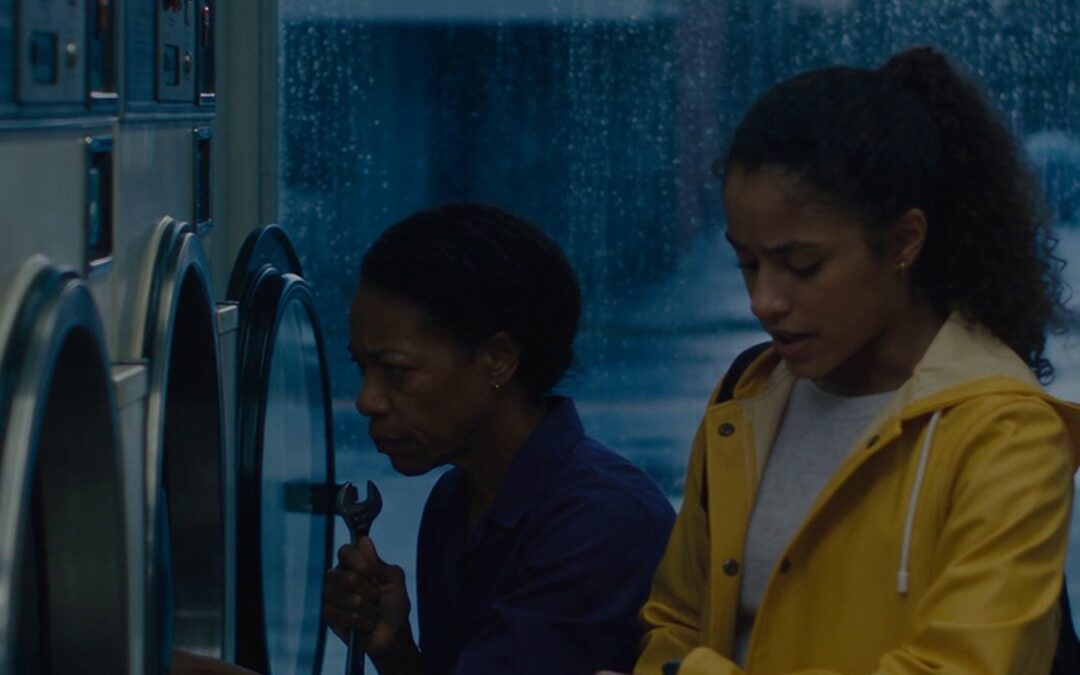
The woman with the keys stood beside a washer that had stopped midcycle.
She was twenty-six, with dark hair escaping a yellow rain jacket, and she kept glancing at the building’s narrow staircase.
“Does anyone live upstairs?” she asked.
“Storage now,” Naomi said.
The woman pressed her lips together, as if she had hoped for one answer and expected another.
“I used to know this address.”
Naomi reached behind the washer for its service switch.
People said things like that in a town where buildings changed hands and old streets kept their names.
She told herself the knot was common, though she had never seen anyone else tie it that way.
The woman lifted her keys, noticed Naomi looking, and closed her hand around them.
“My mom taught me,” she said.
“Good knot,” Naomi answered.
Her own mother had taught her a quicker one.
Naomi had invented this one for a little girl who kept losing her shoes.
Outside, the evening bus idled at the curb while its driver loaded a suitcase.
The woman checked it through the glass.
“Mine leaves in six minutes.”
Naomi could have asked why the address mattered.
She had once asked a stranger about a girl with the same birthday and watched hope drain from both their faces.
Instead she opened the washer, freed a trapped sleeve, and heard the drum turn again.
The woman reached for her bag.
A folded paper slipped from its outside pocket, too small and creased for Naomi to read.
“Thanks,” the woman said, catching it.
As she pushed it back, her left index finger caught on the zipper.
She drew her hand away, revealing a pale, crooked notch across the fingertip.
Naomi went still.
The bus driver called that boarding was closing.
The woman turned toward the door, her keys hanging from the blue knot.
Naomi had six minutes, one old memory, and a question she had been afraid to ask for twenty-three years.
Would she ask about the scar before the bus pulled away?
Chapter 2: The Name Before Willa
Naomi opened her mouth as the woman reached the door.
“Your finger,” she said.
The woman stopped with one hand on the glass.
Naomi saw her look down at the notch, then back at the washer, as if deciding whether this was a warning about the machine.
“Did I leave something on it?”
“No.”
The driver leaned out of the bus.
“Last call.”
Naomi could have said that she remembered a child trapping that finger in the drawer of a kitchen table.
She could have said the child had cried because her shoe was untied and had apologized while Naomi held her hand under cold water.
But she had asked about scars before.
One belonged to a woman who had cut her finger opening a can.
Another belonged to a woman who had never lived in Oregon.
Naomi looked at the blue lace instead.
“Is it all right?” she asked.
The woman bent her finger.
“Always looks worse than it feels.”
The driver called again, and the woman hurried out with her bag and her keys.
Naomi followed her to the curb.
The driver took the bag and swung it into the hold.
Through the bus window, the woman found a seat facing the laundromat.
Naomi stood under the sign while the door folded shut.
She raised her hand, though she did not know whether she meant goodbye or wait.
The woman raised hers too.
The notch crossed the glass for a moment.
Then the bus moved into traffic.
Naomi stayed where she was until it disappeared around the corner.
Inside, the repaired washer finished its spin.
She went behind the counter and opened the shallow drawer.
Twenty-three blue laces lay side by side, each folded once, each tied with two loops and the short end tucked back beneath them.
The first was smaller than the others.
She had tied it on the night she turned nine, using the last lace she still had from her sister’s shoes.
After that she had bought a pair every September twenty-first, the date she remembered because their mother had promised cake for both girls before the caseworker arrived.
Naomi had never been certain it was her sister’s birthday.
It was the day the three of them had always celebrated.
She picked up this year’s lace and tried the knot again.
Two loops.
A pull.
The short end back underneath.
Across town, the woman on the bus untied her keys.
She had watched the laundromat worker stare at the lace and then at her finger.
That stare had followed her into the seat.
Her name was Willa Hart.
Her mother, Claire, had called while Willa was at the station.
“Did you find the building?” Claire asked when Willa answered.
“Yeah.”
“And?”
“It’s a laundromat.”
For a moment Claire said nothing.
Willa could hear plates being stacked in the kitchen at home.
“Did you ask inside?”
“There’s nobody living upstairs.”
“I meant about the address.”
Willa turned the folded paper over in her lap.
It was a copy of the single page Claire had found while sorting the household files before a move: a placement summary from before Willa’s adoption, with her old first name obscured by a dark copier streak and a former address typed clearly below it.
Bell Street.
Apartment above storefront.
Claire had given it to her without ceremony, then sat beside her while she read.
“I asked about upstairs,” Willa said.
“That’s a start.”
“The woman there looked at me strangely.”
“What kind of strangely?”
“I don’t know.”
Willa pulled the blue lace through the ring of her keys.
“She knew the knot, maybe.”
Claire made a small sound.
“What?”
“You learned that knot from me.”
“I know.”
“I learned it from you,” Claire said.
Willa looked up from her hands.
Claire went on before Willa could speak.
“You came with one shoe tied that way, and you kept taking mine off to show me.”
Willa pressed her thumb to the window.
“You never told me that.”
“I thought I had.”
Willa could tell from Claire’s silence that this was true.
There were facts Claire had repeated so often Willa could recite them with her: the county had placed her in care when she was little; Claire and Owen had first fostered her, then adopted her; they had been told little about the family before them.
There were other facts Claire had carried alone, uncertain whether they belonged to Willa or to a file that might be wrong.
“Could you send me a picture of that page?” Claire asked.
“I’ve got it with me.”
“Call when you get in.”
Willa was traveling to Eugene to help install an exhibit at the maritime museum.
She would be there for ten days, then come home to pack the house she and Claire had shared since Owen retired.
There was time to look at Bell Street again.
She knew that.
But from the bus window she watched the laundromat’s light vanish behind a row of dark shops, and ten days suddenly felt like a decision she had made without meaning to.
Naomi did not sleep after her shift.
She went to the kitchen table in her apartment, laid out the laces, and wrote down everything she remembered about the woman before memory could start improving it.
Yellow rain jacket.
Dark hair.
Blue lace around keys.
Left index finger, crooked notch.
Asked who lived upstairs.
Bus to Eugene, Friday evening.
Naomi stopped at that last line.
The bus might have gone farther.
The woman might be back next week.
She had no right to turn six minutes into certainty.
Her aunt Jo found her at the table at eight, after letting herself in with the spare key to return a casserole dish.
Jo looked at the laces.
“Another one?”
“Maybe.”
Naomi had lived with Jo from age nine until she finished school.
Jo knew the difference between Naomi’s ordinary quiet and the silence that followed one of these sightings.
“What did she say?”
“She used to know Bell Street.”
“Lots of people did.”
“She had the finger.”
Jo set down the dish.
Naomi touched her own left index finger.
“The drawer?”
“I saw it.”
Jo sat opposite her.
“Did you talk to her?”
“About her washer.”
“Naomi.”
“She had a bus.”
Jo nodded, but she did not let Naomi hide behind the timetable.
“You could have called after her.”
“I did.”
“What did you ask?”
“If her finger was all right.”
Jo looked at the row of laces for a long time.
She had been the one to take Naomi home when their mother could no longer care for both girls.
She had been told the little one was going to a foster family willing to adopt.
No one had given Jo a name she was allowed to pass to Naomi.
Years later, when Naomi was old enough to ask on her own, the office had explained that the younger child’s records could not simply be handed to a sibling.
Jo had kept every address and phone number she had ever used in case someone came looking.
No one had.
“I’ll go with you,” Jo said.
“Where?”
“To ask about the old building.”
Naomi shook her head.
“I work there.”
“I know.”
“I’m asking about the woman.”
Jo looked up.
Naomi turned over the paper where she had written her notes.
“The bus station might remember her ticket.”
“They won’t give you somebody’s name.”
“I don’t want them to.”
“Then what?”
“I need to find out why she came to Bell Street.”
Jo reached across the table and touched the first lace.
“Start with what you’re allowed to know.”
That afternoon Naomi called the county office where she had last filed a request about her sister.
She did not ask the person who answered to find a stranger from a bus.
She asked which records from her own time in care she could request again, and whether her file contained the address of the apartment above the laundromat.
The clerk explained the process and sent her a form.
Naomi printed it at the library, filled it out at a table beside the copier, and paid for certified identification copies she had not expected to need.
She had made requests before.
The first had brought back three pages about her placement with Jo.
The second had confirmed that her younger sister had gone to another home, then stopped at a wall of protected information.
Naomi had stopped asking for a while after that.
This time she requested only her own file, including the intake notes that described what she had carried out of Bell Street.
She mailed it before the post office closed.
Then she took the bus to the old neighborhood.
She knew every repair at the laundromat and almost nothing about the upstairs apartment.
The staircase had been sealed behind a painted plywood door when she started work six years earlier.
The current owner had once told her the rooms above were too small and awkward to rent, and he used them for spare machine parts.
Naomi called him from the sidewalk.
“Can I go up there?” she asked.
“For a part?”
“For me.”
He paused.
“Sure, after closing.”
She went back to work and watched the door all evening.
At nine, the owner arrived with a ring of keys.
He opened the plywood door, then a second door beyond it.
The stairs smelled of cardboard and old paint.
Naomi had remembered them steeper.
At the top, she found two rooms crowded with boxed hoses, folding chairs, and the metal frames of broken laundry carts.
A patch of different flooring showed where the kitchen table had stood.
She knew the spot because the drawer had caught on the boards when their mother pulled it open.
The younger girl had been trying to reach a pencil.
Naomi had told her to use the chair.
The drawer slipped back as the child climbed down, and afterward Naomi had believed, for years, that the scar was her fault.
The owner stood quietly in the doorway.
“You okay?”
“Yeah.”
“Want a few minutes?”
Naomi looked at the bare wall where they had once measured their heights in pencil.
The marks were gone under paint.
“That would help.”
When he left, she sat on an overturned bucket.
Her mother had tied shoes quickly, with a flat square bow that came loose on little feet.
Naomi had made up her own knot after watching her sister lose one shoe on the walk to the grocery store.
She had called the loops rabbit ears because she was eight and because the little girl liked rabbits.
The last tuck had been Naomi’s invention.
It made the knot hard for a child to undo.
She had taught it to her sister on the kitchen floor, one shoe each, their knees touching.
The following week, the girls had been taken to different houses.
Downstairs, a washer thumped against an uneven load.
Naomi returned to her work before she could begin seeing people who were no longer there.
In Eugene, Willa spent the next morning fitting small brass labels into an exhibit case.
The museum had hired her for jobs that required careful hands, and she liked work with a visible end: a case closed, a light adjusted, an object placed where visitors could see it.
She kept stopping to examine her fingertip.
The scar had been part of her for as long as she could remember.
Claire said it was there when Willa came to them at three.
No one had known what caused it.
Willa had made up several stories when she was a child.
A fox bite was her favorite.
Claire never corrected her by inventing a better one.
At lunch, Willa called home.
“Tell me exactly what was in the folder.”
“Your placement page, the adoption papers, and school records.”
“Nothing else?”
“There’s a little blue shoelace.”
Willa shut her eyes.
“From my shoe?”
“I kept both shoes for a long time.”
“Why didn’t you tell me?”
“Because you stopped asking about before.”
“That’s not an answer.”
“No,” Claire said.
Willa moved away from the other installers.
Claire had never refused to talk about the adoption, but she had learned to wait for Willa to lead.
Willa understood that now, and still felt the weight of the years in which neither of them had opened the folder.
“I worried I’d make you feel you had to search,” Claire said.
“I worried you’d feel I wanted a different mother.”
“That was yours to decide.”
Willa leaned against a blank wall.
“Do you remember the name I had?”
“Only what’s on the papers.”
“The first page is smudged.”
“The adoption order says Willa.”
“I know that name.”
Claire let her breathe.
Willa had been Willa since preschool.
Claire and Owen had chosen it after asking the caseworker whether the name in the early papers was one the child answered to.
The caseworker had said Willa was already being used in her foster placement.
Neither of them had wanted to change it again.
“I can bring the folder when you come home,” Claire said.
“Could you look now?”
“I will.”
That night Claire called back from the dining table.
The early paperwork held two names.
Willa was the one on her adoption order.
The intake summary called her Lila.
Willa repeated it softly.
It felt like saying the name of another child in a crowded room.
Claire had no record of who had first changed Lila to Willa.
The county file listed the Bell Street address, but the family section on Claire’s copy was mostly blank.
“There may be more in the original records,” Claire said.
“Can I ask for them?”
“You can ask.”
“I’m twenty-six.”
“I know.”
“I’ve never asked.”
“I know that too.”
Willa thought of the woman in the laundromat.
She thought of how the woman’s face had changed at the sight of her finger.
“I will when I get back,” she said.
The next morning, Naomi went to the bus station and stood at the counter until a clerk had finished helping passengers.
“A woman left Friday on the evening bus,” Naomi said.
The clerk’s expression closed politely.
“I can’t discuss passengers.”
“I understand.”
Naomi took out a small paper note with the time and the description she had written for herself.
“If someone comes asking about Bell Street Laundry, could you give her my work number?”
The clerk read it.
“You want me to keep this?”
“Only for a week.”
The clerk folded the note and placed it beside the terminal.
“I can’t promise I’ll know who it is.”
“That’s fair.”
Naomi left without a name.
As she stepped out, she realized the note might never move from the counter.
Still, she had offered a way back that did not depend on finding a passenger list or asking a stranger to betray one.
At the laundromat, she put another note under the counter for the night attendant.
“If the woman in the yellow jacket comes back, ask if she wants me,” it said.
The attendant read it when she arrived.
“Is this about a broken washer?”
“Maybe,” Naomi said.
The attendant looked at her.
“I’ll ask.”
Naomi had two ways to be found now.
She had no proof that either mattered.
A week later, an envelope from the county came with a request for a clearer copy of one identity document.
The delay was ordinary.
Naomi put the form beside the laces and went to the library again.
While she waited at the copier, she saw an older woman struggling to feed a page into the machine.
Naomi helped her flatten it.
The woman thanked her and said she hated forms.
“So do I,” Naomi said.
When Naomi returned home, Jo was waiting with a bag of groceries.
“Any news?”
“They want a better copy.”
Jo took out apples, bread, and a carton of eggs.
“That means somebody read it.”
“That’s a generous way to put it.”
“Maybe.”
Naomi set the new copy on the table.
Jo looked at the stacks of previous replies Naomi kept in a file box.
“I should have done more when you were little.”
“You called.”
“I could have kept calling.”
“You did.”
“I stopped when they told me they couldn’t tell us.”
Naomi sat down.
Jo had never said this so plainly.
At nine, Naomi had thought adults stopped because they knew something she did not.
At thirty-one, she knew how easily a polite official answer could become the end of a road when you had a child to feed and a job to keep.
“You gave me a room,” Naomi said.
“I couldn’t give you hers.”
“No.”
Jo nodded once.
Neither of them tried to turn that word into comfort.
Three days before Willa returned, she phoned a records office during her lunch break.
She waited through a recorded menu, then reached a person who explained what request she could submit as an adult and which parts of her childhood records might require a separate process.
Willa wrote the instructions on the back of a packing list.
The person did not offer to tell her whether she had siblings.
Willa had to ask.
“I can’t answer from here,” the person said.
“Would the file say?”
“It may.”
“May,” Willa repeated.
“I don’t want to promise what I haven’t seen.”
Willa thanked her.
She spent the evening filling out the request online, then stopped at the box asking what she hoped to learn.
She typed her former name.
She erased it.
She typed: Names of family members listed at intake, if available for release.
She sat with the cursor blinking after the period.
Then she submitted it.
The fee came out of the money she had set aside for new shelves in Claire’s house.
She had expected the act to feel dramatic.
It felt like paying a bill and being told the balance would arrive later.
At the museum the next day, Willa was handed a crate of small navigation tools to place in the last case.
Each object had a record of where it had been found, who had owned it, and who had given it to the museum.
One brass compass had three names on its label.
Willa thought about how much care it took to keep a thing connected to its history.
She called Claire from the loading dock.
“I sent the request.”
“I’m glad.”
“It might take a while.”
“We’ll be home.”
Willa put her back against the cool wall.
“I don’t know what I’m hoping it says.”
“You don’t have to.”
“If there’s someone—”
“You can decide what to do after.”
Willa looked down at her keys.
She retied the blue lace, though it had not come loose.
In Coos Bay, Naomi’s corrected request was accepted.
The office said it would search for the old file.
Naomi asked whether she would be notified if no records remained.
“Yes,” the clerk said.
“Thank you.”
She hung up, then stood at the counter with her hand on the phone.
The attendant was folding towels behind her.
“Good news?” she asked.
“It’s going somewhere.”
“That sounds like good news.”
Naomi glanced at the drawer.
“Maybe.”
On the day Willa came home, Claire met her at the bus station.
Willa stepped down carrying a canvas tool bag and a rolled paper plan from the museum.
Claire hugged her with one arm because the other held a grocery bag.
“Long ride?”
“Not bad.”
“I made soup.”
“Then we should hurry.”
They passed the station counter on the way out.
The clerk who had taken Naomi’s note was helping a man whose ticket had been printed for the wrong day.
Naomi’s folded paper was still beneath the desk calendar.
Willa never saw it.
In Claire’s kitchen, the folder lay beside two bowls.
Claire had removed nothing from it.
Willa knew because Claire had told her, and because every page remained in the mismatched order of household papers kept for years without a plan.
Willa read the placement summary again.
The old address had drawn her to Bell Street.
Now she noticed a line she had passed over before: personal effects received with child, one pair of shoes, one cloth rabbit, one blue lace detached.
“Where’s the rabbit?” she asked.
Claire went to the hall closet and brought back a shoebox.
Inside were the shoes, too small now to cover Willa’s palm.
One lace was still threaded through a shoe.
The other had been tied around the cloth rabbit’s neck.
Willa touched the knot.
Two loops, a pull, the short end tucked back beneath them.
She looked at Claire.
“You learned it from me.”
“You insisted.”
“What did I say?”
“You called it the staying knot.”
Willa stared at the tiny shoe.
“I don’t remember saying that.”
“You were three.”
“I remember a kitchen drawer.”
Claire waited.
“Or I think I do,” Willa said.
“Tell me.”
“There was a little table.”
“Anything else?”
“A girl was angry with me.”
Claire sat down beside her.
“About the drawer?”
“I don’t know.”
Willa closed the box.
The laundromat worker’s stare had been real.
So was the fact that Willa had just learned a childhood knot could be carried from one family into another without either family knowing where it began.
Claire reached for the rabbit, then stopped.
“You can go back to Bell Street,” she said.
“I know.”
“I’ll come if you want.”
Willa looked at her mother’s hand resting near the box.
“I might go alone first.”
“Okay.”
Claire did not sound wounded.
That made Willa want to cry more than if she had.
The next afternoon Willa walked to Bell Street.
The laundromat was busy.
A child sat on a plastic chair folding warm washcloths into uneven squares while a man loaded a dryer.
The night attendant was at the counter.
Willa looked past her for the woman who had fixed the washer.
“She works here?” Willa asked.
“Who?”
“The mechanic from last Friday.”
“Naomi.”
The name struck Willa without meaning anything yet.
“Is she here?”
“Out on a service call.”
The attendant reached beneath the counter for Naomi’s note.
Before she could unfold it, a dryer sounded its alarm and the man beside it called that its door would not open.
The attendant held up the note.
“Wait one second?”
Willa saw the child’s folded washcloths fall from the chair as the man moved to make room.
She took a step aside.
“Go help him.”
“It’s quick.”
“I can come back.”
Willa left her phone number on a clean scrap from the counter pad.
She wrote her name clearly.
Then she went outside, where Claire was waiting in the car across the street.
The attendant opened the dryer door, reset the latch, and returned to the counter.
The scrap was gone.
A customer had taken the top sheets of the pad to list machine numbers for a refund and carried Willa’s number away with them.
The attendant looked beneath the counter, then in the bin.
She could not find it.
When Naomi returned, she was angry with the attendant for half a minute and ashamed of it for the rest of the shift.
“She said she’d come back,” the attendant said.
“I know.”
“I’m sorry about the number.”
“I know.”
Naomi unfolded her own note.
It was still there.
She added a line in larger writing: Ask for Naomi.
Then she put it in the window, facing out.
Willa did not pass the window again that week.
Her records request was moving, and each day without an answer made the next walk to Bell Street harder.
She could picture herself asking Naomi why she had stared at a scar.
She could also picture Naomi saying she had merely noticed an injured finger.
Willa wanted the paper to give her one fact first.
On Sunday, Claire found her sitting on the floor among half-packed kitchen boxes.
Willa had the rabbit in her lap.
“Is this the one you came with?” Claire asked.
“Yes.”
“You’ve pulled the lace through its ear.”
“I was trying to see how it was tied.”
“You’ll wear it out.”
“I can fix it.”
Claire sat on a chair beside her.
“I used to be scared of this thing.”
“The rabbit?”
“What it might tell you.”
Willa looked up.
“I never asked it much.”
“When you were little, you slept with it every night.”
“I remember that.”
“Then one day you put it in the shoebox and said you didn’t need it.”
Willa ran a thumb over its flattened cloth ear.
“That sounds like me.”
“I thought I had made you feel you had to choose.”
“You didn’t.”
“I’m glad.”
Willa leaned against Claire’s knee.
“I’m still your daughter.”
Claire put a hand on her hair.
“I know you are.”
Willa had said the sentence because she needed Claire to hear it.
She had also needed to hear Claire answer.
Two weeks later, Naomi’s file arrived.
She took it upstairs to Jo’s table because there was more room to lay out the pages.
The cover sheet listed records released from Naomi’s own childhood case.
Some lines were blacked out.
Naomi read slowly, keeping one finger under each line.
There was the date she had left Bell Street.
There was Jo’s name and address.
There was a note that Naomi had asked repeatedly where her younger sister had gone.
She stopped at a page describing what the children had carried.
Older child: jacket, canvas bag, one blue lace.
Younger child: shoes, cloth rabbit, one blue lace detached.
Naomi looked at Jo.
“I didn’t know she took the rabbit.”
“You made it for her.”
“She used to leave it everywhere.”
“Not that day.”
Naomi turned the page.
The younger child’s name was printed there before a black bar hid the name of the next placement.
Lila.
She had known it, of course.
She had said it hundreds of times while looking for her sister.
Seeing it in a file after years of offices declining to say anything about the younger child made it feel both smaller and more solid.
“Can you tell where she went?” Jo asked.
“No.”
Naomi read the margin.
The file recorded that contact between the girls would be reviewed after the younger child’s placement stabilized.
There was no later note about contact.
Naomi turned back and forth, checking whether she had missed a page.
Nothing followed.
“What happened to the review?” she asked.
Jo looked at the photocopied line.
“I don’t know.”
Naomi called the office the next morning.
The clerk could confirm that the copy was complete as released.
She could not explain why a review noted in a twenty-three-year-old file had no visible outcome.
Naomi asked whether there was a separate contact register.
The clerk gave her information for a program where adults connected to past adoptions could register their willingness to be contacted.
Naomi had put her name in a similar register years before.
She checked that her current address and number were correct.
The worker confirmed they were.
“Does anyone know I’m there?” Naomi asked.
“If an eligible person asks through the program, we can explain the process.”
Naomi ended the call and looked at the small blue lace tied around the handle of her toolbox.
A system might have a place for her name.
That did not mean her sister had ever been told where to look.
That evening Willa received an email saying her request needed an additional identity document.
She took a picture of her ID, then read the message again to make sure she had sent it through the office’s official portal.
Claire watched her from the other side of the table.
“What did they say?”
“More proof I’m me.”
“That seems fair, given what you’re asking for.”
“It does.”
Willa clicked submit.
“But it’s strange to prove I’m Willa to ask who Lila was.”
Claire folded the corner of a packing list.
“You can be both.”
Willa thought of the rabbit in its box.
“I don’t know who Lila belonged to.”
“Maybe she belonged to people who’ve been looking.”
Willa wanted to believe that.
She also knew people could leave children and not look back.
Claire had never promised her otherwise.
A month passed.
Naomi repaired washers and dryers, ordered belts, and collected coins from clogged traps.
Willa moved with Claire into a smaller house near the harbor, labeled boxes, and took short museum contracts.
Each kept a paper folded in a place she could reach.
Naomi’s was the page with Lila’s name.
Willa’s was the placement summary with Bell Street.
They lived eleven streets apart.
The laundromat window displayed Naomi’s note until condensation loosened its tape and she put it in the counter drawer.
Willa noticed the empty window once from a passing bus.
She thought perhaps Naomi had left the job.
Naomi saw Willa’s yellow jacket twice in strangers on the sidewalk.
Neither time was Willa.
When Willa’s records finally arrived, she asked Claire to be in the house but not at the table.
She wanted to read first and speak after she knew what the pages said.
The envelope held an explanation of what had been released, copies of early placement records, and a note about how to request further information if she wished.
Some names were withheld.
One was not.
The page headed family composition listed an older sister, Naomi, age eight at intake.
Willa read the line three times.
Then she carried it to the kitchen.
Claire was washing a mug.
“There was a sister,” Willa said.
Claire turned off the tap.
“What name?”
“Naomi.”
Claire dried her hands.
“Is there more?”
“Only that she went to an aunt.”
Willa held out the page.
Claire read it, then looked at Willa rather than at the paper.
“You can sit down.”
“If I sit down, I’ll never get up.”
“Then I’ll stand with you.”
Willa put both hands on the table.
She thought of the woman at the laundromat.
Naomi.
She had learned the name from the attendant and set it aside because she had never heard it before.
Now she tried to call up the woman’s face without changing it to fit what she hoped.
Dark hair pulled back.
Grease on one cuff.
A careful way of looking at Willa’s hand.
“The mechanic,” Willa said.
“What?”
“Her name was Naomi.”
Claire’s eyes moved to the page.
“That can be a coincidence.”
“It can.”
“Do you want me to drive?”
Willa shook her head.
“I need to know why she looked at me.”
She took the rabbit from the shoebox and put it in her bag.
At Bell Street, Naomi was under the counter, tracing a fault in an outlet that supplied the change machine.
She heard the door open and the soft scrape of a bag being set down.
“I’ll be a minute,” she called.
A woman answered, “I can wait.”
Naomi knew the voice.
She kept her hand on the outlet cover until she could trust herself to put down the screwdriver.
When she stood, Willa was across the counter in the same yellow jacket.
The blue lace still hung from her keys.
Neither spoke at first.
Naomi saw the rabbit’s cloth ear peeking from Willa’s open bag.
Willa saw the line of laces in the half-open drawer behind Naomi.
“You came back,” Naomi said.
“I went away first.”
“That’s usually how it works.”
Willa almost smiled.
Naomi closed the drawer slowly.
Willa placed her records page on the counter, face down.
“I got this today.”
Naomi’s hands rested flat beside the change machine.
“Do you want me to read it?”
“I want to ask you something before you do.”
“Okay.”
Willa raised her left hand.
“Why did you look at this?”
Naomi stared at the notch.
“Because I remember someone getting hurt there.”
“How?”
“A drawer slid back on her hand.”
Willa’s mouth opened, then closed.
The kitchen she had carried as a blur gained a table, a drawer, a girl standing beside it.
“That isn’t in my papers,” she said.
“It’s in my head.”
“What was her name?”
Naomi looked at her.
“Lila.”
Willa gripped the edge of the counter.
The dryers continued turning behind them.
A coin dropped into a metal tray.
She turned over the page and pushed it toward Naomi.
Naomi read her own name.
She read the younger sister’s age.
She read the address.
Willa watched her lips move over Bell Street without sound.
“We need to check,” Willa said.
“Yes.”
“I know papers can be wrong.”
“Yes.”
“I don’t want us to decide because we want it.”
Naomi folded her hands.
“Neither do I.”
Willa pulled the rabbit from her bag.
Its blue lace had come loose at one ear.
Naomi looked at the cloth body she had sewn from an old pillowcase.
One ear leaned farther out than the other because she had cut them without a pattern.
She had pictured it for twenty-three years, but the real thing was smaller.
“You made this?” Willa asked.
Naomi nodded.
Willa held it across the counter.
Naomi did not take it.
She touched the loose lace and tied two loops.
She pulled them snug, then tucked the short end beneath both.
“You still tie it twice,” she said.
Willa looked from the knot to the laces in the drawer.
“I thought my mom taught me.”
“She did,” Naomi said.
Willa understood then that Claire had learned from a little girl who had learned from Naomi.
She had carried the knot through two homes, teaching it back to herself each time a shoe came loose.
Naomi let go of the rabbit.
Willa’s hand stayed under it.
For one breath they stood close enough to touch and did not.
Then Willa reached across the counter.
Naomi came around it before Willa had to lean any farther.
They held each other awkwardly over the tool bag at Naomi’s feet.
Willa’s face pressed against a shoulder she did not remember.
Naomi felt how much taller the child had grown.
When they stepped apart, Willa kept one hand around Naomi’s wrist.
“I have a mother,” she said.
“I know.”
“I don’t want her to think—”
“She doesn’t lose you because you found me.”
Willa searched her face.
“You don’t know her.”
“No.”
“Her name is Claire.”
“Then Claire can tell me what she wants me to know.”
Willa gave a short, unsteady laugh.
“That may take a while.”
“I have time.”
Naomi heard how easily she had said it.
Neither of them knew how much time closeness would take.
She meant only that she would not turn Willa’s return into another deadline.
They called Claire from the laundromat office.
Willa kept the phone on speaker.
“I found Naomi,” she said.
Claire was quiet long enough that Willa checked the screen.
“I’m here,” Claire said.
“We looked at the records.”
“And?”
“We think it’s her.”
Naomi leaned toward the phone.
“I want to thank you for keeping the rabbit.”
Claire answered after a moment.
“Willa did that.”
Willa looked down at it.
“You kept the box.”
“I kept the box,” Claire agreed.
Naomi asked whether Claire would come over.
Claire said she would, after Willa told her that was what she wanted.
Jo arrived first, carrying the old file in a grocery sack.
Naomi had called her with one sentence: She came back.
Jo stood just inside the door, studying Willa.
“I knew you when you were small,” she said.
Willa tightened her hold on the rabbit.
“I wish I knew you.”
“So do I.”
Jo did not reach for her.
She set the sack on the counter and let Willa choose whether to open it.
When Claire came, she and Jo shook hands like people meeting at a difficult school conference.
Then Willa introduced Naomi.
Claire looked at the blue laces in the drawer.
“I wondered where that knot came from,” she said.
“I wondered where it went,” Naomi answered.
They all smiled, and for a moment the room was almost easy.
After closing, they went to Jo’s kitchen.
The files from both sides made a thin stack.
They could see the same date, the same address, and the same two children from opposite ends of the paperwork.
Some details still conflicted.
One page called the rabbit a toy.
Another called it a personal comfort item.
One had Willa’s birth date a day later than the date Jo remembered celebrating.
Naomi had baked her private cake on September twenty-first all those years.
Willa’s legal birthday was September twenty-second.
Their mother had bought a cake the night before because that was when she had time.
Naomi sat with that small correction.
“I thought I had the date wrong.”
“You had the cake right,” Jo said.
Willa looked at her.
“You bought cake for me?”
“Every year.”
“Even when you weren’t sure?”
“Especially then.”
Willa wiped one hand on her jeans.
Claire put a plate of bread within reach of both sisters and said nothing.
They agreed to use a consumer DNA service for another piece of confirmation.
Naomi had an old account but had never matched anyone close.
Willa ordered a kit the next day, registered it under her own name, and mailed it after following the instructions.
They waited several weeks.
During that wait, Willa and Naomi met in small ways.
They drank coffee for twenty minutes after Naomi’s shift.
They walked the harbor where Willa knew every boat’s schedule and Naomi knew which storefronts had once been different stores.
They found that they both disliked being interrupted while fixing something.
They found that they could disagree about a movie without either one leaving.
They also found the places where knowing the truth did not help.
Willa asked Naomi what their mother had been like on good mornings.
Naomi remembered her singing while washing cups but could not remember a whole song.
Naomi asked whether Willa had ever missed her.
Willa looked at the table.
“I didn’t know who I was missing.”
Naomi nodded, though the answer hurt.
One afternoon Willa came to the laundromat and found Naomi tying a lace around the handle of a new toolbox.
“You don’t have to keep making them,” Willa said.
“I know.”
“Do you want to?”
Naomi considered the knot.
“Maybe one more.”
Willa took the loose end and made the final tuck herself.
When the results arrived, the service showed a close sibling match between their accounts.
Willa read it at Claire’s kitchen table.
Naomi read it across town, then walked over rather than calling.
Claire opened the door and let her in.
Willa held up the screen.
“It says sisters.”
Naomi nodded.
They had already begun to learn what that word required of them.
The result gave them certainty about where to begin.
It did not give them twenty-three years of birthdays, arguments, or ordinary Tuesdays.
Willa asked Claire to take a picture of them together in the kitchen.
In the first, they stood too far apart.
In the second, Naomi’s hand rested on Willa’s shoulder.
Willa kept both.
That September, Naomi bought one cake.
She carried it to Claire’s house on the twenty-first and waited while Willa cleared a place for it.
Jo came with paper plates.
Claire found the small candles she had bought for Willa’s birthday the next day.
No one tried to decide which date mattered more.
Willa set the cloth rabbit beside the cake so its repaired ear would stay out of the frosting.
Naomi noticed the blue lace around its neck had loosened again.
She reached to fix it.
Willa caught her hand gently.
“Leave it,” she said.
For the first time, the knot did not have to keep anyone from going.