The Theater Went Dark When a Stagehand Showed a Crime Boss Her Mother’s Key—and He Recognized the Number
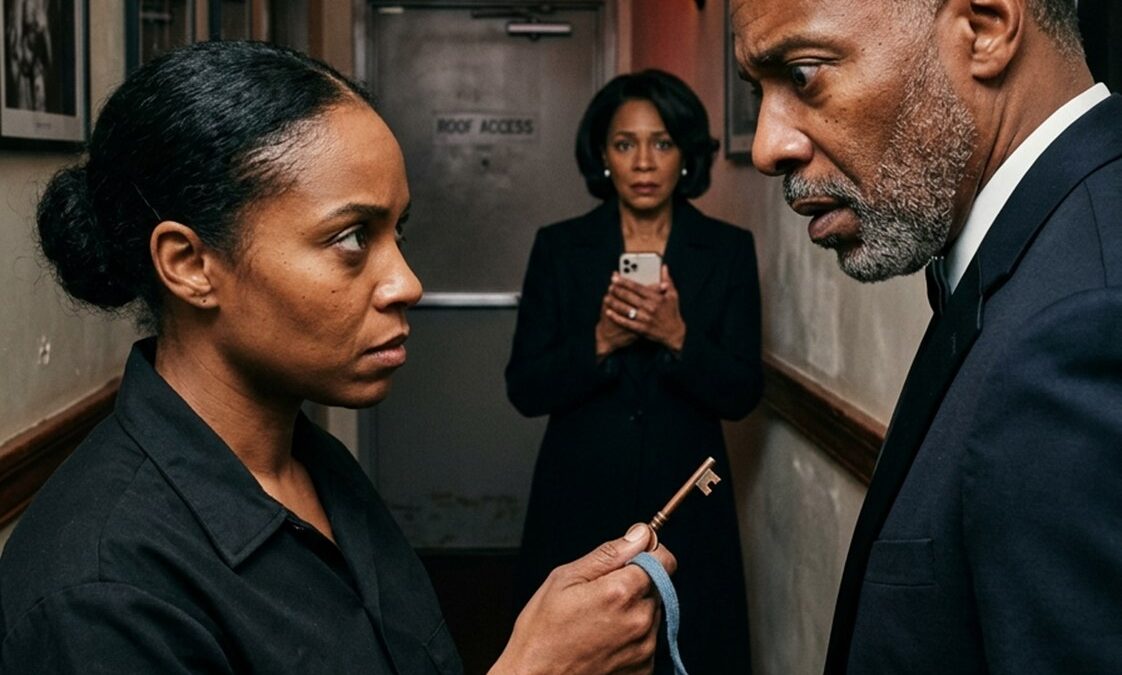
Chapter 2: The Door She Kept Locked
The man behind Mara wore a theater contractor’s badge.
Rowan knew the badge was false.
Every contractor on the project wore green.
His was white.
He looked at Dominic, then at the police lights beginning to wash the alley windows.
“I came to check the alarm,” he said.
“The alarm is disconnected,” Rowan replied.
His gaze flicked toward Mara.
Dominic noticed.
“What’s your name?”
The man read from his badge.
“Peter Dunn.”
“Your real name.”
He backed toward the roof stairs.
A uniformed officer appeared below them.
The man stopped moving.
For a moment, the only sound was Theo breathing through his nose.
Rowan put an arm around him.
Mara stepped away from the roof door.
“That’s enough theater,” she said.
Dominic held out his hand.
“Your phone.”
Mara stared at him.
“You have known me thirty years.”
“Then you know I mean it.”
She handed it over.
The screen had locked.
Dominic offered it to the officer coming up the stairs.
“Please preserve this,” he said.
The officer asked who owned it.
“I do,” Mara answered.
“And I’m not consenting to a search.”
The officer put it in an evidence pouch without opening it.
He separated Mara from the man in the white badge.
Rowan watched him ask each for identification.
Neither looked at the other.
That frightened her more than an argument would have.
Theo picked up his sandwich.
He held it like he had forgotten why.
“You okay?” Rowan asked.
He nodded too quickly.
Dominic looked at the boy’s trembling hands.
“There’s a quiet office downstairs.”
Theo tightened against Rowan.
“We’re staying together,” she said.
“Of course.”
The word sounded unfamiliar in Dominic’s mouth.
He led them to the manager’s office while officers cleared the building.
The gala guests were gone.
Someone had left a silk wrap over a chair.
Someone else had abandoned a half-full glass of water.
Rowan sat beside Theo.
Dominic stayed by the door.
He gave her space to speak first.
“You said daughter.”
“I did.”
“Was that a guess?”
“No.”
“How could you know?”
“Ada told me she was expecting.”
“She also told me you abandoned us.”
Dominic took that without flinching.
“I went looking for her.”
Rowan had imagined this conversation since she found her mother’s last letter.
In every version, he denied knowing them.
She had prepared herself to hate a stranger.
She had not prepared for a man who looked wounded by her mother’s name.
“Why didn’t you find her?” she asked.
“I was told the car she took went into the river.”
“A car?”
“She was supposed to leave Providence that night.”
“Who told you?”
“Mara.”
Rowan turned the copper key between her fingers.
The edge had worn smooth where her mother’s thumb had rubbed it.
“She lived in Albany,” Rowan said.
“For thirteen years.”
Dominic closed his eyes.
Rowan waited.
When he opened them, he looked at Theo.
“Is he Ada’s son?”
“Yes.”
Dominic drew a breath.
“Then you both deserved better answers.”
“Start with the key.”
Dominic pulled a chair toward them.
He stopped before sitting.
“May I?”
Rowan nodded.
He sat.
“Your mother and I rented a bank box.”
“Why?”
“She wanted copies of everything I signed.”
“What did you sign?”
“A trust.”
He looked at the key.
“I wanted my child to own what I could make clean.”
Rowan almost laughed.
The theater smelled of hot wiring and wet wool.
A crime boss wanted to discuss clean money.
Dominic saw the doubt.
“You don’t have to believe me.”
“I don’t.”
“That’s fair.”
He rubbed his hands together once.
“I paid cash for the theater thirty years ago.”
“You saved it tonight?”
“I kept it open.”
“That’s different.”
“Yes.”
His answer surprised her.
He glanced toward the hall, where an officer was speaking into a radio.
“I had done things Ada despised.”
“Did you stop?”
“Not quickly enough.”
Rowan looked at Theo.
He was watching Dominic with the blunt suspicion of a thirteen-year-old who had been told too little for too long.
“Why did she leave?” Rowan asked.
Dominic’s mouth tightened.
“She thought someone would use the baby against me.”
“Was she wrong?”
“No.”
“And Mara knew?”
“She handled the box paperwork.”
A knock came at the office door.
The officer asked Dominic to step into the hall.
Rowan heard the words lighting clamp and deliberate tampering.
Theo leaned close.
“Do we have to go home?”
“Soon.”
“Will those people know where home is?”
Rowan could not answer.
Dominic came back.
“The police want statements.”
“They can have mine.”
“I can arrange somewhere safe afterward.”
“No addresses from you.”
He nodded.
“You choose.”
Rowan studied him.
He had obeyed every boundary she set.
She did not know whether that made him trustworthy.
She knew it kept Theo calm.
“Why tonight?” she asked.
“Why did you bring the key?”
“Mom left me a letter.”
She reached into her work bag.
The envelope had softened at the corners from being carried for weeks.
She did not hand it over.
“She wrote that if anything happened to me or Theo, I should find you before Mara found the key.”
Dominic rose so sharply his chair scraped the floor.
“When did Ada write that?”
“Six months before she died.”
“Did she know Mara was watching?”
“She didn’t say.”
Dominic stared at the envelope.
Then he said, very quietly, “I never told Mara there was a second child.”
* * *
Police took Rowan’s statement until almost midnight.
A detective named Ellis asked her to describe the falling bar.
Rowan drew the clamp on the back of a gala program.
She marked the bolt she had tightened at four that afternoon.
“Could vibration loosen it?” Ellis asked.
“Not enough to open the saddle.”
“Could you be mistaken?”
“I wrote down the torque reading.”
She showed him her work log.
Her supervisor had initialed the page.
Ellis photographed it.
He asked about the man with the white badge.
Rowan described the badge color and the direction he had entered.
Theo described the knocks.
Mara’s contractor account had authorized after-hours access to the roof stairs.
That was a lead, Ellis said.
It was not yet proof of who had sent the man.
Rowan appreciated the distinction.
It meant he was taking the facts seriously.
Dominic gave his own statement in a separate room.
He did not try to join hers.
At one in the morning, Ellis told them the man’s name was Caleb Stroud.
He worked for a private security company that had lost its theater contract three months earlier.
Stroud claimed he had been asked to inspect an alarm.
He would not say by whom.
Mara’s lawyer arrived.
She left without speaking to Rowan.
Outside, rain glazed the theater steps.
Dominic’s driver brought his car to the curb.
Rowan walked past it.
She had booked a room near the police station on her own card.
The charge left twenty-one dollars available.
Dominic saw her phone screen.
“Let me pay for the room.”
“No.”
“Theo needs sleep.”
“He’ll get it.”
Theo climbed into the rideshare when it arrived.
Before Rowan followed, Dominic said, “The bank changed names.”
She turned.
“It’s Harbor Commonwealth now.”
“Can the box be opened?”
“Both renters have to be accounted for.”
“One is dead.”
“I know.”
“Then you bring a lawyer.”
“I will.”
“Not yours.”
He held her gaze.
“Yours.”
The next morning, Rowan called the legal aid office that had helped Ada settle a landlord dispute.
The attorney there could not take the case.
She gave Rowan the name of an estate lawyer who offered a reduced consultation.
Nina Patel met Rowan in a small office above a pharmacy.
Theo sat in the waiting room with a crossword.
Nina read Ada’s letter twice.
“Keep the original flat,” she said.
Rowan stopped twisting it.
“The bank box matters?”
“It might.”
“Can Dominic open it without me?”
“Depends on the rental agreement and estate documents.”
“We’re not guessing, then.”
“No.”
Nina’s smile was brief.
“We’ll ask for the records.”
She also told Rowan to make a copy of every message and stop discussing evidence by phone with strangers.
Rowan called Dominic from the office.
“Nina Patel represents me.”
“I’ll have my attorney contact her.”
“She wants the bank agreement.”
“I’ll send what I have.”
“And no one approaches Theo.”
“You have my word.”
Rowan looked through the window at her brother.
“He’s thirteen.”
“I heard you.”
Two days later, bank staff found the archived rental agreement.
Ada Hale and Dominic Sarto had signed it in August 1997.
The agreement listed two keys and required both renters, or their lawful representatives, to authorize access.
The bank had moved the box to a newer branch.
The number had remained 417.
Nina arranged a meeting there.
Rowan brought Ada’s death certificate and the probate papers naming her estate representative.
Dominic brought his attorney.
The bank manager checked each document.
She checked their identification.
Then she brought the box to a private room.
Rowan set down the copper key.
Dominic set down a steel one.
His was wrapped in a strip of old paper.
He did not touch Rowan’s hand.
“Ready?” he asked.
“No.”
“We can wait.”
“If I wait, I’ll go home.”
The bank manager inserted the keys.
The lock turned.
Inside lay three envelopes and a small cassette.
The top envelope had Ada’s handwriting.
FOR THE CHILD.
Rowan looked at Nina.
The attorney nodded once.
Rowan opened it.
There was a copy of the trust Dominic had described.
Its language was dense.
Nina traced the clauses with a pen.
The trust held shares in a warehouse property company, including land under a row of affordable apartments near the river.
A child born to Ada and Dominic would become a beneficiary after identity was established.
At thirty, the beneficiary could appoint one trustee.
They could not sell the apartments or remove their rent protections by themselves.
Rowan was twenty-eight.
Mara had been managing the company for years.
“She’s a trustee?” Rowan asked.
“She was appointed successor trustee,” Nina said.
“By whom?”
Dominic leaned over the page.
“Me.”
He looked sick.
The second envelope contained bank receipts and copies of letters.
Rowan knew her mother’s handwriting.
The letters were addressed to Dominic.
None had reached him.
Each had a handwritten note saying DELIVERY REFUSED.
The notes were signed with initials.
M.V.
Dominic touched one page.
“I never saw these.”
Rowan turned to the next.
Ada had written about the baby kicking when the theater orchestra rehearsed.
She had asked him to meet her at a public library.
She had said she would not raise a child in fear.
Dominic read without speaking.
The third envelope was sealed with clear tape.
Inside was a photograph of a typed letter dated three weeks after Rowan’s birth.
Ada Hale and infant daughter presumed dead following river accident.
The letter carried the letterhead of a private investigator.
Dominic stared at it.
“He worked for me.”
“Is he alive?” Nina asked.
“Yes.”
“We’ll contact him.”
The cassette had a paper label.
SEPTEMBER 1997 — OFFICE LINE.
Nina set it aside for an examiner.
Rowan expected someone to explain everything.
No one did.
A paper copy could be forged.
An old cassette could be edited.
The bank manager’s log proved only that the box had remained sealed since 1997.
It did not prove who had made every item.
Nina said that aloud.
Rowan was grateful again.
On the sidewalk afterward, Dominic asked if she wanted to hear why he had signed the trust.
“Later.”
“Will you let me explain the photograph?”
“When we know whether it’s real.”
Theo waited beside Nina’s car.
He held up the crossword.
“I got the whole thing.”
“Even the river clue?”
“That was easy.”
Rowan hugged him.
Across the street, a dark sedan slowed.
It kept going when Dominic’s driver turned his head.
Rowan watched its taillights disappear.
That evening, Ellis called.
A forensic technician had photographed the lighting clamp.
The tool marks were fresh.
Someone had loosened it after Rowan’s inspection.
Ellis had also traced the message that made Mara check the booth.
It came from a theater security account.
The account’s recovery email belonged to the office that managed Mara Voss’s personal calendar.
* * *
Rowan took Theo to school on Monday.
She waited until he was inside before leaving.
An unfamiliar man stood across the street beside a coffee cart.
He looked at her once.
Then at the theater work badge on her coat.
She walked into a crowded bakery and called Ellis.
The man was gone when a patrol car arrived.
Ellis took a description.
Rowan hated how little she could give him.
“He didn’t threaten me.”
“He may have been getting coffee,” Ellis said.
“He never bought any.”
“That matters.”
It did not make her feel safer.
Her supervisor put her on paid leave while the theater inspected every overhead fixture.
He sounded embarrassed.
“It’s insurance,” he said.
“I know.”
“We checked your log.”
“I know.”
“You did your job.”
“I know that too.”
After the call, Rowan sat at the kitchen table.
Theo’s field-trip form lay under a stack of bills.
She signed it.
She had put sixty dollars in an envelope the night before.
Dominic had offered her much more.
She was not ready to let him solve this.
Nina called at noon.
The investigator named on the old death report, Warren Pike, was alive in Connecticut.
He had agreed to speak with Ellis and their attorneys together.
Nina wanted Rowan there.
The meeting took place at a state police office the next afternoon.
Pike arrived carrying an accordion folder.
He was seventy-four and used a cane.
When Dominic entered, Pike stared at the floor.
“You lied to me,” Dominic said.
Pike nodded.
“Tell them.”
Pike looked at Ellis.
“Mara Voss brought me a police report.”
“Was it genuine?” Ellis asked.
“I thought it was.”
“Did you verify it?”
“No.”
He glanced at Rowan.
“I should have.”
Rowan held his gaze.
“Yes.”
Pike opened the folder.
He had kept a copy of the report and the invoice for his work.
The report’s incident number matched a real river accident.
The names of its occupants did not.
A clerk had altered the copy before Pike received it.
Pike said Mara had told him Dominic was unstable with grief.
She had asked him to deliver the conclusion quickly.
“Why keep these?” Nina asked.
“I keep every case.”
That answer sounded honest.
It also sounded inadequate.
Ellis collected the documents for comparison with official records.
Pike then produced a carbon copy of a payment receipt.
Mara had paid him from a property company account.
The same company held the apartments in the trust.
Dominic stood at the window.
Rowan could see his reflection in the dark glass.
“You had a phone,” she said.
He turned.
“You could have called Albany.”
“I didn’t know Albany.”
“You could have looked harder.”
“Yes.”
He did not defend himself.
That made it easier to say the next thing.
“My mother died thinking you chose money.”
“I know.”
“She stayed awake whenever a car stopped outside.”
“I know that now.”
“She taught me which windows opened onto the fire escape.”
Dominic gripped the windowsill.
“I’m sorry.”
Rowan looked away.
An apology could acknowledge a wound.
It could not give Ada back her sleep.
After the meeting, Dominic asked if Theo had eaten.
Rowan almost refused the question.
Then she remembered her brother’s empty lunchbox.
“He’s at a friend’s house.”
“I found a photograph Ada sent me years ago.”
Rowan looked up.
“How?”
“She gave it to a clerk at my warehouse.”
“Did you see it then?”
“No.”
“The clerk kept it?”
“He thought it was personal.”
Dominic’s mouth tightened.
“I found it yesterday in the files my office sent to storage.”
Rowan saw what he meant.
Mara’s office had chosen which files Dominic saw.
She had kept Ada’s letters away from him.
Perhaps she had kept this too.
Dominic took a small envelope from his coat.
He did not open it.
“You can have it.”
Rowan accepted it.
Inside was a school photograph of a girl with crooked bangs and a furious expression.
She was eight.
Ada’s handwriting covered the back.
Rowan starts third grade Monday.
She loves machines.
She hates peas.
Please tell her you tried.
Rowan had never seen her mother plead.
She sat down on the nearest bench.
Dominic stayed standing.
“Did you know she sent it?” he asked.
“No.”
Ada had hidden the fear so well.
She had hidden hope too.
For years, Rowan had believed her mother stopped trying because Dominic had made his answer clear.
Now she held proof that Ada had tried again when Rowan was eight.
That night, the cassette examiner called Nina.
The tape was continuous where it mattered.
It contained an office conversation from September 1997.
Nina sent Rowan a transcript.
A woman’s voice identified herself as Mara Voss.
A man’s voice was harder to hear.
Mara discussed moving Ada to a private address.
She said Dominic would never be told.
Then the man asked about the child.
Mara answered, “The child keeps the trust alive.”
Rowan read the line three times.
She had thought Mara wanted to hide an affair.
She had thought Mara wanted control of Dominic.
The tape pointed somewhere colder.
Mara had wanted control of the apartments.
* * *
The first tenants came to the theater on Thursday.
They were not gala donors.
They lived in the river apartments, where Mara’s company had sent notices about a proposed redevelopment.
Nina had asked three of them to meet Rowan and Dominic there.
Ellis had no objection as long as they did not discuss witness testimony about the criminal investigation.
The lobby looked smaller without flowers.
A woman named Mrs. Alvarez carried a folder thick with rent receipts.
“They say the building needs to close,” she said.
“For repairs?” Rowan asked.
“For progress.”
Her voice made the word bitter.
Dominic read the notice.
His signature appeared beneath Mara’s.
“I didn’t sign this.”
The tenants looked at one another.
Rowan had learned enough to ask for the original.
Nina scanned the page.
“The company may have used a signature authority you granted.”
Dominic nodded grimly.
“I did.”
A younger tenant, a bus driver named Malcolm Reed, stepped forward.
“If the trust protects the rents, why did nobody tell us?”
“Because I didn’t know it was being ignored,” Dominic said.
Mrs. Alvarez did not soften.
“That doesn’t put the heat back on.”
Rowan looked at her.
“Is it out?”
“Half the nights.”
“Since when?”
“Since the notices.”
Dominic asked for the maintenance logs.
Malcolm handed him copies.
The company had closed several work orders without visits.
Mara’s management office had approved them.
There were no dramatic confessions.
Just dates.
Cold nights.
Initials.
People who had learned to document what nobody wanted to see.
Rowan understood that kind of work.
She asked Mrs. Alvarez if the basement radiators had failed first.
“They did.”
“Did anyone photograph the pressure gauge?”
Malcolm had.
On his phone.
He found the image.
The reading suggested the boiler had been allowed to run too low.
It did not prove why.
But it gave a licensed inspector something to check.
Dominic called the city housing department from the lobby.
He gave his name.
He asked for an inspection and said the company would provide access.
Mrs. Alvarez watched him.
“You could have done that last month.”
“Yes,” he said.
Police arrived before the meeting ended.
Ellis asked to speak with Rowan privately.
Caleb Stroud had changed his account.
His lawyer had arranged an interview.
Stroud said Mara had hired him to retrieve a key from Rowan.
He claimed he never intended to approach Theo.
“She texted him the booth location?” Rowan asked.
“He says she did.”
“Can he prove it?”
“We have messages from his phone.”
“Did he loosen the bar?”
“He denies it.”
Ellis did not say he believed him.
A camera in the theater’s service corridor showed another person entering the rigging area after Rowan’s inspection.
The image was grainy.
The person wore a theater staff jacket.
Rowan watched the clip at Ellis’s request.
She recognized the walk.
“Julian Kroll,” she said.
“He’s the project engineer.”
“Are you sure?”
“He drags his left foot on stairs.”
Ellis replayed the clip.
The person turned.
A reflective strip on the jacket caught the light.
The face remained hidden.
Rowan pointed to a tool bag.
“Kroll added a red tape loop to that handle.”
“Who else uses it?”
“Nobody should.”
Ellis had already obtained a warrant for Kroll’s work phone.
Rowan left the viewing room shaking.
She had walked under that lighting bar for hours.
Theo had waited above it.
She had pulled the curtain because a clamp moved where it should not have moved.
At home, Theo was building a tiny motor from an old fan.
He had stripped the screws neatly into a cup.
“Can I help?” Rowan asked.
“You’ll make it faster.”
“Is that bad?”
“I want to figure it out.”
She sat beside him.
He pushed the cup toward her.
“You can hold those.”
It was a small mercy.
She held screws while he worked.
When the fan blade finally turned, he grinned.
For the first time since gala night, Rowan laughed.
Then he asked, “Is Dominic really your dad?”
She considered lying until the test.
“He might be.”
“Would he be mine too?”
“No.”
Theo nodded.
He looked at the little motor.
“You won’t go live somewhere else?”
“No.”
“You sure?”
Rowan set down the cup.
“I’m sure.”
He leaned against her shoulder.
She understood then why Ada had feared every car.
She also understood why Ada had kept getting up in the morning.
The next day, Rowan and Dominic submitted DNA samples through a court-accredited laboratory.
Nina arranged it.
The results would take time.
Rowan did not ask Dominic how he felt.
She had enough feelings of her own.
Ellis called that afternoon.
Kroll had admitted to loosening the clamp.
He said Mara told him the bar would be kept above an empty section.
He expected a scare, not injuries.
The fallen weight had landed behind the fire curtain.
That was luck.
The tool marks and video supported his admission.
His bank records showed a payment from a consulting company Mara controlled.
Dominic listened from Nina’s speakerphone.
“What was she trying to scare me into doing?” he asked.
Ellis paused.
“She had prepared papers for you to sign after the gala.”
Nina had already found the draft in Mara’s office files.
It removed the apartment properties from the old trust through a proposed restructuring.
The draft claimed no eligible beneficiary existed.
With Dominic frightened and Rowan discredited as the stagehand who triggered an evacuation, Mara meant to push it through.
The cassette explained why she had feared the key.
The trust papers explained what she wanted.
Rowan looked at the draft’s final page.
Mara’s name appeared as manager of the company that would receive the land.
* * *
The confrontation happened in a plain conference room.
Nina had asked for an emergency meeting of the company board and the trust’s independent trustee.
Dominic had insisted the apartment tenants send representatives.
Mara arrived with two attorneys.
She looked tired.
She also looked ready.
Ellis and a prosecutor observed from the back.
They were not there to decide a criminal case in a boardroom.
They were there because several witnesses might make statements.
Rowan sat beside Nina.
Mrs. Alvarez and Malcolm sat across from her.
Dominic took no seat at the head of the table.
Mara noticed.
“You’ve assembled an audience,” she said.
“You sent them notices,” Rowan replied.
“They deserved to hear why.”
Mara opened a folder.
“The buildings need major repairs.”
Mrs. Alvarez held up her receipts.
“We’ve been paying for them.”
“Rent doesn’t cover what the city now requires.”
Malcolm leaned forward.
“Your office closed the work orders.”
Mara turned to the board.
“Deferred maintenance is exactly why restructuring is necessary.”
It was a good argument.
Rowan hated that.
The buildings were old.
The repairs would cost real money.
Mara had figures for every failing pipe.
She had photographs of damp walls and worn stairs.
She had a plan to move tenants temporarily.
The plan had no guaranteed return date.
It had no guarantee their rents would remain affordable.
Nina asked where the proposed company would get the land.
“From a transaction permitted by the trust,” Mara said.
“If there is no beneficiary.”
“There is no established beneficiary.”
Dominic looked at her.
“You knew Ada had a daughter.”
“I knew Ada made claims.”
“You told me she died.”
“I reported what an investigator found.”
Pike’s corrected statement lay in Nina’s folder.
Mara did not glance at it.
She had planned her position carefully.
A bad report was someone else’s fault.
Letters might have been lost.
A cassette might be disputed.
A key did not establish parentage.
She was right about the last point.
Rowan had spent two weeks learning the difference between a clue and proof.
Nina passed copies of the bank’s access log to the board.
The box had remained sealed.
The envelopes inside were old.
The paper and ink examinations were consistent with their dates.
Mara’s attorneys said consistent did not mean certain.
They were right too.
Dominic looked toward Rowan.
She shook her head slightly.
Not yet.
Nina introduced the authenticated correspondence.
The company had kept scans of Ada’s letters in a storage account Mara’s office controlled.
An independent data examiner had recovered them after the board granted access.
Mara’s initials appeared in the routing notes.
Her lawyer objected to the word intercepted.
Nina used withheld.
No one objected to that.
Mara folded her hands.
“Dominic was dangerous then,” she said.
The room changed.
Even Dominic went still.
“Ada was frightened,” Mara continued.
“She told me she wanted distance.”
Rowan thought of the letters in the box.
Ada had asked for distance from Dominic’s work.
She had asked him to meet her in public.
Mara could use both truths.
“I tried to protect a young woman,” Mara said.
“By telling him she was dead?” Rowan asked.
“I believed she was.”
“For thirteen years?”
“I had no reason to reopen it.”
“You received my school photograph.”
Mara’s face hardened.
“I received a photograph of a child.”
“You filed it.”
“I filed many things.”
“You kept it from him.”
“I was following Ada’s wishes.”
Rowan looked at Dominic.
His anger was visible now.
He kept it behind his teeth.
“Let the records answer,” Nina said.
She placed another page on the table.
It was the original rental agreement for box 417.
Mara had signed as witness.
Beside her signature was a handwritten note.
TRUST COPY HELD INSIDE.
Nina had asked the bank to examine its stored scan.
The notation was present in the scan made in 1997.
Mara had known exactly what the key could reach.
Still, she leaned back.
“I witnessed a box rental.”
“Then why did you pay someone to take Rowan’s key?” Nina asked.
Mara’s attorney began to speak.
Mara raised a hand.
“I never authorized force.”
“Stroud says you hired him.”
“Stroud is trying to reduce his exposure.”
That was also possible.
Rowan could feel the board wavering.
They were businesspeople.
They wanted a way to repair buildings without admitting their own oversight.
Mara had spent years giving them easy answers.
The prosecutor had told Nina the DNA report might arrive that morning.
Rowan had checked her phone six times.
It stayed dark.
Mrs. Alvarez rose.
“I don’t care whose father he is,” she said.
Everyone turned.
“I care whether the agreement that kept my rent fair still applies.”
Nina answered her.
“It does unless a court rules otherwise.”
Mara’s attorney said the trust could still be modified.
“By the proper people,” Nina said.
“Not under a false statement that they don’t exist.”
The conference room door opened.
A courier handed Nina an envelope.
Rowan watched her attorney read.
Nina passed it to Rowan first.
The accredited laboratory found a father-daughter relationship between Dominic and Rowan with overwhelming support.
Rowan’s name sat beside his on the page.
It looked ordinary.
She had expected thunder.
All she heard was Mrs. Alvarez’s chair creak.
Nina gave the board a copy.
“This establishes Rowan as Ada’s child and Dominic’s daughter,” she said.
Mara looked at the report.
For the first time, she seemed to run out of words.
Then she found one more.
“Congratulations,” she said to Rowan.
“It won’t give you your mother back.”
Rowan folded the report once.
“No,” she said.
“It will help us keep her promises.”
The independent trustee called for the proposed transfer to be withdrawn.
The board voted to suspend Mara’s authority pending review.
Dominic abstained where his own decisions were under scrutiny.
That mattered.
He had signed powers he had not monitored.
He did not get to erase that with grief.
The tenants stayed to discuss immediate repairs.
A licensed inspector had found serious faults in the heating system.
The city ordered work.
Dominic put company funds into an account the trustee could oversee.
Mrs. Alvarez asked for dates in writing.
She got them.
Outside the conference room, Ellis spoke with Mara’s lawyers.
No one was arrested for the benefit of an audience.
The investigation continued through bank records, phone data, and interviews.
Three months later, Kroll pleaded guilty to a reduced charge related to the rigging sabotage and agreed to testify.
Stroud admitted his role in trying to take the key.
Mara was charged with fraud, obstruction, and conspiracy tied to the trust and the theater incident.
Her attorneys fought the case.
At trial, the cassette was only one piece.
The bank record, recovered correspondence, payments, phone messages, Kroll’s testimony, and her own signed transaction drafts carried the rest.
The jury convicted her on the fraud and conspiracy charges.
She received a prison sentence.
The appeal would take longer.
Rowan understood that a verdict could be challenged.
She also understood the apartment transfer was stopped.
The heaters worked through winter.
* * *
Spring came without asking permission.
Rowan returned to the Orpheum after the safety inspection.
She replaced the damaged lighting bar herself.
Her supervisor hovered below.
“You checked the clamp?” he asked.
“Twice.”
“I knew you would.”
“Then stop staring.”
He went to bother someone else.
Theo came after school with a bag of pretzels.
He ate two before offering her one.
The theater no longer frightened him.
He still kept the booth door locked when he waited there.
Rowan considered that reasonable.
She had moved them to an apartment with windows that opened easily and locks the landlord maintained.
She paid the rent.
Dominic had offered to buy the building.
She had said no.
He had accepted it.
His first offer after the trial had been larger.
Shares.
A house.
A salary from one of his companies.
Nina had advised Rowan to understand what she was legally owed before refusing anything.
Rowan listened.
The trust was not a gift from Dominic’s present wealth.
Ada had helped write it.
Rowan accepted her position as beneficiary.
Then she used her vote to appoint an independent trustee with housing experience.
She insisted on an outside audit.
She asked the tenants to review repair plans before contracts were signed.
None of it was glamorous.
Mrs. Alvarez said it was the first useful thing anyone had done with the family name.
Dominic heard her.
“I’ll take that,” he said.
“You should,” she replied.
He also began answering harder questions about the companies he still owned.
He sold off interests he could not defend.
He cooperated with investigators about old business practices.
Rowan did not ask for a tidy account of every year.
She asked for records when his decisions touched the trust.
He gave them.
One Sunday, he came to her apartment carrying a small toolbox.
Theo had invited him.
Rowan found them at the table with the fan motor.
“Did you tell him he could come?” she asked Theo.
“Yes.”
“Did you tell me?”
“I wrote it on the fridge.”
A square of paper on the fridge read DOMINIC, 2 P.M.
Rowan looked at the clock.
It was two.
Dominic stood.
“I can leave.”
“You can stay.”
Theo grinned without looking up.
He had learned how to arrange a room.
Dominic did not pretend he knew more about motors than he did.
That made Theo generous with explanations.
Rowan watched them fit a new switch.
She thought of Ada teaching her to strip wire at the same table.
The thought hurt.
It also warmed the room.
Later, when Theo went to wash his hands, Dominic asked to speak with Rowan.
She opened the apartment door.
They stood in the hall.
“I owe you an apology without an excuse,” he said.
“You’ve apologized.”
“I said I was sorry for losing you.”
He glanced down.
“I should have said I failed to look past the answer I wanted.”
Rowan waited.
“I trusted a report because grief made it easier than doubt.”
“And because Mara handled things.”
“Yes.”
“You gave her that power.”
“Yes.”
Rowan leaned against the doorframe.
“I can have dinner with you sometimes.”
“I’d like that.”
“Theo chooses whether he does.”
“Of course.”
“You don’t call my job to check on me.”
“I won’t.”
“And if I say no, you stop asking.”
“I will.”
She believed he meant it.
She would still notice whether he did it.
That was the boundary.
Not a punishment.
A way to build something that could bear weight.
Dominic reached into his coat.
He brought out the paper strip that had wrapped his bank key.
“I found what this was.”
Rowan took it.
Ada’s handwriting ran along one edge.
Buy oranges after the appointment.
Rowan smiled.
“She always forgot oranges.”
“She sent me for them that day.”
“Did you go?”
“Yes.”
“Did you come back?”
“She was gone.”
The smile faded.
He let the silence stand.
“I kept the list,” he said.
Rowan handed it back.
“You should.”
He looked surprised.
“It belongs to your memory,” she said.
“The copper key belongs to mine.”
That summer, the river apartments held a block party after the last heating repairs passed inspection.
There were folding tables and too much food.
Malcolm ran a grill.
Mrs. Alvarez guarded a tray of pastries like a bank vault.
Theo helped children build simple battery lights under Rowan’s supervision.
Dominic arrived without an entourage.
People watched him.
Some spoke.
Some did not.
He carried chairs.
That was a task nobody could argue with.
Near sunset, Mrs. Alvarez told Rowan the trust board wanted her to speak at its next public meeting.
“You have to ask her,” Theo said.
“I am asking,” Mrs. Alvarez replied.
Rowan looked toward the apartment windows.
A few glowed with the lights Theo had built.
She had spent years keeping her head down because rent was due and trouble was expensive.
She could speak for a room without owning it.
“Yes,” she said.
“I’d like to.”
* * *
Five years later, the Orpheum curtain fell on purpose.
Rowan stood beneath it with a wrench in her hand.
The audience applauded.
The safety demonstration had become part of the theater’s annual open house.
Students watched how the fire curtain moved and how the overhead rigging was inspected.
No one had to take an old stagehand’s word for it.
They could see the bolts.
Theo, now eighteen, ran the booth for the afternoon.
He had labeled every switch.
Dominic sat in the third row.
His hair had gone almost white.
Mrs. Alvarez sat beside him, correcting a program with a pen.
Rowan’s supervisor, who still worried aloud, checked the bar from the wings.
The apartments remained open.
The trust paid for repairs without selling the homes beneath them.
Nina served on its board.
Malcolm had persuaded the company to train residents for maintenance jobs.
The theater employed two of them.
Rowan still worked with her hands.
She had never stopped loving the instant a dead lamp came back to life.
After the demonstration, Theo came down from the booth.
He held out the copper key.
“You left this upstairs.”
Rowan took it by its faded blue shoelace.
She no longer carried it because she feared forgetting.
She carried it because Ada had.
Dominic approached slowly.
“Are you hurt?” he asked.
It was what he had asked beneath the emergency light.
Rowan looked at her brother.
At the safe curtain.
At the audience leaving through open doors.
“No,” she said.
Theo slipped an arm around her shoulders.
Dominic waited beside them until Rowan offered him her hand.
The key rested between their fingers.
Then Theo reached for the theater doors, and all three walked into the evening together.
THE END








