They Called Her a Trespasser Outside the Charity Gala—Until the Old Theater’s Marquee Lit Her Name
Chapter 2: The Name Above Us
The attorney had not meant to speak aloud.
Her hand stayed lifted after the words left her mouth.
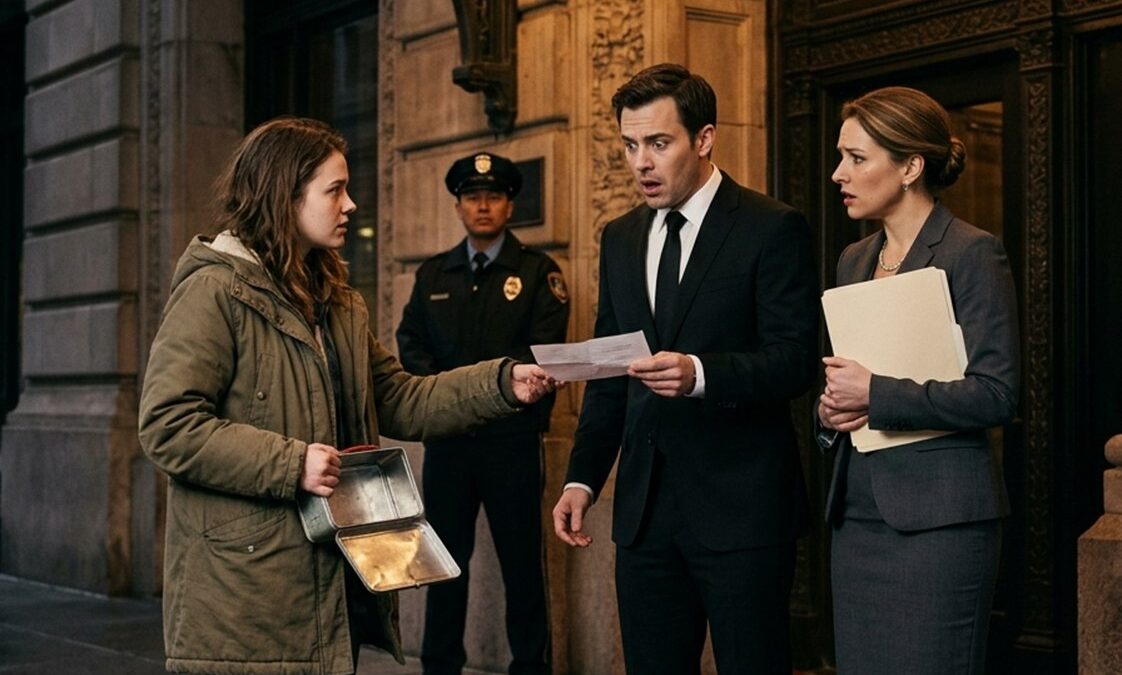
Tessa held the carbon copy beneath the dead marquee.
Adrian watched the paper, not her face.
“What does that line mean?” Tessa asked.
“Let me see the document,” Celia said.
“You just told him not to let me open it.”
“I said that because the crowd is watching.”
“That’s why I opened it.”
Adrian stepped between them.
“Everyone should put their phones away.”
Nobody did.
“This is a private legal matter,” he said.
“You invited us to witness the transfer,” Tessa replied.
“It hasn’t happened.”
“Then there’s no reason to rush.”
His eyes stayed on her hand.
“Let the attorney review the original.”
“She can read it here.”
Celia came closer.
“My name is Celia Moss. I represent the Vale Civic Foundation.”
“I know.”
“May I see the document?”
“Tell me what the last line means first.”
Celia looked at Adrian.
He gave her a small shake of his head.
The crowd shifted around them.
The marquee gave a faint electrical buzz.
Adrian lowered his voice.
“This is not the place to discuss it.”
“It became the place when you brought cameras.”
“I didn’t bring them.”
“You invited the guests.”
“I invited them for a fundraiser.”
“Then tell them what their money is funding.”
Celia’s folder slipped against her hip.
“The contract included a community reversion clause,” she said. “If the owner failed to maintain the building or sold it outside its stated purpose, the parcel could return to the trust.”
“Who owns the trust?”
“The foundation,” Adrian said.
“Which you control.”
“Which a board controls.”
“Your name is on the board.”
“I’m one of nine members.”
“You’re the chair.”
Tessa’s eyes returned to the paper.
The final line read:
To be recorded with the Trust deed before transfer.
Below it were initials in darker ink.
The pressure marks crossed the back of the page. She turned it toward the streetlight.
She could make out fragments.
Board.
Independent.
Calder.
“Someone wrote over this,” she said.
Celia stiffened.
“How can you tell?”
“The carbon sheets weren’t separated.”
Tessa laid the page over the photograph in the tin. The impression showed through backward.
The guests leaned in.
Adrian reached out.
She pulled the paper away.
“Don’t touch it.”
“Give it to me.”
“No.”
“Then you can’t make a scene and refuse to show your evidence.”
“I can take it to the clerk.”
“Tomorrow.”
“If you sell it tonight, tomorrow is too late.”
“We are not selling anything tonight.”
“Your board is signing the transfer.”
“Our board approved a plan.”
“Your company gets the land for one dollar.”
His eyes flicked toward the cameras.
“That document is confidential.”
“It’s public.”
The event planner lowered her clipboard.
Adrian nodded toward the guard.
“Walk her off the property.”
The guard hesitated.
“I’m on the public sidewalk,” Tessa said.
“You’re blocking the entrance,” Adrian replied.
“I’m standing here.”
“Please,” Adrian told the guard. “Do your job.”
The guard looked at the phones, then at Tessa’s affidavit.
“You can stay on the public sidewalk,” he said.
Adrian’s mouth tightened.
Tessa lowered her eyes to the tin.
She had come intending to hand it to a clerk. Now the crowd was waiting, and Adrian was already preparing to say she had brought nothing.
If the paper was missing, he would call her bluff.
If it was there, he could still call it false.
Either way, her mother’s private things would become a spectacle.
Her fingers found the brass latch.
Two scratches marked the lid.
One came from a dropped wrench.
The other came from Tessa’s own hand, years ago, when she fell on the theater stairs.
Naomi had laughed, then wrapped Tessa’s palm in a bandage.
Tessa pressed the latch.
“Wait.”
A woman in a gray suit hurried down the steps, gripping a folder.
Adrian’s attorney looked pale.
“Don’t let her open that here.”
The guests went quiet.
Tessa felt the lid shift beneath her thumb.
Adrian stared at Celia.
“Why?”
The silence answered first.
Tessa raised the lid.
Inside lay an old brass key, a folded carbon copy, and a photograph of her mother beside the Orpheum’s original marquee.
The carbon copy bore a date from eleven years earlier.
Under Naomi Ward’s signature, someone had written a final line.
The attorney took a step forward.
Adrian stopped her with a hand.
“What does it say?” a guest asked.
Tessa unfolded the page.
Her mother’s signature was plain.
The final line was not.
The marquee flickered once.
Then every letter went dark except two.
T.
W.
Adrian went still.
“You weren’t supposed to find that,” he whispered.
The attorney had stopped moving.
Tessa held the page steady beneath the dead sign.
“What did you mean by that?” she asked.
Adrian looked toward the guests.
“Everyone should leave.”
A man in a tuxedo lowered his phone.
“You invited us.”
“This has nothing to do with you.”
“It does if our donations are paying for the deal.”
The guest’s question started several conversations at once.
Celia’s hand tightened around her folder.
Tessa read the added line again.
To be recorded with the Trust deed before transfer.
The initials beneath it were unfamiliar.
The pressure marks on the back were clearer now.
“Someone wrote over this,” Tessa said again.
Celia’s face changed.
“Let me see the page.”
“Tell me what you saw.”
“I can’t say from here.”
“You can.”
“I need to examine it.”
“Did you know the line was changed?”
Celia looked at Adrian.
He gave her the same small shake of his head.
This time, she did not obey it.
“Your mother’s contract had a community reversion clause,” she said.
Adrian turned toward her.
“Celia.”
“If the owner failed to maintain the building or sold outside its stated purpose, the parcel could return to the trust.”
“Who owns that trust?” Tessa asked.
“The foundation,” Adrian said.
“Which you control.”
“The board controls it.”
“Your name is on the board.”
“I’m one of nine members.”
“You’re the chair.”
The guests watched him.
Tessa looked at the folded page.
“Then why are you afraid of a sentence?”
“I’m not afraid of it.”
“Let the clerk verify the filing.”
“Tomorrow.”
“The transfer is tonight.”
“The transfer is ceremonial.”
“Then it can wait.”
His face tightened.
Tessa saw recognition in his expression.
Or fear.
He shifted his attention to the tin.
“What else is in there?”
“My mother’s things.”
“Open it.”
“I already did.”
“If you want people to believe you, show them the evidence.”
“I want the records checked.”
“Then why bring a lunch tin?”
“Because it’s mine.”
Whispers moved through the guests.
Tessa heard the word opportunist.
The guard heard it too and looked uncomfortable.
Adrian gestured at the phones.
“Everyone here has a camera pointed at us.”
“I noticed.”
“Be careful what you make this.”
“I’m not making anything.”
“You can leave with your dignity.”
“I came here with it.”
His face colored.
Adrian stepped closer to the tin.
“Your mother was paid to operate the projector.”
“She kept this place running.”
“She had an option to buy it.”
“She did.”
“She never exercised it.”
“That’s what your file says.”
“So the building isn’t yours.”
“The same file says the transfer couldn’t proceed if her claim passed to me.”
“Your mother’s claim expired.”
“Her signature is on the renewal.”
“Where?”
“In the tin.”
The crowd leaned closer.
Adrian’s confidence softened.
Tessa could feel her heartbeat against the metal.
She had planned to hand the tin to a clerk and keep her mother’s things private.
But Adrian was already telling the crowd there was nothing inside.
“Give it to me,” he said.
“No.”
“You can’t make a scene and refuse to show your evidence.”
“I can take this to the clerk.”
“You can do that tomorrow.”
“If you sell it tonight, tomorrow is too late.”
“We are not selling anything tonight.”
“Your board is signing the transfer.”
“Our board has approved a plan.”
“Your company gets the land for one dollar.”
His eyes shifted toward the cameras.
“That document is confidential.”
“It’s public.”
The event planner lowered her clipboard.
Adrian turned to the guard.
“Walk her off the property.”
The guard looked toward the sidewalk.
“I’m on it,” Tessa said.
“You’re blocking the entrance.”
“I’m standing here.”
“Please do your job,” Adrian told him.
The guard paused, then spoke evenly.
“You can stay on the public sidewalk.”
Adrian’s mouth tightened.
Tessa looked down at the tin.
She had wanted the clerk to open it. If the document was missing, Adrian would call it a bluff. If it was there, he could still call it false.
The lid bore two scratches.
One from a dropped wrench.
The other from Tessa’s hand, years ago, when she had fallen on the theater stairs.
Naomi had laughed and bandaged her palm.
Tessa pressed the latch.
“Wait.”
Celia hurried down the steps, clutching her folder.
“Adrian, don’t let her open that here.”
The crowd went quiet.
Adrian stared at her.
“Why?”
Tessa raised the lid.
Inside lay an old brass key, the folded carbon copy, and a photograph of her mother beside the original marquee.
The copy bore a date from eleven years earlier.
Under Naomi Ward’s signature, someone had written a final line.
The attorney took a step forward.
Adrian stopped her.
“What does it say?” a guest asked.
Tessa unfolded the page.
Her mother’s signature was plain.
The last line was not.
The marquee flickered.
Then every letter went dark except two.
T.
W.
Adrian’s face had gone still.
“You weren’t supposed to find that,” he whispered.
Tessa held the page between them.
The crowd kept recording.
“What does that mean?” she asked.
Adrian glanced toward the guests.
“Everyone should leave.”
Nobody moved.
“You invited us,” a man said.
“This has nothing to do with you.”
“It does if our donations are paying for the deal.”
The guests began asking questions.
Celia gripped her folder.
Tessa read the line again.
To be recorded with the Trust deed before transfer.
The initials beneath it were unfamiliar.
The pressure marks crossed the back of the paper.
She tilted it toward the streetlight.
The reversed words showed through faintly.
Board.
Independent.
Calder.
“Someone wrote over this,” she said.
Celia’s face tightened.
“Let me see the page.”
“Tell me what you saw.”
“I can’t say from here.”
“You can.”
“I need to examine it.”
“Did you know the line was changed?”
Celia looked at Adrian.
His small shake of the head returned.
This time, she ignored him.
“Your mother’s contract had a community reversion clause,” Celia said.
Adrian turned sharply.
“Celia.”
“If the owner failed to maintain the building or sold outside its stated purpose, the parcel could return to the trust.”
“Who owns the trust?” Tessa asked.
“The foundation,” Adrian said.
“Which you control.”
“The board controls it.”
“Your name is on the board.”
“I’m one of nine members.”
“You’re the chair.”
Adrian looked at the crowd.
“This is a private legal matter.”
“You made it public when you called my mother’s claim expired,” Tessa said.
Celia lowered her folder.
“The foundation’s title search didn’t find an active claim.”
“That isn’t the same as saying it didn’t exist.”
“No,” Celia said. “It isn’t.”
The admission spread through the guests.
A woman near the entrance set down her glass.
The event planner moved toward the lobby.
Adrian called after her.
“Where are you going?”
“To stop the signing.”
The words landed harder than any accusation.
Celia took out her phone.
“I’ll call the title office.”
“You don’t need to,” Adrian said.
“I do.”
She stepped away from him.
That was the first crack.
A guest asked Adrian whether the transfer could be paused.
He said it could.
Another asked if the land was really being conveyed for one dollar.
Adrian explained that the foundation’s redevelopment agreement included other commitments.
Tessa held up the public filing.
“It’s listed as a sale.”
His attorney started to object, but Celia had already reached the title officer.
The event planner returned to the doorway.
“The title officer is here,” she said.
A narrow-faced man in a green city badge came down the steps.
He introduced himself as Martin Feld.
Tessa showed him the stamped affidavit, the carbon copy, and the brass key.
He did not take the original.
Instead, he entered the filing number from her copy into a city tablet.
“You filed this today at 2:18 p.m.”
“Yes.”
“The succession claim is in the system.”
“Does it suspend the transfer?”
“Pending review.”
Adrian drew a breath.
“Then there is no transfer tonight.”
“There shouldn’t be,” Feld said.
A few guests lowered their phones.
Others raised them.
“What about ownership?” Tessa asked.
“I can’t resolve that here.”
“Can you confirm the current deed?”
“Yes.”
“Whose name is on it?”
“Naomi Ward.”
The guests reacted quietly.
Adrian remained still.
“What about the trust?” Tessa asked.
“That’s a separate question.”
“Can the building be sold?”
“Not tonight.”
“Can it be damaged?”
Feld glanced at the dark windows.
“Anyone entering should be escorted.”
Celia looked toward the lobby.
“We’ll secure it.”
Tessa noticed the key’s tag.
Her mother had written a small number on it.
The number matched a narrow cabinet beside the ticket booth.
“Can we see the maintenance log?”
“Why?” Celia asked.
“The marquee has a separate circuit.”
The guard looked at Tessa.
“She knows the building.”
“What does the key open?” Adrian asked.
“The cabinet.”
“Why bring it?”
“I thought the filing would be enough.”
“And now?”
“I want to know who ordered the sign disconnected.”
Feld considered this.
“I’ll go with you.”
Adrian looked toward the lobby.
“Then we’ll all go.”
The gala did not end all at once.
Guests spoke in small groups while the board postponed the speeches.
Some stayed close to Adrian, waiting for more facts.
Others moved away.
The guard rolled the stanchions aside.
Tessa carried the tin through the entrance.
The lobby smelled of dust, cold stone, and fresh paint.
A brass chandelier hung over the floor.
The ticket booth remained in the corner.
Tessa knelt by the cabinet and fitted the key.
Inside were a maintenance binder, coils of wire, and old envelopes.
The binder had soft corners.
She opened it to the last filled page.
Her mother’s handwriting covered the lines.
At the bottom, someone else had written:
Disconnect marquee.
No authorization attached.
The date was three days earlier.
Celia leaned over her shoulder.
“Do you recognize the handwriting?”
“No.”
Feld held up a hand.
“Don’t touch that page again.”
“I already did.”
“Then step back.”
Tessa stood.
The event planner found a service order tucked into the binder pocket.
It listed Brightline Electrical.
The order said the marquee circuit would be removed before the building inspection.
“The inspection isn’t for six weeks,” Tessa said.
“That date changed,” Adrian replied.
“Who changed it?”
“Someone on the project team.”
“Who?”
“I don’t know.”
“You’re the chair.”
“I don’t approve every maintenance order.”
“Then your process is broken.”
“My process belongs to the foundation.”
“It nearly transferred a disputed building.”
Feld photographed the page and order with his tablet.
“Leave everything where it is.”
The event planner found an old photograph inside the tin.
Naomi stood beside the marquee, smiling with a screwdriver in one hand.
The back carried a date and a note:
For when someone says the building is empty.
Tessa read the words silently.
Her throat tightened.
Adrian watched her without speaking.
That was probably the kindest thing he could have done.
* * *
The next morning, the city clerk’s office confirmed that Naomi had filed a renewal before her death.
The renewal had been scanned under the wrong parcel number.
Tessa had found the matching receipt in the lunch tin.
That explained the missing claim.
It did not explain the altered carbon copy.
The original went to the city archivist and a forensic document examiner.
Tessa brought the tin to the records office.
The archivist, Salim, examined its seams with a magnifier.
“You said you found it behind a closet panel?” he asked.
“Yes.”
“Was the panel already loose?”
“No. A repairman removed it because of a pipe leak.”
The apartment building had changed owners after Naomi died.
Someone clearing old storage might have thrown the tin away.
The leak was the only lucky accident in the case.
The brass key carried an inventory code from the Orpheum’s equipment list.
The carbon copy was thinner than standard stock and had been folded while its ink was wet.
Under magnification, the overwritten line separated into two layers.
The original said:
Transfer only to a public arts trust.
The replacement said:
Transfer to the Vale Civic Foundation.
The new line came from a different pen.
A pressure impression beneath Naomi’s signature showed through on a second sheet in the tin.
It was a witness page.
The signatures belonged to Naomi and Celia Moss.
Tessa stared at Celia’s name.
“Celia was there?”
“According to the page,” Salim said.
Tessa asked Celia to meet at the records office.
Celia came without Adrian.
Tessa laid the witness page between them.
“Why did you sign this?”
Celia looked down.
“I was twenty-six. I was a junior associate, sent to take notes.”
“You witnessed my mother’s signature.”
“I did.”
“You saw the line changed.”
“I saw Walter Pike replace it after your mother left the room.”
“And you stayed quiet.”
“I was told he was correcting a clerical error.”
“Did you believe him?”
“At first.”
“Later?”
“No.”
“Why keep the page?”
“I made a copy and put it in a client file.”
“Why?”
“I knew it mattered.”
“Why didn’t you report it?”
“I was afraid of losing my position.”
“Did you tell Adrian?”
“I don’t know.”
“Did you tell him the transfer was clean?”
“I told him the current search showed no recorded challenge.”
“That isn’t the same thing.”
“No.”
“Did he know about my mother’s renewal?”
“Not from me.”
“Who did?”
“Walter Pike’s final file went to the foundation’s outside counsel.”
“Who was the outside counsel?”
“Adrian’s father.”
“Could Adrian have read it?”
“Yes.”
“Did you tell him?”
“No.”
Tessa let the silence sit.
“You’re protecting him again.”
“I’m trying not to invent facts.”
“That’s fair.”
Celia looked relieved, then ashamed of it.
“What happens now?” she asked.
“The city checks the deed.”
“And if it’s yours?”
“It stays in public use.”
“You have no money for that.”
“I know.”
“The roof is in bad shape.”
“I know.”
“You could let the city handle it.”
“I could.”
“Why fight so hard?”
“Because someone changed my mother’s words.”
The document examiner’s report came back three days later.
The altered handwriting matched Walter Pike’s known signature.
The change had been made after Naomi signed.
A second report confirmed Celia’s initials.
The city paused all transfer activity.
The foundation’s board hired an outside investigator.
Adrian resigned as chair while the investigation proceeded, but stayed on the board.
The city issued an emergency stabilization order.
A contractor named Elena Ruiz inspected the rafters and found water damage above the balcony.
“The building has eight weeks before the heavy storm season,” she said.
The city asked Tessa to name a temporary caretaker.
She asked Elena to serve.
Elena refused.
“I’m paid to keep buildings standing,” she said. “I’m not qualified to keep a board honest.”
“Fair.”
“Get a lawyer.”
“I have one.”
“Get two.”
“I can’t afford two.”
“Find one who charges later.”
Tessa contacted the city’s legal clinic.
Rowan Bell, a young attorney, took the case on a reduced fee.
Rowan reviewed the documents and found a second problem.
The foundation had taken a loan against the parcel.
The agreement named Adrian’s company as a prospective buyer.
The loan came due in nine months.
“If the foundation can’t repay it, the lender can force a sale,” Rowan said.
“Can it sell the theater to Adrian?”
“It can sell to anyone.”
“Can the city stop it?”
“Possibly, if the reversion clause applies.”
“The carbon copy has the original language.”
“It helps. We need the trust deed.”
“Where?”
“County records.”
They went together.
The deed was stored on microfilm, and the scanned version showed the altered line.
But a notation in the register book directed the county to retain the paper instrument.
It had never been destroyed.
An archivist brought the original to the counter.
The paper was brittle and stained.
The original carried Naomi’s name and the public arts trust clause.
The foundation’s copy did not.
The alteration had also removed the requirement for independent trustees.
The Vale Civic Foundation could not sell the parcel to Adrian’s company without approval from a separate community trust.
That trust had never been dissolved.
Its appendix named three trustees.
Two were dead.
One had moved overseas.
The last living trustee, Judith Kline, was an eighty-one-year-old retired teacher.
She lived in a small house near the river.
When Tessa visited, Judith opened the door with a mug of tea in her hand.
“I wondered when someone would find me,” she said.
“You knew about the trust?”
“I signed the first petition.”
“Why did you stop attending meetings?”
“They stopped sending notices.”
“Did you ask why?”
“I did.”
“What did they say?”
“That the trust had been folded into the foundation.”
“Was it?”
“No. I still have my appointment letter.”
Judith brought out a folder.
It contained the original notice naming her trustee and minutes from the year Naomi filed the renewal.
The minutes allowed the foundation to fund repairs, but not acquire the theater.
A handwritten note beside the motion read:
Adrian Vale requested an exception.
Judith recognized the handwriting as Walter Pike’s.
“Did you tell anyone?” Tessa asked.
“I wrote to the board.”
“What did they say?”
“They called the minutes unofficial.”
“Were they?”
“I was secretary for three years.”
She signed an affidavit and gave Rowan copies of the minutes.
The city attorney and county clerk verified the trust’s authority.
The foundation had never been allowed to control the property by itself.
* * *
Someone entered the Orpheum after closing a few days later.
They did not break a window or take anything.
They cut the alarm panel’s service cable and left the rear door open.
The city inspector found it at sunrise.
Elena examined the hinges.
“Someone had a key.”
Tessa called Rowan, who called the police.
An officer photographed a shoe print in the dust and took a statement.
He advised them to secure the building.
That night, Tessa slept at her aunt Pauline’s apartment with her phone in hand.
Pauline made tea at dawn.
“You can let the city take over,” she said.
“I could.”
“You don’t have to fix what your mother left unfinished.”
“I know.”
“You’re allowed to be tired.”
“I am.”
“Then rest.”
Pauline sat beside her and rested a hand on her sleeve.
“Your mother wouldn’t want the roof to fall on you.”
“I know.”
“She wanted people inside that theater.”
“I know.”
“She didn’t want you to spend your whole life defending it.”
Tessa looked at her aunt.
“What if I let them take it?”
“Then we’ll grieve the building.”
“And if I don’t?”
“Then we’ll make a plan.”
The kindness was simple, and it felt safe.
When Tessa returned to the theater, a letter had been slipped through the front doors.
The foundation warned that unauthorized entry could expose her to civil liability.
Rowan read it twice.
“This is meant to frighten you.”
“It worked.”
“Good. Fear means you’re paying attention.”
They photographed the doors, logged the alarm damage, and sent a preservation letter to the foundation and contractor.
The police report remained open.
The city added a fresh inspection to its file.
The roof still needed repair before the storm season.
The city offered emergency preservation funds, but the theater needed a designated custodian.
The board refused to name Tessa.
Judith’s appointment offered a way forward.
As the living trustee, she could appoint a temporary caretaker.
She chose Tessa.
The appointment did not make Tessa owner.
It made her responsible for keeping the building accessible and safe while the title dispute continued.
Tessa signed at a folding table in the lobby.
Her hand cramped halfway through.
Rowan slid over a pen with a thicker barrel.
“Use mine.”
“Thanks.”
“Try not to turn it into a weapon.”
“I wasn’t planning to.”
“I know. It’s a legal pen.”
Tessa smiled.
Judith watched from the ticket booth.
“Your mother used to sit there.”
“Did you know her?”
“I did.”
“What was she like?”
“She listened longer than most people spoke.”
“That sounds like her.”
“She also had a temper.”
“When?”
“When someone lied badly.”
“That sounds like her too.”
“She didn’t yell much,” Judith said. “She just asked them to repeat the lie slowly.”
The foundation scheduled a public hearing to review the title dispute and its control of the property.
Adrian’s attorneys argued that the foundation acted in good faith.
They pointed to the recorded deed, the city search, and the money spent on repairs.
They said the transfer would save the theater.
Adrian’s company had hired an architect.
Its plan included shops, apartments, a screening room, and an arts classroom.
The theater would remain part of the neighborhood.
The argument was not foolish.
A roof could not be repaired with affection.
A building could not survive on nostalgia.
The hearing would take place in the Orpheum’s lobby.
The guests from the gala returned, along with reporters, city officials, contractors, and neighborhood residents.
Tessa wore her mother’s coat and carried the lunch tin.
Celia came with another folder.
Adrian arrived with two attorneys.
He looked rested, but less certain.
The board chair set the rules.
Everyone would have three minutes.
Questions would follow the evidence.
No one would be removed for disagreeing.
Adrian spoke first.
He said the foundation had funded the building for years.
He said it had been unsafe and unused.
He said private investment could restore it faster than the city.
He said his company intended to preserve public access.
A board member asked whether the company would guarantee free community use.
“Fifty hours a year,” Adrian said.
The audience stirred.
Fifty hours was less than one hour a week.
His attorney said more time could be negotiated.
Celia was called next.
She confirmed that her initials were on the witness page.
She said she had seen Walter Pike alter the contract.
“I believed it was a correction,” she said.
“Why?”
“Because he told me that.”
“When did you learn otherwise?”
“Years later.”
“Why didn’t you disclose it?”
“I was afraid of losing my position.”
“Did you remain at the foundation?”
“Yes.”
“Did you advise Adrian Vale?”
“Yes.”
“Did you tell him about the alteration?”
“No.”
Adrian’s attorney stood.
“Ms. Moss, you knew it was changed at the time?”
“I did.”
“You copied the document and kept it?”
“Yes.”
“Why didn’t you report the change?”
“I should have.”
“Why didn’t you?”
“Fear.”
“Fear of whom?”
“My employers.”
“Mr. Vale?”
“Not at the time.”
“His father?”
“I don’t know.”
“So you cannot connect Mr. Vale to the alteration.”
“No.”
The attorney let the silence settle.
Celia’s delay made her testimony vulnerable.
She had witnessed the change and stayed quiet for eleven years.
The crowd could see that.
“I can’t tell you what Adrian knew,” Celia added. “I can tell you what I saw.”
The chair thanked her.
A city archivist described the original deed.
A forensic examiner explained the handwriting comparison.
Judith read the trust minutes and identified her signature.
A county clerk confirmed the original instrument had not been altered in the vault.
The foundation’s attorney challenged the chain of custody, the carbon copy, and the meaning of the public trust language.
He argued that the current recorded deed controlled until a court ruled otherwise.
The city attorney agreed that final title might require court review.
The board could still suspend its own transfer.
When Adrian stood, he asked permission to question Tessa.
“Can you afford to repair this building?” he asked.
“No.”
“Can your aunt?”
“No.”
“Can the trust?”
“Not yet.”
“Can the city?”
“Partly.”
“Do you have a plan to open it?”
“Yes.”
“What is it?”
“Preserve the marquee. Stabilize the roof. Open the lobby first.”
“With what money?”
“Grants. Donations. Volunteer labor where it’s safe.”
“That’s not a business plan.”
“It’s a preservation plan.”
“Will people come?”
“I don’t know.”
“Will they pay?”
“Some will.”
“Will that cover the repairs?”
“Not at first.”
“Then what do you offer that my company doesn’t?”
Tessa looked at the board.
“A process the trust permits.”
“That’s not an answer.”
“It is the answer to the question before this board.”
“You’re willing to let the building fail rather than work with us.”
“I’m willing to work with anyone who follows the deed.”
“Would you work with my company?”
“If the independent trustees approve it.”
“They might never approve it.”
“Then we’ll have to earn their approval.”
Adrian glanced at his attorneys.
“Ms. Ward, you’ve made this personal.”
“It was personal when you called my mother’s signature expired.”
“That was a legal phrase.”
“Was it true?”
“I believed the file was accurate.”
“Who gave you the file?”
“Counsel.”
“Your father?”
“My counsel.”
“Did your father tell you the trust clause had been removed?”
“This is not evidence,” Adrian’s attorney interrupted.
“It’s a question,” Tessa said.
Adrian looked at the board chair.
“My father is dead.”
“That doesn’t answer it.”
“He handled the legal work.”
“Did you read his file?”
“My attorneys did.”
“Before the gala?”
“Yes.”
“Did you know my mother had renewed her claim?”
“I knew there was an expired claim.”
“Did you know the renewal was in the archive?”
“No.”
“Did you know your company’s loan could force a sale?”
“The board approved the loan.”
“Did you know your company would be the buyer?”
“It was a possible buyer.”
“Did you know the trust required independent approval?”
“No.”
“Did you know Celia witnessed the change?”
“No.”
Tessa stopped.
Rowan presented the loan agreement.
It named Adrian’s company as the intended purchaser and had been signed six months before the title review.
A lender condition required confirmation that no public trust remained before transfer.
The foundation had submitted a title summary without the original deed.
The summary had been prepared by Adrian’s father.
A board member requested the summary.
Its date showed that the loan had been authorized before title was cleared.
Adrian’s company would profit from the transaction.
The board could not yet prove he knew the deed had been altered.
It could prove he had a financial interest.
The tin rested on Tessa’s knees.
She opened it.
Inside were the brass key, carbon copy, witness page, and old photograph.
The title officer had sealed the document envelope.
The archivist had certified the copy.
“The key opened the maintenance cabinet,” Tessa said. “The log shows the marquee circuit was ordered cut before the scheduled inspection.”
Adrian’s attorney stood.
“There is no evidence Mr. Vale ordered the work.”
“There’s an unsigned order from his project team.”
“Unsigned is not proof.”
“The contractor identified who sent it.”
The contractor had signed a statement that morning.
The work request came from the foundation’s redevelopment manager, who said Adrian had ordered it.
Adrian denied that.
The statement did not prove he had wanted to hide the deed.
It did show that his team wanted the sign disconnected before the hearing.
The chair read the statement and called a recess.
The room broke into whispers.
Tessa stayed seated, fingers resting on the tin.
Adrian passed her on his way out.
“You’ve made a mess.”
“I found one.”
“You think that’s the same thing?”
“No.”
He looked at the old photograph.
“Your mother knew how this place worked.”
“So do I.”
“Do you?”
“Enough to know the roof needs fixing.”
The hearing resumed after forty minutes.
The board suspended the transfer.
It ordered the foundation to preserve all records, froze work by Adrian’s company, and referred the altered deed and missing notices to the county attorney.
It did not declare Tessa the owner.
The city would seek a court ruling.
The lender agreed to pause foreclosure while the dispute proceeded.
The next morning, Adrian resigned from the board.
The outside investigator found emails in Walter Pike’s archive.
One asked the foundation’s counsel to keep the public trust language out of the transfer packet.
Another said Adrian’s company would repay the preservation loan after closing.
The messages did not show that Adrian wrote the alteration.
They did show that he knew about the public trust before the gala.
Pike had sent him the original meeting minutes.
Adrian had replied:
This is an obstacle, not a reason to stop.
His assistant confirmed he received the message.
The county attorney opened a fraud investigation.
The state licensing board reviewed Celia’s conduct.
The foundation replaced its management team.
The legal outcome took seven months.
The Orpheum remained closed for performances.
The roof was patched, the fire alarm replaced, and the lobby cleared for limited access.
The marquee stayed dark.
Tessa worked mornings at the bakery and afternoons at the theater.
Her aunt brought soup when Tessa forgot to eat.
Rowan filed the civil claim.
Judith served as independent trustee.
Celia gave sworn testimony.
The foundation settled the property dispute before trial.
It recognized the trust’s authority and agreed to convey the theater to the public arts trust.
The city court confirmed Naomi’s succession claim.
Tessa became the trust’s first property steward.
She was not its sole owner.
The foundation agreed to repay the emergency preservation fund and contribute toward the roof.
Adrian’s company lost its purchase rights.
The county resolved the false filing through a civil settlement with Walter Pike’s estate.
Adrian was not charged with altering the deed.
He was fined for failing to disclose his conflict of interest and barred from nonprofit board service for five years.
Celia received a professional reprimand and left the firm.
The foundation paid the legal fees.
The old sign contractor paid to restore the marquee circuit.
When the judge issued the final order, Tessa took the stamped copy to the Orpheum.
She placed it inside the lunch tin.
The tin did not close properly.
The folded deed pressed against the lid.
She left it that way.
* * *
The first month of reopening was mostly dust.
Volunteers carried brooms and wore work gloves.
A retired electrician replaced the lobby lights.
A drama teacher sorted scripts.
Two brothers rebuilt the ticket counter.
Elena Ruiz supervised the roof crew and carried a thermos labeled BEST ROOFER IN THE COUNTY.
The lettering was peeling.
“I’ve been told that’s a modest title,” she said.
“By who?”
“My brother.”
“Does he roof?”
“No.”
“Then he doesn’t know.”
The theater warmed by degrees.
A small grant paid for new fire doors.
A neighborhood business donated lumber.
The city lent them folding chairs.
Tessa wrote grant letters after work and learned to read repair budgets.
She also learned to say no when a donor asked for too much control.
The trust set aside a room for community meetings.
The old projection booth became an archive.
Naomi’s photograph went into a frame.
The lunch tin stayed on a shelf beneath it.
A plaque beside the picture read:
Naomi Ward, projectionist and caretaker.
The simple wording felt right.
At the first public screening, the theater opened for free.
A silent comedy clicked through the old projector.
Tessa sat in the back row with Pauline, who had brought tea.
“I can’t read that from here,” Pauline whispered.
“You’re in the fourth row.”
“I like to be prepared.”
“For what?”
“For when someone asks what the movie said.”
Tessa nudged her.
The audience laughed at a pratfall.
The sound bounced through the room.
The building was alive again.
Some gala guests returned to volunteer.
The man who had called Tessa an opportunist sent a handwritten apology and offered to pay for a door closer.
She accepted his help.
She did not invite him onto the board.
Celia came back six months later and stood beneath the dark marquee.
“I owe you an apology,” she said.
“You do.”
“I should have told you what I saw.”
“Yes.”
“I was afraid.”
“I know.”
“That doesn’t excuse it.”
“No.”
Celia looked at the sign.
“Will you forgive me?”
“I don’t know yet.”
“That’s fair.”
“I’m not keeping you away from the building.”
“I understand.”
“But you don’t get to write the history display.”
“I wasn’t planning to.”
“You can help the archivist identify documents.”
“If you ask.”
“I might.”
Celia nodded without asking for more.
The trust received a funding offer from Adrian’s foundation.
It was enough to repair the stage and balcony rail, but the letter asked for naming rights to the education program.
Tessa brought it to the trustees.
Judith read it twice.
“Would your mother have accepted it?”
“I don’t know.”
“Would you?”
“Not with the name attached.”
“Then say so.”
The trust countered with a smaller donation, no naming rights, and a public audit.
The foundation declined.
The roof still needed work.
The trustees created a public giving fund instead.
Small donations came from former patrons, businesses, and people who had never entered the theater.
A woman in Ohio sent twenty dollars and a note saying she had seen the video.
A carpenter donated a day of labor.
The school drama club offered a performance.
The theater did not become rich.
It became less alone.
Adrian arrived one Tuesday without his attorneys.
Tessa was sanding the ticket counter.
“Can I talk to you?”
“You can.”
“I’m sorry.”
“For what?”
“For how I treated you outside.”
“That was part of it.”
“For what I knew and chose not to ask.”
“Did you know about the altered deed?”
“No.”
“Did you know the trust clause existed?”
“Yes.”
“Before the gala?”
“Yes.”
“Did you know my mother renewed her claim?”
“I knew there was a renewal receipt.”
“Your father’s email mentioned it.”
He looked down.
“I read the email.”
“Then you knew.”
“I didn’t know the renewal was valid.”
“You knew enough to check.”
“Yes.”
“Why didn’t you?”
“My father told me the city would correct the record.”
“Did you ask how?”
“No.”
“Why?”
“I wanted the project. Investors were waiting, and the loan was due.”
“So the theater was a way out.”
“It was a way to keep the foundation afloat.”
“And a way to make money.”
“Yes.”
“Did you plan to make it public?”
“I believed we would.”
“Your plan offered fifty hours a year.”
“I thought we could negotiate more.”
“After the sale.”
“Yes.”
“You asked people to trust you after you took control.”
“I did.”
He looked at the raw wood.
“I’m sorry.”
“I believe you’re sorry.”
“Is that enough?”
“No.”
“I understand.”
“Do you?”
“I think so.”
“You can’t use my forgiveness to repair your reputation.”
“I won’t.”
“You can’t come back and call yourself the person who saved this place.”
“I won’t.”
“You can tell the truth when someone asks.”
“I can do that.”
“You can keep doing it.”
“I will.”
“If you want to help, ask the trustees.”
“Would you support that?”
“I don’t speak for them.”
He nodded.
“Then I’ll ask.”
“That’s all.”
He left without asking to see the photograph.
The trustees did not accept his money.
They did accept his testimony.
His account helped the county close the deed investigation.
The court found that Walter Pike had altered the language.
His estate paid a settlement to the public trust.
Pike had left no confession, but his records established the scheme.
Adrian’s last sting came in a letter to the local paper.
He said he had become the face of an old mistake.
He said his father’s conduct was being used to destroy a project that could revive the neighborhood.
He wrote that Tessa had inherited a property she could not maintain.
People asked her to respond.
She gave one sentence.
“The theater belongs to the trust, and the trust is doing the work.”
She did not argue about what Adrian could afford.
She did not list the times his lawyers delayed access.
The documents were public.
The work was visible.
The sentence was enough.
* * *
The next spring, the Orpheum held its first full season.
The schedule included old films, school plays, local bands, and a weekend market.
The marquee shone again, this time in warm white.
“Gold looks expensive,” Elena said.
“That’s the point.”
“White looks honest?”
“It looks like the old photographs.”
“Your mother liked those.”
“She did.”
The first paid performance sold out.
It was a youth production by a local teacher.
One actor forgot a line.
Another made up a new one.
The audience laughed.
At intermission, a small boy found Tessa by the ticket booth.
“Is this your theater?”
“It belongs to the trust.”
“What’s that?”
“People who promised to take care of it.”
“Are you one of them?”
“I’m the caretaker.”
“Like a janitor?”
“Some days.”
“Can caretakers be famous?”
“Not usually.”
“Could you?”
Tessa glanced toward the stage.
“I’d rather the theater be.”
A year after the gala, the theater had not paid off its debt or become profitable.
It had repaired the roof, replaced the electrical panel, and held forty-three public events.
A city grant covered the fire alarm.
The trust had six months of operating funds.
That was not enough to feel safe.
It was enough to continue.
Tessa stopped working at the bakery two years later.
The trust paid her a modest salary.
She still took the bus and kept her mother’s coat.
She no longer slept at Pauline’s apartment, though her aunt kept a spare key.
The theater archive held hundreds of documents.
The lunch tin stayed on its shelf with the stamped court order, brass key, and carbon copy inside.
The dent remained.
At the theater’s anniversary, Elena arrived in her work jacket.
Rowan brought a folder she did not need.
Judith sat in the front row.
Pauline brought enough snacks for twice the crowd.
Celia stood near the back with her partner.
Adrian did not attend.
Tessa stepped outside to check the marquee.
A boy on the sidewalk looked up at it.
“Is it open?” he asked.
“Tomorrow at ten.”
“What’s happening?”
“A free movie.”
“Can I bring my sister?”
“If she wants to come.”
“Do we need tickets?”
“No.”
He nodded.
“Then I’ll tell her.”
He hurried away.
Tessa watched him cross the street.
The theater’s name glowed above him.
She thought of her mother holding a screwdriver beneath the old sign.
She thought of the lunch tin wedged behind the closet panel.
She thought of the signature nearly erased beneath someone else’s handwriting.
The building had not become perfect.
It had become honest.
The next morning, volunteers swept the lobby while the projector warmed.
Children chose their seats.
Naomi Ward’s name remained beneath the photograph.
In the archive, the dented tin rested beside the old key.
The dent stayed.
The light stayed on.
THE END








