They Wanted Him Sent Away for Tapping on the Pipes—Until an Old Custodian Realized What the Boy Was Hearing
Chapter 1: The Shaking Needle
The evaluation form on Principal Miller’s metal desk had the words “chronic inattention and tactile disruption” circled in red ballpoint ink.
Eleven-year-old Nolan Vance did not look at the red circle.
He sat on the green vinyl chair in the corner of the boiler annex office, pressing his thumbs into his knees to keep his knuckles from twitching.
Beneath the scuffed linoleum, the high-pressure steam pipes of Oakhaven Middle School hummed with their usual October rattle.
Nolan’s fingers moved against his jeans in tiny, uneven pulses.
Three taps on the left thigh, a half-second pause, then two heavy presses with his right heel into the floorboards.
“His teachers report that he refuses to keep his seat during fifth period,” Principal Miller said, sliding the evaluation sheet toward Nolan’s mother.
“He walks to the back wall and presses his palms flat against the heat registers,” the principal continued.
“Last Tuesday, he took apart three ballpoint pens just to roll the brass springs between his knuckles while the class was reading.”
Sarah Vance kept both hands wrapped around her canvas purse, her knuckles white against the faded strap.
She worked sixteen-hour shifts driving a rural mail delivery route through the county, and the exhaust pipe on her station wagon had been held together by baling wire since August.
“Nolan hears things before the rest of us do,” Sarah said softly, keeping her voice level.
“He isn’t trying to cause a scene.”
“The district psychologist recommends a self-contained behavioral room at the regional facility in Mercer,” Principal Miller replied, tapping his pen against the desk blotter.
“We cannot have a child leaving his desk to touch the plumbing every forty minutes.”
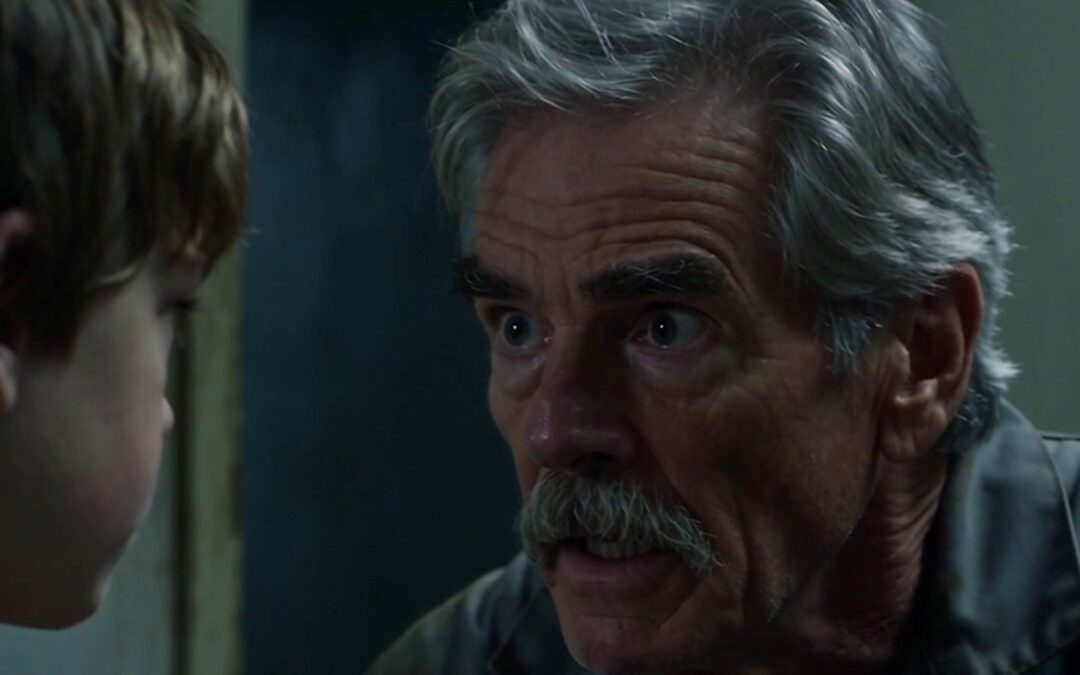
Across the office threshold stood Arthur Cross, the district’s sixty-four-year-old master pipefitter, holding a scarred brass pressure gauge by its threaded stem.
Arthur had spent forty-one years balancing steam traps across seven county schools, and his knees creaked whenever the weather shifted toward rain.
He did not look at the principal.
He looked down at Nolan’s right heel, which was still striking the linoleum in that strange, broken meter.
Arthur glanced down at the round dial of the test gauge in his own left hand.
Inside the glass face, the thin black needle was shuddering against the brass pin in the exact cadence of Nolan’s heel.
Arthur stepped past the doorway, knelt by the low radiator bench, and laid the cold brass gauge flat in Nolan’s lap.
“Kid,” Arthur whispered, his rasp cutting through the principal’s lecture.
“Which valve is sticking?”
Nolan did not speak, but his index finger rose instantly and pointed through the open doorway toward the sub-basement riser behind the cafeteria wall.
Arthur froze, his hand tightening around the threaded pipe fitting.
Chapter 2: The Sound of Steam
The annex office went dead quiet except for the low drone of fluorescent lighting overhead.
Principal Miller paused with his pen hovering an inch above the Mercer transfer paperwork.
“Arthur, please,” the principal said, adjusting his spectacles.
“We are conducting a confidential student placement conference.”
Arthur did not rise from his knee.
The knees of his work trousers were stained with gray anti-seize compound and boiler scale.
He kept his gray eyes fixed on Nolan’s face, watching the boy’s nostrils flare slightly as the heating system cycled.
Nolan’s eyes were not on the principal or his mother.
Nolan was staring through the doorway at the painted green wall where the main three-inch supply line dropped toward the basement.
His small left thumb remained resting against the knurled rim of Arthur’s brass gauge.
“Arthur, did you hear me?” Principal Miller asked, his tone tightening with administrative authority.
“I heard you, Richard,” Arthur said without turning his head.
“I also heard the low-water cutoff alarm fail its trip test twenty minutes ago while you were eating lunch.”
Sarah Vance sat forward in the vinyl chair, her worn sneakers gripping the linoleum.
“What does that mean, Mr. Cross?” she asked, her voice tight with exhaustion and alarm.
“It means line four has a clogged float chamber,” Arthur said, slowly standing up and brushing his knees.
“Or it means we’ve got scale caught in the seat of the expansion loop right beneath the ninth-grade study hall.”
“That is impossible,” Principal Miller said, waving a dismissive hand toward the corridor.
“The state boiler inspector gave this plant a clean certificate in August.”
“The state inspector spent eleven minutes in the pit and signed his name while his truck was still idling in the fire lane,” Arthur replied bluntly.
He looked down at Nolan again.
“You felt that kick twenty minutes ago, didn’t you, son?” Arthur asked.
Nolan did not answer with words.
He curled his middle finger against his thumb and snapped it once against the glass of the brass gauge.
The sharp ping of metal on glass echoed down the hallway.
“Come with me,” Arthur said, reaching down and taking the brass gauge from Nolan’s lap.
“He is not leaving this office until we execute these transfer papers,” Principal Miller insisted, rising to his feet behind the desk.
“If you keep him in this chair, Richard, you’d better call the Mercer fire marshal first,” Arthur said.
Sarah stood up immediately, her hand reaching out to touch Nolan’s thin shoulder.
Nolan did not pull away from his mother, but his gaze remained locked on Arthur’s tool belt.
“We’re going with Mr. Cross,” Sarah said, her voice firmer than it had been all morning.
Principal Miller exhaled a sharp breath of disgust, but he followed them into the corridor.
The air in the hallway smelled of floor wax, damp wool coats, and scorched dust from the heat vents.
Every thirty yards along the baseboard, cast-iron radiators hissed with intermittent bursts of pressure.
Other students were in class; the tiled hall stretched long and empty beneath yellowed acoustic tile.
Arthur led them past the double doors of the cafeteria toward the padlocked metal bulkhead at the rear of the service wing.
He pulled a heavy ring of brass keys from his pocket and unlocked the hasp.
Beyond the door, a steep wooden staircase descended into the heat of the central mechanical pit.
The ambient temperature jumped twenty degrees within six steps.
Two massive cast-iron Cleaver-Brooks scotch marine boilers sat in the center of the concrete floor like sleeping iron whales.
The drone down here was physical; it rattled in the teeth and vibrated through the soles of their shoes.
Nolan did not cover his ears.
He stepped onto the concrete slab, took a deep breath, and let his shoulders drop two inches.
For the first time since eight o’clock that morning, the tension left his forehead.
“See?” Arthur said, gesturing to the complex web of black iron and copper piping overhead.
“Most people walk into a plant like this and hear one giant wall of noise.”
“Because it is noise, Arthur,” Principal Miller said, staying near the bottom of the wooden stairs and checking his wrist watch.
“It is an industrial facility, not an auditorium.”
“Listen to it,” Arthur said, ignoring the administrator and looking straight at Sarah.
“Every elbow, every check valve, every steam trap has an individual heartbeat.”
“An Armstrong 811 inverted bucket trap cycles twice a minute when the condensate load is normal.”
“If the bucket loses its prime, it chatters like a machine gun.”
“If the vent hole plugs up with sludge, it goes stone silent and backs water into the headers.”
Arthur turned to Nolan and pulled a solid steel mechanic’s stethoscope from his canvas tool tote.
The tool had a long metal rod attached to a diaphragm, designed to amplify internal mechanical vibrations through a pair of rubber ear tips.
Arthur offered the earpieces to Nolan.
Nolan looked at the black rubber tips, then looked up at Arthur and shook his head once.
Instead of taking the earpieces, Nolan walked past the primary feedwater tank to the painted green riser where a six-inch schedule-40 steam header entered the building footing.
He placed his bare forehead against the iron pipe support strut, then pressed the flat of both palms against the cool lower return line.
“Get him away from those pipes!” Principal Miller shouted, taking a step forward.
“He’ll burn himself!”
“That’s the gravity return, Richard; it’s barely ninety degrees,” Arthur snapped without looking back.
Nolan closed his eyes.
His fingers began their rhythmic tapping against the green iron.
Tap-tap… tap.
Tap-tap… tap.
He kept his right ear tilted toward the ceiling, tracing the path of the insulated steam main where it disappeared through the poured-concrete wall toward the gymnasium wing.
After ten seconds, Nolan opened his eyes, pointed his left hand toward the ceiling, and spread three fingers.
Then he pointed at the floor drain by the boiler blowdown tank and curled his hand into a fist.
Arthur stared at the boy’s hands.
“Three traps downstream,” Arthur murmured, translating the gestures aloud.
“Blocked shut.”
“This is ridiculous,” Principal Miller said, pulling out a white handkerchief to wipe sweat from his brow.
“You are reading meaning into random behavioral gestures from an emotionally disturbed child.”
“Richard, shut up for five seconds and let me test something,” Arthur said, his voice dropping into hard authority.
Arthur walked over to the manual bypass valve on the condensate return receiver.
The valve was a heavy red iron wheel, crusted with yellow mineral deposits around the packing gland.
He gripped the wheel with both gloved hands and spun it four turns counter-clockwise, flooding the main return header with a rush of cold makeup water.
A sharp, violent hammering erupted instantly inside the overhead pipes—the dreaded phenomenon known in steam systems as water hammer.
It sounded like sledgehammers striking raw iron from the inside.
Principal Miller jumped back against the stairs, his face suddenly pale.
Sarah gasped and reached for Nolan, but Nolan did not flinch.
Nolan’s eyes darted along the ceiling, following the shockwave as it traveled at four thousand feet per second through the steel line.
He ran twelve steps toward the rear corner of the boiler room, where an obsolete auxiliary heating bank sat behind a stack of unused desks.
He stopped directly beneath a tiny two-inch gate valve that was hidden behind three layers of canvas insulation.
Nolan jumped once, reached up, and touched the valve body with the tip of his middle finger before pulling his hand back from the radiating heat.
Arthur was already running toward him with an adjustable wrench in his right fist.
“Did it back up here?” Arthur asked, looking up at the pipe junction.
Nolan nodded twice, hard and fast.
Arthur clamped the wrench onto the test petcock just below the gate valve and cracked it open a quarter-turn.
Instead of dry steam, a dark, foul-smelling torrent of rust-colored water and calcified scale shot into the metal bucket Arthur had kicked into place.
The water was thick with sulfur deposits, nearly cold to the touch.
The violent banging in the ceiling instantly ceased, replaced by a smooth, deep hiss of balanced circulation.
Principal Miller stood frozen on the bottom step, staring at the bucket of rust.
“That trap hasn’t cycled since 2018,” Arthur said, his breath coming in ragged puffs as he wiped his brow with his sleeve.
“The line was waterlogged all the way back to the cafeteria floor.”
“If that slug had hit the main boiler header during Monday morning’s high-fire cycle, it would have cracked the cast-iron drum.”
Arthur turned slowly to face the principal.
“That would have cost the school board forty-two thousand dollars to replace, Richard.”
“And it would have dumped two hundred gallons of boiling condensate straight through your cafeteria ceiling while three hundred kids were eating fish sticks.”
Principal Miller swallowed hard, his collar suddenly looking too tight for his neck.
“Arthur, that… that might have been a lucky guess,” Miller said, though his voice lacked any trace of its earlier certainty.
“He saw you open the bypass and ran to the nearest valve.”
Arthur walked over to Nolan and knelt beside him again.
The boy was looking at his own fingers, rubbing the faint smudge of rust off his fingertip against the denim of his jeans.
“Nolan,” Arthur said gently.
“How did you know the water was trapped up in that corner?”
Nolan looked down at Arthur’s brass gauge, which still rested on the workbench where Arthur had set it.
He picked up a piece of white soapstone that pipefitters use to mark cut lines on steel.
On the dark concrete floor, Nolan drew a long horizontal line.
Near the left side, he drew three small circles.
Near the right side, he drew a jagged, saw-toothed line with five peaks.
Between the third circle and the first peak, he drew a heavy, dark square.
Arthur leaned over the drawing, his calloused thumb tracing the soapstone marks.
“The circles are the three supply risers in the science wing,” Arthur said quietly, piecing the map together in his head.
“The saw-teeth are the fin-tube baseboard heaters in the gym locker rooms.”
Arthur touched the heavy square.
“And this is the old expansion joint we buried behind the sheetrock during the 1994 renovation.”
He looked up at Sarah, who was watching her son with tears welling in the corners of her tired eyes.
“Mrs. Vance,” Arthur said.
“Your boy didn’t guess.”
“He has a three-dimensional acoustic blueprint of this entire three-story building sitting inside his head.”
Sarah knelt down beside Nolan and wrapped her arms around his waist.
“He does this at home, Mr. Cross,” she whispered.
“Every night, he sits by the radiator in our kitchen and taps his spoon against his milk glass.”
“I thought he was just restless because his father left three years ago.”
“I thought he was angry with me because I’m gone so much on the mail route.”
Nolan leaned his head against his mother’s shoulder, his fingers relaxing completely for the first time in weeks.
“He isn’t angry, ma’am,” Arthur said.
“He’s just listening to things the rest of the world is too loud to notice.”
Principal Miller cleared his throat, stepping down from the wooden stair with slow, deliberate steps.
“Be that as it may,” the principal said, his voice regaining some of its formal posture.
“A student cannot spend his school day wandering the boiler room.”
“The state education code requires documented academic progress in reading, arithmetic, and social studies.”
“He cannot remain enrolled at Oakhaven if he cannot sit through fifth-period English.”
Arthur stood up to his full height, towering over the school administrator.
“What if we adjust his schedule, Richard?” Arthur proposed.
“What if he spends fifth period down here with me as an apprentice helper under the district vocational exploratory program?”
“He’s eleven years old, Arthur!” Principal Miller protested.
“The state apprentice program begins at age sixteen for high school juniors.”
“The paperwork alone would require a dozen board variances.”
“Then start typing the variances,” Arthur said coldly.
“Because if you send this boy to a regional lock-in room where they drug him up to stop him from tapping on walls, I submit my retirement papers to the superintendent this afternoon.”
Principal Miller’s eyes widened.
“Arthur, you know there isn’t another licensed stationary engineer in Mercer County who knows how to balance these 1950 low-pressure boilers.”
“Then you’d better find a way to let him carry my wrench, hadn’t you?” Arthur said.
The silence that followed was broken only by the steady, healthy rhythm of the Cleaver-Brooks burners firing on low flame.
Principal Miller looked at Nolan, then at the bucket of rust-red water, and finally at Sarah’s defiant face.
“I will speak to the district special services director on Monday,” Miller said quietly.
“On one condition.”
Arthur crossed his arms.
“Name it.”
“He must pass his standardized math and reading diagnostics at the end of the semester,” Miller said.
“If his academic scores drop below grade level, the vocational variance is revoked immediately, and the Mercer transfer proceeds.”
“Fair enough,” Arthur said.
He held out his hand to the administrator, who shook it with a reluctant, hesitant grip before turning and heading up the wooden stairs.
When the heavy bulkhead door clicked shut behind the principal, Sarah let out a long, trembling breath.
“Mr. Cross, I can’t pay for special tutoring,” Sarah said, her voice cracking slightly.
“My route pays nineteen dollars an hour, and my transmission is slipping between second and third.”
“I didn’t ask for a dime, Mrs. Vance,” Arthur said.
He walked over to his steel workbench and pulled a wooden crate from underneath the shelf.
Inside the crate were dozen of brass fittings, old dial indicators, copper capillary tubes, and disassembled valve bodies.
“If Nolan wants to understand why the pipes talk to him, he’s going to learn the math behind the pressure,” Arthur said.
He looked at Nolan, who had already wandered back to the workbench and was staring into the box of brass.
“Every pound of steam pressure equals 2.31 feet of water head,” Arthur said, his voice turning instructional.
“If you can’t calculate friction loss in an elbow, you can’t tell whether a pipe is singing because it’s happy or because it’s about to burst its seams.”
Nolan reached into the wooden crate and pulled out a battered, four-inch Marsh liquid-filled pressure gauge.
The glass lens was cracked across the center, and the needle was stuck permanently at forty-five pounds per square inch.
He turned the gauge over in his small hands, feeling the cold brass threads of the mounting stem.
“That gauge was on the main header the day this school opened in 1962,” Arthur said softly.
“Keep it in your pocket.”
“Whenever you feel like your head is going to explode from the noise upstairs, you take that out and remember there’s always an order to the pressure.”
Nolan slipped the heavy brass instrument into the front pocket of his canvas coat.
His hand stayed inside the pocket, his fingers tracing the cracked bevel of the glass.
For the next three months, Nolan lived in two different worlds that barely acknowledged each other.
From eight in the morning until one in the afternoon, he sat in the regular sixth-grade classroom, surrounded by thirty other children who viewed him as an oddity.
He sat in the back row by the window, his head down, drawing intricate schematics in the margins of his lined notebook paper.
He did not draw superheroes or sports cars.
He drew isometric piping diagrams, with valves labeled in tiny, precise block letters and arrows indicating fluid direction.
His English teacher, Mrs. Gable, grew frustrated when Nolan refused to participate in oral reading circles.
When called upon, Nolan would stare at the floorboards, his right foot keeping time with the subterranean flow beneath the building.
“Nolan, you must read aloud to demonstrate fluency,” Mrs. Gable told him one snowy Tuesday in December.
Nolan took his Marsh gauge from his coat pocket and set it gently on the corner of his desk.
He looked up at Mrs. Gable, pointed to the paragraph on page eighty-four of the reader, and read four sentences in a low, flat monotone that sounded like a mechanical transmission engaging.
He read without pauses, without inflection, but every syllable was pronounced with absolute phonetic precision.
When he finished the fourth sentence, he immediately clamped his mouth shut and returned his fingers to the brass gauge.
Mrs. Gable sighed, marked a check on her clipboard, and moved on to the next student.
At one-fifteen, the bell rang for fifth period, and while the other students headed to art, music, or study hall, Nolan walked down the service corridor to the boiler room.
There, Arthur was waiting with a pair of leather work gloves, a clipboard with engineering paper, and two twenty-ounce travel mugs of black coffee and hot chocolate.
Their lessons were not quiet.
Arthur did not believe in simplified explanations.
“Listen to that burner,” Arthur said one freezing January afternoon as the wind howled against the foundation walls outside.
“What is that high whistle?”
Nolan stood before the secondary air damper, closing his eyes.
He held up his index finger, tilted it slightly to the left, and moved his hand toward the gas train.
“Air shutter needs a sixteenth of an inch more draft,” Arthur translated, checking the draft gauge mounted on the breeching.
The draft gauge confirmed the boy’s diagnosis: negative 0.02 inches of water column instead of negative 0.04.
Arthur adjusted the set screw with a flathead screwdriver, and the whistle smoothed out into a deep, steady roar.
“You’re hearing combustion efficiency, kid,” Arthur muttered, shaking his head.
“Most guys need a five-hundred-dollar flue gas analyzer to figure that out.”
To meet the school board’s academic conditions, Arthur forced Nolan to convert his sensory observations into standard mathematical notation.
On the concrete wall behind the tool bench, Arthur had hung a four-by-eight sheet of green plywood to serve as a chalkboard.
“You want to know why line two bangs when the cafeteria dishwasher starts up?” Arthur asked, pressing a piece of chalk into Nolan’s hand.
“Calculate the volume of water traveling at seven feet per second through a two-inch pipe.”
Nolan stared at the board for ten seconds.
Then his hand began to fly across the green surface.
He didn’t use the standard step-by-step methods taught in the sixth-grade workbook.
He grouped numbers by geometric clusters, factoring out friction coefficients by mental ratios before writing down the final flow rates.
He wrote the formulas with chalk held tight between his thumb and index finger, the dust coating his knuckles:
Flow rate equals 0.408 times gallons per minute divided by the diameter squared.
He solved three complex hydraulic velocity equations without using a calculator, arriving at the exact answer—forty-four gallons per minute—within ninety seconds.
Arthur checked the figures against his worn Cameron Hydraulic Data manual, his thumb following the small printed tables.
The numbers were identical to the third decimal place.
“Good,” Arthur said, slapping the boy on the back.
“Now explain to me in plain English why we need an air cushion on that dishwasher line.”
Nolan took a breath, struggling to form the words with his vocal cords.
Speech was an effort for him; it felt like pushing a heavy steel dolly through deep sand.
“Water… doesn’t… compress,” Nolan forced out, his voice cracking on the final syllable.
“Air does.”
“That’s right,” Arthur smiled.
“Water has no mercy.”
“If you don’t give it room to bounce, it takes it out on the iron.”
By late February, word of Nolan’s presence in the boiler room began to spread among the district maintenance staff.
Some of the younger mechanics from the county bus garage were skeptical.
“Arthur’s losing his marbles in that pit,” a mechanic named Duane Miller—the principal’s younger cousin—said over coffee at the diner on Route 4.
“He’s got an eleven-year-old kid doing building rounds with him like he’s training an apprentice.”
“The kid doesn’t even talk to his teachers.”
“He just walks around staring at the walls.”
Duane was thirty-two, held an associate’s degree in HVAC technology from the regional vocational institute, and carried a brand-new digital diagnostic scanner in a molded plastic case.
He believed in computerized sensors, digital readouts, and factory preset parameters.
He had applied for Arthur’s master engineer position twice, expecting Arthur to retire, but the school board had refused to promote him until Arthur stepped down.
The tension between them came to a head on the first Tuesday of March, during the annual Mercer County Regional Facilities Inspection.
Every spring, the county brought together facility directors, boiler inspectors, and maintenance supervisors to evaluate the mechanical systems of three regional schools.
The inspection determined state maintenance grants, insurance ratings, and capital improvement budgets.
This year, Oakhaven Middle School was the first stop on the schedule.
At nine o’clock that morning, seven men in navy blue work shirts and steel-toed boots gathered in the Oakhaven boiler pit, led by Duane Miller and state inspector Marcus Vance—no relation to Sarah, though he came from the northern part of the county.
Principal Miller was there too, wearing a yellow hard hat that looked brand new and clutching a black leather binder.
Arthur stood by his workbench with his arms crossed, his old canvas jacket buttoned against the draft from the open bulkhead.
Nolan stood slightly behind him, half-concealed by the water treatment tank, clutching his cracked Marsh gauge in both hands.
“Morning, Arthur,” inspector Marcus Vance said, unrolling a set of mechanical drawings on the portable folding table.
“We’re doing the full load-shedding test today.”
“The state board wants to see how this 1950 plant handles a simulated main breaker trip while operating under peak steam demand.”
Arthur’s jaw tightened.
“Marcus, you don’t trip the main breaker on a twin-drum system when the outdoor temp is fourteen degrees,” Arthur said warned.
“These old safety valves have original bronze springs.”
“If you drop electrical load instantly, the feed pumps stop, the pressure spikes before the gas valves can close, and you risk lifting a safety that might not seat back down.”
Duane Miller stepped forward, tapping his digital scanner against his thigh with a smirk.
“The state manual says all modern schools must pass a load-shedding simulation once every three years, Arthur,” Duane said.
“Unless, of course, your equipment isn’t up to code.”
Principal Miller nodded in agreement.
“We cannot receive the state facility improvement grant without this test, Arthur,” the principal said.
“The board requires it.”
Arthur looked at the men, then down at Nolan.
Nolan was looking at the glass sight glass on boiler number one.
The water inside the glass tube was boiling violently, the meniscus bouncing an inch above the center mark.
Nolan reached out and grabbed Arthur’s sleeve, pulling it down twice.
Arthur leaned down so the boy could whisper in his ear.
“The… flame… is… yellow,” Nolan whispered, his words barely audible above the roar of the blowers.
“Too… heavy.”
Arthur straightened up.
“Marcus, the modulating actuator on boiler one is hanging up on the high-fire cam,” Arthur said.
“The burner isn’t backing down to low fire when the steam header reaches eight pounds.”
“If you cut power now, the firebox will stay at maximum input for six seconds after the water circulation dies.”
Duane Miller let out a short, mocking laugh.
“My digital combustion analyzer checked that actuator fifteen minutes ago, Arthur,” Duane said, pointing his tablet toward the burner housing.
“The servo motor is reading ninety-eight percent travel.”
“The computer says it’s clear.”
“The computer is reading the position of the motor shaft, not the internal butterfly linkage,” Arthur snapped.
“The linkage pin is sheared inside the housing.”
“And who told you that?” Duane asked, his grin widening as he looked over Arthur’s shoulder at Nolan.
“Your eleven-year-old assistant?”
“Did the pipes whisper that to him during recess?”
Two of the other county mechanics chuckled under their breath.
Principal Miller looked uncomfortable, shifting his weight from one foot to the other.
“Duane, proceed with the test,” Principal Miller ordered, wanting to end the argument.
“Kill the main breaker.”
Arthur grabbed Nolan’s shoulder and pulled him back behind the heavy steel column that supported the central ceiling beam.
“Get behind the web, Nolan,” Arthur commanded, his voice dropping all trace of warmth.
“Keep your head down.”
Duane Miller walked to the forty-eight-volt distribution panel on the north wall, unlocked the red disconnect lever, and pulled it down with both hands.
A deafening clunk echoed through the concrete room as the main contactors dropped out.
Instantly, the electric feedwater pumps died with a winding whine.
The fluorescent lights flickered off, replaced by the eerie, dull yellow glow of emergency battery fixtures.
The hum of the building ceased.
In its place came a sound that every steam engineer fears: a rising, high-pitched scream inside the main furnace chamber.
Because the linkage pin was indeed broken, the heavy gas valve had remained wide open, firing twelve million BTUs into an iron drum that was no longer receiving cold feedwater.
The water in the sight glass dropped two inches in four seconds as it flashed into superheated steam.
Inside the header, the pressure gauge needle swung past ten pounds… twelve pounds… fourteen pounds.
“The burner didn’t cut!” one of the mechanics yelled, dropping his clipboard and scrambling toward the wooden stairs.
“The safety valve should pop at fifteen!” inspector Marcus Vance shouted, backing away toward the exit.
“Why isn’t the safety lifting?”
The safety relief valve on top of boiler one was a six-inch bronze assembly with a massive steel lever.
Over fifty years, dust and calcified steam leaks had crusted around the valve stem.
At fifteen pounds, the internal spring groaned, but the valve disc remained frozen against its seat.
The pressure needle hit sixteen pounds.
The cast-iron shell of the boiler began to ping—tiny, terrifying sounds of metal stretching past its elastic limit.
Duane Miller stood frozen in front of the open panel, his face bloodless, his digital tablet slipping from his fingers and shattering on the concrete slab.
“Run!” Duane screamed, his voice breaking into a high shriek as he bolted toward the stairs.
“It’s going to rupture!”
Principal Miller was already halfway up the wooden steps, clawing at the wall for balance.
Arthur lunged toward the manual emergency fuel shutoff valve, but the valve was located directly above the trembling burner housing, where superheated steam was already hissing through the flange gaskets.
Arthur raised his arm against the blast of scalding vapor, but the heat drove him back three steps, his boots slipping on the slick floor.
“I can’t reach the handle!” Arthur roared over the rising scream of the boiler.
Through the clouds of white steam, a small figure darted past Arthur’s knees.
It was Nolan.
He did not hesitate.
He did not look at the screaming men or the trembling gauges.
In his right hand, he carried a heavy sixteen-inch pipe wrench he had grabbed from the bottom shelf of the workbench.
In his left pocket was his cracked Marsh gauge.
Nolan ran directly to the boiler’s rear mud drum, where a low-level blowdown line was plumbed into an emergency bypass pit beneath the concrete.
He didn’t try to fight the fire or reach the burning gas valve.
He knew where the system was weakest.
He slipped under the scalding clouds, dropped to his knees on the concrete, and jammed the jaws of the pipe wrench around the square head of the manual blowdown plug.
He didn’t pull with his arms alone; he threw his entire eighty-pound body weight backward, planting his heels against the concrete foundation footing.
The rusted iron threads screamed in protest.
For two agonizing seconds, the plug refused to budge.
Then, with a sound like a rifle shot, the threads broke free.
Nolan spun the wrench three full rotations and kicked the iron lever of the dump line.
A massive wall of boiling water and steam exploded downward into the blowdown separator pit, venting seventy percent of the boiler’s pressure directly into the underground cooling trench outside the building.
The needle on the main header dropped from sixteen pounds down to eight… then six… then three.
The stretching sounds inside the iron drum ceased.
The safety valve on top gave one violent, clearing snort of trapped steam, then settled back onto its seat with a heavy metallic clack.
In the sudden silence that followed, only the hiss of water draining into the trench broke the stillness.
The emergency lights cast long, trembling shadows across the concrete floor.
Arthur Cross stumbled through the mist, his eyes wide, his hands shaking as he reached the rear of the boiler.
Nolan was sitting on the wet floor, his jeans soaked with gray condensate water, his hands covered in black pipe dope and rust.
His knuckles were raw, but his face was completely calm.
He was holding his cracked Marsh gauge in his lap, tapping its brass rim with his right index finger.
One… two… three.
Pause.
One… two.
Arthur fell to his knees in the puddle, reached out, and pulled the boy into his chest, holding him so tight Nolan’s breath came in small gasps.
“You crazy, beautiful kid,” Arthur choked out, his voice thick with tears he didn’t try to hide.
“You saved this whole damn school.”
On the wooden stairs, Principal Miller, Duane Miller, and the state inspector stood frozen, their hands gripping the wooden handrails, staring down into the pit.
Duane’s knees were trembling so hard he had to sit down on the step to keep from collapsing.
State Inspector Marcus Vance walked slowly down the stairs, his boots splashing through the shallow water on the floor.
He looked at the open blowdown line, then at the frozen safety valve, and finally at the eleven-year-old boy sitting in the puddle.
The inspector knelt down beside Arthur and Nolan.
He looked at the boy’s raw knuckles, then reached into his own breast pocket and pulled out his official state inspection badge—a heavy piece of stamped nickel with the state seal in the center.
Marcus Vance laid the badge on the concrete beside Nolan’s pipe wrench.
“In thirty-two years of inspecting high-pressure systems,” Marcus said, his voice quiet and steady, “that is the most remarkable piece of emergency engineering I have ever witnessed.”
He looked up at Principal Miller, who was standing at the base of the stairs with his mouth slightly open.
“Principal Miller,” the inspector said coldly.
“Your district will not be receiving a citation for this equipment failure today.”
“On the condition that this boy is officially registered with the state Department of Labor as a certified mechanical apprentice under Arthur Cross’s direct supervision.”
“Effective five minutes ago.”
Principal Miller swallowed, looked at the mud on his clean shoes, and nodded once.
“The paperwork will be signed before three o’clock,” Miller whispered.
That evening, Sarah Vance sat at the kitchen table in their small two-bedroom rental on the outskirts of town.
On the table between them sat a plate of scrambled eggs, a loaf of white bread, and the cracked Marsh pressure gauge.
Sarah took Nolan’s hands in hers, looking at the small blisters and the black grease that wouldn’t wash out from under his fingernails no matter how hard they scrubbed with dish soap.
“Did you feel afraid, Nolan?” she asked softly.
Nolan looked at his mother’s eyes.
He picked up a stainless steel fork and tapped the edge of the ceramic plate once.
Ping.
“The… pipe… was… hurting,” Nolan said, each word chosen with immense care.
“I… helped… it.”
Sarah pressed his hands to her cheek and closed her eyes.
“I know you did, baby,” she whispered.
“I know you did.”
Over the next four years, the basement of Oakhaven Middle School became Nolan Vance’s true home.
While other boys in Mercer County joined Little League teams or spent their weekends playing video games in carpeted basements, Nolan learned the physical anatomy of heat and steam.
He learned to cut two-inch steel pipe with a hand wheeled cutter, his shoulders broadening as he leaned his weight into the turn.
He learned to thread pipe with an ancient Ridgid ratcheting die, using dark cutting oil that smelled of sulfur and animal fat.
He learned to pack valve glands with braided Teflon rope so tightly that not a single molecule of steam could escape past the stem.
Most importantly, he learned that his mind was not broken.
It was simply calibrated to frequencies that other people did not possess.
When he turned fourteen, Arthur helped him apply for a special enrollment variance at the Mercer County Vocational-Technical High School.
The transition was not easy.
The vocational school was larger, louder, and filled with three hundred teenagers who had no patience for a boy who rarely spoke and walked with his head tilted toward the ceiling.
In his freshman plumbing and heating shop, his instructor was a retired Navy boilermaker named Chief Kowalski.
Kowalski was a man who believed in military discipline, square corners, and loud, barking lectures that echoed across the concrete shop floor.
On Nolan’s first day in the shop, Kowalski gave the class a diagnostic test: identify seven common pipe fittings laid out on a wooden bench.
While the other fifteen boys huddled around the bench, arguing over whether a fitting was a street elbow or a standard union, Nolan stood ten feet back, his hands deep in his pockets.
“Vance!” Chief Kowalski barked, slamming a steel clipboard against the tool bench.
“You got eyes, don’t you?”
“Step up here and identify fitting number four or take a zero for the day!”
Nolan walked to the bench, picked up fitting number four—a heavy, threaded cast-iron tee—and held it up to his ear.
He tapped the side of the casting with the knuckle of his ring finger.
A low, dull thud came from the iron.
Nolan set the fitting down, picked up a piece of chalk, and wrote on the wooden bench top:
“Defective casting. Internal void at branch throat. Will fail at sixty PSI.”
The other students laughed.
“He’s tapping it like a watermelon!” one of the boys shouted.
Chief Kowalski did not laugh.
He picked up the cast-iron tee, took it to the shop’s hydraulic hydrostatic testing rig in the corner, and threaded it onto the high-pressure test port.
He clamped the plexiglass safety shield into place and began pumping water into the fitting with the manual hydraulic lever.
The needle on the test gauge climbed: twenty pounds… forty pounds… fifty-eight pounds.
At sixty-two pounds per square inch, a sharp crack echoed through the shop.
Water sprayed against the plexiglass shield from a hairline fissure that had opened directly at the branch throat—exactly where Nolan had pointed.
Chief Kowalski stepped back from the test bench, wiped a drop of water from his cheek, and looked at Nolan Vance with narrowed, calculating eyes.
“Where did you learn that?” Kowalski asked.
Nolan reached into his pocket, touched the rim of his Marsh gauge, and pointed through the shop window toward the southwest—the direction of Oakhaven Middle School.
“Arthur,” Nolan said.
Kowalski’s expression softened into something resembling respect.
“Old Art Cross,” Kowalski muttered.
“I served with his older brother in the Pacific.”
He turned to the rest of the class, who were now staring at Nolan in stunned silence.
“Listen up, you knuckleheads,” Chief Kowalski barked.
“Vance just saved one of you from losing an eye during an installation test.”
“From now on, if Vance tells you a fitting is bad, you throw it in the scrap bin without asking questions.”
Yet despite his technical triumphs, Nolan’s greatest struggle remained the barrier between his thoughts and the spoken language of the world around him.
He could calculate thermal expansion ratios in his sleep, but when he had to stand in front of the county vocational judging panel for his third-year apprentice presentation, his voice locked completely.
The county competition was held every April at the regional exhibition hall in Mercer.
The winner received a five-thousand-dollar scholarship and an automatic placement with the International Union of Operating Engineers Local 95.
To win, an apprentice had to complete two sections: a hands-on troubleshooting test on a live boiler simulator, and a fifteen-minute oral defense of their mechanical methodology before three union examiners.
On the day of the competition, Sarah took the morning off from her mail route, putting on her only clean church dress and sitting in the front row of the exhibition hall.
Arthur sat beside her, wearing a stiff brown suit that smelled of cedar shavings and mothballs, his hands resting on his wooden cane.
Nolan blew through the practical examination like a sudden storm.
The examiners had secretly planted four complex faults inside the steam simulator: a reversed check valve, a fouled flame sensor, a blown differential pressure switch, and an intentional air lock in the primary loop.
The other six competitors spent forty-five minutes with wiring diagrams and multimeters, testing components one by one.
Nolan walked up to the simulator, placed his palm flat against the circulation pump casing, listened for eight seconds, and then picked up his tools.
He cleared all four faults in eleven minutes and thirty seconds.
He didn’t use a multimeter once.
He simply followed the sound of the resistance.
The examiners at the scoring table stared at their stopwatches in disbelief.
Then came the oral presentation.
Nolan walked up to the wooden podium at the center of the stage.
The bright overhead stage lights beat down on his forehead, making the sweat bead at his hairline.
In the audience, eighty people sat in folding chairs, waiting for him to speak.
The chief examiner, a burly union business agent named Thomas Higgins, adjusted his microphone.
“Candidate Vance,” Higgins said.
“Please explain to the board why you chose to purge the third secondary loop before resetting the flame sensor on unit two.”
Nolan gripped the sides of the podium.
His knuckles turned chalk-white.
He opened his mouth, but no sound came out.
His throat felt like it had been packed with dry sand.
The silence stretched for ten seconds… twenty seconds… thirty seconds.
Someone in the third row coughed.
A boy from another vocational district leaned over and whispered something to his friend, who smirked.
Sarah leaned forward in her chair, her fingers digging into the fabric of her dress, her heart breaking for her son.
“Come on, Nolan,” she whispered under her breath.
“You know it. You know every bit of it.”
On the stage, Nolan’s breathing grew fast and shallow.
The familiar, terrifying sensation of sensory overload began to claw at his temples—the buzz of the fluorescent transformers above him, the hum of the air conditioning ductwork, the rustle of paper from the judges’ tables.
It was all rushing into his ears at once, a tidal wave of meaningless noise that threatened to drown his balance.
He reached his right hand into his jacket pocket and felt the cold, familiar brass of the cracked Marsh gauge.
He closed his eyes.
He squeezed the brass casing until the sharp edge of the cracked glass pressed into the meat of his thumb.
The pain anchored him.
He took a slow, deep breath, reached out with his left hand, and took the flexible neck of the podium microphone.
He didn’t speak into it.
He tapped the metal casing of the microphone against the wooden podium.
Tap-tap… tap.
Tap-tap… tap.
The rhythmic thud boomed through the exhibition hall’s public address system like the heartbeat of an iron engine.
The examiners looked at each other in confusion.
Nolan opened his eyes.
He looked straight at Thomas Higgins.
“The air… was… fighting… the water,” Nolan said, his voice low, gravelly, and deliberate.
“If you… light the flame… with air in the line… the iron… screams.”
He stopped tapping the microphone and laid both palms flat on the podium top.
“I let… the water… win first.”
“Then… I gave it… the fire.”
Thomas Higgins sat back in his chair, his pen resting on his legal pad.
He looked at the two other examiners beside him.
Both men slowly put their score sheets down on the table.
“He purged the loop to prevent thermal shock to the heat exchanger,” Higgins said softly to his colleagues.
“He didn’t even need to look at the temperature differential.”
Higgins looked back up at the stage, where Nolan stood motionless, his hand still resting inside his pocket on the brass gauge.
“Full marks on methodology,” Higgins announced into his microphone.
“One hundred points.”
The applause that followed was not polite; it was thunderous, led by Chief Kowalski standing at the back of the hall with his arms raised over his head.
Sarah buried her face in her hands and wept, while Arthur Cross sat beside her, grinning so hard his weathered cheeks turned red.
That summer, Nolan Vance graduated from vocational high school with honors in industrial thermodynamics.
Ten years later, the winter of 2026 brought the most severe arctic vortex to Mercer County in half a century.
For four consecutive days in late January, the temperature hovered at twenty-eight degrees below zero, with wind gusts exceeding fifty miles per hour across the open farmland.
The frozen ground cracked along the roadways, and the power grid groaned under unprecedented electrical heating loads.
On the third night of the freeze, disaster struck the Mercer County Regional Medical Center—a six-story hospital that served thirty thousand residents across three rural counties.
At two o’clock in the morning, the hospital’s primary computerized building management system suffered a catastrophic voltage surge when an ice-laden transformer exploded on Route 9.
The electronic controllers that modulated the hospital’s three massive industrial steam boilers went completely black.
The auxiliary heating system was trapped in an emergency shutdown loop.
Without heat, the hospital’s intensive care unit, neonatal ward, and emergency surgical suites began losing temperature at a rate of two degrees every twenty minutes.
The regional emergency management director arrived on site at three in the morning, accompanied by five mechanical contractors carrying laptop diagnostic units.
None of them could communicate with the blackened electronic panels.
“The proprietary code is locked in the central server!” a young technician yelled frantically, waving his hands over a frozen screen.
“We can’t fire the burners manually without bypassing twenty-four separate electronic safety interlocks!”
“The temperature in the nursery is down to fifty-eight degrees!” the chief of surgery shouted, storming into the basement boiler room in his surgical scrubs.
“If we don’t have heat in forty minutes, we have to evacuate twenty premature infants into a blizzard!”
“You can’t evacuate them!” the county sheriff answered from the doorway.
“The state highway is drifted shut under six feet of snow!”
Standing in the corner of the crowded, freezing boiler room was a tall, broad-shouldered twenty-five-year-old man in a dark canvas work coat and heavy leather boots.
On the breast of his jacket was an embroidered patch that read:
NOLAN VANCE — CHIEF STATIONARY ENGINEER.
Beside him stood Arthur Cross, now seventy-eight years old, his hair entirely silver, leaning heavily on a carved ash-wood cane but watching his former apprentice with clear, steady eyes.
Nolan did not touch a laptop.
He did not look at the dead digital screens.
He walked past the shouting technicians, pulled a pair of heavy brass manifold wrenches from his leather tool rig, and laid an old, cracked Marsh liquid-filled pressure gauge on top of boiler number one’s primary steam drum.
The glass of the gauge was still cracked across the center, the brass casing worn smooth and golden from fifteen years of human hands.
“Vance!” the hospital administrator shouted, running over to him.
“Can you reset the digital cards?”
Nolan did not look at the administrator.
He looked at Arthur.
Arthur gave a single, slow nod.
“Trust your hands, Nolan,” the old man said softly.
“The iron doesn’t know what year it is.”
Nolan turned to the primary fuel line of boiler number one.
He pulled three steel jumper wires from his pocket—heavy copper cables with alligator clips on both ends.
With three swift, deliberate motions, he physically bypassed the fried electronic circuit boards, wiring the main gas solenoid valves directly to a twelve-volt truck battery he had carried down from his service van.
“That’s illegal!” the young technician gasped.
“You’re overriding the factory safety software!”
Nolan ignored him completely.
He climbed up the steel ladder to the main eight-inch steam distribution header that fed the upper floors of the hospital.
He knelt on the steel catwalk, closed his eyes, and placed his bare cheek flat against the freezing surface of the main insulated pipe.
His hands gripped the steel pipe flanges on either side.
In the dead silence of his mind, the noise of the panic below vanished.
He felt the cold, stagnant condensate lying heavy in the long vertical runs that rose six stories through the hospital’s elevator shafts.
He felt the resistance of forty closed thermostatic radiator valves in the patient wings above.
He felt the exact volume of air trapped between the basement and the roof vents.
He was not guessing.
He was the circuit.
Nolan opened his eyes, climbed down the ladder, and looked at the hospital’s three terrified maintenance men.
“Open… roof… vent… four,” Nolan commanded, his voice deep, clear, and ringing with absolute authority across the room.
“Quarter… turn… on… the… south… riser.”
“Do it now!” Arthur barked, backing up the order with his cane striking the concrete floor.
The two maintenance men scrambled up the stairs to execute the commands.
Nolan walked to the manual gas valve on boiler one.
He picked up a handheld propane torch, struck the flint with a sharp click, and let the blue flame lick against the pilot tube.
With his left hand, he cracked the main fuel cock an eighth of an inch.
A soft, deep whoosh echoed through the firebox as the blue flame caught.
He didn’t fire it to maximum.
He listened to the sound of the draft through the chimney, matching the flame’s growth to the rising temperature of the water drum.
Inch by inch, pound by pound, he brought the massive boiler back to life using nothing but his ears, his bare hands, and the needle of the cracked Marsh gauge.
Ten minutes later, a warm, rhythmic thrum began to vibrate through the concrete floors of the hospital.
In the neonatal ward on the third floor, the cold cast-iron radiators gave a gentle, familiar hiss as clean, dry steam displaced the freezing air.
The temperature monitors in the nursery stopped falling.
Then, slowly, the numbers began to climb: fifty-nine… sixty-one… sixty-four… sixty-eight.
Down in the boiler room, the shouting had completely stopped.
The hospital administrator stood with his back against the wall, watching the steady, perfect two-pound pressure reading on Nolan’s old brass gauge.
The five computer technicians stood in silence, their laptops hanging uselessly at their sides.
Nolan Vance sat on an overturned wooden milk crate beside the warm iron drum of the boiler.
His hands were dirty with grease, his face smeared with soot, his hair damp with sweat.
He reached into his pocket and pulled out a small thermos of hot black coffee his mother had packed for him before he left for the emergency call.
He poured a cup and handed it to Arthur Cross, who took it with trembling, grateful hands.
“How does she sound, kid?” Arthur asked quietly, taking a slow sip.
Nolan leaned his head back against the warm green casing of the boiler, closed his eyes, and listened to the steady, balanced pulse of steam rising six stories into the dark winter sky, keeping three hundred human beings warm while they slept through the storm.
A faint, peaceful smile touched the corners of his mouth.
“She’s… singing, Arthur,” Nolan said softly.
“She’s singing just fine.”








