Two Months After His Wife’s Funeral, a Little Girl Made an Impossible Claim—and a Gray SUV Followed Her Home
Chapter 1: The Bent Ring
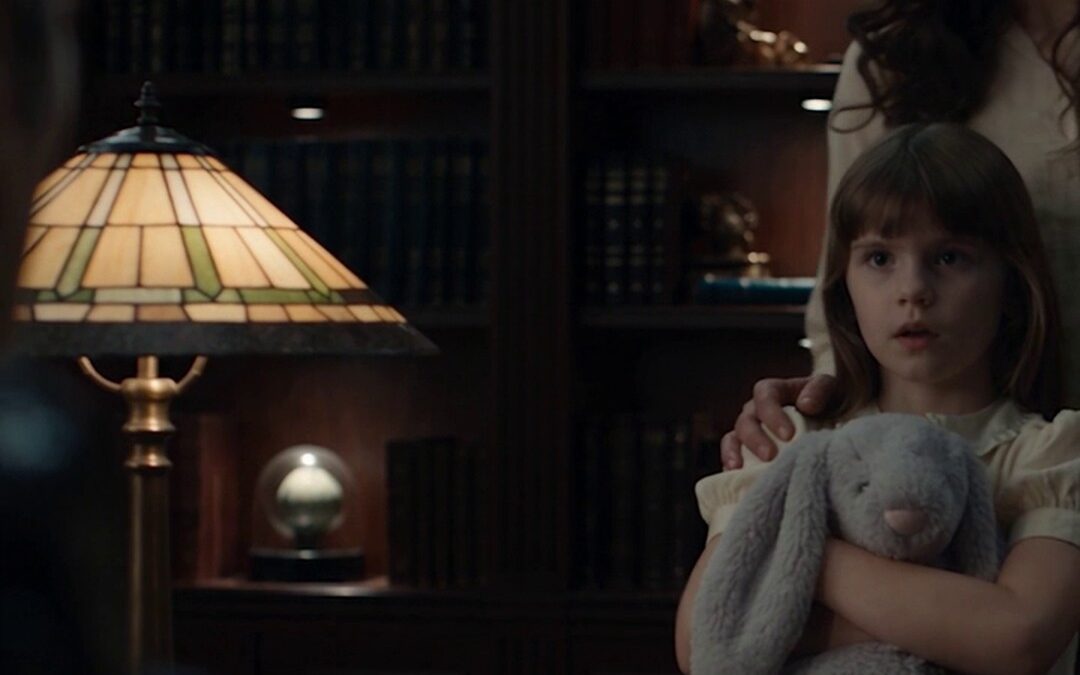
“I saw Miss Isabella behind the old train station,” Emma Walker said, standing in Lorenzo DeLuca’s study with a stuffed gray rabbit pressed under her chin.
Lorenzo looked up from the condolence letter he had been unable to answer and saw Sophia Walker reach the doorway a step behind her daughter.
Isabella had been dead for two months, and Lorenzo had buried a sealed casket under her name after a fire left almost nothing of the car she had been driving.
“Who did you see?” he asked.
“Miss Isabella,” Emma said, as if he had failed to hear the first time.
Sophia put a hand on Emma’s shoulder, but Lorenzo raised his palm before either of them could say more.
He was thirty-nine, wealthy enough to make officials return calls, and feared by people who mistook his habit of getting answers for a power over facts.
“What was she doing?” he asked.
“Hiding by the big doors,” Emma said, rubbing the rabbit’s ear.
“A woman who looked like her?”
Emma frowned. “Bruno was there.”
Isabella’s black dog had vanished the week of the crash, though Lorenzo had paid for searches long after everyone else stopped expecting him back.
“How did you know it was Bruno?”
“He had his old brown collar,” Emma said, “and the round thing was bent.”
Lorenzo remembered bending the collar’s metal ring against a fence latch the previous winter and promising Isabella he would replace it.
He had never done so.
Sophia told him she had seen a thin woman with short hair and a torn dark coat pull the dog behind a warehouse, then waited until Emma went to the kitchen before admitting that a gray SUV had followed their bus home.
“I should’ve called sooner,” she said, “but it followed us off the bus route, too.”
Lorenzo reached for his phone, intending to send every guard he employed to the freight district.
Mason Reed, his security director, stopped him at the door and said, “If she’s there, a crowd will scare her off, and if someone followed Sophia, it’ll tell them what we know.”
Mason called Detective Rachel Ortiz, then the warehouse owner, who agreed to open the archive of a concealed camera he had installed after repeated copper thefts.
On the owner’s screen, a woman in a torn coat crossed the loading dock with a black dog at her heel and turned briefly toward the lens.
Lorenzo knew those eyes, but Ortiz said quietly, “It could be Isabella, and now we have to prove it.”
Chapter 2: What the Records Held
The image remained on the screen after Ortiz spoke, its clock showing 4:18 p.m. the previous afternoon, and Lorenzo kept his hands flat on the warehouse owner’s desk because there was nothing useful for them to do.
The woman’s face occupied less than a dozen blurred frames, and the camera had recorded her from above while rain darkened the hood of her coat.
Bruno looked thinner than he had in the last photograph on Lorenzo’s phone, but he moved close to the woman without a leash and looked up when she touched his neck.
“Can you copy it?” Lorenzo asked.
“Once we document the recorder and get the proper authority,” Ortiz said.
The owner, a man named Daniel Cho, explained that he had hidden the camera under a rusted loading light in May because thieves kept stripping wire from the empty warehouse.
He had not reviewed the footage until Mason called, and the recorder’s clock was maintained by its network connection, a detail Ortiz wrote down without treating it as a guarantee.
She asked Cho not to use the system while she arranged a warrant for the recorder, the dock, and the narrow service corridor behind it.
Mason offered to station a guard at the public end of the block, where the guard could watch for anyone entering without setting foot inside the property.
Ortiz accepted the offer after making clear that the guard would call police, observe, and leave evidence where it lay.
Lorenzo wanted someone behind every door, but he had watched enough frightened witnesses withdraw from rooms he controlled to understand what his presence could do.
He left with Ortiz and Mason through the warehouse’s front office while uniformed officers took positions outside.
In the car, Sophia answered Ortiz’s call on speaker only after Lorenzo asked whether she preferred him to step away.
She did, and he got out beside the curb while the detective spoke with her privately.
Through the window he saw Mason listening, taking no notes, while traffic moved beneath the old elevated tracks.
When Ortiz opened the door again, she said Sophia had agreed to go with Emma to a child advocacy center that afternoon.
“A specialist will let Emma give one account in her own words,” Ortiz said, “and nobody from your household should ask her about it again.”
Lorenzo thought of the questions he had already asked in the study and felt their weight.
At home, he asked Sophia whether she wanted the estate’s guesthouse, a hotel, or somewhere he did not know.
“My sister’s apartment in Queens,” she said, “with a police car checking the block if Detective Ortiz thinks that’s warranted.”
He offered a driver, and she accepted transportation only after Mason arranged for a car from an outside firm whose route would be shared directly with Ortiz.
Sophia said she would take paid leave for the week, then decide whether to return to work.
“Whatever you decide,” Lorenzo said, “you won’t owe me a story about it.”
She looked at him for a moment, as though deciding whether she believed him, and went upstairs to pack Emma’s rabbit.
That evening Ortiz called to say Emma had described a “lady with little hair,” a coat “broken at the bottom,” and Bruno’s bent ring during a single recorded interview conducted by a specialist.
The specialist had asked open questions, stopped when Emma tired, and made no request for her to identify anyone from pictures.
Emma had also said she and Sophia waited because the bus “didn’t come,” a detail Ortiz could check against transit records without returning to the child.
Sophia separately placed the sighting on the public path behind the old station at about four, after a delayed bus forced her to walk Emma toward a different stop.
She described a gray SUV that passed them twice, then stayed behind their bus and turned onto their street.
She had written down three characters from its plate after she got Emma indoors, although rain and distance made her uncertain of their order.
Lorenzo wrote the characters in his own notebook and closed it when he realized he was trying to make them into a name.
The next morning Ortiz’s warrant team photographed the loading light, the recorder, its connections, and the clock display before a technician removed the storage drive and sealed it.
The original drive went into evidence, while a verified copy went to an examiner who could compare the recorded time with network logs and nearby traffic cameras.
At the dock, technicians found a fresh black dog print in dried grit near a puddle, a dark thread snagged on a splintered doorframe, and a small brass coat button beneath the stairs.
Those traces showed movement through the place, Ortiz told Lorenzo, but none identified the woman.
The button bore the mark of a tailor Isabella had used, a fact that made Lorenzo sit forward until an investigator found that the tailor sold the same inexpensive buttons to three uniform suppliers.
“It may still matter,” Ortiz said, “but it cannot carry more weight than it has.”
A second search of the narrow service corridor found a used gauze pad pressed into the gap behind an electrical cabinet.
The pad had a small brown stain, and its wrapper came from a clinic supply brand sold throughout New York.
An evidence technician photographed it in place, collected it with clean tools, and sealed it for testing.
Lorenzo saw only the scene photographs Ortiz chose to show him, which was enough to understand that someone wounded had tried to hide a trace where the first casual search would miss it.
The corridor opened toward the old station, and a person crossing the dock could reach either the street or a warren of vacant workshops in less than a minute.
For the first time since the funeral, he tried to picture Isabella moving through a real place instead of the fire described in a report.
He could not decide whether the picture comforted him.
By Thursday, August 6, the lab had determined that the stain on the gauze was human blood and had begun a comparison with a preserved medical sample collected from Isabella during surgery the previous year.
Ortiz had obtained a court order for the hospital reference after a judge reviewed the renewed missing-person investigation and the possibility that a death had been misidentified.
The hospital released the stored sample directly to the forensic laboratory under seal, with its accession record and collection date attached.
Lorenzo had offered Isabella’s hairbrush, but Ortiz said a household object could be contaminated and the hospital specimen had a documented source.
He accepted that answer, then spent the night thinking about how easily he had accepted a far weaker one in June.
The fire had been on June 3, on a service road near the river, and the funeral had been June 12.
A medical examiner’s amended note in the original file said the burned body was believed to be Isabella because the vehicle was registered to her, her handbag was recovered in the footwell, and a dental comparison appeared consistent.
The notation had been described to Lorenzo as a final identification.
He had read the first page, signed the funeral documents, and let the sealed casket become the one object he could still control.
Ortiz would not tell him that his failure caused the mistake, but she would not let him pretend the paperwork had been as certain as the funeral felt.
The examiner reviewing the case now had requested the original radiographs, the dental office’s source records, and the autopsy photographs.
An initial look showed a crown listed on the chart supplied in June that did not appear on Isabella’s earlier insurance radiograph.
The difference might have a harmless explanation, Ortiz said, because dentistry changed and records were sometimes mislabeled.
It was enough to stop calling the old identification settled.
In the afternoon, the footage examiner confirmed that the warehouse recording had been made on August 4.
A traffic camera two blocks away showed the same rain beginning at 4:11 p.m., and the warehouse system’s time differed from the network server by less than two seconds before and after the clip.
The footage still could not establish the woman’s identity, but it proved that a woman resembling Isabella had been alive in that corridor sixty-two days after the crash.
Bruno’s collar appeared for six frames when he shook himself beneath the loading light.
The bent ring was visible as a small oval pressed flat along one side.
Lorenzo asked Ortiz to pause there, then immediately wished he had not.
He had repaired the fence latch but left the collar unchanged because Isabella had laughed at the dog’s ability to turn every household object into a maintenance problem.
The ring was a private memory, yet anyone who had Bruno for two months could have noticed it.
Ortiz let him say that aloud.
Near sunset, a technician found a narrow silver band wedged behind the electrical cabinet where the gauze had been tucked.
Its inner surface carried the date of Lorenzo and Isabella’s wedding, along with a scratched line Isabella had made on a trip when she called it her travel ring and wore it instead of her larger one.
The technician photographed it before removal, packaged it separately, and logged its recovery beneath the cabinet lip.
Ortiz showed Lorenzo the photograph but did not hand him the band.
He knew it was hers, and he knew a person holding Isabella captive could have put it there.
“What does it prove?” he asked.
“That someone left something she owned where we found a fresh blood trace,” Ortiz said, “and we need the lab before we say who.”
Lorenzo went home before dark because Sophia’s sister had reported another gray SUV idling near her block, and he needed to be available if Ortiz called.
The police found no vehicle when they arrived, though a building camera held an image of its rear lights and part of the plate.
The visible characters resembled the number on one of Mason’s security vehicles.
Lorenzo called Mason into the study and put the still image on the desk between them.
Mason read it, grew still, and gave Ortiz immediate access to his fleet records, garage cameras, and the vehicle keys.
He had been on the warehouse owner’s security call at the time of the sighting, and the vehicle in question appeared on garage footage entering the estate at noon and remaining there until evening.
A toll camera captured a gray SUV with the same partial plate heading toward Queens, but the roof rails and rear window differed from Mason’s vehicle.
Ortiz did not clear him that night.
She said the image could show a copied plate, another fleet vehicle, or simply a different plate that happened to share three characters.
Mason offered to step back from security decisions involving Sophia until the plate question was resolved, and Lorenzo accepted without calling it an admission.
By Friday morning, the lab reported a full DNA profile from the blood on the gauze and a match to the hospital reference sample attributed to Isabella DeLuca.
Ortiz read the written result to Lorenzo in her office, where no camera was present and no one from his staff could overhear.
The lab had not determined the precise hour the blood was deposited, but the gauze had been found dry beneath dust disturbed by the August 4 rain, and the pad appeared in no image of the corridor taken by Cho’s insurance inspector on July 28.
Taken together with the camera footage, the result established that Isabella had survived the June fire.
It did not establish that she was safe on August 6, or that the woman on the video was free to leave.
Lorenzo heard only the first part for several seconds.
Then he asked whether the lab could be wrong.
Ortiz explained the sample identifiers, the duplicate analysis, and the independent review still pending, and she said every system had limits that had to be checked.
He had expected relief to arrive whole.
Instead, it came with the knowledge that Isabella had lived through every day he had mourned her, while he knew nothing about where she had slept or who had kept her silent.
“Find her,” he said.
“We are,” Ortiz answered, without promising when.
The medical examiner’s office obtained a court order to exhume the casket the following week, but the identification review began before the earth was opened.
The dental comparison made in June had used a scanned chart supplied by Isabella’s dental office rather than the original radiographs.
The chart included a recent crown on the lower left molar and omitted an extraction Isabella’s oral surgeon had documented five years earlier.
The reviewing odontologist pulled the source images from the surgeon and a dental insurer, then found that the burned woman’s remaining dental structures could not belong to Isabella.
A clerk at the dental office named Nina Bell had exported the incorrect chart on June 5, two days after the fire.
She had altered patient fields in a temporary copy before sending it to an investigator who believed it was the office’s current record.
Ortiz could not yet say whether Bell had made the changes deliberately.
The examiner who had signed the June identification had recorded the dental match as “consistent,” then allowed that provisional conclusion to become final when the car registration, handbag, and a note from police all pointed the same way.
The fire had damaged the remains severely, and no direct DNA comparison had been completed before burial because the available tissue required slower testing and the office had treated the other evidence as sufficient.
Ortiz laid the pages before Lorenzo and gave each failure its separate place.
“A misleading chart, an incomplete comparison, and a decision that the whole picture was strong enough,” she said.
He looked at Isabella’s name on the burial authorization until the letters stopped seeming attached to a person.
“Who was in the car?” he asked.
“We have a missing-person comparison underway,” Ortiz said.
The remains were exhumed on August 11 under the court order, with the cemetery, medical examiner, and funeral director documenting the transfer.
Lorenzo stayed away because his presence would serve no one who had to perform the work.
He spent the day in his study with the curtains open, hearing Emma’s small voice in the same room every time a vehicle crossed the gravel drive.
Sophia called once to say she and Emma were safe at her sister’s apartment and that Emma wanted to know whether Bruno had eaten.
Lorenzo told Sophia the dog had appeared thin in the footage, but investigators were looking for him, too.
He did not tell Emma that Isabella’s blood had been found, because a three-year-old had no use for a lab result she could not place.
The medical examiner obtained a DNA profile from a protected bone sample after exhumation and compared it with a missing-person family reference already held by the state.
The preliminary kinship result pointed to Mara Velez, a thirty-two-year-old home health aide reported missing on June 4.
Mara’s younger sister, Elena, had supplied a reference sample in June and had spent the summer searching hospitals, shelters, and transit stations.
Ortiz met Elena with a victim advocate before asking for a direct comparison using Mara’s medical records.
Lorenzo learned these facts because Ortiz told him there was a family waiting for an answer, and because his name had stood above that family’s sister in a graveyard.
Mara had lived in the Bronx, trained new aides at a community agency, and saved ticket stubs from every concert she took Elena to after their mother died.
On June 2, Mara had told Elena she was taking a private overnight care assignment in the freight district that paid unusually well.
She sent a photograph of the address written on a slip of paper, then stopped answering her phone.
The number that offered the assignment was prepaid, and the agency she normally worked for had no record of it.
Elena had told detectives about the job when she reported Mara missing, but no one had connected her report to the burned car identified as Isabella’s.
The direct comparison, completed with Mara’s treatment records and the family sample, confirmed her identity.
Ortiz told Lorenzo in person.
He tried to ask what had happened to Mara but stopped at the thought of Elena having waited ten weeks while his family held a funeral over the wrong woman.
Elena did not ask to meet him.
Through the advocate, she asked that Mara’s name appear on every corrected record, that the remains be released to her when the investigation allowed, and that no one describe her sister as a mistaken body in public statements.
Lorenzo paid the cemetery and funeral costs through an attorney who made no demand for contact or gratitude.
Elena accepted the practical help after the advocate assured her it would not limit her choices in the criminal case.
That night Lorenzo removed the framed photograph from the mantel above the fireplace, then put it back because taking it down could not restore the time Mara’s family had lost.
The search for Isabella widened carefully from the warehouse.
Transit footage showed a thin woman and a black dog moving east through the freight district on August 4, but one camera lost them beneath the elevated tracks.
Officers checked vacant buildings with warrants or owners’ permission, while outreach teams received a missing-person bulletin that included the woman’s description and instructions to call Ortiz if she sought help.
The bulletin avoided Emma’s name, Sophia’s address, and the wedding ring.
Ortiz had grounds to believe someone was watching the Walkers, but she still needed to know who and why.
The gray SUV seen near Sophia’s sister’s apartment returned on a traffic camera with a clearer plate, and the number proved to belong to a vehicle registered to a delivery company that had been scrapped in April.
A different camera showed a man changing the plate in an underground garage.
His face was partly obscured, but the garage lease led to a small security consulting firm owned by Paul Gage.
Lorenzo knew Gage’s name.
Vincent Hale, his chief of staff for nine years, had recommended Gage the previous winter as a contractor for difficult site inspections, though Mason had rejected him for the estate detail after finding gaps in his licensing history.
Lorenzo called Vincent into the office and watched him read Ortiz’s request for all company records involving Gage.
Vincent said Gage had done routine property work for a subsidiary and that the old freight district contained several buildings the company might buy.
His voice was steady.
It had always been steady, including on the day he handed Lorenzo the first report of Isabella’s death.
Vincent also volunteered that Isabella had become distressed before the crash and might have met Gage herself while investigating a charitable grant.
The suggestion struck Lorenzo as possible for a moment because Isabella had kept some of her work separate from his business.
Then he remembered that Vincent had supplied no date, no document, and no reason he had never mentioned the connection while she was missing.
Ortiz obtained the relevant business records through subpoenas and warrants rather than Lorenzo’s permission alone, because company records in a criminal case needed a path a court could examine.
Lorenzo’s counsel arranged preservation of devices and accounts, and Mason blocked routine deletion schedules without searching employee messages himself.
The records showed payments to Gage’s firm for “site stabilization” at two freight properties, beginning four months before the fire and continuing after the funeral.
The amounts were too large for the inspections Vincent described.
A separate ledger assigned the same costs to a housing initiative Isabella oversaw, whose grants should have been held in a restricted account.
Her signature appeared on two approvals she had been out of town to sign.
Before the crash, Isabella had asked the foundation’s outside accountant for the underlying invoices.
The accountant’s archived email, recovered under a warrant from the foundation account, showed her request on May 29 and a follow-up on June 1 asking why an unfamiliar consulting firm had access to restricted funds.
Vincent had been copied on the follow-up through an administrative rule that forwarded all foundation finance mail to his office.
Lorenzo had approved that rule years earlier because he wanted one person to tell him when a problem required his attention.
He saw now how easily a gatekeeper could decide what he never saw.
The accountant had received a message on June 2, apparently from Isabella, canceling the inquiry and saying she had found the missing receipts.
A device log showed the message had been sent from Isabella’s account while her phone was connected to the estate’s guest network, though she had left for a meeting before dawn.
Vincent said the log proved she might have returned without telling anyone.
Mason produced the gate camera from that morning, which showed her car leaving at 6:43 and never returning.
The network address had been assigned to a tablet kept in Vincent’s office.
An investigator imaged the tablet under the warrant and found the email in a deleted mail cache.
It was a strong record of impersonation, but Ortiz cautioned that an office tablet could have been used by more than one person.
Vincent’s assistant had access to the office, and Lorenzo hated how quickly he wanted to make her the answer.
Her badge logs, taxi receipt, and a hospital visitor record placed her with her father across town when the message was sent.
Vincent himself had entered the office at 7:02 and remained until 9:11.
The same week, Nina Bell received two transfers from a company tied to Gage’s consulting firm.
The first preceded the crash; the second followed the altered dental chart.
Bell initially told investigators the money was a loan for her brother’s surgery.
Bank records showed the brother’s treatment had been covered by insurance and the transfers had gone into an account Bell used to pay her own debts.
She eventually admitted creating the false chart but refused to say who had requested it until her lawyer was present.
Ortiz waited for the lawyer.
Lorenzo waited less gracefully, walking from one end of his study to the other until the carpet seemed to hold a path.
When Bell’s interview resumed, she said Gage had given her a source chart for an unnamed woman and told her to make it appear to be Isabella’s current record.
She claimed she did not know a death was involved.
Her account required corroboration, Ortiz said, because Bell had a reason to minimize her part.
The file history, transfers, and messages recovered from Gage’s phone supported the timing even where her motives remained disputed.
The wrong chart had not created the fire, but it had given a damaged body the wrong name.
Mara’s photograph stayed on Lorenzo’s desk after the advocate sent an approved copy for identification purposes.
In it she stood outside a small theater with Elena, holding two paper tickets against her jacket.
He had no claim on the photograph, and that was why he kept it visible while his lawyers gathered files bearing Isabella’s name.
Mara had taken an overnight job because the pay could cover a certification course she wanted to complete.
Her presence in the case could not be reduced to the role her body had been made to play.
On August 7, while records were still being gathered, Ortiz received a call from a nurse at a nonprofit urgent care clinic serving the freight district.
A thin woman with short hair and a black dog had come in shortly before dawn with a fever and an infected cut on her arm.
She had seen the missing-person bulletin on the clinic counter and asked whether Detective Rachel Ortiz could come without telling Lorenzo DeLuca or anyone from his company.
The nurse had not disclosed the woman’s medical information to anyone else.
Ortiz brought a uniformed officer, a victim advocate, and an ambulance crew to the clinic, leaving Lorenzo at home.
He argued for one minute, then heard the nurse’s account again and stopped.
Isabella had asked for Ortiz, and he had to let that request mean something.
For three hours he knew she was alive in a room he could not enter.
Ortiz called when Isabella had been transferred to a hospital and had agreed that Lorenzo could be told she was safe.
She had dehydration, malnutrition, a healing wrist injury, and the infected cut, and she needed assessment and rest before any detailed interview.
Bruno was with an animal rescue worker at the hospital’s request, frightened but eating.
Lorenzo asked whether Isabella wanted to see him.
“Not today,” Ortiz said.
He sat down before his knees could decide for him.
Mason drove him to the hospital anyway, but Lorenzo remained in a family waiting room downstairs because Isabella had agreed only to receive a note.
He wrote that he was glad she was alive, that he would follow her choices about contact, and that Bruno was being cared for.
He crossed out three sentences explaining what he had done since June.
A nurse took the note upstairs, and no answer came before visiting hours ended.
Lorenzo went home with the same driver who had brought him.
The next day Isabella allowed Ortiz to ask a few questions in the presence of the advocate and a clinician who could stop the interview if she became overwhelmed.
Ortiz later told Lorenzo only what Isabella had permitted her to share.
Isabella had discovered the diverted foundation funds and a set of invoices for work never performed at the freight properties.
She had copied the records to a small encrypted drive because she suspected someone inside Lorenzo’s business office was altering the ledger.
On June 2, Gage stopped her after she left a meeting near the river, claiming Lorenzo had sent him because a threat had been made against her.
She recognized him from a site visit and got into his SUV long enough to see that the door handle on her side had been removed.
Mara arrived that evening at a vacant workshop, believing she had been hired to provide care to an injured private patient.
Isabella had been restrained and frightened, and Mara refused to leave without calling for help.
Isabella did not know exactly how Mara died.
She heard a struggle in the adjoining room and later saw a stain on Mara’s sleeve while Gage and another man carried her away.
Ortiz did not tell Lorenzo more, and he did not ask her to make Isabella relive it for his sake.
The medical examiner’s later findings were consistent with violence before the fire, but the exact sequence remained for the court.
Isabella said Gage had kept her alive because Vincent wanted the encrypted drive’s password and needed to know whether she had sent copies elsewhere.
She had hidden the drive in a wall cavity during a brief move between rooms.
Gage took Bruno from the estate kennel after the crash and brought him to the workshop as a way to make Isabella cooperate.
The dog’s arrival also showed her that someone with access to Lorenzo’s household could act without Lorenzo noticing.
Vincent visited once, staying on the other side of a partly open door.
Isabella heard him tell Gage that Sophia Walker had carried Emma to a bus stop at 8:06 that morning and that a single message to the wrong person would make them “part of the problem.”
He showed her a photograph taken from across the street, with Sophia holding Emma’s hand beside the bus shelter.
It was dated after the funeral.
Isabella had once asked Sophia to watch Bruno when she traveled, and Emma had fed him biscuits from a cup by the kitchen door.
She believed Vincent’s threat because the photograph proved he could reach them through the same network that controlled her husband’s calls, cars, and security reports.
Lorenzo listened to Ortiz’s account with a pressure building behind his ribs.
He wanted to say Vincent would never have been allowed near Sophia’s child if he had known.
That was true, and it did nothing to change what Isabella had reasonably believed.
The workshop had changed hands twice through companies Vincent managed, and a former tenant’s mail was still delivered there.
On July 29, Gage moved Isabella after hearing that an inspector would visit one of the buildings.
An exterior camera from a neighboring truck depot showed his SUV leaving with two occupants and Bruno in the back at 5:12 a.m.
It also showed Isabella and Bruno escaping during a fuel stop when Gage went inside the station, though the angle could not explain how she opened the door.
Isabella later told Ortiz that Gage had been careless with the child lock after moving the dog, and she had waited until he was out of sight to slip into a drainage passage behind the station.
She knew he would look for her near hospitals and transit stops.
For days she slept in unused loading spaces, drank water from a public tap, and took food a shopkeeper left for Bruno without asking who she was.
She had no phone, and when she reached a public library she found that her missing-person notice named Lorenzo’s private security office as a contact.
She had seen Mason only once since his hiring and had no reason to know whether Vincent could read those messages, too.
At the old station on August 4, she returned toward Cho’s warehouse because she had hidden her travel ring in the corridor as a marker near the wall cavity containing the drive.
She had cut her arm forcing the cabinet loose, pressed gauze over the wound, and left the ring where it might be found if she could not return.
Then she saw Sophia and Emma on the public path.
Emma said her name before Sophia could draw her away.
Isabella almost stepped out, Ortiz reported, but a gray SUV turned at the corner and slowed behind them.
She pulled Bruno out of sight and waited until the bus carried them away.
The surveillance camera caught the movement that made Lorenzo recognize her.
Two days later, fever drove her to the clinic, where an old newspaper clipping on a bulletin board happened to name Ortiz as the detective assigned to the reopened death investigation.
She asked the nurse to reach the detective directly.
The account filled holes in the timeline, but Ortiz still treated each part as something to test.
A search warrant for the workshop uncovered the wall cavity Isabella described and the encrypted drive inside a wrapped cloth beneath loose plaster.
The recovery was filmed and logged, and a digital examiner made a forensic image before opening the files with a password Isabella supplied through counsel.
The files included copies of the foundation ledger before alterations, invoice attachments, and a short video Isabella had recorded on June 1 while scrolling through payment approvals.
The video showed her speaking only to mark the date and explaining that she feared the ledger would change before the accountant could review it.
It did not name Vincent.
The file metadata and cloud backup logs placed its creation before the crash, and a later comparison with bank records showed which invoices had been falsified.
The same warrant search found packaging from the medical gauze brand in a storeroom, a strip of Bruno’s hair on a doorframe, and a receipt for dog food bought with Gage’s card in July.
None of those items alone proved confinement.
Together with the depot footage, lease records, and Isabella’s account, they made her route through the district testable.
The ring’s position behind the cabinet became clearer after technicians removed the panel.
A fresh tool mark matched damage on a loose screw, and inside the cavity the drive sat where Isabella said she had placed it.
Lorenzo realized she had left two things there for different reasons.
The drive preserved what she knew.
The ring was a promise to herself that she might live long enough to return.
Ortiz asked Lorenzo for a formal interview about his company’s access controls, his communications with Vincent, and what he had known before the fire.
He went with counsel and answered without asking to review Isabella’s statement first.
His calendar placed him at a public charity dinner when Mara was taken to the workshop, but Ortiz said that cleared only his physical location.
The more persuasive record was a sequence of messages from Lorenzo to Vincent on June 2 asking why Isabella had missed their agreed call and requesting the number for the driver who was supposed to bring her home.
Vincent had replied that she had contacted him privately, wanted space, and did not want Lorenzo sending anyone after her.
The reply had made Lorenzo angry at the time, then ashamed of his anger after the crash.
Investigators found no message from Isabella authorizing that account.
A backup of Vincent’s phone held a draft of the same wording created before Lorenzo asked the question.
That finding cleared a suspicion Ortiz had kept open: that Lorenzo might have known she was missing and used Vincent to manage the story.
It also showed Lorenzo the danger of letting one trusted person interpret silence for him.
He had asked Vincent for facts, then accepted a version that resembled the answer he expected.
Mason’s vehicle was cleared by garage footage from two independent systems and a mechanic’s work order showing it had been locked inside for a brake repair when the SUV followed Sophia.
The copied plate had been printed at a shop that retained order images, and payment came from Gage’s firm.
Gage had used the same SUV at the workshop and outside Sophia’s sister’s building.
Ortiz told Mason directly that the evidence no longer pointed to him.
Mason thanked her, then asked whether he could provide a copy of his hiring notes on Gage.
Those notes showed he had rejected Vincent’s recommendation for estate work after Gage failed to account for a suspended license in another state.
Lorenzo had signed off on Mason’s decision without reading the notes.
That small boundary, made by someone willing to disappoint Vincent, had kept Gage out of the house’s daily security chain.
The financial search reached Vincent’s personal accounts the following week.
He had moved foundation money through two property companies and paid Gage from one of them, while Bell’s transfers came from the other.
The scheme had begun as concealed borrowing to cover losses in a redevelopment project Vincent managed.
By May, Isabella’s planned review threatened to expose false invoices and forged approvals.
The false death delayed that review, let Vincent control correspondence with the foundation accountant, and bought him time to move more records out of reach.
Lorenzo had once praised Vincent for resolving problems before they reached his desk.
He now understood that the praise had rewarded a man for making other people’s questions disappear.
Vincent’s counterclaim came through his lawyer after warrants were served.
He said Isabella had uncovered the accounting problem but had chosen to stage her own disappearance with Gage, planning to return after the company settled its debts.
He pointed to her hidden drive, the travel ring, and the days she spent avoiding police as signs of a plan rather than captivity.
For a few hours, even Lorenzo found the argument hard to dismiss entirely.
Isabella was capable of planning, and her fear of his network had led her to hide after she escaped.
Then the bank and device records answered the parts of the claim that could be answered.
Gage’s firm had been paid before Isabella vanished.
Vincent’s office tablet had sent the false cancellation of her audit inquiry.
The dental chart was altered after the crash.
Mara had accepted a job arranged by a prepaid number linked to Gage, and her body had been placed in Isabella’s car without any possible consent.
Isabella’s actions after escape did not explain those earlier acts.
Ortiz said the remaining questions belonged to charges and trial, where each witness and record could be challenged.
She would not turn Isabella’s suffering into proof of every accusation against Vincent.
On August 15, police arrested Gage on charges tied to unlawful imprisonment, evidence tampering, and Mara’s death.
Vincent was arrested on conspiracy, fraud, obstruction, and charges connected to the staged death after a judge reviewed the documentary and witness evidence.
Bell was charged with falsifying the dental record and obstructing the identification, with her precise knowledge of the larger plan left for a court to decide.
Lorenzo heard the news from Ortiz, not from his own employees.
He went to the hospital afterward with no plan to tell Isabella that anyone had been arrested unless she wanted to know.
She had moved from acute care to a quieter room and had begun short sessions with a trauma clinician.
Her wrist still hurt when she held a cup, and she tired after a few minutes of conversation.
The nurse said she had agreed to see him for ten minutes.
When he entered, Isabella sat beside the window in clothes brought by an advocate rather than anything from their house.
Her hair was short and uneven, and there was a fine scar near her temple that he did not recognize.
He stopped where she could see him clearly.
“Hi,” he said.
“Hi, Lorenzo.”
He had imagined reaching for her so many times that standing still required effort.
“I’m glad you’re here,” he said.
She looked down at her hands.
“I don’t know where I want to go when they discharge me.”
“You can decide later.”
“I don’t want the estate.”
“Then you won’t go there.”
She watched him long enough to make sure he understood the sentence as a decision rather than a symptom.
“I kept thinking you’d send someone,” she said, “and then every time someone came, it was his.”
Lorenzo felt the old impulse to explain why he had not known, but the explanation would ask her to carry his innocence when she was still carrying the memory.
“I’m sorry,” he said.
She nodded once, without forgiving him or rejecting the words.
When the nurse came to end the visit, Isabella said Bruno could stay with her advocate for now, and Lorenzo said he would ask no one to move the dog.
Outside, he sat on a bench until Mason came to drive him home.
He had seen her alive, and the sight had not returned either of them to June 2.
The estate’s internal review began under an outside firm selected with Isabella’s foundation counsel.
The firm examined who could forward mail, access security reports, approve payments, and claim to speak for someone who had not spoken.
Lorenzo gave the reviewers authority to interview staff without him in the room.
Sophia declined their offer to discuss what Vincent had done to her family beyond the statement she had already given police.
She wanted a written assurance that her personal details would be removed from company systems, and she wanted her wages and unused leave paid before she made any decision about returning.
Lorenzo signed the assurance.
Two weeks later she told him she would take a position with a school closer to her sister, where Emma could start a preschool program in the fall.
He thanked her for the years she had worked in his home.
Sophia said Emma still asked about Bruno, then smiled faintly and said she would handle that answer herself when she knew what Isabella wanted.
Elena Velez received Mara’s remains after the medical examiner completed the necessary work.
The corrected death certificate named Mara, and the state removed Isabella’s name from the burial record.
Elena chose a cemetery near their mother’s grave, with a service attended by coworkers, neighbors, and the people who had known the things Mara liked before anyone knew how she died.
Lorenzo did not attend.
He sent flowers only after the advocate confirmed Elena would welcome them, and he wrote a letter offering to pay for the certification scholarship Mara had hoped to earn.
Elena accepted the scholarship for aides at Mara’s old agency, with her sister’s name on it and no DeLuca name beside it.
Months later, Ortiz told him Elena had asked for a copy of the corrected investigative record and had received one with protected information removed.
That mattered more than the flowers.
She could read what officials now knew, identify what remained uncertain, and keep asking questions in her sister’s name.
Isabella left the hospital for an apartment arranged through her own lawyer.
She chose its location, controlled who knew the address, and resumed no work while she recovered.
Some days she answered Lorenzo’s messages with a single word.
Some days she did not answer at all.
He learned to send information only when it concerned a decision she had asked him to help make.
A month after the rescue, she invited him to walk Bruno with her along a quiet path near the clinic where she still attended appointments.
The dog had gained weight, though he moved stiffly after sleeping and startled at loud engines.
Isabella held the leash herself.
She told Lorenzo she wanted to keep her foundation work separate from his company when she was ready to return.
He said the review had found a way to make that possible and that her counsel had the documents.
She asked whether he had read them.
“Only the parts I needed to sign,” he said.
She looked surprised, then turned to call Bruno back from a patch of weeds.
They walked without speaking for several blocks.
At a crossing, the dog’s old brown collar slipped partly from beneath his new harness, and the metal ring flashed in the sun.
Lorenzo had offered to replace the collar, but Isabella had wanted it kept after a veterinarian confirmed it was still safe.
Emma had recognized the bend because she had spent ordinary mornings feeding Bruno biscuits and watching him shake them from a cup.
Her words had opened a question adults believed was closed.
The answer had required a camera with limits, a blood sample with a source, records that could be checked, and room for the living to say what they needed.
When Bruno stopped beside the crossing, Isabella waited for the signal and then asked Lorenzo to hold the leash while she adjusted her sleeve.
He took it without pulling.
Across the street, she offered her hand for a moment, and they crossed at Bruno’s pace.








