When the Flood Reached Our House, My Sister Made One Impossible Request—and I Had to Decide Whether to Trust Her
Chapter 1: The Water in the Hall
The first wave came up through the kitchen floor.
Cal heard Nessa drop a pan, then the scrape of a chair against the tiles. By the time he reached the kitchen, his sister had opened the back door and was standing barefoot on the sill. Water covered her ankles. Beyond her, Wharf Street was dry.
The pan rocked beside the stove. Cal grabbed a dish towel and pressed it over the seam where the floor met the wall. Water pushed through the cloth and soaked his hand.
“Get away from it,” Cal said.
Nessa held up one hand. She was looking past the yard toward the alley between the bait shop and the vacant cannery.
“We have to leave that alley open.”
Cal had spent the afternoon stacking sandbags there with the public works crew. The cannery lot was low ground; the bags would keep the next high tide from pushing through it and into the houses on Wharf Street.
He had come home with grit inside his gloves. Nessa had set aside dinner for him, then asked twice whether the crew had finished the alley. Now he understood why she had kept asking, though not what she expected him to do about it.
“Nessa. Inside.”
She began saying the names of their rooms under her breath. “Kitchen. Front room. Dad’s room.”
The water around her feet pulled away from the refrigerator. It ran across the threshold and down the yard, against the slight rise Cal knew by heart. His job was fixing the town’s pumps. Water did not travel that way.
He stepped toward her, but she gripped the doorframe and said the names once more. The water streamed past the porch steps, carrying a scrap of newspaper Cal had left by the door.
It vanished around the corner of the bait shop. Nessa caught the doorframe before she fell.
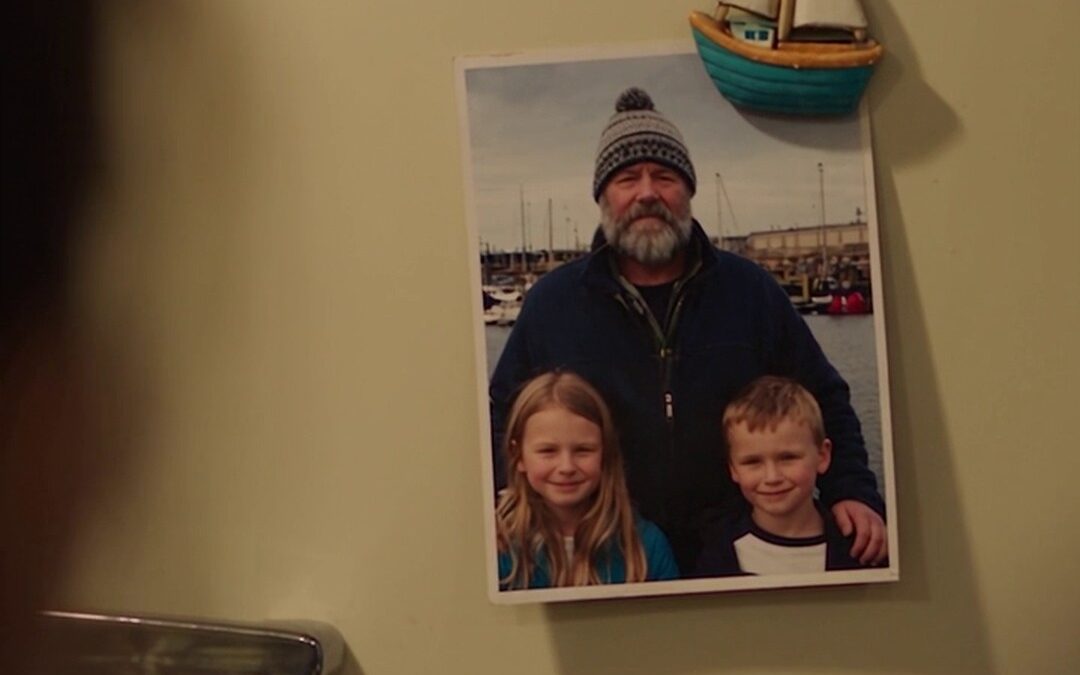
Cal got her onto a chair and brought a towel. Her feet were cold, though the water had been no deeper than his boots. On the refrigerator, beneath a magnet from their father’s old boat, was a photograph of the three of them painting the house. Nessa had painted one sleeve of Cal’s shirt blue because he would not put down his sandwich.
She saw him looking at it.
“Who’s that man?” she asked.
Cal turned. Nessa was studying their father’s face.
For sixteen years after the storm that killed him, she had kept that photograph on the refrigerator. Every morning, she straightened it while the coffee brewed.
“Nessa,” Cal said. “That’s Dad.”
Outside, the emergency siren began its first warning for the night’s high tide.
Chapter 2: Where the Water Goes
Nessa looked from the photograph to Cal as if she expected him to laugh and end a joke she had missed.
“Dad?” she repeated.
Cal took the picture off the refrigerator. The magnet stayed in his palm, its little blue fishing boat chipped along one edge. “Dad,” he said again. “The two of us. You were nineteen. I was fourteen.”
“I know how old we were when we painted.” She pressed the towel against her feet. “I know we painted this house.”
“But you don’t know him?”
She searched the face. Cal watched her do it. He had seen her forget where she had set her glasses and once, after a double shift at the diner, what day of the week it was. This was different. She looked at the man in the photograph with the careful politeness she gave customers whose names she could not place.
“I know he died,” she said. “I know he was our father. I can tell you his name.”
“Tell me something about him.”
Nessa closed her eyes. For a moment Cal thought she was refusing. Then he saw how hard she was trying.
“I’m sorry.”
A horn sounded down at the harbor. It was the second of three signals the volunteer fire crew used when a storm gate needed attention. Cal put the photograph on the table, took out his phone, and called his supervisor. Owen answered over wind and voices.
“We’re getting water through the floor on Wharf Street,” Cal said. “No standing water outside. It came up under the kitchen, then went out toward the cannery.”
Owen asked whether a pipe had burst. Cal looked at the dry ceiling, the wet floor, and Nessa’s bare feet. He said he hadn’t found one.
“I’ll send someone to check the main,” Owen said. “You get your sister uphill. We’ve moved the overnight tide estimate up. There’s already water over the harbor steps.”
Cal ended the call. Nessa was watching him.
“You can tell him it wasn’t a pipe,” she said.
“Tell him what it was.”
She looked toward the back door. “I was going to. After I made sure you were out.”
Cal waited. Nessa stood and held the chair until her legs steadied.
“Not here,” she said.
“It happened here.”
“The next one will, too.”
She went to the narrow cupboard beside the stove, lifted the flour tin from its shelf, and took out a small oilcloth notebook. Cal knew the tin. He had reached into it for spare keys often enough to tease her about hiding everything in the one place a burglar would check. He had never seen the notebook.
Nessa opened it at the kitchen table. Dates filled the pages in her small handwriting. Beside most dates were short descriptions: the name of a person, a place, a shared errand. Some were crossed through once.
Cal recognized the October flood four years earlier. Beside its date, she had written: *Dad teaching Cal to tie the boat to a cleat.* He remembered her sitting on the porch after that storm, listening while he described the knot their father had taught them. He had thought she wanted to hear him tell it again.
A date from last winter had *Cal’s middle school graduation, blue jacket*. Another said *first morning in this house after Mom died*. That line was crossed through, too.
“What is this?”
“The things I thought I could bear to lose.”
Cal turned a page without meaning to. Nessa let him.
“I can move some water,” she said. “When it reaches our house. There has to be another low place it can reach from here, and I have to know where I’m sending it. I can’t stop a tide. I can only pull the front of it away long enough for the rest to follow a different route.”
She spoke as plainly as she did when explaining to a new dishwasher why the sanitizer had to reach the whole sink. Cal stared at her. He wanted the floor to yield a broken pipe, the photograph to be a misunderstanding, the dates to mean anything ordinary.
“What you just did,” he said. “What did you lose?”
“I didn’t choose. I ran out of time.”
He looked at their father’s face on the table. Nessa followed his gaze.
“I wrote down what he was like,” she said. “Not everything. You can tell me the rest, if you want.”
Cal set the notebook down. “How long?”
“Since the storm.”
The storm. In their house, those two words meant one night when Cal was fourteen and Nessa was nineteen. Their father had died in the boat shed at the bottom of the alley. A surge had come around the cannery, torn the shed open, and carried him into the harbor. Nessa had gotten Cal upstairs before the first floor filled.
For sixteen years, when she mentioned that night at all, she said the sea had chosen a bad way in.
“Did you do it then?”
Nessa nodded.
“Where did you send the water?”
Her answer came so quietly he almost missed it. “Toward the shed.”
Cal heard another horn from the harbor. It seemed to come from very far away.
“You knew he was there?”
“I knew he’d gone down to secure the boats. I thought he’d come back. I didn’t know how fast it would move.”
He got up and went to the sink. The water from the tap was clear and cold. He turned it off without filling a glass.
Nessa did not come after him. “The first rush was coming through the front door. You were asleep on the couch. I could see it reaching you before I got across the room. Mom had told me what I might be able to do someday. I’d never managed it. I saw the alley and I called the water there.”
“You told me you pulled me upstairs.”
“I did. After.”
“You told me Dad was already gone.”
“I found out later that he was.” Nessa’s voice shook. “I let you believe he had died before I made a choice. That was a lie.”
Cal had a hundred questions, and none of them changed what she had said. He picked up his coat from the back of the chair.
“We’re leaving,” he said.
“We are. But the alley—”
“We can talk about the alley when we’re uphill.”
“It matters now.”
“So does getting you out of this house.”
Nessa took her boots from beneath the bench. Cal watched her struggle with the first lace. His anger was large and precise; it did not keep him from seeing that her hands were trembling. He knelt, tied the boot, and stood before she could thank him.
The lane outside smelled of salt and wet rope. Lights burned in the houses farther up Wharf Street. At the corner, their neighbor Mrs. Varela was loading her terrier and three covered baking pans into her son’s truck. She called that the fire station had opened as a shelter. Cal raised a hand.
Nessa stopped at the mouth of the alley. The sandbags he had stacked that afternoon ran in a neat, dark row behind the bait shop. Beyond them, the cannery lot lay between two warehouses and the old reed flats. The town had filled the lot with gravel over the years. At its far end was a concrete opening Cal had helped board up in the spring: an old storm gate that once let water spread into the flats.
“The bags close this end,” Nessa said. “The boards close the other. When the harbor comes over the wall, it will take Wharf Street instead.”
“The bags were put there because the cannery flooded three years running.”
“I know why you put them there.”
Cal looked toward the dark windows across the street. “There are people in those houses.”
“Yes.”
“You were going to send the surge into the cannery lot?”
“I thought the gate might still be open. I hadn’t seen the boards.”
He remembered carrying them into place. The flat land beyond the gate was being considered for a storage yard, and the town had worried about children getting through the opening. Closing it had seemed like a small job. He had come home with a splinter in his palm, and Nessa had pulled it out under the kitchen light.
“Why didn’t you tell me this afternoon?” he asked.
“You were with the crew. I thought I could get to the gate before high tide.”
“You told me the sandbags were a bad idea. You could have said why.”
“I should have.”
Mrs. Varela’s truck pulled away. Cal stepped aside to let it pass. Its tires sent a shallow sheet of water across the road. A minute ago, Nessa’s account would have been impossible. Now he watched that ordinary splash settle into the gutter with relief.
His phone rang. Owen said the water main showed no pressure loss. More urgently, a wave had cleared the harbor wall, and the crew wanted Cal at the lower pump station if he could get there safely.
“I’m on Wharf Street with Nessa,” Cal said. “I’m taking her to the shelter. Owen, what’s behind the old cannery gate?”
“The flats. Why?”
“If that gate and the alley were open, could a surge from Wharf Street spread out there?”
“The alley’s bagged. The gate’s boarded.”
“I know. Could it?”
Owen paused. “Some of it. Depends how high it gets. There are survey stakes up there and a power cabinet by the warehouse, so I’m not opening anything blind. Get uphill. We’ll check it.”
Cal repeated the part about getting uphill to Nessa. She said nothing as they walked. At the steep end of the street, she looked back once at their house. Its kitchen window showed a soft yellow square between dark buildings.
They had lived there since Cal was born. Their mother died when he was nine. Their father kept the place by fixing engines and taking whatever work the harbor offered; Nessa, still in school, learned to shop for three people on money meant for two. After the flood, she and Cal took turns painting over water stains. They kept their father’s room shut for a year, then made it into a room for whoever came to stay: a cousin between apartments, Mrs. Varela after knee surgery, Cal when he came home from a night shift too tired to climb another flight of stairs. Nessa had made the house feel occupied enough to hold them both.
He did not know how to fit that life beside the notebook in her flour tin.
At the fire station, volunteers had set out coffee and folding cots. Mrs. Varela was there already, her terrier asleep under her chair. Nessa went to speak to her. Cal stepped into the apparatus bay to call Owen again.
“I need you to look at the gate with me,” he said.
“We’re stretched thin. The lower pump’s backing up.”
“I can meet you there.”
“You told me you had water coming through your floor.”
“I did. Nessa and I are out.”
Owen gave him five minutes at the station, then told him to bring his rain gear. Cal found Nessa beside the coffee urn.
“I’m going with Owen,” he said. “Stay here.”
She glanced toward the open bay doors. “If the water reaches the house again—”
“You can’t be in two places.”
“No. I can’t.”
He had never heard her say it as if that were a problem she had been solving alone for years.
Cal left before he said something he could not take back. Outside, the fire truck’s red lights moved across the station windows. Rain struck the pavement at an angle. He drove the public works pickup toward the cannery, following the route he knew would remain passable longest.
Owen was waiting by the upper entrance to the flats with a flashlight and a second crew member, Priya Bell. Priya had worked the town’s drainage maps for eleven years and could remember every culvert by the nickname the crew had given it. Cal trusted her judgment even when it came wrapped in a complaint.
They walked to the old gate from the inland side. Water slapped against its boarded opening. Beyond it, the reed flats lay black under the rain. The land had once taken the harbor’s overflow, Owen said, but after the last warehouse expansion the town had closed several connections and relied on the pumps.
Priya aimed her light at the new power cabinet. “We can cut power to that line if we have to. The survey crew isn’t out there tonight. But those boards aren’t meant to come off in a storm.”
Cal felt the wood with his gloved hand. It was fixed with brackets, not nailed through the concrete. Three bolts on each side, rust beginning around the heads.
“We have the driver in the truck,” he said.
“First tell me what we gain,” Owen said.
Cal took a breath. “A route into the flats. The alley sandbags have to come out too. If the water finds the alley, it can spread here.”
“If it finds the alley,” Priya said. “The road slopes toward the houses.”
“I know.”
He had spent years measuring grades and clearing drains. His claim about the route was sound until it reached the point where water would have to choose an uphill turn. He could not tell Owen that Nessa had made it choose before. He did not yet know what telling anyone would cost her. He also could not let the crew make a decision with half the facts.
“My sister says she can draw the first surge toward the alley,” he said.
Priya’s flashlight dropped a little. “How?”
Cal looked at the boards. “I saw her do it at the house.”
Owen waited.
“I know how it sounds. Water came up through our kitchen floor. She stood in the back doorway, and it ran across the yard toward the cannery. The street was dry. I saw it.”
“You had a backflow,” Priya said. “The drains can spit water up—”
“And then send it uphill?”
“There may be a connection under the yard.”
“There isn’t. I replaced the line myself.”
Owen rubbed rain from his face. “We can check the route without deciding why water might take it. The harbor’s over the wall. If opening this gives it somewhere safer to go, I want it open. Priya, call in the cabinet. I’ll get the front loader to the alley.”
He did not ask Cal to explain Nessa. Cal was grateful for the delay.
They cut power to the warehouse cabinet. A crew came from the pump station with tools, and Priya directed them to the gate. Cal went with Owen toward the sandbags. By the time they reached the lower street, water was running ankle-deep along the curb. Every front window held a lamp or a flashlight. A firefighter moved from door to door, confirming who had left.
Their own house was dark. Nessa had switched off the lights when they went out, though Cal knew she must have wanted to keep the kitchen window bright.
They counted the bags that could be pulled by hand and those the loader would need to lift. Owen sent Cal to the bait shop to warn its owner that opening the alley would put the shop’s ground-floor freezer at risk. Mr. Wu answered from his van. He had already unplugged the equipment and moved what he could.
“Do it,” he said after Cal explained the route. “You’ve got people living behind that wall.”
Cal thanked him. Mr. Wu looked at the water on Cal’s boots.
“Your sister at the station?”
“Yes.”
“Good. She brought me dinner every night my wife was sick.”
Cal knew. Nessa had told him Mr. Wu kept forgetting to eat. She had made extra portions of whatever they were having, wrapped them in foil, and insisted Cal deliver half so Mr. Wu wouldn’t mistake it for charity.
By the time Cal returned to the alley, the front loader had arrived. Owen had a map open on the hood of the pickup. Priya’s call came over the radio: the gate was unbolted, but the boards were holding under pressure from the inland side. Water had begun filling the flats from a separate creek.
“That changes things,” Owen said. “If the flats are already high, we can’t just offer the harbor an empty basin.”
“How high?”
“Priya’s checking the marker.”
A tide pushed past the harbor wall. Cal heard it before he saw it, a low impact followed by rattling debris. Water slid into Wharf Street. It filled the tire tracks, then covered them.
Owen ordered the loader back. A firefighter reported that the last two houses had been cleared. The crew could open the alley, but with both ends under pressure, they could not promise the water would go through. They could make Wharf Street worse by giving the surge another opening.
Cal watched it touch the bottom step of his house. He thought of Nessa’s notebook and the line about their father showing him a knot. He thought of how many storms she must have met at that door while he worked elsewhere, measuring water that had already taken a route she had chosen.
“Hold the bags,” Owen said. “Wait for Priya’s reading.”
Cal called Nessa. She answered at once.
“Is the alley open?” she asked.
“No. The flats have water in them from the creek.”
“How much?”
“We’re finding out. Stay where you are.”
“I can feel it against the house.”
He turned toward the dark kitchen window. “You’re at the station.”
“I know. I meant I can feel it from here.” She paused. “I’ve spent years learning the difference between rain in the yard and tide against the sill. I can picture it.”
“Can you move the water if the flats are full?”
“If there’s lower ground beyond them. The old channel reaches the creek.”
“And if there isn’t?”
“I can’t force it. I can pull the front toward the alley and give it a start. If it meets water that’s too high, it comes back.”
“Into the houses.”
“Yes.”
“Then we wait for the reading.”
Nessa was quiet for a moment. “Cal, about Dad—”
“Not now.”
“I need you to know I would have gone to the shed if I’d understood where the water would hit.”
He looked down the street at the place where their father’s shed had stood. A concrete pad remained beside the cannery fence, visible only at low tide.
“I believe you,” Cal said. “I still need to know why you let me grow up with the other story.”
“I know.”
Priya came through the radio. The flats had eighteen inches of water near the gate. The old channel farther inland was still open, and the creek beyond it was flowing out. If they removed the boards and cleared debris at the channel mouth, the flats could take more. She could not say how much before the next tide pulse.
Owen looked at Cal. “If we do it, we do it with the evacuation complete. We open the gate, then the alley. If the water turns back, we pull the crew out and let the street flood. Agreed?”
Cal nodded. “We should tell the people at the station what’s happening to their property.”
“We will.”
Owen radioed the fire chief and got approval to open the route. The loader lifted the bags from the alley while a crew cut the boards at the gate. Cal helped drag the last bags aside. The work took twenty minutes. In that time, water climbed the first step of his porch.
When the opening was clear, it did nothing.
Water moved along the curb and pooled in the low dip by Mrs. Varela’s house. A little ran into the alley, met the rise behind the bait shop, and came back. Cal had expected it. Seeing it still made his stomach drop.
Owen shook his head. “The gate won’t help this street until the water’s higher. We did what we can. Get uphill.”
Cal stood in the rain while the crew loaded tools. Their route was ready. It needed the impossible part.
Nessa had already spent one memory that evening. He had no right to ask her for another. He also knew she would come whether he asked or not if she believed people’s houses were at risk. He called the station and asked a volunteer to give her the phone.
“It’s open,” he said.
“Is the gate clear?”
“Yes. Priya checked the channel. The creek’s carrying water out.”
“I’m coming.”
“Nessa, listen. We cleared every house. Everyone’s uphill. You don’t owe Wharf Street another piece of yourself.”
“Our house is there.”
“Our house is empty.”
“So are the other ones.” Her voice was steady. “Their owners still have to go back to them.”
Cal leaned against the truck. There were things he wanted to say about all the mornings she had pretended not to know what she had lost, and about their father. He could not say them in the thirty seconds she would give him.
“If you come,” he said, “we do this together. Owen knows there’s something you can do. You tell us what you need, and we decide where the water goes before you touch it.”
“I’m at the station. I’ll ask for a ride.”
She arrived in the back of a fire department utility truck. The driver dropped her at the high end of the street and turned around before another wave could block the road. Nessa wore her diner raincoat and the boots Cal had tied for her. Owen met her by the pickup.
“Cal tells me you can affect the flow,” he said.
“I can shift the first rush when it reaches my home,” Nessa answered. “Only toward a place it could eventually run by itself. I have to stand in the doorway and speak the rooms I’m protecting.”
Owen glanced at Cal. He had the look he wore when a pump’s motor ran though the breaker was open: he doubted the explanation, but he respected the danger in front of him.
“And the risk to you?”
Nessa looked at her brother. “I lose a memory. One I’d want to keep.”
Owen let out a breath. “I can’t authorize you to stand in a flooding doorway.”
“I’m going home,” she said. “You can keep your crew clear of it.”
“I can also tell the fire chief you’re going back into an evacuated area.”
“He should know.”
Owen did tell him. He reported exactly where she meant to stand and asked for a rescue team at the top of the street. The chief came on the radio himself. He told Nessa he could stop anyone from entering an active flood zone if he had to. She said she understood and asked for the latest depth at the porch.
Cal heard the chief hesitate. He gave her the reading. The water was six inches below the threshold.
“You have until it reaches the first interior step,” the chief said. “If it does, you leave. I’ll have people ready to bring you out.”
Nessa agreed. Cal wondered whether she would have agreed to any limit if other people hadn’t heard it. He was glad Owen had made the call.
At the porch, she stopped and looked through the front window. The house was dark except for a battery lantern Cal had left on the kitchen table. It showed the photograph beside it.
“I wish I could tell him I’m sorry,” she said.
“You can,” Cal answered.
“I don’t remember his voice.”
Cal did. Their father sang whatever tune came into his head while he worked. When he couldn’t make the words fit, he hummed them. Cal had spent years hearing Nessa hum at the stove and thinking she had learned it from him, too.
“He’d hear the words,” Cal said. “He was good at that.”
They went inside. The floor was damp from the earlier rush, and a line of grit marked where it had crossed the kitchen. Cal moved the lantern to the counter. Nessa took off her raincoat and laid it over the back of a chair, a gesture so familiar it made him ache.
“What happened the other times?” he asked. “When you chose a memory.”
“Sometimes I lost a day. Sometimes just a moment. Once I forgot how Mom laughed for about a year, then you laughed with your mouth full and it came back to me.” She touched the flour tin. “Most things don’t come back.”
“How many?”
“Seven times before tonight.”
He counted the crossed lines he had seen. There might have been more he hadn’t turned to. “Every time for the street?”
“Once for the harbor road. Once for the school bus when it was caught by the causeway. The rest for the houses here.”
He remembered those storms. He remembered Nessa calling to check whether his truck had made it through, setting towels by the doors, handing coffee to volunteers. He had thought she worried because they had already lost their father to water. She had worried because she knew she could choose who received some of it.
“Did you ever send it toward someone?”
“Toward places I thought were clear. I asked questions first when I could. I watched where the crews went. After Dad, I never trusted a guess.”
Cal looked out at the alley. The gate was open; Mr. Wu’s freezer would flood if the water found it. Farther away, the flats would take the rush. People had cleared both places. He knew that because he had helped clear them, not because Nessa had promised.
“You should have told me years ago,” he said.
“I know.”
“You don’t get to decide what I can live with.”
“I know that too.”
“Then why didn’t you?”
She sat at the kitchen table. Outside, something knocked against the porch rail.
“At fourteen you thought you could have saved Dad if you’d woken up when he left. You said it for months. I couldn’t bear to give you another reason to blame yourself.”
“So you let me blame myself for the wrong thing.”
“I told you he was caught at the shed by the surge. That part was true. I kept thinking I’d tell you when you were older.” Nessa looked at her hands. “Then I moved it again, and I had another loss to explain. Every year I waited, the truth got bigger.”
He could hear her regret. It did not close the sixteen-year gap she had made.
“Did anyone know?” he asked.
“Mom knew what I might be able to do. She died before it happened. Dad knew the story she’d told me. I never told him I’d tried it.”
Cal pictured their father walking to the shed in the rain, trusting that a place he had checked a hundred times would be safe enough for one more trip. “Would he have told you to save me?”
“He would have come for you himself.”
That was the first answer she had given that Cal could bear without arguing.
Water struck the porch steps. The lantern shivered on the counter. Cal checked the gauge mark he had drawn beside the front door when they replaced the trim. The water was climbing faster now.
“We have minutes,” he said.
Nessa opened the notebook to a blank line. She took a pencil from the tin and held it over the page. Cal knew she was choosing a memory before it could be taken at random.
“Does writing it down help you keep it?” he asked.
“No. It helps me know what I’ve lost.”
The pencil stayed in her hand. After a moment she said, “I was going to put down the day you came home from Portland.”
Cal had moved away at twenty-two for an apprenticeship. Two years later he returned when a storm damaged the town pump station and the public works department offered him a job. Nessa had met him at the bus stop with a thermos of coffee and a bag of warm rolls. Neither of them had said he was coming home for good until he put his work boots beside hers in the hall.
“Choose something else,” he said.
“I could.”
“Do you have to choose now?”
“If I don’t, it takes what’s close. The last thing I was thinking about.”
Cal looked at the photograph on the table. She had lost their father because he was there in her mind, as present as he had always been in that kitchen. Nessa wrote a short line and folded the page over before he could see it.
“I want you to take this,” she said. She pushed the notebook toward him. “If I ask what happened, tell me what you know. Tell me where we sent the water.”
“I will.”
She crossed to the front door. Cal stayed by the gauge mark. When water reached the sill, it seeped under the door in a thin brown line. He radioed Owen with the level. Owen confirmed that the rescue crew was at the top of Wharf Street, then asked about the alley. Cal could hear water there, but it had not passed the rise.
Nessa put her hand on the doorframe.
“I need a clear picture of the route,” she said.
Cal traced it for her aloud. From the porch, around the side of the house, behind Mr. Wu’s shop, through the sandbag gap into the cannery lot. Across the lot to the opened gate. Over the reeds to the old channel, then out with the creek. He named each place he and the crew had checked. Nessa repeated the route until she could say it without him.
A wave rolled over the harbor wall. The front door bowed inward. Cal put one hand on its handle and the other around the radio. Nessa began to speak.
“Kitchen,” she said. “Front room. Dad’s room.”
The water under the door deepened. It spread across the boards toward Cal’s boots. Nessa said the rooms again. He felt a vibration through the handle, small at first, like the truck passing outside when their father used to come home late.
Rain struck the front windows. In the kitchen, the grit from the first rush lifted off the floor. Water moved around Cal’s boots and away from the door. It ran through the hall toward the back of the house, carrying a little paper grocery list from beneath the table.
Nessa gripped the frame with both hands. “Back porch. Yard.”
The water rose against the kitchen door. Cal opened it. A dark stream poured across the threshold and turned along the side wall, toward the alley. It was not a great wave. It was the front edge of one, water that seemed to know where more water could follow.
Over the radio, Priya shouted that the cannery gate had begun to flow.
Nessa kept speaking the route Cal had given her. Her voice grew rough. Water pushed harder through the kitchen, wetting the legs of the table. At the front, the door sprang inward a fraction against Cal’s shoulder.
“Now,” he told her. “We go.”
She shook her head.
“Now, Nessa. The first rush is through. The rest has a way.”
She released the frame. Cal caught her elbow and guided her through the back door. They crossed the yard while water ran around their boots. In the alley, it rushed past Mr. Wu’s shop and out into the cannery lot. Cal could see it spreading toward the open gate.
The fire crew met them at the rise. Nessa climbed into the rescue truck under her own power, then leaned against Cal, suddenly too tired to hold her head up. He sat beside her as they drove uphill. Through the rear window he saw water enter the ground floor of their house.
At the station, a volunteer brought blankets. Mrs. Varela’s terrier climbed into Nessa’s lap without waiting for permission. Nessa rubbed its ears, looked around the crowded room, and asked Cal where they were.
“The fire station,” he said. “The street flooded. We got out.”
“I know the street,” she said. “I don’t remember getting here.”
He remembered the folded page in his pocket. He could tell her later. For now he gave her coffee and sat with her while the radio reported that the flow through the cannery gate was holding.
By morning, the tide had begun to fall. The town kept Wharf Street closed until crews checked the power lines and foundations. Cal and Nessa slept for an hour each in chairs. When he woke, she was reading the notebook. She had unfolded the last page.
“What did I choose?” he asked.
She turned it toward him. *The day Cal came home from Portland*, it said. A single line ran through the words.
“I know you came home,” Nessa said. “I know you work here. I can’t remember the bus stop.”
Cal described the rain that afternoon, the paper bag going soft around the rolls, and how she had complained that he was taller than when he left even though he wasn’t. She listened without interrupting.
“You called this house yours again,” she said. “Didn’t you?”
“I put my boots in the hall.”
She smiled faintly. “That sounds like you.”
The fire chief entered with Owen. He said the flats had taken a great deal of water. Mr. Wu’s shop and the cannery had flooded, and several houses on Wharf Street had water in their first floors. No one had been reported missing. Crews would be assessing damage all day.
Owen stopped beside their chairs. He had seen enough at the alley to know something he could not explain had happened. He asked Nessa whether she needed medical help. She said she needed dry socks and would welcome a doctor if she still felt dizzy after breakfast. He brought her socks from a donation box.
“I told the chief what I saw at the gate,” Owen said to Cal. “Water came through fast once the first flow reached it. We’re looking at the drainage route before we close anything.”
Cal nodded. The route deserved a proper plan. It could not depend on Nessa standing in their house and losing another piece of her life.
Two days later, they were allowed home.
The front room smelled of mud and soaked wood. Their couch sat crooked against the wall, its cushions dark with water. The kitchen table had shifted a few inches. The lantern remained on the counter, and the photograph of their father had stayed where Cal left it.
Nessa picked it up. She knew who he was now because Cal had told her. She studied the blue paint on his sleeve and asked how it got there. Cal told her about the sandwich. She laughed at the part where their father kept eating while Nessa painted around his arm. When Cal finished, she asked if he could tell her again later.
They spent the morning carrying ruined things to the curb. Mr. Wu came over with a borrowed dolly, though his own shop needed clearing. Mrs. Varela brought sandwiches and made them stop long enough to eat. Nobody asked Nessa why water had taken the alley. They talked about the gate, the creek, the warehouse cabinet, and what the town might do before the next storm.
In the afternoon Cal found Nessa in their father’s room. A tide line marked the wall below the window. She held one end of a damp quilt while the other trailed across the floor.
“Throw it out?” she asked.
“Maybe it can be cleaned.”
She laid it over a chair. “I want to stay here, if we can repair the place.”
“I want that too.” Cal stepped into the room. “I need you to hear the rest.”
Nessa sat on the bare bed frame.
“I’m glad you got us out,” he said. “I’m glad you helped the street. And I’m angry that I learned what happened to Dad sixteen years after you did.”
“I know.”
“I’ll tell you what I remember about him. I’ll tell you about Portland. I can do that. But I can’t be the only person holding the truth for both of us anymore.”
“You won’t be.”
“Before another storm, we make a plan with Owen and the town. You tell me if you think you might use what you can do. You don’t decide alone what I should know.”
Nessa looked down at the waterline on the wall. “All right.”
Cal believed she meant it. He also knew he would need time to believe she would do it. He sat beside her, leaving space between them.
After a while Nessa said, “Dad used to make up songs when he fixed things. You told me that at the station. Is it true?”
“Yes. Half the words were wrong.”
“Can you remember one?”
Cal tried. What came to him first was the sound of a wrench falling against the boat shed floor, then his father’s voice fitting the noise into a tune. He sang what he could recall. Nessa joined on the second line, though she had no memory of learning it. Her words were wrong, too.
Outside, the crew clearing Wharf Street started up a pump. Cal went to the window. He could see Mr. Wu guiding them around a stack of broken freezer shelves. Beyond the houses, the cannery gate stood open to the flats.
He turned back to Nessa. They had a wall to strip, a quilt to save if they could, and years of stories she had trusted him to remember without telling him why. He picked up the damp end of the quilt. Together they carried it into the light.